
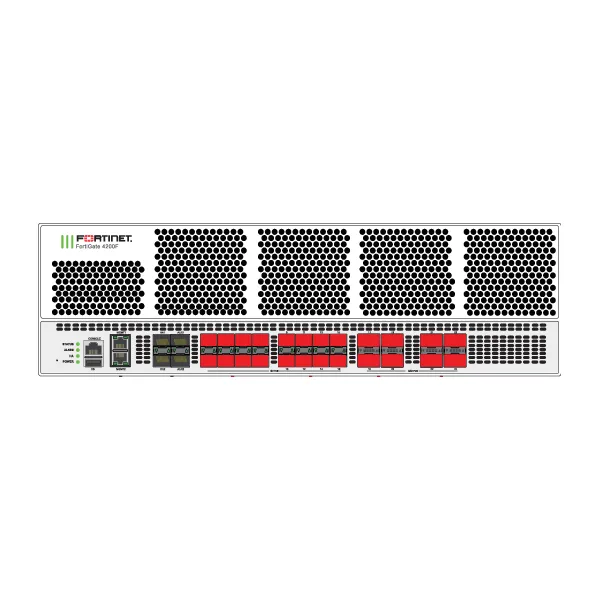
FortiGate 4201F (FG-4201F) Tanzania
FortiGate 4201F is a high-end Fortinet next-generation firewall designed for demanding data-center, enterprise edge and service-provider environments where interface density, accelerated packet processing, secure segmentation and large-scale network protection matter. The FG-4201F combines Fortinet SPU acceleration with high-speed 100GE/40GE and 25GE/10GE connectivity and integrated local storage. For Tanzania projects, the correct buying decision should combine the appliance with an appropriate FortiGuard security-service plan, FortiCare support, optics, rack and power planning, high-availability requirements, routing design and a realistic inspection workload.
What is the FortiGate 4201F?
The FortiGate 4201F, order code FG-4201F, belongs to Fortinet’s FortiGate 4200F Series. Fortinet’s current datasheet describes the FG-4201F with eight 100GE/40GE QSFP28 slots, eighteen 25GE/10GE SFP28 data slots, two GE RJ45 management ports, NP7 and CP9 hardware acceleration, two 1.92TB storage devices and two AC power supplies. Fortinet documentation also identifies four NP7 processors in the 4200F/4201F architecture and an integrated switch fabric that allows supported traffic between front-panel data interfaces to be offloaded to the network processors. This architecture is aimed at organizations that need security processing at substantially higher scale than a typical branch firewall.
The 4201F differs from the storage-less 4200F variant by including local storage. That distinction can matter when a design calls for appliance-local logging or other supported functions that benefit from integrated disks. Procurement teams should still define the logging architecture before ordering: large organizations may use FortiAnalyzer or another centralized operational design rather than treating internal storage as the complete logging strategy. The appliance choice therefore belongs inside a wider architecture covering traffic flows, security policy, management, analytics, subscriptions, resilience and lifecycle operations.
QSFP28 high-speed slots for data-center and core connectivity designs.
SFP28 data slots listed in Fortinet ordering information for the FG-4201F.
Integrated storage distinguishes the FG-4201F from the FG-4200F base model.
Purpose-built Fortinet processing for accelerated networking and security functions.
FortiGate 4201F Verified Hardware Highlights
| Area | FG-4201F detail | Planning significance |
|---|---|---|
| High-speed interfaces | 8 × 100GE/40GE QSFP28 | Supports high-capacity core, aggregation and data-center edge designs. |
| SFP28 data interfaces | 18 × 25GE/10GE | Useful for dense server, switching, zone and upstream connectivity. |
| Management | 2 × GE RJ45 management ports | Supports separation of management connectivity from production traffic. |
| Acceleration | NP7 and CP9; Fortinet documents four NP7 processors | Designed for hardware-accelerated networking and security processing. |
| Storage | 2 × 1.92TB | Provides onboard storage; logging architecture should still be designed deliberately. |
| Power | 2 AC power supplies | Plan independent protected feeds and UPS/PDU capacity where resilience is required. |
Sizing the FG-4201F for a Real Network
A high-end firewall should not be selected from raw firewall throughput alone. A useful sizing exercise starts with the actual traffic that will cross security boundaries: internet transit, east-west data-center flows, site-to-site VPN, remote access, public services, private cloud traffic, application tiers, backup flows and inter-VLAN segmentation. The next step is to identify which traffic needs intrusion prevention, application control, malware inspection, web security, encrypted-traffic inspection or other FortiGuard-backed controls. Security inspection changes the effective capacity requirement, so a design based only on an uninspected packet-forwarding number can produce the wrong result.
Interface design matters just as much. Confirm transceiver types, fiber standards, switch compatibility, link speeds, LACP requirements, routing protocols, virtual domains if planned, HA links, management networks and cable paths. Fortinet documents speed grouping behavior for the SFP28 interfaces, so interface-speed planning should be checked against the current FortiOS and hardware documentation before ports are assigned. For critical deployments, document both normal traffic and failover traffic: when a link, switch, ISP or firewall fails, the surviving path must have enough capacity to carry the intended services.
FortiGuard, FortiCare and Licensing Planning
The FG-4201F hardware is one component of the security solution. Security-service and support choices should be matched to the organization’s operating model rather than added automatically. FortiGuard services can provide threat-intelligence-backed capabilities used by FortiGate security controls, while FortiCare provides support services according to the purchased entitlement. The exact bundle, term and feature set should be confirmed on the quotation because Fortinet packaging can change over time and different organizations require different coverage.
Before requesting a price, state whether the project is a new deployment, renewal, replacement, HA pair or expansion. Include the required subscription term, any centralized management or analytics requirements, support expectations and whether hyperscale features are part of the design. Fortinet lists a separate Hyperscale Firewall License for the FG-4200F/FG-4201F Series. It should only be included when the architecture requires those licensed capabilities; it is not a substitute for defining the actual security use case.
FortiGate 4201F Tanzania
For Tanzania organizations evaluating FortiGate 4201F, the most important question is whether the appliance matches a genuinely high-capacity security requirement. The FG-4201F is positioned well above branch-firewall territory. Typical evaluation scenarios include a data-center internet edge, a large enterprise perimeter, a shared-services environment, high-throughput segmentation, a service-provider security edge or an architecture where many high-speed links converge on the firewall. Procurement should begin with a traffic and interface schedule rather than with a model name alone. Record current and planned WAN capacity, data-center uplinks, application zones, VPN requirements, number of protected networks, expected session behavior, security inspection profile and growth horizon.
Tanzania deployments should also include practical facility planning. A high-end 3RU-class appliance belongs in a properly designed rack environment with controlled cooling, organized fiber and copper management, protected power and documented upstream/downstream connections. If the firewall is business-critical, evaluate an HA pair and the surrounding switch topology so the network does not retain a single point of failure outside the firewall. Power feeds, UPS capacity, PDUs and generator transition behavior should be reviewed with the facility team. The security platform can only remain available when the rack, power and connectivity around it are engineered to the same standard.
Fourteck Tanzania’s business technology portal explains the broader networking and cybersecurity approach, while the Tanzania IT services overview is useful when the firewall forms part of a wider infrastructure project. For an FG-4201F quotation, provide the deployment city, quantity, AC or DC requirement, subscription term, optics requirement, HA plan, existing firewall model, desired migration window and any FortiManager/FortiAnalyzer integration. This information makes the commercial response more useful and reduces the risk of missing essential accessories or licenses.
FortiGate 4201F (FG-4201F) Dar es Salaam
Dar es Salaam buyers are likely to evaluate a platform such as the FG-4201F for environments where many business systems converge: corporate headquarters, data centers, financial or service platforms, logistics operations, large campuses and organizations supporting multiple branches. In these networks, firewall design should account for both internet-edge traffic and internal segmentation. A security gateway can sit between user networks, server zones, public application tiers, partner links, cloud connectivity and management networks, but the final topology should avoid forcing unnecessary traffic through the appliance simply because capacity is available. Map trust boundaries first, then decide which flows require enforcement and inspection.
Connectivity diversity is another planning point. If the organization uses more than one carrier, define whether links are active-active, primary/backup or application-steered. FortiGate supports secure networking and SD-WAN capabilities through FortiOS, but the policy should reflect business priorities. Critical SaaS, ERP, voice, payment, customer portals and VPN traffic may have different path and failover needs. For a large Dar es Salaam site, also consider how carrier handoffs reach the rack, whether diverse physical routes really exist, and whether upstream switching introduces a common failure domain.
A quotation request should therefore include interface speeds and media, ISP handoffs, autonomous-system or routing requirements where relevant, public-address design, expected encrypted traffic, remote-site count, logging retention and maintenance windows. If the firewall replaces an existing platform, export a policy inventory and identify rules that should be migrated, redesigned or retired. Migration is a chance to remove obsolete objects and overly broad access rather than reproduce years of configuration history unchanged. Fourteck’s verified Tanzania contact page accepts firewall and network project enquiries and specifically recommends sharing internet bandwidth, user count, current equipment, applications and expected growth.
FortiGate 4201F (FG-4201F) Mwanza
For Mwanza organizations, an FG-4201F evaluation should be tied to the scale and criticality of the network rather than simply to a desire for a powerful firewall. A large regional hub, data-processing site, service platform, multi-building campus or organization aggregating branch connectivity may justify high interface density and accelerated processing. Smaller offices will generally need a different FortiGate class. A proper design review should measure internet and private-WAN bandwidth, east-west traffic, concurrent applications, VPN encryption, security inspection, redundancy and expected growth before confirming the appliance.
Where Mwanza is part of a wider Tanzania network, the FG-4201F can be assessed as a central policy and connectivity point while smaller sites use appropriately sized edge devices. Standardization does not mean deploying the same hardware everywhere. It means applying consistent security zones, naming, authentication, VPN standards, logging, firmware processes and change control across different appliance sizes. That approach helps a central IT team operate remote branches without turning every location into a unique troubleshooting exercise.
Physical infrastructure deserves equal attention. Confirm rack depth, available rack units, airflow, ambient temperature, power protection and fiber presentation before delivery. Document which 100GE, 40GE, 25GE or 10GE links are required and ensure compatible optics and patching are included in the bill of materials. If local storage is a reason for choosing the 4201F over the 4200F, define how it will be used and how central logs will be retained. The purchasing discussion should cover appliance, subscriptions, support, optics, rails where required, HA quantity, configuration and migration scope as separate line items so the project team can understand what is and is not included.
FortiGate 4201F (FG-4201F) Arusha
Arusha enterprises considering the FortiGate 4201F may include large hospitality groups, regional headquarters, service organizations, campuses or operations that consolidate connectivity for multiple sites. The appliance’s high-speed interfaces are most valuable when the surrounding network can use them. A 100GE firewall port does not improve a design whose switching, ISP capacity or application architecture is limited elsewhere. Start by identifying bottlenecks and security boundaries, then choose port speeds and inspection policy that match the real traffic profile.
For multi-site organizations, VPN and routing design can become more important than the raw number of users at the main office. Branch traffic may need to reach shared applications, cloud services, voice platforms and internet breakout points with predictable failover. Decide whether the central site should backhaul branch internet traffic or whether branches should use secure local breakout. If multiple WAN providers are available, define path monitoring and application priorities. Security policy should also separate administrative management from user traffic, public services from internal applications, and infrastructure devices from general endpoints.
An Arusha procurement request should state whether the requirement is hardware-only or a complete project. A complete scope can include design validation, subscription selection, configuration, migration, HA, routing, VPN, policy cleanup, testing and documentation. Avoid assuming that an enterprise firewall automatically includes every FortiGuard service or support entitlement desired by the project. Request exact part numbers and terms. For broader infrastructure dependencies such as switching, racks, UPS and server connectivity, Fourteck Tanzania’s services and shop pages can be used alongside the firewall quotation so the security appliance is planned as part of a working environment.
FortiGate 4201F (FG-4201F) Dodoma
Dodoma projects requiring the FG-4201F are likely to be large, security-sensitive or highly connected environments rather than ordinary office networks. The planning process should define which services are mission-critical, how much downtime is acceptable and what dependencies exist outside the firewall. An HA pair can reduce appliance-level risk, but resilient design also requires redundant switching, diverse links, protected power and tested failover procedures. A firewall cluster connected through one upstream switch or one power path can still leave a major single point of failure.
Security policy should be developed from business zones and application requirements. Instead of a large flat network, consider separating server tiers, users, guest access, management, voice, surveillance, public services and other operational systems where appropriate. Access between zones should be explicit and documented. For encrypted services, determine which traffic can and should be inspected and account for privacy, application compatibility and performance. Logging should be designed to support operations and incident investigation, with appropriate central retention for the organization’s requirements.
Before a Dodoma quote is finalized, confirm appliance variant, power type, quantity, FortiGuard services, FortiCare term, transceivers, rack accessories, centralized management, analytics and professional-service scope. For migrations, collect the current firewall configuration, routing table, VPN inventory, public IP mappings, critical policies and maintenance constraints. A staged implementation plan with pre-change backup, rollback criteria and acceptance testing is preferable to an unstructured cutover. Fourteck’s Tanzania contact page lists Dodoma among its office contact locations and provides a direct path for project discussions and quotation requests.
FortiGate 4201F (FG-4201F) UAE
UAE buyers often evaluate high-end FortiGate platforms for data centers, enterprise campuses, large internet edges, service platforms and multi-site environments. For FG-4201F procurement, separate the hardware decision from the full solution bill of materials. The firewall requires the right subscriptions, support entitlement, optics, fiber patching, rack preparation, power feeds and management architecture. If a pair is required for HA, both the network and power topology should be built so a single switch, PDU or circuit failure does not defeat the redundancy objective.
The UAE also commonly serves as a regional IT or procurement hub for organizations operating across Africa and the GCC. In that situation, consistency of part numbers, subscription terms and configuration standards becomes valuable. A regional standard can define FortiOS baseline, administrative access, logging, naming, security zones, VPN methods, firmware governance and documentation while allowing each country to use the capacity appropriate to its site. Buyers can use the Fourteck Fortinet UAE product hub to review the wider Fortinet portfolio and regional firewall context.
For cross-border projects, do not assume that stock, lead time, warranty handling, installation scope or licensing conditions are identical in every market. Confirm them per quotation. If the UAE team is purchasing for Tanzania, include the destination, required power variant, subscription registration details, optics, shipping scope and whether deployment services are expected locally or remotely. A clean handover pack should include serial records, entitlement information, configuration backup, interface map, IP plan, policy documentation and operational contacts.
FortiGate 4201F (FG-4201F) Uganda
Uganda organizations considering the FG-4201F should first determine whether the project is a central enterprise or data-center requirement. High-speed 100GE and 25GE connectivity is designed for networks with substantial aggregation needs. If the environment consists primarily of conventional branch internet links, a smaller FortiGate may be more appropriate. Where a central facility serves many branches, however, the design can focus on aggregated VPN, shared applications, security inspection, public services and high-capacity internal segmentation.
A central firewall should be sized for failure conditions as well as normal conditions. If branch VPNs, internet links or data-center paths fail over to a secondary circuit or secondary firewall, calculate the resulting load. Check routing convergence, tunnel recovery, DNS dependencies and application behavior. High availability should be tested under controlled conditions before the system is considered complete. Operational teams should know how to confirm cluster health, interface status, subscription state, log flow and configuration synchronization.
For organizations with operations in both Tanzania and Uganda, a shared security standard can reduce support complexity while still using different models per site. The Fourteck Uganda technology site provides regional context for networking and security enquiries. When requesting an FG-4201F proposal, include the role of the appliance, required ports, expected traffic, branch count, security features, subscription term and whether the deployment will integrate with existing Fortinet management or analytics platforms.
FortiGate 4201F (FG-4201F) Kampala
Kampala is a natural location for centralized corporate infrastructure, and an FG-4201F discussion should focus on the scale of that central role. A large organization may terminate branch VPNs, protect public services, inspect internet traffic and segment data-center applications at the same site. Each of these traffic classes has different performance and policy characteristics. Build a traffic matrix that identifies source, destination, bandwidth, protocol, encryption and security controls. This gives engineers a better basis for sizing than a simple user count.
The appliance’s interface density can support multiple high-speed network zones, but port allocation should be planned carefully. Reserve management and HA connectivity appropriately, check interface speed-group behavior and document transceiver requirements. Where switches connect redundantly, confirm LACP and spanning-tree behavior with the complete topology. For internet edges, define routing and failover. For internal segmentation, avoid creating unnecessary complexity: security zones should correspond to meaningful trust boundaries that administrators can understand and maintain.
Kampala buyers should request a quotation that distinguishes appliance hardware, security subscriptions, FortiCare, optics, accessories, centralized tools and implementation. If the project is replacing another firewall, include migration discovery and policy cleanup. A technically accurate migration is not merely a syntax conversion; it should preserve required business access while eliminating obsolete rules, duplicate objects and unsafe broad permissions where the customer approves those changes. Testing should cover internet access, published services, VPNs, routing, failover, logging and administrator access.
FortiGate 4201F (FG-4201F) Arua
For an Arua requirement, the FG-4201F should be considered only where there is a substantial central, carrier, data-center or aggregation use case. Many regional sites can be protected effectively by smaller FortiGate models, and deploying a high-end chassis without a corresponding traffic requirement can add unnecessary cost and operational overhead. The right approach is to measure WAN capacity, number of protected networks, VPN concentration, security inspection and growth, then select the model that provides sensible headroom.
If Arua is connected to a central Kampala or cross-border infrastructure environment, the design may instead place the high-end firewall at the aggregation point while Arua uses a branch platform. In that architecture, consistent VPN, routing, segmentation and monitoring standards matter more than using identical hardware. Remote sites should have a clear failover strategy and an operational method for recovering from ISP or power disruption. Central logging and configuration management can improve visibility when IT staff are not physically present at every location.
Where the FG-4201F is genuinely required at the Arua site, facility readiness becomes a procurement prerequisite. Confirm rack space and depth, cooling, protected power, fiber presentation and remote management access. Ensure that the bill of materials includes the correct optics and support/subscription term. Document who owns firewall administration after deployment and how firmware, backups, policy reviews and license renewals will be handled. These lifecycle questions are important because a high-capacity firewall remains effective only when its configuration and security services are maintained.
FortiGate 4201F (FG-4201F) Mbarara
Mbarara enterprises evaluating FortiGate 4201F should connect the purchase to a defined architecture. A high-end appliance may be relevant to a regional data center, a large campus, an organization consolidating many branch links or a service environment that needs high-speed security enforcement. Begin with a capacity worksheet: internet links, private WAN, internal high-speed segments, peak traffic, VPN encryption, expected session rates, security profiles and planned expansion. Then map the required physical interfaces and optics.
If business continuity is important, redundancy planning should include the whole path. Two firewalls do not create end-to-end resilience when both depend on the same carrier handoff, switch, PDU or fiber route. Consider independent upstream and downstream connections, protected power and tested failover. Configuration backups and central management also reduce recovery time. For remote operational support, separate management access from production user traffic and restrict administrative services to approved networks and identities.
Commercially, request clarity on the exact FG-4201F SKU, AC or DC version, FortiGuard bundle, FortiCare term, optics, rails or accessories, HA quantity and implementation. Avoid treating phrases such as “fully licensed” as sufficient; list the required services and term. If a migration is included, specify whether the scope covers rule conversion, VPN recreation, routing, NAT, testing, documentation and post-cutover support. This makes proposals comparable and reduces ambiguity during project delivery.
FortiGate 4201F (FG-4201F) Gulu
Gulu buyers should assess whether the FG-4201F will operate as a local high-capacity security gateway or whether a smaller local appliance connected to a central high-end platform would be more efficient. The answer depends on where applications, internet breakout and security boundaries actually reside. A distributed organization may keep local internet access at branches and use encrypted connectivity to shared services, while another may centralize internet and inspection. Each design has bandwidth, resilience and operational implications.
For a local FG-4201F deployment, high-speed interfaces are useful only when connected infrastructure supports them. Check core-switch port types, optics, fiber distances and link aggregation. If 100GE or 25GE connectivity is planned, include transceivers and patching in the bill of materials rather than assuming they are automatically supplied for every desired connection. Fortinet ordering information should be used to confirm what is included with the specific SKU and what must be ordered separately.
Operational readiness should be part of acceptance. The handover should document interfaces, VLANs, routes, security policies, VPNs, administrator roles, subscriptions, HA status, log destinations and backup procedures. Schedule periodic review of firmware, security services, configuration and rules. If the project spans Gulu, Kampala, Arua or Mbarara, a common documentation template and policy standard can make support more consistent even when the appliance sizes differ between sites.
FortiGate 4201F (FG-4201F) Kenya
Kenya organizations considering FG-4201F are likely to be evaluating a large enterprise, data-center, carrier or high-capacity aggregation role. In Nairobi or another major operating center, the firewall may sit between internet providers, core switches, server fabrics, public application zones and private networks. The design should establish which flows need security enforcement and how those flows behave during failover. High-capacity links can move a great deal of traffic quickly, so policy mistakes can also have a large impact; change control and staged testing are important.
For multi-country East African organizations, the central architecture may connect Kenya, Tanzania and Uganda. Standardizing security policy concepts, VPN methods, logging and management can simplify operations, while each country uses an appliance appropriate to its traffic. The Fourteck Kenya IT solutions site provides a regional route for firewall and networking discussions. Cross-border designs should account for carrier diversity, latency, cloud access patterns and the possibility that one country’s internet path may not be the best backup for another.
A Kenya quotation should identify the exact hardware variant and subscription/support term and should separately list optics, accessories, HA units and professional services. For data-center deployments, include rack, power and cooling requirements in the readiness checklist. For migrations, inventory public services and partner VPNs early because these dependencies often determine the maintenance window. The final acceptance test should confirm routing, NAT, security inspection, VPN, published services, logging, management and HA behavior under realistic conditions.
FortiGate 4201F (FG-4201F) Kuwait
Kuwait enterprises can evaluate the FortiGate 4201F for high-throughput perimeter, data-center and segmentation roles. The dense high-speed interface mix makes the model relevant when security policy must sit directly in fast network paths rather than behind a lower-speed bottleneck. Architecture teams should identify the required 100GE, 40GE, 25GE and 10GE connections, validate optics and switch interoperability, and reserve ports for HA and management according to the final design.
Environmental and continuity planning is especially important for high-end security infrastructure. Verify rack dimensions, cooling, power-feed diversity, UPS/PDU capacity and maintenance access. If an HA pair is used, place the devices and connections so one infrastructure fault does not remove both units. Operational monitoring should include hardware health, cluster state, interface utilization, security-service status and log delivery. Capacity trends should be reviewed so internet or data-center upgrades do not silently consume all planned headroom.
The Fourteck Kuwait technology portal covers firewall, networking and business IT enquiries. For FG-4201F procurement, send a requirement that states quantity, power variant, support term, FortiGuard services, optics, current platform, expected migration date and whether professional services are needed. When comparing proposals, check scope line by line rather than comparing only the appliance price, because subscription duration, support and implementation can materially change the project package.
FortiGate 4201F (FG-4201F) Ghana
Ghana buyers looking at FG-4201F should treat the purchase as an enterprise security architecture project. A model at this level is typically justified by high traffic volumes, high-speed interfaces, large-scale segmentation, concentrated VPN or service-provider requirements. Define the business services protected by the firewall and their availability targets. A banking, telecom, cloud, public-service or large corporate environment may have very different traffic patterns, but all benefit from a documented dependency map before the firewall topology is finalized.
For organizations with multiple sites, determine where inspection should occur. Centralizing every flow can simplify policy but may create bandwidth and latency dependencies. Distributed enforcement can improve local autonomy but requires consistent management. Fortinet’s platform supports centralized operational approaches, but the exact FortiManager, FortiAnalyzer and FortiGuard components should be selected according to the project. The firewall’s local storage is useful, yet central logging remains important when security operations require consolidated search, retention and reporting.
Fourteck’s Ghana IT solutions site provides regional infrastructure context. A procurement pack should include a network diagram, traffic estimates, interface schedule, HA design, subscription term and migration requirements. Also state whether the customer already has Fortinet assets, because existing management, analytics, authentication or Security Fabric components can affect the deployment approach. Final documentation should make the environment maintainable after installation rather than leaving critical knowledge only with the implementation engineer.
FortiGate 4201F (FG-4201F) Nigeria
Nigeria has many enterprise and service-provider environments where high-capacity firewalling can be relevant, but FG-4201F sizing should still be evidence-based. Large internet edges, data centers, financial platforms, telecom environments and multi-branch organizations can create substantial session, VPN and inspection workloads. Capture peak and sustained traffic, application mix, encrypted traffic, public services, branch aggregation and expected growth. Then evaluate the Fortinet datasheet figures for the specific security profile rather than relying on the largest headline throughput number.
Carrier diversity and power resilience can be critical parts of the architecture. Multiple ISPs should be connected and routed in a way that meets the organization’s failover objectives, and HA firewalls should use protected independent power where possible. If public services are hosted behind the firewall, DNS, routing and NAT behavior during provider failover must be tested. Security policy should be reviewed for least-required access and should avoid exposing management services to untrusted networks.
For regional organizations coordinating Nigeria with Tanzania or other African operations, use shared configuration standards and documentation while respecting local connectivity and procurement differences. Request the exact FG-4201F hardware, subscription and support SKUs, optics and implementation scope. Confirm lead time and commercial terms on the quotation rather than assuming availability. A successful project should finish with tested failover, validated security policies, central logging, configuration backups and a renewal record that allows the organization to plan FortiGuard and FortiCare lifecycle events before expiry.
FortiGate 4201F (FG-4201F) Seychelles
Seychelles organizations evaluating a FortiGate 4201F may include large hospitality groups, service providers, data-center operations or organizations consolidating critical services. Because island connectivity and logistics can shape infrastructure decisions, the architecture should emphasize resilience, remote manageability and a clear spares/support strategy. The FG-4201F is a high-end appliance, so verify that its capacity is justified by the actual network rather than choosing it solely for maximum headroom.
If the firewall protects several properties or sites, decide whether traffic should be centralized or whether each location should retain local security and internet breakout. Centralization can provide consistent inspection but increases dependency on inter-site connectivity. A hybrid design may keep critical local services functioning during WAN disruption while still centralizing management and logs. For hospitality environments, guest, staff, payment, building, voice, surveillance and management networks should be segmented according to operational and security needs rather than sharing a single flat network.
Procurement should include the complete lifecycle requirement: appliance, FortiGuard, FortiCare, optics, rack accessories, power design, HA if required, configuration, migration and documentation. Remote support is easier when management access is designed securely from the beginning and configuration backups are stored appropriately. If equipment must be shipped internationally, confirm logistics, warranty handling and lead time as part of the commercial process. Do not assume regional availability until it is verified for the specific order and destination.
Deployment and Migration Checklist
Measure WAN, data-center, VPN and inter-zone traffic; document applications, peak periods and growth.
Define port speeds, optics, LACP, HA, management, carrier handoffs and switch connections.
Choose FortiGuard and FortiCare coverage according to required controls, support level and term.
Inventory policies, NAT, routes, VPNs, objects, certificates, public services and rollback steps.
Validate firewall HA, link failover, routing convergence, application access and log continuity.
Record configuration, diagrams, subscriptions, backups, admin ownership and renewal dates.
Related Fourteck Tanzania Infrastructure
A FortiGate 4201F project normally touches more than the firewall itself. Use the Fourteck Tanzania technology shop to explore related business equipment and the services page for infrastructure planning. The main Tanzania solutions page explains how firewalls, switching, servers, racks, UPS, Wi-Fi and other systems should be planned together. This matters at FG-4201F scale because high-speed security depends on compatible switching, fiber, power and management around the appliance.
Regional teams can also coordinate requirements through Fourteck’s Fortinet UAE portfolio and Uganda, Kenya, Kuwait and Ghana sites when the same organization operates in multiple markets.
FortiGate 4201F Quotation Checklist
For a useful quotation, provide the following information: required quantity; AC or DC preference; single appliance or HA pair; deployment country and city; internet and private-WAN bandwidth; required 100GE, 40GE, 25GE and 10GE interfaces; optics and fiber type; current firewall model; FortiGuard security-service requirements; FortiCare term; centralized management and analytics requirements; hyperscale licensing if specifically required; migration scope; VPN count; routing requirements; desired implementation date; and whether rack, UPS, switching or cabling work is part of the project.
Where exact requirements are not yet known, share a network diagram and the business objective. Fourteck can use that information to structure the discovery discussion. Prices, stock and delivery times should be confirmed at quotation stage because they can change and should not be assumed from a static web page.
FortiGate 4201F FAQs
What is the difference between FortiGate 4200F and 4201F?
Fortinet’s ordering information lists the same core high-speed interface arrangement and NP7/CP9 acceleration for both, while the FG-4201F adds two 1.92TB internal storage devices. Confirm all current specifications in the latest Fortinet datasheet when ordering.
How many 100GE ports does the FG-4201F provide?
Fortinet lists eight 100GE/40GE QSFP28 slots on the FortiGate 4201F.
Does FortiGate 4201F include storage?
Yes. Fortinet lists two 1.92TB storage devices for the FG-4201F. The logging and analytics architecture should still be planned according to the organization’s retention and operational requirements.
Is FG-4201F suitable for a small office?
It is a high-end platform intended for substantially larger security and connectivity requirements. A small office should normally be sized against Fortinet’s branch and midrange portfolio instead of selecting the 4201F simply for extra headroom.
Should I buy one FG-4201F or an HA pair?
That depends on the acceptable downtime and the overall topology. Critical environments often evaluate high availability, but redundancy must also cover upstream/downstream switching, links and power to remove meaningful single points of failure.
Does FG-4201F support current FortiOS releases?
Fortinet’s current release documentation lists FG-4201F among supported models for FortiOS 8.0.0. Always review the release notes, upgrade path and feature compatibility before changing production firmware.
How do I request FortiGate 4201F pricing in Tanzania?
Send Fourteck Tanzania the quantity, city, power variant, HA requirement, subscription term, required optics, current environment and deployment scope. This allows the quotation to reflect the complete project rather than hardware alone.
Decision Recap
FortiGate 4201F is a high-end Fortinet NGFW with eight 100GE/40GE QSFP28 slots, eighteen 25GE/10GE SFP28 data slots, dual GE management ports, NP7/CP9 acceleration, dual AC power supplies and two 1.92TB storage devices. It should be evaluated for data-center, large enterprise, service-provider and other high-capacity security roles where the surrounding network can use this level of interface density and processing.
The strongest procurement process combines verified hardware specifications with a traffic model, security-service requirements, HA design, optics, power, subscriptions, migration and lifecycle operations. Fourteck Tanzania can use those inputs to prepare a more accurate FG-4201F commercial and deployment discussion.
Consult Fourteck Tanzania
Share your network diagram, current firewall, internet capacity, required interfaces, security services, branch/VPN count and availability target. Fourteck can help structure the FortiGate 4201F requirement around the actual environment and prepare a quotation covering the appliance and agreed project scope.


Reviews
There are no reviews yet.