
FortiGate 50G Series Tanzania
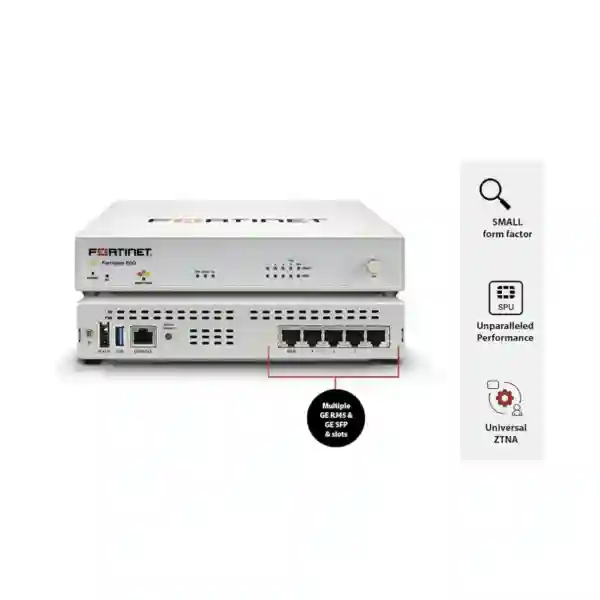
The FortiGate 50G Series is designed for organizations that want security and networking functions to work together at branch and distributed enterprise sites. Powered by FortiOS, the platform combines next-generation firewall controls with secure SD-WAN, VPN capabilities, application visibility and access to FortiGuard security services. For a Tanzania deployment, the useful buying question is not simply whether a firewall can pass the raw internet speed. The appliance, subscriptions and configuration should be selected around inspected traffic, VPN demand, segmentation, branch connectivity, application use, interface requirements and expected growth.
FourTeck can help translate those requirements into a practical bill of materials and deployment plan. This is particularly useful when a new firewall must coexist with managed switches, wireless access points, servers, IP phones, CCTV systems, multiple internet links or remote branches.
What is the FortiGate 50G Series?
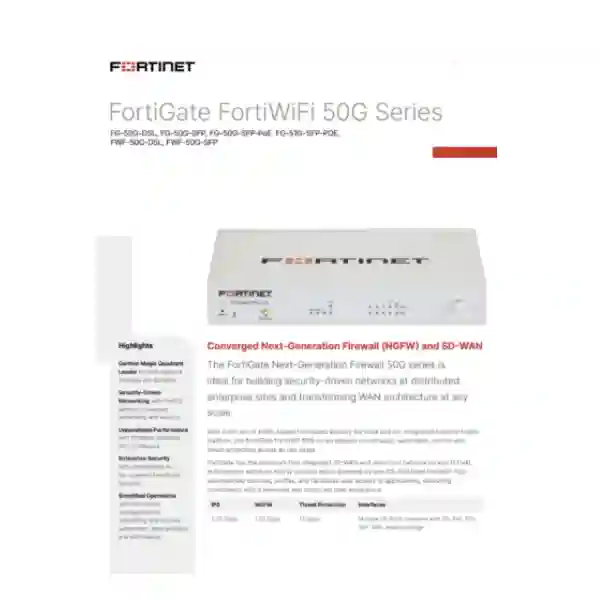
Fortinet positions the FortiGate 50G family as a converged next-generation firewall and SD-WAN platform for distributed enterprise locations. It runs FortiOS and can participate in the broader Fortinet Security Fabric. The value of that approach is architectural: routing, firewall policy, VPN, SD-WAN decisions and security inspection can be coordinated on one platform rather than assembled from unrelated point products. Fortinet publishes a threat-protection figure of 1.1 Gbps for FortiGate 50G; actual deployment results depend on configuration, enabled services, traffic mix and software version, so sizing should be based on the security functions the organization intends to use rather than on a single headline number.
The family also includes variants intended for different connectivity requirements. Exact interfaces and capabilities vary by model, so a quotation should identify the required variant rather than treating “50G” as one universal hardware configuration. Buyers should confirm WAN media, PoE needs where relevant, storage requirements, wireless or DSL requirements where applicable, licensing term and support expectations before ordering.
Why businesses consider FortiGate 50G
Converged security
FortiOS brings firewall and networking functions into a common operating environment. That can simplify policy design when a branch needs internet security, inter-VLAN controls, VPN and WAN steering at the same edge.
Secure SD-WAN
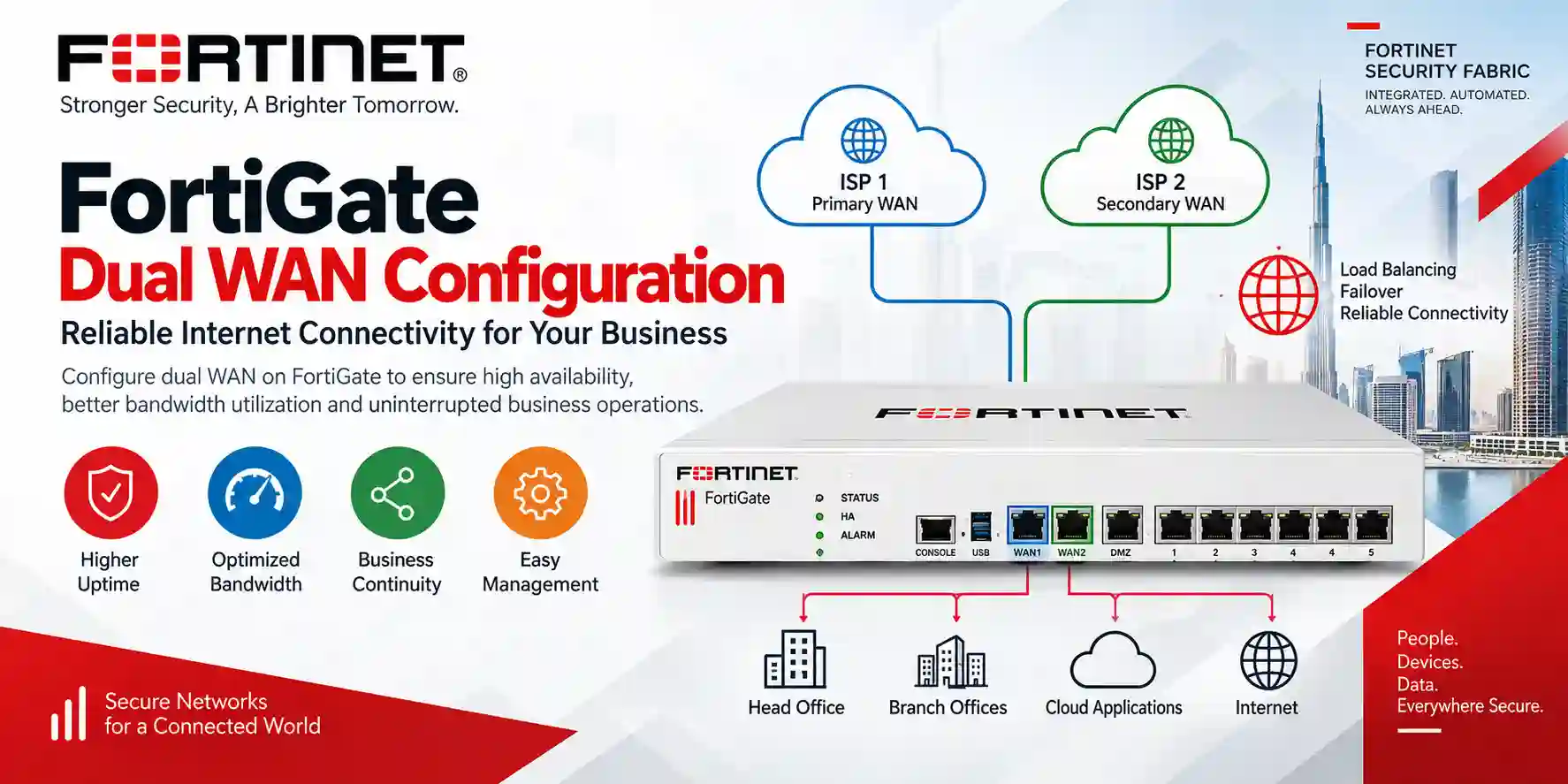
Organizations with two or more WAN paths can design application-aware steering and resilience policies. The correct design should account for circuit quality, business-critical applications and what happens when a preferred link becomes unavailable.
FortiGuard services
FortiGuard security services can add inspection and threat-intelligence capabilities according to the selected subscription. Procurement teams should compare service bundles and renewal terms rather than assuming all security functions are permanently included with hardware.
Security Fabric integration
The firewall can be planned as part of a broader Fortinet environment. Integration is most useful when it serves a defined operational goal such as centralized visibility, coordinated policy or simplified branch management.
FortiGate 50G sizing and buying guidance
Firewall selection should begin with the traffic that will actually be inspected. Record current and planned internet bandwidth, number of users, cloud applications, server publishing, VPN tunnels, remote-access users, VLANs, guest networks, voice traffic, cameras and other devices. Then identify which security functions must be enabled. Deep inspection and multiple security services can create a different performance profile from simple stateful firewall forwarding. Growth matters too: an appliance selected for today’s connection should not become the constraint immediately after an ISP upgrade.
Interface planning is equally important. A branch may require separate WAN links, LAN trunks to managed switches, dedicated networks for servers or CCTV, or a particular media type. Some 50G-family variants address specialized connectivity needs. Confirm the exact model and interface map against the current Fortinet data sheet before procurement. Where high availability is required, design the pair, switching, WAN handoff, power and licensing as one solution rather than simply ordering two appliances.
Subscription selection should be tied to risk and operational requirements. A business seeking web filtering, intrusion prevention, malware protection or other FortiGuard capabilities should specify those requirements in the quotation. Renewal planning is part of lifecycle management; it prevents a firewall from being treated as a one-time capital purchase when the intended security posture depends on active services.
Deployment, VPN and segmentation considerations
A well-sized firewall can still deliver a poor result if the policy design is unclear. Before migration, document existing subnets, DHCP scopes, static routes, NAT rules, published services, DNS dependencies, VPN peers and any rules that exist only because of legacy applications. Classify traffic by business purpose. Staff endpoints, guest Wi-Fi, servers, IP phones, CCTV cameras, access-control devices and management interfaces often deserve different trust boundaries. Segmentation should reduce unnecessary communication without making legitimate business workflows difficult to operate.
For site-to-site VPN, record the peer platform, encryption requirements, local and remote networks, routing behavior and failover expectations. For remote access, define who needs access, which applications they need, how identities are verified and what endpoint controls are appropriate. ZTNA capabilities may be relevant where organizations want more application-focused access decisions, but deployment should follow the actual identity, endpoint and application architecture rather than being enabled merely as a feature checkbox.
Change control is essential during replacement projects. Export and retain the old configuration, document rollback steps, schedule a maintenance window, test critical applications and confirm monitoring after cutover. A clean configuration built from verified requirements is often safer than carrying years of obsolete firewall rules into a new appliance.
Related FourTeck network resources
FortiGate 50G Series Tanzania
Tanzania organizations evaluating the FortiGate 50G Series commonly need to solve several network problems at the same time: secure internet access, reliable connectivity to cloud services, controlled communication between internal systems, branch VPN connectivity and better visibility into applications. A branch firewall can become the point where these requirements meet. The 50G family is relevant when the required scale and inspected throughput fit its published capabilities, but the selection should be validated against the intended FortiGuard services and actual traffic profile. A growing office that expects faster ISP circuits should include that planned bandwidth in sizing rather than purchasing only for current utilization.
Tanzania deployments also benefit from careful WAN design. A business may use fiber as the primary circuit and maintain another provider or wireless path for continuity. Secure SD-WAN can help make link selection policy-driven, but redundancy is effective only when the alternative circuit, upstream routing, DNS and critical applications are tested. For organizations with branches, standardized naming, address plans and VPN templates can make operations easier while still allowing each location to have the bandwidth and interfaces it needs.
Procurement should include the exact appliance variant, power requirements, required subscriptions, support term and any transceivers or accessories. It should also identify implementation scope: migration from an existing firewall, VLAN creation, VPN configuration, security-policy tuning, logging, user access and documentation. Customers should avoid assuming that a hardware quote automatically includes every security subscription or engineering task.
FourTeck Tanzania can discuss the firewall in the context of the wider network, including switching, Wi-Fi, servers, voice and surveillance traffic. That integrated view matters because the firewall is only one layer. Correct VLAN trunks, switch configuration, DNS, DHCP, routing and endpoint settings determine whether the final design operates as intended. A quotation request is more useful when it includes user count, ISP speeds, number of sites, VPN needs and the security services the business wants enabled.
FortiGate 50G Series Dar es Salaam
For businesses in Dar es Salaam, the FortiGate 50G Series can be evaluated for headquarters, branch offices, retail environments, professional services, logistics operations and other sites where internet connectivity supports daily transactions and cloud applications. Dense business operations often place varied traffic on the same network: collaboration calls, SaaS platforms, ERP access, IP telephony, CCTV viewing and guest Wi-Fi. The firewall policy should distinguish these uses instead of allowing one flat network to grow without control.
A practical Dar es Salaam design starts with WAN circuits. If the business has multiple providers, document their handoff type, addressing, bandwidth and failover behavior. SD-WAN rules can then prioritize applications according to business value and link quality. For example, interactive voice and video may need different treatment from large backups. The goal is not merely to distribute traffic but to keep important services usable when link conditions change.
Security inspection should be sized against peak traffic and future upgrades. If encrypted traffic inspection, intrusion prevention, application control and other services are planned, those functions belong in the capacity discussion. The 50G platform’s published figures provide a starting point, while a final design should consider the selected FortiOS release, traffic mix and policy set. Remote workers and administrators also need a deliberate access model with strong authentication and restricted permissions.
Before requesting a quote, Dar es Salaam buyers can prepare a simple network inventory: current firewall, ISP speeds, public IP requirements, VLANs, number of users, site-to-site VPNs, remote users, servers and any internet-facing applications. This gives the supplier enough context to recommend a specific 50G-family configuration and subscription bundle without guessing. It also makes migration planning more predictable and reduces the chance of discovering a missing interface or service during cutover.
FortiGate 50G Series Mwanza
Mwanza organizations may use the FortiGate 50G Series where a regional office, commercial site, hospitality operation, healthcare facility or growing enterprise needs secure connectivity to central systems and internet services. Branch design should account for the fact that a site can be operationally important even when it has fewer users than a headquarters. A network outage can interrupt payment systems, communications, cloud applications and access to centralized resources, making WAN resilience and clear troubleshooting procedures valuable.
For a Mwanza branch connected to another Tanzania office, site-to-site VPN can create protected connectivity across public networks. The design should specify the networks that may communicate, routing behavior, tunnel monitoring and what should happen if the primary internet link fails. If a secondary circuit is available, SD-WAN and VPN failover can be planned together. Testing is important: redundancy that has never been exercised may not behave as expected during a real outage.
Local LAN segmentation can also improve control. Finance systems, staff devices, guest Wi-Fi, CCTV and infrastructure management do not necessarily need unrestricted communication with one another. A FortiGate policy can enforce boundaries when the switching and VLAN design supports them. Administrators should keep rules understandable, name objects consistently and document exceptions. This makes future support easier than a large rule base built from temporary changes.
Mwanza procurement teams should request the exact hardware model and verify subscriptions, renewal period, support, power arrangements and implementation scope. If the site depends on centralized IT staff, include secure administration and logging in the project. A concise network diagram showing WAN links, switches, subnets and VPN peers can substantially improve quotation accuracy and later become part of the handover documentation.
FortiGate 50G Series Arusha
Arusha businesses considering FortiGate 50G may include hospitality, travel, professional offices, education, NGOs and multi-site organizations that depend on cloud services and secure communication with other locations. These environments can have a mixture of corporate and guest traffic. A firewall deployment should therefore begin with trust zones: identify which devices belong to employees, visitors, operations, servers, cameras and management, then define only the communication each group requires.
Guest connectivity is a useful example. Guests normally need internet access without broad visibility into business systems. Staff may need cloud applications and internal resources. Cameras or building devices may require tightly limited destinations. Segmentation supported by VLANs and firewall policy can keep these functions separate. Where wireless networks carry multiple SSIDs, switch trunks and access-point configuration must align with the firewall design so that policy boundaries are maintained end to end.
For organizations connecting Arusha to Dar es Salaam or international offices, VPN and SD-WAN planning should be based on application requirements. Interactive applications may be sensitive to latency and loss, while backups may tolerate slower paths. Multiple links can provide options, but policy must define how sessions move during degradation or outage. Logging and monitoring should make it possible to determine whether a user problem originates from the LAN, firewall, WAN circuit or remote service.
When preparing an Arusha FortiGate 50G quotation, include expected user/device counts, current and planned internet speeds, number of WAN circuits, VPN peers, guest-network requirements and desired FortiGuard services. If the project replaces another firewall, supply an anonymized rule and network summary where possible. This helps identify migration complexity early and supports a cleaner transition rather than copying obsolete policies into the new platform.
FortiGate 50G Series Dodoma
In Dodoma, FortiGate 50G Series planning can suit offices and institutions that need controlled internet access, branch connectivity and segmentation within a manageable edge platform. The first design decision is scope. Determine whether the firewall will serve only as an internet perimeter, route between internal VLANs, terminate VPNs, steer multiple WAN connections or perform all of these roles. Combining roles can simplify architecture, but capacity and change management must account for the resulting workload.
Organizations with formal governance requirements should pay particular attention to administrative access and auditability. Management interfaces should not be broadly exposed. Administrator roles, authentication, configuration backups and change records should be defined. Security logs are more useful when time settings, device names and retention practices are consistent. If logs are sent to a central platform, bandwidth and storage requirements should be considered as part of the project.
Branch continuity is another planning area. If critical applications are hosted elsewhere, a second WAN connection can reduce dependence on one circuit, but the alternative path must be sized for essential traffic. During failover, noncritical traffic may need lower priority so core services remain usable. Secure SD-WAN policies can support this approach when they are built around measured link health and business requirements.
Dodoma buyers can improve procurement by requesting a complete solution line-up rather than a firewall model alone. Specify hardware variant, FortiGuard bundle, term, support expectations, implementation, migration, VPN setup, documentation and training or handover requirements. The result is easier to compare across quotations because each supplier is responding to the same operational scope instead of presenting different assumptions behind similar hardware prices.
FortiGate 50G Series UAE
UAE organizations evaluating the FortiGate 50G Series may be standardizing branch security across offices, retail sites, warehouses or distributed operations. The platform’s combination of NGFW and SD-WAN functions can be useful when IT teams want repeatable branch templates. Standardization should cover more than hardware: consistent interface naming, VLAN conventions, policy objects, VPN design, logging and change procedures can reduce operational variation across sites.
For branches using cloud applications and multiple WAN services, link-quality measurement can inform routing decisions. A policy can consider more than whether a circuit is simply up or down. However, application behavior during path changes should be tested, especially for long-lived or latency-sensitive sessions. If the firewall is part of a larger Fortinet environment, centralized management and analytics options can be assessed according to fleet size and operational needs.
Procurement in the UAE should still verify exact model variants and subscriptions. The FortiGate 50G family contains configurations intended for different connectivity scenarios, and the correct choice depends on interfaces and deployment goals. Hardware, FortiGuard services, support and implementation are separate commercial considerations. Buyers should ask suppliers to state term lengths and renewal items clearly so lifecycle cost can be understood.
Organizations coordinating Tanzania and UAE branches can benefit from a shared security baseline while preserving site-specific exceptions. The baseline can define minimum segmentation, administrator controls, VPN parameters and logging. A documented exception process then handles local applications or circuit differences. This approach is more maintainable than allowing every site to develop an unrelated rule set over time.
FortiGate 50G Series Uganda
Uganda deployments of FortiGate 50G can be assessed for businesses that need a secure branch edge with VPN, SD-WAN and application-aware security. For companies operating in both Uganda and Tanzania, the firewall can form part of a standardized branch architecture, but WAN bandwidth, user counts and local connectivity should still be sized independently. A standard design is a template, not an assumption that every branch has identical requirements.
The procurement process should identify the security services the organization expects. If web filtering, intrusion prevention and other FortiGuard capabilities are part of the desired outcome, request the appropriate subscription explicitly and note the term. Ask how renewals will be handled and what functionality depends on active services. This avoids comparing a hardware-only quote with a bundled security quote as though they were equivalent.
For branch-to-branch connectivity, map all networks before VPN configuration. Duplicate IP ranges between sites can complicate routing and should be discovered early. Decide whether internet traffic exits locally or follows a central path, and document DNS behavior. If dual WAN is used, test VPN recovery and application sessions under realistic failure conditions.
Uganda buyers should also include LAN dependencies in the plan. VLANs require compatible managed switching; wireless segmentation requires coordinated SSIDs and trunks; PoE endpoints require adequate switch power; and network equipment needs appropriate UPS protection. A firewall cannot compensate for an undocumented or unstable LAN. Treating the FortiGate as part of the complete branch architecture produces a more supportable result.
FortiGate 50G Series Kampala
Kampala offices frequently depend on SaaS applications, video meetings, voice, web services and remote connectivity, creating a need to manage both security and WAN quality. FortiGate 50G can be considered where the expected inspected traffic fits the platform. Sizing should use peak rather than average usage and include growth. If the organization plans a faster internet service within the hardware lifecycle, that future circuit belongs in the calculation.
Application control and security policy should reflect business roles. Finance users, general staff, guest devices and infrastructure management may require different access. Rules are easier to audit when they use meaningful names and groups instead of large collections of individual addresses. Administrators should periodically review temporary exceptions and unused objects to prevent policy sprawl.
For remote access, define the user population and applications first. Access to a single internal service may call for a different approach than broad network access for administrators. Strong identity controls and least-privilege policy reduce exposure. Where ZTNA is being considered, validate endpoint, identity and application prerequisites before treating it as a direct replacement for every legacy VPN use case.
A Kampala quotation request should therefore contain technical context: WAN circuits, user and device counts, security-service expectations, remote users, VPN peers, public services and interface needs. Procurement teams can then compare offers on a consistent scope that includes subscriptions and implementation, not simply appliance price.
FortiGate 50G Series Arua
For an Arua branch or operational site, network resilience may be as important as raw firewall throughput. FortiGate 50G planning should begin with the services that must continue during connectivity problems. List essential cloud applications, communications, remote systems and management access, then determine whether a second WAN path is available and what capacity it provides.
If two links are used, SD-WAN policies can prioritize important traffic and respond to measured link conditions. The backup circuit should not automatically be expected to carry the full normal workload. During constrained operation, lower-priority updates, backups or guest traffic may need different treatment. This should be documented and tested so users understand expected behavior during failover.
Remote support also benefits from clean management design. Administrators need a secure way to reach the firewall and related network equipment without exposing management interfaces indiscriminately. Configuration backups, network diagrams, interface labels and a record of ISP details reduce recovery time when onsite technical resources are limited. Monitoring should distinguish a WAN outage from a firewall or LAN issue.
For procurement, Arua customers should verify the exact 50G variant, subscriptions, support term and accessories. Include environmental and power planning for the network cabinet. A UPS sized for the firewall, switches and connectivity equipment can protect against short interruptions, while adequate ventilation and organized cabling make maintenance safer and easier.
FortiGate 50G Series Mbarara
Mbarara organizations can consider FortiGate 50G for branch security where staff need dependable access to internet and centralized business systems. A good design separates capacity planning from feature selection. First quantify traffic and VPN demand; then identify security services; finally validate the hardware variant and subscription package against both. This sequence reduces the risk of selecting a model because its name is familiar rather than because it matches the workload.
Segmentation can be particularly useful where business endpoints share infrastructure with cameras, wireless guests or operational devices. Managed switches and VLANs create the logical boundaries, while firewall policy controls permitted communication. The rule set should allow required services such as DNS, time synchronization or application access without giving every device unrestricted reach across the network.
If the Mbarara site connects to a headquarters, document routing and addressing before building VPNs. Overlapping private networks are easier to resolve before migration than after tunnels are live. Define how internet traffic should flow and whether security policies are managed locally or according to a central standard. A consistent template can simplify multi-branch support.
The quotation should state hardware, subscription bundle and term, implementation tasks, migration assumptions and handover deliverables. Asking for configuration backup and network documentation at project completion creates a useful operational baseline. Future changes can then be evaluated against a known working design rather than reconstructed from memory.
FortiGate 50G Series Gulu
A Gulu FortiGate 50G deployment can be designed around secure connectivity, branch standardization and manageable remote operations. Sites that depend on centralized IT should favor configurations that are well documented and easy to diagnose. Interface descriptions, object naming, VPN labels and monitoring conventions may appear minor, but they significantly improve support when an engineer is not physically present.
WAN health should be monitored with business context. A circuit may remain technically online while suffering loss or latency that affects voice, video or cloud applications. Secure SD-WAN policies can use performance information to make path decisions when configured appropriately. The design should define thresholds carefully and avoid unnecessary route changes caused by overly sensitive settings.
Security subscriptions should be matched to the threat controls the business expects. FortiGuard services can extend the NGFW security capabilities, but licensing and renewal are commercial items that should be explicit. Administrators should also maintain FortiOS according to an approved lifecycle process, reviewing release guidance and testing changes rather than upgrading production equipment without preparation.
For Gulu procurement, provide a branch profile that includes users, internet services, switches, access points, servers, cameras and VPN dependencies. This helps determine whether the 50G family is appropriately sized and which interfaces are required. If future expansion is expected, include that growth in the design so the security edge does not become the first bottleneck.
FortiGate 50G Series Kenya
Kenya businesses evaluating FortiGate 50G may be looking for a compact branch NGFW that can combine security and WAN functions. For regional organizations with operations in Kenya, Tanzania and Uganda, a common FortiOS-based branch standard can reduce configuration variation. Standardization is most effective when it includes documentation and lifecycle processes as well as appliance models.
Connectivity design should reflect each Kenyan site’s circuits and application patterns. Dual WAN can support resilience, while SD-WAN can make path selection more application-aware. However, branch design should avoid assuming that every circuit has equivalent quality or capacity. Measure performance, define priority traffic and decide how the site should behave when only the backup path remains.
Security sizing must account for enabled inspection. Raw firewall throughput is not the same as threat-protection capacity. Fortinet publishes separate performance metrics, and the relevant one depends on the intended configuration. Include encrypted traffic, VPN, number of sessions and security services in the evaluation. For organizations with heavy cloud usage, future bandwidth upgrades should also be included.
Kenya procurement teams can ask for a clearly itemized proposal covering exact hardware variant, FortiGuard subscription, term, support and implementation. Regional IT managers should also decide whether management is local, centralized or shared. Consistent policy templates and logging make it easier to compare branch behavior across countries while retaining local network details.
FortiGate 50G Series Kuwait
Kuwait branch environments considering FortiGate 50G can evaluate the platform for secure internet access, VPN connectivity and SD-WAN. The device should be sized for the security policy that will run in production. If multiple FortiGuard services and encrypted traffic inspection are required, procurement should focus on the relevant inspected-throughput profile rather than a basic firewall forwarding figure.
Organizations with multiple offices can use a branch template to standardize network zones, VPNs and management controls. A template should remain flexible enough to account for different ISP handoffs, local subnets and application needs. Maintaining a controlled set of policy objects and naming standards can make centralized troubleshooting much easier.
Power, rack placement and cabling deserve attention even for compact appliances. Network security equipment should be installed where cooling, physical access and power protection are appropriate. WAN equipment and switches involved in failover should share the continuity plan; keeping only the firewall on UPS does not preserve service if the modem or switch loses power.
A Kuwait quote should state the exact model, interfaces, subscription bundle, renewal term and deployment services. If the firewall replaces an existing platform, include migration of required VPNs, objects and policies, but use the project as an opportunity to remove obsolete rules. Testing should cover internet, business applications, VPNs, DNS, failover and administrative access before final handover.
FortiGate 50G Series Ghana
Ghana organizations can consider FortiGate 50G where branch sites need a combination of NGFW security, VPN and WAN control. Selection begins with a branch profile: user count, endpoint count, internet bandwidth, cloud reliance, public-facing services and inter-site traffic. This prevents under-sizing and also avoids buying capacity that does not address the actual risk or connectivity requirements.
For multi-site companies, site-to-site VPN design should use a documented addressing plan. Centralized services such as ERP, file systems or identity platforms may require predictable routing and DNS. If branches have dual WAN, decide whether both links participate during normal operation or whether one is primarily a backup. The answer influences SD-WAN policy and capacity planning.
Security operations should include more than initial configuration. Define who reviews alerts, how configuration backups are stored, how firmware changes are approved and how expired subscriptions are prevented. FortiGuard services can provide important security capabilities, but an organization still needs operational ownership for policies and events.
Ghana procurement requests should specify whether installation, configuration and migration are required. Include the desired subscription term and any management or logging components. A clear scope helps compare proposals fairly and provides a basis for acceptance testing. For regional organizations, the same checklist can be used in Tanzania, Ghana and other markets to create a repeatable security standard.
FortiGate 50G Series Nigeria
Nigeria deployments of FortiGate 50G may serve offices, distributed commercial sites or branches that need secure access to internet and central applications. In larger regional organizations, the 50G can be evaluated as one branch tier within a wider firewall standard. Sites with heavier workloads should be sized independently rather than forcing one appliance model everywhere.
Where connectivity diversity is available, SD-WAN can support policy-based use of multiple links. Application priority should be agreed with business owners. Payment, ERP, voice or operational systems may deserve preference over software downloads or guest traffic when a site is running on a constrained backup circuit. Health checks and failover behavior should be tested during implementation.
Cybersecurity controls should align with organizational policy. Application control, intrusion prevention, web security and other FortiGuard services may be relevant depending on the subscription and risk profile. Network segmentation can limit unnecessary lateral communication, while remote access should use strong identity controls and least privilege. Logging should be retained in a way that supports troubleshooting and security review.
Nigeria buyers should request an itemized bill of materials with exact model variant and subscription term. Migration services should state what is included: rule conversion, VPN recreation, cutover, testing and documentation. If the firewall will integrate with Fortinet switching, wireless or centralized management, identify those dependencies before purchase so licensing and architecture are evaluated together.
FortiGate 50G Series Seychelles
Seychelles organizations considering FortiGate 50G can focus on reliable secure connectivity for offices, hospitality operations and distributed sites where cloud access and remote management are important. Network design should reflect available WAN options and the operational impact of an outage. If redundancy is feasible, the backup service should be tested with the same attention as the primary connection.
Hospitality and guest-facing environments often require clear separation between business systems and visitor networks. Staff devices, guest Wi-Fi, payment systems, cameras and building devices should not automatically share one trust zone. VLAN design, managed switching and firewall policies can create boundaries, while carefully defined rules permit only required communication.
Remote administration should be planned securely because onsite access may not always be convenient. Use controlled management paths, strong authentication and configuration backups. Monitoring should provide enough information to determine whether a service problem originates from the WAN, firewall, switch or application. Documentation is particularly valuable when support involves teams in different locations.
For Seychelles procurement, identify the exact FortiGate 50G variant, FortiGuard bundle, subscription term, support expectations and implementation scope. Include spare or replacement planning according to business criticality without assuming local stock. A detailed quotation and handover package can reduce ambiguity over responsibilities and make future renewal or expansion decisions easier.
FortiGuard subscription and renewal planning
FortiGate hardware and FortiGuard security services should be treated as related but distinct parts of the solution. The correct service bundle depends on the protections the organization wants to operate. Procurement teams should ask for a clear description of included services, subscription duration and renewal date. This is especially important when comparing offers because one quotation may contain only hardware while another includes a multi-year security bundle.
Renewal should be tracked before expiry. Security teams can record device serial information, service terms and renewal ownership in their asset-management process. Where multiple branches use FortiGate, aligning renewal dates may simplify administration, although commercial and operational circumstances vary. Changes to service bundles should be evaluated against security policy and budget rather than made automatically.
For more background on lifecycle planning, FourTeck’s Tanzania security content can be paired with integrated firewall and network planning, while regional teams can consult the relevant FourTeck country resources linked above.
Quotation checklist for FortiGate 50G Series
Frequently asked questions
Is FortiGate 50G suitable for a branch office?
Fortinet positions the 50G series for distributed enterprise sites. Suitability for a specific branch depends on inspected traffic, security services, VPN demand, interfaces, sessions and growth. Validate these requirements against the current data sheet and selected configuration.
Does FortiGate 50G support SD-WAN?
Yes. Secure SD-WAN is part of Fortinet’s converged networking and security approach. Effective use still requires multiple suitable WAN paths, health checks and policies aligned to application priorities.
What is the FortiGate 50G threat-protection performance?
Fortinet publishes 1.1 Gbps threat-protection throughput for FortiGate 50G. Published performance figures are measured under defined test conditions; real deployments vary with software, configuration, traffic and enabled features.
Do I need a FortiGuard subscription?
The appropriate subscription depends on the security services your organization intends to use. Ask for the exact bundle and term in the quotation and plan renewals as part of the firewall lifecycle.
Can FortiGate 50G connect Tanzania and overseas branches?
Site-to-site VPN can connect appropriately designed networks across internet services. Addressing, routing, encryption parameters, WAN resilience and remote-peer compatibility should be confirmed for each project.
What information should I provide for a quote?
Provide ISP speeds, user/device counts, sites, VPN needs, interface requirements, security services, existing firewall details, VLANs and expected growth. This allows a supplier to recommend a specific variant and subscription rather than guessing from the product family name.
Decision recap
FortiGate 50G Series is a branch-focused NGFW platform that combines security and networking functions through FortiOS. The strongest procurement approach is to match the exact model variant and FortiGuard subscription to inspected throughput, WAN interfaces, VPN requirements, segmentation and expected growth. Do not choose only from raw firewall throughput or appliance price.
For Tanzania projects, include the wider network in the assessment. Switches, wireless, ISP handoffs, power protection and application dependencies determine whether the firewall can deliver the intended result. A documented design and tested migration are as important as the hardware selection.
Consult FourTeck about FortiGate 50G Series
Share your ISP bandwidth, number of users, branch locations, VPN requirements, required security services and existing network design. FourTeck can use that information to discuss model selection, subscription options, deployment scope and integration requirements. Pricing, availability, delivery and warranty should be confirmed in the formal quotation rather than assumed from general product information.


Reviews
There are no reviews yet.