
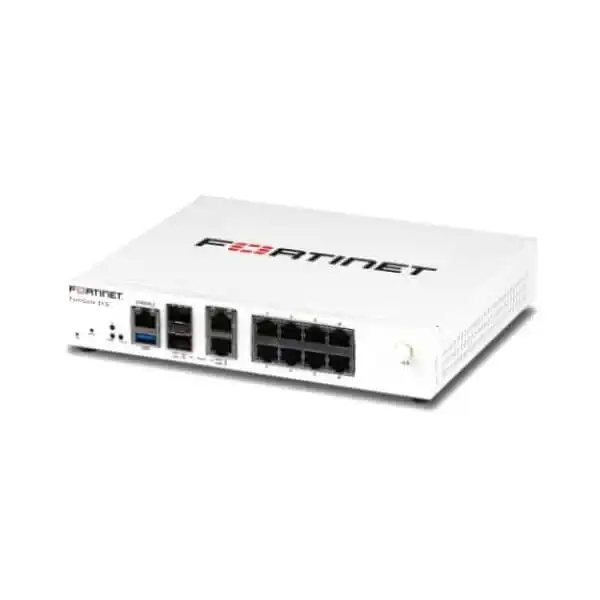
FortiGate 91G (FG-91G) Tanzania
FortiGate 91G gives Tanzania organizations a compact security platform for internet-edge protection, secure SD-WAN, VPN connectivity, application visibility, segmentation and coordinated FortiGuard security services. It is part of Fortinet’s 90G series for distributed enterprise sites and combines FortiOS with purpose-built SP5/SOC5 acceleration, multi-gigabit connectivity and 120 GB local storage in the 91G model.
Verified FG-91G highlights
Fortinet publishes up to 28 Gbps firewall throughput, 25 Gbps IPsec VPN throughput, 4.5 Gbps IPS throughput, 2.5 Gbps NGFW throughput and 2.2 Gbps threat-protection throughput for the 90G platform under its stated test conditions. Real deployment performance depends on enabled inspection, traffic mix, policy design and software version.
Interfaces: eight GE RJ45 ports plus two shared-media pairs that can operate through 10GbE SFP+ or multi-gigabit RJ45 connectivity. Storage: 120 GB on FG-91G.
What the FortiGate 91G solves
A business firewall has to do more than pass packets. Modern Tanzania offices depend on cloud applications, Microsoft 365 or Google Workspace, ERP platforms, payment systems, VoIP, CCTV, guest Wi-Fi, remote users and branch connectivity. The FG-91G can sit at the internet edge and apply security policy while also providing routing, encrypted connectivity and SD-WAN functions. This consolidation is particularly useful when an organization wants a common FortiOS operating model across several sites instead of maintaining separate routers, VPN gateways and security appliances.
The model is best evaluated by inspected throughput rather than headline firewall throughput alone. Buyers should document internet bandwidth, expected growth, number of users and devices, SSL inspection scope, IPS requirements, VPN traffic, VLANs, FortiSwitch or FortiAP integration, logging expectations and high-availability requirements. That sizing process helps determine whether FG-91G is appropriate or whether another FortiGate model provides a better operational fit.
Converge routing, firewall policy, SD-WAN and security controls through FortiOS.
Use applicable FortiGuard services for IPS, malware, web and application security according to the selected subscription.
Build encrypted site-to-site connectivity and policy-based WAN selection for distributed operations.
FG-91G includes 120 GB local storage, distinguishing it from the FG-90G variant.
FortiGate 91G technical specification guide
| Specification | Fortinet-published value / capability |
|---|---|
| Firewall throughput | Up to 28 / 28 / 27.9 Gbps (1518 / 512 / 64 byte UDP) |
| IPsec VPN throughput | Up to 25 Gbps (512 byte) |
| IPS throughput | Up to 4.5 Gbps, Enterprise Mix |
| NGFW throughput | Up to 2.5 Gbps, Enterprise Mix |
| Threat protection | Up to 2.2 Gbps, Enterprise Mix |
| Concurrent sessions | Up to 3 million |
| New sessions/second | Up to 124,000 |
| Interfaces | 8 × GE RJ45 plus 2 × 10GE shared-port pairs |
| Local storage | 120 GB on FG-91G |
| Form factor | Desktop |
Published performance values are laboratory measurements with specific traffic profiles and security configurations. Production results vary. Size the appliance against the security services you actually intend to enable.
Connectivity, FortiLink and network design
The 90G/91G hardware architecture provides two 10 Gigabit SFP+ interfaces and two multi-gigabit BASE-T WAN interfaces arranged as shared-media pairs. Each SFP and corresponding copper WAN member shares a hardware path, so deployment teams should design around the shared-port behavior rather than assuming all four high-speed physical connectors operate independently at once. Eight additional Gigabit Ethernet RJ45 interfaces include ports A and B for FortiLink use. This combination makes the appliance flexible for organizations moving from ordinary 1 GbE internet links toward faster fiber or multi-gigabit handoffs.
For a clean deployment, define WAN circuits, LAN VLANs, server or DMZ segments, voice networks, CCTV, wireless corporate access and guest access before configuration begins. If FortiSwitch and FortiAP products are part of the architecture, FortiLink and Security Fabric planning can reduce management fragmentation. The firewall should not be selected only because ports are available; interface speed, switching topology, east-west traffic, inspection path and redundancy all matter.
FortiGuard, FortiCare and licensing guidance
The appliance and the security-service entitlement are separate procurement considerations. Fortinet offers FortiGuard security services and FortiCare support in different bundles and terms. The appropriate package depends on whether the project needs services such as intrusion prevention, web security, malware protection, application controls and other FortiGuard capabilities. A quotation should clearly identify the hardware model, service bundle, term, support level and renewal date so procurement teams can compare like with like.
Organizations replacing an existing FortiGate should also plan migration rather than treating the purchase as a simple hardware swap. Review FortiOS compatibility, configuration conversion, VPN peers, certificates, address objects, policy order, SD-WAN rules, routing, DHCP, authentication, logging and maintenance windows. Subscription renewal should be tracked as an operational lifecycle item because expired security services can change the protection available to the deployment.
Buying checklist before requesting an FG-91G quote
Provide the current and expected internet speed, number of users, number of locations, VPN requirements, critical applications, security inspection requirements, VLAN count, WAN technologies, expected log retention, preferred FortiGuard/FortiCare term, high-availability requirement and any FortiSwitch, FortiAP, FortiManager or FortiAnalyzer integration. This information makes a quotation more useful and reduces the risk of selecting a firewall on model name alone.
FortiGate 91G Tanzania
For Tanzania businesses, the FortiGate 91G is relevant where internet security and connectivity have become operational infrastructure rather than an optional IT layer. A headquarters, busy branch, hospital, school, hotel, logistics company, professional-services office or multi-site enterprise may have several types of traffic sharing the same WAN: cloud applications, ERP sessions, VoIP, video meetings, backups, remote administration, guest Wi-Fi and security cameras. The FG-91G provides a platform for separating those functions with policies and VLANs while applying next-generation security services according to the chosen FortiGuard package. Its multi-gigabit interfaces are especially useful when an organization is planning beyond a basic 1 GbE edge.
A Tanzania deployment should begin with measured requirements. Record peak WAN utilization, cloud dependence, number of remote users, branch tunnels, SSL inspection needs and the applications that must remain responsive during congestion. If two internet providers are used, document how traffic should fail over and whether selected applications need preferred paths. Secure SD-WAN can then be designed around business intent rather than simply connecting two WAN cables. For organizations with remote branches, standardizing firewall templates, VPN addressing and security profiles can simplify expansion.
Procurement teams should ask for the exact FG-91G hardware and clearly identified service subscriptions. Do not compare a hardware-only offer directly with a bundle containing FortiGuard and FortiCare. Also consider transceivers, patch leads, rack placement or shelf requirements, UPS protection, logging architecture and implementation effort. FourTeck can help prepare a solution discussion around these requirements. For broader regional Fortinet resources, visit FourTeck Africa, while Tanzania enquiries can be directed through FourTeck Tanzania contact.
FortiGate 91G Dar es Salaam
Dar es Salaam organizations often operate dense business networks where reliable access to cloud services, payment systems, voice, video and partner portals is essential. The FG-91G can serve as a consolidated security and WAN edge for offices that have outgrown basic router firewalls. A good design separates staff devices, servers, finance systems, guest wireless, IP phones and operational devices into appropriate security zones. Policy should then control which segments can communicate and which internet services they may reach. This reduces unnecessary trust inside the network and gives administrators clearer visibility when troubleshooting.
For companies using primary fiber plus a secondary ISP, microwave or cellular backup, the project should define failover objectives before installation. Some traffic may require the lowest latency while other traffic can tolerate a backup path. SD-WAN rules can support that distinction, but only after link quality and application priorities are understood. VPN planning is equally important for businesses connecting warehouses, branches or remote employees. The Fortinet-published IPsec capability gives the platform substantial headroom, but real encrypted performance must be evaluated with the security profile and packet mix expected in production.
When requesting a Dar es Salaam quotation, include internet speeds, user count, expected growth, number of branch tunnels, inspection requirements and whether 10GbE or multi-gigabit handoffs will be used. Ask for service subscriptions and support terms to be itemized. If the network will use FortiSwitch or FortiAP, include those devices in the architecture discussion so FortiLink, VLAN and management choices are planned together. This produces a more useful bill of materials than purchasing a firewall first and designing the network afterward.
FortiGate 91G Mwanza
Mwanza businesses can use the FortiGate 91G as a secure edge when they need dependable connectivity between local operations, cloud services and other company locations. Retail groups, distribution businesses, education environments, healthcare sites and regional offices frequently need to protect many different device types while keeping critical applications available. The firewall can enforce segmentation and application-aware policy while encrypted VPNs connect the site to headquarters, data centers or other branches.
Sizing should account for inspection rather than raw internet speed alone. A 1 Gbps connection carrying encrypted web traffic with IPS, application control and other security services enabled is a different workload from basic stateful firewalling. Future bandwidth upgrades should also be considered because the cost of replacing an undersized security appliance can exceed the benefit of choosing the smallest possible device today. The FG-91G’s high-speed shared-media interface pairs provide useful connectivity options for a growing edge, while its 120 GB local storage can support use cases that benefit from onboard storage.
For Mwanza procurement, create a simple network brief before asking for pricing: WAN type and speed, user/device count, VLANs, VPN peers, remote users, public-facing services, Wi-Fi architecture and required FortiGuard functions. This gives the supplier enough context to identify the relevant hardware and subscription bundle. Where uptime matters, discuss power protection, backup connectivity, configuration backups and whether high availability is required. These design choices are independent of the city and should be based on the actual business risk and continuity objectives.
FortiGate 91G Arusha
Arusha has hospitality, tourism, professional-services, education and regional business environments where internet availability and secure guest separation can be important. In a hotel or hospitality setting, for example, guest Wi-Fi should not share unrestricted trust with finance systems, property-management platforms, staff devices, CCTV or voice systems. The FortiGate 91G can form the policy boundary between these zones and apply internet security controls while supporting multiple WAN paths.
An Arusha deployment should map the traffic that is business-critical. Reservation platforms, cloud accounting, payment services, VoIP and collaboration may need higher priority than guest downloads or software updates. Secure SD-WAN policies can help steer applications over preferred circuits when multiple links exist. The project should also define what happens during link degradation, not only complete failure. Health checks and routing policy are most useful when they reflect application requirements.
Buyers should decide whether the 120 GB storage of the FG-91G is required compared with the related FG-90G and should validate the chosen FortiGuard and FortiCare package against security objectives. Include any need for FortiAP wireless infrastructure, FortiSwitch access switching, centralized management or external logging in the quotation request. For East African regional projects spanning multiple countries, the FourTeck Kenya and FourTeck Uganda sites provide related regional solution context.
FortiGate 91G Dodoma
Organizations in Dodoma evaluating the FG-91G should focus on governance, secure access and network resilience. Offices that handle sensitive administrative, financial or citizen-facing workflows may need strong separation between user groups, controlled remote access, detailed policy and dependable connectivity to cloud or central systems. FortiGate provides the framework for firewall policy, VPN, application control and FortiGuard security services, while the exact configuration should reflect the organization’s own risk assessment.
Network segmentation is a practical starting point. Staff workstations, servers, management interfaces, wireless users, guests, voice systems and IoT devices do not all need the same access. VLANs and firewall policies can reduce unnecessary lateral connectivity. Administrators should also define logging and change-control procedures so that security policy remains understandable as the network evolves. The FG-91G’s local storage may be useful in some logging or operational scenarios, but retention requirements should be designed explicitly and may call for centralized FortiAnalyzer or other approved logging architecture.
For procurement, document whether the deployment is a new installation or replacement. A migration requires time for configuration review, VPN changes, certificate handling, testing and rollback planning. Ask for the exact service term and support entitlement, and ensure renewals are assigned to an owner internally. If redundancy is required, include HA design, duplicate appliances and switch/WAN topology in the initial scope rather than adding them late in the project.
FortiGate 91G UAE
UAE businesses considering the FortiGate 91G may be planning branch offices, retail sites, professional-services networks, warehouses or regional operations with high cloud usage and fast broadband. The platform’s multi-gigabit edge connectivity is useful where ISP handoffs exceed traditional Gigabit Ethernet. The security design should still be driven by inspected throughput, number of users, VPN load and enabled FortiGuard services rather than by interface speed alone.
For a regional company with UAE headquarters and African branches, standardized FortiOS policy can simplify site-to-site VPN, SD-WAN and security operations. Define a repeatable branch template for addressing, VLANs, VPN naming, logging and administrative access while allowing local WAN differences. This approach can reduce configuration drift as new offices are added. Centralized management may also be considered when the number of FortiGate appliances grows beyond what is practical to manage individually.
UAE procurement should specify whether the requirement is hardware only or includes FortiGuard and FortiCare, and should list any SFP+ optics or accessories separately. For Fortinet-focused UAE information, see FourTeck Fortinet UAE. Confirm commercial availability and exact entitlement at quotation time rather than relying on generic web claims, because bundles and lifecycle details can change.
FortiGate 91G Uganda
Uganda organizations can evaluate the FortiGate 91G for larger branches and distributed enterprise sites that need stronger inspected performance and faster edge connectivity than entry-level firewalls. Typical design goals include protected internet access, encrypted links between sites, application visibility, segmented Wi-Fi, resilient WAN connectivity and centralized policy. The 90G series is positioned by Fortinet for distributed enterprise sites, making requirements-based branch design the natural way to assess the model.
A multi-site Uganda deployment should start with a consistent addressing and VPN plan. Kampala headquarters may have different bandwidth from regional branches, but security policy naming, authentication, logging and SD-WAN intent can remain standardized. This makes troubleshooting easier and supports future expansion. If FortiSwitch and FortiAP are included, define which functions will be managed through FortiGate and how FortiLink will be connected.
For purchasing, avoid comparing only appliance prices. Confirm FortiGuard service coverage, FortiCare support term, implementation, accessories and renewal responsibilities. FourTeck’s Uganda site provides regional Fortinet and firewall information for buyers planning local or multi-country projects.
FortiGate 91G Kampala
Kampala offices with fast internet, many cloud users and multiple business systems need a firewall sized for the security work it will perform. The FG-91G can support a design that combines firewalling, IPS, VPN, SD-WAN and application controls, but configuration choices determine the real workload. SSL inspection, for example, can materially change performance compared with basic packet filtering. Capture these requirements before selecting the final bundle.
For a headquarters environment, consider separate zones for servers, finance, general staff, IT administration, voice, CCTV, corporate Wi-Fi and guests. Remote branches can connect through IPsec VPN, while SD-WAN policy can choose among available WAN links. Administrative access to the firewall itself should be restricted and logged. Configuration backups and a documented change process are as important to operational security as the appliance specification.
A Kampala quote request should state current and planned ISP bandwidth, VPN peer count, remote-access needs, high-availability expectations and subscription term. If the firewall is replacing an older FortiGate, provide the existing model and FortiOS version so migration complexity can be considered. This makes the procurement discussion about the complete security outcome rather than a box price.
FortiGate 91G Arua
For an Arua branch, the value of a FortiGate 91G depends on the scale of the site and its role in the wider organization. A regional office handling important business applications may need secure connectivity back to a central site, local internet breakout, controlled guest access and reliable failover. The appliance can support these functions through FortiOS firewall, VPN and SD-WAN capabilities while FortiGuard services add subscribed threat-protection functions.
Branch design should be simple enough to support remotely. Use consistent VLAN naming, documented VPN settings, clear WAN failover rules and restricted administration. If a secondary circuit is slower than the primary, decide which applications remain permitted during failover so backup bandwidth is not overwhelmed. Monitoring should distinguish between total link failure and poor quality such as packet loss or latency.
Before ordering, verify that the site genuinely needs the 91G performance class. User count alone is not enough; internet speed, encrypted traffic, inspection features and growth plans matter. A properly sized smaller or larger FortiGate may be more appropriate depending on measured requirements. FourTeck can use the site brief to frame that selection discussion.
FortiGate 91G Mbarara
Mbarara organizations operating branch, education, healthcare, retail or distribution networks can use next-generation firewall policy to reduce exposure between business systems and uncontrolled devices. The FG-91G offers substantial branch performance and flexible interfaces, making it relevant when a site has fast WAN connectivity or expects growth. Segmentation should be designed first so the firewall’s interfaces and VLANs serve a clear security architecture.
VPN requirements deserve separate sizing. Site-to-site tunnels may carry ERP, voice or database traffic, while remote users have different authentication and access needs. Define which resources each user group can reach instead of allowing broad network access. Where identity systems are available, integrate access controls according to the organization’s approved security design. Logging should capture enough information for troubleshooting and incident review without assuming local storage alone meets every retention requirement.
Procurement should include power protection and physical placement as well as licensing. The 91G is a desktop form-factor appliance; the final installation should provide appropriate ventilation, secure placement and reliable power. If the organization expects an HA pair, redundant switching and WAN design must support it. Ask for these items in the initial project scope.
FortiGate 91G Gulu
A Gulu site that functions as a significant regional branch may need more than a simple internet firewall. It may need encrypted connectivity, local application access, Wi-Fi segmentation, voice support and resilience across more than one ISP. The FortiGate 91G can consolidate many of these edge functions and apply consistent FortiOS policy. Its selection should follow a site survey or requirements review rather than a generic user-count chart.
For resilience, identify the applications that must survive an ISP outage and the capacity of the backup link. SD-WAN policy can prioritize business traffic, but the rule set should be tested during commissioning. VPN failover should also be validated so branch connectivity follows the intended path when a circuit fails. Document DNS behavior, routing, NAT and any public services because these often determine whether failover works as expected.
The security subscription should align with the controls the organization intends to operate. If IPS, web security or other FortiGuard services are required, make sure the quoted entitlement includes them for the desired term. Establish a renewal calendar and named owner so protection does not become an afterthought after deployment.
FortiGate 91G Kenya
Kenya businesses with distributed sites can evaluate the FG-91G for high-capacity branches and office edges that need integrated security and SD-WAN. Nairobi headquarters, regional offices, warehouses, schools, healthcare facilities and retail operations may all have different traffic patterns, so sizing should be based on actual bandwidth and inspection. The 90G series provides a strong platform for organizations that want room for faster links while retaining FortiOS policy consistency.
Multi-country organizations can benefit from standard templates. A Kenya office and Tanzania office may use different ISPs but can share common VPN, segmentation, logging and administrative standards. Centralized policy and monitoring become increasingly valuable as the number of sites grows. The design should also account for local application dependencies and cloud services so SD-WAN rules do not treat all traffic equally.
For related Kenya firewall guidance, visit FortiGate Firewall Kenya. When requesting FG-91G pricing, provide the exact subscription requirement and project scope, and verify current availability at the time of quotation.
FortiGate 91G Kuwait
Kuwait offices considering FG-91G may be upgrading for faster WAN circuits, more encrypted traffic, stronger application controls or standardized branch security. The appliance’s 10GbE-capable shared-media pairs can accommodate modern edge connectivity, while the FortiOS platform brings routing, SD-WAN and security functions together. The network design should still account for downstream switching capacity so a faster firewall interface does not create unrealistic expectations about end-to-end performance.
For branch security, separate corporate users, servers, voice, guest wireless and operational devices. Define VPN access by role and use least-privilege policy. If the site has dual ISPs, identify preferred paths and business-critical applications before writing SD-WAN rules. Security profiles should be tested against real applications because inspection can affect compatibility and throughput.
Commercial proposals should identify the exact hardware and FortiGuard/FortiCare term. Regional information is available through FourTeck Kuwait. Availability, pricing and service scope should always be confirmed in the current quotation rather than inferred from older product pages.
FortiGate 91G Ghana
Ghana organizations planning secure branches can assess the FG-91G when they need higher inspected performance, multi-gigabit connectivity and a Fortinet platform that can scale with distributed operations. A typical business edge may protect cloud users, finance systems, ERP, IP phones, Wi-Fi and remote access simultaneously. Good segmentation prevents those systems from becoming one flat trust zone.
The WAN design should consider both capacity and reliability. Where two links are available, define which traffic uses each link in normal conditions and what changes during failure. VPN and DNS behavior should be tested as part of acceptance. For organizations with multiple branches, consistent FortiOS configuration standards can make remote support and security review easier.
Buyers should request a complete bill of materials covering appliance, service subscriptions, optics where needed, implementation and any centralized management or logging requirements. The FourTeck Ghana site provides regional context for Ghana technology projects, while exact FG-91G commercial terms should be confirmed for each request.
FortiGate 91G Nigeria
Nigeria enterprises and growing businesses may consider the FortiGate 91G for branch or office sites that combine fast internet, cloud access, VPN and layered security inspection. The platform can reduce the number of separate edge devices by converging secure networking functions under FortiOS. This does not remove the need for architecture: the firewall must be placed within a well-designed switching, wireless, identity and logging environment.
For sites with variable WAN quality, secure SD-WAN can use health information to influence path selection. Define acceptable latency, loss and application behavior during degraded conditions, then test those assumptions. If business systems are hosted centrally, VPN resilience may be more important than raw internet browsing speed. If cloud applications dominate, local breakout with consistent security policy may be preferable. These are design decisions that should precede configuration.
Procurement should separate verified manufacturer specifications from reseller marketing. Confirm exact service entitlement, term, hardware quantity and support scope in writing. Visit FourTeck Nigeria for related regional information, and use a project requirements list when requesting a quotation.
FortiGate 91G Seychelles
Seychelles businesses, hospitality groups and distributed organizations can evaluate the FG-91G where secure internet, guest separation, remote management and resilient connectivity are important. Hospitality environments in particular often mix guest Wi-Fi, staff devices, property systems, payment functions, CCTV and voice. These should be segmented with explicit policy rather than placed on one trusted network.
WAN resilience can be particularly important for organizations dependent on cloud platforms. If multiple circuits are available, document the applications that need priority and the expected behavior when the primary connection degrades. SD-WAN can help automate path decisions, while IPsec VPN can connect the site to other offices or central resources. Testing failover before production handover is essential.
For island deployments, procurement planning should include all required accessories and subscription details in the initial order to reduce avoidable project delays. Confirm optics, cabling, power protection, licensing, configuration scope and renewal ownership. Do not assume stock or delivery time from a web listing; obtain current confirmation for the specific project and destination.
Integration and deployment considerations
FortiGate works most effectively when firewall policy is part of the wider network design. Map VLANs, IP addressing, DHCP, DNS, routing, WAN circuits, VPN peers and administrative access. Determine whether FortiSwitch, FortiAP, FortiAnalyzer, FortiManager or FortiClient will be used. If existing third-party switches and access points remain, document trunking, spanning-tree behavior and management boundaries. The goal is not to force every function into one product but to create clear operational ownership.
For migration, export and review the current configuration rather than blindly importing years of accumulated policy. Remove obsolete objects where appropriate, verify NAT and VIP behavior, confirm certificate dependencies and test business applications. Build a rollback plan and schedule a maintenance window. After cutover, validate internet access, DNS, VPNs, public services, voice, critical cloud applications, logging and failover.
Frequently asked questions
What is the difference between FortiGate 90G and 91G?
The 91G is the storage-equipped variant in the series. Fortinet’s current product matrix lists 120 GB local storage for FG-91G, while FG-90G is listed without local storage. Core 90G-series performance and interface characteristics are otherwise presented together by Fortinet.
Does FG-91G have 10GbE ports?
Yes. Fortinet documents two 10 Gigabit SFP+ interfaces and two multi-gigabit copper WAN interfaces organized as two shared-media pairs. Because each SFP/copper pair shares media, only one member of each pair is used at a time.
Is FortiGuard included automatically?
Do not assume a security subscription is included with every hardware offer. FortiGuard and FortiCare are sold through different service bundles and terms. Confirm the exact entitlement and duration in the quotation.
Can FortiGate 91G support dual-WAN and SD-WAN?
The 90G series is positioned by Fortinet as a converged NGFW and SD-WAN platform. A dual-WAN design should be configured around actual circuit types, application priorities and health-check requirements.
How should we size FG-91G for our office?
Use inspected throughput, WAN speed, user/device count, VPN load, SSL inspection, enabled security services and growth plans. Headline firewall throughput alone is not a sufficient sizing method.
What information should we send for a quotation?
Send site location, WAN speeds, user/device count, number of branches, VPN needs, required security services, subscription term, HA requirement, existing Fortinet products and any installation or migration scope.
Decision recap
FortiGate 91G is a strong candidate for distributed enterprise sites and growing offices that need a modern Fortinet security edge with substantial inspected throughput, secure SD-WAN, high IPsec capacity, multi-gigabit connectivity and local storage. Its suitability depends on the real security workload. Compare the required FortiGuard services, traffic inspection, VPN, WAN design and growth plan against Fortinet’s published performance data before purchase.
Consult FourTeck about FortiGate 91G Tanzania
Share your network size, internet links, branch plan, VPN requirements, existing firewall, security-service needs and preferred subscription term. FourTeck can use that information to structure a FortiGate 91G quotation discussion and identify the hardware, licensing and deployment items that should be considered. Current pricing, stock, lead time and commercial terms must be confirmed at quotation time.



Reviews
There are no reviews yet.