
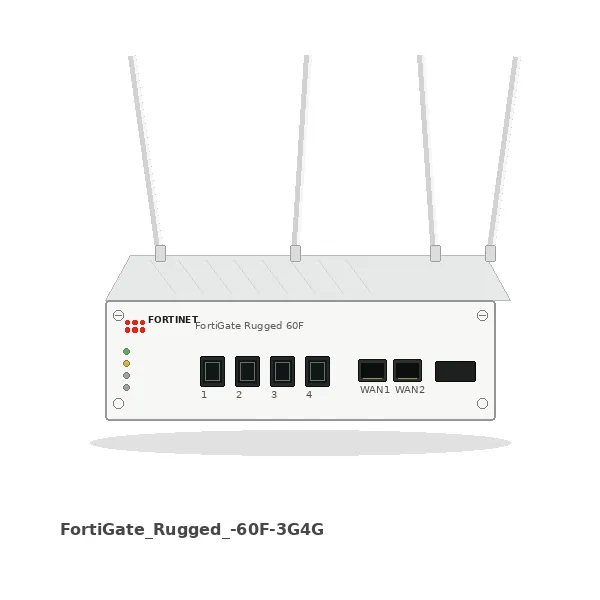
FortiGate Rugged 60F 3G4G (FGR-60F-3G4G) Tanzania
The FortiGate Rugged 60F 3G4G is an industrial next-generation firewall for organizations that need cybersecurity at remote, electrically demanding or operational-technology locations. The FGR-60F-3G4G combines Fortinet security functions with an integrated 3G/4G LTE modem, GPS, dual SIM capability, Ethernet and shared fiber interfaces, a network bypass pair and redundant DC power inputs. This combination makes it relevant to utilities, manufacturing plants, transport infrastructure, energy sites, remote telemetry networks and other environments where conventional office appliances may not match deployment conditions.
Fortinet publishes IPS throughput of 950 Mbps, NGFW throughput of 550 Mbps and threat-protection throughput of 500 Mbps for the FGR-60F-3G4G. Real deployment performance depends on traffic mix, enabled inspection and configuration.
An integrated 3G/4G LTE modem with GPS and dual SIM in active/passive operation supports cellular connectivity for remote sites, backup WAN designs and locations where fixed connectivity is limited or needs a secondary path.
The platform provides four GE RJ45 interfaces, two shared GE RJ45/SFP media pairs, a PORT4/WAN1 bypass pair, DB9 serial connectivity, USB, console access and redundant DC power inputs.
FortiGate Rugged 60F 3G4G Overview
The FGR-60F-3G4G belongs to Fortinet’s FortiGate Rugged family, developed for mission-critical industrial environments. Its value is not simply that it is a firewall with cellular access. It brings network security, routing, VPN, segmentation and WAN connectivity into a hardened platform that can be positioned close to operational assets. For buyers, this can simplify designs that would otherwise require separate security, routing and cellular devices. The product is powered by FortiOS and uses FortiSoC4 hardware. Fortinet also lists a Trusted Platform Module for the model. Organizations should size the appliance according to inspected traffic, VPN load, application mix, growth expectations and the security services they intend to activate rather than selecting solely from raw firewall throughput.
Published Fortinet specifications list IPv4 firewall throughput up to 6 Gbps depending on packet size, 3.5 Gbps IPsec VPN throughput, 600,000 concurrent TCP sessions and 19,000 new TCP sessions per second. These are laboratory specification values and should be treated as design references rather than guarantees for every production network. For procurement, confirm the required FortiCare and FortiGuard service package, contract duration, LTE compatibility, antenna placement, DC power arrangement and environmental requirements before ordering.
Technical Highlights and Buying Considerations
| Model | FGR-60F-3G4G |
| IPS / NGFW / Threat Protection | 950 Mbps / 550 Mbps / 500 Mbps |
| Wired interfaces | 4 GE RJ45; 2 shared GE RJ45/SFP media pairs; bypass pair |
| Cellular | Integrated 3G/4G LTE, GPS, dual SIM active/passive |
| Power | Redundant 12V–125V DC inputs |
| Typical fit | Industrial OT, utilities, transport, remote sites and critical infrastructure |
Deployment, Integration and Security Planning
A successful rugged-firewall project begins with the network diagram rather than the appliance order. Document every upstream WAN path, downstream industrial zone, management network, VPN peer, routing dependency, serial-connected system and cellular requirement. Decide whether LTE is intended as the primary WAN, emergency failover, out-of-band access path or part of an SD-WAN strategy. Dual SIM capability can improve carrier resilience, but carrier coverage, SIM provisioning, data plans and antenna placement remain external design factors. Where the bypass pair is required, engineers should document the intended failure behavior and test it during commissioning.
For OT environments, segmentation should reflect operational trust boundaries rather than simply mirroring an office LAN. Separate management systems, engineering workstations, controllers, supervisory systems and external access paths where appropriate. Remote administration should use controlled authenticated channels, and VPN policies should grant only the connectivity required for each operational role. Security subscriptions should be selected around the actual inspection requirements and organizational support model. FourTeck can help customers prepare a bill of materials and quotation request, while final configuration should follow the approved security architecture and Fortinet documentation.
FortiGate Rugged 60F 3G4G Tanzania
In Tanzania, the FortiGate Rugged 60F 3G4G is relevant to organizations extending secure IP connectivity beyond conventional air-conditioned offices. Industrial estates, utilities, processing sites, transport infrastructure, remote communications shelters and distributed operational facilities often need a firewall positioned closer to field systems. The FGR-60F-3G4G addresses that design requirement with rugged hardware, FortiOS security, integrated LTE and a mixture of copper and fiber-capable interfaces. A Tanzania procurement team should begin by identifying the traffic that must cross the firewall, the expected inspection profile and whether 3G/4G connectivity will be primary or secondary. This determines whether the model’s published 950 Mbps IPS, 550 Mbps NGFW and 500 Mbps threat-protection figures align with the intended workload.
Connectivity planning is equally important. The two shared RJ45/SFP media pairs allow designers to accommodate copper or suitable optical uplinks, while the four GE RJ45 interfaces support local Ethernet connections. The bypass pair can be relevant in designs where continuity requirements justify a defined bypass behavior. Integrated GPS and dual-SIM LTE provide additional options for geographically distributed deployments, but cellular performance depends on the selected operator, signal conditions, antenna placement and service plan. Buyers should therefore include site surveys and carrier validation in project planning instead of assuming that an embedded modem alone guarantees WAN availability.
For Tanzanian industrial cybersecurity projects, procurement should also cover subscriptions, support entitlement, power, mounting, spares and implementation responsibilities. The appliance accepts redundant wide-range DC inputs, a practical characteristic for sites that use industrial DC systems or require power-path resilience. Confirm the exact power design before installation. Organizations comparing Fortinet solutions can review FourTeck Tanzania technology solutions and discuss how the rugged firewall can fit alongside switching, wireless, VPN and network-security requirements. A quotation request is more useful when it states expected users or devices, WAN types, VPN peers, desired security services, installation environment and contract term.
FortiGate Rugged 60F 3G4G Dar es Salaam
Dar es Salaam buyers may evaluate the FGR-60F-3G4G for industrial facilities, logistics environments, utility sites, transport operations, warehouses and remote infrastructure managed from the commercial center. The model is especially relevant where a security gateway must operate near operational equipment rather than in a conventional data-room environment. Its integrated 3G/4G LTE capability can support a secondary communications path for distributed sites, while Ethernet and shared SFP connectivity allow it to participate in mixed-media network designs. The procurement question is not simply whether LTE is available; it is how cellular connectivity should interact with the primary WAN, routing, VPN, monitoring and security policies.
A Dar es Salaam deployment should map critical flows before policies are created. Identify which industrial assets must communicate with enterprise systems, which services require internet access, which third parties need remote maintenance and which management traffic should remain isolated. From that map, engineers can define zones and firewall policies with a least-privilege approach. IPsec VPN capability can be used to connect remote locations to central networks where the design requires it. The product’s published performance should be interpreted in the context of enabled inspection services, encrypted traffic and application behavior. Sizing with realistic headroom is preferable to selecting an appliance only from the highest firewall-throughput number.
Physical installation deserves the same attention as logical configuration. Confirm DC supply characteristics, grounding, mounting location, ambient conditions, cable paths and cellular antenna placement. If fiber is planned, verify compatible transceivers separately because the shared media slots do not by themselves define the complete optical link. For organizations coordinating security across multiple branches or industrial locations, the broader FourTeck Africa technology portfolio can provide regional context, while Tanzania-specific quotation discussions should document the exact appliance, service bundle and deployment scope. This approach reduces ambiguity between hardware acquisition and the operational services required after installation.
FortiGate Rugged 60F 3G4G Mwanza
For Mwanza, the FortiGate Rugged 60F 3G4G can suit organizations that need secure networking at industrial, processing, logistics or geographically distributed operational sites. The rugged platform can be positioned where standard office-oriented appliances are less suitable, and its cellular capability gives network designers another WAN option when fixed circuits are unavailable, slow to provision or require backup. Before purchase, the project team should determine the operational consequence of losing the primary link. If connectivity must continue, define whether LTE should automatically take over, carry only selected critical applications or remain reserved for management and incident recovery.
The model’s dual SIM active/passive capability can support carrier-diversity planning, but resilience depends on more than installing two SIM cards. Coverage, antenna orientation, tower diversity, data-plan restrictions and routing behavior should be assessed at the actual location. The GPS function may be useful in certain asset or deployment designs, while the serial interface can be relevant to industrial environments with legacy equipment. Each of these features should be tied to a documented requirement rather than treated as a reason to complicate the design. A clean deployment uses only the interfaces and services needed for the intended architecture.
Security planning in Mwanza should also consider how remote technicians and central IT teams will access operational networks. Establish authenticated VPN paths, restrict management interfaces, log administrative activity and avoid exposing industrial management services directly to the public internet. Where FortiGuard services are planned, include the appropriate subscription and renewal term in the commercial request. The FGR-60F-3G4G is a platform around which secure connectivity can be designed; it is not a substitute for segmentation, patch governance, backups and operational procedures. FourTeck Tanzania can discuss product selection and quotation preparation based on the number of sites, expected traffic, connectivity choices and required Fortinet service coverage.
FortiGate Rugged 60F 3G4G Arusha
Arusha organizations with remote operations, industrial systems, hospitality infrastructure, utilities or distributed facilities may consider the FGR-60F-3G4G when a secure gateway needs both rugged construction and integrated cellular connectivity. The appliance combines FortiOS networking and security with 3G/4G LTE, dual SIM, GPS, multiple Gigabit Ethernet interfaces and shared SFP options. This makes it possible to design a compact edge-security node without automatically adding a separate LTE router. Whether that consolidation is appropriate should be decided from availability, maintenance and operational requirements.
A practical Arusha design process starts with site connectivity. Record the primary circuit, cellular coverage, any fiber handoff, internal VLANs or network zones and the systems that require remote support. Determine how failover should work and which applications are allowed to use the backup connection. Cellular data can become expensive or constrained if all traffic moves to LTE during an outage, so policy-based routing or SD-WAN rules may be appropriate depending on the FortiOS design. The dual SIM arrangement can improve options for carrier redundancy, but it should be tested under realistic failure conditions during commissioning.
Procurement teams should request a quotation that separates the base hardware from the desired FortiCare and FortiGuard term so commercial comparisons remain clear. They should also state whether installation, migration, VPN setup, policy configuration or ongoing support is part of the requested scope. Where the firewall protects operational technology, maintenance windows and rollback procedures are particularly important because security changes can affect production traffic. A staged deployment with documented acceptance tests can verify routing, bypass behavior, VPNs, LTE failover, logging and management access before the appliance is considered operational. This planning discipline is as important as choosing the correct firewall model.
FortiGate Rugged 60F 3G4G Dodoma
In Dodoma, the FortiGate Rugged 60F 3G4G can support secure edge designs for distributed public infrastructure, utilities, industrial facilities, remote compounds and organizations connecting operational sites to central networks. The rugged format and redundant DC inputs are relevant where the firewall must live outside a typical office rack environment. Integrated LTE can provide a communications path for locations where fixed connectivity is constrained or where a backup WAN is required. The most effective projects define the operational objective first: secure site-to-site connectivity, segmentation, internet security, remote maintenance, resilient WAN access or a combination of these needs.
Fortinet lists substantial firewall and VPN capabilities for the platform, but buyers should size against the security profile they intend to use. Deep inspection, threat prevention, encrypted traffic and VPN usage can change effective throughput. Allowing growth headroom is sensible for sites expected to add devices, cameras, sensors or applications. The model supports a large number of sessions relative to many small industrial networks, yet session count alone does not determine suitability. Application behavior, east-west traffic, logging, management and future integration all matter.
For procurement, document the exact model as FGR-60F-3G4G to avoid confusion with the non-cellular FGR-60F or other Rugged models. Confirm the required service bundle and term, and do not assume that hardware automatically includes every FortiGuard service. Installation planning should include power, mounting, grounding, SIMs, antennas, carrier activation and optical components where SFP links are required. The resulting bill of materials should be reviewed against the approved network diagram before ordering. FourTeck Tanzania can use this information to prepare a more precise product discussion and quotation rather than relying on a generic firewall request.
FortiGate Rugged 60F 3G4G UAE
UAE projects frequently combine centralized enterprise networks with remote industrial, utility, construction, logistics and infrastructure sites. The FGR-60F-3G4G can fit designs that require a rugged FortiGate with embedded cellular connectivity and a flexible mix of copper and fiber-facing interfaces. For a project spanning Tanzania and the UAE, standardizing on FortiOS can simplify policy concepts and operational procedures, but each site should still be sized and configured according to its local traffic and connectivity conditions. LTE frequency compatibility, SIM provisioning and carrier service must be validated for the intended deployment.
The firewall’s dual DC inputs and industrial certifications make it distinct from a standard branch appliance. Fortinet identifies IEC 61850-3 and IEEE 1613 certification for the model, which is relevant to certain electric-power and substation environments. Certification does not remove the need for system-level engineering; the complete installation, enclosure, power system, cabling and surrounding equipment must meet project requirements. Similarly, DNV type-approval information published by Fortinet should be checked against the exact deployment and mounting conditions when maritime use is being evaluated.
Organizations sourcing for UAE projects can review FourTeck’s Fortinet UAE resource for regional Fortinet context. When requesting FGR-60F-3G4G pricing, specify whether the requirement is hardware only or includes FortiCare and FortiGuard services, plus the desired term. Include the number of appliances, intended HA or standalone design, LTE role, VPN requirements and any implementation services. A structured request helps prevent price comparisons between materially different bundles and makes lifecycle costs clearer.
FortiGate Rugged 60F 3G4G Uganda
Uganda deployments can use the FortiGate Rugged 60F 3G4G for industrial and remote-site security where integrated LTE provides useful connectivity resilience. Energy, utilities, transport, production and distributed enterprise operations can benefit from a firewall that supports Ethernet, shared SFP media and cellular WAN in a rugged platform. The first design decision is whether the FGR-60F-3G4G will sit at an isolated site, at an industrial boundary between OT and IT networks, or at a remote branch edge. Each placement leads to different policy, routing and availability requirements.
If LTE is used for failover, test the transition between primary and cellular links, including VPN re-establishment, DNS behavior, application sessions and monitoring alerts. Dual SIM active/passive functionality provides another layer of choice, but it should be combined with carrier and coverage analysis. In remote areas, antenna placement may have a greater effect on connectivity than firewall configuration. Where fiber is available, the shared SFP interfaces can support appropriate optical links, subject to compatible transceiver selection and the shared-media behavior documented by Fortinet.
Security policy should be built around the minimum communication required between zones. Industrial protocols and remote maintenance flows should be documented so the firewall can enforce intentional access rather than a broad allow policy. Organizations coordinating procurement in Uganda can consult FourTeck Uganda for regional technology context. For a quotation, include the exact FGR-60F-3G4G model, service subscriptions, quantity, installation environment, VPN topology and required implementation scope. This makes it easier to distinguish the appliance requirement from professional services and recurring security subscriptions.
FortiGate Rugged 60F 3G4G Kampala
Kampala-based organizations may use the FGR-60F-3G4G as a secure aggregation or remote-site gateway for operations extending beyond headquarters. A central IT team can use IPsec VPNs and FortiOS policy controls to connect remote industrial or infrastructure sites while maintaining defined security boundaries. The integrated cellular modem is particularly useful when a remote site needs an alternate path that does not depend on the same fixed-line provider as its primary connection. This can improve architectural diversity, although true resilience depends on independent infrastructure and tested failover behavior.
The published 3.5 Gbps IPsec VPN throughput is a useful reference for encrypted connectivity, while threat-protection and NGFW figures are lower because security inspection adds work. Project teams should use the metric that best matches their intended configuration rather than comparing only the highest number in a data sheet. If the appliance will inspect internet-bound traffic, terminate VPNs and enforce OT segmentation simultaneously, capacity planning should account for all of these functions. Logging and centralized management traffic should also be considered.
Kampala procurement teams should confirm whether the firewall is being purchased as a replacement, a new deployment or part of a broader Fortinet architecture. Migration projects need configuration review, object cleanup, change windows and rollback planning. New sites need addressing, VLANs, routing, security zones, VPN definitions and acceptance criteria. Where cellular service is involved, add SIM ownership, data-plan management and antenna installation to the operational checklist. A complete scope produces a better quotation and reduces the chance that essential accessories, subscriptions or engineering tasks are discovered only during deployment.
FortiGate Rugged 60F 3G4G Arua
Arua projects may place a greater emphasis on remote connectivity and operational continuity, making the FGR-60F-3G4G’s integrated LTE capability particularly relevant. For a distributed site, the firewall can combine security policy enforcement with primary or backup cellular WAN access and encrypted connectivity to a central network. The design should begin with an assessment of available fixed and mobile services, expected bandwidth and the applications that must remain reachable during an outage. If LTE is the only viable WAN, data usage and signal quality become important capacity-planning inputs.
Dual SIM support allows an active/passive cellular arrangement, but organizations should validate both carriers at the site and document how a SIM change affects addressing, VPNs and remote management. GPS capability is integrated, while external SMA connections support the cellular and GPS antenna arrangement. Antennas should be installed according to vendor guidance and local site conditions. Remote equipment cabinets also require attention to power, heat, grounding and physical security. The firewall’s wide-range redundant DC inputs can fit industrial power designs, but the actual supply and protection scheme should be engineered for the site.
From a cybersecurity perspective, remote sites should not become trusted simply because they connect over a VPN. Apply segmentation and explicit policies to limit which central services each site can access. Use secure administration methods and maintain configuration backups. If third-party vendors need access to operational equipment, create controlled paths with authentication and time-limited operational procedures rather than exposing management interfaces. When requesting the FGR-60F-3G4G for Arua, provide a site list, connectivity plan, expected traffic, required subscriptions and deployment responsibilities so hardware, licensing and services can be scoped coherently.
FortiGate Rugged 60F 3G4G Mbarara
Mbarara organizations operating processing, logistics, utility or distributed infrastructure can evaluate the FortiGate Rugged 60F 3G4G as an industrial edge-security appliance. Its rugged design is intended for conditions that differ from conventional enterprise offices, while the integrated modem can provide cellular WAN without adding a separate external LTE router. Consolidation can reduce the number of devices at a remote site, but project teams should still consider whether separating connectivity and security functions is preferable for their maintenance strategy and redundancy requirements.
The firewall includes four GE RJ45 interfaces and two shared GE RJ45/SFP media pairs. This gives designers flexibility when connecting local copper equipment and upstream optical infrastructure. Because the RJ45 and SFP connections are shared media pairs, interface planning should follow Fortinet documentation rather than assuming every connector can operate independently at the same time. The bypass pair between PORT4 and WAN1 may support continuity scenarios where bypass operation is part of the approved architecture. Test this behavior before production use.
A Mbarara security deployment should define how alerts and logs will be monitored after installation. A firewall that is installed and then ignored provides less operational value than one integrated into routine security monitoring, configuration management and renewal processes. Determine who owns policy changes, firmware planning, incident response and subscription renewals. FortiCare and FortiGuard options should be selected according to the organization’s support and security-service needs. A quotation request should therefore include both technical and operational requirements, enabling the appliance and lifecycle services to be evaluated together.
FortiGate Rugged 60F 3G4G Gulu
Gulu deployments that connect remote facilities to central systems can benefit from the FGR-60F-3G4G’s combination of rugged construction, VPN, security inspection and cellular connectivity. A common architecture is a remote site with local operational devices, a primary WAN where available and LTE as an independent backup. Another is an LTE-primary site that uses encrypted tunnels to reach central applications. The correct design depends on service availability, traffic criticality and the organization’s tolerance for downtime.
Before rollout, conduct a connectivity test at each target location rather than extrapolating cellular performance from a nearby town. Signal strength, antenna placement and network congestion can vary significantly. Where multiple sites are involved, standardize configuration templates for interfaces, VPNs, logging and security policy while retaining site-specific addressing and carrier details. Consistent templates can simplify support and reduce configuration drift, especially when a small central team manages many remote appliances.
Operational technology introduces additional change-management requirements. Firewall upgrades and policy changes should be scheduled with awareness of production processes and remote-access dependencies. Maintain backups and document recovery procedures. The rugged firewall can enforce network boundaries, but broader OT security also includes asset inventory, secure remote access, endpoint controls, vulnerability management and incident planning. Buyers in Gulu should view the FGR-60F-3G4G as one component of that architecture. For procurement, specify hardware quantity, subscription term, SIM strategy, power arrangement, mounting requirements and whether commissioning assistance is required.
FortiGate Rugged 60F 3G4G Kenya
Kenyan organizations can consider the FGR-60F-3G4G for industrial plants, utilities, transport systems, remote branches and infrastructure projects where a rugged next-generation firewall with cellular WAN is needed. In multi-country deployments, using a consistent FortiGate platform can simplify configuration standards and operational training, while local connectivity and regulatory requirements still need separate validation. The integrated 3G/4G LTE modem can be used as a primary or backup path, and dual SIM capability supports a carrier-diversity strategy where appropriate.
For a Kenya deployment, define the traffic profile and security services before selecting quantities. If sites mainly carry telemetry and management traffic, their bandwidth needs may be modest but uptime requirements high. Other sites may carry video, large software updates or enterprise application traffic that changes the sizing calculation. The published 500 Mbps threat-protection figure provides a reference point for security-inspected traffic, while 950 Mbps IPS and 550 Mbps NGFW figures represent other Fortinet test profiles. Production performance varies with configuration, so leave capacity headroom.
Organizations coordinating Kenyan projects can visit FourTeck Kenya for regional product and solution context. Procurement documents should state the exact FGR-60F-3G4G model, required Fortinet service package, term, number of sites and any installation or configuration work. If the project spans Tanzania and Kenya, identify which location owns central management, logging and support escalation. Cross-border standardization is most useful when operational ownership is equally clear.
FortiGate Rugged 60F 3G4G Kuwait
Kuwait industrial, energy, utility and infrastructure environments can present demanding edge-security requirements, including remote assets, high availability expectations and harsh installation conditions. The FortiGate Rugged 60F 3G4G is designed for industrial networks and combines FortiOS security with LTE, GPS, dual SIM, redundant DC power and mixed copper/fiber connectivity. Project engineers should verify the full environmental envelope and installation design against Fortinet’s current data sheet for the exact site conditions rather than assuming that the word rugged covers every enclosure or temperature scenario.
LTE can serve as an alternate WAN for remote assets, but antenna engineering is critical. Equipment installed inside metal cabinets or electrically complex environments may need carefully planned antenna positioning. The cellular data plan should be sized for the traffic permitted during failover. For example, a backup path might prioritize VPN management, telemetry and essential business applications while restricting bulk transfers. This approach can preserve critical connectivity and control cellular consumption. Dual SIM functionality provides an additional carrier option when the architecture calls for it.
Kuwait buyers should include power, mounting, fiber transceivers, antennas, subscriptions and support requirements in the bill of materials. Fortinet’s industrial certifications may be relevant to regulated projects, but procurement teams should verify whether project specifications require additional approvals or documentation. Lifecycle planning should include firmware governance, configuration backups, monitoring and FortiGuard renewal. The appliance is most valuable when it is incorporated into an operating model rather than treated as a one-time hardware purchase.
FortiGate Rugged 60F 3G4G Ghana
Ghana projects in utilities, mining, industrial production, transport and remote enterprise operations can use rugged security gateways to protect communications between field networks and central IT. The FGR-60F-3G4G is designed for this type of boundary, providing FortiGate security functions together with an integrated 3G/4G modem and flexible wired interfaces. For remote sites, cellular can reduce dependence on a single fixed service, but the network architecture should define exactly what happens when the preferred WAN becomes unavailable.
A robust Ghana deployment plan includes site-specific carrier testing, IP addressing, VPN design, routing priorities, security zones and management access. Where a site hosts industrial controllers or monitoring equipment, firewall policies should be based on documented application flows. Avoid broad any-to-any rules simply to accelerate commissioning; temporary rules have a tendency to become permanent. Instead, gather traffic requirements early and create an acceptance test that verifies necessary communications while confirming that unwanted paths remain blocked.
For commercial planning, distinguish the base appliance from subscriptions and support. Different FortiGuard packages and contract periods can materially change the total quotation, so buyers should compare equivalent configurations. Organizations coordinating regional projects can use FourTeck Ghana for local-market technology context while maintaining consistent design standards across countries. A clear request should include model, quantity, service term, WAN design, expected traffic and implementation scope, allowing the security solution to be priced against actual requirements.
FortiGate Rugged 60F 3G4G Nigeria
Nigeria has many use cases for secure remote connectivity across energy, industrial, logistics, utilities and distributed enterprise environments. The FortiGate Rugged 60F 3G4G can provide a hardened security edge with integrated cellular access for sites where WAN diversity and compact deployment are important. Its FortiOS platform enables firewall policy, VPN and secure networking functions, while dual SIM active/passive capability can support a multi-carrier approach. The effectiveness of that approach depends on actual carrier diversity and site coverage.
Project teams should evaluate traffic patterns carefully. A remote operational site with telemetry may require little bandwidth but strong availability, whereas a site carrying video surveillance, remote desktop, software distribution and enterprise traffic can consume substantially more. Use the relevant Fortinet security-performance metrics rather than raw firewall throughput when estimating inspected traffic capacity. Also consider growth: adding cameras, sensors or cloud-connected applications can change bandwidth and session requirements over the life of the deployment.
Physical and operational resilience should be planned together. Redundant DC inputs can support dual power feeds where the site design provides them, while the bypass pair may be used in architectures that require a defined traffic path during certain failures. These features must be tested in the intended topology. Procurement should include the correct FortiCare and FortiGuard package, contract term and any required accessories. Central monitoring, backup, firmware and incident-response responsibilities should be assigned before commissioning so the firewall remains actively managed throughout its lifecycle.
FortiGate Rugged 60F 3G4G Seychelles
Seychelles deployments can involve geographically separated facilities, maritime-linked operations, utilities, hospitality infrastructure and remote technical sites where resilient communications are valuable. The FGR-60F-3G4G offers an integrated LTE option alongside Ethernet and SFP-capable connectivity, enabling network designers to build a compact secure edge. Where maritime environments are involved, Fortinet publishes DNV type-approval information for the model when tested with a rackmount; project engineers should confirm the precise applicability and installation requirements for their use case.
For island or remote-site connectivity, WAN planning should include both technical and operational considerations. Determine which applications need continuous access, whether LTE is primary or backup, how VPN tunnels recover after a path change and who receives alerts when connectivity degrades. Cellular data plans should match expected failover usage. Antenna placement should be assessed on site, and dual SIM capability should be validated with the intended providers. A resilient design is one that has been tested under failure conditions, not merely one that contains redundant components.
Security architecture should keep remote sites segmented from central systems according to business need. Use authenticated VPN access, restrict administrative interfaces and centralize logs where feasible. Procurement should include service subscriptions and support as explicit line items so renewal obligations are understood from the start. For multi-country organizations, standardized FortiGate policies and management practices can reduce complexity, but local network conditions still require individual validation. FourTeck Tanzania can discuss the FGR-60F-3G4G as part of a regional procurement requirement when the site list, connectivity model and security objectives are clearly defined.
Licensing, FortiGuard and FortiCare Planning
The FGR-60F-3G4G can be purchased in different commercial configurations, and organizations should avoid assuming that every security service is included with the base hardware. FortiCare covers support-related entitlements according to the selected offering, while FortiGuard subscriptions provide security services according to the chosen bundle. The correct package depends on inspection requirements, organizational security controls and support expectations. Request the term explicitly—such as one, three or five years where offered—and compare quotations on an equivalent basis.
Renewal planning should be part of the original deployment. Record contract dates, responsible owners and budget cycles. Security services that are central to the approved policy design should not be allowed to lapse unnoticed. Before renewal, review whether the site’s role, traffic and security requirements have changed. This is also an opportunity to evaluate firmware support and hardware lifecycle status using current Fortinet documentation.
Quotation Checklist for FGR-60F-3G4G
✓ Hardware-only or FortiGuard/FortiCare bundle
✓ Required subscription term
✓ Primary and backup WAN types
✓ VPN topology and remote-access needs
✓ Copper/fiber interface requirements
✓ Power and mounting design
✓ OT/IT segmentation requirements
✓ Migration and commissioning scope
✓ Ongoing support and monitoring needs
Frequently Asked Questions
Does the FGR-60F-3G4G include 4G LTE?
Yes. Fortinet specifies an integrated 3G/4G LTE modem with GPS and dual SIM in active/passive operation for the FGR-60F-3G4G.
What is the threat-protection performance?
Fortinet publishes 500 Mbps threat-protection throughput, 550 Mbps NGFW throughput and 950 Mbps IPS throughput. Actual results vary with configuration, traffic and enabled services.
Can it connect to fiber?
The appliance provides two shared GE RJ45/SFP media pairs. Confirm compatible optical transceivers and the intended shared-interface configuration before deployment.
Is it suitable for industrial OT networks?
Fortinet positions the Rugged Series for mission-critical industrial environments and OT networks. Suitability for a specific site still depends on environmental, performance, certification and architecture requirements.
Does it support redundant power?
Yes. Fortinet lists two redundant 12V–125V DC power inputs for the FGR-60F-3G4G.
Decision Recap
Choose the FortiGate Rugged 60F 3G4G when the requirement calls for FortiGate security in an industrial form factor with integrated 3G/4G LTE, GPS, dual-SIM flexibility, redundant DC power and mixed copper/fiber connectivity. Validate inspected throughput, LTE coverage, subscriptions, power, mounting and interface requirements before ordering. For projects that need a higher-performance rugged model or 5G connectivity, compare the requirement against other current FortiGate Rugged models rather than assuming the FGR-60F-3G4G is the only option.
Discuss Your FortiGate Rugged Requirement
Share your site count, expected traffic, LTE role, VPN design, security-service needs and support term with FourTeck Tanzania. A requirement-led quotation helps align the FGR-60F-3G4G hardware, Fortinet subscriptions and deployment scope with the actual industrial network rather than treating the firewall as an isolated component.



Reviews
There are no reviews yet.