
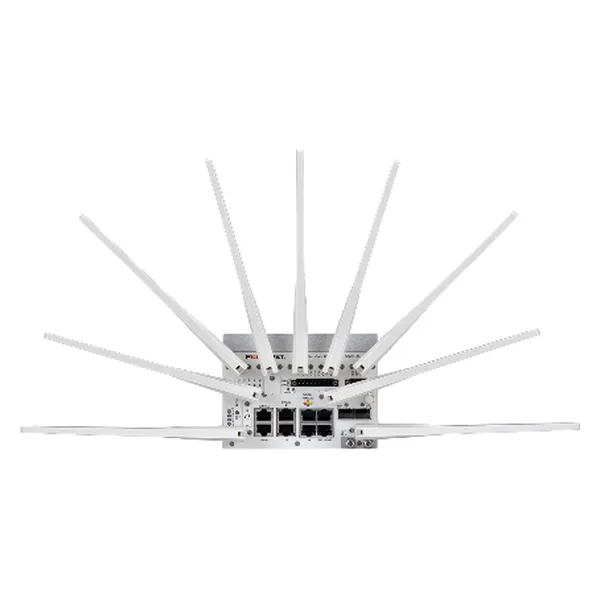
FortiGate Rugged 70G 5G Dual (FGR-70G-5G-Dual)
The FortiGate Rugged 70G 5G Dual is built for organizations that must extend secure networking into operational technology, industrial and remote environments where ordinary branch appliances may not be the right physical fit. Fortinet combines its FortiSP5 security processor, FortiOS networking and security capabilities, rugged construction and two embedded 5G cellular modems in one compact platform. For Tanzanian organizations planning remote branches, industrial sites, utility infrastructure, transport systems, distributed facilities or resilient WAN designs, the FGR-70G-5G-Dual provides a practical foundation for converging firewall security, SD-WAN, VPN and cellular connectivity. Its dual cellular design can be used as additional Internet connectivity or as a redundant WAN path, while wired Gigabit Ethernet and SFP interfaces support integration with existing network infrastructure. Procurement should always consider carrier coverage, antenna placement, security subscriptions, FortiOS design, power architecture and the actual application traffic profile before deployment.
Two embedded 5G cellular modems support resilient wireless WAN designs, with dual SIM capability and GPS documented by Fortinet.
IP40, fanless, DIN-rail construction and dual DC power inputs suit controlled industrial and infrastructure environments.
Fortinet lists 8 Gbps firewall throughput, 7 Gbps IPsec VPN throughput, 2.5 Gbps IPS and 1.3 Gbps threat protection for this model under its stated test conditions.
FGR-70G-5G-Dual verified hardware and connectivity
Fortinet documentation identifies the FGR-70G-5G-DUAL as a ruggedized indoor appliance with an IP40 rating. The platform provides six Gigabit Ethernet RJ45 interfaces, including four LAN ports and two WAN ports, with a bypass pair between PORT1 and PORT2. Two dedicated Gigabit SFP slots provide fiber or compatible transceiver options. Management and industrial integration interfaces include an RJ45 console port, an RJ45 serial data port, USB 2.0, a MicroSD card slot and digital I/O capability. Fortinet also documents Trusted Platform Module support and Bluetooth Low Energy. The dual embedded cellular subsystem includes two 5G modems, dual SIM functionality, eight external SMA WWAN antennas and passive GPS with a dedicated external GPS antenna. Dual 12V to 125V DC power inputs support redundant power design. These characteristics make the appliance particularly relevant when a security gateway must be installed near industrial equipment or in a compact infrastructure cabinet rather than a conventional office rack.
| Area | Fortinet-published detail |
|---|---|
| Processor | FortiSP5 |
| Ethernet | 6 x GE RJ45, including 2 WAN; PORT1/PORT2 bypass pair |
| Fiber expansion | 2 x dedicated GE SFP slots |
| Cellular | 2 x embedded 5G modems, dual SIM capability, GPS |
| Form factor | DIN-rail, fanless, IP40 |
| Power | 12V–125V DC redundant dual inputs |
Secure networking, SD-WAN and OT use cases
A rugged firewall is most valuable when it simplifies the architecture around a remote or industrial location. The FGR-70G-5G-Dual can combine policy enforcement, VPN connectivity, application-aware networking, SD-WAN and cellular WAN within the FortiGate platform. This can reduce the need to design separate firewall and cellular-router layers for every site, although final architecture should still be based on availability, segmentation and operational requirements. Typical use cases include utility substations, manufacturing zones, remote telemetry sites, transport infrastructure, mining operations, distributed retail or banking endpoints, construction sites and branch locations where fixed-line connectivity may be unavailable, slow to provision or insufficient as the only WAN path. Fortinet specifically positions its rugged portfolio for operational technology environments and remote locations where temperature, humidity, shock and vibration are design considerations.
Security planning should go beyond appliance throughput. Buyers should map trust zones, industrial protocols, north-south and east-west traffic, remote-access requirements, site-to-site VPNs, management access, logging, update windows and incident-response procedures. Where 5G is intended for failover, test the failover path under realistic application load and confirm that upstream carrier addressing, NAT and any required inbound services are compatible with the chosen SIM plan. Where both 5G modems are used for availability, document carrier diversity, signal quality and antenna placement rather than assuming that two modems automatically eliminate a common carrier or coverage dependency.
FortiGate Rugged 70G 5G Dual Tanzania
For Tanzania, the strongest procurement case for the FGR-70G-5G-Dual is a site where cybersecurity and WAN resilience must be designed together. Enterprises with operations outside conventional office environments may need a firewall that can sit close to industrial controls, telemetry equipment, cameras, access systems or distributed network cabinets while retaining centrally managed FortiGate security policies. Dual embedded 5G is useful when a project requires cellular connectivity as a primary link, rapid secondary path or continuity option alongside fiber, microwave or another fixed service. Before ordering, Tanzanian buyers should document the intended mobile operators, expected 5G or LTE coverage at each site, antenna mounting constraints, DC power source, grounding, cabinet environment and required wired or fiber uplinks.
A quotation should also identify the required FortiGuard security services and support term rather than treating the hardware alone as the complete security solution. If the appliance will terminate IPsec tunnels to a head office or data center, define tunnel count, encryption expectations, routing design and failover behavior. If it will protect OT equipment, document VLANs, industrial zones, maintenance access and the protocols that need inspection. Tanzania deployments can also benefit from reviewing related Fortinet planning on FourTeck Tanzania and regional Fortinet resources from FourTeck Africa. The objective is to select a configuration that matches the actual site rather than relying on a generic branch-firewall bill of materials.
For multi-site projects, standardization matters. Define a repeatable configuration template, naming convention, firmware policy, logging destination, administrator roles, SD-WAN health checks and cellular monitoring process. Record the expected signal conditions and test each site before handover. This makes later troubleshooting more predictable and helps procurement teams compare the cost of fixed connectivity, cellular backup and security subscriptions over the planned lifecycle.
FortiGate Rugged 70G 5G Dual Dar es Salaam
Dar es Salaam organizations often combine headquarters, warehouses, logistics facilities, retail points, port-related operations and distributed commercial sites. In these environments, the FGR-70G-5G-Dual can serve as a secure edge where a business wants wired WAN plus cellular diversity without adding a separate external 5G router for every connection. A sensible design starts by identifying which applications must survive a fixed-line interruption: ERP access, payment traffic, voice, CCTV monitoring, remote administration, cloud services or operational systems. SD-WAN policies can then be planned around those priorities, while cellular links are tested for latency, signal strength and data-plan behavior.
Physical deployment deserves equal attention. The appliance is DIN-rail mounted and uses external WWAN antennas, so cabinet position and antenna routing can materially affect the cellular result. The IP40 rating should not be interpreted as permission for unprotected outdoor mounting; enclosure design must suit the actual environment. Dual DC inputs allow resilient power architecture when appropriate power feeds are available. Procurement teams should include compatible SFPs where fiber handoff is required, suitable DC power arrangements, security subscriptions and installation accessories in the bill of materials.
For a Dar es Salaam quotation, provide the number of sites, expected user and device counts, current ISP handoffs, cellular carriers under consideration, VPN topology, required security inspection and whether the firewall will connect to FortiSwitch, FortiAP or other Security Fabric components. That information makes model validation and licensing discussions more useful than asking only for a unit price. Organizations planning broader East African connectivity can also review FourTeck Kenya and FourTeck Uganda for related regional procurement context.
FortiGate Rugged 70G 5G Dual Mwanza
Mwanza projects may include industrial facilities, logistics operations, distributed commercial branches and remote infrastructure around the Lake Zone. The FGR-70G-5G-Dual is relevant when a site needs secure routing and firewalling but cannot depend on one terrestrial circuit. Dual 5G capability can provide an additional path for business traffic or operational management, subject to actual carrier coverage and service characteristics at the installation point. Site surveys should therefore include cellular signal assessment and antenna-placement planning, not simply a city-level assumption about mobile availability.
For industrial networks, define which assets belong in separate security zones and how remote engineers will reach them. Avoid flat networks that mix office users, cameras, controllers and management interfaces without policy boundaries. FortiGate policies, VLANs and VPNs can form part of a segmentation design, while the rugged form factor allows deployment closer to operational equipment. If the project uses fiber within the facility, the two SFP slots can support appropriate Gigabit optical connectivity with compatible transceivers. The RJ45 bypass pair can also be considered in designs that require its specific behavior, but the intended fail-open or continuity scenario should be validated by the network architect.
Mwanza buyers should prepare a quotation brief covering site count, cabinet conditions, power range, network diagrams, required WAN links, SIM strategy, expected throughput and FortiGuard services. For critical sites, include a commissioning plan that tests wired failure, cellular switchover, VPN recovery, DNS behavior, application reachability and monitoring alerts. This turns the firewall purchase into an operationally testable solution rather than a hardware-only transaction.
FortiGate Rugged 70G 5G Dual Arusha
Arusha businesses with tourism, logistics, manufacturing, institutional and distributed branch requirements may need resilient connectivity without maintaining separate security and cellular appliances. The FGR-70G-5G-Dual provides two embedded 5G modems alongside wired WAN and SFP connectivity, making it suitable for designs where mobile connectivity complements fixed broadband. The business case is strongest where an outage would interrupt reservations, cloud applications, payments, voice, remote management or operational monitoring.
Network teams should first classify applications by importance and determine whether cellular links are intended for full-site failover or only selected traffic. That decision affects SIM data requirements, SD-WAN rules and bandwidth expectations. Fortinet publishes high firewall and VPN performance for the platform, but real application performance depends on enabled security features, packet sizes, traffic mix, mobile-network conditions and configuration. Capacity planning should therefore use the vendor figures as reference points rather than guarantees for a particular carrier or site.
For sites outside dense urban coverage, antenna planning becomes especially important. The supplied external antenna architecture gives installers flexibility, but mounting, cable routing and enclosure placement should be considered during the survey. Buyers should also decide how the device will be monitored and updated, where logs will be retained and who will administer policy changes. A standardized deployment template across Arusha-area sites can simplify operations and reduce configuration drift.
FortiGate Rugged 70G 5G Dual Dodoma
Dodoma deployments can include government-adjacent facilities, institutions, construction projects, utilities, branch offices and infrastructure sites that need dependable secure access to centralized applications. The FGR-70G-5G-Dual is particularly relevant where cellular connectivity must be integrated into the security gateway rather than bolted on as an unmanaged backup device. Two 5G modems provide architectural options for carrier diversity, while two wired WAN ports and SFP interfaces allow the appliance to participate in mixed-media connectivity designs.
Procurement should distinguish resilience from redundancy on paper. Two modems are most useful when their dependencies are understood: SIM providers, towers, upstream networks, antenna placement and power must all be considered. Dual DC inputs can help with power-path resilience, but they should be connected according to the electrical design of the site. For sensitive networks, administrator access, MFA strategy, configuration backup, firmware governance and centralized logging should be agreed before deployment.
A Dodoma project brief should include the type of protected equipment, expected traffic, WAN services, IP addressing, routing, VPN peers and any OT protocols. This information helps determine whether the FGR-70G-5G-Dual is appropriately sized and which subscriptions are needed. Commissioning should include documented failover tests and a rollback plan, especially when the firewall sits in front of operational systems where unplanned downtime has business consequences.
FortiGate Rugged 70G 5G Dual UAE
In the UAE, the FGR-70G-5G-Dual fits industrial, energy, transport, construction, smart-infrastructure and remote-site projects that require a compact rugged firewall with integrated cellular WAN. The combination of FortiSP5, dual 5G, Gigabit Ethernet, SFP connectivity and DIN-rail mounting can simplify edge designs where cabinet space is limited. Buyers should validate carrier bands, SIM plans, site signal conditions and any project-specific compliance requirements before finalizing a bill of materials.
For OT projects, segmentation and remote-access design are usually more important than raw firewall speed alone. Map controllers, HMIs, cameras, sensors, engineering workstations and vendor-maintenance paths into appropriate zones. Decide which traffic requires deep security inspection and which operational flows need carefully controlled exceptions. Where 5G is a backup path, define SD-WAN health checks that represent real application reachability rather than only interface state. Where 5G is primary, account for mobile-network NAT and addressability when designing inbound services and VPN topology.
Regional buyers can review FourTeck Fortinet UAE for Fortinet-focused procurement context. A useful quotation request should include deployment count, preferred support term, FortiGuard service requirements, WAN architecture, fiber-transceiver needs, cellular carriers and target commissioning schedule. Avoid selecting subscriptions solely by price; align security services with the threat-inspection and operational requirements of the environment.
FortiGate Rugged 70G 5G Dual Uganda
Uganda organizations with distributed branches, utility sites, industrial facilities, financial endpoints or remote infrastructure can use the FGR-70G-5G-Dual where secure connectivity and mobile resilience need to be combined. Dual 5G is valuable for sites where terrestrial connectivity is unavailable, slow to provision or requires an independent backup path. The appliance also provides conventional Ethernet and SFP connectivity, allowing cellular to be integrated into a broader SD-WAN design rather than treated as the only network option.
Before procurement, test likely installation locations with the intended carriers and document signal quality. Plan external antenna positioning and verify that the enclosure and environmental conditions match the IP40 indoor rating. For operational technology, identify the devices and protocols that cross security zones and build policies around least-necessary access. Site-to-site IPsec can connect remote facilities to centralized systems, while centralized management and logging can support consistent operations across multiple sites.
Ugandan buyers can use FourTeck Uganda as a regional reference when coordinating multi-country requirements. A complete quotation request should state whether 5G is primary, secondary or dual-carrier; list required interfaces; identify security subscriptions; and specify the number of sites. This avoids comparing incomplete hardware-only quotations that omit services or accessories required for the intended deployment.
FortiGate Rugged 70G 5G Dual Kampala
Kampala enterprises may deploy rugged firewalls at warehouses, payment sites, transport facilities, industrial locations and branch networks where fixed connectivity exists but continuity is still important. The FGR-70G-5G-Dual can combine two cellular modems with wired WAN interfaces, giving architects multiple paths to build SD-WAN policy. Critical applications can be prioritized and failover behavior can be tested before production cutover.
Because mobile performance can vary by building and cabinet location, an installation survey should include antenna placement and real signal measurements. Security design should also cover administrator access, VPN authentication, firmware lifecycle, log retention and incident response. Where the device protects OT, changes should follow operational change-control procedures rather than ordinary office-network maintenance practices.
For procurement, list current ISP circuits, intended mobile operators, required FortiGuard services, expected user/device count and whether fiber handoffs need SFP modules. If several Kampala sites are planned, standardize configuration templates and monitoring thresholds so that cellular failover, VPN status and security events can be compared consistently across the estate. The result is easier to operate than a collection of individually configured edge devices.
FortiGate Rugged 70G 5G Dual Arua
Arua and surrounding remote-site projects can make cellular resilience especially relevant where fixed connectivity choices are limited or lead times are long. The FGR-70G-5G-Dual offers an integrated way to combine FortiGate security with two 5G-capable modems, but coverage must be verified at the actual installation site. If 5G is unavailable, Fortinet documentation also identifies 4G LTE and 3G handover capabilities for the modem platform, subject to carrier support and local network conditions.
Remote locations should be designed for maintainability. Define how administrators will reach the firewall when the primary circuit fails, how configuration backups are stored, how alerts are delivered and what local staff can safely check before escalation. Dual power inputs can support resilient power design, while DIN-rail mounting is convenient in industrial cabinets. The IP40 rating still requires an appropriate protected enclosure for dusty, wet or outdoor environments.
When requesting a quote for Arua, include power details, enclosure type, carrier options, antenna constraints, VPN destination and the number of Ethernet or fiber connections. If the site supports critical operations, ask for a deployment plan that includes failover testing and acceptance criteria. This helps ensure that the purchased platform is configured to solve the actual availability problem rather than merely adding another WAN interface.
FortiGate Rugged 70G 5G Dual Mbarara
Mbarara organizations with agricultural processing, logistics, education, healthcare, branch operations or industrial facilities can consider the FGR-70G-5G-Dual where a resilient secure edge is required. Its dual cellular capability is useful when fixed connectivity needs backup or when a remote site must come online before a terrestrial circuit is available. The same appliance can provide firewalling, VPN and SD-WAN functions, reducing the number of independently managed edge components.
A deployment should begin with traffic classification. Identify essential cloud applications, voice, payment traffic, monitoring systems and operational data, then decide what should move to cellular during a fixed-link outage. This prevents a backup SIM from being overwhelmed by nonessential traffic. Where security inspection is enabled, capacity planning should use the relevant Fortinet security-throughput figures rather than only the maximum firewall figure.
Mbarara procurement teams should also include subscription and support planning. FortiGuard services and support terms affect the security capabilities and lifecycle of the appliance, so they belong in the same purchasing discussion as the hardware. Record SIM ownership, renewal responsibilities and data-plan limits as operational dependencies. Clear documentation at purchase time makes handover and long-term support considerably easier.
FortiGate Rugged 70G 5G Dual Gulu
Gulu deployments may involve remote branches, public-service infrastructure, logistics, NGOs, utilities or commercial facilities that need dependable secure communications. The FGR-70G-5G-Dual can provide an integrated security and cellular edge, with two 5G modems supporting designs that require more than one mobile path. Carrier diversity should be verified in practice, because two SIMs do not create meaningful independence if both depend on the same underlying coverage or upstream infrastructure.
For remote sites, operational simplicity is a major benefit. A standardized FortiGate configuration can define firewall policy, VPNs, SD-WAN rules, DNS, logging and administrator access in a repeatable way. The rugged DIN-rail form factor can fit infrastructure cabinets, while external antennas allow cellular reception to be planned separately from the firewall position. Appropriate surge protection, grounding, power design and enclosure selection remain site-engineering responsibilities.
A Gulu quotation should specify the business service that must remain available during an outage and the acceptable recovery behavior. Include the number of remote users or devices, tunnel requirements, management platform, logging destination and desired support period. For projects spanning Uganda, consistent bills of materials and configuration standards can reduce troubleshooting complexity and make spare strategy more predictable.
FortiGate Rugged 70G 5G Dual Kenya
Kenyan enterprises can deploy the FGR-70G-5G-Dual in industrial, transport, energy, financial, retail and remote-site networks where cellular WAN needs to be part of the security architecture. The platform’s dual 5G design can complement fiber or microwave services, while FortiGate SD-WAN policies can steer applications according to link health and business priority. As with every mobile deployment, actual carrier coverage and performance should be measured at the installation location.
Projects spanning Nairobi and remote counties may have very different WAN conditions, so one generic cellular policy may not suit every site. Define site classes based on fixed connectivity, carrier availability, application importance and environmental conditions. Use those classes to determine SIM strategy, antenna installation, failover rules and monitoring thresholds. The two SFP slots are useful where industrial or campus networks use fiber, while the Ethernet interfaces support conventional local and WAN connections.
For Kenya procurement context, visit FourTeck Kenya. A multi-country customer should keep FortiOS versions, security profiles and logging standards aligned wherever practical. A good quotation brief includes site counts, desired licensing term, accessories, cellular plan assumptions and implementation scope, allowing hardware and services to be compared on the same basis.
FortiGate Rugged 70G 5G Dual Kuwait
Kuwait industrial and infrastructure environments may require secure connectivity in compact cabinets, remote facilities or operational sites where environmental tolerance and cellular redundancy are important. The FGR-70G-5G-Dual combines a fanless rugged form factor with dual 5G, wired Gigabit interfaces, SFP slots and FortiGate security. It can therefore serve as an edge platform for sites that need fixed and mobile WAN options under one policy framework.
High ambient temperatures make enclosure and installation engineering particularly important. Fortinet publishes environmental specifications for the rugged platform, but installers should validate the complete cabinet system, airflow, power supply, antenna placement and any local environmental requirements. Cellular performance also depends on carrier network conditions and antenna position. For critical applications, test both modem paths and document expected behavior during loss of the primary WAN.
Procurement should identify whether the appliance will inspect ordinary enterprise traffic, OT protocols or both. Security subscriptions, VPN design, centralized management and log retention should be selected accordingly. Include compatible transceivers if fiber is required and document the DC power arrangement. This creates a complete deployment bill of materials rather than a firewall-only purchase that later requires unplanned accessories.
FortiGate Rugged 70G 5G Dual Ghana
Ghanaian organizations operating mines, utilities, logistics facilities, branches and distributed infrastructure can consider the FGR-70G-5G-Dual where a secure edge must support cellular connectivity as well as conventional WAN. Dual 5G can help provide alternative paths, but carrier selection should reflect actual coverage at each location. Remote and industrial sites benefit most when network, power and enclosure design are treated as one deployment project.
For mining or industrial use, segment operational assets from general user networks and restrict remote maintenance to defined pathways. IPsec VPNs can connect sites to central security or application services, while SD-WAN can choose among available links. If cellular is used during fixed-link outages, prioritize essential operational traffic so that background updates or guest usage do not consume backup capacity.
Ghana procurement teams should include FortiGuard services, support duration, antenna requirements, SFP modules and installation scope in the quote request. Record who supplies and manages SIMs and how data usage is monitored. A commissioning checklist should verify policy, VPN, failover, logging and cellular recovery before the site is accepted into production.
FortiGate Rugged 70G 5G Dual Nigeria
Nigeria’s mix of large metropolitan networks and widely distributed industrial, energy, financial and commercial sites creates strong use cases for integrated secure cellular connectivity. The FGR-70G-5G-Dual can combine fixed WAN services with two 5G modems, allowing SD-WAN designs that account for outages or variable last-mile availability. The rugged form factor is useful for infrastructure locations where a conventional office appliance is not ideal.
For high-value remote sites, avoid assuming that cellular redundancy alone guarantees continuity. Test different carriers, power dependencies and upstream reachability. Define which applications can use backup links and configure health checks that test meaningful destinations. Security policies should preserve segmentation during failover; an emergency path should not become a less controlled path. FortiGate VPN and security functions can remain part of the same policy framework as traffic moves between links.
A Nigerian quotation request should specify site geography, intended carriers, traffic profile, security subscriptions, support term and whether installation includes antenna positioning and commissioning. Multi-site organizations should consider centralized configuration standards and monitoring so that link quality, tunnel state and security events can be reviewed consistently across the estate.
FortiGate Rugged 70G 5G Dual Seychelles
Seychelles organizations with hospitality, government, utilities, marine, logistics or distributed island operations may value a security gateway that can combine fixed connectivity with cellular resilience. The FGR-70G-5G-Dual provides dual 5G modems alongside Ethernet and SFP connectivity, enabling architects to design multiple WAN paths while retaining FortiGate security and VPN functions. The value depends on local carrier service at each site, so coverage and signal tests should precede final deployment decisions.
Island and coastal environments require careful enclosure and environmental planning. The appliance itself is IP40 and intended for protected installation, so exposure to moisture, salt or outdoor conditions requires a suitable cabinet strategy. Antenna positioning should balance reception with environmental protection and cable routing. Dual power inputs can be incorporated into resilient power designs where independent DC sources are available.
For procurement, specify whether cellular is primary or backup, the required VPN topology, security services, support period, fiber needs and the operational systems behind the firewall. If remote administration is essential, design secure management access and out-of-band procedures before deployment. A documented acceptance test should verify both wired and cellular paths so the organization knows how the site behaves during a real outage.
Licensing, subscriptions and buying guidance
The hardware model should be matched with the FortiGuard security and Fortinet support services required by the project. Subscription bundles and service names can change over time, so buyers should request a current quotation rather than relying on an old bundle description. Define whether the project needs advanced threat prevention, web and DNS security, application control, IPS, malware protection, centralized logging or other Fortinet services. Also decide the support duration and renewal ownership. For OT deployments, confirm that the chosen security services align with the protocols and inspection requirements in the environment.
Sizing should consider inspected traffic, VPN load, concurrent sessions, growth and the behavior of cellular links. Fortinet’s published performance figures are measured under defined laboratory conditions and should not be interpreted as guaranteed application throughput over a mobile carrier. The latest rugged-series data sheet should be used during final design. If the project is replacing another firewall, collect existing interface utilization, session counts, VPN statistics and security-policy complexity before selecting the new platform.
Quotation checklist for FGR-70G-5G-Dual
✓ Number and location of sites
✓ Primary and backup WAN services
✓ Intended cellular operators and SIM strategy
✓ Required FortiGuard services and support term
✓ VPN topology and remote-access needs
✓ Expected users, devices and traffic profile
✓ Copper and fiber interface requirements
✓ Compatible SFP transceivers where needed
✓ DC power and enclosure design
✓ Antenna placement constraints
✓ Central management and logging requirements
✓ Installation, testing and handover scope
Frequently asked questions
Does the FGR-70G-5G-Dual have two 5G modems?
Yes. Fortinet documents two embedded 5G cellular modems for the FGR-70G-5G-DUAL, together with dual SIM capability and GPS. The architecture can support additional Internet connectivity or redundant WAN use cases, subject to carrier and configuration design.
Is the FortiGate Rugged 70G 5G Dual an outdoor firewall?
Fortinet specifies an IP40 rating and rugged indoor form factor. Outdoor or exposed installations therefore require an appropriate protective enclosure engineered for the environment.
Can 5G be used as a backup Internet link?
Yes. Fortinet’s modem documentation describes the integrated cellular modem as providing additional Internet connectivity and/or a redundant WAN link. Final behavior depends on FortiOS configuration, carrier service and the network design.
What should be checked before ordering?
Confirm cellular coverage, SIM/carrier requirements, FortiGuard subscriptions, support term, power design, enclosure, antenna placement, copper/fiber interfaces, VPN needs and the expected inspected traffic profile. These details determine whether the appliance and accessories fit the intended site.
Decision recap
Choose the FortiGate Rugged 70G 5G Dual when the requirement combines FortiGate security with a rugged DIN-rail platform and integrated dual 5G connectivity. Its strongest fit is an industrial, OT, infrastructure or remote-site edge where wired and cellular WAN options, VPN, SD-WAN and centralized security policy need to work together. Validate the environmental installation, mobile coverage, subscriptions and real traffic requirements before procurement.
Plan your FGR-70G-5G-Dual deployment
Share your site count, WAN design, mobile carriers, security requirements, support term and installation environment with FourTeck. A complete project brief helps align the firewall, FortiGuard services, accessories and deployment scope with your operational requirements.



Reviews
There are no reviews yet.