
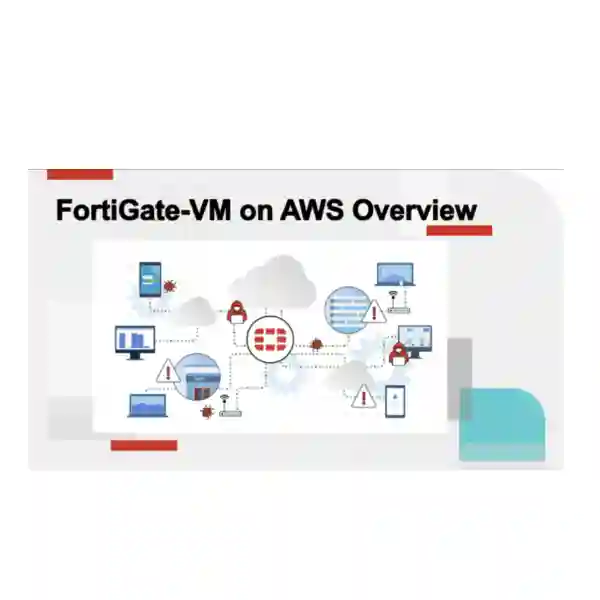
FortiGate VM64 AWS
FortiGate VM64 AWS brings Fortinet FortiOS next-generation firewall capabilities into Amazon Web Services so organizations can apply consistent network security, secure connectivity and visibility to AWS VPCs and hybrid-cloud traffic. Fortinet documents the FGT-VM64-AWS image for x86 AWS deployments and supports use cases that include NGFW enforcement, VPN gateways, cloud security hubs, workload protection and secure connectivity. The right deployment depends on the FortiOS release, licensing model, supported EC2 instance, interface requirements, traffic paths and security services that will actually be enabled.
Direct answer
FortiGate VM64 AWS is suitable when an organization wants FortiGate security controls inside AWS rather than relying only on a physical perimeter firewall. It can protect cloud workloads, inspect traffic, terminate VPN connectivity and participate in AWS-centric security architectures. EC2 sizing and licensing should be selected from current Fortinet support information rather than assumed from the VM64 name.
AWS-native deployment
Delivered as an AWS virtual firewall image and designed for security controls around VPC and hybrid-cloud traffic.
FortiOS security
Supports FortiOS firewall, VPN, application control, IPS, web filtering and other capabilities according to licensing and configuration.
Flexible licensing
AWS listings include consumption approaches such as on-demand and BYOL. Procurement should account for both Fortinet licensing and AWS infrastructure charges.
Hybrid connectivity
Useful for organizations connecting branches, data centers, remote users or multiple cloud networks to protected AWS workloads.
What FortiGate VM64 AWS solves
Moving applications to AWS changes the security perimeter. Traffic may move between internet-facing services, private subnets, branch networks, remote users, shared services and other VPCs. FortiGate-VM allows teams already familiar with FortiOS to extend network security policies into this cloud environment. Fortinet positions the AWS virtual firewall for next-generation firewall and VPN/SD-WAN use, with integration options for AWS networking services including Transit Gateway and Gateway Load Balancer. This makes it relevant to organizations that need inspection and policy enforcement at strategic traffic paths rather than only at an office edge.
A successful deployment starts with traffic-flow design. Buyers should define which networks need inspection, where routes will send traffic, whether public services require inbound protection, how branch and data-center tunnels terminate, how administration is restricted, and whether the design requires high availability. Security subscriptions should be chosen around the services actually needed. The virtual appliance is only one component: AWS routing, security groups, network ACLs, elastic network interfaces, IAM/API permissions where required, logging and operational monitoring all influence the result.
Verified capabilities and deployment considerations
| Area | What to plan | Buyer significance |
|---|---|---|
| NGFW | Firewall policy, IPS, application control, malware/web controls and inspection requirements | Enabled inspection changes resource and licensing needs. |
| AWS networking | VPCs, subnets, route tables, ENIs, Transit Gateway or Gateway Load Balancer architecture | Traffic must actually traverse the firewall to receive policy enforcement. |
| VPN | Site-to-site and remote-access requirements, peers, routes and authentication | Important for branch, data-center and remote-user connectivity. |
| High availability | Availability-zone design, interface requirements and failover method | Cloud resilience must be designed; a single VM remains a single firewall instance. |
| EC2 sizing | Current supported instance family, RAM, vCPU, NIC and workload requirements | Fortinet states supported/recommended instances can change and differ by licensing/listing. |
Sizing note: VM64 does not mean a fixed 64-vCPU appliance
FGT-VM64-AWS is an AWS image/model designation used by Fortinet for x86 FortiGate-VM deployments. Do not select compute merely from the number in the name. Fortinet publishes supported AWS instance families and minimum FortiGate license/order guidance, and those lists can change with FortiOS releases and AWS offerings. A quotation should therefore identify the target FortiOS branch, licensing model, expected throughput, inspected traffic, VPN load, number of interfaces, high-availability design and supported EC2 type.
FortiGate VM64 AWS Tanzania
For Tanzania-based organizations running workloads in Amazon Web Services, FortiGate VM64 AWS can provide a familiar Fortinet policy layer between cloud networks, internet-facing applications and private connectivity. A company may keep users, branches and some servers in Tanzania while hosting ERP, web applications, APIs, backup services or development environments in AWS. In that architecture, the security requirement is not simply “a cloud firewall”; it is a clear decision about which traffic must be inspected and how users and sites reach protected resources. FortiGate-VM can serve as a next-generation firewall or VPN gateway, helping extend FortiOS policy controls into AWS while preserving a consistent operating model for teams that already manage Fortinet equipment.
Tanzania procurement should start with the workload and connectivity map. Identify AWS Regions in use, VPC count, expected north-south and east-west traffic, public services, site-to-site VPNs, remote users, internet bandwidth at local offices and the security functions that will be enabled. This prevents an EC2 instance or license from being chosen on headline throughput alone. Intrusion prevention, application control, encrypted-traffic inspection and other security services can materially affect resource planning. If the organization expects growth, include additional branches, cloud workloads and higher internet capacity in the sizing discussion rather than treating the initial deployment as static.
FourTeck Tanzania’s broader IT, networking and cybersecurity portfolio is relevant because AWS firewall projects often depend on local LAN, WAN, VPN and identity decisions. Buyers requesting a quotation should provide current firewall details, approximate users/devices, WAN speeds, AWS architecture, required VPN peers, desired FortiGuard services and whether high availability is needed. This produces a more useful commercial and technical response than requesting “VM64 AWS price” without the deployment context.
FortiGate VM64 AWS Dar es Salaam
Dar es Salaam businesses frequently combine local offices, internet-connected branches and cloud applications, making hybrid connectivity an important part of an AWS firewall discussion. FortiGate VM64 AWS can be positioned at selected AWS traffic paths to enforce security policy for cloud-hosted applications and connectivity from local sites. For a head office using a physical FortiGate and workloads hosted in AWS, an IPsec design can connect the environments while keeping cloud-side controls close to the workloads. The exact routing model depends on whether the organization has one VPC, several VPCs, a Transit Gateway architecture or shared security services.
A Dar es Salaam deployment should be planned around business continuity as well as security. If cloud applications are critical, assess the local internet dependency, secondary connectivity strategy, DNS, VPN failover and the AWS firewall’s own availability design. Fortinet supports high-availability patterns for FortiGate-VM, but the architecture must account for AWS interfaces, routing and the selected deployment method. It is also useful to decide where logs will be collected and who will respond to security events. A firewall that is deployed but not monitored can become a configuration checkpoint rather than an effective security control.
For quotation preparation, Dar es Salaam customers can use the verified FourTeck Tanzania contact page and include the AWS account architecture, preferred licensing approach, current Fortinet estate, number of VPN tunnels, public applications, expected traffic and target deployment timeline. If the project includes office switching, Wi-Fi or other local infrastructure, include those dependencies so cloud and site security can be considered together rather than as unrelated purchases.
FortiGate VM64 AWS Mwanza
Organizations in Mwanza may use AWS to centralize business systems while local operations depend on reliable access over one or more internet links. FortiGate VM64 AWS can protect the cloud side of that design by applying FortiOS security policies to traffic reaching workloads or crossing between cloud networks. This is useful for branch-centric businesses where applications need to be available from several locations but security teams want a consistent policy framework. Rather than exposing cloud services broadly, the architecture can use controlled VPN connectivity, segmented VPC networks and narrowly defined access rules.
The key design question is what happens when connectivity changes. A Mwanza site may need backup WAN access, while AWS may require redundant firewall instances or another resilient pattern depending on the business impact of downtime. Route behavior should be documented so failover does not unintentionally bypass inspection. Administrators should also understand how AWS security groups and network ACLs complement FortiGate policy: these controls operate at different points, and good designs use them deliberately rather than duplicating rules without a clear purpose.
When requesting FortiGate VM64 AWS for Mwanza, provide expected user and device counts, critical cloud applications, traffic estimates, required VPN peers, existing Fortinet licenses and whether security inspection includes IPS, application control, web filtering or other FortiGuard services. Those details allow licensing and supported EC2 options to be assessed against the actual workload. Procurement should also distinguish Fortinet software/subscription costs from AWS compute, storage, data transfer and other infrastructure charges.
FortiGate VM64 AWS Arusha
Arusha organizations using cloud applications for hospitality, professional services, logistics, education or multi-site operations can use FortiGate VM64 AWS as part of a controlled AWS network-security architecture. The firewall can help protect workloads, terminate secure connectivity and provide application-aware policy enforcement. For companies with both cloud and on-premises systems, the benefit is operational consistency: FortiOS concepts used at the physical network edge can also be applied in the AWS environment, reducing the need to manage entirely separate firewall policy models.
Cloud firewall planning should begin before the instance is launched. Define subnets, route tables, trusted networks, public services, administrative access and logging. Decide whether the firewall protects inbound application traffic, outbound workload traffic, branch-to-cloud connectivity, inter-VPC traffic or several of these flows. That decision determines placement and interface requirements. Fortinet documentation also notes memory recommendations and supported EC2 instance constraints, especially when more advanced security services are enabled, so buyers should use current support matrices rather than a copied instance recommendation from an older deployment.
Arusha buyers should include business-critical application details and recovery expectations in a quotation request. If an application cannot tolerate a single firewall failure, state that high availability is required so the architecture and AWS costs can be evaluated correctly. If the requirement is primarily secure site-to-site connectivity, provide peer networks and expected throughput. Clear scope helps separate a straightforward virtual firewall deployment from a broader cloud-security project that may require centralized management, analytics or integration with other Fortinet Security Fabric components.
FortiGate VM64 AWS Dodoma
Dodoma enterprises and institutions considering AWS often need a security architecture that can support controlled access to cloud-hosted applications without making every service directly reachable from the internet. FortiGate VM64 AWS provides a FortiOS-based virtual firewall option for applying network security controls within AWS. It can be used in designs that combine VPN connectivity, workload segmentation and next-generation firewall inspection, with the exact features determined by the FortiOS release and licensing package selected.
For regulated or policy-driven environments, deployment documentation is as important as the virtual appliance itself. Record route tables, interface mappings, security policies, administrative roles, VPN parameters, software versions and backup procedures. Define a process for firmware upgrades and security-subscription renewals. AWS changes can also affect routing or interfaces, so cloud and security administrators should coordinate rather than treat FortiGate as an isolated device. Centralized logging can support troubleshooting and security review, but retention and access should be planned according to organizational requirements.
A Dodoma quotation should specify whether the organization wants BYOL or a marketplace consumption model, subject to current availability. BYOL can suit customers with an established Fortinet procurement model, while on-demand approaches can align with cloud consumption; the commercial comparison should include both Fortinet charges and AWS infrastructure costs. Provide expected traffic, required security services, VPN needs and resilience objectives so the design can be mapped to a currently supported AWS instance family.
FortiGate VM64 AWS UAE
UAE organizations often operate hybrid estates spanning offices, data centers and public cloud. FortiGate VM64 AWS can extend FortiOS policy controls into AWS while supporting secure connectivity between cloud networks and corporate locations. Where an organization already uses FortiGate appliances, a virtual FortiGate can simplify operational consistency for firewall objects, VPN concepts and security-policy administration. AWS integrations can also support centralized inspection patterns for larger environments.
The UAE requirement may involve several AWS accounts, multiple VPCs or shared services. In these environments, Transit Gateway and Gateway Load Balancer designs can be relevant, but architecture should be based on actual traffic paths and supported Fortinet guidance. High availability, scaling, logging and change control need to be considered from the start. Organizations should avoid assuming that a larger EC2 instance automatically delivers a proportionate security result; license entitlement, supported instance mapping and enabled inspection services all matter.
For regional Fortinet context, buyers can review the FourTeck Fortinet UAE specialist site. A useful VM64 AWS request should state AWS Region, architecture, expected throughput, number of protected networks, VPN requirements, security subscriptions and availability target. This makes it easier to distinguish a simple single-VPC deployment from a centralized cloud firewall architecture serving many application networks.
FortiGate VM64 AWS Uganda
Uganda businesses with AWS-hosted services can use FortiGate VM64 AWS to create a controlled security boundary for cloud workloads and hybrid connections. The virtual firewall can apply FortiOS policies to traffic moving between users, branches, the internet and protected VPC resources. This is particularly useful for organizations that want one security operating model across physical FortiGate appliances and AWS rather than a completely different firewall platform in each environment.
Planning should account for connectivity from Uganda to the chosen AWS Region, the role of local ISP links, and the consequences of a branch or cloud-path outage. VPN topology may be hub-and-spoke, direct site-to-site or part of a broader SD-WAN strategy. In AWS, routing must be explicit so protected flows pass through the firewall. Security groups remain useful for workload-level restrictions, while FortiGate can provide deeper network and application inspection where configured and licensed.
Organizations can also review FourTeck Uganda IT solutions when the cloud firewall is part of a broader branch or network project. For pricing and sizing, include the number of VPCs, estimated traffic, VPN tunnels, public applications, security profiles and HA requirement. This avoids treating the VM license as the entire project cost and helps identify AWS compute, networking and operational dependencies early.
FortiGate VM64 AWS Kampala
Kampala-based companies commonly centralize applications for branch users, remote teams and customers. If those applications run in AWS, FortiGate VM64 AWS can enforce firewall and threat-prevention policies close to the cloud workloads while also supporting VPN connectivity. The design can reduce broad exposure by limiting application access to defined networks, users and services, while retaining FortiOS visibility for security administrators.
A practical Kampala deployment should map business applications to network flows. Identify which services are public, which are private, which require branch access and which are administration-only. From there, build subnets and routes that make inspection predictable. If several VPCs share one firewall layer, consider how route propagation, asymmetric traffic and failure scenarios are handled. Logging should capture enough information for incident review without creating uncontrolled retention costs.
Licensing should be selected after architecture. BYOL and AWS Marketplace consumption can have different commercial implications, and AWS infrastructure charges remain separate. A request for FortiGate VM64 AWS Kampala should include expected growth, because adding branches, cloud applications or inspection services can change the required instance and license. Planning for expansion is usually more efficient than redesigning a cloud security hub immediately after deployment.
FortiGate VM64 AWS Arua
For organizations operating from Arua while consuming centralized AWS services, the cloud firewall can become a key control point even though it is not physically located at the branch. FortiGate VM64 AWS can protect AWS-side networks, while secure tunnels connect approved local networks to cloud applications. This model can be useful where applications need centralized hosting but local offices require controlled, authenticated access.
The branch connectivity design deserves particular attention. If the local WAN is interrupted, cloud access may be unavailable regardless of AWS firewall health. Businesses should therefore decide whether secondary connectivity is justified and how VPN routes change during failover. On the AWS side, resilience may require multiple firewall instances or another supported architecture. These are separate availability layers and should be documented independently.
Arua procurement requests should focus on outcomes: which applications must be reachable, from which networks, with what security inspection and what downtime tolerance. Include existing FortiGate models if branch devices will form tunnels to AWS. The cloud firewall license, EC2 compute, data transfer and any FortiGuard subscriptions should be considered together when estimating operating cost. Avoid choosing a VM order solely because it appears inexpensive without checking whether it maps to the required supported instance and inspection workload.
FortiGate VM64 AWS Mbarara
Mbarara organizations connecting to AWS can use FortiGate VM64 AWS for cloud-side security inspection, VPN termination and workload segmentation. A common design objective is to let branch users reach private AWS applications without exposing those applications directly to the public internet. FortiGate policies can restrict allowed networks and services, while AWS security groups add workload-specific controls. The combination should be intentionally designed rather than duplicated mechanically.
When applications are sensitive to latency or connectivity interruption, test the complete path from Mbarara to the AWS workload. Firewall processing is only one part of performance; ISP quality, VPN encryption, AWS Region choice, application design and route efficiency also matter. If SSL inspection or intensive threat-prevention profiles are enabled, resource requirements can increase. Current Fortinet support tables should therefore guide EC2 selection.
For a meaningful quotation, provide the existing network ranges, internet speeds, number of sites, VPN requirements, AWS VPC layout and security subscriptions needed. State whether the project is new or a migration from another firewall. Migration projects may require object conversion, policy cleanup, tunnel coordination and a cutover plan, while greenfield projects can establish a cleaner naming and segmentation model from the beginning.
FortiGate VM64 AWS Gulu
Gulu businesses using AWS for shared systems, backup, customer applications or centralized services can use FortiGate VM64 AWS to apply Fortinet security controls inside the cloud environment. The virtual firewall is especially relevant when cloud workloads must communicate with remote sites over controlled VPN paths or when public-facing services need an additional network-security layer.
The design should separate security requirements from connectivity assumptions. A VPN may encrypt traffic, but firewall policy still determines which networks and services are allowed. Likewise, a security group may restrict a workload, but a FortiGate can provide broader inspection and centralized policy visibility. Define responsibilities for each control so troubleshooting remains manageable. Route tables should be documented alongside firewall policies because a correct policy cannot inspect traffic that bypasses the appliance.
Gulu customers should also plan administration. Restrict management access, use appropriate authentication, back up configuration and establish an upgrade process. Fortinet publishes new FortiOS releases and AWS instance support evolves, so ongoing maintenance is part of the deployment lifecycle. A purchase request should therefore include not only the initial license but also subscription and support expectations, operational ownership and the intended service life of the environment.
FortiGate VM64 AWS Kenya
Kenyan organizations adopting AWS can use FortiGate VM64 AWS for next-generation firewall controls around VPC workloads, hybrid connectivity and centralized security services. Companies with offices in Kenya and operations across East Africa may particularly value consistent FortiOS policy across physical and virtual firewalls. This can simplify the way network teams describe objects, VPNs, application controls and security zones across locations.
For multi-country networks, avoid building separate one-off cloud tunnels without an addressing and routing plan. Overlapping private networks, inconsistent VLANs and undocumented routes can complicate cloud connectivity. Before deploying VM64 AWS, inventory site networks, define route ownership and decide whether AWS acts as a hub, application destination or shared-services platform. Transit Gateway can be relevant for larger topologies, while simpler environments may use direct VPC routing; the correct approach depends on scale and operational requirements.
Kenya buyers should compare licensing and AWS costs across the expected life of the deployment rather than only the first month. Include growth assumptions and required FortiGuard services. If the organization already has Fortinet support agreements, state that during procurement so entitlement options can be reviewed. The goal is a supported architecture whose security capacity and commercial model match the workload, not merely the lowest-cost virtual machine.
FortiGate VM64 AWS Kuwait
Kuwait businesses using AWS for production applications, disaster recovery or hybrid infrastructure can deploy FortiGate VM64 AWS as a cloud network-security control. The FortiOS platform supports firewalling, VPN and advanced inspection capabilities, allowing teams to apply familiar Fortinet security concepts to AWS traffic. This can be useful where cloud migration must preserve policy standards already used in on-premises networks.
Disaster-recovery projects require a different design from always-on production security. If VM64 AWS is part of a standby environment, licensing, automation, configuration synchronization and activation procedures should be documented. For active production, availability and monitoring requirements are usually higher. AWS infrastructure-as-code tools can help make deployments repeatable, but templates must still reflect supported Fortinet architecture and organization-specific network values.
A Kuwait quotation should identify whether the requirement is production, DR, test or a shared security hub. State the expected traffic and operating schedule, because commercial models may have different implications for continuously running versus variable workloads. Include the required security subscriptions and management components. This gives procurement teams a clearer view of recurring software, AWS compute and network costs rather than a single undifferentiated “firewall price.”
FortiGate VM64 AWS Ghana
Ghana organizations connecting offices and users to AWS can use FortiGate VM64 AWS to enforce security policy at the cloud layer. The firewall can support private connectivity patterns, workload protection and controlled internet access depending on placement. For companies expanding from a single office to multiple sites, the cloud environment can become a central application hub while FortiGate provides consistent security rules around that hub.
Sizing should be based on inspected traffic rather than only internet bandwidth. East-west traffic between VPCs or application tiers may also traverse the firewall in a centralized design. VPN encryption, IPS, application control and other features consume resources differently. Fortinet’s current AWS support information should therefore be checked for the chosen FortiOS version and licensing model. This is more reliable than reusing an old EC2 recommendation from another project.
Ghana procurement teams should request a bill of materials that separates Fortinet entitlement from AWS infrastructure. Include the number of protected VPCs, public IP requirements, HA design, logging destination and support expectations. If centralized management or analytics is required, mention it at the beginning because the architecture may include additional Fortinet components. Clear scope helps avoid discovering operational requirements after the firewall has already been deployed.
FortiGate VM64 AWS Nigeria
Nigeria enterprises with distributed branches, digital services and cloud-hosted applications can use FortiGate VM64 AWS as part of an AWS security architecture that scales beyond a single physical perimeter. The virtual FortiGate can inspect traffic at selected VPC paths, enforce segmentation and terminate secure connectivity. For organizations already standardized on Fortinet, this can reduce operational differences between branch and cloud firewall administration.
Large or fast-growing environments should consider architecture before license order. Multiple AWS accounts and VPCs can create complex routing, and centralized inspection may require Transit Gateway or Gateway Load Balancer patterns. High availability should be designed for the business service, not only the firewall VM. Consider what happens if an Availability Zone, route, tunnel or local ISP path fails. Monitoring should cover both FortiGate health and AWS network dependencies.
Nigeria buyers should provide projected traffic, branch count, AWS topology, inspection features and compliance/logging requirements when requesting a quotation. If the environment includes e-commerce, APIs or customer-facing systems, describe inbound traffic patterns and availability expectations. FortiGate is a network security control and should be integrated with application, identity and AWS-native controls rather than expected to replace every security layer.
FortiGate VM64 AWS Seychelles
Seychelles organizations using AWS for hospitality systems, business applications, websites or remote-access services can use FortiGate VM64 AWS to establish a controlled cloud security layer. Where local operations rely heavily on cloud connectivity, a well-designed VPN and firewall architecture can provide private access to AWS resources while limiting unnecessary exposure. The virtual appliance brings FortiOS controls into AWS without requiring physical firewall hardware in the cloud environment.
Connectivity resilience can be particularly important when cloud applications are central to daily operations. Evaluate local internet redundancy separately from AWS firewall high availability. Both may be needed, but they solve different failure modes. VPN tunnels should have clear route and failover behavior, and administrators should test recovery rather than assuming it will work. AWS security groups, FortiGate policies and application access controls should be documented so support teams know which layer is blocking or permitting a connection.
For Seychelles quotations, include the number of sites and users, AWS Region, application criticality, VPN requirements, expected bandwidth and FortiGuard services. State whether remote users also need secure access. If the project supports hotels or multi-property operations, identify whether each site needs independent tunnels or a standardized branch template. Repeatable configuration and documentation can make future property or office expansion easier to manage.
Licensing, subscriptions and AWS cost planning
FortiGate-VM on AWS is available through different commercial approaches, including Fortinet BYOL and AWS Marketplace consumption options. With BYOL, the Fortinet license is acquired separately and applied to the supported deployment. Marketplace models can meter software according to the listing terms. In either case, AWS infrastructure costs such as EC2, storage, data transfer, public addressing or related networking services can apply separately. Pricing changes over time, so this page does not publish an invented fixed price.
Security service bundles also matter. A base firewall requirement differs from a deployment that needs advanced threat prevention, web filtering, application control and continuous security updates. The correct subscription should be selected from current Fortinet offerings and matched to the intended security policy. Renewal planning is important because cloud infrastructure may continue running even if a security entitlement changes. Procurement teams should record license term, support level, AWS account ownership and renewal responsibility at handover.
Related FourTeck resources
Tanzania technology solutions
Use FourTeck Tanzania when the AWS firewall requirement connects to local networking, servers, Wi-Fi, branch infrastructure or broader cybersecurity planning.
Fortinet UAE specialist context
The FourTeck Fortinet UAE site provides regional Fortinet-focused context for organizations with operations spanning Tanzania and the UAE.
Uganda operations
For cross-border projects, FourTeck Uganda can be referenced when branch connectivity and IT infrastructure form part of the same East African cloud-security requirement.
Tanzania sales contact
Use the verified Tanzania contact page to submit VM64 AWS licensing, sizing, VPN, high-availability and deployment requirements.
FortiGate VM64 AWS quotation checklist
Cloud scope: AWS Region, account/VPC count, subnet plan, Transit Gateway or Gateway Load Balancer use, public applications and protected networks.
Traffic: expected normal and peak throughput, east-west traffic, internet traffic, encrypted traffic and projected growth.
Security: IPS, application control, antivirus, web filtering, SSL inspection, segmentation, logging and compliance requirements.
Connectivity: site-to-site VPN peers, remote users, branch networks, BGP/static routing and any SD-WAN requirements.
Resilience: single instance or HA, Availability Zone strategy, recovery expectations and maintenance windows.
Commercial: BYOL or marketplace preference, license term, support level, subscription bundle and AWS cost ownership.
Frequently asked questions
What is FGT-VM64-AWS?
FGT-VM64-AWS is Fortinet’s x86 FortiGate-VM image designation for AWS. Fortinet documentation references it for supported x86 EC2 instance families. It should not be interpreted as a fixed 64-vCPU hardware specification.
Can FortiGate VM64 AWS protect multiple VPCs?
Yes, FortiGate-VM can participate in centralized AWS security architectures, including designs using AWS Transit Gateway or Gateway Load Balancer. The routing and scale should be engineered for the specific environment.
Does FortiGate VM64 AWS support VPN?
FortiGate-VM on AWS supports VPN gateway use cases. Site-to-site and remote-access requirements should be matched to the FortiOS version, authentication method, topology and license.
Which EC2 instance should I use?
Use Fortinet’s current AWS instance-support documentation for the FortiOS version and licensing model. Fortinet states that supported and recommended instance types can change. Sizing should also consider RAM, vCPU, NIC requirements, throughput and enabled security inspection.
Is BYOL available?
Fortinet provides a BYOL FortiGate listing for AWS, and marketplace consumption listings are also available. Current terms and supported configurations should be confirmed at purchase time.
What should I send for a Tanzania quotation?
Send the AWS Region and VPC design, expected throughput, number of sites and VPNs, required security services, current Fortinet environment, availability target, licensing preference and deployment timeline. These details allow a more accurate supported configuration to be discussed.
Decision recap
Choose FortiGate VM64 AWS when the requirement is to bring FortiOS network-security controls into AWS for VPC protection, VPN, hybrid connectivity or centralized inspection. Do not select it from the VM64 name alone. Validate the current FortiOS release, supported AWS instance, license model, required interfaces and security-service workload.
For procurement, separate the Fortinet license/subscription from AWS infrastructure costs and provide enough architecture information for correct sizing. For operations, document routes, policies, VPNs, logging, backups, upgrades and high-availability behavior. This approach turns a virtual firewall purchase into a maintainable cloud-security deployment.
Plan your FortiGate VM64 AWS deployment with FourTeck Tanzania
Share your AWS architecture, protected workloads, VPN requirements, traffic expectations, FortiGuard services and availability target. FourTeck Tanzania can use that information to discuss a suitable procurement and deployment scope without assuming unsupported specifications, stock or fixed pricing.



Reviews
There are no reviews yet.