
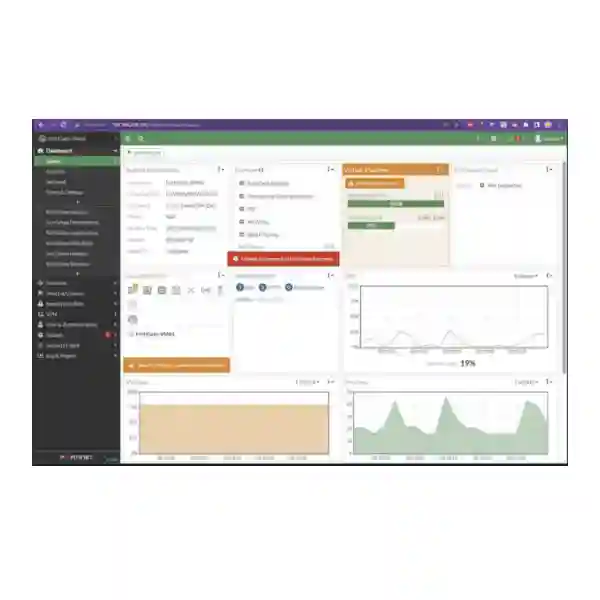
FortiGate VM64 VMware Tanzania
FortiGate VM64 VMware gives organizations a software-defined Fortinet security gateway for VMware virtual infrastructure. Fortinet documents FG-VM64 and FortiGate-VM64 deployment packages for VMware ESXi, enabling teams to place FortiOS security controls close to virtual workloads, data-center networks, application tiers and internet-facing services. It can operate as a next-generation firewall or VPN gateway and brings firewall policy, VPN, intrusion prevention, web filtering, antivirus and anti-malware functions into a virtual appliance that can be integrated into a broader Fortinet Security Fabric design.
For Tanzania buyers, the important procurement question is not simply whether a virtual firewall can be installed. The design should match the VMware release, expected traffic, security inspection profile, vCPU entitlement, interface topology, high-availability requirement, FortiGuard service needs and operational model. FourTeck can help turn those inputs into a quotation and deployment plan without assuming that one virtual sizing choice fits every environment.
VMware-ready security
Fortinet publishes FortiGate-VM deployment guidance for VMware ESXi and supports VMware-related virtual networking scenarios. This makes the platform relevant to private-cloud and virtual-data-center security projects.
FortiOS controls
Apply firewall rules, encrypted VPN connectivity, intrusion prevention, application-aware controls and licensed FortiGuard protections using the same FortiOS security platform used across FortiGate deployments.
Flexible virtual deployment
A virtual appliance can protect workloads without adding a physical appliance at every virtual boundary, helping architects align security placement with server clusters, network zones and application requirements.
What FortiGate VM64 VMware solves
Virtualized infrastructure changes where security boundaries exist. Applications may communicate between virtual machines on the same data-center platform, reach shared databases, publish services to external users, connect to remote branches or consume cloud services. A perimeter-only hardware firewall may not provide the placement flexibility required for every virtual security zone. FortiGate-VM provides a software firewall form factor that can be inserted into virtual network designs and managed as part of a Fortinet architecture.
Typical requirements include controlling north-south traffic entering or leaving a virtual environment, separating application tiers, creating secure VPN termination, protecting management networks, applying policy between trusted and less-trusted zones, and providing security inspection for virtual workloads. Fortinet also documents integration with VMware NSX-T for advanced security of east-west and north-south traffic in applicable designs. Exact compatibility should always be checked against the intended FortiOS, VMware and NSX versions before implementation.
| Planning area | Questions to confirm | Why it matters |
|---|---|---|
| VMware platform | ESXi/vSphere version, cluster design, virtual switches and NSX use | Determines the appropriate supported deployment package and integration approach. |
| Security workload | Bandwidth, sessions, VPN, IPS and other inspection needs | Security inspection demand should guide resource and license selection. |
| Availability | Single VM or high-availability architecture | Business-critical environments should avoid creating an unnecessary single point of failure. |
| Licensing | BYOL or applicable licensing model, vCPU entitlement and FortiGuard services | The quote should align security services and virtual resources with the intended deployment. |
FortiGate VM64 VMware features and deployment guidance
Fortinet positions FortiGate-VM as a virtual next-generation firewall with firewall, VPN, intrusion prevention, web filtering, antivirus and anti-malware protection. VMware ESXi deployment packages include OVF templates and virtual disks, while Fortinet documentation identifies VMXNET3-based templates for modern ESXi releases. The exact package varies with FortiOS release, so deployment teams should use the current Fortinet documentation and image intended for their supported environment rather than reusing an old template simply because it boots.
Virtual firewall sizing should be based on inspected traffic rather than raw link speed alone. Enabling IPS, application controls, web security, encrypted traffic inspection and VPN can change resource demand. The number of protected networks, route tables, policies, tunnels and concurrent connections also matters. A proof-of-concept or staged rollout can be useful for critical applications because it allows teams to validate routing, security policy, logging and performance before placing production traffic behind the new virtual firewall.
Fortinet documents FortiGate-VM licensing around virtual resources and offers multiple virtual-appliance models. Current product positioning includes FortiGate-VM options sized by vCPU as well as an unlimited-vCPU model. Because commercial bundles and licensing terms can change, procurement teams should request a current quote based on the required vCPU capacity, FortiGuard protection level, support term and deployment platform rather than relying on an old part number from a previous project.
Compatibility, integration and security architecture
FortiGate-VM can be used in private and public cloud designs and Fortinet lists VMware ESXi, vSphere and NSX-T among supported hypervisor or virtualization environments. In VMware projects, architects should map port groups, VLANs, routing, management access and protected application zones before deployment. This prevents a common design problem in which the virtual firewall is installed successfully but traffic paths bypass inspection because virtual switching and routing were not aligned with the security policy.
Where NSX-T integration is required, Fortinet describes controls for east-west and north-south traffic and integration that can support dynamic security operations. This is relevant to organizations building software-defined data centers, but compatibility is version-specific. Confirm the FortiOS and VMware support matrix for the planned release before procurement or upgrade. Teams using conventional vSphere networking can still deploy FortiGate-VM as a routed or policy enforcement point without assuming that NSX integration is mandatory.
Management architecture should also be decided early. A standalone deployment may be administered directly, while larger Fortinet estates may benefit from centralized management and analytics products. Logging destinations, retention, administrator roles, backup procedures, change control and recovery should be documented before go-live. These operational details often determine whether a virtual firewall remains manageable after the initial installation.
Related FourTeck security resources
Review the Tanzania technology portfolio and use it as the starting point for related infrastructure requirements.Fortinet specialist resources
Explore FourTeck Fortinet-focused information for firewall and security planning.FortiGate Kenya portfolio
Useful for regional teams comparing physical and virtual FortiGate directions.FortiGate Uganda options
Reference physical branch-firewall choices when a virtual appliance is not the appropriate form factor.
FortiGate VM64 VMware Tanzania
Organizations in Tanzania evaluating FortiGate VM64 VMware are commonly trying to secure a virtual server environment while retaining the operational flexibility of virtualization. The project may involve a private data center, a VMware cluster hosting business applications, a disaster-recovery environment, an internet-facing application stack or a hybrid design that connects virtual workloads to branch offices. In each case, the firewall should be selected from the traffic and security requirements rather than from a generic user-count estimate. Server traffic can be very different from office browsing traffic, especially where applications exchange large datasets, backups cross network zones or encrypted services require inspection.
A Tanzania procurement brief should state the VMware and ESXi versions, number of hosts, virtual network topology, internet bandwidth, internal traffic that must cross the firewall, expected VPN tunnels, public services, high-availability objective and required FortiGuard protections. It should also identify whether the FortiGate-VM will replace an existing physical firewall, supplement one, or create a new internal segmentation layer. This distinction changes routing, migration and rollback planning.
For regulated or business-critical workloads, buyers should include logging, administrator access, configuration backup and recovery in the project scope. Security effectiveness depends on ongoing operations as much as initial installation. A virtual firewall that is correctly placed but poorly monitored can still leave gaps. FourTeck can assist with quotation preparation and solution planning for Tanzania organizations seeking a Fortinet virtual firewall aligned with VMware infrastructure, while exact licensing, support and compatibility should be confirmed for the chosen FortiOS release.
FortiGate VM64 VMware Dar es Salaam
Dar es Salaam businesses often concentrate headquarters systems, private server infrastructure and internet-facing services in one operational environment. For a VMware estate, FortiGate VM64 can provide a virtual security boundary for application networks without requiring every protected zone to terminate on a separate physical appliance. This is useful when IT teams need to segment ERP, finance, web, database, management or customer-facing systems and want security policy to follow the virtual architecture.
Before requesting a quote in Dar es Salaam, document both internet traffic and internal east-west traffic. A data-center firewall may inspect far more than the organization’s public internet bandwidth. Database queries, application calls, backup flows, replication and administrative connections can all cross security zones. Teams should decide which flows genuinely require inspection and which can remain within a trusted segment. This keeps the design understandable and avoids allocating resources without a clear security objective.
Organizations moving from a physical perimeter firewall can use the project to review IP addressing, VLANs, default gateways and VPN termination. Migration can be staged so that a new virtual zone is protected first before more services are moved. High availability should be considered for applications where firewall downtime would interrupt business operations. Procurement teams should also request the appropriate FortiGuard and support terms rather than treating the base virtual license as the complete security solution. FourTeck can help Dar es Salaam buyers organize these technical inputs into a more accurate FortiGate-VM quotation and deployment scope.
FortiGate VM64 VMware Mwanza
Mwanza organizations using VMware may need virtual firewalling for a regional data room, centralized business applications, branch connectivity or a disaster-recovery environment. FortiGate VM64 VMware can be considered where security needs to sit inside the virtual infrastructure rather than only at a physical WAN edge. A virtual deployment can be particularly practical when server workloads are already consolidated and the organization wants to create controlled network zones around them.
The design should begin with application dependencies. Identify which servers initiate connections, which services must be published, which administrator networks need access and which branches connect through VPN. This application map can then be translated into firewall interfaces, routes and policies. Avoid creating broad allow rules simply to make migration easier; staged testing can reveal required flows while preserving a least-privilege approach. Logging should be enabled for important policies so troubleshooting and security review remain possible after cutover.
For Mwanza procurement, include growth expectations. Virtual infrastructure can expand quickly as new servers are added, so a firewall sized only for today’s traffic may constrain later projects. At the same time, oversizing without measurement can increase cost unnecessarily. Share current traffic observations, planned applications, VPN use and inspection features when requesting pricing. The final solution should also account for FortiOS maintenance, configuration backups and the VMware resources needed during host maintenance or failover. FourTeck can support solution selection and quotation preparation based on these inputs.
FortiGate VM64 VMware Arusha
Arusha businesses, hospitality groups, institutions and multi-site organizations may operate centralized applications on VMware while users connect from offices, remote sites or guest-facing environments. FortiGate VM64 VMware can provide a virtual security layer around those applications and can also serve VPN gateway requirements where the architecture calls for secure connectivity into the virtual data center. The value is the ability to deploy FortiOS security controls as software alongside virtual infrastructure.
A useful Arusha design separates business application security from general user internet security. Some organizations may keep a physical FortiGate at the branch or internet edge and deploy FortiGate-VM internally for server segmentation. Others may use the virtual appliance as the primary gateway when the network design and availability model support that choice. Neither approach should be selected automatically; routing, failure domains, hypervisor maintenance and recovery requirements should determine placement.
Buyers should ask how licensing relates to the required virtual resources and which FortiGuard services are needed for the intended controls. If IPS, web filtering, malware protection or other subscription-backed functions are part of the security objective, they should appear in the commercial scope. VMware version compatibility should also be confirmed before installation. FourTeck can help Arusha customers structure a bill of requirements covering FortiGate-VM licensing, security subscriptions, implementation objectives and integration considerations so the quotation reflects the actual environment.
FortiGate VM64 VMware Dodoma
Dodoma organizations planning virtualized government, education, enterprise or institutional applications may require security controls that can be deployed within a VMware environment. FortiGate VM64 VMware is relevant where virtual networks need controlled connectivity to users, branches, external services or other application zones. Fortinet’s virtual appliance approach allows firewall and VPN capabilities to be deployed without tying the security boundary to a dedicated physical chassis.
Project documentation should identify the sensitivity of each application zone and the permitted communications between them. Management networks deserve particular attention because hypervisor administration, backup systems and firewall management can become high-value paths. Use dedicated administrative access controls, restrict management exposure and plan authentication and logging according to organizational policy. The virtual firewall should be part of a layered architecture rather than the only security control protecting critical workloads.
For procurement in Dodoma, request a solution based on measurable requirements: VMware release, vCPU capacity, traffic profile, number of security zones, VPN demand, FortiGuard services, high availability and support term. If the environment is being modernized, include migration from existing routes and policies in the planning discussion. Testing and rollback should be defined before production cutover. FourTeck can assist with FortiGate VM64 VMware quotation preparation and technical scoping while final compatibility and subscription details are verified against the selected Fortinet release.
FortiGate VM64 VMware UAE
UAE enterprises commonly operate dense VMware environments, private clouds and hybrid infrastructure where virtual security appliances can complement physical data-center firewalls. FortiGate VM64 VMware can be used to enforce policy around virtual application zones, terminate VPN connectivity and support Fortinet security services inside a software-defined architecture. Fortinet also documents VMware NSX-T integration for designs that need advanced controls around east-west and north-south traffic.
UAE data-center projects should pay close attention to performance engineering. High-speed server networks can generate traffic volumes that exceed internet-edge assumptions, and encrypted application flows may require deeper inspection. Collect utilization data before choosing a virtual license tier. Consider CPU scheduling, host redundancy, virtual NIC design and how the firewall behaves during VMware maintenance. Where SR-IOV or other acceleration approaches are contemplated, verify the exact FortiOS, hardware and VMware support requirements rather than assuming portability between clusters.
Commercial planning should separate the virtual appliance entitlement, FortiGuard security subscriptions, FortiCare support and any centralized management or analytics requirements. Organizations with multiple FortiGate instances should also consider consistent policy and logging workflows. For regional Fortinet information, buyers can review FourTeck Fortinet UAE resources and FourTeck UAE. Final design should be validated against current Fortinet and VMware documentation before deployment.
FortiGate VM64 VMware Uganda
Uganda organizations consolidating servers onto VMware can use FortiGate VM64 as a virtual policy enforcement point for applications, data-center segments and VPN-connected networks. The virtual form factor is useful when the security boundary needs to move closer to workloads or when a physical appliance alone cannot conveniently segment internal virtual networks. It can coexist with branch FortiGate appliances, allowing a broader Fortinet architecture to protect both user locations and centralized services.
For Uganda projects, map branch-to-data-center traffic carefully. If branches use IPsec tunnels to reach applications hosted behind FortiGate-VM, the design should define tunnel termination, routing, failover and overlapping-address considerations. Application owners should identify required ports and dependencies so firewall policies can remain specific. Where remote administrators need access, management interfaces should not be exposed casually to public networks; use controlled administrative paths and appropriate authentication.
Procurement should include the VMware environment, intended vCPU allocation, security inspection features, support period and FortiGuard subscriptions. Organizations comparing a virtual data-center firewall with physical branch appliances can review the FortiGate Uganda branch option as a form-factor reference. FourTeck can help prepare a Uganda quotation that separates virtual firewall requirements from branch hardware needs and avoids buying one form factor for a problem better solved by the other.
FortiGate VM64 VMware Kampala
Kampala headquarters and data-center teams may run ERP, finance, collaboration, web and database workloads on VMware and need a security gateway that can be inserted directly into the virtual topology. FortiGate VM64 VMware provides that software-based FortiOS layer. It can protect application zones, control connections between network segments and provide VPN functions while remaining independent of a dedicated physical appliance for each virtual boundary.
Kampala buyers should distinguish server segmentation from office edge security. A physical FortiGate may still be appropriate for WAN termination and branch internet access, while FortiGate-VM handles internal server zones. This layered model can simplify policy ownership because infrastructure teams can define which traffic reaches virtual applications while branch policies remain focused on users and WAN connectivity. The exact topology depends on the existing routers, switches, VMware networking and redundancy design.
Before purchasing, inventory the ESXi hosts and software versions, identify the virtual networks that must connect to FortiGate-VM, estimate inspected throughput and decide whether high availability is required. Include centralized logging and configuration backup in the operational plan. A successful project should leave administrators with documented routes, policies, interface mappings and recovery steps, not just a running VM. FourTeck can help Kampala customers translate these requirements into a current Fortinet virtual-firewall quotation and deployment scope.
FortiGate VM64 VMware Arua
Arua organizations may use virtualization to reduce the number of physical servers required for business applications and local infrastructure. When those workloads need stronger separation, FortiGate VM64 VMware can introduce firewall policy within the virtual environment. This can be useful for organizations that operate application, database, management and user-facing services on the same VMware platform but do not want every network to communicate freely.
The deployment should remain proportionate to the environment. Smaller VMware estates may need only a few clearly defined security zones and VPN connections. Complex policy is not automatically better security; unnecessary rules can make troubleshooting and audits harder. Start with a network diagram, list application dependencies and define the security objective for each interface. Then build only the policies required for approved business flows and log important traffic for validation.
Arua procurement teams should also consider resilience. If the virtual firewall protects a critical application, ask what happens when its ESXi host is unavailable. VMware host redundancy and FortiGate high-availability design should be evaluated together rather than separately. Licensing and security subscriptions should be quoted for the intended production term. FourTeck can assist with requirements gathering, quotation preparation and planning so the FortiGate-VM design matches the actual VMware footprint and operational capability of the organization.
FortiGate VM64 VMware Mbarara
Mbarara businesses and institutions with centralized VMware servers can consider FortiGate VM64 when they need to protect applications, create secure network zones or provide controlled VPN access to virtual resources. The virtual appliance approach is particularly useful when adding a physical firewall between every internal server network would be operationally awkward. Security policy can instead be placed in the virtual network path, subject to correct routing and VMware configuration.
Planning should account for branch and remote-user access. If applications are consumed from multiple sites, the firewall may become a critical aggregation point. Document tunnel counts, remote networks, authentication requirements and application latency sensitivity. Security inspection should be enabled according to risk and capacity, with testing to ensure business applications continue to function. Where encrypted inspection is planned, certificate management and application compatibility deserve attention before broad enforcement.
For a Mbarara quotation, provide the FortiOS target, VMware platform version, vCPU requirement, security subscriptions, high-availability expectation and support term. Do not assume that the label VM64 itself specifies one fixed performance level; FortiGate-VM commercial models and resource entitlements determine capacity. FourTeck can help customers compare virtual firewall licensing with physical FortiGate alternatives and build a procurement scope that reflects server security, branch connectivity and future expansion.
FortiGate VM64 VMware Gulu
Gulu organizations deploying VMware for local applications, file services, institutional systems or regional operations can use FortiGate VM64 VMware to create a controlled security layer around virtual workloads. The platform can provide firewall and VPN capabilities and, with appropriate services, advanced threat protection functions. The design is most valuable when it solves a defined segmentation or connectivity requirement rather than simply duplicating an existing firewall without a clear traffic path.
A practical deployment process begins with discovery. Record existing VLANs, default gateways, application servers, DNS and directory dependencies, branch routes and administrator access. Determine which gateways will move to the FortiGate-VM and which will remain elsewhere. Build a test plan covering normal application use, failover, VPN connectivity, logging and rollback. This reduces disruption when production routes are changed and makes it easier to identify whether an issue comes from policy, routing or the application itself.
Gulu buyers should request licensing that matches expected resource allocation and required FortiGuard functions. Support should be considered part of lifecycle planning because FortiOS and VMware environments receive updates that can affect compatibility. Maintain configuration backups and review release notes before major upgrades. FourTeck can support Gulu customers with quotation and solution scoping for FortiGate VM64 VMware while ensuring the final bill of materials is based on current vendor licensing rather than assumptions from older deployments.
FortiGate VM64 VMware Kenya
Kenya enterprises with VMware private-cloud and virtual-data-center environments can deploy FortiGate-VM to protect server segments, internet-facing applications and VPN-connected networks. Fortinet’s virtual firewall portfolio is designed for virtual and cloud environments, allowing security capacity to be aligned with virtual resources. This is useful for organizations that want a Fortinet security layer within the data center while retaining physical FortiGate appliances at campuses, branches or WAN edges.
Sizing should consider internal server traffic as well as internet throughput. Nairobi or regional data centers may host applications for many branches, creating aggregate flows that differ substantially from a single office firewall. Measure peak traffic, concurrent connections, encrypted sessions and the security profiles that will be enabled. Where high availability is required, validate both FortiGate and VMware failure scenarios so host maintenance does not unexpectedly remove the security path.
Kenya buyers comparing deployment models can review the FourTeck FortiGate Kenya portfolio, which includes physical and virtual firewall directions. A quotation for VM64 VMware should state the intended vCPU resources, FortiGuard bundle, support term, VMware version and implementation scope. FourTeck can assist with requirements analysis so the selected virtual license and architecture match the applications and growth plan rather than relying on a generic firewall recommendation.
FortiGate VM64 VMware Kuwait
Kuwait organizations running VMware for enterprise applications and private-cloud services may use FortiGate VM64 to introduce FortiOS security controls directly into virtual network paths. Typical objectives include protecting application tiers, isolating management systems, securing published services and terminating encrypted connectivity from remote offices or users. Virtual deployment can reduce dependence on physical insertion points when workloads move between server hosts or when multiple internal zones need separate policy.
Data-center teams should coordinate firewall and virtualization changes. A FortiGate-VM upgrade, ESXi maintenance event, virtual-switch modification or route change can all affect application reachability. Change procedures should therefore include configuration backups, dependency checks and rollback. If high availability is required, test it under realistic conditions rather than assuming that VMware host redundancy alone provides firewall-state continuity.
Commercial requirements should specify virtual resource entitlement and security services. Organizations may need IPS, web filtering, malware protection, VPN and other FortiGuard-backed capabilities depending on their risk profile. Centralized management and analytics may also be appropriate for larger estates. Regional buyers can use FourTeck Kuwait for related technology discussions. The final FortiGate-VM package should be confirmed against current Fortinet documentation and the VMware environment selected for production.
FortiGate VM64 VMware Ghana
Ghana organizations virtualizing business systems on VMware can use FortiGate VM64 as a software firewall for server networks, application zones and VPN access. This approach can help when workloads are consolidated onto a small number of hosts but still require separation based on business function or sensitivity. The firewall can sit in the routed path between virtual networks and enforce FortiOS policies without requiring a separate physical appliance for each internal boundary.
Accra and regional IT teams should identify whether the primary requirement is perimeter security, internal segmentation, remote connectivity or a combination. This matters because interface layout, routing and security profiles differ by use case. A virtual firewall used for internal segmentation may see high east-west traffic even if internet bandwidth is modest. A VPN gateway may instead be driven by encrypted tunnel capacity and concurrent remote access. Collecting the right measurements makes licensing and resource planning more defensible.
Operational planning should cover FortiOS updates, VMware compatibility, backups, monitoring and administrator access. Fortinet’s virtual platform evolves, so release documentation should be checked before upgrades. Buyers can reference FourTeck Ghana for regional technology requirements. FourTeck can help build a FortiGate VM64 VMware quotation that reflects the intended security services, support term and virtual infrastructure instead of treating the product name as a complete technical specification.
FortiGate VM64 VMware Nigeria
Nigeria enterprises with large VMware estates, multi-branch networks and application-heavy data centers can use FortiGate VM64 as part of a layered virtual security architecture. FortiGate-VM can enforce policies around server zones and provide VPN or next-generation firewall functions while integrating with broader Fortinet operations. This can complement physical edge firewalls rather than replacing them automatically, allowing each form factor to be positioned where it is operationally strongest.
For high-traffic Lagos, Abuja or regional deployments, performance planning should include east-west application flows, replication, backup windows and encrypted traffic. A data-center virtual firewall can encounter bursts that are not visible in average WAN statistics. Use monitoring data to estimate peak demand and include expected security inspection. Where applications are latency sensitive, validate policies and inspection in a controlled test environment before production cutover.
Procurement should also consider scale of administration. Multiple virtual firewalls may justify centralized management, consistent templates and consolidated analytics. Define who owns firewall policy, VMware networking and application approvals so changes do not become fragmented across teams. Buyers can review FourTeck Nigeria for regional technology discussions. FourTeck can assist with current FortiGate-VM licensing, FortiGuard subscription and deployment scoping based on the actual VMware design.
FortiGate VM64 VMware Seychelles
Seychelles organizations may operate compact but business-critical VMware environments for hospitality, finance, government, professional services or centralized corporate applications. FortiGate VM64 VMware can provide a virtual firewall layer where applications need segmentation, secure internet exposure or VPN connectivity. A virtual appliance can be especially useful when physical data-center space is limited or when the organization already standardizes infrastructure around virtualization.
Resilience deserves careful attention in island environments where replacement hardware or specialist intervention may require planning. Virtualization can improve recovery flexibility, but the firewall remains a critical dependency. Maintain documented configuration backups, understand license recovery procedures, plan host redundancy and test how protected networks behave during maintenance. If a second site or disaster-recovery platform exists, define how firewall configuration and routing will be restored there.
A Seychelles quotation should include the VMware release, expected security zones, traffic levels, VPN needs, FortiGuard services, support term and availability design. Organizations should avoid purchasing solely from a model label without confirming the current Fortinet virtual licensing tier and supported software combination. FourTeck can help prepare a requirements-led FortiGate VM64 VMware solution so security, virtualization and business-continuity objectives are considered together before procurement.
Deployment checklist for FortiGate VM64 VMware
Before quotation
Record VMware/ESXi versions, host count, vCPU requirement, protected networks, peak traffic, VPN requirements, FortiGuard services, availability target and support term. Identify whether NSX-T integration is required or whether conventional virtual networking will be used.
Before deployment
Verify the Fortinet support matrix, download the correct FortiGate-VM package, prepare virtual networks, define management access, document routes and policies, plan logging, create a rollback method and schedule application testing.
After go-live
Monitor resource utilization, policy hits, blocked threats, VPN health and application performance. Back up configurations, review administrative access, keep FortiGuard services current and evaluate FortiOS upgrades against VMware compatibility before maintenance.
FortiGate VM64 VMware FAQs
What is FortiGate VM64 VMware?
FG-VM64 and FortiGate-VM64 naming appears in Fortinet documentation for FortiGate virtual-machine images and VMware deployment templates. It is a FortiOS virtual firewall deployment used to provide security functions in a VMware environment. Commercial sizing is determined by the applicable FortiGate-VM license model and allocated resources, so VM64 should not be interpreted as a single fixed hardware performance specification.
Does FortiGate-VM support VMware ESXi?
Yes. Fortinet publishes FortiGate-VM on VMware ESXi documentation and OVF deployment packages. Always verify the exact FortiOS release against the VMware version used in the production environment.
Can FortiGate VM64 protect traffic between virtual networks?
Yes, when virtual networking and routing are designed so the required traffic passes through FortiGate-VM. Fortinet also documents NSX-T integration for applicable east-west and north-south security designs. Traffic that bypasses the firewall cannot be controlled by its policies, so topology is critical.
Which license should I buy?
Choose licensing from the required virtual resources, inspected throughput, security services, support term and deployment model. Because Fortinet licensing and bundles can change, request a current quotation rather than relying on an old SKU.
Can it be deployed in high availability?
Fortinet positions FortiGate-VM with high-availability options. The architecture should consider both FortiGate HA behavior and VMware host or cluster failure scenarios so application traffic retains an intended security path.
Is FortiGuard required?
Base firewall and routing requirements differ from subscription-backed security services. If the project requires current threat intelligence and services such as web or advanced threat protection, include the appropriate FortiGuard bundle in the quote. Confirm exact entitlements for the selected package.
Quotation checklist
For an accurate FortiGate VM64 VMware quotation, provide your VMware ESXi/vSphere version, host and cluster design, required vCPU allocation, internet and internal traffic estimates, number of virtual security zones, VPN requirements, high-availability objective, FortiGuard services, desired support term, centralized management requirements and implementation scope. Include the current firewall or routing design if this is a migration.
This information helps distinguish a straightforward virtual firewall deployment from a larger data-center segmentation or NSX integration project and reduces the risk of quoting an unsuitable license or incomplete service bundle.
Decision recap and consultation
FortiGate VM64 VMware is appropriate to evaluate when your organization needs FortiOS firewall and VPN capabilities inside VMware infrastructure, wants to segment virtual workloads, protect application networks or build a virtualized security gateway. Selection should be based on supported VMware/FortiOS versions, virtual resource entitlement, real traffic, enabled security services and availability requirements. For small branch internet edges, a physical FortiGate may remain simpler; for virtual data-center boundaries, FortiGate-VM can provide more flexible placement.
Share your VMware architecture and security objectives with FourTeck before ordering. A requirements-led quote can identify the appropriate virtual license, FortiGuard subscription and deployment scope while avoiding unsupported assumptions about performance, compatibility or licensing.




Reviews
There are no reviews yet.