
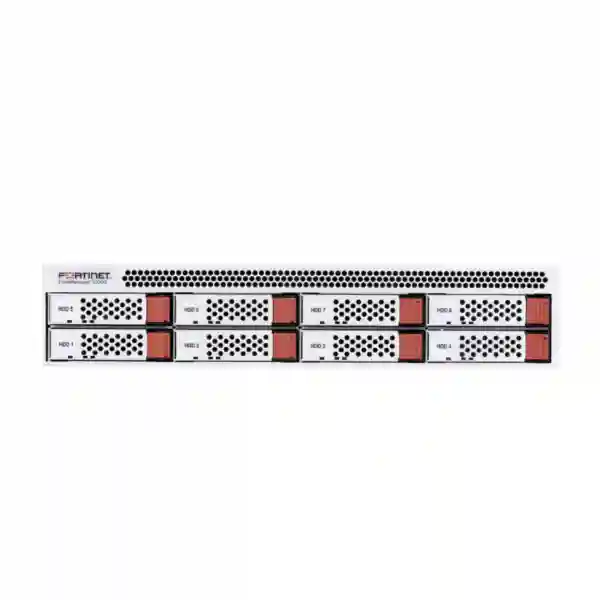
FortiManager FMG-1000G Tanzania
FortiManager FMG-1000G gives enterprises, service providers and distributed IT teams a dedicated Fortinet platform for centralized policy, configuration, provisioning and operational control. Fortinet lists the appliance with a default capacity of 1,000 Devices/VDOMs, 32 TB raw storage, 24 TB usable storage after RAID, two 2.5GBase-T RJ45 interfaces and two 25GbE SFP28 interfaces. For Tanzanian organizations operating many branches, administrative domains or security devices, the practical value is governance: administrators can work from a consistent management plane instead of maintaining every firewall or site as an isolated configuration.
What FortiManager FMG-1000G solves
As a Fortinet estate grows, operational complexity can grow faster than the number of devices. A small environment may tolerate direct administration of individual firewalls, but a multi-branch organization needs repeatable policy, controlled change, configuration history, standardized objects, administrative separation and a practical way to introduce new sites. FortiManager is designed for this centralized-management role. It can orchestrate FortiGate environments across physical, virtual and cloud form factors and supports broader FortiOS-based networking operations, including FortiSwitch, FortiAP and FortiExtender management scenarios. This matters when the security team wants a consistent operational model rather than a collection of independent devices.
The FMG-1000G is specifically positioned for substantial deployments. Its default 1,000 Devices/VDOMs capacity means sizing must count virtual domains as well as physical or virtual managed devices. A procurement team should therefore build a complete inventory before purchase. Count production firewalls, VDOMs, disaster-recovery devices, lab systems and expected growth. Do not size only to the present-day appliance count. A management platform should retain enough headroom for branch openings, acquisitions, segmentation projects and changes to the way VDOMs are used.
Central management also improves change discipline. Policy and object updates can be prepared within a controlled workflow, configuration revisions can be retained, and administrators can use templates and provisioning methods to reduce repetitive manual work. The benefit is not that every site becomes identical; rather, common standards can be applied consistently while site-specific parameters remain documented. This is particularly useful for organizations with headquarters, branches, data centers and remote facilities managed by one security operations team.
Verified FMG-1000G hardware snapshot
| Default Devices/VDOMs | 1,000 |
| Sustained log rate | 50 |
| GB/day | 2 |
| Storage | 32 TB (8 × 4 TB), 24 TB usable after RAID |
| RAID | 0/1, 1s/5, 5s/6, 6s/10/50/60; default RAID 50 |
| Interfaces | 2 × 2.5GBase-T RJ45 + 2 × 25GbE SFP28 |
| Form factor | 2RU rackmount |
| Power | 100–240V AC, 50–60 Hz; redundant hot-swap power supplies |
| Operating temperature | 0°C to 40°C |
These figures are based on current Fortinet documentation. Buyers should validate current ordering information, software compatibility, support entitlement, transceiver requirements and any lifecycle notices when the quotation is prepared.
Centralized policy, provisioning and operations
FortiManager is intended to make large Fortinet environments easier to govern. Central policy packages can help security teams define reusable controls while retaining the ability to handle local differences. Administrative domains can separate environments by business unit, customer, geography or operational responsibility. Revision control helps teams understand configuration history, while controlled installation workflows make it easier to review what is changing before a policy package reaches managed devices. In regulated or change-controlled organizations, this operational discipline can be as important as the hardware specification itself.
Zero-touch provisioning is another important use case for distributed environments. New branches can be prepared around standard templates and onboarding procedures, reducing the amount of device-by-device work required at remote sites. The organization still needs a carefully designed rollout process: device identity, WAN addressing, site-specific parameters, authentication, policy assignment and acceptance testing should be documented. Automation works best when the underlying standard is clear.
Fortinet also positions FortiManager as part of broader Security Fabric operations, with automation through APIs, scripts, connectors and automation stitches, and integrations with external operational tools. Buyers planning integrations should identify the exact workflow they want to automate before treating an integration logo as a project plan. Determine which system owns the change, what credentials are used, how failures are handled and what audit record is required. A controlled integration design prevents automation from becoming another source of untracked configuration change.
Deployment, rack and resilience planning
FMG-1000G is a 2RU rackmount appliance measuring approximately 8.8 × 43.8 × 62.0 cm and weighing about 22.5 kg. The rack plan should therefore confirm depth, rail clearance, airflow and service access before delivery. Fortinet specifies front-to-back forced airflow. Data-center teams should verify that the rack’s hot-aisle/cold-aisle orientation, cable management and adjacent equipment do not obstruct that airflow. The appliance’s redundant hot-swap power supplies should be connected according to the site’s resilience design, ideally avoiding a single upstream power dependency where the facility provides independent power paths.
Network connectivity deserves equal attention. Two 25GbE SFP28 interfaces provide high-speed options, while two 2.5GBase-T RJ45 interfaces support copper connectivity. The correct transceivers, fiber type, switch ports and link design should be identified in the bill of materials rather than assumed to be included. Management-plane availability should also be considered: if administrators depend on FortiManager during a network incident, the path to the appliance should not rely unnecessarily on the same component or circuit that is most likely to be affected.
High availability is an architectural decision, not simply a checkbox. Organizations that regard centralized management as operationally critical should discuss whether a single appliance meets their recovery objectives. Backup, configuration recovery, administrative access and change-control procedures should be documented regardless of topology. The quotation process should capture whether the buyer requires a single appliance, a resilient design, implementation services, migration from an existing FortiManager or a new deployment built from a clean policy model.
Related FourTeck Tanzania resources
A FortiManager project normally touches more than the management appliance. Review the FourTeck Tanzania technology shop when the project also needs firewall, switching, wireless or supporting infrastructure. The Tanzania services overview explains how network, security and infrastructure dependencies can be planned together. For secure wireless estates that may be governed alongside Fortinet infrastructure, compare the FortiAP FAP-221K and FortiAP FAP-231G. Multi-country procurement teams can also review the FourTeck Africa FMG-1000G resource for a broader regional procurement route.
FortiManager FMG-1000G Tanzania
For Tanzania organizations, FMG-1000G is most relevant when the network has moved beyond independent firewall administration. Banks, telecom environments, universities, government institutions, logistics groups, healthcare networks, hospitality operators, retailers, industrial companies and multi-site enterprises may have security policy spread across headquarters, branches, data centers and remote facilities. A centralized manager gives the security team a place to organize those devices and VDOMs into a governed operational model. The first Tanzania buying question should be capacity. Build an inventory of every managed Fortinet device and every VDOM, then add realistic growth. The official default capacity is 1,000 Devices/VDOMs, and each VDOM counts as a licensed network device. That detail matters for enterprises using segmentation extensively.
The second question is operational ownership. Identify who creates policy, who approves changes, who installs them, who can administer individual domains and who reviews failed deployments. A large management appliance delivers more value when these responsibilities are defined. Tanzanian organizations with teams split between head office and regional locations can use standardized templates and administrative domains to reduce variation while preserving site-specific parameters. Migration planning should include existing objects, policy packages, naming conventions, firmware practices and backup procedures. If the current estate has grown organically, the move to centralized management is an opportunity to document and rationalize configuration rather than simply importing years of inconsistency.
Infrastructure readiness is equally important. The 2RU chassis needs suitable rack depth, cooling and power. The 25GbE SFP28 interfaces require compatible upstream switching and optics if they are used. Procurement should therefore include a rack and connectivity review alongside the hardware quote. For organizations operating nationally, the management-plane design should also consider WAN resilience between sites and the central platform. A branch that temporarily loses reachability should have a clear operational procedure, and administrators should know which functions remain local and which depend on centralized access. FourTeck Tanzania can use the quotation stage to capture device count, VDOM count, current FortiManager status, rack environment, interface requirements, support term and implementation scope so the commercial response reflects the real project rather than hardware alone.
FortiManager FMG-1000G Dar es Salaam
Dar es Salaam enterprises often concentrate headquarters, data-center, financial, logistics and commercial operations in environments where network changes can affect many users and sites. An FMG-1000G project in the city should therefore begin with governance as much as hardware. Security teams can map policy ownership across internet edges, branch VPNs, SD-WAN, data-center firewalls and segmented internal networks, then determine which policies should be global and which must remain site-specific. Administrative domains can be useful when separate business units, subsidiaries or operational teams need controlled separation under one management platform.
For a Dar es Salaam data-center installation, confirm rack depth, 2RU space, front-to-back airflow, dual power feeds where available and the network interfaces that will carry management traffic. The appliance supports two 25GbE SFP28 and two 2.5GBase-T RJ45 interfaces, but the project bill should separately identify compatible optics, fiber and switch ports. A resilient design should also consider how administrators reach FortiManager if a primary WAN, core switch or firewall path is impaired. Management infrastructure is most valuable during change and incident response, so avoid unnecessary single points of dependency.
Organizations migrating from direct FortiGate administration should plan a staged transition. Start with a representative set of devices, validate object and policy behavior, document revision and approval workflows, then expand in controlled groups. For large branch estates, template-driven provisioning can reduce repetitive effort, but branch-specific addressing, circuits, VLANs and local services still need structured records. Procurement teams in Dar es Salaam should request a quote that distinguishes appliance supply, support entitlement, optics, implementation, migration, training and any high-availability requirement. This produces a clearer comparison than a unit-price request and helps technical teams identify dependencies before the appliance arrives.
FortiManager FMG-1000G Mwanza
Mwanza organizations with regional branches can use centralized Fortinet management to reduce the operational distance between a central IT team and remote sites. The practical challenge is often not the number of firewall features available but the consistency of configuration across locations. When branches are administered independently, objects, VPN settings, naming and security rules can diverge over time. FMG-1000G provides a platform for standard policy packages, configuration revisions and controlled deployment so a central team can establish a repeatable operating model.
Before procurement, Mwanza buyers should create a branch matrix. Record each FortiGate model, VDOM count, FortiOS version, WAN circuits, VPN relationships, local networks and business-critical applications. This inventory reveals whether the current environment is ready for consolidation and helps estimate the true Devices/VDOMs count. It also highlights sites that may need software alignment or cleanup before onboarding. For organizations expecting expansion around the Lake Zone, include future branches and disaster-recovery systems in capacity planning rather than sizing exactly to the current estate.
Remote operations also make change windows and rollback procedures important. A centrally installed policy can affect a distant branch, so administrators should define pre-change checks, connectivity validation and escalation paths. Where local technical resources are limited, zero-touch and template-based provisioning can simplify new-site rollout, but only when the standard configuration has been tested. The FMG-1000G hardware itself should be located in a controlled rack environment with suitable cooling and protected power. If the appliance is hosted outside Mwanza while managing Mwanza sites, WAN reachability and administrative access should be designed so management remains dependable. A useful quotation should state the number of managed sites, devices, VDOMs, migration status and required support scope, enabling the supplier to discuss a complete deployment rather than a standalone chassis.
FortiManager FMG-1000G Arusha
Arusha has a mix of hospitality, tourism, NGOs, education, healthcare, professional services and regional business operations, many of which may manage networks across several properties or offices. In these environments, centralized management can help separate policy standardization from local variation. A hotel group, for example, may want common security controls and administrative standards across properties while retaining different WAN details and local networks. An NGO may need consistent branch templates with tightly controlled administrator roles. FMG-1000G provides the scale for substantial Fortinet estates, but the project should begin by defining those operational boundaries.
Arusha procurement teams should pay particular attention to change governance when sites support guest-facing or operational services. A firewall change can affect reservations, cloud applications, payment services, staff access or inter-site connectivity. FortiManager workflows and revision history can support a more controlled process, but the organization still needs clear approval and testing procedures. Define which changes can be standardized, which require local review, and how urgent security changes are handled. If multiple business units share the platform, administrative domains and role separation should be designed before onboarding.
The physical appliance requires enterprise infrastructure. Confirm the 2RU rack location, front-to-back airflow, redundant power strategy and interface connectivity. If the design uses 25GbE, validate SFP28 optics and switch compatibility in advance. The project should also document backups and recovery expectations. Central management should not become a single undocumented dependency. For Arusha buyers, the quotation brief can include the managed-device inventory, VDOM count, site list, current management method, target rollout sequence and whether migration assistance is required. This information lets FourTeck frame the FMG-1000G discussion around the operating environment while current commercial availability and support terms are confirmed at the time of enquiry.
FortiManager FMG-1000G Dodoma
Dodoma institutions, public-sector environments, universities and distributed enterprises may require structured network governance where configuration changes must be documented and responsibilities clearly separated. FMG-1000G can support this operating model by centralizing policy and device administration for a large Fortinet estate. For procurement, the important starting point is an exact requirement statement rather than a generic request for a management appliance. Record how many devices and VDOMs must be managed, how many administrative groups need separation, whether there is an existing FortiManager deployment, and what growth is expected during the planned lifecycle.
Institutional environments often benefit from a formal onboarding and acceptance process. Each managed firewall can be associated with a site owner, configuration baseline, approved policy package and recovery procedure. Before a large migration, test a small set of representative devices and verify that routing, VPNs, objects and policy installation behave as expected. The central platform can improve consistency, but it should not be used to push broad changes without an agreed review process. Change windows, backup points and rollback criteria should be documented for critical services.
Data-center preparation in Dodoma should cover the FMG-1000G’s 2RU rack footprint, power, cooling and network links. The appliance weighs approximately 22.5 kg, so rack handling and rail installation should be planned safely. Redundant hot-swap power supplies support resilient power design when upstream power paths are available. If procurement documents specify 25GbE connectivity, include the required SFP28 components and confirm the receiving switch ports. Buyers should also separate support entitlement from the base hardware in commercial review so renewal responsibilities remain clear. A complete Dodoma quotation request should include technical scope, implementation responsibility, required documentation and administrator handover, helping the project move from purchase approval to a controlled operational deployment.
FortiManager FMG-1000G UAE
UAE enterprises operating regional hubs, data centers and multi-country branch networks may evaluate FMG-1000G as a centralized control platform for Fortinet infrastructure. The appliance’s 1,000 Devices/VDOMs default capacity is suitable for substantial estates, but capacity should be mapped to the organization’s actual segmentation model. A business with many VDOMs can consume management capacity faster than a simple physical-device count suggests. Regional organizations should therefore maintain one inventory that records both devices and virtual domains across all countries.
A UAE deployment may also serve as a management hub for sites in East Africa or other markets. If so, WAN design and operational latency should be considered alongside security. Administrators need reliable access to the central platform, and remote sites need predictable reachability for management workflows. Standardized templates can simplify multi-country rollouts, but IP addressing, local circuits, routing, regulatory requirements and site-specific services remain local variables. The management architecture should distinguish global standards from parameters that belong to each location.
Data-center teams should verify 2RU rack capacity, cooling direction, redundant power and interface design. The two 25GbE SFP28 ports can integrate with high-speed switching where required, while 2.5GBase-T copper interfaces provide additional connectivity options. Optics and cables should be specified explicitly. UAE buyers coordinating with Tanzania should keep commercial quotations market-specific rather than assuming identical stock, support or delivery conditions. A consolidated technical standard can still be valuable: use the same naming, policy hierarchy, administrator roles, change workflow and acceptance checklist across regions. This creates operational consistency without hiding regional differences. The procurement package should identify whether the project is new, a migration, an expansion or a resilience upgrade and should state the required support and implementation scope.
FortiManager FMG-1000G Uganda
Uganda organizations with headquarters and distributed branches can use FMG-1000G to bring Fortinet policy and configuration into one managed workflow. The strongest business case appears when the IT team is spending too much time repeating the same administrative work across firewalls or when configuration differences make troubleshooting difficult. A centralized platform can support common policy packages, configuration revisions and standardized provisioning while allowing site-specific values to remain distinct.
For a Uganda deployment, start with a national site inventory. Include Kampala, regional branches, data centers and disaster-recovery locations. Count VDOMs explicitly because they contribute to the Devices/VDOMs capacity. Record FortiOS versions and identify any devices that need compatibility review before onboarding. This inventory also helps the team group sites into logical deployment waves. A pilot can validate the policy model before a larger migration, reducing the risk of repeating a configuration issue across many branches.
Operational resilience is important for sites connected over different WAN services. Define how administrators will respond when a branch is temporarily unreachable, how local changes are controlled, and how configuration state is reconciled after connectivity returns. New branches can benefit from zero-touch and template-driven processes, but local addressing and circuit details still require accurate records. If FMG-1000G is installed in a central data center, plan the 2RU rack, power, cooling and upstream interfaces before delivery. Procurement teams should ask for separate clarity on appliance, support, optics, migration and implementation so the total project scope is visible. Organizations that operate in both Uganda and Tanzania can maintain a common Fortinet management standard while keeping each country’s commercial and site requirements distinct.
FortiManager FMG-1000G Kampala
Kampala is a natural location for centralized IT operations in organizations with branches across Uganda. FMG-1000G can support that model by providing one management environment for policy, device configuration and provisioning across a large Fortinet estate. Financial services, retail groups, education networks, healthcare providers, logistics companies and service organizations can use a central policy architecture to reduce configuration drift between headquarters and remote sites. The platform does not remove the need for network design; it makes a well-defined design easier to administer consistently.
A Kampala deployment should classify devices before migration. Group firewalls by function, software version, branch template and risk level. Identify special sites that cannot use the standard policy package without modification. This avoids forcing every branch into one configuration and makes exceptions visible. Administrative roles should also be mapped: central security teams, network teams, auditors and local support staff may need different permissions. Where multiple business units are involved, administrative domains can provide structured separation.
The data-center design should treat FortiManager as operational infrastructure. Provide appropriate rack space, airflow, protected power and management connectivity. If the appliance is connected through 25GbE SFP28, specify optics and upstream ports explicitly. If resilience requirements are strict, discuss architecture and recovery objectives rather than assuming redundant power alone covers all failure scenarios. During quotation, Kampala buyers should provide current device and VDOM counts, expected three-to-five-year growth, site numbers, existing FortiManager details if any, and the desired migration scope. That gives procurement and technical teams a shared baseline and reduces ambiguity around what is included in the project.
FortiManager FMG-1000G Arua
Arua branches can benefit from centralized management when technical administration is performed from another city or country. The value is operational consistency: local sites can follow a standard firewall policy and configuration framework without requiring every change to be recreated manually on the branch device. For organizations with many remote locations, this can reduce drift and make troubleshooting more predictable because administrators know how objects, policies and naming are intended to be structured.
The design should still respect branch realities. WAN services, IP addressing, local applications and maintenance windows may differ. A useful FortiManager template separates common security policy from local variables, allowing the organization to standardize what should be common while documenting what cannot be. For Arua, connectivity-loss procedures are especially worth defining. The central team should know how the branch behaves if the management connection is unavailable and what local access, if any, is permitted during an incident. Changes made outside the normal workflow should be reconciled and documented afterward.
FMG-1000G itself would normally sit in an appropriate central rack environment rather than at every branch. Arua procurement therefore often forms part of a wider multi-site project. Include Arua’s FortiGate model, VDOMs, WAN links, VPN relationships and critical applications in the national inventory. During rollout, test branch reachability, policy installation, VPN continuity and business applications before closing the change window. For new sites, template-driven provisioning can improve repeatability when circuit and addressing information is prepared in advance. A commercial request should state whether the organization needs only the central appliance or also branch onboarding, migration, documentation and training. That distinction makes the quotation more useful and helps the project team assign responsibilities clearly.
FortiManager FMG-1000G Mbarara
Mbarara organizations that are part of distributed retail, education, healthcare, financial or service networks may use centralized Fortinet management to create a consistent branch-security operating model. The main planning task is to define the standard. Before onboarding devices, document common address objects, security policy intent, VPN architecture, administrator roles, naming conventions and change procedures. FortiManager can then help apply that model repeatedly rather than becoming a repository for inconsistent legacy configurations.
For existing Mbarara sites, conduct a configuration review before migration. Identify rules that are unique for legitimate business reasons and rules that exist only because the branch evolved independently. Clean separation between global and local requirements makes future management easier. If the organization uses VDOMs, count each one in capacity planning. The FMG-1000G’s default 1,000 Devices/VDOMs capacity provides significant scale, but a fast-growing enterprise should reserve headroom rather than planning to the exact current count.
Branch rollout should use acceptance tests that reflect real business use. Confirm internet access, critical SaaS applications, site-to-site VPNs, DNS, authentication and any locally hosted services after policy installation. Keep a rollback point and record the final configuration state. If Mbarara sites depend on a central team in Kampala or outside Uganda, document escalation contacts and out-of-band options where appropriate. Procurement can be centralized while technical site records remain location-specific. A well-prepared quotation request includes the number of branches, device models, VDOMs, desired support term and whether implementation includes discovery, migration, policy rationalization or only hardware supply. This gives the buyer a clearer view of total project effort and prevents deployment services from being confused with the base appliance cost.
FortiManager FMG-1000G Gulu
Gulu branches in a larger Fortinet environment can be managed through a centralized policy framework that reduces the need for site-by-site administration. This is useful for organizations where local IT resources are limited or where the security team needs assurance that branch controls remain aligned with corporate standards. FortiManager can support repeatable configuration and policy workflows, but successful centralization depends on accurate branch information and disciplined change management.
Create a Gulu site record that includes firewall model, VDOMs, software version, WAN circuits, LAN and VLAN structure, VPN peers and critical services. This record becomes the source for onboarding and future troubleshooting. If the branch differs from the standard, document the reason rather than hiding the difference in an unexplained policy exception. During migration, schedule a window that allows validation of connectivity and business applications. Central administrators should be able to compare intended configuration with deployed state and understand the revision history if a problem appears.
For greenfield Gulu branches, standardized provisioning can make rollout cleaner. Prepare addressing, WAN credentials, device identity and site-specific values before shipment or installation, then apply the approved template through the management workflow. The FMG-1000G appliance itself requires central rack infrastructure with suitable power and cooling; remote sites primarily need reliable management connectivity and a clear support process. Procurement teams should avoid assuming that appliance purchase alone includes migration, training, optics or implementation. State these requirements separately. For organizations managing Gulu together with Tanzania locations, a common operational standard can reduce training overhead, while country-specific procurement, support and connectivity conditions remain documented independently.
FortiManager FMG-1000G Kenya
Kenyan enterprises with large branch estates can evaluate FMG-1000G for centralized policy, configuration and provisioning across Fortinet devices. Nairobi-based IT teams may manage sites across the country and neighboring East African markets, making consistency and delegation important. A single management architecture can define common security standards while administrative domains and templates help separate business units, regions or customer environments. The appliance’s default 1,000 Devices/VDOMs capacity should be assessed against the full regional inventory rather than Kenya devices alone if the platform will serve multiple countries.
Cross-border management introduces design questions beyond capacity. Determine where the appliance will be hosted, how remote devices reach it, which administrators need access and how changes are approved across time zones and local operating windows. Standard policy objects and naming conventions can reduce confusion, but local WAN addressing, service-provider details and business applications must remain site-specific. A regional rollout should therefore use a structured data sheet for each location and a common acceptance checklist.
Kenya procurement teams should also review rack and connectivity requirements early. FMG-1000G is a 2RU appliance with redundant hot-swap power supplies, 32 TB raw storage and high-speed SFP28 connectivity. Verify rack depth, airflow, dual power availability, optics and upstream switch ports. If migrating from an older FortiManager or direct firewall administration, define whether the project includes policy cleanup, device import, testing and administrator training. Buyers operating both Kenya and Tanzania can maintain one technical architecture while requesting separate commercial confirmation for each market. This keeps security operations consistent without assuming identical availability, pricing or delivery conditions. The resulting procurement package is more useful when it describes the managed environment and implementation outcome, not merely the appliance part number.
FortiManager FMG-1000G Kuwait
Kuwait organizations with data centers, branch networks or regional operations can use FMG-1000G to centralize Fortinet administration at enterprise scale. The platform is particularly relevant when policy consistency, administrator separation and repeatable branch deployment have become difficult to maintain through direct device management. Before selecting the appliance, build a device and VDOM inventory and estimate growth. The default 1,000 Devices/VDOMs capacity is substantial, but VDOM-heavy environments should model consumption carefully.
Data-center deployment in Kuwait should account for environmental and rack requirements. Fortinet specifies a 0°C to 40°C operating range and front-to-back airflow for the appliance. Rack planning should ensure cooling remains within specification and that the 2RU chassis can be serviced without obstructing adjacent equipment. Redundant hot-swap power supplies can support resilient power architecture where the facility provides separate feeds. Network planning should confirm whether 25GbE SFP28 links are required and, if so, specify compatible optics and fiber rather than treating them as implicit accessories.
Regional companies that manage Tanzania and Kuwait sites from one security team should create a common change-control model. Global policy can be standardized, while local site parameters and maintenance windows remain separate. Administrative roles should reflect responsibility rather than geography alone. Migration should be phased so representative devices are validated before broad deployment. Commercially, the quotation should distinguish base hardware, FortiCare/support term, accessories, implementation and any high-availability design. This makes lifecycle cost easier to understand and gives operations teams a clear handover. Current stock, price and delivery should be confirmed for the specific order rather than inferred from another region or an older quotation.
FortiManager FMG-1000G Ghana
Ghana enterprises with multiple FortiGate locations can consider FMG-1000G when centralized governance becomes necessary for consistent policy and configuration. Accra-based security teams may manage branch firewalls, remote offices, data-center environments and segmented VDOMs across the country. FortiManager can provide a common operating layer for these systems, helping teams organize policy packages, revisions, templates and administrative boundaries instead of relying on individual device sessions.
The planning process should begin with discovery. List managed devices, VDOMs, software versions, branch functions and VPN relationships. Identify where configurations have diverged and which differences are required by business needs. A central manager is most effective when the organization knows what it wants to standardize. For growing companies, include planned branches and additional segmentation in the capacity forecast. Do not consume the full 1,000 Devices/VDOMs design target on day one if expansion is expected.
Operational procedures should cover approvals, installation windows, backup points and rollback. A centrally pushed change can affect many sites, so the blast radius of a mistake can also be larger. Controlled workflows and pilot groups help reduce that risk. The physical appliance requires appropriate 2RU rack space, cooling and power, while high-speed connectivity may require SFP28 optics and compatible switching. Ghana buyers should request commercial clarification for hardware, support, accessories and implementation separately. If the project spans Ghana and Tanzania, technical standards can be shared across both markets while site inventories and commercial terms remain country-specific. This approach gives regional IT leadership a common management model without erasing local operational differences.
FortiManager FMG-1000G Nigeria
Nigeria’s large enterprise and service-provider environments can create significant management complexity when hundreds of security devices, VDOMs and branch policies are involved. FMG-1000G is designed for centralized Fortinet operations at this scale, with a default 1,000 Devices/VDOMs capacity and enterprise rack hardware. Organizations in finance, energy, telecom, retail, logistics, education and other distributed sectors can use a central platform to standardize policy workflows while delegating administration appropriately.
A Nigeria deployment should model both current size and organizational structure. Device count alone does not describe the management problem. Determine how many business units, security zones, customers or operational teams need separation; how many VDOMs exist; and how frequently policies change. Administrative domains and role-based operations can then be planned around real responsibilities. For multi-site migrations, group locations by similarity and risk. Test representative sites first, validate VPNs and critical applications, then expand in waves. This reduces the chance that one incorrect assumption is propagated nationwide.
Infrastructure resilience deserves deliberate design. The FMG-1000G provides redundant hot-swap power supplies, but the surrounding rack, UPS, power distribution, switching and management network determine end-to-end availability. Confirm cooling, rack depth and the required 25GbE or 2.5GbE connections. Organizations with geographically separated operations should also define recovery procedures and backup ownership. A procurement request should state whether the requirement is hardware supply, migration from an existing FortiManager, greenfield implementation, high availability or a broader Security Fabric management project. Regional groups operating in Nigeria and Tanzania can share policy architecture and administrator standards while maintaining separate country rollout plans and commercial confirmation.
FortiManager FMG-1000G Seychelles
Seychelles organizations in hospitality, financial services, government, professional services and multi-property operations may need centralized management when Fortinet security is distributed across islands, hotels, offices or facilities. The operational advantage is the ability to maintain a common security-management framework even when sites are physically separated. Policy packages, templates and configuration history can help a central team maintain consistency without requiring every site to be administered independently.
Remote-site realities make documentation especially important. Record each site’s FortiGate model, VDOMs, WAN links, local networks and critical services. If connectivity between islands or properties is interrupted, administrators should know how the branch continues to operate and how management changes are handled after connectivity returns. Standardized provisioning can simplify new properties or branches, but local addressing, circuits and operational services must be treated as explicit variables. A pilot rollout at one representative site can validate the model before broader adoption.
The FMG-1000G appliance should be installed in a suitable central facility with 2RU rack space, front-to-back airflow, protected power and the required network interfaces. Procurement planning should account for logistics and support expectations without assuming stock or delivery dates before quotation. If spare components, resilience or remote implementation assistance are important, include those requirements in the commercial request. For organizations that also operate in Tanzania, a shared Fortinet governance model can make training and policy control more consistent across countries. Keep commercial terms, deployment windows and site-specific dependencies separate so the common technical standard does not create unrealistic assumptions about local supply or infrastructure.
Selection and sizing guidance
Choose FMG-1000G because its management capacity and hardware profile match the estate, not simply because it is a higher model. Count devices and VDOMs, define ADOM requirements, review projected growth and decide whether a hardware appliance is preferable to other FortiManager deployment options. Compare the operational requirement with smaller and larger FortiManager models using current Fortinet documentation. A buyer with far fewer managed devices may not need this capacity, while an organization expecting to exceed the platform’s intended scale should evaluate a larger architecture rather than planning an early replacement.
Licensing and support should be reviewed with the current ordering guide. Fortinet lists support and optional FortiAI-related subscriptions for the FMG-1000G family. Exact entitlement, term and commercial part numbers can change, so the quotation should identify the required support level and subscription period explicitly. Renewal ownership should be documented at purchase time so the organization knows who tracks expiry and how future renewals are budgeted.
Migration effort can be as important as hardware. If an existing FortiManager is being replaced, document its software release, ADOMs, managed devices, policy packages, scripts, templates and integrations. If moving from direct device management, allow time to normalize objects and policies. The cleanest centralized-management deployment is one where the organization uses the migration to improve governance rather than simply relocating existing complexity.
FortiManager FMG-1000G quotation checklist
Estate details
Provide the number of Fortinet devices, total VDOMs, FortiOS versions, site count, current management method, expected growth and whether the platform will manage one country or multiple regions.
Infrastructure
State rack location, available RU space, rack depth, power feeds, cooling, upstream switches, desired interface speeds, optics requirements and any management-network resilience requirements.
Services
Clarify whether the requirement includes hardware only, support entitlement, migration, policy cleanup, configuration, high availability, integration, administrator training, documentation or post-deployment assistance.
Frequently asked questions
How many devices can FortiManager FMG-1000G manage?
Fortinet currently lists a default capacity of 1,000 Devices/VDOMs for FMG-1000G. Each VDOM counts as one licensed network device, so capacity planning should include VDOMs as well as physical and virtual appliances.
What storage does FMG-1000G include?
Fortinet lists 32 TB raw storage using eight 4 TB drives and 24 TB usable storage after RAID. The appliance supports multiple RAID levels and lists RAID 50 as the default.
Does FMG-1000G have redundant power?
Yes. Current Fortinet documentation lists redundant hot-swap power supplies for FMG-1000G. End-to-end resilience still depends on upstream power feeds, UPS/PDU design and the broader deployment architecture.
Can FortiManager help with branch rollout?
Yes. Fortinet positions FortiManager for centralized management, templates, automation and zero-touch provisioning workflows. A branch rollout should still define site-specific WAN, addressing, VLAN and application requirements before deployment.
What information should I provide for a Tanzania quote?
Provide current and projected device/VDOM counts, FortiOS versions, site locations, existing FortiManager details if any, required support term, rack and power environment, interface/optics requirements and whether migration or implementation services are needed.
Is FortiManager the same as FortiAnalyzer?
No. FortiManager is primarily a centralized management and orchestration platform, while FortiAnalyzer is focused on centralized logging, analytics and reporting. Some projects use both because their roles are complementary.
Decision recap and consultation
FMG-1000G is a serious centralized-management platform for Fortinet estates that need scale, consistent policy operations and disciplined administration. Its verified hardware profile includes 1,000 default Devices/VDOMs, 32 TB raw storage, 24 TB usable storage after RAID, 2RU rackmount construction, redundant hot-swap power and 25GbE SFP28 connectivity. The buying decision should be based on managed-device inventory, VDOM count, growth, administrative-domain structure, migration scope, resilience and support requirements.
For a useful consultation, send FourTeck the current Fortinet inventory, number of locations, desired management model and target deployment date. The sales and technical discussion can then focus on the correct commercial package and implementation dependencies without assuming stock, pricing, delivery or support conditions before they are confirmed.


Reviews
There are no reviews yet.