
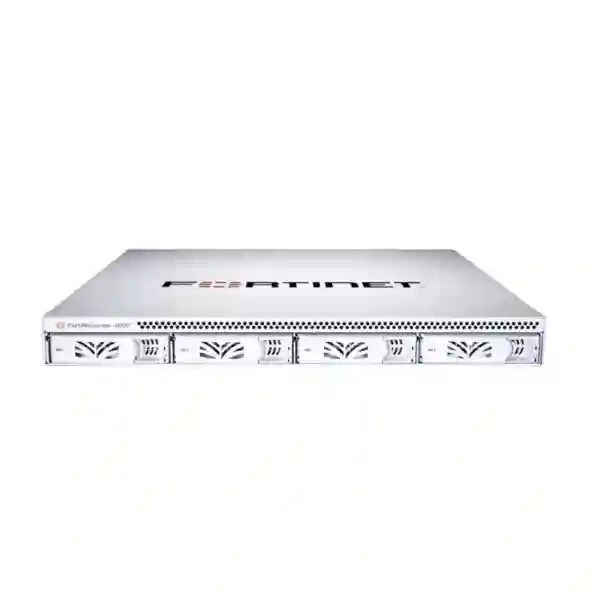
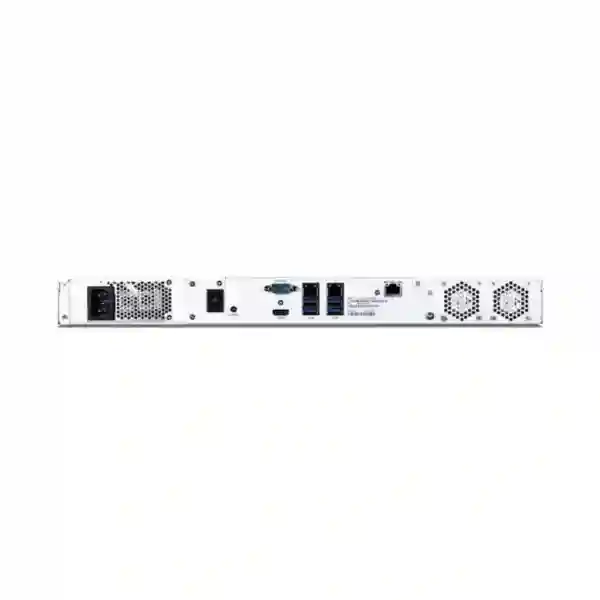
FortiRecorder 400F
FortiRecorder 400F is a rack-mount network video recorder for organizations that want centralized surveillance recording with Fortinet infrastructure. The appliance supports up to 64 cameras and combines local storage, RAID options, browser-based administration and integration with the wider Fortinet video-security environment. For businesses planning surveillance across offices, campuses, warehouses, hospitality properties, retail locations, institutions and controlled facilities, the 400F provides a practical on-premises recording platform with room to expand storage as retention requirements grow.
Maximum supported camera capacity, suitable for medium-sized surveillance deployments and consolidated recording projects.
Rack appliance format for structured installation in network rooms, equipment racks and security infrastructure cabinets.
One 4 TB drive is specified as standard, with support for up to four 8 TB drives for a maximum raw internal capacity of 32 TB.
RAID 0, 1, 5 and 10 options let project teams balance usable capacity, performance and storage resilience according to deployment goals.
FortiRecorder 400F Overview
Video surveillance projects are not only about selecting cameras. The recorder determines how streams are collected, stored, reviewed and managed, and it strongly affects retention planning. FortiRecorder 400F is positioned as an on-premises Fortinet recorder for deployments requiring up to 64 cameras. Its 1U form factor makes it appropriate for a rack-based security design, while its three 10/100/1000 copper RJ45 interfaces provide network connectivity for integration into the surveillance environment.
Storage planning starts with the included 4 TB drive. The platform can accommodate four drives of up to 8 TB each, giving a maximum raw internal disk capacity of 32 TB. Actual retention is not a fixed number of days because it depends on camera count, bitrate, resolution, frame rate, compression, recording schedule and motion activity. A project with a modest number of cameras may prioritize longer retention, while a 64-camera installation may need to balance image quality and retention carefully. For this reason, FourTeck recommends sizing the recorder around the surveillance policy rather than selecting storage from camera count alone.
Fortinet also supports RAID 0, RAID 1, RAID 5 and RAID 10 on the 400F. These modes provide different trade-offs, so the right configuration should be chosen after establishing the required usable capacity and resilience. The recorder fits naturally into organizations already standardizing on Fortinet security infrastructure, but camera compatibility, firmware level, network design and storage targets should still be validated for every project.
Key FortiRecorder 400F Features
Centralized recording
Consolidate recording for up to 64 supported cameras on one appliance, reducing the need to manage isolated recorders for each small camera group.
Scalable internal storage
Begin with the specified 4 TB drive and scale internal disk capacity as retention and recording requirements increase, up to four 8 TB drives.
RAID choices
Choose among RAID 0, 1, 5 and 10 according to the project’s capacity and resilience priorities rather than relying on a single fixed storage architecture.
Rack-ready appliance
The 1U chassis supports professional equipment-room deployments where surveillance recording is installed alongside switching, firewall and server infrastructure.
Fortinet ecosystem
FortiRecorder is part of Fortinet’s network-based video security portfolio and is designed to work with FortiCamera and Fortinet video-management capabilities.
Web-oriented management
The FortiRecorder platform provides a management interface for surveillance administration, monitoring and footage workflows without turning the recorder into an isolated black box.
Verified Hardware Specifications
| Camera capacity | Up to 64 cameras |
| Format | 1U appliance |
| Network interfaces | 3 × 10/100/1000 copper RJ45 |
| Storage | 1 × 4 TB; up to 4 × 8 TB maximum |
| RAID | 0 / 1 / 5 / 10 |
| Power | 100–240V AC, 50–60 Hz, 300W ATX PSU |
| Average power consumption | 50 W |
| Operating temperature | 0°C to 40°C |
| Dimensions | 44 × 440 × 420 mm |
| Weight | 7.4 kg |
Specifications should be rechecked against the applicable Fortinet datasheet and firmware documentation when preparing a final bill of materials, especially where storage accessories, camera models or support services are part of the project.
Storage and Retention Planning
The most important sizing question for an NVR is usually not simply “How many cameras can it connect?” but “How much video must it retain at the required quality?” Fortinet documentation uses a planning guideline that roughly one terabyte can store one camera consuming 1 Mbps for approximately 100 days. That is a useful starting point rather than a guarantee. Real retention varies with bitrate, codec behavior, motion, scene complexity, resolution, frame rate and whether recording is continuous or event driven.
For a Tanzania project, prepare a camera schedule before requesting a quotation. Record the camera quantity, target resolution, desired frames per second, expected bitrate, recording mode and required retention period. Then decide whether storage resilience is required. RAID can reduce usable capacity in exchange for redundancy, so the raw 32 TB maximum should never be treated as identical to usable recording capacity under every RAID configuration.
Bandwidth matters too. Fortinet sizing guidance lists laboratory-tested FRC-400F throughput figures that vary by video profile and workload. These are planning indicators rather than hard limits. A properly engineered design therefore considers switch capacity, uplinks, VLANs, recorder placement and remote viewing traffic together. FourTeck can use your camera and retention requirements to structure a clearer bill of materials before procurement.
Deployment and Integration Guidance
Place the FortiRecorder 400F in a controlled equipment environment with reliable power, suitable rack space and ventilation. The published operating range is 0°C to 40°C, so equipment-room cooling should be considered where ambient temperatures are high. A UPS can help protect the recorder and connected network infrastructure from abrupt outages, but UPS capacity and runtime must be sized for the complete surveillance stack rather than the recorder alone.
Network design should separate camera traffic logically where appropriate. Many organizations use dedicated surveillance VLANs, controlled routing and restricted administrative access. The exact design depends on switches, security policy and whether operators need remote access. Organizations already using Fortinet security infrastructure may also consider how surveillance networks fit into their broader segmentation and security policy. For related network-security planning, see FourTeck Tanzania technology solutions, and for broader Fortinet expertise across Africa review FourTeck Africa.
Before deployment, confirm the exact supported camera models and applicable FortiRecorder firmware release. Compatibility evolves as products and software releases change. This is especially important when integrating existing cameras rather than deploying a new, standardized camera estate.
FortiRecorder 400F Tanzania
Organizations searching for FortiRecorder 400F in Tanzania commonly need a recorder that can centralize video from a meaningful number of IP cameras without moving immediately to a large virtualized video-management architecture. With capacity for up to 64 cameras, the 400F fits projects such as headquarters, warehouses, educational campuses, healthcare facilities, hotels, industrial sites, multi-floor offices and larger retail environments. The key procurement step is to define the surveillance outcome before selecting disks. Camera count establishes an upper boundary, but retention policy, image quality and recording behavior determine storage consumption.
Tanzania deployments can face practical infrastructure considerations such as equipment-room temperature, power quality, network distances and the need to manage cameras across buildings. The 1U appliance format supports installation in a structured rack, while its three Gigabit Ethernet interfaces provide connectivity options for the surveillance network. A well-planned installation should document camera IP addressing, VLAN design, operator access, backup power, storage configuration and the process for exporting footage when an incident requires investigation.
For quotation preparation, provide the number of cameras, camera models if already selected, target retention in days, preferred recording quality and whether the recorder will serve one site or receive streams across routed links. Existing-camera projects should include model numbers so compatibility can be checked against the relevant Fortinet documentation. New projects can be planned as an integrated camera, switching, recorder and security solution.
FourTeck can assist with requirements gathering and procurement planning without assuming that every 64-camera deployment should use the same storage configuration. This matters because a high-resolution, continuous-recording environment can consume storage very differently from a motion-triggered deployment. Request a project-specific quotation rather than treating disk capacity as a generic bundle.
FortiRecorder 400F Dar es Salaam
For businesses evaluating FortiRecorder 400F in Dar es Salaam, surveillance design often centers on busy commercial properties, logistics operations, offices, hospitality sites, retail facilities and institutional campuses. These environments may have many simultaneous camera streams and multiple operators who need reliable access to live and recorded footage. The 400F’s support for up to 64 cameras makes it suitable for consolidating a medium-sized camera estate into a rack-mounted recording platform rather than maintaining separate small recorders around a facility.
A Dar es Salaam deployment should pay close attention to the physical equipment environment. The recorder’s published operating temperature reaches 40°C, but the surrounding rack may also contain PoE switches, firewalls, UPS equipment and servers that generate heat. Proper ventilation and equipment-room cooling therefore contribute to overall system reliability. Power planning should include the recorder, camera PoE load, switches and network equipment so surveillance does not lose recording capability because only one part of the system was protected.
Storage should be quoted from retention requirements. Security teams may need different retention periods for entrances, loading areas, public zones and sensitive operational areas. Rather than assuming every stream needs identical settings, the project can classify cameras by purpose and assign appropriate profiles. RAID selection should then reflect whether the organization values maximum usable capacity or disk-failure resilience more strongly.
When requesting a Dar es Salaam quotation, include a site summary, camera count, expected bitrate or resolution, retention target and any existing Fortinet components. This creates a more useful procurement discussion and reduces the risk of buying a recorder that meets channel count but misses the desired retention objective.
FortiRecorder 400F Mwanza
FortiRecorder 400F projects in Mwanza can serve businesses that want centralized video recording for offices, warehouses, hospitality sites, institutions, commercial properties and operational facilities. The 64-camera ceiling provides useful headroom for sites that begin with fewer cameras but expect surveillance coverage to expand. Capacity planning should still be based on the final expected design, because adding cameras later changes both storage consumption and aggregate video bandwidth.
For sites with cameras distributed across buildings, the network path to the recorder deserves as much attention as disk size. Video streams are continuous network workloads. Switching capacity, uplink design, VLANs and cable infrastructure should be checked before installation. Where remote buildings connect over routed or wireless links, project teams should account for link reliability and bandwidth. Recording critical cameras across a constrained connection without calculating stream demand can produce a design that looks adequate on a device list but performs poorly in practice.
The 400F’s expandable storage allows a project to align disks with retention policy. RAID 1, 5 or 10 may be considered where disk resilience is important, while RAID 0 prioritizes usable capacity without the same redundancy. The correct choice is a business decision informed by surveillance criticality, retention needs and recovery expectations. It should be documented during design rather than left as an installation-time assumption.
Mwanza buyers can prepare for quotation by listing each camera location and purpose, desired recording schedule, number of days of footage required and who needs viewing access. If cameras already exist, provide their exact models and current network arrangement so compatibility and migration considerations can be reviewed before procurement.
FortiRecorder 400F Arusha
Organizations seeking FortiRecorder 400F in Arusha may be planning surveillance for hospitality, tourism-related facilities, offices, campuses, warehouses, retail premises or institutional environments. A centralized recorder is valuable when security teams need a consistent place to review footage rather than working with isolated recording devices. The 400F supports up to 64 cameras and provides an expandable internal storage platform in a 1U rack appliance.
Hospitality and multi-building environments should identify which cameras are operationally critical. Entrances, perimeter areas, reception points, vehicle zones and service areas can have different recording priorities. These priorities affect resolution, frame rate and retention. A camera pointed at a high-motion entrance may consume storage differently from a low-motion corridor even when both use the same nominal resolution. This is why retention estimates should be treated as calculated planning values and then validated after commissioning.
Rack location is another design factor. Keep the recorder in a secure, ventilated area with controlled administrative access. Surveillance systems contain sensitive operational data, so management interfaces should not be exposed casually to user networks. Segmentation, strong administrative controls and documented operator roles help turn the NVR into part of a managed security architecture rather than simply a storage box.
For Arusha procurement, submit the intended camera count, storage-retention target, site topology and any requirement for centralized viewing. FourTeck can use those inputs to frame the recorder, disk configuration and related network components more accurately. If the project will grow, include the expected future camera count rather than only the initial phase.
FortiRecorder 400F Dodoma
FortiRecorder 400F in Dodoma is relevant to organizations designing structured surveillance for administrative facilities, educational environments, commercial premises, institutions and multi-building operations. Its support for up to 64 cameras makes it a candidate for projects that need more capacity than a small-office recorder while still preferring a dedicated on-premises appliance. The rack format also suits organizations with established network rooms and structured IT operations.
Procurement teams should separate three requirements: camera capacity, recording bandwidth and retention. The 64-camera figure answers only the first question. Recording quality and bitrate influence the second, while storage size and recording behavior determine the third. A robust specification documents all three so suppliers are quoting against the same requirement. This is particularly useful in formal procurement where ambiguous phrases such as “one month recording” can produce inconsistent proposals unless camera quality and recording assumptions are also stated.
For resilience, FortiRecorder 400F supports several RAID levels. The selected RAID mode changes usable disk capacity and fault tolerance, so project documentation should state whether redundancy is required. The recorder should also be protected by suitable backup power and installed in an environment that remains within Fortinet’s operating specifications.
Dodoma buyers can improve quotation accuracy by providing a simple camera matrix: location, camera model, resolution, bitrate if known, recording schedule and retention target. Add the network topology and any remote-site links. These details help distinguish a straightforward local recording deployment from a project that needs additional switching, segmentation or bandwidth planning.
FortiRecorder 400F UAE
For UAE projects, FortiRecorder 400F provides a dedicated Fortinet NVR option for organizations requiring up to 64 camera channels. Commercial towers, warehouses, retail operations, offices, hospitality sites and controlled facilities can use a centralized recorder to bring surveillance storage and management into a structured equipment environment. The appliance’s 1U format is convenient for rack-based deployments where networking and security equipment are already centralized.
Storage and retention should be engineered against the organization’s policy and any applicable project requirements. The 400F starts with a 4 TB drive and can scale to four 8 TB drives. Because RAID configuration affects usable capacity, buyers should specify whether redundancy is required before finalizing disks. High-resolution cameras and continuous recording can consume capacity quickly, while event-driven recording may extend retention depending on scene activity.
UAE installations should also consider rack cooling, power continuity and network segmentation. Cameras are network endpoints and should be deployed with the same discipline applied to other infrastructure: controlled addressing, secure administration and defined access paths. Existing camera estates should be checked for compatibility rather than assuming universal interoperability.
For UAE procurement and related Fortinet requirements, organizations can also review FourTeck Fortinet UAE solutions. A quotation request should state camera quantity, retention days, recording quality, disk-resilience expectations and whether installation is new or a migration from an existing recorder.
FortiRecorder 400F Uganda
FortiRecorder 400F in Uganda can support organizations consolidating surveillance for business premises, institutions, warehouses, campuses, hospitality facilities and distributed operations. With up to 64 cameras, the appliance provides room for a substantial single-site deployment or a carefully designed environment where camera streams reach the recorder over a managed network. The correct architecture depends on bandwidth and reliability between cameras and the recording appliance.
Uganda buyers should begin with retention requirements rather than a generic hard-drive bundle. The 400F supports up to four 8 TB drives and multiple RAID modes. If footage is operationally critical, the storage design should consider disk resilience. If maximizing retention is the main goal, the trade-offs of each RAID option should be reviewed. These choices affect usable capacity and should be made before the quotation is finalized.
For projects spanning more than one building, verify the switching and uplink design. Video streams can create sustained traffic, and remote viewing adds additional network demand. Keep camera networks segmented where appropriate and restrict administrative access to authorized users. Backup power should protect the recorder and the network path that cameras depend on; protecting the NVR alone does not maintain recording if upstream PoE switches lose power.
Organizations planning Uganda projects can also visit FourTeck Uganda for regional technology context. Provide camera models, quantity, retention, site topology and growth expectations when requesting a FortiRecorder 400F proposal.
FortiRecorder 400F Kampala
Kampala organizations evaluating FortiRecorder 400F often need centralized recording for offices, commercial buildings, warehouses, schools, hotels or retail environments. The platform’s 64-camera capacity gives security teams a single recording tier for a medium-sized IP camera deployment. Centralization can simplify operational workflows, but it also makes the recorder and its network path important infrastructure that should be installed securely and supported by appropriate power protection.
Dense commercial sites may have cameras with very different workloads. Busy entrances and parking zones can generate sustained scene changes, while internal corridors may be quieter. Variable bitrate video can therefore produce retention that differs from simple estimates. During commissioning, administrators should compare actual storage consumption with the planned retention target and adjust video profiles only where security requirements permit.
Kampala projects should define who needs access to live view, playback and exported evidence. Administrative credentials and operator privileges should be controlled, and management access should be placed behind appropriate network security. If cameras already exist, exact models and firmware should be checked against Fortinet compatibility information before assuming they can be retained.
For a useful quotation, document the current and future camera count, desired days of retention, recording mode, rack environment and network topology. This lets the project team evaluate whether the base disk is sufficient or whether expanded storage and RAID should be included from the beginning.
FortiRecorder 400F Arua
FortiRecorder 400F in Arua can be considered for organizations that need structured IP video recording at business sites, institutions, warehouses or operational compounds. The dedicated 1U recorder supports up to 64 cameras, allowing a project to centralize recording while retaining an appliance-based architecture. For locations where technical visits may require planning, a clear design and documented configuration are especially valuable for ongoing administration.
Power continuity should be considered across the complete surveillance chain. A recorder connected to a UPS cannot capture video if cameras or PoE switches lose power. Project teams should identify critical cameras and determine how long those devices, the switching infrastructure and the NVR need to remain operational during interruptions. Equipment-room temperature and ventilation should also be checked against the recorder’s published environmental range.
Storage planning should use camera bitrate and retention rather than channel count alone. The 400F can expand to four 8 TB drives, but RAID configuration changes usable capacity. Organizations should state whether the priority is longer retention, disk resilience or a balance of both. That decision can then be reflected in the bill of materials.
Arua quotation requests should include the number of cameras, their locations, target recording quality, required retention, existing network equipment and whether remote viewing is needed. This information helps identify bandwidth, switching and storage requirements early and makes later installation more predictable.
FortiRecorder 400F Mbarara
Businesses and institutions considering FortiRecorder 400F in Mbarara can use the appliance as the recording core for an IP surveillance design of up to 64 cameras. Typical planning scenarios include campuses, offices, hospitality properties, warehouses, retail sites and operational facilities where footage needs to be available from a centralized system. The recorder’s expandable disk architecture helps align storage with the organization’s retention policy.
Before purchasing, identify how many days of video are genuinely required and whether all cameras need identical settings. High-priority zones may need higher quality or longer retention, while other views may be configured differently according to policy. This approach can make storage allocation more purposeful. Actual results should be reviewed after deployment because motion and scene complexity influence bitrate and therefore retention.
The network should be treated as part of the surveillance solution. Sustained camera traffic needs adequate switch capacity and stable uplinks. Camera and recorder management interfaces should be protected from unnecessary access, and administrative roles should be documented. If footage will be viewed remotely, account for that traffic and secure the access path appropriately.
For Mbarara procurement, a camera schedule and basic topology diagram can substantially improve quotation quality. Include existing cameras and switches if this is an upgrade, plus future expansion expectations. That information helps determine whether the FortiRecorder 400F is being sized for today’s requirement or for the intended operational life of the surveillance system.
FortiRecorder 400F Gulu
FortiRecorder 400F in Gulu is suited to buyers seeking a dedicated network video recorder for a structured IP camera deployment. Its capacity of up to 64 cameras can cover many medium-sized business and institutional projects while keeping recording on an on-premises appliance. The rack format is appropriate where the organization has a secure communications room and wants surveillance infrastructure installed alongside managed network equipment.
A practical design should establish recording priorities before choosing storage. The included 4 TB disk provides a starting configuration, while expansion to four 8 TB drives supports larger retention requirements. RAID 0, 1, 5 and 10 are available, but each creates different capacity and resilience characteristics. Project stakeholders should agree on the required fault tolerance rather than treating RAID as a purely technical afterthought.
Gulu deployments may also need careful power and environmental planning. The recorder’s published operating temperature is up to 40°C, and a populated rack can run warmer than the surrounding room. Ventilation and cooling should therefore be assessed. Backup power should include network devices and camera power sources that are essential for recording continuity.
When requesting a proposal, list the camera count, retention objective, desired recording quality, current network equipment and remote-access requirements. For existing surveillance estates, provide camera model numbers. This allows compatibility checks and reduces the risk of assuming that every third-party camera feature will work identically.
FortiRecorder 400F Kenya
FortiRecorder 400F in Kenya provides an appliance-based option for organizations standardizing IP video recording around Fortinet. It can support up to 64 cameras and offers internal storage expansion to 32 TB raw capacity. Offices, logistics facilities, hospitality environments, campuses, commercial buildings and industrial sites can evaluate it where centralized on-premises recording aligns with operational and security requirements.
Kenya projects should distinguish camera-channel capacity from retention capacity. Sixty-four cameras can represent very different workloads depending on resolution, frame rate and bitrate. A system recording lower-bitrate streams on motion can retain footage much longer than one recording high-quality continuous streams. The right approach is to build a camera matrix and calculate expected storage, then select disks and RAID accordingly.
Network topology is equally important. Where cameras are spread across a large property, ensure uplinks can carry the aggregate stream traffic and that camera networks are segmented appropriately. If remote users require playback, consider the additional bandwidth. The recorder should be placed in a secure rack with suitable cooling and power protection.
For Kenya-specific technology requirements, buyers can review FourTeck Kenya. A FortiRecorder 400F quotation should identify current camera count, expected growth, retention period, RAID preference, camera models and any integration with existing Fortinet infrastructure.
FortiRecorder 400F Kuwait
FortiRecorder 400F in Kuwait can serve commercial, hospitality, office, warehouse and institutional surveillance projects that require centralized recording for up to 64 IP cameras. Its 1U rack design supports professional equipment-room deployment, and expandable internal storage gives project teams flexibility to design around the desired retention period rather than being limited to a single fixed disk size.
Environmental management is important in any rack deployment. Although the recorder has a published operating range up to 40°C, the temperature inside an equipment cabinet can be higher than room temperature if airflow is poor. Cooling, ventilation and rack layout should therefore be part of the installation plan. Power protection should cover the recorder and the network equipment necessary to keep camera streams flowing.
Storage requirements should be calculated from bitrate and retention. The maximum raw internal capacity of four 8 TB drives does not mean every RAID configuration provides 32 TB of usable recording space. Buyers should specify the required resilience level and allow the design to account for RAID overhead. Existing camera models should also be checked for compatibility with the intended FortiRecorder software release.
For regional procurement context, visit FourTeck Kuwait. A project-ready request should include camera quantities, recording settings, retention objectives, rack and power details, and any requirement for operator workstations or remote viewing.
FortiRecorder 400F Ghana
FortiRecorder 400F in Ghana is a practical candidate for organizations requiring a dedicated on-premises NVR for up to 64 cameras. Businesses can use it as the central recording layer for offices, warehouses, schools, hospitality sites, commercial premises and operational facilities. The platform’s storage expansion and RAID options allow the recorder to be configured around project-specific retention and resilience goals.
For multi-building sites, aggregate camera traffic should be mapped before deployment. Video is a sustained workload, so uplink congestion can affect viewing and recording. Separate camera VLANs and controlled management paths can improve operational clarity and security. Remote access should be designed deliberately rather than exposing recorder management directly to untrusted networks.
Retention calculations should consider actual camera profiles. A project with 20 high-bitrate cameras may consume storage differently from one with many lower-bitrate streams. Motion activity can also change variable-bitrate storage use. After commissioning, teams should monitor real consumption and compare it with the target retention period. Disk expansion can then be planned based on measured demand where appropriate.
Ghana procurement teams should include current and future camera counts, camera models, required days of recording, preferred RAID resilience and network topology in the request for quotation. This creates a more defensible bill of materials and helps avoid choosing storage from channel count alone.
FortiRecorder 400F Nigeria
FortiRecorder 400F in Nigeria can be used for medium-sized surveillance environments where organizations want an on-premises Fortinet recorder rather than a purely cloud or virtual recording architecture. Supporting up to 64 cameras, the appliance can consolidate footage for commercial properties, warehouses, offices, campuses, hospitality operations and controlled facilities while providing expandable internal storage.
Power design can be particularly important for surveillance continuity. A complete backup-power plan should consider cameras, PoE switching, uplinks, the recorder and any operator infrastructure required during an outage. The recorder itself averages 50 watts according to Fortinet’s published specification, but total surveillance power demand will be substantially influenced by the cameras and network equipment. UPS sizing should therefore use the full equipment list.
The 400F’s disk expansion and RAID choices allow organizations to design for different retention and resilience goals. The maximum raw disk capacity is not the same as guaranteed usable recording capacity, and actual days of retention depend on video profiles and scene activity. A camera-by-camera design is preferable for procurement because it creates transparent assumptions that can be reviewed later.
Nigeria buyers should provide site count, camera count, camera models, expected bitrate or quality, retention days and remote-access requirements. If surveillance will cross WAN links, include link bandwidth. This helps determine whether recording should remain local to a site or whether centralized stream transport is practical.
FortiRecorder 400F Seychelles
FortiRecorder 400F in Seychelles can support hospitality, commercial, institutional and operational surveillance projects requiring a dedicated NVR for up to 64 cameras. Hotels, resorts, offices, storage facilities and multi-building properties may benefit from central recording where security operators need consistent playback and evidence-export workflows. The appliance format also allows the recorder to be installed in a secure equipment room rather than distributed around public areas.
Island and hospitality environments should give careful attention to equipment conditions and continuity planning. Rack cooling, ventilation, UPS capacity and secure physical access all contribute to a stable recording platform. Where cameras span buildings, network links should be sized for sustained video traffic. Critical camera streams should not depend on an under-provisioned uplink simply because normal user traffic appears light.
Storage requirements should be tied to security policy. Entrance, perimeter and transaction-sensitive views may have different retention priorities from general operational cameras. The 400F can scale from its specified 4 TB disk to four 8 TB drives, while RAID choices allow different resilience strategies. Project teams should calculate usable capacity under the chosen RAID mode before promising a retention period.
For Seychelles procurement, provide the site layout, camera quantities and models, required recording quality, retention target and any need for centralized monitoring. Where equipment procurement or support logistics affect project timing, confirm those details during quotation rather than assuming stock or delivery availability.
Who Should Consider FortiRecorder 400F?
The 400F is most relevant when an organization wants a dedicated recorder and expects a camera count within its 64-camera capacity. It is particularly attractive for Fortinet-oriented environments that value a consistent security ecosystem. It may also suit buyers replacing smaller independent NVRs with a rack-based platform that provides greater storage flexibility.
A different architecture may be appropriate when the project requires substantially more than 64 cameras on one recording platform, very large centralized storage, extensive virtualization, or specialized third-party VMS capabilities. Fortinet offers FortiRecorder VM for larger virtualized scenarios, so project scale and operational model should guide product selection rather than choosing the 400F solely because it is a hardware appliance.
Quotation Checklist
FortiRecorder 400F FAQ
How many cameras does FortiRecorder 400F support?
Fortinet specifies support for up to 64 cameras. Actual project design should also consider aggregate video bandwidth, storage retention and the exact camera compatibility for the software release being deployed.
How much storage can FortiRecorder 400F provide?
The appliance is specified with one 4 TB drive and supports up to four 8 TB drives, giving 32 TB maximum raw internal capacity. Usable capacity depends on RAID configuration.
Which RAID levels are supported?
Fortinet lists RAID 0, RAID 1, RAID 5 and RAID 10 for the FortiRecorder 400F. Each option has different capacity and resilience characteristics.
How long can it retain video?
There is no single retention figure. Retention depends on disk capacity, camera count, bitrate, resolution, frame rate, recording schedule, motion and RAID. Fortinet provides sizing guidelines, but the final design should be calculated for the actual camera profiles.
Can FortiRecorder 400F be installed in a rack?
Yes. Fortinet specifies the 400F as a 1U appliance, making it suitable for structured rack deployment with appropriate cooling, power and physical security.
Should existing cameras be checked before purchase?
Yes. Provide exact camera models and check compatibility against the relevant FortiRecorder release documentation. Do not assume that every camera or every advanced feature is universally compatible.
Related FourTeck Resources
For Tanzania project enquiries, use FourTeck Tanzania contact and quotation support. Organizations coordinating projects across East Africa can also review FourTeck Kenya and FourTeck Uganda. For wider regional security requirements, FourTeck Africa provides broader technology context, while FourTeck Fortinet UAE is relevant to Fortinet-focused requirements in the UAE.
Decision Recap
Choose FortiRecorder 400F when your design calls for a dedicated 1U Fortinet NVR supporting up to 64 cameras, with internal storage that can scale from the specified 4 TB disk to four 8 TB drives and RAID 0/1/5/10 options. Do not choose storage by camera count alone. Calculate retention from bitrate, recording behavior and the required number of days, then account for RAID overhead and future expansion.
For the most useful quotation, send FourTeck your camera schedule, site topology, retention objective, existing camera models and future growth expectations. The result can be a project-specific bill of materials rather than a generic recorder-and-disk bundle.
Plan Your FortiRecorder 400F Deployment
Need help deciding camera capacity, storage, RAID or retention? Share your surveillance requirements with FourTeck. We can structure the discussion around verified Fortinet specifications and the practical requirements of your site. Pricing, stock, delivery timing and service scope should be confirmed in the quotation for your specific project and region.




Reviews
There are no reviews yet.