
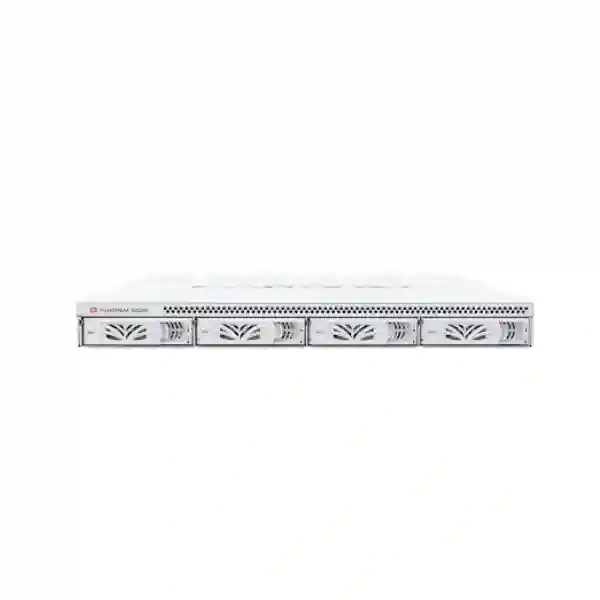
FortiSIEM FSM-500G Tanzania
FortiSIEM FSM-500G is a dedicated collector hardware appliance for organizations building or expanding a distributed FortiSIEM architecture. Fortinet positions the FSM-500G as a collector and specifies support for up to 5,000 events per second. For enterprises with branch offices, data-center segments, operational technology networks, remote sites or geographically separated infrastructure, a collector can place data acquisition closer to the systems being monitored while participating in a centralized FortiSIEM deployment.
Verified model snapshot
Role: FortiSIEM Collector hardware appliance
Ordering SKU: FSM-500G
Supported rate: up to 5,000 EPS
Memory: 16 GB DDR4
Interfaces: 4 × GbE RJ45
Storage: 4 TB
What the FortiSIEM FSM-500G does
The FSM-500G is not an all-in-one SIEM server. It is the collector member of the FortiSIEM hardware family. That distinction matters during procurement because the value of a collector is architectural: it is deployed where event sources, infrastructure devices and monitored systems can reach it reliably, then registered into the wider FortiSIEM environment. Fortinet documentation for the appliance describes rack mounting, network connection, initial configuration through the GUI and collector registration as part of the deployment workflow.
For a buyer in Tanzania, the practical starting point is therefore not simply “how many appliances do I need?” but “where are the event sources, how much event traffic will each site generate, what links connect those sites, and how should collection be segmented?” FourTeck can help translate those questions into a quotation scope without treating the published 5,000 EPS ceiling as a substitute for actual sizing. Event volume, source count, topology, retention design, licensing and the roles of supervisor or worker systems should be reviewed together.
Distributed collection
Place collection capability nearer remote or segmented environments instead of designing every source around a single collection point.
5,000 EPS class
Fortinet’s current ordering information specifies support for up to 5,000 EPS for the FSM-500G collector hardware appliance.
FortiSIEM architecture
Use the appliance as a collector within a properly licensed FortiSIEM deployment, with supervisor and worker roles selected for the wider design.
FortiSIEM FSM-500G specifications
| Item | Fortinet published information | Planning relevance |
|---|---|---|
| Product role | FortiSIEM Collector Hardware Appliance | Designed for collector duties in a FortiSIEM architecture. |
| EPS support | Up to 5,000 EPS | Use measured or estimated event rates when sizing. |
| CPU | Intel Xeon E-2226GE, 6C/6T, 3.40 GHz | Fixed appliance platform specification. |
| Memory | DDR4 16 GB (2 × 8 GB) | Published appliance memory configuration. |
| Network | 4 × GbE RJ45 | Plan management and collection connectivity around the appliance interfaces. |
| Storage | 4 TB (1 × 4 TB) | Do not confuse collector local storage with a complete SIEM retention design. |
| Console | DB9 | Useful for appliance-level setup and administration. |
Architecture, licensing and deployment planning
A FortiSIEM collector purchase should be tied to the overall FortiSIEM design. Fortinet’s ordering guide separates hardware products, device/EPS licensing and support services. This means a hardware quote should be checked against the intended software licensing, support term and any supervisor or worker capacity required by the solution. Buyers should avoid assuming that the collector appliance by itself provides a complete licensed SIEM environment.
Deployment planning should identify log and telemetry sources, expected EPS, network reachability, DNS and time synchronization requirements, administrative addressing, firewall policy between the collector and other FortiSIEM components, rack and power readiness, and the operational ownership of the system. Fortinet’s FSM-500G configuration guide describes a workflow that includes rack mounting, connecting Port1, powering on, verifying system information, configuring FortiSIEM through the GUI and registering collectors. Production deployments should follow the documentation that corresponds to the FortiSIEM release in use.
The collector can be especially relevant where organizations operate multiple sites and want a structured collection tier. A head office may host centralized FortiSIEM roles while collectors serve remote data centers, branches or segmented networks. The right design depends on event rate and connectivity rather than geography alone. A site with modest device count but very high event volume may require different planning from a large office with comparatively quiet sources.
FortiSIEM FSM-500G Tanzania
Tanzanian enterprises evaluating the FortiSIEM FSM-500G commonly need to connect security monitoring with practical realities such as distributed offices, data-center networks, internet edge devices, servers, identity systems, business applications and mixed infrastructure estates. The collector role is useful when an organization wants event acquisition close to those sources while maintaining centralized FortiSIEM operations. The published 5,000 EPS capacity gives procurement teams a defined appliance class, but a sound bill of materials still begins with source discovery and an event-rate estimate.
For procurement, document the number of sites, approximate devices per site, critical log sources, current or projected EPS, WAN connectivity, redundancy expectations and desired support period. Also identify whether FortiSIEM is new to the organization or whether FSM-500G is being added to an existing deployment. Existing environments should be checked for software release compatibility and the planned collector registration method. New environments require broader sizing for supervisor, worker, licensing and retention requirements.
FourTeck can assist with a requirement-led quotation for the appliance and related Fortinet security infrastructure. Customers building a broader security stack can also review FourTeck Tanzania technology solutions and the regional Fortinet-focused resources available through FourTeck’s Fortinet specialist site. These links provide context for complementary network-security requirements without changing the need to size FortiSIEM on its own telemetry and architecture requirements.
FortiSIEM FSM-500G Dar es Salaam
Organizations in Dar es Salaam may operate headquarters, commercial offices, data-center infrastructure, logistics systems and branch-connected services that create a diverse monitoring footprint. In such an environment, the FSM-500G can be considered as a FortiSIEM collector when event sources need a defined local collection point. The design task is to map where logs and operational events originate, how they reach the collector, and how the collector communicates with the wider FortiSIEM system.
A procurement brief should include expected EPS during normal and peak periods rather than relying only on the number of devices. Firewalls, authentication platforms, servers and applications can produce very different event volumes. Network teams should also identify VLAN or security-zone boundaries that affect reachability. Where a collector receives data across controlled segments, firewall rules and routing should be planned explicitly, with management access restricted according to the organization’s security policy.
Before requesting a quote, confirm whether the requirement is for a single collector, several collectors across separated environments, or a complete FortiSIEM platform. This distinction helps prevent a hardware-only quotation from being mistaken for a complete SIEM bill of materials. For related security infrastructure, buyers can explore FourTeck firewall solution resources when planning event sources such as enterprise firewalls alongside the SIEM architecture.
FortiSIEM FSM-500G Mwanza
For businesses in Mwanza with centralized IT plus remote operational sites, the FSM-500G collector can support a distributed monitoring strategy in which event acquisition is organized around network topology. The key benefit is architectural consistency: rather than treating every remote source as an isolated integration, teams can plan a collector tier and register collectors into the FortiSIEM environment. This is particularly relevant when WAN design, segmentation or operational ownership makes a local collection point preferable.
Sizing should consider the published maximum of 5,000 EPS together with realistic peak behavior. Projects should inventory network equipment, security systems, server platforms, authentication services and important applications that will send events. If the organization is growing, include a reasonable capacity margin based on known projects rather than an arbitrary percentage. The quotation should also identify the FortiCare support requirement and any FortiSIEM licenses needed for the deployment.
Deployment preparation should cover rack space, power, Ethernet connectivity, IP addressing, DNS, time synchronization and administrative access. Teams should use the Fortinet guide that matches their installed software version when commissioning the appliance. A disciplined preparation checklist reduces delays after delivery because the collector can be integrated into a planned architecture rather than being treated as a standalone server.
FortiSIEM FSM-500G Arusha
Arusha organizations considering centralized security visibility across offices, hospitality environments, institutions or distributed business operations can evaluate FSM-500G where a physical FortiSIEM collector is appropriate. The appliance’s role is collection, so purchasing decisions should be anchored to the wider SIEM architecture. Teams should determine which sources will report to the collector, expected event rates and whether network policy permits dependable communication between source systems, the collector and FortiSIEM’s other roles.
A useful discovery exercise separates mandatory sources from optional sources. Mandatory sources might include perimeter security devices, critical servers, identity infrastructure and systems required by internal monitoring policy. Optional sources can be phased after the core deployment is stable. This approach helps estimate initial EPS more realistically and gives the project team a controlled onboarding sequence. It also makes it easier to identify whether one FSM-500G is sufficient for the planned collection domain.
Procurement teams should request an itemized proposal that distinguishes the FSM-500G hardware from support and the licensing required for the FortiSIEM platform. If the project also includes network-security modernization, FourTeck Africa solutions can provide broader regional technology context while the FSM-500G quotation remains tied to the exact FortiSIEM design.
FortiSIEM FSM-500G Dodoma
In Dodoma, institutions and enterprises planning structured security monitoring may need to collect events from administrative networks, branch links, security gateways, servers and application platforms. FSM-500G provides a defined FortiSIEM collector appliance option for that role. Because it is a collector rather than the complete SIEM system, project documentation should show how it fits into the supervisor and worker architecture and what licenses support the intended deployment.
Network readiness is as important as hardware selection. Teams should verify routing, permitted ports, naming services, time synchronization and management access before installation. Where systems are divided into security zones, the project should explicitly document which sources communicate with the collector and how the collector reaches the remaining FortiSIEM components. This creates a cleaner implementation and supports later troubleshooting.
For quotation accuracy, provide a source inventory and an EPS estimate or available measurements. Include future systems already approved for deployment so that the design does not become undersized immediately after commissioning. Support duration should also be identified during purchasing. FourTeck can use this information to frame a more relevant FSM-500G proposal rather than quoting an appliance without the surrounding deployment context.
FortiSIEM FSM-500G UAE
UAE deployments frequently involve multi-site enterprise networks, data centers, cloud-connected services and branch infrastructure. FSM-500G can serve as a physical FortiSIEM collector in architectures that benefit from distributed event acquisition. The same sizing principles apply: identify source systems, measure or estimate EPS, map network paths and determine how many collection domains are required. The 5,000 EPS specification should be treated as a published appliance limit, not as a guarantee that every environment with fewer than 5,000 EPS has identical design requirements.
Organizations operating across countries can also use collector placement to align monitoring architecture with network boundaries. A UAE hub, for example, may participate in a larger regional design with collectors elsewhere. The design should account for WAN resilience, security controls between components and operational responsibility. Support services and FortiSIEM licensing should be quoted separately and aligned to the actual architecture.
For UAE-focused Fortinet information, buyers can visit FourTeck Fortinet UAE. Organizations with wider infrastructure requirements can also use FourTeck UAE as a regional technology reference while coordinating multi-country procurement.
FortiSIEM FSM-500G Uganda
Ugandan enterprises with multiple locations can evaluate FSM-500G when they require a FortiSIEM collector close to monitored infrastructure. The collector architecture is relevant for organizations that want to organize event acquisition by site or network domain while retaining centralized visibility. Start by identifying the sources that will send events, their normal and peak rates, and the connectivity available between each source network and the planned collector.
For cross-border organizations operating both Tanzania and Uganda, standardizing collector hardware can simplify architecture documentation, but each site should still be sized independently. A site with fewer devices can generate more events than a larger office depending on logging levels and workload. WAN paths and security policies may also differ. Those factors should be captured before deciding the number and placement of appliances.
Regional buyers can review FourTeck Uganda for Uganda-focused technology information. For FSM-500G specifically, request a quotation that clearly identifies hardware, FortiCare support and the FortiSIEM licensing components relevant to the intended solution.
FortiSIEM FSM-500G Kampala
Kampala-based headquarters often aggregate connectivity from branches and business systems, making them natural locations to evaluate security monitoring architecture. An FSM-500G may be placed as a collector where its 5,000 EPS class aligns with measured requirements. The decision should account for whether sources are local to the Kampala network, distributed over WAN connections or separated by security zones that influence collector reachability.
During design, identify high-volume sources first. Security gateways, authentication services, virtualization platforms and busy application systems can contribute substantially to event rates. Define which data is operationally required and configure source logging intentionally rather than collecting indiscriminately. This makes EPS estimates more meaningful and supports a cleaner SIEM deployment.
Implementation planning should include appliance rack placement, power, Ethernet, addressing, DNS and time synchronization. The collector must then be configured and registered according to the Fortinet documentation for the FortiSIEM release being used. Buyers should ensure that the quote covers the intended support term and associated licensing rather than assuming those elements are included automatically with the hardware.
FortiSIEM FSM-500G Arua
For organizations in Arua, the business case for a dedicated collector often depends on site autonomy, WAN topology and the number of systems that require monitoring. FSM-500G offers a physical FortiSIEM collector platform with a published capacity of up to 5,000 EPS. Rather than sizing from employee count, teams should inventory actual event-producing systems and estimate the rate at which they will send information.
A remote-site collector can reduce the architectural dependence on every source communicating directly across long network paths, but the collector itself still needs dependable connectivity to the wider FortiSIEM deployment. Network security teams should document permitted communications, routing and resilience. Where WAN outages are a concern, operational expectations during interruption and recovery should be considered as part of the design.
For purchasing, specify whether the FSM-500G is an expansion appliance or part of a new deployment. Expansion projects should identify the existing FortiSIEM version and architecture. New projects should include requirements for the broader platform, licensing, support and retention strategy. This information enables a more accurate quotation and reduces the risk of ordering collector hardware without the components needed for the intended system.
FortiSIEM FSM-500G Mbarara
Mbarara organizations planning SIEM coverage across business applications, security devices and network infrastructure can consider FSM-500G as the collection layer for a FortiSIEM design. A collector is particularly useful when the environment benefits from local event acquisition and centralized analytics. The architecture should define what sends data to the collector and how the collector is registered with the rest of FortiSIEM.
Capacity planning should consider both current and foreseeable event sources. The Fortinet specification of up to 5,000 EPS provides a hard reference for the model, but practical sizing also depends on logging policy and deployment topology. Teams should gather sample event rates where possible, especially for critical or noisy systems, and document assumptions for sources that have not yet been deployed.
A quotation request should state the required quantity, support term, deployment type and whether FortiSIEM licenses are already available. It should also identify whether professional configuration assistance is needed. Clear inputs make it easier to distinguish appliance procurement from implementation work and to build a bill of materials that matches the intended monitoring architecture.
FortiSIEM FSM-500G Gulu
Gulu deployments may involve branch networks, institutional infrastructure or operational sites where centralized monitoring is required but network topology favors a local collection point. FSM-500G is Fortinet’s collector hardware appliance in the current FortiSIEM hardware range, supporting up to 5,000 EPS. The appliance should be evaluated as one component in the overall platform rather than as a standalone SIEM.
Before procurement, identify systems that will forward events and determine how they reach the collector. Include security zones, routing constraints and WAN links in the design. Time synchronization should be treated as a foundational requirement because consistent timestamps are important to event analysis. Administrative access should also be restricted and documented according to the organization’s operational security practices.
Where a Gulu site belongs to a larger Ugandan or East African organization, collector placement can be coordinated across sites. Each site should still have its own EPS and connectivity assessment. This prevents a uniform hardware template from masking important differences in event volume or network design. FourTeck can use those site-level details to support a more precise quotation discussion.
FortiSIEM FSM-500G Kenya
Kenyan organizations deploying FortiSIEM across headquarters, data centers and branches can use FSM-500G as a collector where the site requires a dedicated hardware collection point. The model’s published support for up to 5,000 EPS provides a clear sizing boundary, while actual design should consider the distribution of event sources, network segmentation and the roles of other FortiSIEM components.
For organizations operating in both Kenya and Tanzania, a consistent FortiSIEM architecture can simplify operational procedures. However, licensing, source counts, EPS and network paths must still be documented for each environment. A Nairobi data center, branch network or Tanzanian site may have different event behavior. Standardization is most useful when it is paired with site-specific sizing rather than used to bypass it.
Kenya-focused customers can consult FourTeck Kenya for regional infrastructure information. When requesting FSM-500G, include the desired support term and clarify whether the requirement is hardware expansion or a new FortiSIEM implementation so that licensing and platform components can be reviewed correctly.
FortiSIEM FSM-500G Kuwait
Kuwait enterprises with regulated, distributed or data-intensive IT environments can evaluate FSM-500G as a physical collector for FortiSIEM. A collector-centric design can help organize event acquisition across network domains while centralized FortiSIEM roles perform the wider analytics and operational functions. Planning should begin with an inventory of event sources and their expected rates.
The appliance’s four GbE RJ45 interfaces and dedicated collector role should be considered within the network design, including management addressing and reachability to source systems. The implementation team should follow the current Fortinet configuration guide for the software release being deployed. Support and licensing requirements should be included in procurement planning from the start.
For regional context, FourTeck Kuwait provides a Kuwait-focused technology channel. Multi-country organizations can coordinate specifications across regions while still requesting separate sizing validation for each site’s event profile and network topology.
FortiSIEM FSM-500G Ghana
Ghanaian enterprises considering FortiSIEM can use the FSM-500G where a dedicated collector appliance suits the topology. Typical planning questions include how many event-producing systems exist, what peak EPS they generate, where those systems are located and how reliably they can communicate with the collector. Those answers are more useful than choosing a collector purely from organization size.
When a company has several facilities, collectors can be evaluated by site or collection domain. This can make monitoring architecture easier to document and can reduce the number of independent source-to-core paths. The final design should still account for communications from collectors to the FortiSIEM platform and should define the operational process for adding new event sources over time.
Customers can visit FourTeck Ghana for regional information. An FSM-500G request should include quantity, deployment location, expected EPS, support term and whether the organization already owns FortiSIEM licensing. These details help keep the quote aligned with the actual project.
FortiSIEM FSM-500G Nigeria
Nigeria’s large multi-site enterprises can have substantial differences in event volume between headquarters, data centers, branches and operational facilities. FSM-500G can be evaluated as a collector for sites whose event rates and architecture fit the model’s up-to-5,000-EPS specification. For larger or more complex environments, multiple collectors or different platform roles may be required after sizing.
Procurement teams should work with security and infrastructure teams to build an event-source register. Record device or system type, location, expected logging method, estimated EPS and network path. This makes the collector count easier to justify and provides an onboarding plan after deployment. It also helps identify high-volume systems that may need logging-policy review.
For Nigeria-focused requirements, see FourTeck Nigeria. Cross-border organizations can standardize documentation and operational procedures, but every collector location should retain a site-specific capacity and connectivity assessment before hardware is ordered.
FortiSIEM FSM-500G Seychelles
Organizations in Seychelles may have compact local infrastructure combined with remote services, hospitality systems, business applications or regional connectivity. An FSM-500G collector is appropriate to evaluate when a physical FortiSIEM collection point is required. The decision should be based on event sources and topology rather than assuming that a smaller geography automatically means a small event workload.
Where connectivity to other regions is part of the FortiSIEM design, network resilience deserves particular attention. The collector must be able to receive events from its assigned sources and communicate with the broader FortiSIEM environment according to the architecture. Document expected behavior during WAN interruption, management access and recovery procedures as part of implementation planning.
A procurement request should state whether the appliance is for an existing FortiSIEM deployment or a new system, along with expected EPS, quantity and desired support term. If the deployment spans several countries, identify those sites so that collector placement can be reviewed as one architecture rather than as unrelated hardware purchases.
Buying and sizing checklist
✓ Number and location of event sources
✓ Normal and peak EPS estimates
✓ Existing FortiSIEM version and roles
✓ Required collector quantity
✓ WAN and segmentation design
✓ FortiSIEM licensing requirements
✓ FortiCare support term
✓ Installation and configuration scope
Integration considerations
FortiSIEM is designed to bring together security and infrastructure information from diverse sources, but successful collection depends on deliberate integration. For each source category, confirm the supported collection method, authentication requirements, network path and expected event volume. Avoid enabling every possible log category without considering operational value, because unnecessary event generation consumes capacity and can make monitoring less focused.
Time synchronization should be consistent across sources and FortiSIEM components. DNS and addressing should be stable, and management access should follow least-privilege practices. When network security devices are part of the monitored estate, teams may also review FourTeck Tanzania for complementary infrastructure planning. For broader regional Fortinet deployment information, Fortinet UAE by FourTeck provides another approved FourTeck resource.
Integration planning should produce a source-onboarding sequence. Start with high-value systems, validate parsing and event flow, then add additional sources in controlled groups. This allows teams to observe EPS growth and adjust assumptions before onboarding the entire environment. It also provides a clear acceptance process for the collector deployment.
FortiSIEM FSM-500G FAQ
Is FSM-500G a complete FortiSIEM all-in-one appliance?
No. Fortinet identifies FSM-500G as a FortiSIEM Collector Hardware Appliance. It should be purchased and deployed as part of the appropriate FortiSIEM architecture, with licensing and other required platform roles reviewed separately.
How many events per second does FSM-500G support?
Fortinet’s current data sheet and ordering guide specify support for up to 5,000 EPS. Real deployments should be sized using normal and peak event rates, expected growth and the complete FortiSIEM architecture.
What network interfaces does FSM-500G provide?
Fortinet lists four GbE RJ45 network interfaces for the FortiSIEM 500G collector appliance.
What storage is included?
The current Fortinet data sheet lists 4 TB using one 4 TB drive for FSM-500G. Collector storage should not be interpreted as the complete retention design for the overall SIEM platform.
Does the appliance include every FortiSIEM license required?
Procurement should treat hardware, FortiSIEM licensing and support as separate bill-of-material considerations. Ask for a design-based quote that identifies what is required for your specific deployment.
What information should I provide for a Tanzania quotation?
Provide the number of sites, approximate source count, normal and peak EPS if known, existing FortiSIEM version if applicable, required quantity, support duration, network topology and whether installation or configuration assistance is required.
Decision recap
Choose FSM-500G when your FortiSIEM design calls for a dedicated hardware collector and the assigned collection workload fits within Fortinet’s published up-to-5,000-EPS model class. Do not select it solely because it is the smallest current collector model: validate event rates, network placement, software architecture, licensing and support requirements first.
For an accurate proposal, send FourTeck your source inventory, site layout and expected EPS. The resulting discussion can cover appliance quantity, support, licensing alignment and deployment scope without making unsupported assumptions about your environment.
Request a FortiSIEM FSM-500G consultation
Tell FourTeck whether you are expanding an existing FortiSIEM environment or designing a new deployment. Include locations, source counts and EPS data where available. This makes it possible to discuss the FSM-500G in the correct architectural context and prepare a quotation around the actual requirement.




Reviews
There are no reviews yet.