
FORTINET DATA CENTER SWITCHING
FortiSwitch FS-2048F-B2F Tanzania
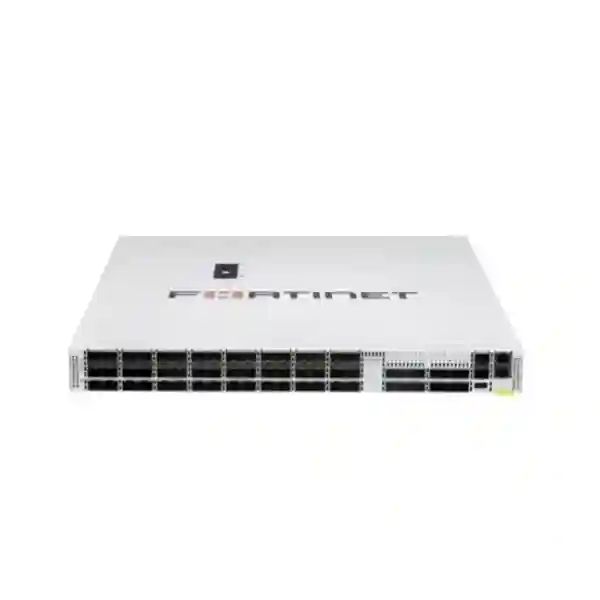
FortiSwitch FS-2048F-B2F is designed for high-density 25 Gigabit Ethernet server connectivity and high-capacity 40/100 Gigabit Ethernet aggregation in data centers, campus cores and demanding enterprise networks. The B2F model combines the FortiSwitch 2048F platform with back-to-front airflow, dual hot-swappable AC power supplies and a compact 1RU rack format. For Tanzanian buyers, the important procurement question is not simply whether a switch has enough ports; it is whether its port speeds, optics, fiber plant, airflow direction, rack power, redundancy and management model fit the intended architecture.
SFP28 access/server-facing ports supporting 25G/10G/1G media according to Fortinet specifications.
QSFP28 uplink/aggregation ports supporting 100G/40G connectivity for high-capacity fabric designs.
Published duplex switching capacity with up to 4,000 Mpps packet forwarding performance.
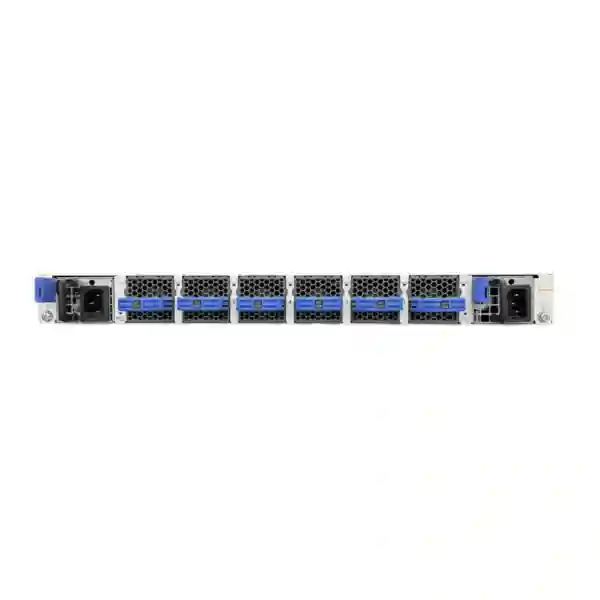
Back-to-front airflow for rack designs whose cooling direction requires intake and exhaust orientation opposite the standard F2B model.
FortiSwitch FS-2048F-B2F Overview
The FS-2048F-B2F belongs to Fortinet’s campus-core and data-center switching family. Its port mix makes it suitable where many servers, storage nodes, hypervisors or downstream switches need 10/25GbE connectivity while the aggregation layer requires multiple 40/100GbE links. Fortinet publishes 48 SFP28-class ports, two additional 10G/1G SFP+/SFP ports and eight QSFP28-class ports. The platform supports IPv4/IPv6 routing, up to 4K VLANs, 96K MAC-address storage, eight queues per port, a 32 MB packet buffer, 8 GB DDR4 memory and a 32 GB SSD. Published network latency is below one microsecond.
The B2F suffix matters operationally. Airflow direction must match the rack and aisle cooling strategy. Mixing opposite-airflow equipment can cause hot-air recirculation and raise inlet temperatures even when the room itself is adequately cooled. Before ordering, identify the cold-air intake side, hot-air exhaust side, neighboring equipment orientation and rack depth. The switch uses dual hot-swappable AC power supplies and accepts 100–240V AC at 50–60Hz. Fortinet lists a 0–40°C operating-temperature range and 10–90% non-condensing relative humidity. These are planning values, not an invitation to operate a rack without suitable environmental control.
Verified Technical Specifications
| Network interfaces | 48× 25G/10G/1G SFP28/SFP+/SFP, 2× 10G/1G SFP+/SFP, 8× 100G/40G QSFP28/QSFP+ |
| Switching capacity | 4,000 Gbps duplex |
| Packet rate | 4,000 Mpps, 64-byte packets |
| Form factor | 1RU rack mount |
| Power | Dual hot-swappable AC, 100–240V AC, 50–60Hz |
| Airflow | Back to front for FS-2048F-B2F |
| VLANs | 4K |
| MAC storage | 96K |
| Management/deployment | Standalone or FortiGate-integrated FortiLink deployment, subject to supported software and design requirements |
Architecture, Integration and Buying Guidance
A 25G/100G switch purchase should begin with traffic flows. Map server NIC speeds, virtualization hosts, storage traffic, backup windows, east-west application traffic, uplink oversubscription and redundancy. The presence of 48 25G-capable ports does not mean every endpoint automatically operates at 25G: compatible transceivers or DAC/AOC assemblies, fiber type, endpoint interfaces and link configuration must all align. The same applies to 100G uplinks. Procurement teams should specify connector type, reach, media, quantity and compatibility rather than ordering the chassis alone and treating optics as an afterthought.
FortiGate integration is relevant for organizations standardizing on the Fortinet Security Fabric. FortiLink can centralize switch management through a compatible FortiGate architecture, while standalone operation remains available. The appropriate model depends on network scale, operational responsibilities and software compatibility. For an existing Fortinet environment, record FortiGate model, FortiOS version, current FortiSwitch topology and desired upgrade sequence before finalizing a bill of materials. For a multi-vendor data center, document VLANs, routing adjacencies, LAG design, spanning-tree boundaries and monitoring requirements so integration is deliberate.
For related infrastructure planning in Tanzania, review FourTeck’s business technology and networking overview, technology shop, IT infrastructure services, and FourTeck Tanzania profile. These pages help buyers connect the switch requirement with firewall, server, fiber, rack, UPS and deployment planning rather than viewing the chassis in isolation.
FortiSwitch FS-2048F-B2F Tanzania
Organizations evaluating the FortiSwitch FS-2048F-B2F in Tanzania are typically planning a high-throughput core, aggregation or data-center network rather than a conventional office access layer. The switch’s 25G server-facing density and 100G aggregation capacity can fit virtualization clusters, private-cloud infrastructure, storage networks, service-provider environments, research platforms and enterprise data centers where 1G or 10G uplinks have become a constraint. A sound Tanzanian procurement process should therefore start with a port map. Count current 10/25G hosts, expected growth, required 40/100G uplinks, redundant paths and spare capacity. Then identify the exact optics, DACs or AOCs required for each link and confirm the fiber plant can support the selected reach and speed.
Power and cooling deserve equal attention. The FS-2048F-B2F specifically uses back-to-front airflow. Buyers should verify that this matches rack orientation and adjacent equipment before ordering. Dual hot-swappable AC power supplies provide hardware-level power-supply redundancy, but resilient deployment also requires appropriate A/B power feeds, UPS design and facility practices. In Tanzania, project planning should account for the actual site environment rather than assume every server room has identical power conditioning, cooling or rack depth. Document available circuits, UPS runtime objectives, rack units, cable-management paths and temperature monitoring.
For networks already using FortiGate, the switching design can also consider FortiLink management and security-policy integration. That decision should be based on the supported FortiOS/FortiSwitch software combination and operational model. A quotation request is more useful when it includes the FortiGate model, number of switches, desired uplink topology, transceiver requirements, support term and installation scope. FourTeck Tanzania can use those details to frame the request around a complete switching requirement rather than a chassis-only enquiry. For broader Fortinet projects across the region, FourTeck Africa provides a regional reference point for connected infrastructure requirements.
FortiSwitch FS-2048F-B2F Dar es Salaam
For Dar es Salaam enterprises, the FS-2048F-B2F is most relevant where dense compute, storage or aggregation traffic justifies 25G and 100G Ethernet. Data centers, financial-services infrastructure, large corporate server rooms, hosting environments, telecom-adjacent facilities and organizations consolidating virtual workloads may need this class of switching. Before procurement, network teams should distinguish endpoint bandwidth from fabric bandwidth. A server may have dual 25G interfaces for redundancy, while uplinks may be grouped across multiple 100G paths. Capacity planning should consider normal production traffic, backups, replication, failover and maintenance states because a topology that looks sufficient during ordinary operation can become constrained after one link or device is taken out of service.
Dar es Salaam projects should also treat rack airflow as a specification, not a cosmetic detail. The B2F model exhausts in the back-to-front direction, so it should be selected only when that orientation fits the intended aisle and equipment layout. Confirm intake and exhaust sides during the site survey. Include optics and patching in the rack plan, because high-density fiber connections require disciplined labeling and bend-radius management. If 100G breakout designs are contemplated, verify supported transceivers, cabling and software behavior for the exact intended topology rather than assuming every QSFP28 use case is interchangeable.
Procurement documentation should list required quantities, support coverage, software context, optics, rack accessories and implementation responsibilities. If the switch will be managed through FortiGate, provide the existing firewall model and software version. If it will operate standalone, specify the required management, authentication, logging and monitoring approach. FourTeck Tanzania’s verified contact page lists Dar es Salaam among its office contacts, so buyers can submit a structured requirement through the FourTeck Tanzania sales enquiry page. A clear bill of materials reduces ambiguity and helps distinguish the FS-2048F-B2F chassis from the optics and services needed to make it operational.
FortiSwitch FS-2048F-B2F Mwanza
In Mwanza, a FortiSwitch FS-2048F-B2F requirement may arise from a regional data room, industrial network, large institutional campus, healthcare environment, logistics operation or organization consolidating servers and storage. The model is substantially beyond ordinary desktop access switching, so selection should be justified by workload and architecture. Begin with a traffic matrix showing which systems communicate at high speed, where virtualization or storage clusters are located, and which uplinks connect to the core, firewall or adjacent racks. This identifies whether 25G server connectivity and 100G aggregation solve a real bottleneck and helps prevent paying for capacity that the rest of the infrastructure cannot use.
Fiber readiness is especially important. A 25G or 100G switch does not upgrade legacy cabling automatically. Confirm fiber type, connector presentation, patch-panel condition, link distance and transceiver compatibility. Where direct-attach copper or active optical cabling is appropriate inside a rack or row, document cable lengths before ordering. For longer inter-rack or building links, the optical design should be engineered around reach and media. Redundant uplinks should follow physically sensible paths where possible so one cable incident does not remove both logical links.
Environmental planning should include rack power, UPS capacity, grounding, cooling and airflow. Because this is the B2F variant, confirm that back-to-front cooling aligns with the rack. Remote operational support also benefits from disciplined management: meaningful interface descriptions, configuration backups, monitoring, syslog, authentication controls and documented VLAN/routing design. If Mwanza infrastructure is part of a wider Tanzanian WAN, the data-center switch should be considered alongside firewalls, WAN resilience and branch connectivity. A quotation should therefore include intended use, port counts by speed, optics, support period, FortiGate integration needs and whether installation or configuration assistance is required.
FortiSwitch FS-2048F-B2F Arusha
Arusha organizations considering the FortiSwitch FS-2048F-B2F may include larger hospitality groups, institutions, corporate campuses, regional headquarters and technology environments that operate centralized server or storage infrastructure. The correct design starts by separating access switching from data-center switching. Employee desks, IP phones and ordinary wireless access points generally belong on access-layer switches; the FS-2048F-B2F is better aligned with high-speed fiber-connected infrastructure, aggregation and compute environments. This distinction keeps the architecture cost-effective and ensures the 25G/100G interfaces are used where they deliver meaningful value.
For a new server-room build, create the rack elevation before equipment arrives. Reserve the 1RU switch position, define patch-panel locations, confirm front/rear service access and make sure the B2F airflow direction matches cooling. Plan A/B power where available and identify which PSU connects to which protected feed. Cable-management space matters because dozens of fiber or DAC connections can become difficult to maintain if routing is improvised. Labels should identify both ends of every link and correspond to switch interface descriptions and network documentation.
If the Arusha site connects to other Tanzanian branches, consider how the core switch interacts with the firewall and WAN edge. VLAN and routing boundaries should be explicit, and redundancy should be tested rather than merely configured. FortiGate-managed FortiSwitch deployments can provide an integrated operational model, but software compatibility and topology support should be validated for the exact environment. FourTeck Tanzania’s current contact information includes Arusha, and buyers can provide the model, quantities, optics list, target topology and desired support scope through the central contact workflow. This produces a more useful quotation than requesting “one 48-port switch” without identifying the 25G/100G design behind the requirement.
FortiSwitch FS-2048F-B2F Dodoma
For Dodoma deployments, the FS-2048F-B2F can support high-capacity network cores where organizations are centralizing applications, virtualization, storage or inter-building services. Its 48 25G-class interfaces and eight 100G-class interfaces allow architects to build a dense fabric, but port quantity should be translated into an actual topology before purchase. Determine how many ports are required on day one, how many are reserved for growth, which connections need redundant pairs and how the 100G interfaces connect to peer switches, cores or upstream infrastructure. Capacity should be checked during failure conditions as well as normal conditions.
Public-sector, institutional and enterprise projects often require detailed procurement documentation. The bill of materials should distinguish chassis, transceivers, fiber assemblies, support services and any installation work. Specify the airflow variant explicitly as FS-2048F-B2F to avoid receiving the wrong cooling direction. Record electrical and environmental requirements and confirm rack compatibility. If the switch participates in Layer 3 routing, document route ownership, gateway placement, redundancy protocol requirements and how routing integrates with the firewall and WAN.
Operational handover should include configuration backups, interface maps, VLAN definitions, IP addressing, authentication method, logging destinations and monitoring thresholds. These details make future changes safer and reduce dependence on individual memory. FourTeck Tanzania’s verified contact page lists Dodoma among its office contacts, while the main site covers switching, routing, fiber, rack and UPS planning. Buyers can therefore frame the request as an infrastructure project: specify server NIC speeds, required uplinks, existing FortiGate or other firewall platform, desired management mode, optics reach and implementation timeline. That context helps ensure the FS-2048F-B2F is evaluated as part of the complete network rather than as an isolated line item.
FortiSwitch FS-2048F-B2F UAE
UAE buyers evaluating the FortiSwitch FS-2048F-B2F often have mature rack standards, structured cold-aisle/hot-aisle practices and high-density server environments. The B2F airflow variant should be chosen specifically to match those mechanical standards. In a mixed data-center estate, document airflow direction for every network device because a switch that pulls hot exhaust air from neighboring equipment can operate outside the intended thermal design. The 1RU chassis and dual hot-swappable AC power supplies support dense racks, but power-feed diversity and UPS/generator architecture remain site responsibilities.
The networking design should focus on 25G server attachment and 100G fabric connectivity. Common planning questions include whether servers use single or dual 25G NICs, whether storage traffic is converged or separated, how many 100G uplinks are required, and what oversubscription is acceptable. Transceiver choice depends on distance and fiber plant. For in-rack links, DAC or AOC options may be considered where compatible; for longer paths, select optics according to the actual media and reach. Procurement teams should request exact manufacturer-compatible part numbers rather than generic “25G fiber modules.”
Organizations operating across Tanzania and the Gulf may benefit from standardized configurations, naming and support terms. A repeatable template can define VLANs, routing, authentication, monitoring and configuration backup while still adapting port counts to each site. For UAE-related Fortinet requirements, FourTeck’s Fortinet UAE specialist site is a relevant regional resource. Cross-region procurement should still verify local commercial terms, support entitlements and delivery details at quotation time rather than assuming one market’s terms apply to another.
FortiSwitch FS-2048F-B2F Uganda
Ugandan organizations considering the FS-2048F-B2F should first confirm that their workload genuinely needs data-center-class 25G/100G switching. The model fits dense server, storage and aggregation requirements rather than ordinary user access. A design workshop can map compute hosts, storage arrays, backup systems, firewalls and uplinks, then assign port speeds and redundancy. This is particularly useful for organizations standardizing infrastructure across multiple sites, because a central high-speed switch may serve as the core while smaller access switches support desks, phones, cameras and wireless access points.
For regional procurement, optics and support are often as important as the chassis. The bill of materials should state the number of 25G and 100G connections, link distances, fiber type and whether spare transceivers are required. Confirm rack airflow before selecting B2F. Dual hot-swappable AC PSUs should be connected to an appropriately designed power environment, and UPS capacity should be calculated for the whole rack rather than this switch alone. Temperature and dust management should follow the data-room conditions and Fortinet environmental limits.
Management can be standalone or integrated with compatible FortiGate/FortiLink designs. If an organization has FortiGate at the data center and branches, centralized policy and visibility may be part of the architecture, but exact software support must be checked before deployment. For Uganda-specific project coordination, FourTeck Uganda covers networking and business IT solutions. Customers operating in both Uganda and Tanzania can use consistent documentation and network standards while requesting commercial and deployment details for each location separately.
FortiSwitch FS-2048F-B2F Kampala
Kampala data-center, enterprise and institutional networks may use the FS-2048F-B2F where server density and east-west traffic have outgrown 1G/10G designs. The move to 25G should be coordinated with server NIC refreshes and storage architecture. If hosts remain limited to lower speeds, installing a 25G-capable switch alone will not create end-to-end performance. Build a migration matrix showing current interfaces, target interfaces, transceiver types and the point at which each workload will move. This supports phased upgrades without losing track of compatibility.
At the aggregation layer, eight 100G-capable QSFP28 interfaces provide substantial design flexibility. Architects should decide whether these ports connect to a spine, peer core, firewall environment or other high-speed infrastructure. Link aggregation can add bandwidth and resilience, but physical diversity matters. Two links in the same cable pathway can still fail together. Routing, VLAN boundaries and failure convergence should be documented and tested. The switch supports IPv4/IPv6 routing, but the correct Layer 3 boundary depends on the broader design.
Kampala procurement requests should specify the B2F airflow requirement, dual-power-feed plan, optics, support term and management mode. If FortiGate integration is expected, include firewall model and software version. If the project spans branches, document WAN and security dependencies too. FourTeck Uganda’s site describes networking solutions and business connectivity services, providing a regional route for project discussions. For Tanzania-headquartered organizations with Kampala operations, maintaining consistent configuration standards can simplify cross-border support while allowing each site’s rack, power and carrier conditions to be handled independently.
FortiSwitch FS-2048F-B2F Arua
An FS-2048F-B2F deployment in Arua should be driven by a clear centralized-compute or aggregation requirement. High-capacity switches can be valuable for regional hubs, but they also depend on supporting infrastructure that must be planned carefully. Assess the number of servers, virtualization hosts, storage systems and high-speed uplinks. Determine whether 25G connectivity is needed immediately or as part of a staged growth plan. If the design is primarily office access, a different FortiSwitch family may be more appropriate, so sizing should precede procurement.
For sites where replacement hardware or specialist assistance may require additional logistics, resilience deserves special emphasis. Dual power supplies are useful only when connected to a sensible power design. Network redundancy should avoid single points of failure in uplinks, optics and upstream devices. Keep spare critical optics where the business impact justifies it, and maintain current configuration backups and diagrams. Remote monitoring should expose interface errors, temperature, power-supply state and link changes so problems can be investigated before they become prolonged outages.
The B2F airflow orientation must be checked against rack cooling, particularly if equipment from multiple vendors shares the rack. Fiber links should be labeled and protected, with patch panels and cable management arranged for safe maintenance. For a quotation, include exact model, quantity, port-speed requirements, optics reach, support duration, rack environment and whether FortiGate/FortiLink management is intended. FourTeck’s Uganda regional presence can be used for networking discussions, while Tanzanian organizations managing an Arua branch can standardize documentation and security practices across both countries without assuming that physical infrastructure is identical at each location.
FortiSwitch FS-2048F-B2F Mbarara
Mbarara organizations with growing server rooms, institutional data systems or regional aggregation requirements can evaluate the FS-2048F-B2F as a high-density fiber switch. The first task is to quantify demand: current server connections, storage traffic, virtualization migration, backup throughput and uplink utilization. A 4 Tbps switching platform provides substantial internal capacity, but application performance remains dependent on endpoints, storage, routing, security inspection and WAN connectivity. Capacity planning should therefore be end-to-end rather than focused on a single device specification.
A robust design reserves ports for redundancy and expansion. If every interface is consumed on day one, routine growth can force disruptive redesign. At the same time, excessive unused capacity can be poor procurement. Create a three-to-five-year port forecast based on credible infrastructure plans. Identify 25G links separately from 10G/1G requirements and document the eight 40/100G interfaces according to their intended uplink role. Confirm optics against cable distance and fiber type.
Rack and facility planning should verify 1RU space, power feeds, UPS capacity and B2F airflow. Operational readiness includes administrator authentication, configuration backup, monitoring and change control. For Fortinet Security Fabric environments, confirm FortiLink design and supported versions before migration. A Mbarara quotation request should state whether the project is hardware supply only or includes configuration, migration and testing. This distinction matters because moving production workloads onto a new high-speed core requires a rollback plan and maintenance window, not simply physical installation. Regional FourTeck resources can support broader Uganda networking discussions while Tanzania-based IT teams retain a common architecture across their sites.
FortiSwitch FS-2048F-B2F Gulu
For Gulu, the FS-2048F-B2F is best evaluated as part of a core infrastructure design. Suitable projects may involve centralized applications, private-cloud services, storage, backup repositories or aggregation for multiple network segments. Begin by identifying traffic that stays inside the data center versus traffic that crosses the firewall or WAN. East-west traffic between servers can justify faster switching even when internet bandwidth is much lower. Conversely, if most workloads are cloud-hosted and the local server footprint is small, a different switch class may be more economical.
The switch’s 25G/100G interfaces require compatible media. Procurement should include an optics schedule that records source port, destination device, speed, distance and fiber type. This prevents last-minute substitutions that may not work. For redundant links, keep logical and physical design aligned. Separate pathways where practical, use meaningful port descriptions and document link aggregation. The FS-2048F-B2F’s back-to-front airflow should be explicitly checked against the rack’s cooling direction before purchase.
Operational support can be strengthened with configuration backups, remote monitoring, logging and a clear escalation process. If FortiGate manages the switch through FortiLink, document dependencies so firewall maintenance does not surprise the switching team. If standalone management is preferred, define administrative access and monitoring standards. For organizations with both Gulu and Tanzanian operations, common VLAN naming, interface descriptions and configuration templates can make support more predictable. Commercial requests should still separate each location’s quantities, support terms and physical requirements, because logistics and site conditions vary even when the technical standard is shared.
FortiSwitch FS-2048F-B2F Kenya
Kenyan enterprises, data centers and regional headquarters evaluating the FS-2048F-B2F can use its 25G density for compute and storage connectivity and its 100G interfaces for aggregation. Before selecting it, assess whether the existing server and fiber infrastructure can exploit those speeds. A common migration pattern is to retain some 10G connectivity while new hosts move to 25G, but the exact approach depends on supported transceivers and endpoint capabilities. The design should document every link rather than assume backward compatibility will solve all media combinations.
For Nairobi or other major-site data rooms, cooling design can be sophisticated, making the B2F variant particularly relevant when rack airflow standards call for back-to-front operation. Verify aisle orientation, adjacent equipment and blanking practices. Dual hot-swappable power supplies can support resilient power design when connected to independent protected feeds. Network redundancy should similarly extend beyond the chassis: peer switches, diverse uplinks and upstream devices should be considered where uptime requirements justify them.
Regional organizations often want the same core design in Kenya, Tanzania and Uganda. Standardization can reduce training and configuration variation, but each site should still be sized from its workloads. FourTeck Kenya covers enterprise networking and firewall solutions and can serve as a Kenya-specific project resource. Procurement teams can align model naming, support periods, optics standards and documentation across countries while confirming local quotation, availability and deployment scope separately. For the FS-2048F-B2F specifically, always include the airflow suffix in purchasing documents to avoid confusion with the standard airflow configuration.
FortiSwitch FS-2048F-B2F Kuwait
Kuwait data-center and enterprise environments may consider the FS-2048F-B2F for dense 25G server access and 100G aggregation. In high-availability facilities, the B2F airflow option should be coordinated with rack mechanical standards before ordering. Temperature-controlled rooms still depend on correct equipment airflow, unobstructed intakes and disciplined cable placement. The published operating range should be treated as an equipment limit, while the facility should be engineered to maintain stable conditions with appropriate monitoring and redundancy.
Network planning should examine oversubscription and failure states. Forty-eight 25G ports can represent significant aggregate edge capacity, so the number and arrangement of 100G uplinks should reflect real traffic patterns. Storage, virtualization and backup can create bursts that differ from average utilization. Monitoring existing links before migration provides evidence for sizing. If multiple 100G uplinks are aggregated, confirm upstream support and hashing behavior for the intended flows. Where Layer 3 is used, routing design and convergence should be tested.
Procurement should include optics, support and implementation responsibilities. Do not treat transceivers as generic accessories: reach, wavelength, fiber and compatibility must match. Organizations with infrastructure in Kuwait and East Africa can use a common engineering template while adapting power, rack and carrier details locally. The broader FourTeck regional network can assist with multi-country technology discussions, but commercial commitments should be verified in the relevant quotation. For a Kuwait deployment, provide the target topology, quantity, required support period and B2F airflow confirmation so the request is technically unambiguous.
FortiSwitch FS-2048F-B2F Ghana
Ghanaian organizations planning data-center modernization can evaluate the FS-2048F-B2F where virtualization, storage and aggregation require more bandwidth than traditional access switches provide. The 48 25G-capable interfaces support dense server connectivity, while eight 100G-capable ports can connect to an upstream core or fabric. A technical assessment should determine whether traffic is primarily north-south toward the internet and firewall or east-west among local workloads. This affects uplink sizing and architecture.
Before procurement, inspect the physical layer. Confirm rack space, power, airflow and fiber. The B2F model’s back-to-front cooling must align with the site. List transceivers by link and distance, and verify endpoint interfaces. If existing hosts use 10G, document the migration path to 25G rather than replacing optics ad hoc. For 100G links, ensure patch panels and fiber media are appropriate for the chosen optical standard. A clean physical design improves both reliability and future troubleshooting.
Management strategy is another decision. Standalone operation may suit some architectures, while organizations already using FortiGate can evaluate FortiLink integration. Either way, administrator access, backups, logging and monitoring should be established before production cutover. FourTeck Ghana covers networking, servers, firewalls and related infrastructure, making it a useful regional resource for Ghana projects. Multi-country buyers can standardize the switch platform where requirements match, but should size each site separately and verify local support and commercial terms.
FortiSwitch FS-2048F-B2F Nigeria
Nigeria’s large enterprise, financial, hosting, telecom-adjacent and institutional environments can generate the server and storage density that makes a 25G/100G switch relevant. The FS-2048F-B2F should be selected from measured or forecast traffic rather than headline port speed alone. Review virtualization host uplinks, storage replication, backup traffic, application clusters and inter-rack connectivity. Build redundancy into both server attachment and 100G aggregation where uptime objectives require it, then validate that the upstream architecture can carry the resulting traffic.
Facility design is critical. Back-to-front airflow should match rack cooling. Dual hot-swappable PSUs should connect to protected feeds according to the site’s electrical design. Cable management must preserve airflow and keep high-density fiber maintainable. For large deployments, consistent labeling and an optics inventory reduce troubleshooting time. Monitoring should capture interface utilization, errors, link changes, environmental state and hardware alarms so teams can distinguish congestion from physical faults.
Organizations operating in Nigeria and Tanzania may want common Fortinet standards across regions. That can simplify training, configuration templates and security integration, but it should not lead to identical bills of materials when workload sizes differ. Nigeria-specific IT project coordination can use FourTeck Nigeria as a regional reference, while Tanzania requirements can be handled through the Tanzania contact workflow. For each site, request the exact FS-2048F-B2F model, optics schedule, support duration and implementation scope, and confirm availability and pricing at quotation time.
FortiSwitch FS-2048F-B2F Seychelles
Seychelles organizations with centralized hospitality, government, financial, service-provider or enterprise computing environments may consider the FS-2048F-B2F when a compact 1RU platform with high-density 25G and 100G interfaces fits the architecture. Because island deployments can make logistics and replacement planning especially important, the network design should emphasize maintainability. Document optics, keep configuration backups, identify critical spares based on business impact and make remote monitoring part of the initial deployment rather than an afterthought.
The physical environment should be carefully controlled. The B2F airflow model must align with rack cooling, and equipment should be protected from unsuitable heat, humidity and power conditions. Confirm UPS capacity and power-feed design for the full rack. Fiber patching should be labeled and routed so maintenance does not disturb neighboring links. If inter-building fiber is used, ensure the optical specification is selected for actual distance and media rather than copied from an in-rack design.
For high availability, consider how the switch participates in a redundant topology and what happens during an upstream failure or maintenance event. Test failover paths and maintain diagrams that remote engineers can understand. If FortiGate/FortiLink management is part of the solution, verify supported versions before shipment and pre-stage configuration where practical. Seychelles buyers requesting a quotation should include quantity, port-speed plan, optics, support term, rack airflow orientation and implementation expectations. Regional procurement through a broader FourTeck relationship can help maintain common standards, but local delivery, support and commercial details should always be confirmed for the specific project.
Related Infrastructure for a Complete Deployment
The FS-2048F-B2F normally sits inside a wider architecture. Server and storage interfaces must support the intended 10/25G speeds. Fiber, DAC or AOC assemblies must match distance and port type. A firewall may provide segmentation and north-south security, while upstream switching or a peer core provides resilient aggregation. Racks require correct airflow and cable management, and UPS systems protect the switching layer from unsuitable interruptions. FourTeck Tanzania’s service portfolio covers these surrounding areas, so a quotation can include the dependencies that turn the switch into a working design.
For cross-border projects, FourTeck’s regional sites in Uganda, Kenya, Ghana, Nigeria and its Fortinet-focused UAE presence can help organizations keep product naming and architecture consistent. These links are provided as related regional resources rather than claims of stock or delivery. Availability, price, support entitlement and project scope should be confirmed in a formal quotation for each destination.
Quotation Checklist
✓ Quantity of FS-2048F-B2F switches
✓ Required 25G/10G/1G port counts
✓ Required 100G/40G uplinks
✓ Fiber type and link distances
✓ Optics, DAC and AOC quantities
✓ Existing FortiGate model and FortiOS version
✓ Standalone or FortiLink management preference
✓ Support term requirements
✓ Rack airflow confirmation
✓ Installation, migration and testing scope
FortiSwitch FS-2048F-B2F FAQ
What is the difference between FS-2048F and FS-2048F-B2F?
The B2F designation identifies the back-to-front-airflow variant. The core 2048F platform provides the same high-density 25G and 100G interface class, but airflow orientation is a critical rack-selection detail.
How many ports does the FS-2048F-B2F provide?
Fortinet specifies 48× 25G/10G/1G SFP28/SFP+/SFP ports, 2× 10G/1G SFP+/SFP ports and 8× 100G/40G QSFP28/QSFP+ ports.
What is the switching capacity?
Fortinet publishes 4,000 Gbps duplex switching capacity and up to 4,000 Mpps packet forwarding for the 2048F platform.
Can it be managed by FortiGate?
FortiSwitch supports FortiGate-integrated FortiLink deployment as well as standalone operation. Exact topology and software compatibility should be verified for the FortiGate and FortiSwitch versions in the project.
Are optics included?
Optics and cabling should be specified explicitly in the quotation. The correct transceiver depends on speed, media, connector, reach and endpoint compatibility; do not assume a chassis quotation includes every required optical module.
How do I request a Tanzania quotation?
Send the model, quantity, optics schedule, intended topology, existing FortiGate details if relevant, support term and deployment location through FourTeck Tanzania’s contact page. This gives the sales and technical team enough context to prepare a meaningful response.
Decision Recap and Consultation
Choose the FS-2048F-B2F when the network genuinely needs dense 25G connectivity, multiple 40/100G aggregation links and back-to-front airflow. Validate server NICs, optics, fiber, uplink capacity, FortiGate integration, rack cooling and power before purchase. The strongest quotation request is a short architecture brief rather than a model number alone. FourTeck Tanzania can review the requirement and help align the chassis with optics, cabling, rack, firewall and deployment needs.



Reviews
There are no reviews yet.