
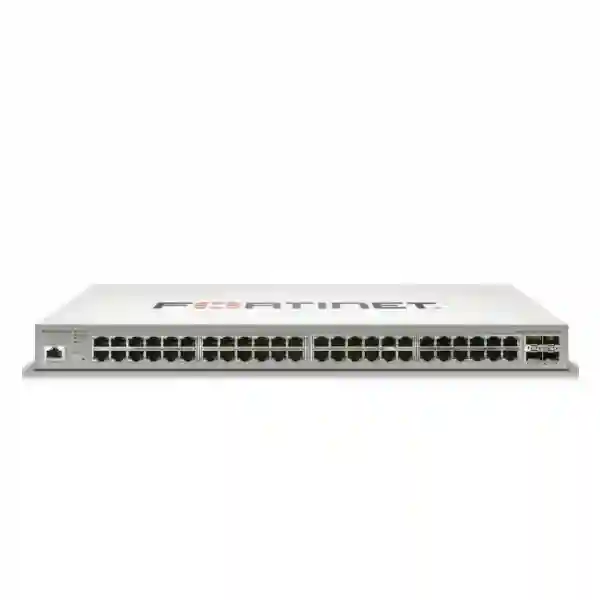
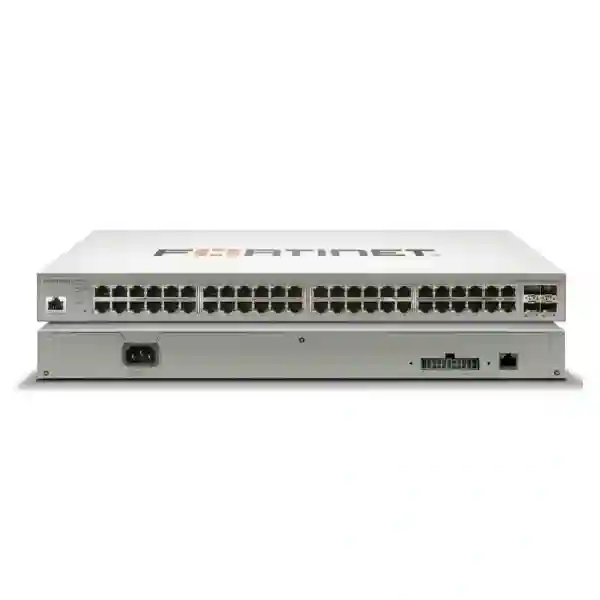
FortiSwitch FS-248E-FPOE Tanzania
FortiSwitch FS-248E-FPOE is a 48-port Gigabit Ethernet secure access switch built for organizations that need substantial Power over Ethernet capacity, straightforward edge connectivity and alignment with a Fortinet security architecture. The model combines 48 GE RJ45 access interfaces, four GE SFP interfaces, PoE+ capability across all 48 copper access ports and a maximum 740W PoE power budget. For Tanzanian businesses planning voice, wireless, surveillance or converged campus networks, those characteristics make the switch particularly relevant where many powered endpoints must be connected from a single rack-mounted platform.
Dense Gigabit access connectivity for users, phones, access points, cameras and other Ethernet devices.
IEEE 802.3af/802.3at power delivery is available across all 48 copper access ports.
A substantial maximum PoE budget supports planning for larger populations of powered edge devices.
Fortinet specifies 104 Gbps duplex switching capacity and 155 Mpps packet forwarding.
FortiSwitch FS-248E-FPOE overview
The FS-248E-FPOE belongs to the FortiSwitch secure access family and is designed as a 1RU rack-mount access switch. Its value is easiest to understand in environments where Ethernet access and endpoint power need to be consolidated. Rather than installing separate electrical injectors for every compatible endpoint, network designers can use the switch’s PoE+ ports to carry data and electrical power over Ethernet cabling, subject to endpoint requirements and the overall 740W power budget. This can simplify structured cabling designs for IP telephony, wireless LAN access points, security cameras and other standards-based PoE devices.
The switch provides four GE SFP ports in addition to the 48 copper interfaces. These fiber-capable interfaces can be used when the deployment design calls for compatible optical transceivers and fiber links, for example between wiring areas or toward an aggregation layer. Actual optics, distances and fiber types should always be selected against the transceiver and cabling requirements of the project rather than assumed from the switch alone.
Fortinet specifies a dedicated 10/100 management port and an RJ45 serial console port, which are useful during deployment and administration. System specifications include 16K MAC address storage, support for 4K VLANs, 32 spanning-tree instances, 1.5 MB packet buffers, 512 MB DDR3 memory and 128 MB flash. The platform is intended to fit into a standard equipment rack, measuring approximately 44 × 410 × 440 mm and weighing about 6.1 kg. These details matter when planning rack depth, power, cooling, cable management and UPS capacity.
Where the FS-248E-FPOE fits
A 48-port full-PoE switch is typically considered when a site has a relatively high concentration of powered network endpoints. An office may need dozens of IP phones and wireless access points. A hospitality property may combine phones, cameras and access points. A school or campus building may need wireless coverage across classrooms while also supporting CCTV and administrative endpoints. A warehouse may use cameras, wireless coverage and operational devices. The FS-248E-FPOE provides a common access layer for these scenarios, but final suitability depends on port counts, PoE consumption, uplink design, redundancy objectives, FortiSwitchOS feature requirements and the broader network architecture.
PoE planning should be performed by adding the expected power draw of connected devices and preserving practical headroom. The 740W figure is the maximum switch PoE budget, not a guarantee that every attached device will consume an equal share. Device class, negotiated power and actual endpoint consumption influence the result. A quotation request is more useful when it includes the number and models of access points, phones, cameras or other powered endpoints so the proposed switch quantity and power design can be checked before purchase.
Verified technical specifications
| Network interfaces | 48 × GE RJ45 and 4 × GE SFP |
| PoE ports | 48 × IEEE 802.3af/802.3at |
| PoE power budget | 740W maximum |
| Switching capacity | 104 Gbps duplex |
| Packet forwarding | 155 Mpps duplex |
| MAC addresses | 16K |
| VLANs | 4K |
| Form factor | 1RU rack mount |
| Power input | 100–240V AC, 50/60 Hz |
| Operating temperature | 0°C to 50°C |
FortiSwitch FS-248E-FPOE Tanzania
Organizations evaluating the FortiSwitch FS-248E-FPOE in Tanzania commonly need to balance three practical requirements: enough Ethernet ports for current users, sufficient PoE capacity for powered endpoints and an architecture that can be administered consistently as the network grows. The 48-port format is particularly useful for a full wiring cabinet or a floor where endpoint density makes smaller switches inefficient. Its full PoE+ capability means the design does not have to reserve a limited subset of ports for powered devices, although the total 740W budget still needs to be calculated against actual endpoint demand.
For a Tanzanian deployment, start with an endpoint schedule. Count desktop connections, IP phones, wireless access points, cameras, access-control devices and any specialist Ethernet equipment. Then identify which endpoints require PoE and record their maximum power requirements. This prevents a common procurement mistake: selecting a switch because the port count is sufficient while overlooking aggregate PoE demand. It also helps decide whether one FS-248E-FPOE is appropriate or whether the network should be distributed across multiple access switches for resilience, cable-distance or building-layout reasons.
Uplink planning is equally important. The FS-248E-FPOE has four GE SFP ports, so the design team should confirm whether Gigabit fiber uplinks satisfy the expected traffic profile and aggregation architecture. Where the wider project requires higher-speed uplinks, another FortiSwitch model may be more suitable. Buyers can also coordinate the switching decision with firewall, wireless and endpoint-security planning through FourTeck Tanzania, while organizations building a broader Fortinet architecture can review Fortinet solution guidance for related security concepts.
Procurement discussions should include rack space, UPS sizing, environmental conditions, compatible optics, patching, configuration responsibilities and support requirements. The switch itself is only one component of a reliable access network. A well-prepared bill of materials should account for transceivers where fiber is required, suitable cabling, rack accessories and the intended management model. FourTeck can use these project details to prepare a more relevant quotation rather than treating the switch as an isolated item.
FortiSwitch FS-248E-FPOE Dar es Salaam
In Dar es Salaam, the FS-248E-FPOE can suit offices, hotels, education environments, commercial properties and multi-department organizations that are consolidating voice, Wi-Fi and surveillance connectivity. Dense buildings often create a straightforward requirement for many powered Ethernet ports in each communications room. A 48-port full-PoE+ switch can reduce dependence on separate PoE injectors and make the physical access layer easier to document, provided the 740W budget and endpoint requirements are checked during design.
For new office fit-outs, a useful approach is to map ports by room and service before ordering hardware. Separate counts for employee data, phones, access points, CCTV, meeting-room devices and spare capacity make the switching requirement clearer. VLAN design can then be planned around business functions and security policy rather than added after installation. The FS-248E-FPOE supports up to 4K VLANs, giving network teams significant logical segmentation capacity, although the actual VLAN plan should remain as simple as operational requirements permit.
Dar es Salaam projects may also involve multiple floors or nearby buildings. The four GE SFP interfaces allow compatible fiber uplinks to be incorporated into the design. Engineers should validate optical module compatibility, fiber type, connector format and distance before procurement. They should also evaluate whether Gigabit uplinks are sufficient for aggregate traffic. High-density wireless networks, large surveillance deployments or heavy server traffic can change uplink requirements and may justify a different aggregation design.
When requesting a quote, include the intended number of switches, powered endpoint models, rack availability, uplink media and whether the switch will be integrated with an existing Fortinet environment. This allows the commercial conversation to cover more than unit price. It can address deployment readiness, accessories and future growth. For wider infrastructure needs, FourTeck IT services resources provide additional context on infrastructure planning, while the Tanzania team can be contacted through the page CTA for a project-specific discussion.
FortiSwitch FS-248E-FPOE Mwanza
For Mwanza organizations, the FS-248E-FPOE is relevant when a site needs a centralized access switch for many users and powered devices. Typical planning scenarios include administrative buildings, schools, healthcare environments, hospitality properties and commercial sites where wireless access points, phones and cameras share the same structured cabling system. The switch’s 48 Gigabit copper ports provide a dense access layer, while PoE+ availability on all 48 ports gives designers flexibility in where powered endpoints are patched.
A good Mwanza deployment plan should distinguish between installed port count and simultaneous utilization. Not every wall outlet needs an active switch port on day one, but the communications rack should have enough headroom for additions. Likewise, PoE headroom should be preserved for future access points or cameras. The 740W maximum budget is generous for many mixed-device environments, yet actual consumption must be calculated from the endpoints. This is particularly important when high-power access points or camera accessories are included.
Operational simplicity should also influence procurement. Document port naming, VLAN assignment, uplink paths and endpoint ownership so troubleshooting does not depend on individual staff knowledge. The dedicated management interface and serial console can support administrative workflows during deployment. Where FortiSwitch is used with a broader Fortinet architecture, confirm the intended management mode, FortiSwitchOS version and compatibility before scheduling changes to a production network.
Buyers should provide a concise network schedule with the quotation request: number of users, number of powered devices, expected uplinks, fiber distances and any existing Fortinet products. This helps determine whether the FS-248E-FPOE is the right fit rather than simply the largest convenient port count. The objective is a switch design that matches the building topology, endpoint power profile and expected growth while avoiding unnecessary complexity.
FortiSwitch FS-248E-FPOE Arusha
Arusha businesses considering the FortiSwitch FS-248E-FPOE may be supporting hospitality, professional offices, education, tourism operations or distributed business facilities. These environments frequently rely on wireless coverage and IP surveillance in addition to conventional desktop connectivity. Full PoE+ availability across 48 access ports makes the switch useful where the exact mix of powered devices may evolve over time, because powered endpoints are not restricted to a small fixed group of PoE-enabled interfaces.
Wireless projects deserve specific attention. Count access points by coverage plan rather than guessing from building size, and check each model’s PoE requirement. The switching design should also consider how traffic from many access points reaches the rest of the network. The FS-248E-FPOE provides four GE SFP interfaces, so uplink capacity should be validated against expected aggregate wireless and wired demand. If the network is expected to carry unusually high throughput, the aggregation architecture may need a switch family with faster uplink options.
For surveillance deployments, calculate both port demand and power demand. Camera counts can grow rapidly when entrances, corridors, parking areas and perimeter zones are included. Some cameras also have different power requirements because of heaters, illuminators or PTZ mechanisms. Use the actual camera specification rather than assuming a standard draw per port. Preserving PoE budget headroom can reduce the need for disruptive redesign when additional cameras are introduced.
Arusha procurement teams can make vendor discussions more efficient by supplying a floor plan or endpoint list, rack details, preferred fiber paths and information about existing Fortinet equipment. That enables a quotation to include the relevant switching hardware and associated accessories. For cross-border organizations with Kenyan operations, FourTeck Kenya can provide a related regional reference point while Tanzania requirements remain centered on the local project brief.
FortiSwitch FS-248E-FPOE Dodoma
In Dodoma, the FS-248E-FPOE can be evaluated for institutional offices, corporate sites, education networks and facilities that need a substantial number of powered access ports. The model’s 48 GE RJ45 interfaces make it suitable for a full access-layer cabinet, and the 740W PoE budget supports a mixed population of compatible phones, wireless access points, cameras and other IEEE 802.3af/802.3at devices. The key design task is to translate the building’s endpoint plan into port, power and uplink requirements before hardware is ordered.
Segmentation is another consideration. Different endpoint classes often require different network policies: staff computers, guest wireless, voice, cameras and building systems should not automatically share one unrestricted broadcast domain. The FS-248E-FPOE supports extensive VLAN capacity, but VLAN quantity alone does not create security. The network architecture should define which segments may communicate, where routing and security controls are applied and how administrators will monitor the environment.
Power continuity matters for PoE networks because a switch outage can simultaneously affect phones, Wi-Fi and cameras. UPS sizing should therefore consider the switch’s own consumption and the expected powered load rather than only the nominal electronics draw. Fortinet’s published maximum power consumption for the model is substantially influenced by PoE usage, so infrastructure teams should size electrical protection using the planned load and appropriate engineering margins.
A Dodoma quotation request should identify whether the switch is for a new network, expansion or replacement. Replacement projects should include the current switch model and any known limitations, while new deployments should provide endpoint and cabling schedules. This makes it easier to check whether the FS-248E-FPOE meets the actual requirement and whether optics, patching or other accessories need to be included in the bill of materials.
FortiSwitch FS-248E-FPOE UAE
Organizations with operations in both Tanzania and the UAE may want to standardize access switching across sites. The FS-248E-FPOE provides a consistent 48-port Gigabit and full-PoE+ profile that can simplify network templates where the same endpoint types are deployed in multiple offices. Standardization can reduce variation in configuration documentation and spares planning, but it should not replace site-specific sizing. Each location still needs its own port count, PoE calculation, rack, electrical and uplink assessment.
For UAE projects, procurement teams often need to coordinate switching with wireless, IP telephony, surveillance and security architecture. A clear bill of materials should identify the exact FS-248E-FPOE model, required quantity, support expectations, optical transceivers and any related Fortinet components. The FourTeck network resource at FourTeck UAE can support regional solution exploration, while Tanzanian deployments can remain aligned to the same technical baseline where appropriate.
A cross-region design should also define software and change-management standards. Fortinet currently documents the FS-248E-FPOE as supported by recent FortiSwitchOS releases, but production upgrades should always follow the release notes, supported upgrade path and compatibility requirements relevant at the time of implementation. Do not assume that a configuration tested on one software train can be copied blindly to another environment.
From a purchasing perspective, separate the technical decision from assumptions about stock or delivery. Availability can change, so request a current quotation for the exact project date and destination. Include all required accessories and service expectations in the inquiry. This provides a clearer basis for comparing proposals and avoids discovering after purchase that optics, rack accessories or deployment services were outside the original scope.
FortiSwitch FS-248E-FPOE Uganda
Ugandan organizations assessing the FS-248E-FPOE can use the same disciplined approach: begin with endpoint count, separate powered from non-powered devices, calculate PoE demand and then validate uplinks. The switch is particularly relevant where 48 Gigabit access ports can be efficiently filled within one wiring area. Because all 48 copper ports support PoE+, the patching plan remains flexible as phones, cameras and access points are moved or added.
For organizations operating multiple sites, consistent switch models can simplify training and documentation, but topology still matters. A headquarters floor, branch office, school building and warehouse can have very different traffic patterns even if they use the same number of ports. Confirm whether four GE SFP interfaces and the intended aggregation design provide adequate capacity. The goal is not merely to connect every endpoint but to maintain predictable performance as traffic converges on uplinks.
The FS-248E-FPOE also fits naturally into conversations about a Fortinet security fabric where switching, firewall and wireless components are planned together. Integration should be designed deliberately, with management mode, software compatibility, VLANs and security policies documented before rollout. Teams can review regional information through FourTeck Uganda when coordinating Ugandan requirements.
A useful procurement request lists device quantities, PoE requirements, current network equipment, fiber needs and the desired deployment date. This enables suppliers to distinguish between a simple hardware quote and a broader solution requirement. It also makes it easier to identify when a different FortiSwitch model is more appropriate because of uplink speed, port density or lifecycle considerations.
FortiSwitch FS-248E-FPOE Kampala
Kampala offices and commercial facilities may use the FS-248E-FPOE as a dense access-layer switch where IP phones, Wi-Fi access points, CCTV cameras and conventional Ethernet endpoints share the same communications cabinet. The model’s full PoE+ configuration is useful when powered-device locations are likely to change because any of the 48 copper ports can participate in the PoE design, subject to the total power budget.
Before ordering, network teams should build a simple port map. Allocate connections for staff, meeting spaces, wireless, cameras, voice and infrastructure, then preserve a reasonable number of spare ports. Next, calculate PoE using the endpoint data sheets. This two-stage exercise is more reliable than choosing a switch from port count alone and helps expose whether the 740W maximum budget is sufficient for the intended device mix.
Kampala sites with multiple floors should also document the fiber topology. The four GE SFP interfaces can support compatible fiber links, but optics must match the fiber plant and distance. Uplink bandwidth should be checked against traffic from all connected endpoints, especially when many access points or cameras operate simultaneously. If traffic projections exceed the practical design target, consider an access model with faster uplink interfaces rather than creating a bottleneck.
For quotation preparation, state whether configuration, installation or migration assistance is required. Hardware-only pricing does not necessarily include these activities. A complete project brief helps separate the switch purchase from implementation tasks and gives stakeholders a clearer view of total project scope.
FortiSwitch FS-248E-FPOE Arua
For an Arua site, the FS-248E-FPOE may be appropriate when a single communications area needs to serve a large number of Ethernet and PoE endpoints. Branch facilities, education sites, hospitality properties and operational offices can all benefit from consolidating powered access devices onto a managed switch rather than maintaining many individual injectors. The design should nevertheless preserve serviceability: cable labels, patch-panel records and port descriptions are essential when dozens of connections terminate in one rack.
Power planning is especially important when phones, wireless and surveillance are combined. Add endpoint maximum requirements, compare the result with the 740W PoE budget and retain headroom for growth. UPS planning should reflect the intended PoE load because maintaining the switch during an outage may also mean maintaining power to dozens of connected devices. A network that centralizes endpoint power creates operational convenience but also concentrates electrical dependency in the rack.
The four SFP ports offer options for fiber uplinks, which can be valuable where copper distance limits or building separation make fiber preferable. Confirm optics and fiber compatibility before purchase. The switch’s 1RU form factor also makes rack planning straightforward, but the 410 mm depth and airflow path should be checked against the actual cabinet and neighboring equipment.
Arua buyers can improve quote accuracy by describing the complete endpoint environment rather than requesting only a switch price. Include the number of PoE devices, expected uplink medium, rack type, existing firewall and any growth plans. That information gives the solution provider a basis for checking fit and identifying associated components.
FortiSwitch FS-248E-FPOE Mbarara
Mbarara organizations planning network upgrades can evaluate the FS-248E-FPOE when they need a 48-port Gigabit access switch with extensive PoE capability. The platform is particularly useful for converged access networks where voice, wireless and video surveillance devices are powered from the switch. This can simplify endpoint installation and centralize power protection, but it makes accurate PoE and UPS sizing a core part of the design.
Start by separating essential and non-essential powered endpoints. During a power event, organizations may want phones, selected wireless access points and security cameras to remain operational longer than lower-priority devices. That requirement can influence UPS capacity, switch distribution and even whether endpoints should be divided across multiple switches. The FS-248E-FPOE provides the port and PoE capacity, while resilience is determined by the broader architecture.
Logical network design should be prepared at the same time. Staff data, voice, guest Wi-Fi, cameras and management traffic often benefit from distinct VLANs and security policies. The switch supports large VLAN tables, but operational clarity is more important than creating many segments without purpose. Use a documented addressing and policy scheme that administrators can maintain.
When seeking pricing for Mbarara, specify the exact FS-248E-FPOE model and avoid assuming that similarly named POE variants have identical power capability. Fortinet lists FS-248E-POE and FS-248E-FPOE separately; the FPOE model provides PoE+ across 48 ports with a 740W budget, while the POE variant has a different PoE profile. Exact model identification prevents quotation and deployment errors.
FortiSwitch FS-248E-FPOE Gulu
In Gulu, the FortiSwitch FS-248E-FPOE can support projects that need dense wired access and centralized PoE for devices such as IP phones, wireless access points and cameras. Its 48 Gigabit access interfaces can reduce the number of separate switches needed in a wiring area when the endpoint count is high enough to justify a full 48-port platform. The four SFP ports provide fiber-capable connectivity for suitable uplink designs.
The practical question is whether the network should be concentrated or distributed. A single large switch can simplify rack layout, while multiple smaller switches may sometimes better match separate buildings, floors or power zones. Cable distance, resilience, rack locations and growth should guide that choice. A site survey or accurate floor plan is therefore useful before finalizing quantities.
PoE calculations should use actual endpoint specifications. The 740W budget is shared across the switch, and endpoint demand varies by model and operating condition. Cameras with mechanical features and high-performance wireless access points may consume more than basic phones. Planning from real device data produces a more dependable result and helps maintain spare capacity.
For Gulu procurement, include fiber requirements and any desired optical modules in the bill of materials. Also identify whether the switch will be standalone or part of an existing Fortinet environment. Software compatibility and the intended management approach should be reviewed before deployment so installation work is not delayed by architectural decisions that could have been made during procurement.
FortiSwitch FS-248E-FPOE Kenya
Kenyan organizations considering the FS-248E-FPOE can use it as a standardized access platform for offices, hospitality, education, healthcare and other environments with substantial PoE demand. Its 48-port configuration is well suited to structured cabling designs that terminate many endpoints in a single cabinet. The ability to provide PoE+ on all access ports gives flexibility for mixed phone, Wi-Fi and camera deployments.
Cross-border businesses operating in Tanzania and Kenya may benefit from using common network templates, naming conventions and documentation. However, each site should be independently sized. Building layouts, endpoint density and uplink requirements differ, and a model that is ideal for one branch may be oversized or constrained at another. Standardization works best when it is a preferred architecture rather than an inflexible purchasing rule.
Kenya deployments should also review aggregation bandwidth. Four GE SFP ports are available, but high-density access networks can generate substantial upstream traffic. Wireless designs in particular should compare access-point capabilities and user demand with the planned wired uplinks. Where faster uplinks are required, evaluate another FortiSwitch platform rather than relying on assumptions about future traffic.
For Kenya-specific enquiries and related infrastructure, FourTeck Kenya provides a regional route. When coordinating a Tanzanian project with Kenyan branches, provide a site-by-site schedule so quotations can preserve common standards while reflecting local quantities and accessories.
FortiSwitch FS-248E-FPOE Kuwait
For Kuwait deployments, the FS-248E-FPOE offers the same dense Gigabit and full-PoE+ access profile. Organizations with regional operations may consider it when they want consistent switching at offices where powered devices form a large portion of the endpoint population. The 1RU chassis is suitable for conventional rack installations, while the 740W PoE budget makes electrical and thermal planning important.
Environmental specifications should be respected. Fortinet publishes an operating range of 0°C to 50°C for this model. Equipment rooms should therefore provide suitable environmental control and airflow rather than relying on ambient conditions outside the rack. The switch uses side-to-back airflow, so cabinet design should avoid blocking intake or exhaust paths.
Procurement teams should request compatible optics only after confirming fiber type and distance. The presence of SFP ports does not make every optical module interchangeable. A complete bill of materials should identify switch quantity, optics, support requirements, patching and any implementation scope. For regional context, FourTeck Kuwait can be used for Kuwait-focused enquiries.
If the switch is being introduced into an existing Fortinet environment, document the current FortiGate and FortiSwitchOS versions before implementation. Current Fortinet documentation still lists FS-248E-FPOE in supported model sets, but administrators should always validate the exact software release and upgrade path planned for the production environment.
FortiSwitch FS-248E-FPOE Ghana
Ghanaian businesses can evaluate the FS-248E-FPOE for access networks where 48 Gigabit ports and a high PoE budget align with the building’s endpoint plan. The switch is particularly relevant when Wi-Fi, IP telephony and surveillance are being deployed together because those services can share the same managed access infrastructure while remaining logically segmented through the network design.
A useful sizing method is to create three totals: required copper ports, required powered ports and expected PoE watts. Then add planned growth. This quickly shows whether the switch is a fit and whether its 740W budget provides enough margin. It also exposes situations where port count is adequate but power is not, or where power is ample but uplink requirements point to a different model.
Fiber uplinks should be treated as a separate design decision. Confirm the building backbone, fiber type and transceiver requirements. The FS-248E-FPOE’s four GE SFP ports can serve many conventional access-layer designs, but organizations expecting heavy aggregate traffic should validate that Gigabit uplinks meet their performance objectives.
For Ghana-specific regional enquiries, FourTeck Ghana provides a relevant route. Multi-country organizations should use a common technical worksheet for each site so port, PoE, optics and support requirements can be compared consistently without assuming identical local conditions.
FortiSwitch FS-248E-FPOE Nigeria
Nigeria deployments can use the FS-248E-FPOE as a high-density access switch where many Ethernet endpoints require PoE+. Offices, campuses, hospitality sites and surveillance-heavy facilities are typical examples of environments that may benefit from a 48-port full-PoE platform. The key advantage is not merely the number of powered ports but the ability to design a cleaner centralized access layer with managed connectivity and power distribution.
Power resilience should be considered from the start. When dozens of endpoints receive power from one switch, the UPS and electrical design influence the availability of phones, Wi-Fi and cameras. Estimate realistic PoE load, decide which services must remain available during an outage and size backup power accordingly. In larger sites, distributing critical endpoints across more than one access switch can also be considered as part of resilience planning.
Network teams should validate uplink capacity and topology. Four GE SFP interfaces provide options for fiber connectivity, but the expected aggregate traffic from 48 access ports can vary enormously. A branch dominated by phones has different traffic behavior from a floor with many access points or high-resolution cameras. Use projected application demand to determine whether the FS-248E-FPOE’s uplink profile fits the project.
For Nigeria-focused enquiries, FourTeck Nigeria provides a regional point of reference. Quote requests should identify the exact model, quantity, endpoint mix, optics and any deployment scope so the proposal can be assessed on complete project requirements rather than hardware price alone.
FortiSwitch FS-248E-FPOE Seychelles
Seychelles organizations, including hospitality and commercial environments, may consider the FS-248E-FPOE when a property requires a substantial number of powered network endpoints. Hotels and resorts can have particularly dense combinations of wireless access points, IP phones, cameras and back-office connections. A full-PoE 48-port switch can simplify rack design, but endpoint and building topology should be mapped carefully before selecting quantities.
Hospitality wireless projects should pay close attention to both PoE demand and uplink traffic. Access-point models differ in power requirements, and guest usage can create significant aggregate bandwidth. The FS-248E-FPOE’s four GE SFP interfaces should be evaluated in the context of the complete network, including aggregation, internet capacity and any local server or video traffic. Where the design requires faster uplinks, a different FortiSwitch model may be preferable.
Environmental and power protection planning also matter. Communications rooms should remain within the published operating conditions, with airflow maintained around the rack. Because the switch can supply up to 740W of PoE, UPS calculations should reflect expected endpoint power rather than only the switch electronics. This helps ensure backup-power expectations match real operating load.
For a Seychelles quotation, provide a property or building endpoint schedule, number of racks, fiber distances and desired management architecture. This enables a more accurate hardware and accessories list and gives stakeholders a clear basis for evaluating whether the FS-248E-FPOE is the appropriate access platform for each wiring area.
Selection, integration and deployment guidance
Choosing an access switch should begin with requirements rather than model familiarity. Record the number of active ports required today, growth expected during the planned service life, number of PoE endpoints, total expected PoE draw, uplink speed and media, redundancy requirements and management architecture. The FS-248E-FPOE is a strong match when the requirement centers on 48 Gigabit copper ports and extensive PoE+, but projects that require multi-gigabit access or faster uplinks should compare other current FortiSwitch models.
When integrating with Fortinet security infrastructure, verify the FortiGate model, FortiOS version, FortiSwitchOS version and supported management mode. Fortinet documentation should be consulted for the exact release combination. Plan VLANs, trunks, access policies and management addressing before migration. For live networks, define a rollback approach and maintenance window, especially if the switch replaces an existing device serving many users.
Physical deployment requires equal attention. Check the 1RU rack position, chassis depth, airflow, available AC power and UPS capacity. Label patch panels and switch ports. If SFP uplinks are required, document the fiber plant and compatible transceivers. These steps reduce installation delays and make future troubleshooting easier.
Quotation checklist for FortiSwitch FS-248E-FPOE
Frequently asked questions
How many PoE ports does the FS-248E-FPOE have?
Fortinet specifies PoE+ support on all 48 GE RJ45 access ports, using IEEE 802.3af/802.3at, with a maximum overall PoE budget of 740W.
What is the difference between FS-248E-POE and FS-248E-FPOE?
They are distinct variants. Fortinet specifies the FS-248E-POE with 24 PoE+ ports and a 370W budget, while FS-248E-FPOE provides PoE+ on 48 ports with a 740W budget. Confirm the exact suffix when requesting a quotation.
Does the FS-248E-FPOE have fiber ports?
Yes. Fortinet lists four GE SFP interfaces. The appropriate optical transceiver and fiber type depend on the project, so compatibility and distance should be checked before ordering.
Can it power IP phones, access points and cameras?
It can power compatible IEEE 802.3af/802.3at endpoints. Final suitability depends on each device’s requirements and the combined PoE draw staying within the switch’s available power budget.
Is FS-248E-FPOE still supported by FortiSwitchOS?
Fortinet’s current documentation lists FS-248E-FPOE among supported models in recent FortiSwitchOS releases. Administrators should still verify the exact target release, compatibility and upgrade path before making production changes.
Decision recap
FortiSwitch FS-248E-FPOE is best evaluated as a dense Gigabit access switch for projects that need extensive PoE+. Its defining characteristics are 48 GE RJ45 ports, four GE SFP interfaces, PoE+ across all 48 copper ports and a 740W PoE budget. Before purchase, validate endpoint count, aggregate PoE load, uplink bandwidth, optics, software compatibility, rack conditions and power protection. This requirements-led approach helps ensure that the selected switch matches the real network rather than only the desired port count.
Plan your FortiSwitch deployment with FourTeck
For a useful quotation, share the number of switches required, connected device types, PoE endpoint quantities, fiber requirements, existing Fortinet environment and intended deployment location. FourTeck can use this information to discuss product fit and the associated components needed for the project. No stock, delivery time or regional service availability should be assumed until confirmed in a current quotation.




Reviews
There are no reviews yet.