
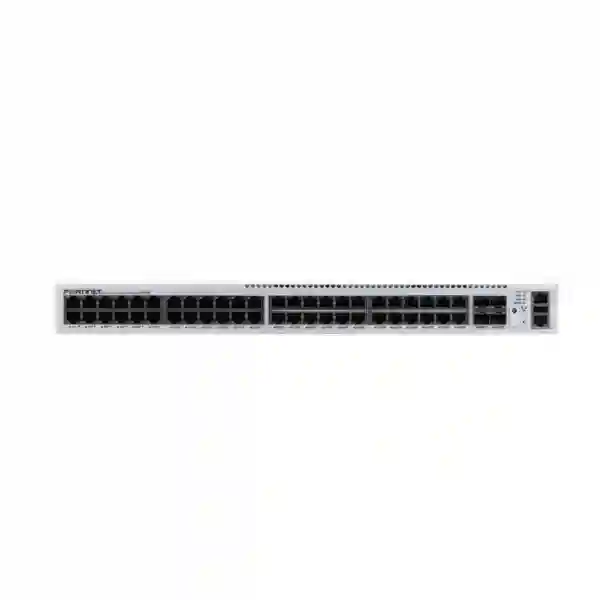
FortiSwitch FS-348G Tanzania
Fortinet FortiSwitch FS-348G gives organizations a dense, multi-gigabit access switching platform for business networks that are moving beyond traditional one-gigabit edge connectivity. The model combines 24 x 1GE RJ45 ports, 24 x 2.5GE RJ45 ports and 4 x 10GE SFP+ interfaces, allowing network teams to connect conventional endpoints and higher-speed devices while preserving fast uplink capacity. The FS-348G is the non-PoE model, making it particularly relevant where powered endpoints use separate power sources or where PoE is supplied through another switching layer.
FortiSwitch FS-348G Overview
The FS-348G belongs to Fortinet’s FortiSwitch 3xx family and is designed for organizations that need substantial copper access density with a mix of standard Gigabit Ethernet and 2.5 Gigabit Ethernet. This port combination helps IT teams modernize a LAN without forcing every connected endpoint onto the same speed. Existing desktops, printers, controllers and business appliances can remain on 1GE interfaces while workstations, wireless infrastructure, storage-facing devices or other compatible equipment can use 2.5GE links where the network design requires additional access-layer bandwidth.
Four 10GE SFP+ interfaces provide flexible uplink options for aggregation, server-room connectivity or links toward the network core. Actual topology should be planned around traffic patterns, redundancy goals, transceiver compatibility, cable plant and the capabilities of the upstream equipment. Fortinet documentation also supports FortiSwitch operation in standalone mode or through Fortinet management options, including FortiGate-integrated management, FortiEdge Cloud and FortiSwitch Manager. That flexibility makes the platform useful for organizations standardizing on the Fortinet ecosystem as well as teams evaluating a controlled transition from independently managed switching.
24 x 1GE RJ45
Connect standard Gigabit Ethernet endpoints without consuming multi-gigabit ports unnecessarily.
24 x 2.5GE RJ45
Provide higher access-layer bandwidth for compatible endpoints and modern LAN designs.
4 x 10GE SFP+
Plan fast fiber or DAC uplinks according to distance, media and upstream equipment requirements.
Non-PoE Model
FS-348G does not provide PoE. Buyers needing powered access ports should evaluate the appropriate FPOE variant separately.
Why Businesses Consider the FS-348G
Access networks increasingly carry mixed device types. A business may have ordinary desktop PCs, high-performance engineering workstations, Wi-Fi infrastructure, IP-based building systems, servers, security appliances and specialized operational devices on the same campus. A switch with both 1GE and 2.5GE copper ports gives designers more freedom to place bandwidth where it matters. Instead of replacing every endpoint or overbuilding the entire access layer, teams can reserve multi-gigabit ports for devices that can benefit from them.
The 10GE SFP+ interfaces are equally important during sizing. Forty-eight copper access ports can aggregate considerable traffic, so uplink planning should consider application usage, east-west traffic, internet capacity, virtualization, backups, cloud access and peak demand. Procurement teams should therefore evaluate the FS-348G as part of a complete LAN design rather than only by port count. FourTeck can help translate endpoint counts, uplink needs, rack layout and Fortinet integration requirements into a quotation scope.
Technical Planning and Compatibility
| Item | Verified / Planning Detail |
|---|---|
| Model | Fortinet FortiSwitch FS-348G |
| Copper access ports | 24 x 1GE RJ45 plus 24 x 2.5GE RJ45 |
| High-speed interfaces | 4 x 10GE SFP+ |
| PoE | Not provided on FS-348G |
| Management approach | Standalone or supported Fortinet management architecture, depending on deployment design |
Before ordering, confirm the exact transceivers or direct-attach cables required for each SFP+ connection. Fiber type, distance, connector standard and upstream switch compatibility matter. Also document VLAN requirements, link aggregation needs, spanning-tree design, management addressing, authentication strategy and whether the switch will participate in a FortiGate-managed FortiLink environment. These decisions influence both the bill of materials and implementation scope.
Related FourTeck Network Resources
Organizations building a broader Fortinet architecture can review FourTeck Fortinet UAE resources for Fortinet-focused solution context, Fortinet Kenya for regional procurement guidance, and FourTeck Uganda for East African project requirements. Businesses with multi-country operations can also use FourTeck Ghana and FourTeck Nigeria when coordinating network projects across African markets. For broader infrastructure and technology sourcing, visit FourTeck global solutions.
FortiSwitch FS-348G Tanzania
For Tanzania organizations, the FS-348G is relevant when the LAN needs more than a basic 48-port Gigabit switch. A typical buying requirement may come from a head office refreshing its access layer, a campus adding multi-gigabit endpoints, a hospitality property improving wired capacity, a healthcare organization separating clinical and administrative traffic, or a technology team building a standardized Fortinet network. The mix of 24 one-gigabit and 24 2.5-gigabit copper ports lets the designer assign ports according to endpoint capability instead of paying for unnecessary speed everywhere.
Tanzania procurement teams should begin with a port schedule. Record each endpoint, its required speed, VLAN, rack location, power method and expected growth. Because the FS-348G is not a PoE switch, devices such as access points, cameras and IP phones that require switch-delivered power need another power strategy. That distinction should be resolved before purchase. If a large proportion of endpoints require PoE, compare the correct FortiSwitch powered variant rather than assuming the FS-348G will energize those devices.
Uplink planning is another important step. The four 10GE SFP+ interfaces can support high-speed connectivity toward aggregation or core infrastructure, but the exact design depends on traffic, redundancy and physical distance. A business with heavy local file transfers, virtualization, backups or high-density wireless traffic may place different demands on uplinks than a branch dominated by internet and cloud traffic. FourTeck Tanzania can use those requirements to help structure a quotation and identify related Fortinet components. Buyers should request current commercial terms, availability and implementation scope rather than relying on static online assumptions.
FortiSwitch FS-348G Dar es Salaam
Dar es Salaam businesses often operate dense office environments, commercial facilities, hospitality sites, logistics operations and multi-floor buildings where a high port count can simplify access-layer consolidation. The FS-348G offers 48 copper access interfaces split between 1GE and 2.5GE, giving network architects room to separate ordinary office endpoints from devices that justify multi-gigabit connectivity. This is useful during phased upgrades because existing Gigabit equipment can continue operating while newer compatible systems are assigned to faster ports.
A Dar es Salaam project should assess the building cabling before assuming that every endpoint will achieve the desired speed. Cable category, termination quality, distance and patching condition can affect results. Rack power, cooling, UPS capacity and uplink fiber routes should also be documented. Where the network uses FortiGate security, FortiSwitch can be considered within a coordinated Fortinet architecture, but management mode and topology should be selected deliberately rather than treated as an automatic default.
For quotation preparation, provide the number of switches, required SFP+ optics or DACs, rack location, existing firewall and core-switch models, VLAN count, endpoint mix and whether deployment assistance is required. Also specify whether any connected equipment requires PoE. The standard FS-348G does not provide it, so that requirement can materially change model selection. A clear project brief helps procurement compare the complete installed solution rather than only the switch chassis price.
FortiSwitch FS-348G Mwanza
Organizations in Mwanza evaluating the FS-348G may be planning office expansion, a server-room refresh, a new campus segment or improved access for bandwidth-sensitive applications. The model’s mixed-speed port design supports a practical migration strategy: maintain standard 1GE connectivity for routine endpoints while reserving 2.5GE ports for compatible devices that need greater access bandwidth. This approach can help avoid unnecessary replacement of working endpoint equipment during a network modernization project.
Network resilience should be considered alongside port density. The four 10GE SFP+ interfaces can be incorporated into an uplink strategy, but designers need to decide how links are distributed, whether redundancy is required and what upstream equipment supports. Fiber route length, optical module selection and patch-panel standards should be confirmed before the bill of materials is finalized. If multiple switches are being deployed, document how access, aggregation and security layers interact so that capacity and failure domains remain understandable.
Mwanza buyers should also distinguish switching requirements from endpoint power requirements. The FS-348G is non-PoE. A network with many cameras, phones or wireless access points may need powered switching elsewhere, local injectors, or evaluation of a suitable PoE FortiSwitch model. FourTeck can help build a quotation around the actual topology, including switching, security and related network components, while current price and availability should be confirmed at the time of purchase.
FortiSwitch FS-348G Arusha
Arusha businesses in hospitality, professional services, education, healthcare and other sectors can use a multi-gigabit access switch when ordinary Gigabit switching no longer matches every endpoint. The FS-348G’s combination of 1GE and 2.5GE copper ports provides flexibility for mixed estates. A hotel, for example, may have back-office computers and controllers that need only 1GE while other infrastructure benefits from faster wired access. An office campus can use the same principle to allocate higher-speed ports selectively.
Good sizing starts with traffic rather than simply counting sockets. Teams should identify applications that exchange significant local data, internet-dependent workloads, backup windows, server access, voice and video usage and wireless traffic that may traverse the wired LAN. The four 10GE SFP+ ports can then be planned as part of the uplink design. Redundancy and aggregation choices should match the capabilities of the upstream network and the organization’s operational requirements.
For an Arusha procurement request, include the desired management model. Fortinet documents standalone FortiSwitch operation as well as management within supported Fortinet environments. Businesses already using FortiGate may value an integrated design, while other projects may have different operational constraints. FourTeck can help review this architecture before quotation. Buyers should also explicitly state any PoE needs because FS-348G itself does not deliver PoE to connected devices.
FortiSwitch FS-348G Dodoma
In Dodoma, the FS-348G can fit network refresh projects where administrators need many copper access ports and a controlled path toward multi-gigabit connectivity. Government-related organizations, education environments, professional offices and growing enterprises may have a mixture of older and newer endpoint capabilities. Splitting access between 24 x 1GE and 24 x 2.5GE ports allows the switch to support that mixed environment without treating every connection identically.
A project team should map each department, VLAN and device category before deployment. This makes it easier to reserve faster ports for appropriate endpoints, plan security segmentation and estimate uplink demand. The four 10GE SFP+ interfaces can connect toward aggregation or other compatible infrastructure, subject to correct optics, media and topology. Documentation should include port labels, VLAN assignments, uplink purpose, management addressing and change-control procedures so the installed network remains supportable after handover.
Procurement should also include lifecycle considerations such as support requirements, firmware planning, spare strategy and configuration backup. Current Fortinet documentation lists FS-348G among supported FortiSwitch models. FourTeck can help prepare a commercial quotation and deployment scope for Dodoma requirements. Availability, delivery arrangements and support terms should be confirmed for the specific order rather than assumed from general product information.
FortiSwitch FS-348G UAE
For UAE projects, FS-348G can serve organizations requiring dense multi-gigabit access connectivity in offices, campuses, commercial buildings and technology environments. Its 48 copper ports are deliberately mixed: half provide 1GE and half provide 2.5GE. This can be valuable in refresh projects where businesses need to preserve compatibility with ordinary Gigabit endpoints while increasing bandwidth for selected modern devices. Four 10GE SFP+ interfaces support high-speed uplink planning toward compatible aggregation or core infrastructure.
UAE buyers commonly need a precise bill of materials, so the request should identify transceiver types, fiber distances, rack requirements, management approach and integration with existing Fortinet infrastructure. The standard FS-348G is non-PoE, an important distinction for projects involving wireless access points, surveillance cameras or IP phones. If powered access is required, the correct FortiSwitch powered variant should be evaluated independently rather than mixing specifications between models.
Multi-site organizations can coordinate standards across locations by documenting VLAN templates, uplink design, naming conventions, management access and firmware procedures. For Fortinet-specific regional context, buyers can review FourTeck Fortinet UAE. Final price, availability, logistics and support scope should be requested against the exact project bill of materials.
FortiSwitch FS-348G Uganda
Uganda organizations considering FS-348G may be consolidating access switching, upgrading office bandwidth or standardizing a Fortinet-based branch and campus design. The model’s combination of 1GE and 2.5GE ports is useful when the endpoint estate is mixed. Existing office devices can remain on Gigabit links while compatible systems with higher throughput needs can use the 2.5GE interfaces. This creates a practical migration path without requiring every device to be replaced at the same time.
For distributed businesses, switching should be designed together with firewall, WAN and wireless architecture. FortiSwitch can participate in supported Fortinet management designs, while standalone deployment is also documented. The right choice depends on existing equipment, operational processes and the desired level of centralized control. Uplink design should account for the four 10GE SFP+ interfaces and the capabilities of upstream devices.
Uganda buyers can review FourTeck Uganda for regional technology sourcing context. A useful quotation request should state switch quantity, endpoint count, required uplinks, optics, rack location, management model and any deployment services. Because FS-348G has no PoE, identify powered endpoint requirements before selecting the final switch mix.
FortiSwitch FS-348G Kampala
Kampala offices, schools, hotels, financial operations and multi-floor commercial sites can encounter access-layer bottlenecks as wireless and wired endpoints become faster. FS-348G provides a way to combine standard Gigabit access with 2.5 Gigabit access in one 48-port platform. This is useful where only part of the endpoint population needs multi-gigabit performance. IT teams can allocate ports based on device capability and application demand rather than applying the same speed profile across the entire floor.
The four 10GE SFP+ ports should be treated as part of the architecture, not simply as spare interfaces. A design should determine whether they connect to a core switch, aggregation layer, server environment or another compatible device, and whether links require redundancy. Optics, fiber type and distance must be checked against the final topology. Where FortiGate is already present, teams can also evaluate a Fortinet-integrated management model.
Kampala procurement teams should provide a clear equipment schedule and avoid assuming PoE capability. The FS-348G is non-PoE. If phones, cameras or access points depend on switch power, include that requirement in the request so an appropriate powered solution can be quoted. This simple distinction prevents a common mismatch between port-count requirements and endpoint-power requirements.
FortiSwitch FS-348G Arua
Arua organizations planning new network rooms or replacing older access switches can consider FS-348G when they need high copper port density and a mixture of conventional and multi-gigabit Ethernet. The 24 one-gigabit ports suit many ordinary business endpoints, while the 24 2.5-gigabit ports can be assigned to compatible higher-bandwidth systems. This helps create a balanced design that supports present requirements and selected future upgrades.
Implementation planning should account for the complete physical path. Patch panels, horizontal cabling, rack layout, UPS capacity and uplink media all affect a successful deployment. The four 10GE SFP+ interfaces provide high-speed connectivity options, but the exact modules and link design should be selected only after distances and upstream equipment are known. Administrators should also decide how configurations will be backed up and who will manage firmware and access controls.
For Arua quotations, list endpoint types and explicitly identify any devices requiring PoE. FS-348G does not supply PoE. Where powered devices are numerous, a different or mixed switch design may be more appropriate. FourTeck Uganda resources can support regional procurement discussion, while commercial terms and logistics should be confirmed for the actual order.
FortiSwitch FS-348G Mbarara
Mbarara businesses can evaluate FS-348G for office, education, healthcare, hospitality and commercial LAN projects that need more flexibility than a conventional all-1GE access switch. Its split between 1GE and 2.5GE copper ports lets the network team place higher-speed capacity where it has a measurable purpose. That may include compatible workstations, infrastructure devices or other endpoints whose traffic profile warrants additional access bandwidth.
The switch should be sized within the broader network. If many access ports are active simultaneously, uplink demand may become important, especially during backups, large file transfers or local application use. Four 10GE SFP+ interfaces provide options for high-speed uplinks, subject to correct topology and compatible media. VLAN segmentation, spanning-tree behavior, link aggregation and management access should be documented before installation.
Mbarara buyers should also determine whether the project expects switch-powered devices. FS-348G is not a PoE model. A network with significant IP telephony, CCTV or wireless access point requirements may need powered switching as part of the design. Providing those details during quotation reduces the risk of ordering a switch that meets port count but not endpoint power requirements.
FortiSwitch FS-348G Gulu
For Gulu organizations, FS-348G can support network expansion where 48 copper connections are needed and some endpoints are moving to multi-gigabit speeds. Rather than replacing an entire access strategy at once, administrators can use the 1GE ports for conventional equipment and reserve 2.5GE ports for compatible higher-bandwidth endpoints. This is useful in phased modernization projects where budgets, cabling and endpoint refresh cycles do not all change simultaneously.
The network plan should define uplink capacity and resilience. Four 10GE SFP+ interfaces are available, but actual use depends on the core or aggregation architecture. If links cross buildings or long distances, fiber type and optics must be specified correctly. If the switch is installed in a local rack, power protection, ventilation and physical security should be included in the deployment checklist.
Fortinet management options give organizations flexibility in how FortiSwitch is operated. Teams already using FortiGate can evaluate integrated management, while other environments may select standalone or another supported management approach. Gulu procurement requests should state this preference and include any required implementation assistance. The non-PoE nature of FS-348G should be confirmed against endpoint requirements before purchase.
FortiSwitch FS-348G Kenya
Kenya enterprises can use FS-348G in campus, branch, office and commercial networks where mixed-speed access provides a practical upgrade path. With 24 x 1GE and 24 x 2.5GE RJ45 ports, the switch can accommodate ordinary Gigabit devices and selected multi-gigabit endpoints in the same access platform. Four 10GE SFP+ interfaces support faster uplinks toward compatible aggregation or core equipment.
A Kenya deployment should be planned around endpoint density, cabling, application traffic and security architecture. Businesses using FortiGate can consider how FortiSwitch management integrates into their Fortinet environment, while standalone operation remains another documented option. If multiple offices are being standardized, consistent VLAN naming, port templates and configuration backup procedures can reduce operational complexity.
For local Fortinet solution context, review Fortinet Kenya from FourTeck. Procurement teams should request the exact switch model, compatible uplink components and required services. Remember that FS-348G is the non-PoE model, so powered endpoint requirements should be addressed separately. Current price, availability and delivery planning should be confirmed when the quotation is prepared.
FortiSwitch FS-348G Kuwait
Kuwait organizations evaluating high-density access switching can consider FS-348G where a combination of standard Gigabit and 2.5 Gigabit Ethernet fits the endpoint mix. The model allows network designers to reserve multi-gigabit capacity for compatible systems while continuing to support a large population of conventional devices. This can make a phased refresh easier to budget and manage than replacing all access connectivity with a single higher-speed profile.
The four 10GE SFP+ interfaces can form part of the uplink strategy to compatible aggregation or core infrastructure. Designers should verify optical or DAC requirements, distance, redundancy and traffic demand before selecting accessories. Environmental and rack planning also matters: document power protection, cooling, patching and cable management so the finished installation remains serviceable.
For regional technology sourcing, organizations can review FourTeck Kuwait. A quotation request should include the required quantity, uplink media, existing firewall and core equipment, management preference and implementation scope. If the network needs PoE for access points, phones or cameras, note that FS-348G itself is non-PoE and evaluate the appropriate powered switching option.
FortiSwitch FS-348G Ghana
Ghana businesses modernizing LAN infrastructure can evaluate FS-348G when they need a dense 48-port access platform with a blend of 1GE and 2.5GE copper connectivity. The mixed port arrangement supports gradual modernization: standard office endpoints remain on Gigabit Ethernet while selected compatible systems receive higher access speed. Four 10GE SFP+ interfaces provide options for high-speed uplinks as part of a properly sized network.
Network planners should consider whether traffic remains local, travels to servers, crosses a WAN or primarily accesses cloud services. Those patterns influence uplink design and segmentation. Businesses should also define VLANs, management access, redundancy goals and monitoring procedures before deployment. Where Fortinet security infrastructure is already in use, the switch can be evaluated as part of a coordinated Fortinet management architecture.
Visit FourTeck Ghana for regional project context. Procurement teams should include endpoint power needs in the request because the FS-348G does not provide PoE. This is particularly important for projects involving cameras, IP phones or wireless access points. Confirm current commercial terms and required accessories against the final design.
FortiSwitch FS-348G Nigeria
Nigeria organizations with expanding offices, campuses and commercial networks can consider FS-348G for access-layer designs that require both conventional Gigabit and multi-gigabit copper connectivity. The switch provides 24 ports of each type, enabling teams to allocate faster connections selectively. This can support modernization without forcing a simultaneous upgrade of every connected endpoint.
High-speed uplinks should be planned around the four 10GE SFP+ interfaces. Designers should document the destination of each uplink, required redundancy, fiber or DAC medium and compatible modules. If several access switches converge on the same aggregation layer, total capacity and failure behavior should be reviewed as part of the project rather than evaluating each switch independently.
Regional buyers can visit FourTeck Nigeria for broader sourcing context. FS-348G does not provide PoE, so the endpoint inventory should clearly distinguish data-only devices from equipment that requires switch power. A complete quotation request should also include management preferences, FortiGate integration requirements, rack location and deployment services so the commercial proposal reflects the full project.
FortiSwitch FS-348G Seychelles
Seychelles businesses in hospitality, professional services and distributed commercial environments can consider FS-348G when a site requires many wired connections and selected multi-gigabit endpoints. The mix of 1GE and 2.5GE copper ports helps match interface speed to actual device requirements, while the four 10GE SFP+ ports support higher-speed uplink design. This is useful when network modernization must coexist with an installed base of conventional Gigabit equipment.
For island deployments, careful project preparation can be especially valuable. The bill of materials should include the exact switch model, compatible optics or DACs, spare considerations, rack accessories and any other components needed for installation. Confirm cabling condition and fiber distances before ordering so the selected interfaces match the physical site. Configuration documentation and backup procedures should be part of handover planning.
The FS-348G is non-PoE, so powered endpoint requirements must be addressed separately. If a hospitality network has numerous access points, phones or cameras, the overall design may combine different switch types or use an appropriate PoE model. FourTeck can help structure a quotation around the complete topology, while price, availability, logistics and support terms should be confirmed for the specific Seychelles project.
Deployment and Buying Guidance
Start by counting endpoints, but do not stop there. Classify each endpoint by speed, power requirement, VLAN, expected traffic and physical location. Determine which devices genuinely need 2.5GE and which are adequately served by 1GE. Identify uplink destinations and decide whether 10GE connections require fiber optics or direct-attach cabling. Record distances and connector types. If the network uses FortiGate, document whether FortiLink-managed switching is part of the intended architecture.
Next, evaluate resilience. Decide whether a single uplink is acceptable or whether redundant paths are required. Review the upstream switch capacity and the consequences of an access-switch or uplink failure. Establish configuration backup, administrator access and firmware processes. These operational details are as important as the physical port count because they determine how easily the network can be supported after installation.
Finally, prepare the procurement request with exact model, quantity, required uplink accessories, support expectations and deployment scope. Do not assume stock, delivery dates, warranty terms or pricing from general web information; request current commercial confirmation. If PoE is required, state it explicitly so the non-PoE FS-348G is not selected where a powered access switch is needed.
Quotation Checklist
✓ Count of 1GE and 2.5GE endpoints
✓ PoE endpoint count, if any
✓ VLAN and segmentation requirements
✓ SFP+ optics or DAC requirements
✓ Existing FortiGate/core switch details
✓ Rack, UPS and cabling information
✓ Installation/configuration scope
✓ Redundancy requirements
✓ Support and documentation needs
FortiSwitch FS-348G FAQ
How many ports does the FortiSwitch FS-348G have?
Fortinet lists 24 x 1GE RJ45 ports, 24 x 2.5GE RJ45 ports and 4 x 10GE SFP+ interfaces for FS-348G.
Does FS-348G support PoE?
No. The FS-348G is listed as non-PoE. Buyers needing switch-delivered power should evaluate the correct powered FortiSwitch variant based on endpoint requirements.
Can FortiSwitch FS-348G be managed with FortiGate?
Fortinet documents FortiSwitch deployment in standalone mode and supported Fortinet-managed approaches, including FortiGate-integrated management. The correct management architecture should be selected for the specific network.
Why are 2.5GE ports useful?
They provide more access-layer bandwidth than 1GE for compatible devices. Whether that speed is useful depends on endpoint capability, cabling and application traffic.
What should I provide for an FS-348G quote?
Provide switch quantity, endpoint counts and speeds, PoE requirements, uplink design, optics or DAC needs, existing Fortinet equipment, rack location, management preference and required implementation services.
Decision Recap
Choose FS-348G when the design specifically benefits from 24 x 1GE plus 24 x 2.5GE copper access ports, four 10GE SFP+ interfaces and a non-PoE switching profile. Before purchase, validate endpoint power needs, cabling, uplinks, Fortinet management architecture and required accessories. This avoids the common mistake of selecting by port count alone.
Consult FourTeck Tanzania
Share your endpoint list, network diagram or project brief with FourTeck Tanzania for FS-348G quotation planning. The discussion can cover model fit, uplink requirements, Fortinet integration, related switching and security components, and implementation scope. Commercial price, availability and logistics can then be confirmed against the exact bill of materials.




Reviews
There are no reviews yet.