
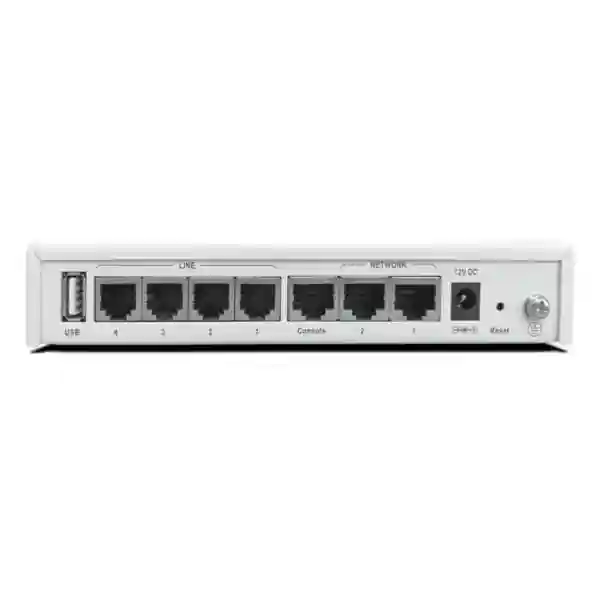
FortiVoice Gateway FVG-GO04 Tanzania
The FortiVoice Gateway FVG-GO04 is an FXO voice gateway for organizations that need to bring traditional analog telephone lines into an IP-based business communications environment. Fortinet identifies the model as a four-port FXO gateway with two 10/100 RJ45 network interfaces, a USB port and a console port. In practical terms, it gives a business a controlled point at which conventional telephone services can meet a FortiVoice or compatible SIP-server-enabled PBX deployment. This makes it relevant when an organization is modernizing telephony but still depends on analog trunks, wants to preserve selected PSTN services, or needs a gateway layer between legacy line infrastructure and a newer IP PBX architecture.
Four traditional analog telephone lines can be presented to the gateway, matching Fortinet’s published GO04 hardware specification.
Dual Fast Ethernet network interfaces support connection of the gateway into the business network used by the voice platform.
Fortinet documents management by FortiVoice 100E and larger systems and FortiVoice-VM-100 and larger systems.
What the FortiVoice Gateway FVG-GO04 Does
An FXO gateway is useful when the telephone service arriving at a site is an analog carrier line but the organization wants calls to participate in an IP PBX workflow. The FVG-GO04 provides four FXO interfaces for that purpose. Fortinet’s deployment documentation explains that the FXO gateway works with a FortiVoice phone system to expand resources and support additional analog phone lines. The gateway can be deployed on the same LAN as the FortiVoice phone system or, according to Fortinet documentation, over a VPN. This gives solution designers useful flexibility when planning a head office, branch, remote facility or phased migration from conventional telephony.
The value of the gateway is not simply the number of ports. It is the ability to retain required analog line connectivity while moving call control toward a modern PBX environment. Businesses can therefore plan migrations around actual operational requirements rather than assuming every existing carrier line must be replaced immediately. Before procurement, confirm the exact FortiVoice platform, firmware compatibility, network design, line presentation and dial-plan requirements. FourTeck can use those details to help prepare an appropriate quotation and deployment discussion.
Verified Hardware and Platform Facts
| Item | FVG-GO04 |
|---|---|
| Gateway type | FXO voice gateway |
| Traditional telephone lines | 4 × FXO |
| Network interfaces | 2 × 10/100 RJ45 |
| Other interfaces | 1 × USB, 1 × console |
| Managed gateway compatibility documented by Fortinet | FortiVoice 100E and larger; FortiVoice-VM-100 and larger |
Deployment and Buying Guidance
Start with the lines, not the box. Count how many analog carrier lines must remain active, identify how inbound calls are routed today, document outbound dialing requirements and determine whether those lines are business-critical, fallback-only or used for a specific workflow. The GO04 provides four FXO ports, so the requirement should fit within that physical capacity. If the requirement is larger, compare the design with other supported gateway options rather than assuming multiple units are automatically the best architecture.
Next, verify the PBX environment. Fortinet’s current FXO deployment guidance identifies FortiVoice 100E and larger and FortiVoice-VM-100 and larger as systems that can manage an FXO gateway, while noting that the 100E itself has reached end-of-order. Buyers should therefore provide their exact PBX model and software version during quotation. This prevents a hardware-only purchase from being treated as a complete solution without compatibility review.
Finally, plan the network and voice cutover. Decide whether the gateway and FortiVoice system will be on the same LAN or connected through an approved VPN design, reserve appropriate addressing, identify the analog demarcation point, and document inbound and outbound dial plans. Testing should cover incoming calls, outgoing calls, caller handling, expected failover behavior and the operational process for troubleshooting. A clear acceptance checklist is especially valuable when replacing an existing analog-to-PBX path.
Related FourTeck Resources
For broader regional technology procurement, visit FourTeck Tanzania. Organizations coordinating projects outside Tanzania can also review FourTeck Uganda, FourTeck Kenya, FourTeck UAE and FourTeck Africa. These links are useful when a voice project spans multiple offices and procurement teams need a common technology discussion across markets.
FortiVoice Gateway FVG-GO04 Tanzania
For organizations sourcing the FortiVoice Gateway FVG-GO04 in Tanzania, the strongest starting point is a line-and-PBX assessment. The product is specifically a four-port FXO gateway, so it suits requirements where up to four traditional analog telephone lines need to be connected into the voice environment. Typical projects may include a business retaining existing PSTN lines during an IP telephony migration, a site that requires analog carrier connectivity for selected inbound numbers, or an office that wants those lines controlled through a FortiVoice-based architecture. The purchase discussion should identify the exact FortiVoice system, software version, number of active analog lines and desired call flows.
Tanzanian deployments can vary considerably between head offices, branches, hospitality environments, education sites, healthcare facilities and distributed commercial operations. The gateway should therefore be selected as part of the communications design rather than from port count alone. Confirm where the carrier lines terminate, where the FortiVoice platform is located, whether the gateway will share the same LAN, and whether a VPN-connected design is being considered. Fortinet documentation supports same-LAN or VPN topology for its FXO gateway, but the actual network path still needs appropriate routing, security and quality planning.
When requesting a Tanzania quotation, provide the required quantity, destination, PBX model, number of analog lines, current topology and whether FortiCare is required. Ask for the exact commercial SKU and support term to be shown clearly on the quotation. Pricing and availability should be confirmed at the time of enquiry rather than inferred from overseas reseller listings. A well-defined request allows the supplier to distinguish hardware, support and any implementation requirements and gives the customer a cleaner basis for procurement approval.
FortiVoice Gateway FVG-GO04 Dar es Salaam
Businesses in Dar es Salaam evaluating the FVG-GO04 often have a practical modernization question: how can existing analog telephone services remain usable while the organization moves toward IP-based call control? The GO04 addresses that specific interface requirement with four FXO ports. It can be relevant to corporate offices, professional services firms, hotels, logistics companies, retail operations and other sites where existing public telephone lines still form part of the communications plan. Procurement should begin by documenting the carrier lines and the business functions attached to them.
For a Dar es Salaam head office, map every incoming number to the intended destination in the PBX. Identify reception queues, departmental numbers, after-hours behavior and outbound line selection. If the gateway is being introduced during a PBX replacement, plan a staged test so users can validate call routing before the old arrangement is retired. The two 10/100 RJ45 interfaces are part of the published hardware configuration, but network placement, addressing and switching should be designed around the wider voice system rather than treated as a generic data connection.
A useful quotation request should state whether the deployment is new, an expansion or a replacement. Include the FortiVoice model and firmware, line count, branch connectivity and desired support period. If the site uses a centralized FortiVoice platform with remote locations, explain that topology so the gateway’s location can be considered correctly. FourTeck can then discuss the hardware requirement in context without making assumptions about carrier services, local stock or installation scope. This is particularly important for procurement teams that need an auditable bill of materials and a clear distinction between appliance, support and deployment services.
FortiVoice Gateway FVG-GO04 Mwanza
In Mwanza, the FortiVoice Gateway FVG-GO04 can be considered where an organization needs to preserve analog line access while operating a FortiVoice or SIP-enabled PBX environment. The gateway is not an extension appliance for analog handsets; its four FXO interfaces are intended for traditional telephone lines. That distinction matters during procurement because FXS and FXO gateways solve different problems. A buyer should confirm that the requirement is to connect carrier-side analog lines into the PBX rather than to connect analog endpoint devices.
For a Mwanza branch linked to a central communications platform, topology deserves particular attention. Fortinet documents that its FXO gateway can be configured on the same LAN as the FortiVoice phone system or over a VPN. A remote design should still be reviewed for routing, security, latency, operational recovery and the dependency between the branch gateway and central PBX. The objective is to ensure that the analog line integration behaves predictably in normal operations and that administrators understand what happens if connectivity between locations is interrupted.
Before ordering, prepare a simple voice inventory: four or fewer analog lines for a single GO04 requirement, the numbers attached to those lines, inbound destinations, outbound dialing rules, PBX model, network addressing plan and support expectations. This information helps avoid a common purchasing mistake in which a gateway is ordered before anyone has confirmed how the existing line service is presented. For Mwanza customers, quotation discussions should also specify delivery destination and project schedule while treating availability and lead time as items to be confirmed by sales rather than assumed in advance.
FortiVoice Gateway FVG-GO04 Arusha
Arusha organizations may use an FXO gateway when traditional telephone lines remain operationally useful alongside an IP PBX. The FVG-GO04 provides four FXO interfaces and is therefore most appropriate when the design calls for a small, clearly defined set of analog trunks. Hospitality, tourism, administration, education and commercial offices may all have different call-flow needs, so the key question is not simply whether analog lines exist but how those lines should participate in the new communications system.
For example, a site may want incoming calls on an established public number to reach an automated attendant or reception group in FortiVoice. Another deployment may reserve an analog line for a particular department or outbound route. These are dial-plan decisions that should be documented before configuration. Fortinet’s gateway administration approach allows rules to be created so calls associated with gateway FXO ports communicate with the SIP-server-enabled PBX. The final configuration should be validated against the organization’s actual call policy.
Arusha procurement teams should ask for the FVG-GO04 hardware and any required FortiCare term to be identified separately. Confirm compatibility with the installed FortiVoice platform and version, especially where an older appliance is in use. The quotation request should also state whether configuration assistance is required. FourTeck can use this information to frame a more accurate commercial response. Customers should avoid relying on foreign web prices because those listings may reflect different support bundles, taxes, shipping assumptions and market conditions and do not establish Tanzania pricing or availability.
FortiVoice Gateway FVG-GO04 Dodoma
For Dodoma deployments, the FortiVoice Gateway FVG-GO04 is relevant where four or fewer traditional analog telephone lines need to feed a modern voice platform. Government-adjacent organizations, professional offices, institutions and businesses often require structured procurement documentation, so the product should be specified by its actual function: a four-port FXO voice gateway with two 10/100 network ports, USB and console connectivity. This avoids ambiguity with FortiVoice FXS gateway models designed for a different analog interface role.
A strong technical request for proposal should describe the existing line environment, target PBX, expected call routes and management model. If the gateway is to be managed by FortiVoice, confirm the platform against Fortinet’s documented support. Fortinet currently identifies FortiVoice 100E and larger and FortiVoice-VM-100 and larger for managed FXO gateway deployments, while separately noting the 100E’s end-of-order status. Organizations with legacy systems should therefore validate lifecycle and software considerations rather than basing a new purchase on historical compatibility alone.
During acceptance, test each analog line individually and then test the intended PBX behavior. Record inbound routing, outbound dialing, caller presentation where applicable and administrative visibility. A deployment checklist should also capture IP addressing, gateway association, configuration backup and responsible support contacts. For Dodoma buyers, this disciplined approach makes the gateway easier to evaluate as part of a complete communications project and provides procurement reviewers with clear evidence of why the device is required.
FortiVoice Gateway FVG-GO04 UAE
In the UAE, the FVG-GO04 addresses the same core technical requirement: connecting up to four traditional analog telephone lines to a FortiVoice or SIP-enabled PBX environment. Multi-site organizations may encounter analog services at selected offices even when their wider communications platform is IP-based. The gateway offers a defined migration and integration point without requiring those analog lines to be treated as IP trunks themselves. Buyers should confirm that the carrier-side service is technically appropriate for an FXO interface.
For UAE projects, commercial teams often coordinate centralized IT standards across branches. Record the FortiVoice model, gateway quantity, analog line count and network topology for each site rather than applying one generic design to every location. If the gateway is remote from the FortiVoice system, document the VPN and routing assumptions. Security teams should review the path as part of the wider voice architecture, and voice administrators should define inbound and outbound rules before cutover.
Organizations coordinating UAE procurement can review FourTeck UAE technology resources alongside the Tanzania project. A quotation should confirm the exact hardware and support bundle required, because reseller listings may show hardware-only and FortiCare-bundled variants with different commercial terms. Do not infer local stock or delivery dates from an international listing; request current confirmation for the destination and project schedule. This keeps the procurement record aligned with the actual market and deployment scope.
FortiVoice Gateway FVG-GO04 Uganda
Uganda organizations considering the FortiVoice Gateway FVG-GO04 should first establish whether their requirement is truly FXO. The GO04 is designed for four traditional analog telephone lines entering the voice system. It is not the model to choose merely because analog devices exist somewhere in the organization. Correctly identifying the line side of the requirement is essential for avoiding an FXS-versus-FXO purchasing error and for building a usable bill of materials.
Where a Ugandan site uses FortiVoice centrally, the gateway can provide a structured connection point for analog trunks. Fortinet documents same-LAN and VPN deployment possibilities for the FXO gateway, which can help when voice resources are distributed across sites. The network team should still validate reachability and security, while the voice team maps every line to its intended inbound and outbound behavior. If the gateway supports a continuity strategy, define the expected operational outcome explicitly instead of assuming analog connectivity automatically creates failover.
For procurement support across Uganda, customers can also consult FourTeck Uganda. Provide quantity, site, PBX model, software version, number of analog lines and desired support term when requesting pricing. This makes it easier to distinguish the base FVG-GO04 from FortiCare bundles and related services. Any installation, carrier coordination or on-site support requirement should be listed separately so the quotation can reflect the actual project rather than only the gateway appliance.
FortiVoice Gateway FVG-GO04 Kampala
Kampala businesses often operate mixed communications environments during technology transitions. If established analog telephone lines still need to reach a FortiVoice PBX, the FVG-GO04 provides four FXO ports for that integration. The model is especially straightforward when the number of retained analog trunks is small and known. Before ordering, verify whether all four lines are required immediately, whether future growth is expected and whether another gateway capacity would be more appropriate if the line count will exceed the GO04’s physical interfaces.
The deployment plan should identify where the gateway will sit in relation to the PBX and network. Two 10/100 RJ45 ports are part of the published GO04 hardware, but the logical network design remains a project decision. Administrators should assign addressing, confirm reachability, plan management access and document the association with the FortiVoice system. Voice testing should cover every carrier line and all critical inbound destinations, including reception, departments, automated attendants or other configured call paths.
Kampala buyers should also clarify support requirements at quotation stage. Fortinet publishes FortiCare contract options for the gateway, and commercial bundles can vary by term. Request the exact SKU and term rather than a generic description such as ‘GO04 with support.’ For a multi-office organization, include the site name and deployment role for each unit in the purchase documentation. That simple discipline reduces ambiguity during delivery, configuration and later support renewal.
FortiVoice Gateway FVG-GO04 Arua
For an Arua office or branch, the FVG-GO04 can provide the analog-line bridge needed when the organization has adopted centralized IP telephony but still receives service through traditional telephone lines. Its four FXO ports define the maximum analog line interfaces on the appliance. A branch assessment should record which lines are active, which public numbers they carry and what business process depends on each one before any migration work begins.
Remote-site planning should consider the dependency between the gateway and the FortiVoice phone system. Fortinet’s deployment guidance allows an FXO gateway to be on the same LAN or over a VPN, so a branch-to-central architecture is possible within supported design guidance. However, the organization should decide how voice operations are affected by WAN or VPN interruption and should document the intended recovery procedure. The gateway should be part of a deliberate network and telephony design rather than treated as a standalone analog adapter.
Arua procurement requests should state the destination, required quantity, FortiVoice platform, analog line count, support term and any configuration assistance required. If an organization is comparing the GO04 with an eight-port option, base that comparison on actual line capacity and growth rather than headline price. Confirm current commercial terms through a quotation, as online listings from other countries do not establish local pricing, tax, delivery or stock conditions. Clear input data gives sales and technical teams a better foundation for a suitable response.
FortiVoice Gateway FVG-GO04 Mbarara
Mbarara organizations that need to integrate a limited number of analog carrier lines with a FortiVoice deployment can evaluate the FVG-GO04 as a four-port FXO gateway. It is most useful when the legacy line requirement is understood and the organization wants those calls to participate in PBX routing rather than remain isolated on separate telephone equipment. The design process should begin with an inventory of telephone numbers, line usage and expected call destinations.
If the gateway is being introduced during a wider voice upgrade, schedule testing before decommissioning the previous path. Verify inbound calls on each line, outbound routing, business-hours and after-hours behavior, and administrative monitoring. FortiVoice Gateway documentation also describes call statistics and call detail records as usage-tracking capabilities, which can assist administrators in understanding calls traversing the gateway. Exact operational reporting should be validated against the deployed software version and configuration.
For Mbarara procurement, include the PBX model and firmware in the request because compatibility is part of a successful gateway project. If the existing system is older, lifecycle status may influence the broader architecture. Ask for the base hardware and required FortiCare option to be identified clearly. This helps finance and IT teams understand what is being purchased now and what support obligations may follow. Delivery and implementation expectations should be confirmed explicitly with the seller rather than assumed from product descriptions.
FortiVoice Gateway FVG-GO04 Gulu
The FortiVoice Gateway FVG-GO04 can support a Gulu branch that needs four or fewer traditional analog telephone lines connected into an IP PBX architecture. The product’s role is specific: terminate FXO-side analog lines and allow them to communicate with the SIP-server-enabled PBX according to configured rules. That makes it a focused infrastructure component rather than a complete phone system by itself. Buyers should plan it together with the PBX, network and carrier service.
A useful Gulu deployment worksheet should identify the line provider, number of active lines, PBX destination, network location, IP addressing and desired inbound and outbound behavior. Where the FortiVoice system is centralized elsewhere, include the inter-site connectivity design and verify the VPN path. The organization should also define who will administer the gateway and how configuration changes will be controlled after deployment. Clear ownership is important when voice and network responsibilities sit with different teams.
During procurement, avoid substituting a superficially similar analog gateway without checking the interface type and management requirement. The GO04’s published specification is four FXO ports and two 10/100 RJ45 interfaces. If that matches the design, request current pricing and support options for the exact FVG-GO04 SKU. If requirements exceed four lines, ask for a capacity review rather than assuming the same unit should simply be duplicated. This creates a more defensible technical and commercial decision.
FortiVoice Gateway FVG-GO04 Kenya
Kenyan organizations can consider the FVG-GO04 when existing analog telephone lines must be integrated into a FortiVoice-based communications environment. The four FXO interfaces suit smaller trunk requirements, branch deployments or specific legacy-line retention scenarios. The business case is strongest when there is a clear reason to keep those lines, such as established public numbers, migration sequencing or a defined operational dependency. The gateway then becomes a controlled bridge within the broader IP telephony plan.
For a Nairobi or regional branch connected to a central PBX, confirm whether the gateway will be local to the FortiVoice system or reached across a VPN. Fortinet documents both topology approaches. The network design should still account for addressing, routing, security policy and operational monitoring. The voice design should map every FXO port to the intended dial plan and establish how incoming and outgoing calls are handled. Testing should be documented before production cutover.
Cross-border procurement teams can review FourTeck Kenya for the Kenya-side technology discussion. When asking for an FVG-GO04 quotation, specify hardware quantity, support term, FortiVoice model, line count and site. If the project spans Tanzania and Kenya, keep a site-by-site bill of materials so gateways are associated with the correct PBX and line requirement. Current price, stock and delivery should be confirmed for each destination rather than generalized across markets.
FortiVoice Gateway FVG-GO04 Kuwait
For Kuwait projects, the FortiVoice Gateway FVG-GO04 is a four-port FXO gateway intended to connect traditional analog telephone lines with a SIP-enabled PBX environment. It may be useful in offices that retain analog services while standardizing call control on FortiVoice. The technical fit depends on the interface presented by the telephone service, the number of lines and the target PBX, so these items should be verified before purchase.
A structured design should distinguish carrier service from gateway configuration. The gateway provides the physical FXO interfaces, while administrators define how calls are passed to the PBX and how the voice system routes them onward. Network teams should plan the two 10/100 RJ45 interfaces within the appropriate management and voice topology. If the gateway is remote from the FortiVoice system, the VPN design and operational dependency should be reviewed in advance.
Kuwait buyers can coordinate regional enquiries through FourTeck Kuwait. Request a quotation that identifies the exact FVG-GO04 hardware and the required FortiCare option. If comparing multiple offers, normalize them by support term and included services instead of comparing only the headline price. Also provide the expected deployment date and destination so commercial teams can confirm current lead time and availability rather than relying on assumptions from international web listings.
FortiVoice Gateway FVG-GO04 Ghana
Ghanaian businesses evaluating the FVG-GO04 should frame the requirement around analog trunk integration. The appliance provides four FXO ports for traditional telephone lines and connects into the IP network through its published 10/100 RJ45 interfaces. It can help preserve selected legacy line services while call handling moves into a FortiVoice or SIP-enabled PBX environment. This is particularly relevant during staged modernization where replacing every carrier service at once is neither necessary nor desirable.
Before procurement, determine whether four FXO ports provide sufficient present and near-term capacity. Record the active numbers, inbound destinations and outbound usage. Confirm the FortiVoice model and version and decide whether the gateway will be on the same LAN or connected over a VPN. These details influence deployment planning and should be captured before a purchase order is raised. If a remote topology is proposed, document connectivity dependencies and troubleshooting ownership.
For Ghana-related regional sourcing, FourTeck Ghana can be referenced as part of the wider FourTeck network. A complete quotation request should state quantity, location, PBX platform, support term and any configuration or implementation assistance expected. Current price and availability should always be confirmed at enquiry time. This protects procurement teams from basing decisions on unrelated foreign-market prices or support bundles that may not match the intended deployment.
FortiVoice Gateway FVG-GO04 Nigeria
Nigeria deployments may involve headquarters, branches and distributed operational sites with different telephony histories. The FVG-GO04 is appropriate where a particular site needs up to four traditional analog telephone lines integrated with a FortiVoice or SIP-enabled PBX. Its role should be documented at each location because a gateway that fits a four-line branch may not be the right capacity for a larger head office. Treat line count and call flow as site-specific design inputs.
When a central FortiVoice system manages remote resources, review the network topology carefully. Fortinet’s FXO deployment documentation allows same-LAN or VPN-connected arrangements. A Nigerian multi-site project should therefore document which gateways are local and which depend on inter-site connectivity. Voice administrators should define inbound and outbound routing, while network administrators validate secure reachability. Operational teams should also know how to diagnose whether a call issue originates with the carrier line, gateway, network or PBX.
Regional procurement teams can consult FourTeck Nigeria for Nigeria-focused enquiries. Ask for the exact FVG-GO04 SKU and required FortiCare term, and identify any implementation scope separately. For large rollouts, provide a site schedule with gateway quantity and analog-line count for each location. This improves quotation accuracy and later deployment tracking. Do not assume stock, local engineering coverage or delivery times until those items are confirmed for the project.
FortiVoice Gateway FVG-GO04 Seychelles
In Seychelles, the FortiVoice Gateway FVG-GO04 can serve organizations that need to retain a small number of traditional analog telephone lines while operating an IP-based PBX. Hotels, professional offices, service businesses and institutions may have different reasons for retaining legacy lines, but the technical requirement is consistent: an FXO interface is needed between those lines and the voice platform. The GO04 supplies four such interfaces.
Island and remote-site deployments benefit from careful pre-configuration planning because logistics can make avoidable hardware mistakes more disruptive. Confirm the line interface, PBX compatibility, network addressing and call plan before shipment. If the FortiVoice system is in another location, review the VPN topology and connectivity dependency. Document the configuration and acceptance tests so local staff and remote administrators share the same understanding of how each analog line should behave.
A Seychelles quotation request should identify quantity, destination, FortiVoice model, software version, analog line count and support term. If spares or support coverage are part of the organization’s resilience policy, state that requirement explicitly rather than assuming it is included. Current availability and shipping should be confirmed at the time of purchase. This disciplined approach helps a relatively small gateway purchase fit cleanly into the wider communications architecture and procurement process.
Frequently Asked Questions
How many analog lines does the FVG-GO04 support?
Fortinet specifies four FXO ports for traditional analog telephone lines. If more than four lines are required, the gateway capacity and wider architecture should be reviewed before purchase.
Is the GO04 an FXS or FXO gateway?
It is an FXO gateway. This distinction is important: the GO04 is intended for traditional analog telephone lines. Fortinet has separate GS-series gateway models using FXS interfaces.
Which network ports are provided?
The Fortinet data sheet specifies two 10/100 RJ45 network interfaces, plus one USB port and one console port.
Can the gateway be remote from the FortiVoice system?
Fortinet’s FXO deployment guide states that the gateway can be configured on the same LAN as the FortiVoice phone system or over a VPN. The actual network and security design should be validated for the deployment.
What information should I send for a quote?
Provide the required quantity, destination, number of analog lines, FortiVoice model and software version, support term, target deployment date and whether configuration or implementation assistance is required.
Quotation Checklist
For a faster and more accurate commercial discussion, prepare the following information: exact product model FVG-GO04; number of gateways; number of analog telephone lines per site; FortiVoice appliance or VM model; FortiVoice software version; deployment location; whether the gateway and PBX are on the same LAN or connected across sites; required FortiCare term; desired project date; and any configuration, migration or testing scope. Where the project spans several countries, create a separate line item for each destination so commercial and technical assumptions remain visible.
Decision Recap
Choose the FortiVoice Gateway FVG-GO04 when the verified requirement is to connect up to four traditional analog telephone lines to an appropriate FortiVoice or SIP-enabled PBX environment. Validate the PBX platform, software, line interface, topology and support requirement before ordering. If the requirement is for analog endpoints rather than carrier lines, or if more than four FXO ports are required, review the gateway selection rather than forcing the GO04 into the design. The right purchasing decision comes from matching the physical interface and capacity to the actual telephony requirement.
Discuss Your FortiVoice Gateway Requirement
Share your FVG-GO04 quantity, analog line count, FortiVoice platform and destination with FourTeck. A structured enquiry makes it easier to confirm the appropriate hardware, support option and project scope without relying on assumptions about pricing, availability or compatibility.




Reviews
There are no reviews yet.