
FortiVoice Gateway FVG-GS16 Tanzania
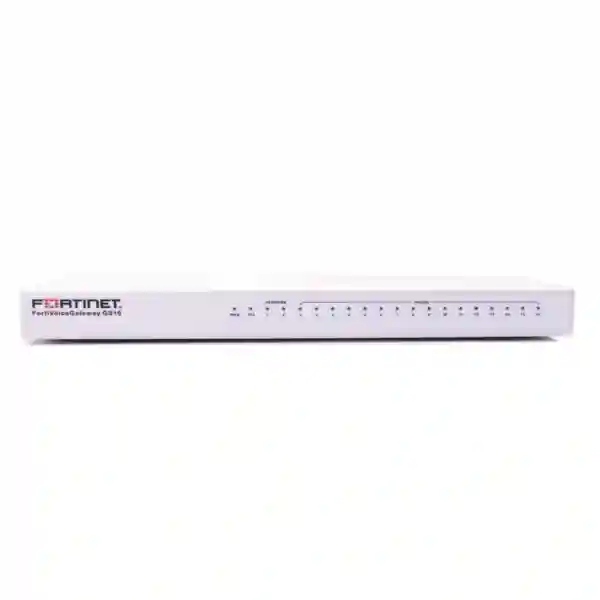
The FortiVoice Gateway FVG-GS16 provides a practical bridge between analog endpoint investments and modern IP communications. Fortinet specifies the FVG-GS16 as a desktop FXS gateway with 16 analog extension ports and two 10/100 Ethernet interfaces. For organizations retaining analog telephones, fax machines, lobby phones, service-area handsets or other conventional endpoints, the gateway provides a structured path into a FortiVoice or compatible SIP-enabled PBX environment without requiring every analog endpoint to be replaced at once.
16 FXS Extensions
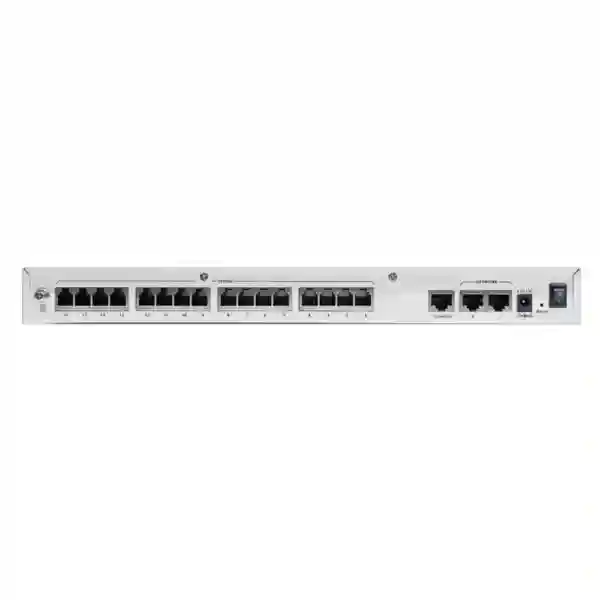
Fortinet documents 16 FXS ports for the FVG-GS16. In supported FortiVoice deployments, the gateway maps these ports to analog extensions, making it useful where established analog devices must remain part of the business phone environment.
IP Network Integration
Two 10/100 RJ45 network interfaces connect the gateway to the IP network. Voice QoS and 802.1Q VLAN support can help administrators integrate voice traffic into a properly designed business LAN.
Voice Security & Fax
The published feature set includes SIP over TLS, SRTP, SNMP, fax over VoIP and T.38, alongside G.711 u-law/A-law, G.729a, G.722 and G.726 codecs.
FortiVoice FVG-GS16 Features and Specifications
The FVG-GS16 is designed specifically for FXS requirements rather than FXO trunk connectivity. Fortinet lists 16 analog extension interfaces, two network interfaces and a desktop form factor. Published dimensions are approximately 35 × 155 × 345 mm and weight approximately 0.91 kg. Management options include a web interface and command-line interface. Administrators planning a deployment should confirm firmware, FortiVoice platform compatibility, extension capacity, LAN design and endpoint requirements before procurement.
| Item | FVG-GS16 |
|---|---|
| Analog extensions | 16 FXS ports |
| Network interfaces | 2 × 10/100 RJ45 |
| Form factor | Desktop |
| Network/voice features | Voice QoS, 802.1Q VLAN, SIP over TLS, SRTP, SNMP, T.38 |
| Codecs | G.711 u-law/A-law, G.729a, G.722, G.726 |
Where the FVG-GS16 Fits
The gateway is relevant to offices, hotels, education sites, healthcare environments, warehouses, service counters and multi-building organizations that have working analog devices but are standardizing communications around IP telephony. The key procurement question is not simply whether sixteen ports are available; buyers should document how many analog endpoints are required, whether those endpoints include fax equipment, where they are physically located, how voice VLANs are configured, and which FortiVoice or SIP PBX will manage the deployment.
Fortinet documentation states that FXS gateways can be discovered by supported FortiVoice systems and can also be added manually. For current FortiVoice environments, confirm the applicable software release and supported gateway-management behavior before implementation. This prevents a purchase based on an older administration guide from being treated as a guarantee for a different software version.
FortiVoice Gateway FVG-GS16 Tanzania
For Tanzanian organizations, the FVG-GS16 can support communications modernization projects where analog endpoints still have operational value. A business moving from a conventional PBX toward IP communications may not want to replace every handset, fax endpoint or utility telephone in one project. A 16-port FXS gateway allows the project team to identify the analog endpoints that should remain and integrate them into the target voice architecture. Procurement teams should prepare an endpoint count, PBX model and software version, IP addressing plan, VLAN details and expected fax requirements before requesting a quotation. This makes compatibility discussions more useful and reduces ambiguity around deployment scope.
Tanzania deployments can vary significantly between a single office and distributed sites. The network should be assessed for voice traffic quality, segmentation and resilience rather than treating the gateway as a standalone appliance. Where the business is also strengthening network security, review relevant solutions on FourTeck Tanzania and discuss how voice services will coexist with routing, switching and security controls. The FVG-GS16 itself should be selected because its sixteen FXS interfaces match a verified analog-extension requirement, not simply because sixteen ports appear sufficient on paper.
For quotation preparation, record the number and type of analog devices, whether fax transmission is required, the intended FortiVoice or SIP server, network switch configuration, site power arrangements and future expansion expectations. This provides a stronger basis for deciding whether one GS16, multiple gateways or a different endpoint strategy is appropriate.
FortiVoice Gateway FVG-GS16 Dar es Salaam
Businesses in Dar es Salaam evaluating the FVG-GS16 commonly need a practical migration plan between existing analog endpoints and IP communications. Offices, hospitality properties, commercial facilities and operational sites may have analog devices installed in reception areas, rooms, security points, warehouses or back-office locations. The GS16 gives the design team sixteen FXS interfaces to account for those endpoints while the LAN carries communications toward the voice platform.
A Dar es Salaam procurement request should identify the exact endpoint inventory and physical cabling path. Existing analog cabling can influence installation effort even when the gateway itself is straightforward to integrate. The IP side should also be reviewed for VLAN assignment, QoS policy, addressing and connectivity to the PBX. Because Fortinet publishes SIP over TLS and SRTP support, security requirements can be considered during design, but the complete security posture depends on the PBX, network and configuration rather than the gateway alone.
Organizations planning growth should compare current analog demand against expected changes. If legacy endpoints are being phased out, sixteen ports may provide a transition layer. If analog endpoint demand will increase, capacity planning should account for future ports before ordering. A quotation should therefore include the FortiVoice model or SIP PBX details, software version, endpoint count, fax requirements and any need for implementation assistance.
FortiVoice Gateway FVG-GS16 Mwanza
In Mwanza, the FVG-GS16 can be considered for organizations that need to retain analog communications devices while adopting a centrally managed IP voice environment. The value is especially clear when replacing every endpoint would add unnecessary cost or operational disruption. Sixteen FXS ports can serve a defined group of analog phones or fax devices, while two Ethernet interfaces provide network connectivity for the gateway.
Deployment planning should begin with the actual communications workflow. Identify which extensions must remain analog, whether they are business-critical, and whether cabling terminates near the intended gateway location. The network team should then confirm IP addressing, switching, VLAN and QoS policies. If fax devices are included, test the expected workflow and configuration because Fortinet supports fax-over-VoIP and T.38 but end-to-end success also depends on the broader voice environment.
For multi-site organizations using Mwanza as a branch location, determine whether call control is local or centralized and how WAN availability affects communications. The FVG-GS16 is an access gateway for analog endpoints; it does not replace the need for a properly designed PBX, WAN and LAN architecture. Buyers should request a solution-level review instead of evaluating the gateway in isolation.
FortiVoice Gateway FVG-GS16 Arusha
Arusha businesses in hospitality, tourism, professional services and institutional environments may have mixed generations of voice equipment. The FVG-GS16 provides a way to retain sixteen analog extensions within a modern IP-oriented communications design. This can be useful when existing analog devices remain serviceable or when particular locations still require conventional endpoints.
A successful design should map each analog port to a business requirement. Rather than ordering based only on capacity, document which extension belongs to reception, administration, guest service, security, operations or fax. This improves extension planning and helps the implementation team verify the completed deployment. FortiVoice documentation describes managed gateway extensions and automatic or manual gateway addition in supported environments, so administrators should align deployment steps with the exact FortiVoice software release in use.
Network preparation is equally important. Voice VLAN design, QoS, secure SIP configuration and switch connectivity should be reviewed before installation. If the site is modernizing other infrastructure simultaneously, coordinate voice changes with firewall, switching and WAN work so troubleshooting boundaries remain clear. Procurement requests should include the target voice system, endpoint inventory, network information and expected support scope.
FortiVoice Gateway FVG-GS16 Dodoma
Organizations in Dodoma can use the FVG-GS16 where analog endpoints must participate in an IP-based communications environment. Government-related offices, institutions, businesses and service organizations may have existing analog phones or fax equipment that cannot be replaced immediately. The sixteen FXS interfaces provide a defined migration capacity, while the Ethernet interfaces connect the gateway to the IP network.
Before procurement, separate endpoint requirements from trunk requirements. The GS16 is an FXS gateway intended for analog extensions; organizations requiring FXO or PRI connectivity should evaluate the appropriate FortiVoice gateway type instead. This distinction prevents a common specification error in voice projects. Buyers should also confirm FortiVoice platform compatibility and software release rather than assuming all historical FortiVoice appliances have identical gateway-management capabilities.
For distributed environments, include WAN design and business-continuity expectations in the project brief. The gateway can connect analog devices, but application availability depends on the surrounding voice and network architecture. A clear quotation request should list extension count, endpoint type, fax use, PBX details, network topology and implementation expectations.
FortiVoice Gateway FVG-GS16 UAE
UAE organizations considering the FVG-GS16 may be consolidating analog endpoints into a SIP-enabled PBX or FortiVoice environment. The model provides sixteen FXS ports, which can be useful in offices, hospitality sites, warehouses and facilities where a subset of analog endpoints remains necessary. Buyers should distinguish between preserving useful analog assets and prolonging equipment that is already due for replacement; the gateway is most valuable when analog retention is a deliberate design decision.
The technical review should cover VLAN, QoS, secure signaling, media protection and fax requirements. Fortinet publishes support for 802.1Q VLAN, voice QoS, SIP over TLS, SRTP and T.38. These features provide useful building blocks, but implementation must be aligned with the PBX, switches and security architecture. For broader UAE technology requirements, FourTeck UAE provides a regional technology reference point.
When requesting pricing, specify the exact FVG-GS16 model, required support contract if applicable, destination, target PBX and installation scope. Avoid treating online price alone as a complete project cost because configuration, cabling, switching and deployment requirements can materially affect the solution.
FortiVoice Gateway FVG-GS16 Uganda
Ugandan businesses can evaluate the FVG-GS16 for projects that retain analog phones or fax machines while transitioning call control to an IP platform. Its sixteen FXS ports create a clear boundary for analog endpoint capacity. This makes the model suitable for carefully scoped branch, office, hospitality or institutional deployments where the endpoint inventory has already been documented.
The procurement team should confirm whether sixteen analog interfaces are sufficient after allowing for expected growth. Network administrators should document VLAN, QoS and addressing requirements, while voice administrators should confirm the target PBX and software release. For organizations operating across East Africa, consistent extension planning and network standards can simplify support across sites. Explore FourTeck Uganda for regional technology context.
If the project includes fax, verify the complete end-to-end design. T.38 support on the gateway is useful, but fax performance depends on configuration and interoperability across the voice path. A proof-of-concept or controlled test can be appropriate where fax is operationally important.
FortiVoice Gateway FVG-GS16 Kampala
Kampala organizations often operate a mixture of new IP infrastructure and established analog communications equipment. The FVG-GS16 can bridge these environments by providing sixteen FXS extension ports. This allows a project to modernize call control and networking while retaining selected analog endpoints that remain useful in reception, operations, security or administrative areas.
Site surveys should establish where analog cabling terminates and whether the gateway can be located appropriately for both analog distribution and Ethernet connectivity. The design should also confirm switch port availability, VLAN assignment, QoS and secure SIP requirements. If a FortiVoice system will manage the gateway, verify current model and software compatibility before deployment.
Kampala buyers comparing gateways should focus on interface type as well as port count. FXS ports serve analog endpoints; they are not interchangeable with FXO trunk interfaces. Documenting this distinction in the request for quotation helps ensure that the proposed hardware matches the intended telephony topology.
FortiVoice Gateway FVG-GS16 Arua
For an Arua branch or institutional site, the FVG-GS16 can provide a structured way to attach up to sixteen analog endpoints to an IP voice design. This can reduce the need for an immediate full endpoint refresh when existing analog devices continue to meet operational needs. The gateway should nevertheless be planned as part of the complete communications architecture, not as an isolated converter.
Where a site depends on WAN connectivity to reach centralized call control, network resilience should be discussed during design. The gateway connects analog endpoints to the IP environment, but branch communications behavior during WAN disruption depends on the overall PBX and network architecture. Procurement documentation should therefore include whether call control is local or remote, expected extension behavior, and any business-continuity requirements.
Arua deployments should also confirm power, cabling, equipment placement and administrative access. The published desktop form factor can make physical placement straightforward, but suitable secure equipment space and reliable network connectivity remain important.
FortiVoice Gateway FVG-GS16 Mbarara
Mbarara businesses considering a voice upgrade can use the FVG-GS16 when sixteen or fewer analog endpoints need to remain in service. The gateway is particularly relevant when the organization wants the management and routing advantages of IP communications but still has operational reasons to keep conventional handsets or fax devices.
Start the design by classifying endpoints. Standard analog phones, fax devices and special-purpose analog equipment may have different testing requirements. Confirm that each intended device is appropriate for the proposed FXS connection and validate critical workflows before broad rollout. Network configuration should then address VLAN, QoS, IP addressing and connectivity to the SIP server or FortiVoice system.
When requesting a quote, include the number of endpoints, target PBX, software version, site network details and whether configuration or deployment assistance is expected. This produces a more useful commercial response than asking for a gateway price without the surrounding requirements.
FortiVoice Gateway FVG-GS16 Gulu
Gulu organizations with mixed analog and IP communications can consider the FVG-GS16 as a migration component. Its sixteen FXS interfaces can preserve selected analog endpoints while voice control is delivered through a FortiVoice or SIP-enabled PBX. This approach can be useful where a phased migration is preferable to replacing endpoints across an entire site at once.
A phased project should define which endpoints remain analog and when they may eventually be replaced. This helps prevent over-investment in gateway capacity that will soon be unused. Conversely, if analog requirements are expected to remain stable, the sixteen-port capacity should be compared against present and future demand so the project does not begin with insufficient headroom.
Technical planning should include secure management access, network segmentation, QoS and firmware management. Fortinet documentation provides both web and CLI management capabilities, but operational processes should define who administers the gateway and how configuration changes are controlled.
FortiVoice Gateway FVG-GS16 Kenya
Kenyan enterprises, institutions and hospitality organizations can use the FVG-GS16 to integrate sixteen analog endpoints into a modern IP voice environment. This is useful when a communications refresh includes a combination of new IP phones and existing analog devices. The gateway gives designers a clear method for keeping the analog portion connected without confusing endpoint interfaces with PSTN trunk interfaces.
For multi-site East African deployments, standardizing the gateway configuration approach can simplify operations. Administrators should establish common VLAN, QoS, addressing, naming and documentation practices while adapting to each site’s network topology. Compatibility should be confirmed against the specific FortiVoice platform and software version used by the organization.
For regional procurement and infrastructure information, visit FourTeck Kenya. A strong request for quotation should state the exact FVG-GS16 model, endpoint quantity, intended voice platform, deployment location and required professional services so that hardware and implementation scope can be discussed together.
FortiVoice Gateway FVG-GS16 Kuwait
Kuwait organizations modernizing telephony can evaluate the FVG-GS16 where analog endpoint retention remains part of the project. Sixteen FXS ports support a defined set of analog extensions, while dual network interfaces connect the gateway to the IP environment. Typical planning scenarios include offices, hospitality environments, operational facilities and sites with legacy fax requirements.
The design should verify whether the target endpoints require FXS service and whether the SIP server or FortiVoice system is compatible with the intended configuration. Secure signaling and media capabilities such as SIP over TLS and SRTP can form part of the design, but they must be configured consistently across the communications environment. Visit FourTeck Kuwait for related regional technology information.
Procurement should also account for support requirements. Fortinet lists a 24×7 FortiCare contract for the GS16 in its ordering information. Buyers should confirm the currently applicable service offering and term at quotation time rather than assuming a particular support entitlement is bundled with hardware.
FortiVoice Gateway FVG-GS16 Ghana
Ghanaian organizations can consider the FVG-GS16 when an IP telephony project must continue serving analog phones or fax devices. The gateway’s sixteen FXS ports provide a practical capacity point for small groups of legacy endpoints, while Ethernet connectivity integrates the appliance into the LAN and SIP communications environment.
The project team should determine whether analog endpoints are concentrated in one building or distributed across a campus. Physical topology influences where the gateway should be installed and how analog cabling reaches it. On the IP side, administrators should plan VLANs, QoS, addressing and PBX reachability. Where security policy requires encrypted SIP signaling or media, validate end-to-end interoperability rather than relying on a single-device feature list.
For regional infrastructure discussions, FourTeck Ghana can provide a related reference. Include endpoint inventory and voice-platform information in quotation requests so the gateway can be evaluated as part of a complete solution.
FortiVoice Gateway FVG-GS16 Nigeria
Nigerian organizations with substantial existing analog telephony can use the FVG-GS16 as one component of a phased IP communications migration. Each gateway provides sixteen FXS ports, so larger deployments should calculate capacity based on the verified endpoint inventory and physical topology rather than simply multiplying gateways without considering cabling and management.
Network reliability, segmentation and power design should be considered alongside telephony requirements. The gateway provides the analog-to-IP access function, while the wider solution determines call routing, resilience and remote-site behavior. Administrators should also establish firmware and configuration management processes, particularly where multiple gateways are deployed.
For Nigerian regional technology information, visit FourTeck Nigeria. When requesting a quotation, specify gateway quantity, endpoint count, target PBX, site topology, support requirements and whether implementation assistance is needed.
FortiVoice Gateway FVG-GS16 Seychelles
Organizations in Seychelles can consider the FVG-GS16 for hotels, offices, institutions and operational sites where analog endpoints must remain connected during an IP voice modernization project. Sixteen FXS ports allow a defined set of analog phones or fax devices to participate in the communications environment without requiring immediate endpoint replacement.
For island or distributed-site operations, procurement planning should clearly separate hardware requirements from connectivity and resilience requirements. The gateway does not by itself determine WAN continuity or PBX availability. Network and voice teams should document where call control resides, how the gateway reaches it, and what service behavior is expected during connectivity interruptions.
Physical deployment should also consider secure placement, analog cabling paths, switch connectivity and power protection. Buyers should provide these details with the endpoint count and target PBX when requesting a quotation. This helps determine whether the GS16 capacity and topology are appropriate for the site.
Compatibility, Deployment and Buying Guidance
Fortinet’s documentation identifies the FVG-GS16 as a supported FXS gateway in FortiVoice environments and describes automatic discovery as well as manual addition in supported releases. Compatibility is version-sensitive, so the safest procurement approach is to provide the exact FortiVoice appliance or virtual-machine model and current software version. Organizations using another SIP-enabled PBX should likewise validate interoperability and configuration requirements before purchase.
The published gateway feature set includes web and CLI administration, voice QoS, 802.1Q VLAN, SIP over TLS, SRTP, SNMP, fax over VoIP and T.38. These capabilities are most useful when they are incorporated into a coherent network design. VLANs require corresponding switch configuration; QoS requires end-to-end policy; TLS and SRTP require compatible peers and certificate/security planning; and T.38 requires compatible fax handling across the communications path.
Related FourTeck Technology Resources
Organizations building a wider communications and security environment can review FourTeck technology solutions for broader infrastructure context. For IP telephony-focused information, FourTeck IP phone resources can help frame endpoint planning, while IP PBX solution resources provide context for call-control architecture. These resources complement the Tanzania site when a project extends beyond the analog gateway itself.
FortiVoice FVG-GS16 Quotation Checklist
For a more accurate technical and commercial discussion, prepare the exact model requirement, number of analog endpoints, endpoint types, fax requirements, target FortiVoice or SIP PBX, software version, network topology, VLAN and QoS requirements, deployment location, expected growth and required support or implementation services. If an existing voice system is being migrated, include a simple description of the current PBX and how analog lines are presently connected.
Frequently Asked Questions
How many analog extensions does the FVG-GS16 support?
Fortinet specifies 16 FXS ports. In supported FortiVoice deployments, these ports map to 16 analog extensions.
Can the FVG-GS16 connect fax machines?
Fortinet lists fax-over-VoIP and T.38 support. End-to-end fax operation still depends on the complete PBX, network and service configuration, so critical fax workflows should be validated.
Does the FVG-GS16 provide FXO trunk ports?
No. The GS16 is the 16-port FXS model. Buyers requiring analog trunk interfaces should evaluate an appropriate FXO gateway rather than substituting the GS16.
What should I provide when requesting a quote?
Provide the exact FVG-GS16 requirement, analog endpoint count and types, PBX model and version, site location, network details, fax needs, support requirements and requested deployment services.
Decision Recap
Choose the FortiVoice Gateway FVG-GS16 when the project specifically requires up to sixteen FXS interfaces for analog endpoints and the target voice environment has been verified for compatibility. Confirm interface type, endpoint quantity, PBX/software version, network design and support requirements before ordering. For deployments that require different analog capacity or trunk interfaces, compare the relevant FortiVoice gateway model rather than forcing the GS16 into an unsuitable topology.
Plan Your FortiVoice Gateway Deployment
Share your analog extension count, existing PBX or FortiVoice details, network topology and deployment location with FourTeck Tanzania. A requirement-led discussion can help clarify gateway capacity, integration considerations and quotation scope before procurement.




Reviews
There are no reviews yet.