
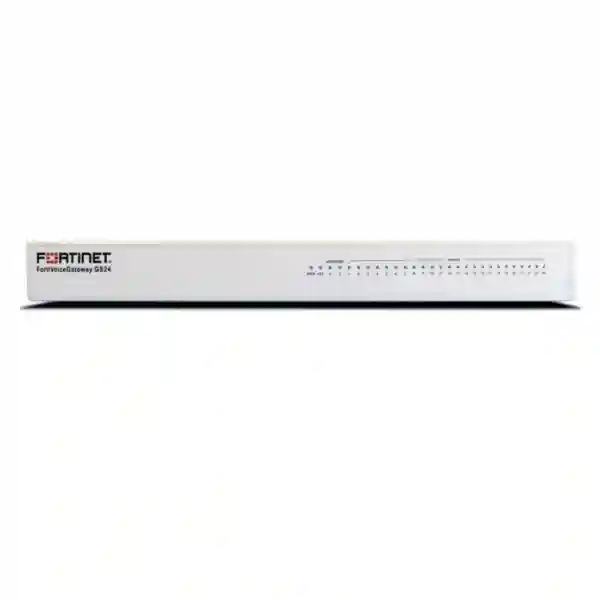
FortiVoice Gateway FVG-GS24 Tanzania
FortiVoice Gateway FVG-GS24 is a purpose-built FXS gateway for organizations that need to connect analog telephones and fax endpoints to a FortiVoice communications environment. The model provides 24 FXS ports mapped to 24 analog extensions and two 10/100 network connections. For Tanzanian businesses planning a phased migration from traditional analog devices to centralized IP communications, the FVG-GS24 offers a practical bridge: existing analog endpoints can remain useful while extension management is brought into the FortiVoice platform.
What the FVG-GS24 solves
Many offices, hotels, campuses, clinics, warehouses and multi-building facilities still have working analog handsets, fax devices or specialty analog endpoints. Replacing every endpoint at once may not fit a migration plan. The FVG-GS24 addresses this requirement by supplying 24 FXS interfaces for analog extensions. Fortinet documents the GS24 as part of its FortiVoice FXS gateway family alongside the GS04 and GS16. It can be discovered or manually added to a supported FortiVoice system, allowing the corresponding analog extensions to be managed as part of the wider phone environment.
Supports 24 analog extension connections for traditional phones and appropriate analog endpoints.
Fortinet lists two 10/100 network ports on the FVG-GS24 hardware.
Designed to expand analog extension resources within supported FortiVoice deployments.
Verified technical overview
Fortinet identifies the product SKU as FVG-GS24 and describes it as a FortiVoice Gateway GS24 with two 10/100 ports and 24 FXS voice-gateway interfaces. Current Fortinet deployment documentation states that GS24 maps its 24 FXS ports to 24 analog phone extensions. Fortinet also documents management support from FortiVoice 100E and larger systems and FortiVoice-VM-100 and larger virtual systems, while noting lifecycle status separately for individual FortiVoice controller models. Procurement teams should therefore validate the exact FortiVoice controller, software release, support entitlement and deployment topology planned for the project rather than treating gateway capacity alone as a compatibility guarantee.
| Item | FVG-GS24 |
|---|---|
| Gateway type | FXS analog extension gateway |
| Analog interfaces | 24 FXS ports / 24 analog extensions |
| Network interfaces | 2 × 10/100 ports |
| Management context | Supported FortiVoice environment |
Compatibility, deployment and buying guidance
A successful analog-gateway project starts with endpoint inventory. Count the analog devices that genuinely need to remain, identify their physical locations, document cabling paths and confirm whether the target FortiVoice system and software version supports the intended gateway configuration. Because FXS ports provide extension-side connectivity, buyers should not confuse the GS24 with FXO gateways used for analog carrier lines or PRI gateways used for digital trunk connectivity. This distinction matters when preparing a bill of materials.
For deployments that need fewer analog extensions, the FortiVoice GS04 and GS16 models may be relevant alternatives. For projects that need analog trunks or PRI connectivity, other FortiVoice Gateway models serve those different interface requirements. A quotation request should therefore state the number of analog extensions, current PBX or FortiVoice platform, expected growth, installation location, endpoint types, rack or desktop requirements, support expectations and any migration deadline.
FortiVoice Gateway FVG-GS24 Tanzania
Organizations evaluating the FortiVoice Gateway FVG-GS24 in Tanzania commonly have a mixed communications environment: IP telephony may be the strategic direction, while analog phones, fax devices or established copper extension cabling still have operational value. The GS24 is relevant where up to 24 analog extension interfaces are required within a supported FortiVoice architecture. Rather than approaching the gateway as a standalone PBX replacement, procurement teams should treat it as an extension resource that works with the broader FortiVoice phone system.
For Tanzania projects, planning should include an accurate analog endpoint count, the FortiVoice controller model, software compatibility, LAN addressing, physical cabling, power and rack requirements, and the intended extension numbering plan. Businesses with several departments can map the 24-port capacity against reception, administration, security desks, guest areas, back offices or other analog endpoint requirements. Where the endpoint count is close to the gateway limit, expected growth should be considered before ordering so the design does not immediately require restructuring.
Buyers should also separate hardware selection from service and support planning. Fortinet publishes FortiCare options for the gateway family, but the appropriate term and entitlement should be confirmed for the specific procurement. FourTeck can use the project requirements supplied by the customer to prepare a more relevant quotation discussion without making assumptions about stock, delivery timing or support coverage. For related network security planning, visit FourTeck Tanzania technology solutions, and for wider regional requirements see FourTeck Africa.
FortiVoice Gateway FVG-GS24 Dar es Salaam
Dar es Salaam organizations considering the FVG-GS24 may be modernizing communications in corporate offices, hospitality properties, education facilities, healthcare environments or multi-department operations where analog endpoints remain installed. The first design question is not simply whether 24 ports are available; it is how many analog devices must remain active after the migration and how those endpoints will be integrated into the supported FortiVoice system.
A practical assessment should document extension locations, cable termination, existing numbering, user groups and any fax requirements. The network team should also identify the VLAN, IP addressing and management approach for the gateway. Fortinet provides a GUI and documented gateway administration workflow, including monitoring functions such as call statistics and call detail records. These capabilities help administrators incorporate the gateway into normal operational procedures instead of treating analog extensions as unmanaged legacy devices.
When requesting a Dar es Salaam quotation, include the FortiVoice platform model, number of required FXS ports, desired support term, site count and whether the gateway will be installed locally with the phone system or in a different network location. These details help distinguish a straightforward 24-extension expansion from a broader voice migration that may require additional FortiVoice components, switching, structured cabling or endpoint changes. The objective should be a clean migration plan with verified compatibility and enough capacity for the intended analog estate.
FortiVoice Gateway FVG-GS24 Mwanza
For Mwanza businesses, the FVG-GS24 can be considered when a FortiVoice deployment must continue serving analog endpoints across offices, reception points, stores, service areas or other operational spaces. Its 24 FXS interfaces provide a defined capacity that makes planning straightforward: inventory each analog endpoint, decide which devices remain in service, and map each required extension to the gateway design.
The physical installation deserves the same attention as logical configuration. Fortinet’s GS24 quick-start material supports rack, wall and desktop installation approaches and emphasizes appropriate airflow. Network connectivity, grounding, power availability and cabling should therefore be reviewed before deployment. In environments where the existing analog cable plant spans a large facility, documenting cable routes and termination points can prevent delays during cutover.
Mwanza procurement teams should request confirmation of the exact hardware, support option and compatibility with the planned FortiVoice version. A complete request should also state whether configuration assistance, migration planning or related network work is expected. Avoid using reseller price listings from other countries as a Tanzania price reference because taxes, logistics, support terms and channel conditions can differ. A project-specific quotation is the appropriate basis for procurement.
FortiVoice Gateway FVG-GS24 Arusha
Arusha deployments may include hotels, tour operators, offices, institutions and distributed business environments that want modern centralized telephony while retaining selected analog devices. The FVG-GS24 is particularly relevant when the requirement is extension-side analog connectivity rather than carrier-side analog trunks. Its 24 FXS ports can map to 24 analog extensions in a supported FortiVoice system.
Hospitality and service environments should inventory guest-area, back-office and operational analog phones separately because migration priorities can differ. An organization might move knowledge workers to IP endpoints while retaining analog handsets in selected rooms or service locations. The GS24 can support that staged approach when the wider FortiVoice architecture is appropriately designed.
Before purchase, verify controller compatibility, firmware planning, extension capacity, network addressing and physical installation. If future expansion is expected, compare the current analog requirement with the 24-port limit and consider whether multiple gateways or a different endpoint strategy is more appropriate. Procurement documentation should specify the exact FVG-GS24 model rather than using a generic “FortiVoice gateway” description, because GS, GO and GT models address different interface types.
FortiVoice Gateway FVG-GS24 Dodoma
In Dodoma, organizations planning communications upgrades can use the FVG-GS24 as an analog-extension bridge within a supported FortiVoice environment. This can be useful where established analog devices remain serviceable but centralized management and IP-based communications are being introduced. The gateway’s 24 FXS interfaces give planners a clear capacity boundary for extension mapping.
Public-facing offices, administrative departments, institutions and growing businesses should begin with a documented voice topology. Identify the existing phone system, analog extension count, network segments, extension-number plan and any devices that cannot be replaced during the initial migration. This information helps determine whether one GS24 is sufficient and whether the supporting FortiVoice platform has the required management capacity.
Operational planning should include administrator access, firmware management, monitoring and support. Fortinet documents gateway monitoring and configuration through its administration interface, and the deployment process should be aligned with the organization’s normal change-control practices. For a useful quotation, provide model and quantity requirements plus the desired support period and implementation scope. This reduces ambiguity and helps separate the gateway hardware requirement from optional installation, configuration and broader communications work.
FortiVoice Gateway FVG-GS24 UAE
UAE organizations with regional operations may evaluate the FVG-GS24 for the same core requirement: integrating up to 24 analog extensions into a supported FortiVoice deployment. The gateway can fit branch, hospitality, office and mixed-endpoint environments where retaining analog devices is operationally or financially sensible during a broader communications modernization program.
A multi-country design should standardize model selection, firmware policy, extension conventions and support expectations while still accounting for each site’s cabling and network topology. The GS24 should be specified specifically for FXS extension requirements. Where the requirement instead involves analog carrier lines or PRI circuits, FortiVoice GO or GT gateway families address those different interfaces.
For UAE technology sourcing and related infrastructure requirements, customers can review FourTeck UAE and specialist communications information at FourTeck IP PBX Dubai. A cross-border procurement request should identify the destination site, required quantity, support term and FortiVoice controller so the solution can be discussed accurately rather than assuming that one regional configuration automatically fits every site.
FortiVoice Gateway FVG-GS24 Uganda
Uganda-based organizations can consider the FVG-GS24 when a FortiVoice phone system needs additional analog extension capacity. The 24 FXS interfaces make it suitable for planned retention of analog phones or fax endpoints while other users move to IP communications. This approach can reduce disruption in sites where the analog cable plant remains useful.
The project should start with a site survey or reliable inventory. Record every analog endpoint, location and business function, then identify which devices must remain after migration. Verify that the planned FortiVoice controller and software release support gateway management and that network connectivity between the gateway and phone system is designed correctly.
Uganda customers can also review FourTeck Uganda for regional technology context. For quotation preparation, include quantity, destination, FortiVoice platform, required support term and whether configuration or installation assistance is part of the request. This provides a better basis for solution planning than relying on generic overseas reseller listings.
FortiVoice Gateway FVG-GS24 Kampala
Kampala offices and institutions frequently need to balance new IP communications with existing analog infrastructure. The FVG-GS24 provides a defined way to retain as many as 24 analog extensions within a compatible FortiVoice deployment. It is useful where the organization wants centralized phone-system management without forcing an immediate replacement of every analog endpoint.
Design teams should distinguish endpoint count from concurrent calling and overall phone-system capacity. The gateway provides physical FXS interfaces, while the FortiVoice platform governs the broader communications environment. Confirm controller sizing, extension licensing or entitlements where applicable, network design and support requirements as part of the complete solution.
For Kampala procurement, specify whether the GS24 will be used at headquarters, a branch or a specialized facility and document the physical termination method for analog extensions. Fortinet’s GS24 hardware uses an RJ-21 interface for FXS 1 through 24, so installation planning should account for the appropriate structured cabling and breakout arrangement. A well-prepared bill of materials should include the gateway and any project-specific cabling, rack, power and support requirements that are actually needed.
FortiVoice Gateway FVG-GS24 Arua
For an Arua site, the FVG-GS24 can support a structured transition from analog extensions toward a centrally managed FortiVoice communications platform. Its capacity is especially useful where several departments or service points still rely on conventional analog handsets and the organization wants to preserve those devices during an IP migration.
Connectivity planning should consider the reliability of the local LAN, IP addressing, management access and the relationship between the gateway and the FortiVoice controller. Administrators should also plan how firmware updates, configuration backups and monitoring will be handled. Treating the gateway as managed communications infrastructure rather than a passive analog adapter improves operational clarity.
Before requesting a quote, count active analog endpoints and leave a clear record of anticipated growth. If only a few ports are required, compare smaller FortiVoice FXS gateway models; if the requirement approaches 24 extensions, the GS24 may provide a more consolidated design. The final selection should follow verified compatibility and project requirements rather than model capacity alone.
FortiVoice Gateway FVG-GS24 Mbarara
Mbarara businesses can use the FVG-GS24 planning model to consolidate analog extension connectivity in environments where legacy phones remain important. With 24 FXS ports, the gateway gives IT teams a clear method for mapping analog users into a FortiVoice system while continuing a broader modernization program at a practical pace.
A branch deployment should document local extension needs and the network path to the FortiVoice system. If centralized management is planned across locations, routing, security policy and voice-network design should be reviewed by the implementation team. Physical factors such as rack space, ventilation, power and analog cable termination are equally important.
Procurement teams should ask for the exact FVG-GS24 hardware and separately clarify FortiCare or other support requirements. They should not assume that a bundle advertised by an overseas seller represents the correct support term or commercial structure for a Mbarara deployment. Providing the intended installation date, endpoint count and controller details makes quotation and compatibility discussions more efficient.
FortiVoice Gateway FVG-GS24 Gulu
Gulu organizations evaluating FortiVoice can retain selected analog extensions by incorporating the FVG-GS24 into a supported phone-system design. The gateway is designed for extension-side analog connectivity, with 24 FXS ports corresponding to 24 analog extensions. This can be valuable for phased projects where replacing every handset is not necessary on day one.
The design process should classify endpoints by business importance and migration readiness. Reception, security, operations and specialist devices may have different requirements from standard office users. By documenting these categories, IT teams can decide which endpoints remain analog and which can move directly to IP phones or soft clients.
For Gulu deployments, include WAN and LAN considerations when the FortiVoice system is located away from the gateway site. Voice quality depends on the complete network path, not simply the gateway hardware. A quotation request should therefore describe topology, quantity, support expectations and implementation scope so that the gateway is evaluated as part of a complete communications solution.
FortiVoice Gateway FVG-GS24 Kenya
Kenyan organizations with existing analog telephone estates can evaluate the FVG-GS24 when a FortiVoice environment requires up to 24 FXS extension interfaces. The gateway can support staged migration strategies for offices, hospitality sites, institutions and other facilities where analog cabling and endpoints remain useful.
When planning multiple East African sites, standardizing on documented FortiVoice gateway models can simplify operational procedures, but each location still needs its own endpoint and cabling assessment. Confirm the FortiVoice controller, software release, network topology and support term for every site rather than assuming identical compatibility.
For Kenya-specific technology sourcing, see FourTeck Kenya. Regional procurement teams can use a common quotation checklist covering gateway quantity, analog endpoint count, destination, controller model, support requirement and implementation services. This creates a consistent basis for comparing project needs across Tanzania, Kenya and other locations without making unsupported assumptions about local stock or delivery.
FortiVoice Gateway FVG-GS24 Kuwait
Kuwait deployments can use the FVG-GS24 to preserve analog extension connectivity while integrating those endpoints into a supported FortiVoice communications environment. The model’s 24 FXS ports are suitable where a site has a moderate concentration of analog devices that should remain operational during or after an IP telephony migration.
Facilities should verify cable termination, endpoint requirements and the planned FortiVoice platform before ordering. In rack deployments, account for installation space and airflow; in all deployments, document network addressing, administrator access and support responsibilities. These practical steps are more important than simply matching a port count.
For regional sourcing context, customers can visit FourTeck Kuwait. A Kuwait quotation request should specify the exact FVG-GS24 model, quantity, support duration, installation destination and FortiVoice controller. Where a project spans multiple countries, list each site separately so compatibility and service requirements can be assessed accurately.
FortiVoice Gateway FVG-GS24 Ghana
Ghanaian businesses modernizing voice infrastructure may still have reliable analog handsets and cabling that do not need immediate replacement. The FVG-GS24 supports this transition by providing 24 FXS interfaces that can become 24 managed analog extensions within a supported FortiVoice deployment.
Project planning should identify whether analog endpoints are concentrated in one building or distributed across operational areas. The physical cable plant, network path to the FortiVoice system, extension-number plan and power environment should all be documented. If analog endpoints are expected to decline over time, the gateway can form part of a staged migration roadmap rather than an endpoint strategy that remains static indefinitely.
For Ghana-focused infrastructure requirements, see FourTeck Ghana. Procurement teams should request a current project quotation instead of applying prices seen in other markets. Specify the model, quantity, support term and required services so commercial and technical discussions are based on the actual deployment.
FortiVoice Gateway FVG-GS24 Nigeria
Nigeria organizations with large offices, hospitality facilities, institutions or multi-site operations can consider the FVG-GS24 where analog extension retention is part of a FortiVoice deployment. Twenty-four FXS ports allow a defined group of analog endpoints to be incorporated into the phone system while IP endpoints can be deployed elsewhere.
For larger sites, one gateway may represent only part of the analog requirement. Count endpoints by building and department, document growth expectations and confirm FortiVoice system capacity for managed gateways. Where several gateways are contemplated, the network and operational design should be reviewed as a whole rather than purchasing units independently.
Customers can review FourTeck Nigeria for regional context. A useful procurement brief includes controller model, gateway quantity, extension count, physical site details, support expectations and target migration schedule. This helps create an accurate technical discussion while avoiding assumptions about stock, lead time or service coverage.
FortiVoice Gateway FVG-GS24 Seychelles
Seychelles hospitality, business and institutional environments may have analog extensions distributed across rooms, offices or service areas while central communications move toward IP. The FVG-GS24 can support up to 24 analog extension interfaces within a compatible FortiVoice environment, making it relevant for carefully planned hybrid deployments.
Island deployments benefit from detailed pre-installation planning because avoidable hardware or cabling omissions can complicate project schedules. Confirm the exact gateway model, FortiVoice controller compatibility, analog termination requirements, network configuration, rack or mounting method and support entitlement before shipment. Maintain configuration documentation so future administrators understand how each FXS port maps to the corresponding extension and physical location.
For a Seychelles quotation, provide destination, quantity, required support term, controller details and any installation or configuration scope. If the project is part of a wider regional rollout, state the other countries involved and whether standardized configuration is desired. FourTeck can then discuss the requirement using a consistent bill-of-materials approach without assuming that commercial conditions or service arrangements are identical across markets.
Related solutions and procurement planning
The FVG-GS24 should be selected in the context of the complete voice and network design. Organizations may also need FortiVoice phone-system capacity, IP endpoints, switching, firewalling, structured cabling or WAN connectivity. For wider Fortinet infrastructure context, review FourTeck Fortinet solutions and FourTeck technology solutions. These resources relate to the broader infrastructure that can surround a business communications deployment.
Quotation checklist
For a more useful quotation discussion, provide: exact model FVG-GS24; required quantity; deployment country and city; FortiVoice controller model and software version; number and type of analog endpoints; current extension numbering; expected growth; site topology; rack or mounting preference; required support term; and whether configuration, migration, cabling or installation assistance is required. Where fax devices or specialist analog equipment are involved, identify them separately so compatibility can be reviewed rather than assumed.
Frequently asked questions
How many analog extensions does FVG-GS24 support?
Fortinet documents 24 FXS ports mapped to 24 analog phone extensions.
Is FVG-GS24 an FXO gateway?
No. FVG-GS24 is an FXS gateway for analog extensions. FortiVoice GO models address FXO requirements, while GT models address PRI connectivity.
Which FortiVoice systems manage FXS gateways?
Current Fortinet deployment documentation lists FortiVoice 100E and larger and FortiVoice-VM-100 and larger for FXS gateway management, with lifecycle notes applying to individual controller models. Always verify the exact controller and software release for a new project.
Can the GS24 connect analog fax machines?
Fortinet describes its FXS gateway use case as connecting traditional analog phones and fax machines to FortiVoice. Project-specific fax compatibility and configuration should still be verified for the intended environment.
What information is needed for a Tanzania quotation?
Provide the exact model, quantity, destination, FortiVoice controller, analog endpoint count, support term and required implementation scope. This allows the requirement to be assessed without assuming stock, delivery time or service coverage.
Decision recap
Choose the FortiVoice Gateway FVG-GS24 when the verified requirement is to add up to 24 FXS analog extension interfaces to a supported FortiVoice environment. Confirm controller compatibility, software, endpoint count, analog cabling, network design and support requirements before procurement. If fewer ports are needed, compare smaller GS models; if the requirement is for analog trunks or PRI, evaluate the appropriate GO or GT gateway instead.
Talk through your deployment
Share your FortiVoice model, site location, number of analog devices and migration objectives with FourTeck. A requirements-led discussion helps identify the correct gateway quantity and supporting infrastructure without relying on generic assumptions.



Reviews
There are no reviews yet.