
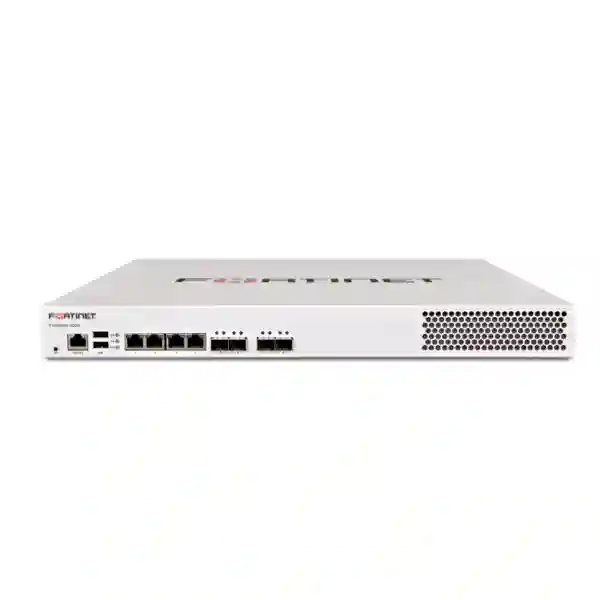
FortiWeb FWB-400F Tanzania
FortiWeb FWB-400F is a Fortinet Web Application Firewall appliance for organizations that need a dedicated security layer in front of business websites, portals, web services and APIs. The appliance combines web application and API protection capabilities with a rack-mountable 1U hardware platform. Fortinet publishes up to 500 Mbps HTTP/HTTPS throughput for the 400F, together with four GE RJ45 interfaces, four GE SFP interfaces, 480 GB SSD storage, unlimited application licenses and support for active/passive or active/active clustering. Performance is stated by Fortinet as an up-to figure and can vary with configuration, enabled security functions and traffic characteristics.
Published up-to HTTP/HTTPS throughput for FortiWeb 400F.
Four GE RJ45 and four GE SFP interfaces for deployment flexibility.
Integrated SSD storage in a rack-mountable 1U appliance.
What FortiWeb FWB-400F protects
Internet-facing applications require controls that understand application behavior rather than relying only on network-layer policy. FortiWeb is positioned by Fortinet for web application and API protection. In a typical design, the appliance is placed logically between users and protected application services so requests can be inspected before reaching origin servers. This makes the platform relevant for customer portals, ecommerce services, corporate web applications, online forms, web-based business systems and API-driven services. A sound design begins by identifying protected hostnames, application owners, expected traffic volumes, authentication flows, certificates, backend servers, API endpoints and availability requirements.
The FWB-400F should be sized against real application traffic rather than model name alone. Procurement teams should document normal and peak HTTP/HTTPS throughput, expected growth, SSL/TLS use, the number and complexity of protected applications, API traffic and the security features that will be enabled. Fortinet notes that performance values are up to figures and vary by configuration. This qualification is important when planning production capacity, failover headroom and future expansion.
Verified FortiWeb FWB-400F specifications
| Product | FortiWeb 400F / FWB-400F Web Application Firewall |
| Throughput | Up to 500 Mbps |
| Interfaces | 4 GE RJ45 and 4 GE SFP |
| Storage | 480 GB SSD |
| Form factor | 1U, rack mountable |
| High availability | Active/Passive and Active/Active clustering |
| Application licenses | Unlimited |
| Administrative domains | 32 |
Application and API security planning
A WAF project succeeds when policy design follows the application. Start with an inventory of public and private web services, owners, DNS names, certificate requirements and backend destinations. Classify applications by business criticality and identify which systems process credentials, personal information, payment-related data or privileged administrative functions. Map expected methods, URLs and API routes. This gives security teams a baseline for deciding how aggressively to enforce controls and how to stage policy changes without disrupting legitimate users.
Deployment should include a learning and validation period. Security controls can be introduced progressively, with logs reviewed for legitimate traffic patterns and exceptions. For API workloads, document clients, authentication methods, expected schemas and versioning practices. For traditional websites, pay attention to uploads, forms, content-management paths and third-party integrations. The goal is not simply to place an appliance in the path; it is to create a maintainable application protection policy that can evolve as development teams release new functions.
High availability and network design
Fortinet lists active/passive and active/active clustering for the FortiWeb 400F. Organizations with availability-sensitive applications should evaluate a resilient design rather than treating a single appliance as the only security path. The correct topology depends on routing, load balancing, application architecture, data-center design and operational procedures. A high-availability project should also account for switch connectivity, addressing, health monitoring, certificate handling, configuration synchronization, maintenance windows and failure testing.
The appliance provides four copper GE RJ45 and four GE SFP interfaces. This mix can be useful where rack environments require both copper and fiber connectivity, but optics, cabling and switch compatibility should be confirmed during quotation preparation. The 400F uses a single power supply according to the Fortinet data sheet, so infrastructure planners should consider the implications for rack power design and overall service resilience. A clustered architecture can address appliance-level availability, while upstream and downstream network dependencies must be designed separately.
FortiWeb FWB-400F Tanzania
Organizations evaluating FortiWeb FWB-400F in Tanzania commonly need a clear way to translate application risk into a practical appliance specification. Begin with the services that must remain reachable: customer portals, ecommerce sites, web-based ERP interfaces, online forms, public APIs, partner portals or internally hosted applications exposed through controlled access. For each service, record peak traffic, encryption use, backend architecture and business impact if the service is unavailable. These details help determine whether the published 500 Mbps class aligns with the intended workload and whether an HA pair should be considered.
Tanzania procurement planning should separate appliance hardware, required security services, implementation effort and lifecycle support. Buyers should request a quotation that clearly identifies the FWB-400F model and any selected subscription or support components rather than comparing only a headline appliance price. Certificate migration, DNS changes, routing, application discovery and policy tuning can affect project effort. A staged rollout is especially useful when several public applications are being protected because teams can validate one service before moving additional workloads behind the WAF.
For organizations already using Fortinet network security, FortiWeb can be assessed as a specialized application-layer control within the broader security architecture. The WAF should still be designed around the web application itself: development practices, authentication, API behavior, change cadence and incident response. Security teams in Tanzania should also plan who will own daily alert review, policy changes and coordination with application developers. That operational ownership is as important as the initial rack installation.
FortiWeb FWB-400F Dar es Salaam
Businesses in Dar es Salaam evaluating FWB-400F may be protecting public digital services that connect customers, staff, suppliers and partners to applications hosted in a local data center, colocation facility or hybrid environment. The procurement conversation should start with the application path rather than a generic firewall checklist. Identify where DNS terminates, where TLS certificates are managed, whether a load balancer is present, and how requests reach application servers. This determines the most appropriate FortiWeb placement and change sequence.
For busy commercial environments, peak demand matters more than an average traffic figure. Seasonal campaigns, customer login periods, online transactions or partner API activity can create bursts. The Fortinet published throughput figure is an up-to value, so teams should preserve headroom for inspection and growth. Where downtime has material business impact, consider clustering and test failover procedures before production acceptance. Rack space, SFP requirements, switch ports and power arrangements should be captured in the bill of materials.
A Dar es Salaam deployment plan should include application-owner workshops, baseline monitoring, controlled policy enforcement and a handover process. Developers and security administrators need a shared method for handling false positives and legitimate application changes. When requesting a quotation, include the number of protected applications, expected throughput, preferred topology, HA requirement and desired implementation scope. This produces a more useful proposal than asking only for a unit price.
FortiWeb FWB-400F Mwanza
For organizations in Mwanza, the FWB-400F can be evaluated for protecting web-facing business systems where application security and predictable operations are priorities. A regional office may consume applications hosted elsewhere, while a local data center may publish services directly. These are different designs. If the protected servers are remote, account for WAN routing, latency and failure paths. If applications are hosted locally, focus on rack integration, switching, public addressing, certificates and upstream connectivity.
Before selecting the appliance, build an application inventory and distinguish public websites from authenticated portals and APIs. Authenticated systems usually need closer coordination between security and application teams because login flows, session behavior and application updates can affect policy tuning. API protection projects should document expected endpoints and client behavior. This makes it easier to recognize abnormal requests without creating unnecessary operational noise.
Procurement teams in Mwanza should request exact model identification, subscription terms, support coverage and implementation scope in writing. Do not assume that optics, accessories or services are automatically included with an appliance quotation. If high availability is required, specify that requirement at the beginning because it affects appliance quantity, network ports and architecture. Plan acceptance testing around both security and business continuity, including legitimate transactions, blocked test traffic, logging and failover.
FortiWeb FWB-400F Arusha
Arusha organizations operating customer portals, booking systems, business websites or web APIs can approach FortiWeb sizing by identifying the services that create the greatest operational and reputational risk. Internet exposure alone does not describe the workload. Record traffic patterns, TLS use, upload behavior, authentication, backend server count and release frequency. These facts help determine how a WAF can be inserted with minimal disruption and how much performance headroom should be reserved.
The FWB-400F offers a 1U form factor and both copper and SFP Gigabit Ethernet connectivity. Data-center planners should verify switch media and transceiver requirements before ordering. The published 480 GB SSD and appliance specifications should be treated as platform characteristics, while retention and monitoring requirements should be designed according to the wider logging architecture. Teams that need centralized visibility should define how WAF events will enter their operational monitoring and incident workflow.
For Arusha procurement, a useful request for quotation should identify the FWB-400F, the desired support and security service period, whether a single appliance or HA design is required, and whether installation, migration, policy tuning or administrator knowledge transfer is expected. This reduces ambiguity between hardware supply and a complete application-security deployment. Application owners should participate in testing because they understand legitimate workflows that may not be obvious from network traffic alone.
FortiWeb FWB-400F Dodoma
Organizations in Dodoma considering FortiWeb FWB-400F may have requirements around controlled access to web applications, public information services, internal portals or API-connected platforms. A structured assessment should identify which services are externally reachable, what data they handle and what availability targets apply. From there, architects can decide whether traffic should pass through a single appliance or a clustered design and whether the network path supports the required interfaces and failover behavior.
Change management is particularly important for WAF deployments. Applications evolve, and a rule that is appropriate today may need adjustment after a new release. Establish a process in which application teams notify security administrators of major changes, while security teams review logs and policy behavior. Start with visibility and controlled tuning before enforcing stricter actions on critical production services. This approach supports security without treating every unusual request as malicious.
Dodoma buyers should include implementation and operational requirements in procurement documentation. Ask for clarity on appliance model, licensing or subscriptions, support period, HA quantity, optics if needed, installation scope and training. Confirm environmental requirements against the Fortinet data sheet before rack deployment. The result should be a solution specification that connects business applications, technical architecture and ongoing administration rather than a standalone hardware purchase.
FortiWeb FWB-400F UAE
UAE organizations evaluating FortiWeb FWB-400F often operate hybrid application environments spanning data centers, cloud platforms and externally consumed APIs. The appliance is most relevant where a physical WAF fits the traffic path and the 500 Mbps class matches the protected workload. Teams should compare that requirement with FortiWeb virtual, cloud and other hardware form factors when architecture demands a different deployment model. The selection should follow application placement, expected traffic and operational ownership.
A production design should map public DNS, TLS termination, load balancers, reverse proxies, origin servers and monitoring. If the WAF will terminate TLS, certificate lifecycle procedures must be clear. If traffic passes through other delivery or security services first, document source-address visibility and header handling so policy and logging behave as intended. HA should be assessed for business-critical services, with failover tested under realistic conditions.
For UAE quotation planning, specify hardware quantity, service term, required optics, implementation scope and migration expectations. Organizations with mature DevOps processes should also define how application changes will be communicated to the security team. A WAF performs best as part of an application-security lifecycle rather than as a static perimeter device. FourTeck network resources for the UAE can be explored through Fortinet UAE solutions and FourTeck UAE for related regional technology requirements.
FortiWeb FWB-400F Uganda
Uganda organizations can evaluate FWB-400F for protecting web applications and APIs that are important to customer access, staff operations or partner integration. Start with a traffic and application inventory, then identify which systems need the strongest availability and policy controls. The published throughput should be considered together with enabled inspection, encryption and growth. If applications are hosted across multiple locations, document the complete network path and the effect of WAN outages.
A good WAF rollout includes application owners from the beginning. Security teams need to understand legitimate URL patterns, authentication, uploads, APIs and release changes. This context supports better tuning and fewer false positives. For high-value services, define how alerts will be escalated and who can approve policy changes. The appliance can provide a security control point, but response processes determine how quickly findings become action.
Uganda procurement should state the exact FWB-400F model, desired service term, HA requirement, interface media and implementation expectations. Buyers can also review FourTeck Uganda technology solutions when coordinating related infrastructure. Avoid assuming local inventory or delivery timing; these should be confirmed at quotation stage based on the requested configuration and commercial terms.
FortiWeb FWB-400F Kampala
Kampala businesses with online customer services, portals and API integrations can use an application-centric checklist to decide whether FWB-400F fits. Identify peak HTTP and HTTPS demand, number of protected hostnames, certificate ownership, backend servers and the consequences of downtime. This helps distinguish a straightforward WAF insertion from a broader redesign involving load balancing, routing or application delivery components.
The combination of RJ45 and SFP GE interfaces can support different rack connectivity designs, but procurement teams should verify the physical media and compatible optics required by their switches. For clustered deployments, count all necessary network connections and plan address allocation in advance. Operational teams should also define backup, monitoring, administrator access and change-control procedures before go-live.
A Kampala implementation can be phased by application. Start with a service whose behavior is well understood, observe legitimate traffic, tune controls, test monitoring and then migrate additional applications. This creates reusable operating knowledge. When seeking a quotation, include whether configuration assistance, migration and post-deployment support are required so commercial proposals can be compared on equivalent scope.
FortiWeb FWB-400F Arua
Arua organizations evaluating a physical WAF should first confirm where protected applications are hosted and whether traffic can be routed through the appliance without introducing an unwanted dependency. For locally hosted systems, check rack, power and switching requirements. For applications hosted elsewhere, assess whether a WAF at the local site is architecturally appropriate or whether protection should sit closer to the application origin.
The FWB-400F belongs to Fortinet’s FortiWeb appliance family and is designed for application and API protection. Its published 500 Mbps throughput is an up-to metric, so capacity planning should account for actual security policy and traffic composition. Keep growth margin for new applications and peak periods. If business continuity requirements are strict, assess active/passive or active/active clustering and validate the entire upstream and downstream path.
For procurement in Arua, document exact requirements instead of requesting a generic WAF. State application count, peak traffic estimate, HA requirement, interface preference, support period and implementation needs. This information helps avoid a mismatch between hardware supply and the final deployment. Security ownership should also be assigned so logs, alerts and policy changes continue to receive attention after installation.
FortiWeb FWB-400F Mbarara
Mbarara businesses can assess FortiWeb FWB-400F where web applications or APIs require a dedicated protection layer. The first design question is not how many users exist, but how much web traffic must be inspected and what application behavior must be supported. Collect peak throughput, TLS usage, request patterns, backend architecture and availability requirements. Then compare these against the appliance class with sufficient headroom.
Implementation planning should cover DNS and certificate changes, network addressing, routing, switch ports and rollback. Application teams should provide test cases for login, search, uploads, transactions and API calls. Security administrators can use these workflows to validate that policies protect the service without blocking legitimate functions. A controlled rollout reduces risk compared with enabling aggressive enforcement immediately across every application.
Mbarara procurement teams should ask suppliers to separate appliance, subscriptions or services, support and professional implementation components. If an HA pair is needed, include that from the start. Verify transceiver requirements for SFP connectivity and confirm all accessory requirements in the final bill of materials. This creates a clearer basis for budget approval and deployment scheduling.
FortiWeb FWB-400F Gulu
For Gulu deployments, the FWB-400F should be considered within the complete application delivery path. A WAF can only inspect traffic that reaches it, so architects should document DNS, public IP addressing, upstream firewall rules, load balancers and backend servers. Where internet connectivity or WAN links are dependencies, include them in availability planning rather than assuming appliance clustering alone guarantees service continuity.
Application security policies require maintenance. New application releases, API versions and authentication changes can alter normal traffic. Establish a review process between developers, infrastructure teams and security administrators. Logs should be monitored for both attacks and unexpected blocking, and policy changes should be tested. This operational discipline makes the investment more useful over its lifecycle.
When requesting FWB-400F pricing for Gulu, provide the exact model, required quantity, desired service term, connectivity requirements and deployment scope. If implementation is included, define whether it covers rack installation, base configuration, application onboarding, policy tuning, HA testing and administrator handover. Clear scope improves quotation quality and reduces assumptions during deployment.
FortiWeb FWB-400F Kenya
Kenya organizations with customer-facing digital platforms can evaluate the FWB-400F as a physical application-security control for web and API traffic. The appliance class should be selected from measured or estimated peak traffic and the number and nature of protected applications. Development cadence also matters: frequently changing applications need a strong process for policy tuning and communication between security and engineering teams.
Infrastructure planners should verify the 1U rack requirement, power, copper or fiber connectivity and high-availability design. Because the 400F has a single power supply, overall resilience should be considered at architecture level. A pair of appliances may be appropriate where application availability requirements justify clustering, while network and server dependencies must be made resilient separately.
Kenya procurement teams can review related regional offerings through FourTeck Kenya. For an FWB-400F request, include expected traffic, protected application count, HA requirement, desired subscriptions, support duration and implementation services. This allows the quotation to reflect the intended solution rather than only a hardware SKU.
FortiWeb FWB-400F Kuwait
Kuwait organizations evaluating FortiWeb FWB-400F should align the appliance with their application hosting model. A physical appliance can fit data-center environments where web traffic can be routed through a dedicated WAF tier. If workloads are predominantly cloud-native, teams should also assess whether another FortiWeb form factor better follows the application. The decision should be architectural, not based solely on model familiarity.
For the 400F, Fortinet publishes up to 500 Mbps throughput, four GE RJ45 and four GE SFP interfaces and HA clustering options. Use these specifications as inputs to a design, not as a guarantee of workload performance. Estimate peak encrypted traffic, security inspection needs and growth. Confirm rack and switch requirements, certificate processes and how WAF events will integrate with security monitoring.
Procurement and infrastructure teams can use FourTeck Kuwait for related regional technology inquiries. A useful FWB-400F RFQ should identify quantity, service term, HA expectations, optics and professional services. Availability, lead time and commercial terms should be confirmed in the quotation rather than assumed from a product page.
FortiWeb FWB-400F Ghana
Ghana businesses can evaluate FortiWeb FWB-400F when web application and API exposure requires controls beyond conventional network firewall policy. Start with critical applications and document how customers or partners reach them. Determine whether TLS will terminate on FortiWeb or another component, how backend servers are addressed and whether load balancing already exists. These decisions affect topology and migration planning.
Security operations should define what happens after an alert. Assign ownership for investigation, policy adjustment and escalation to application teams. During deployment, monitor normal traffic and test important business workflows. For APIs, include expected clients and endpoint behavior. For websites, test authentication, forms, uploads and integrations. This makes the security policy more accurate and easier to maintain.
Ghana procurement teams can explore FourTeck Ghana for related regional requirements. For FWB-400F, request a detailed quotation covering the exact appliance, service term, HA quantity if applicable, interfaces and implementation. Confirm commercial availability directly at the time of purchase because stock and delivery conditions can change.
FortiWeb FWB-400F Nigeria
Nigeria organizations operating high-value online services can assess the FWB-400F for dedicated application and API protection where its performance class fits the traffic profile. Measure peak demand where possible and distinguish total internet bandwidth from actual web traffic that will traverse the WAF. Account for encryption, inspection policy and growth. This provides a more reliable basis for model selection than user count alone.
Availability planning should include the FortiWeb cluster, network switches, upstream security, load balancers, servers, DNS and connectivity. Fortinet supports active/passive and active/active clustering on the 400F, but resilient application delivery requires the surrounding dependencies to be designed and tested as well. Define maintenance procedures and rollback before moving critical applications into the new path.
For regional technology requirements, buyers can visit FourTeck Nigeria. An FWB-400F quotation request should include appliance quantity, desired services, support period, HA design, optics and implementation scope. Do not rely on assumed stock or delivery times; request current commercial confirmation for the required configuration.
FortiWeb FWB-400F Seychelles
Seychelles organizations considering FWB-400F should pay particular attention to where applications are hosted and how traffic reaches them. If services are hosted in a local server environment, a physical WAF can be evaluated within that data-center path. If applications are hosted offshore or in public cloud, assess whether placing the protection closer to the application would simplify routing and improve operational efficiency. FortiWeb is available in multiple form factors, so the physical 400F should be selected when it fits the architecture.
Capacity planning should use expected protected web traffic rather than total site bandwidth. Preserve headroom for peak demand and security inspection. Where continuity is important, evaluate clustering and test failures end to end. Confirm rack space, power, switch interfaces and any SFP optics. Operational plans should include certificate renewal, policy review, monitoring and coordination with application owners.
For procurement, request the exact FWB-400F model and clearly state the desired service period, support, HA quantity and implementation assistance. If remote configuration or onsite activity is required, define that scope explicitly in the quotation. Commercial availability and logistics should be confirmed for the project date rather than inferred from general regional coverage.
Related FourTeck resources
For broader Fortinet and infrastructure planning, explore FourTeck Tanzania technology solutions for the primary Tanzania site, FourTeck Africa for cross-market requirements, Fortinet UAE solutions for Fortinet-focused regional information, FourTeck Kenya, FourTeck Uganda, FourTeck Ghana and FourTeck Nigeria. These links help procurement teams coordinate related networking, security and regional technology discussions without implying inventory or service coverage for a specific project.
FWB-400F buying and sizing checklist
Before requesting a quotation, document the protected applications, peak HTTP/HTTPS throughput, number of hostnames, API use, TLS termination point, backend servers, network topology and availability requirement. Decide whether the project needs one appliance or an HA pair. Confirm whether copper or SFP connectivity will be used and list required optics separately. Identify the desired FortiWeb security services and support term, and specify whether implementation, migration, tuning, testing and administrator handover should be included.
Also define acceptance criteria. These may include successful access to every critical application workflow, correct certificate presentation, expected logging, policy enforcement tests, administrator access, backup procedures and HA failover where applicable. A written acceptance plan helps security, application and procurement teams agree on what a completed deployment means.
FortiWeb FWB-400F FAQs
What is the FortiWeb FWB-400F?
FWB-400F is the SKU/model identifier for the FortiWeb 400F hardware Web Application Firewall. It is designed for web application and API protection and is supplied as a 1U appliance.
What throughput does FortiWeb 400F provide?
Fortinet publishes up to 500 Mbps throughput for FortiWeb 400F. Actual performance varies with configuration and traffic, so production sizing should include security features, encryption, traffic characteristics and growth.
Which network interfaces are included?
Fortinet lists four GE RJ45 and four GE SFP interfaces. Confirm switch media, cabling and any required SFP optics when preparing the bill of materials.
Can FWB-400F be deployed in high availability?
Yes. Fortinet lists active/passive and active/active clustering. The appropriate topology depends on the application and network design, and failover should be tested with surrounding infrastructure.
How should I request an FWB-400F quotation?
Provide the exact model, appliance quantity, expected peak web traffic, HA requirement, connectivity, desired service and support term, and whether implementation or migration assistance is required. This helps create a quotation aligned with the intended deployment.
Decision recap and consultation
FortiWeb FWB-400F is a 1U physical WAF appliance positioned for web application and API protection, with up to 500 Mbps throughput, eight Gigabit Ethernet interfaces across copper and SFP, 480 GB SSD storage and clustering options. The key purchasing decision is whether this performance class and physical form factor fit your real application traffic, topology and availability requirements. Prepare traffic, application, HA, licensing and implementation details before requesting a quote so the proposed solution can be scoped accurately.



Reviews
There are no reviews yet.