
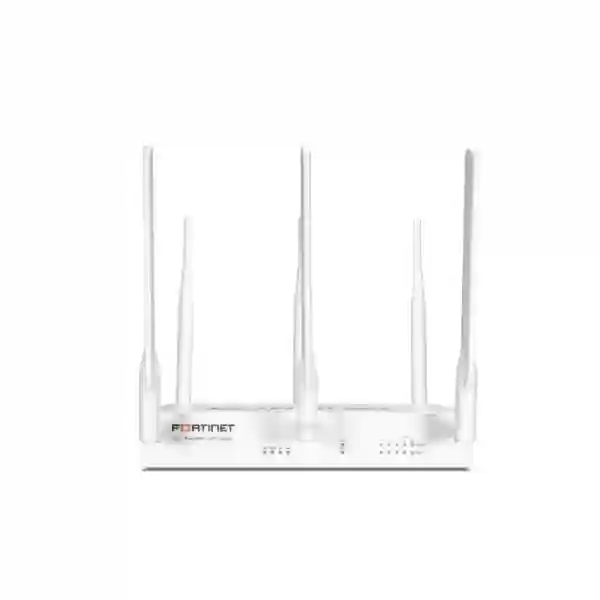
FortiWiFi 40F 3G4G (FWF-40F-3G4G)
FortiWiFi 40F 3G4G is the wireless-and-cellular member of Fortinet’s 40F platform, combining next-generation firewall functions, secure SD-WAN, integrated 802.11a/b/g/n/ac Wave 2 Wi-Fi and an embedded 3G/4G/LTE modem. For organizations planning compact branch, retail, professional-office or distributed-site connectivity, the appliance can consolidate internet security, wired LAN access, local wireless service and cellular WAN options in one desktop platform. The model is particularly relevant where a fixed WAN connection needs a cellular alternative, where a small site benefits from built-in Wi-Fi, or where IT teams want FortiOS policy and management consistency across branches.
Up to IPv4 firewall throughput in Fortinet’s published test conditions.
Embedded Sierra Wireless EM7565 modem with two Nano SIM slots in active/passive operation.
Single-radio 2.4/5 GHz 802.11a/b/g/n/ac Wave 2 wireless interface with 3×3 MU-MIMO.
Compact desktop form factor with published 0 dBA fanless operation.
What the FortiWiFi 40F 3G4G solves
Small and mid-sized sites often accumulate separate devices for firewalling, Wi-Fi and backup connectivity. That can increase cabling, power requirements, configuration touchpoints and troubleshooting complexity. The FWF-40F-3G4G provides a different approach: one FortiOS-based security appliance can enforce network policy while also presenting local wireless service and an integrated cellular WAN option. This does not remove the need for good network design. It does, however, give branch architects a compact platform for sites where space, operational simplicity and WAN resilience are important.
Fortinet positions the 40F family for enterprise branch offices and mid-sized businesses. The platform uses Fortinet’s system-on-a-chip architecture and supports security functions including application identification, intrusion prevention, malware protection, web filtering and encrypted-traffic inspection when the relevant services and configuration are used. Buyers should size the appliance using the security services they intend to enable rather than looking only at headline firewall throughput. Internet bandwidth, VPN use, concurrent sessions, wireless client demand, cellular coverage and future growth should all be part of the selection process.
Verified hardware and performance highlights
| Ethernet interfaces | 1 × GE RJ45 WAN/DMZ, 3 × GE RJ45 internal, 1 × GE RJ45 FortiLink default port |
| Cellular | Embedded 3G/4G LTE modem, CAT-12, 2 × Nano SIM slots, active/passive |
| Wireless | Single radio 2.4/5 GHz, 802.11a/b/g/n/ac Wave 2, 3×3 MU-MIMO |
| Firewall throughput | Up to 5 Gbps IPv4 firewall throughput |
| IPS / NGFW / threat protection | Up to 1 Gbps / 800 Mbps / 600 Mbps under Fortinet published test conditions |
| IPsec VPN | Up to 4.4 Gbps in Fortinet’s specified test |
| Sessions | Up to 700,000 concurrent TCP sessions; 35,000 new TCP sessions/second |
| Dimensions / weight | 40.5 × 216 × 160 mm; approximately 1 kg |
| Operating environment | 0°C to 40°C operating temperature; 10% to 90% non-condensing humidity |
Published performance figures are maximum laboratory values and vary with traffic profile, FortiOS version, enabled security inspection, logging, configuration and other conditions. Fortinet notes that SSL-VPN is not supported on FortiOS 7.6.0 and above, so current remote-access design should be validated against the intended FortiOS release and supported VPN method.
Wi-Fi, LTE and SD-WAN in one branch appliance
The integrated wireless interface can provide local Wi-Fi without requiring a separate access point for a compact site, although larger spaces, higher client density and roaming requirements may still justify dedicated FortiAP access points. Fortinet publishes maximum Wi-Fi rates of 1300 Mbps at 5 GHz and 450 Mbps at 2.4 GHz for the FortiWiFi variant. These are radio data rates rather than guaranteed user throughput. Building materials, interference, channel use, client capability and placement affect real wireless performance.
The embedded CAT-12 cellular modem is a major differentiator from the standard FortiWiFi 40F. Two Nano SIM slots support an active/passive SIM arrangement, giving designers options for cellular provider planning. The published modem supports a broad set of LTE bands, including bands commonly used internationally. Before procurement, the exact region code, local carrier bands, SIM plan, antenna placement and signal conditions should be confirmed. Cellular capability can be valuable for backup WAN, temporary connectivity, remote branches or sites where terrestrial internet options are limited, but it should be designed around real coverage and data-plan conditions rather than assumed performance.
Secure SD-WAN can use available WAN paths according to configured policy and link health. A business might prioritize a fixed broadband service and use LTE when the primary path becomes unsuitable, or create application-aware routing rules according to operational needs. The correct design depends on link cost, latency, jitter, bandwidth, data caps and business-critical applications. For related network planning, review FourTeck Tanzania’s integrated IT and network security portfolio and technology services.
FortiWiFi 40F 3G4G Tanzania
For organizations evaluating the FortiWiFi 40F 3G4G in Tanzania, the strongest use case is usually a compact site that needs security plus connectivity flexibility. A branch may have fibre, fixed wireless or another primary internet service while retaining LTE as a contingency path. Another location may depend more heavily on cellular connectivity because fixed access is unavailable or operationally inconvenient. The integrated Wi-Fi radio can also reduce the number of devices required in a small office. These capabilities make the FWF-40F-3G4G relevant to branch offices, professional services, retail points, clinics, small hospitality operations, project offices and distributed corporate environments, provided the platform is correctly sized for users, applications and inspection requirements.
Tanzania deployments should begin with connectivity facts rather than a generic appliance recommendation. Identify the primary ISP, available bandwidth, expected LTE carrier and signal quality, number of wired and wireless users, VPN requirements, cloud applications and any public services that need protection. If cellular is intended as failover, test antenna placement and understand the data plan before treating it as a business-continuity link. If built-in Wi-Fi is expected to cover the workplace, consider floor area, walls, user density and device mix. A single integrated radio can be practical for a compact site, while larger or more complex premises may need dedicated access points connected through an appropriate switching design.
Security subscriptions are another procurement consideration. The hardware can operate as a firewall, but advanced threat intelligence and security services are typically associated with FortiGuard subscriptions and FortiCare support options. Buyers should request a quotation that clearly identifies hardware, region code, subscription bundle and term rather than comparing hardware-only pricing with bundled offers. FourTeck can use the project details to discuss fit and quotation scope. The broader FourTeck Fortinet specialist resource can also provide context on the wider Fortinet ecosystem, while the Tanzania contact route remains the appropriate starting point for this regional requirement.
FortiWiFi 40F 3G4G Dar es Salaam
Dar es Salaam businesses commonly need branch connectivity that supports cloud applications, voice, payment systems, collaboration tools and remote access without making a small network unnecessarily complicated. The FWF-40F-3G4G can suit a compact office where a wired ISP connection is the main path and LTE is designed as a secondary path. It can also suit temporary project locations where connectivity options change over time. The integrated Wi-Fi interface is useful when the site is small enough for one carefully positioned radio, but a larger office with multiple rooms, dense users or challenging construction should be assessed for additional access points rather than assuming an all-in-one appliance will provide complete RF coverage.
A Dar es Salaam quotation should therefore describe the operational environment. State the internet circuit speed, approximate number of users, expected simultaneous VPN sessions, important SaaS platforms, whether guest Wi-Fi is required, and whether LTE is for failover or regular traffic. If the branch connects to a head office, data centre or cloud environment, include the VPN topology and expected traffic. Fortinet publishes strong IPsec performance for the platform, but real encrypted throughput depends on configuration and traffic. Security inspection also consumes resources, so sizing should use the intended UTM or enterprise security profile rather than raw firewall throughput alone.
The dual SIM capability can help administrators plan cellular provider options, but the two SIM slots are active/passive rather than two simultaneously active cellular modems. That distinction matters when designing resilience. For businesses with several Dar es Salaam branches, standardized firewall templates, VLANs, naming, VPN policies and documentation can simplify ongoing administration. The goal is to make the FWF-40F-3G4G part of a repeatable branch standard, not merely a box at the internet edge. FourTeck Tanzania’s verified contact page lists Dar es Salaam among its contact locations, making it straightforward to submit the model, quantity, bandwidth and deployment details for a more meaningful quotation.
FortiWiFi 40F 3G4G Mwanza
In Mwanza, the FortiWiFi 40F 3G4G can be considered for organizations that want a compact security gateway with more than one connectivity method available at the branch. The embedded LTE modem is useful where the design calls for a cellular backup to a fixed internet service or where a business wants an alternative path for essential cloud traffic. The decision should be based on measured local signal conditions and carrier compatibility at the actual premises. A good procurement process includes a practical LTE survey, suitable SIM service, antenna positioning and a failover test so that cellular connectivity is validated before it becomes part of the continuity plan.
Mwanza sites can vary from professional offices and retail environments to logistics, hospitality and operational facilities. These environments have different traffic profiles. A small office may mainly use email, browser applications, cloud storage and video meetings, while a retail location may prioritize payment connectivity and centrally managed applications. A logistics site may have scanners, cameras or operational devices on separate network segments. FortiOS policy, VLAN segmentation and application controls can help create clearer trust boundaries, but the network still needs suitable switching and wireless coverage. The FWF-40F-3G4G has no PoE ports, so powered endpoints such as access points, cameras or IP phones require appropriate PoE switching or injectors.
When requesting the product for Mwanza, include the number of LAN devices, Wi-Fi clients, any PoE endpoints, internet bandwidth, desired FortiGuard services and whether site-to-site VPN is required. Also identify whether the built-in Wi-Fi is intended as the primary WLAN or only for a limited area. These details determine whether the appliance can stand alone or should be paired with managed switches and FortiAPs. A documented bill of materials should separate the firewall hardware, security subscription, cellular requirements and supporting LAN components. That approach makes it easier to compare quotations and reduces the chance that a seemingly complete firewall purchase lacks the subscriptions, switching or deployment work needed for the intended outcome.
FortiWiFi 40F 3G4G Arusha
Arusha organizations considering the FWF-40F-3G4G may value the combination of firewall, wireless and cellular functions where branch space is limited and internet resilience matters. Hospitality offices, tour operators, professional firms, education environments and distributed businesses can all have different priorities, so model selection should not be reduced to user count alone. Video conferencing, cloud backups, encrypted web inspection and VPN traffic can create very different load patterns. Fortinet’s published threat-protection figure of up to 600 Mbps is a more useful planning reference than the 5 Gbps raw firewall figure when multiple security services are enabled, although actual results still vary by configuration and traffic.
The built-in Wi-Fi can support a compact branch, but guest access and employee access should be separated according to policy. Hospitality or customer-facing environments often need more coverage and client capacity than a single integrated radio can provide. In those cases, the FWF-40F-3G4G can remain the security gateway while dedicated access points provide the WLAN. Fortinet publishes support for managed FortiAP deployments on the 40F platform, allowing an organization to keep policy and wireless management within the same ecosystem. Physical placement is also important: a firewall located in a rack or enclosed cabinet may not be the ideal RF position for the built-in antennas.
Arusha buyers should also clarify how LTE will be used. If it is a failover path, define which applications are permitted during failover so a limited data plan is not consumed by backups or nonessential traffic. If LTE is a primary connection, assess expected monthly data usage, latency sensitivity and antenna placement. If two carriers are being considered, remember that the dual SIM design is active/passive. FourTeck’s Tanzania contact page identifies Arusha as a contact location, and a useful enquiry should include the exact FWF-40F-3G4G model, quantity, site type, current internet connection, preferred cellular provider, security subscription term and any installation or configuration assistance required.
FortiWiFi 40F 3G4G Dodoma
For Dodoma offices and branch environments, the FortiWiFi 40F 3G4G offers a practical architecture when a business wants a single security gateway that can work with Ethernet WAN, Wi-Fi and cellular connectivity. Government-facing suppliers, professional offices, NGOs, education organizations and distributed enterprises may all require secure access to central applications while keeping the branch footprint compact. The appliance can establish IPsec connectivity to other locations, apply application-aware security policy and use SD-WAN logic to make better use of available WAN links. The precise topology should be designed around the organization’s security policy and the services hosted at each site.
Power and environmental planning should accompany network design. The unit is fanless and Fortinet specifies operation from 0°C to 40°C, but it should still be installed where ventilation is adequate and dust, heat and uncontrolled power conditions are managed. A suitable UPS can help protect the firewall, modem and associated switching from short interruptions. If LTE is expected to provide continuity during a fixed-line outage, the network devices required to reach user endpoints must also remain powered; protecting only the firewall does not keep a branch operational if its switch or access points shut down.
Dodoma procurement should also distinguish hardware lifecycle from security-service lifecycle. FortiGuard and FortiCare options are normally purchased for defined terms, and renewal planning should be part of the operational budget. FortiOS version support should be checked before upgrades because feature behavior changes over time; for example, Fortinet documents that SSL-VPN is not supported on FortiOS 7.6.0 and later, which affects organizations that previously relied on that remote-access method. The verified FourTeck Tanzania contact page lists a Dodoma office contact location. A quotation request should specify the model, expected FortiOS and subscription approach, WAN bandwidth, VPN method, Wi-Fi requirement and cellular role so the proposed configuration matches the actual branch design.
FortiWiFi 40F 3G4G UAE
UAE buyers evaluating the FortiWiFi 40F 3G4G often have access to high-speed fixed connectivity, so the integrated LTE modem is commonly considered for resilience, temporary branches, kiosks, project offices or operational sites that benefit from an independent backup path. Because fixed broadband speeds can exceed the throughput available when multiple security services are enabled, sizing should be based on the inspection profile and actual circuit rather than simply selecting the smallest appliance that supports the required ports. The 40F platform publishes up to 800 Mbps NGFW throughput and 600 Mbps threat-protection throughput under Fortinet test conditions, which provides a more realistic starting point for security-enabled design.
Wireless requirements deserve separate analysis. The built-in Wi-Fi 5 radio can be appropriate for a compact branch, but modern UAE offices may have dense client populations, meeting-room video, voice applications and high expectations for roaming. Dedicated access points can be a better fit when coverage extends across several rooms or floors. The firewall can then focus on WAN security, segmentation, VPN and SD-WAN while the WLAN is engineered independently. The absence of onboard PoE also means external PoE switching is required for powered APs, phones and cameras.
For regional Fortinet planning, FourTeck’s Fortinet UAE specialist site is a relevant network resource, while FourTeck UAE covers broader technology requirements. Buyers should confirm the correct regional SKU, FortiGuard bundle, support term and LTE carrier compatibility before ordering. A complete bill of materials may include the appliance, subscription, external switching, UPS, additional FortiAPs and deployment services. That is preferable to treating the FWF-40F-3G4G as a standalone purchase when it will ultimately be responsible for branch security, wireless access and failover connectivity.
FortiWiFi 40F 3G4G Uganda
Uganda organizations can consider the FortiWiFi 40F 3G4G for branch locations that need secure internet access and the flexibility to use cellular connectivity as part of the WAN strategy. Distributed businesses, NGOs, professional offices, retail branches and field operations may benefit from a platform that reduces the number of separate devices at a small site. The integrated CAT-12 modem and dual Nano SIM slots provide a practical foundation for cellular planning, but real-world value depends on local carrier support, coverage, signal strength and data plans at each branch. These conditions should be checked at the premises rather than inferred from national coverage maps alone.
A multi-site Uganda deployment should prioritize standardization. The same VLAN structure, IP addressing conventions, VPN templates, security profiles and SD-WAN policies can reduce support complexity when branches are similar. At the same time, WAN policy may need to vary by location because the available fixed and cellular services differ. Critical applications can be identified so failover behavior is predictable. Administrators may also restrict high-volume traffic when LTE becomes active, preserving cellular capacity for essential business systems.
Wi-Fi should be planned independently from firewall sizing. A small branch may use the built-in radio successfully, while a larger office should use dedicated access points for coverage and capacity. The FWF-40F-3G4G can manage a broader Fortinet access layer, but supporting switches and APs must be included in the design. For Uganda-focused technology requirements, FourTeck Uganda is part of the approved regional network. Procurement teams should request a quotation that identifies the exact regional hardware code, security subscription, support duration, cellular requirements and any configuration or deployment scope so that hardware-only and bundled offers are not compared as though they are equivalent.
FortiWiFi 40F 3G4G Kampala
Kampala offices often run cloud productivity, ERP, voice, video meetings and remote-access workloads over the same internet connection. A FortiWiFi 40F 3G4G deployment can provide a compact policy point for these applications while adding LTE as a secondary connectivity option. The appliance’s SD-WAN capabilities allow administrators to evaluate link health and route traffic according to configured rules. This can be more useful than simple physical failover because application requirements can be considered, but policies must be tested so that critical services behave as expected when the primary link degrades rather than fails completely.
Kampala branch design should also account for wireless density. The integrated Wi-Fi radio supports 2.4 and 5 GHz operation and published 3×3 MU-MIMO capability. That is useful for compact spaces, but an office with many users, multiple meeting rooms or heavy wireless traffic may need additional APs. If the firewall is installed in a server cabinet, its physical location can further reduce the value of the integrated radio. A site survey and client-density estimate provide better guidance than assuming the built-in Wi-Fi replaces a purpose-designed WLAN.
For security, decide which FortiGuard services are required and how encrypted traffic will be handled. Inspection features can materially reduce available throughput compared with raw firewall forwarding, so the internet service and security profile should be evaluated together. Branch-to-head-office IPsec, remote-user access and cloud security requirements should also be documented. A Kampala buyer requesting FWF-40F-3G4G should include user count, internet speed, current firewall, cellular provider preference, expected VPN use, wireless area and subscription term. That information helps distinguish a suitable compact branch design from a site that should move to a larger FortiGate or a separate wireless architecture.
FortiWiFi 40F 3G4G Arua
Arua can present a strong case for a branch appliance with integrated cellular capability when fixed connectivity choices are limited, variable or operationally critical. The FortiWiFi 40F 3G4G allows an organization to combine firewall policy with LTE connectivity in the same platform, reducing dependence on an external USB modem or consumer-grade cellular router. This can simplify security ownership because WAN failover, routing and firewall policy remain within FortiOS. Nevertheless, LTE should be validated at the exact site. Antenna location, building materials, carrier signal, congestion and data-plan terms can have a greater effect on practical performance than the modem’s CAT-12 specification alone.
For NGOs, field offices, healthcare, logistics or branch operations in Arua, the continuity objective should be explicit. Decide which services must remain available if the primary WAN fails. Email and line-of-business applications may be essential, while operating-system updates, cloud backups and entertainment traffic may be restricted during LTE operation. SD-WAN rules and traffic shaping can support this approach. If the branch connects to a central location, the VPN should also be tested over the cellular path because carrier NAT and changing IP addressing can affect some designs.
Physical resilience matters as well. A firewall with LTE failover still depends on power, switching and endpoint connectivity. UPS protection should cover the network chain required for critical users, and the equipment should be installed in a ventilated, secure position. The FWF-40F-3G4G’s fanless form factor is convenient for small sites, but temperature limits still apply. For procurement, provide the site address or area, expected users, primary ISP, preferred mobile carriers, critical applications, VPN requirement and desired FortiGuard bundle. These inputs allow a quotation to reflect the branch architecture instead of supplying only the firewall chassis.
FortiWiFi 40F 3G4G Mbarara
Mbarara businesses with branch operations can use the FortiWiFi 40F 3G4G as a secure edge where wired and cellular internet options need to be coordinated. Retail, healthcare, education, professional offices and regional distribution sites may each have different application priorities, so the firewall should be sized according to traffic and inspection rather than industry label. A branch with frequent video meetings and cloud file transfers behaves differently from a point-of-sale location with lighter bandwidth but higher continuity requirements. The 40F platform provides substantial session capacity for a compact appliance, but security-enabled throughput remains the key planning measure.
The integrated LTE modem can support business-continuity planning without an extra cellular router. Dual Nano SIM slots provide carrier flexibility, although only one SIM is active at a time. Administrators should document which SIM is preferred, how failover is triggered and which traffic is allowed on cellular. Regular testing is important because a backup link that has not been tested may fail due to expired data plans, weak signal, SIM changes or policy drift. Operational checks can be included in routine firewall maintenance.
For local Wi-Fi, consider whether the firewall’s installation point is also a good access-point location. If not, dedicated APs can provide better coverage while the FortiWiFi remains the security and WAN gateway. Managed switches may also be required for VLANs and PoE. A complete Mbarara bill of materials can therefore include the FWF-40F-3G4G, FortiGuard/FortiCare subscription, PoE switch, access points, UPS and configuration services. When requesting pricing, list these needs explicitly and state whether the project is a new branch, firewall replacement or connectivity-resilience upgrade. That makes it easier to assess compatibility with existing addressing, VPNs and network hardware before deployment.
FortiWiFi 40F 3G4G Gulu
Gulu organizations planning secure branch connectivity may find the FWF-40F-3G4G useful when the site needs an integrated cellular alternative to its primary WAN. This is especially relevant for distributed operations where a loss of connectivity can interrupt access to cloud applications, central databases, communications or reporting systems. The embedded modem removes one external network device from the design and allows LTE to participate directly in FortiOS routing and SD-WAN policy. The benefit is strongest when failover requirements are defined in advance and tested under realistic conditions.
A practical Gulu deployment should classify applications by importance. During normal fixed-line operation, the branch may allow full business traffic. During LTE failover, policy can prioritize core applications and limit large downloads, backups or nonessential media. This protects a cellular data allowance and helps critical sessions receive capacity. VPN design should also account for failover so tunnels can recover automatically where supported. Monitoring and alerting are valuable because administrators need to know when a branch has moved to cellular rather than discovering it after a data-plan issue.
Wireless coverage should be assessed separately. The built-in Wi-Fi 5 interface can be sufficient for a small office, reception area or limited user group, while larger facilities may need dedicated APs. If cameras, phones or APs require PoE, remember that the FWF-40F-3G4G itself has no PoE ports. Appropriate switching is therefore part of the network design. For a quotation, Gulu buyers should specify branch size, user and device count, primary connection, mobile carrier options, security features, VPN destinations and expected support term. This creates a clearer procurement basis and avoids selecting the appliance solely because it includes LTE without confirming that the wider network can support the intended continuity plan.
FortiWiFi 40F 3G4G Kenya
Kenya businesses can deploy the FortiWiFi 40F 3G4G at compact branches that need security, Wi-Fi and cellular WAN flexibility in one platform. The model is particularly relevant where fixed fibre or broadband is the primary connection and LTE is retained for resilience. Retail chains, professional offices, clinics and distributed enterprises can use standardized FortiOS policies across sites, while each branch’s SD-WAN configuration reflects local connectivity. Standardization can simplify VPN design, logging, security profiles and troubleshooting when many branches share a common architecture.
High-speed connectivity in major Kenyan business areas makes correct firewall sizing important. Raw 5 Gbps firewall throughput should not be interpreted as 5 Gbps of full security inspection. Fortinet publishes up to 1 Gbps IPS, 800 Mbps NGFW and 600 Mbps threat protection for the platform under defined test conditions. A branch with a fast circuit and extensive TLS inspection may therefore require careful validation or a larger appliance. Likewise, built-in Wi-Fi is convenient but should not replace a wireless design for multi-floor or high-density environments.
Cellular carrier compatibility and regional SKU should be confirmed before ordering. The modem supports a broad range of LTE bands, but actual service depends on the selected carrier and location. Dual SIM can provide provider flexibility, with active/passive operation. For Kenya-specific procurement and integration discussions, FourTeck Kenya is a relevant regional resource. A useful request should include exact model, quantity, subscription duration, branch bandwidth, expected users, VPN requirements, wireless coverage and LTE role. This information allows the appliance to be assessed as part of a complete branch solution rather than compared only on hardware price.
FortiWiFi 40F 3G4G Kuwait
Kuwait deployments of the FortiWiFi 40F 3G4G can suit small branches, project offices, retail points and other compact sites that need Fortinet security with an integrated cellular WAN option. LTE can be used as a backup to fixed connectivity or, where appropriate, as a primary path. Because cellular services may offer high advertised speeds, the design should still consider signal quality, indoor antenna placement, network congestion and data-plan terms. A CAT-12 modem provides technical capability, but end-to-end application performance depends on the carrier network and the branch’s security configuration.
Environmental placement is also relevant. Fortinet specifies an operating range up to 40°C for the appliance, so it should be installed in a controlled indoor environment with suitable ventilation rather than exposed to extreme heat. The fanless design supports quiet office use, but a secure network cabinet remains preferable where practical. If Wi-Fi is required, avoid hiding the unit in a location that compromises RF coverage; use dedicated access points when the best firewall position and best wireless position are different.
Kuwait buyers should define security subscriptions at procurement time. Hardware-only offers and bundles with FortiGuard and FortiCare are not equivalent, and renewal terms affect total cost of ownership. The correct FortiOS release should also be planned against required features, particularly remote access. For regional context, FourTeck’s Kuwait presence can be referenced through the approved network, while the product specification should remain tied to Fortinet’s official documentation. Include WAN bandwidth, branch applications, VPN use, LTE carrier, SIM strategy, Wi-Fi expectations and any switching needs in the quotation request. That produces a clearer architecture and reduces surprises during installation.
FortiWiFi 40F 3G4G Ghana
Ghana organizations with distributed sites can use the FortiWiFi 40F 3G4G to consolidate several branch-edge functions while retaining a cellular connectivity option. A typical design might use fixed internet for normal operations, LTE for failover, built-in Wi-Fi for a small user area and IPsec to connect the branch to headquarters or cloud infrastructure. The appliance’s value comes from bringing these functions under FortiOS policy and monitoring, but good design still requires clear segmentation, secure administration and a documented recovery plan.
Cellular resilience should be treated as an operational process rather than a checkbox. Verify the selected carrier’s signal at the installation point, test the SIM, configure failover thresholds and confirm which traffic can use LTE. If a second SIM is installed, document its role and renewal status. The dual SIM arrangement is active/passive, so it should not be confused with dual active cellular links. For branches that need more bandwidth or carrier diversity than one integrated modem can provide, an alternative architecture may be more suitable.
Security sizing should use the intended inspection profile. Fortinet’s published 600 Mbps threat-protection and 800 Mbps NGFW figures provide useful context for a branch where advanced services are enabled. If the internet circuit, user count or encrypted traffic profile approaches these levels, test assumptions carefully. Wireless demand should also be considered: a compact office may use the integrated radio, while larger spaces require FortiAPs and PoE switching. Ghana procurement teams should specify the FortiGuard bundle, support term, WAN and VPN requirements, Wi-Fi area, LTE carrier and branch growth expectations. This turns the quotation into a solution comparison rather than a hardware-only price exercise.
FortiWiFi 40F 3G4G Nigeria
Nigeria presents many branch scenarios where cellular WAN resilience is operationally important. The FortiWiFi 40F 3G4G can provide an integrated LTE path alongside a fixed connection, with SD-WAN policy controlling how traffic uses the available links. For retail, professional services, healthcare, logistics and distributed corporate branches, this can reduce reliance on an external consumer-grade modem. The appliance can also enforce application and security policies at the branch while connecting to central resources through IPsec VPN.
Connectivity conditions can vary significantly by city and building, so LTE performance should never be assumed from the modem category alone. Carrier selection, supported bands, indoor signal, antenna position, congestion and data plans all matter. Dual SIM gives administrators a way to plan an alternate provider, but only one SIM is active at a time. A sensible continuity policy identifies essential traffic and limits high-volume background activity when the branch is running on cellular. Monitoring should alert IT teams when failover occurs and when the primary path returns.
Power continuity is equally important. A firewall with cellular backup cannot maintain branch operations if the switch, access point or endpoint loses power. UPS planning should cover the minimum network chain required for essential services. Where the built-in Wi-Fi does not provide sufficient coverage, dedicated APs and PoE switching should be added. Nigerian buyers should also distinguish the cost of the appliance from FortiGuard subscriptions and FortiCare support. A complete quotation request should include model, region code, quantity, security bundle, term, internet bandwidth, LTE carrier preference, VPN topology and wireless requirements. These details support accurate comparison and a more predictable deployment.
FortiWiFi 40F 3G4G Seychelles
Seychelles businesses in hospitality, professional services, retail and distributed operations may consider the FWF-40F-3G4G when compact deployment and connectivity resilience are priorities. The integrated cellular modem can provide an alternative WAN path, while FortiOS applies security and routing policy across the branch. In an island environment, organizations may place particular value on having more than one access method for essential cloud services and communications. The architecture should still be built around actual carrier availability and signal at the premises, not around a generic assumption that LTE will always outperform or replace the fixed link.
Hospitality and guest-facing sites should pay special attention to Wi-Fi design. The FortiWiFi’s integrated radio can serve a compact administrative office, but it is not a substitute for a properly engineered guest WLAN across rooms, public areas or multi-building properties. Dedicated FortiAPs, managed switching and segmented guest networks are more appropriate for larger coverage requirements. The firewall can then provide policy, internet security, VPN and SD-WAN functions while the wireless layer is sized for client density and roaming.
Procurement should also account for support and subscription continuity. FortiGuard services, FortiCare term, FortiOS lifecycle and renewal dates should be recorded alongside the hardware asset. If LTE is part of disaster recovery, SIM ownership, carrier account details and testing procedures should also be documented. A Seychelles quotation request should state the branch type, internet connection, user count, critical applications, VPN requirements, Wi-Fi coverage area, LTE carrier options and desired security bundle. This helps determine whether the compact 40F platform is the right fit or whether the site’s bandwidth, wireless density or redundancy requirements justify a different Fortinet architecture.
Selection, licensing and deployment guidance
Choose the FWF-40F-3G4G because its combination of firewall, Wi-Fi and LTE fits the site—not simply because it has more integrated features. Confirm the fixed WAN speed, security inspection profile, expected user count, concurrent sessions, VPN topology and future bandwidth. Then evaluate the wireless area and client density. Finally, validate the cellular carrier, supported bands, signal and data plan. If any one of these dimensions exceeds the platform’s practical fit, a larger FortiGate with separate FortiAPs or an external cellular architecture may be more appropriate.
FortiGuard subscription choices affect the security services available and the commercial package. FortiCare support also varies by offer. Request quotations that identify the exact hardware SKU/region code, subscription bundle, service term and renewal path. Do not compare a hardware-only appliance against a multi-year security bundle using price alone. FortiOS release planning is also important because supported features change. Validate current release notes and upgrade paths before deployment, especially when remote-access VPN is a requirement.
Installation should include configuration backup, administrative access controls, firmware planning, WAN health checks, VLAN and DHCP design, Wi-Fi security, VPN testing, logging, cellular failover testing and documentation. If LTE is a backup service, simulate primary-WAN failure and confirm that essential applications continue to work. If a second SIM is installed, test the operational procedure for switching. These steps turn a feature-rich appliance into a dependable branch platform.
Related FourTeck resources
FortiWiFi 40F 3G4G FAQs
Does the FWF-40F-3G4G include both Wi-Fi and LTE?
Yes. Fortinet documents a single-radio 2.4/5 GHz 802.11a/b/g/n/ac Wave 2 wireless interface and an embedded CAT-12 3G/4G/LTE modem on the FortiWiFi 40F-3G4G.
How many SIM slots does it have?
It has two Nano SIM slots. Fortinet describes the modem’s SIM operation as active/passive, so this should not be interpreted as two simultaneously active cellular modems.
Can LTE be used for WAN failover?
The integrated cellular interface can be incorporated into WAN and SD-WAN designs, including resilience scenarios. The exact failover policy should be configured and tested using the intended carrier, SIM plan and critical applications.
Does the appliance provide PoE ports?
No. Fortinet’s specification lists zero hardware-accelerated GE RJ45 PoE/+ ports for this model. Use appropriate PoE switching or injectors for powered access points, phones or cameras.
Is the built-in Wi-Fi enough for a whole office?
It can be suitable for a compact site, but coverage depends on placement, walls, interference, client density and traffic. Larger or higher-density offices should be assessed for dedicated access points.
What should I include in a quotation request?
Include the exact FWF-40F-3G4G model, quantity, site location, internet bandwidth, user/device count, VPN requirements, LTE carrier preference, Wi-Fi area, required FortiGuard/FortiCare term and any installation or configuration scope.
Quotation checklist
A useful FortiWiFi 40F 3G4G quotation should be based on the deployment, not only the model number. Provide the following details so compatibility, licensing and supporting components can be considered together.
Decision recap
The FortiWiFi 40F 3G4G is a strong functional match for compact branches that specifically benefit from the combination of Fortinet NGFW security, built-in Wi-Fi and embedded LTE. Its 40F-class security performance, fanless form factor and SD-WAN capabilities make it useful for distributed sites where IT teams want fewer separate edge devices and more consistent policy control.
The model should not be selected from headline throughput alone. Confirm security inspection requirements, current FortiOS feature support, wireless coverage, LTE carrier compatibility, subscription bundle and supporting switching. If the site has high bandwidth, dense Wi-Fi, many PoE endpoints or more demanding redundancy requirements, compare the 40F design with larger FortiGate platforms and dedicated access infrastructure before procurement.
Plan your FortiWiFi 40F 3G4G deployment
Share your site location, internet bandwidth, LTE carrier options, user count, VPN requirements, Wi-Fi coverage and desired FortiGuard term. FourTeck Tanzania can use those inputs to discuss product fit and prepare a quotation around the actual branch requirement. The objective is to ensure the firewall, wireless, cellular, switching and subscription choices work together rather than treating each component as an isolated purchase.



Reviews
There are no reviews yet.