
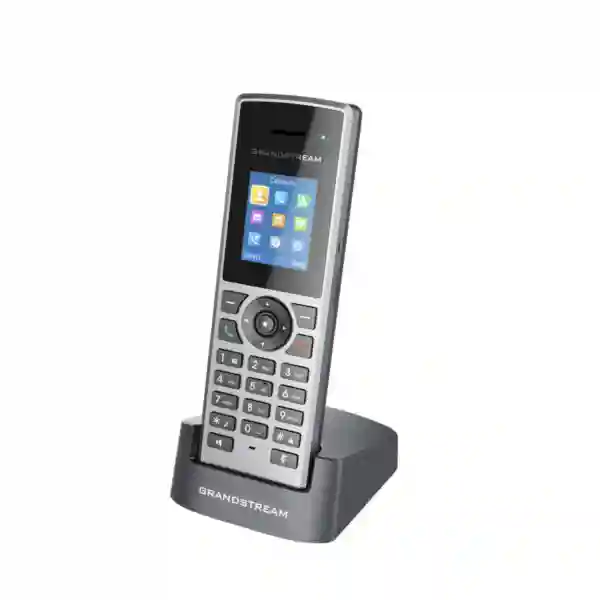
Grandstream DP722 DECT Cordless HD Handset
The Grandstream DP722 is a cordless DECT handset designed for mobility within a Grandstream DECT voice environment. It is suited to employees who cannot remain at a desk but still need reliable access to business calls, extension features and SIP-based telephony. Official Grandstream information confirms support for DP750, DP752 and DP755 base stations, a 1.8-inch 128×160 color display, HD audio, push-to-talk, a 3.5 mm headset jack, three-way conferencing, over-the-air software updates, up to 20 hours of talk time and up to 250 hours of standby time. Coverage depends on the paired base station and environment: up to 350 metres outdoors with DP755 or DP752, up to 300 metres outdoors with DP750, and up to 50 metres indoors under stated conditions.
Choose the DP722 when you need a mid-range cordless SIP handset and already use, or plan to use, a compatible Grandstream DECT base. Before ordering, confirm the base model, number of handsets, SIP accounts, expected concurrent calls, building layout and headset needs.
Up to 20 lines and 20 SIP accounts with DP755, or up to 10 lines and 10 SIP accounts with DP752 or DP750.
Up to 350 m outdoors with DP755/DP752, up to 300 m with DP750, and up to 50 m indoors. Actual buildings can reduce practical coverage.
Official laboratory figures state up to 20 hours talk time and 250 hours standby. Charging practice, battery condition and call patterns influence real usage.
HD audio, speakerphone, configurable push-to-talk, three-way conferencing, soft keys, headset jack and common business call features.
What the Grandstream DP722 solves
A conventional desk phone is suitable when a user works at a fixed position, but many business roles require movement. Warehouse supervisors walk between storage and loading zones. Retail personnel move between counters, back rooms and customer areas. Hospitality teams cross reception and service spaces. Technical staff may need to answer an internal extension while checking equipment elsewhere in the building. The DP722 addresses that mobility requirement by connecting wirelessly to a compatible Grandstream DECT base while the base integrates with the IP network and SIP environment.
This architecture is different from simply using Wi-Fi calling on a smartphone. A DECT deployment creates a dedicated cordless voice layer with predictable handset registration, base-station capacity and telephony controls. The DP722 can therefore be a practical endpoint for organizations that want business calling without tying selected staff to a desk. The handset supports common features such as hold, transfer, forwarding, call waiting, call logs, downloadable phonebook functions and configurable dial plans when supported by the surrounding platform.
For procurement teams, the important point is that the DP722 is not a standalone SIP endpoint that directly plugs into Ethernet. It depends on a compatible Grandstream DECT base station. A correct quotation should therefore confirm whether the customer already owns a DP750, DP752 or DP755, or whether a base station must be included. Capacity, outdoor range and supported lines/accounts differ by base model, so the handset should be selected as part of the DECT system rather than as an isolated item.
Verified DP722 technical highlights
| Product type | DECT cordless HD handset |
| Compatible bases | Grandstream DP750, DP752 and DP755 |
| Display | 1.8-inch 128×160 color TFT LCD with programmable soft keys |
| Range | Up to 350 m outdoors with DP755/DP752, up to 300 m with DP750, up to 50 m indoors |
| Accounts and lines | Up to 20 SIP accounts/lines with DP755; up to 10 with DP752/DP750 |
| Audio | HD audio on handset, speakerphone and headset path; G.722 support and base-dependent codec support |
| Battery rating | Up to 20 hours talk time and 250 hours standby under laboratory conditions |
| Headset | 3.5 mm headset jack |
| Security | DECT authentication and encryption |
| Management | Over-the-air handset software/firmware updates; provisioning capabilities depend on the base and system design |
Compatibility, PBX integration and deployment planning
The DP722 should be evaluated as one component in a complete voice design. The compatible DECT base handles the network connection and registration to the SIP platform. Where a Grandstream UCM IP PBX is used, Grandstream documents Zero Config provisioning support through its ecosystem. In other SIP environments, administrators should confirm registration parameters, dial plans, call features, codecs, NAT behavior and any provider-specific requirements. A handset may expose advanced telephony features, but the final user experience depends on what the PBX, SIP trunk and base station support together.
Coverage planning deserves particular attention. The published range figures are useful engineering references, not guaranteed building-wide measurements. Concrete walls, reinforced structures, metal shelving, elevator cores, equipment rooms, floor separation and radio interference can reduce usable distance. For offices and warehouses in Tanzania, a sensible deployment process is to place the DECT base where it has a clear relationship to the main usage area, register the handsets, perform a walk test and confirm call quality at the practical edge of the required zone. Where a single base cannot provide the required coverage or capacity, the wider DECT architecture should be reconsidered before simply adding handsets.
The DP722 also supports one-touch door control with compatible Grandstream GDS facility-access devices, creating a useful integration path for environments where reception or mobile staff need to respond to an entry request. That function should still be designed with appropriate access-control policy and physical security. For more general access-control requirements, review FourTeck Tanzania’s access-control and door-security solution overview, which explains the wider role of readers, locks, controllers and event handling.
Related FourTeck Tanzania resources
The DP722 belongs inside a complete business voice environment, so several Tanzania FourTeck resources are relevant when preparing a quotation. The FourTeck Tanzania technology shop provides broader guidance on selecting IP phones, PBX hardware, switches and supporting infrastructure by compatibility and capacity rather than by model name alone.
For call routing, extensions, SIP trunks, IVR and queues, use the IP PBX and VoIP communication guidance. For endpoint planning, the IP phones and business telephony section explains how user roles influence handset selection. Voice quality also depends on the LAN, so the network switching and LAN infrastructure section is useful when VLANs, uplinks and PoE are part of the wider project, even though the DP722 handset itself communicates through its DECT base rather than connecting directly to a PoE switch.
For site-wide technology planning, FourTeck Tanzania also publishes guidance on Wi-Fi and wireless networks, business technology services, FourTeck Tanzania’s integrated IT approach and the verified Tanzania contact page. The public site currently exposes fewer than seven distinct, directly relevant telephony/product URLs that could be independently verified, so this page deliberately avoids inventing category or product paths.
Grandstream DP722 Tanzania
For organizations evaluating the Grandstream DP722 in Tanzania, the most useful starting point is the mobility requirement. The handset is suited to staff who need to remain reachable while moving between working areas rather than sitting beside a fixed desk phone. Warehouses, retail operations, hospitality sites, clinics, offices with shared workspaces and light industrial environments can all have roles where cordless extension access improves responsiveness. The DP722 delivers this through a compatible Grandstream DECT base station, so buyers should think in terms of the complete cordless voice cell: base station, handset count, PBX or SIP service, network connection, power, coverage and user workflow.
A Tanzania quotation should therefore include several practical facts. First, identify the existing or proposed base station. DP750 and DP752 support up to 10 SIP accounts/lines per handset, while DP755 enables up to 20. Published outdoor range is also base dependent. Second, count how many mobile users need handsets and how many simultaneous calls are expected. Third, review the building. A single floor with relatively open partitions may behave very differently from a multi-storey concrete structure or warehouse with metal racks. The manufacturer’s up-to-50-metre indoor figure is a reference, but an on-site walk test is the more reliable way to validate coverage.
Tanzania buyers should also include infrastructure readiness in the procurement decision. The DECT base needs a stable network path to the PBX or SIP service. Voice traffic should be considered in VLAN, QoS, firewall and internet planning where appropriate. If the business relies on calling during short power disturbances, the switch, router, firewall, PBX and DECT base may all need suitable UPS support. The handset has its own rechargeable batteries, but cordless operation still depends on the base and upstream voice system remaining available.
When requesting a Grandstream DP722 Tanzania quotation, provide the handset quantity, base model, PBX model or hosted-SIP provider, approximate floor plan, number of floors, intended working zones, headset preference and whether door-control integration is required. These details make it easier to determine whether the DP722 fits the job and whether additional base stations, network work or configuration services should be included.
Grandstream DP722 Dar es Salaam
In Dar es Salaam, the Grandstream DP722 can fit businesses that combine office administration with spaces where employees move continuously. Examples include multi-room offices, retail sites, showrooms, logistics facilities, warehouses, service centres and hospitality operations. In such environments, a fixed desk extension may not reach the person who is responsible for a customer, delivery, stock question or operational issue. A DP722 registered to a compatible Grandstream base can give that employee an internal extension that moves with them while keeping business calls inside the organization’s controlled telephony environment.
Dense urban commercial buildings can introduce practical DECT planning challenges. Reinforced concrete, lift shafts, service cores, metal partitions and multiple floors can all affect radio coverage. A base station placed for convenience beside the network rack may not provide the best signal to the actual work area. For Dar es Salaam sites, it is therefore useful to map the required calling zones before installation. Mark reception, corridors, stock rooms, customer areas, loading points and any outdoor transition zones where staff must remain reachable. Place the base with those zones in mind and test real calls rather than relying only on theoretical distance.
Capacity is equally important. If only a few users need cordless calling, a DP750 or DP752 may be sufficient depending on the wider requirements. If the design calls for more handsets, lines or accounts, DP755 may be the better platform because it raises supported handset/system capacity and allows up to 20 lines and SIP accounts per DP722. The correct choice should be based on the expected number of users and simultaneous calls, not simply on the highest published specification.
Procurement teams in Dar es Salaam should ask for a complete bill of materials that identifies the handset, base, power method, any PBX licenses or SIP-service requirements, headset options, configuration scope and network dependencies. If the DP722 will integrate with a Grandstream UCM PBX, include the UCM model and firmware environment in the request. If it will register through another SIP platform, include provider or PBX details so compatibility and feature behavior can be reviewed before deployment.
Grandstream DP722 Mwanza
Businesses seeking a Grandstream DP722 in Mwanza may be looking for a cordless extension that can follow staff around a worksite without turning personal mobile phones into the primary business-calling tool. The handset can be relevant to warehouses, distribution operations, offices with adjacent storage, hospitality properties, clinics and service businesses where an employee may need to answer calls while away from a desk. Because the DP722 operates through a Grandstream DECT base, the main design question is whether the required working area can be covered cleanly by the selected base station and whether the wider IP voice system is ready.
For Mwanza deployments, plan coverage around the physical environment rather than using a simple radius on a floor plan. Walls, racks, doors, staircases and building materials can attenuate the DECT signal. The published indoor figure is up to 50 metres, but practical range can be lower in complex buildings. Outdoor line-of-sight conditions can be much more favorable, with the DP722 specified for up to 350 metres when paired with DP752 or DP755, and up to 300 metres with DP750. Those values should be treated as manufacturer maximums under appropriate conditions, not as a guarantee that every compound or warehouse will achieve them.
The battery rating of up to 20 hours talk time and 250 hours standby can support long shifts when charging routines are managed correctly. Teams should still define where charging cradles will be placed, who owns each handset and how spare or replacement batteries will be managed over time. For mobile staff who use a headset, the 3.5 mm jack provides a simple wired option. Push-to-talk may also be useful for quick coordination among supported users, but organizations should confirm how that workflow fits their operational procedures.
A good Mwanza quotation request should state the number of handsets, base model, existing PBX, number of floors, rough site dimensions, materials or obstacles that may affect coverage and whether the deployment needs door-control integration, headsets or centralized provisioning. That information enables a more reliable proposal than asking only for a unit price.
Grandstream DP722 Arusha
The Grandstream DP722 can be useful in Arusha environments where teams must move between guest-facing areas, administration spaces, storage rooms, service corridors or operational zones. Hospitality properties, tour and travel offices, healthcare settings, educational facilities and general businesses may all need a cordless extension that remains part of the company’s SIP phone system. The DP722 provides that mobility without requiring the user to carry a desk phone replacement based on Wi-Fi or a personal smartphone.
Arusha buyers should first determine whether the project is a handset addition to an existing Grandstream DECT deployment or a new system. If a DP750, DP752 or DP755 is already installed, confirm available capacity, firmware and registered handset count before adding devices. If the project is new, choose the base based on the scale of the deployment. The DP722 can access up to 20 lines and SIP accounts with DP755, while DP752 and DP750 configurations support up to 10. Base capacity also determines how many handsets and concurrent calls the system can handle, so the final architecture must be sized at system level rather than handset level.
Coverage validation is particularly useful in larger hospitality or campus-style sites. A manufacturer maximum of up to 350 metres outdoors does not mean that a base inside one building will cover every external area through several walls. Conducting a call walk-through across reception, offices, back-of-house areas, corridors and outdoor zones reveals where the usable signal actually falls. If callers will move between buildings or large separated areas, the DECT design may require a different architecture than a single-base installation.
When requesting DP722 pricing in Arusha, include the operational use case as well as quantity. State whether users need ordinary extension calling, push-to-talk, headset use, call transfer, conferencing or GDS door-control functions. Also provide the PBX or SIP provider and whether the network and power infrastructure are already prepared. This lets procurement compare complete deployment cost and suitability rather than comparing handset prices without the supporting system.
Grandstream DP722 Dodoma
For offices and institutions in Dodoma, the Grandstream DP722 provides a practical way to extend SIP telephony to staff whose work takes them away from a fixed desk. Administrative buildings, support teams, facilities personnel, stores, clinics and service operations may benefit from a cordless handset that can receive internal and external calls through the organization’s PBX. The DP722 remains part of a managed Grandstream DECT system, giving IT teams clearer control over registration and user configuration than ad-hoc personal-phone calling.
Planning should begin with the call workflow. Decide which users actually require cordless mobility, which extensions should ring on the DP722, whether calls need to transfer back to reception or other departments, and whether users need conference, push-to-talk or headset functions. This prevents organizations from deploying cordless handsets simply because they appear convenient. The strongest use case is where movement is part of the role and missed calls create operational delay.
Next, review the building and base placement. DP722 indoor range is specified up to 50 metres, but concrete walls, internal partitions, equipment rooms and floor separation can reduce coverage. The base should be positioned with the actual user path in mind, and a walk test should include the furthest offices, stairwells, corridors and any external areas where calls matter. The outdoor figure rises to up to 350 metres with DP752/DP755 under suitable conditions, but real performance remains environment dependent.
Dodoma procurement teams should also check the upstream voice system. The DECT base needs network access to the PBX or SIP service, and the broader network may need voice VLAN, QoS and firewall planning. Include base station, handset quantity, configuration, network readiness, UPS requirements and any required PBX work in the purchase scope. A well-defined quotation avoids the common situation where handsets arrive before the base, SIP credentials or network configuration needed to make them usable.
Grandstream DP722 UAE
Organizations sourcing the Grandstream DP722 for the UAE often need cordless voice for offices, retail environments, warehouses, hospitality properties and service teams. The same technical design principles apply: the handset must be paired with a compatible Grandstream DECT base, and the base must be integrated with the SIP platform. For businesses operating across multiple countries, standardizing on the same DP722 and Grandstream base architecture can simplify user training and configuration, provided local telephony requirements and radio compliance are considered for each deployment.
The DP722 supports DECT authentication and encryption, HD audio, a speakerphone, headset connection and business calling features. With DP755 it can access up to 20 lines and SIP accounts; with DP752 or DP750, up to 10. If a UAE branch expects higher handset density or more simultaneous conversations, base-station capacity should be sized accordingly. A warehouse may focus more on radio coverage and push-to-talk, while an office may prioritize call transfer, directory access and headset use. The same handset can serve different roles, but the configuration should reflect the workflow.
For regional FourTeck context, FourTeck UAE provides a broader entry point for UAE IT and telecom requirements, while FourTeck’s IP phone specialist site is relevant to business endpoint selection. These resources can be useful when a procurement team wants to align a Tanzania deployment with a UAE branch or central standard.
A UAE request for quotation should state quantity, intended base station, PBX or hosted-SIP platform, building type, number of floors and whether the phones will operate mainly in open areas or through multiple partitions. Also include requirements for provisioning, user setup and integration with Grandstream UCM or GDS devices. That information helps distinguish a simple handset purchase from a multi-site voice deployment that needs coordinated configuration.
Grandstream DP722 Uganda
For organizations in Uganda, the Grandstream DP722 is relevant where cordless extension mobility is more useful than a fixed desk endpoint. Warehouses, branches, retail businesses, hospitality venues and operational offices may all have staff who need to remain reachable while moving. The handset links to a Grandstream DECT base rather than directly to the IP network, which means deployment planning should include both radio coverage and the quality of the base station’s connection to the PBX or SIP provider.
If the organization operates several sites, a standard Grandstream DECT design can make support more consistent. Administrators can define extension naming, handset ownership, charging procedures, PBX dial plans and firmware practices across branches. However, each building still needs its own coverage assessment. The up-to-50-metre indoor range is a specification under suitable conditions; solid walls and multi-floor layouts can reduce practical distance. Outdoor maximums depend on the selected base and should also be verified through a walk test.
Organizations comparing base stations should consider both current and future handset counts. DP755 supports a higher scale than DP750/DP752 and allows the DP722 to access up to 20 lines/accounts. A smaller site may not need that capacity. Procurement is more efficient when the base is chosen from actual user count, simultaneous call demand and expansion plans rather than simply buying the newest or largest model.
For Uganda-wide project context, FourTeck Uganda covers regional IT, PBX and networking requirements. A useful quotation request should include the site location, handset quantity, base model, PBX platform, internet or WAN arrangement where hosted voice is used, and any request for installation or remote configuration. These details allow the DP722 to be assessed as part of a functioning voice system rather than as an isolated cordless device.
Grandstream DP722 Kampala
In Kampala, the DP722 can support mobile voice users across offices, shops, hospitality properties, clinics, stock rooms and commercial premises where staff move between customer-facing and back-office areas. The handset’s value comes from keeping a user connected to the business extension while moving inside the DECT coverage area. Reception can transfer calls to a mobile employee without forcing that employee to return to a desk, which can shorten response time in busy environments.
Urban commercial buildings can make radio planning important. Reinforced structures, elevator shafts, multiple tenancy walls and equipment rooms may create coverage shadows. Rather than mounting the base beside the network rack by default, identify the routes users actually walk. Test calls from reception to stock areas, meeting rooms, corridors and exterior service zones. If the call becomes unstable before reaching the required boundary, repositioning the base can sometimes improve performance without changing hardware. Larger or more complex sites may need a broader design review.
The DP722’s 20-hour talk-time and 250-hour standby figures are useful for shift planning, but charging discipline remains important. Each assigned handset should have a known charging location and ownership process. Organizations with shared devices should define handover and cleaning routines. The 3.5 mm headset jack can help personnel who need hands-free use, while push-to-talk can support fast internal coordination where the feature is appropriately configured.
Kampala buyers should not assume that a DP722 purchase automatically includes a DECT base, PBX account or SIP service. Ask the quotation to list each component explicitly. Include whether an existing Grandstream base is already installed, how many other handsets are registered, which PBX is in use and whether configuration support is needed. This is particularly important when replacing or expanding an older cordless system because firmware, base capacity and extension assignments may need review before new handsets are introduced.
Grandstream DP722 Arua
For buyers in Arua, the Grandstream DP722 may suit branch offices, stores, hospitality businesses, clinics and operational facilities that want cordless access to a SIP phone system. The handset can help a small number of mobile users remain connected while moving within a site, but it should be purchased together with a clear understanding of the base station and PBX environment. A handset on its own cannot register directly to the network without the compatible DECT base.
Branch deployments often benefit from simplicity. A well-documented design can specify one base model, a defined number of DP722 handsets, extension names, charging locations, firmware practice and a clear support procedure. This makes troubleshooting easier because staff know which device provides the radio layer, which system handles call routing and which network path connects the base to the PBX. When the branch uses a centralized or hosted PBX, WAN and internet reliability also become part of call quality.
Coverage testing should be done at the actual premises. Even a small building can contain thick walls or storage structures that affect signal. If users need to move between an office and an external yard, test the transition path with a live call. Outdoor range can reach the published base-dependent maximum under favorable conditions, but walls between the base and outside area may reduce that significantly. Selecting base placement from the user route rather than from cabling convenience often improves results.
Arua procurement requests should include the required number of handsets, type of workplace, approximate site dimensions, current PBX, existing Grandstream equipment and whether the branch needs on-site installation or remote configuration. If the objective is to standardize several Uganda branches, identify that in the request so base and handset capacity can be planned consistently. A consistent design can make future replacement and expansion easier even when each branch has different physical coverage needs.
Grandstream DP722 Mbarara
In Mbarara, the DP722 is a practical consideration for businesses that need staff mobility within a controlled phone-system environment. Retail teams can answer calls while checking stock, hospitality staff can move between service areas, and office support personnel can remain reachable during routine movement. Because the handset uses DECT, it does not depend on the employee’s personal mobile plan and does not require the user to carry a smartphone as the business extension.
The system should be sized with realistic call activity in mind. The DP722 itself supports access to multiple lines and SIP accounts, but base-station limits govern the overall deployment. A small business may have only three or four cordless users and modest concurrency, while a busy hospitality or warehouse environment may need more handsets and more simultaneous calls. Those differences determine whether DP750, DP752 or DP755 is appropriate. Buyers should therefore provide expected handset count and peak call volume before selecting the base.
Network readiness also matters. The DECT base is an IP device that must communicate reliably with the PBX. Where the PBX is hosted or located at another site, stable WAN connectivity becomes important. If voice competes with large data transfers, video or guest traffic, network quality of service and segmentation may need attention. A cordless handset cannot solve underlying packet loss or unstable internet, so a voice deployment should include basic network checks where call quality is business critical.
For a Mbarara quotation, include whether the DP722 will be used with Grandstream UCM or another SIP PBX, whether the base already exists and the approximate building layout. Specify any requirement for a headset, call groups, reception transfer workflow, door control or push-to-talk. Clear requirements help ensure that the quotation includes the right supporting components and that the handset arrives ready to fit the intended workflow rather than requiring unplanned additions later.
Grandstream DP722 Gulu
Organizations looking for the Grandstream DP722 in Gulu may need a dependable cordless extension for mobile staff in offices, clinics, stores, hospitality properties, workshops or branch facilities. The DP722 can deliver that mobility when paired with a Grandstream DP750, DP752 or DP755 base and connected through the organization’s SIP telephony platform. The key procurement principle is to treat the handset, base, PBX and network as one voice system rather than purchasing each independently.
For a branch or remote operational site, resilience may matter as much as features. If the phone system is hosted over the internet, voice depends on local power, router/firewall availability and WAN connectivity. A UPS for the network and DECT base can help preserve service during short power interruptions, but the correct capacity should be calculated from the actual equipment. If the PBX is on-premises, it should also be included in the power and network continuity plan. The handset battery provides mobility, but it cannot compensate for an offline base or PBX.
The DP722 offers HD audio, speakerphone, push-to-talk, a headset jack and standard call controls. These features can support a wide range of roles, but training should still be part of deployment. Users should know how to transfer calls, place a call on hold, use the speakerphone, charge the handset and report coverage problems. A short handover can prevent avoidable support calls and helps teams use the device as intended.
Gulu buyers should ask for a quote that separates hardware, configuration and installation. State how many handsets are required, whether the base exists, the PBX or SIP platform and the required working area. If the site has several buildings or large outdoor zones, provide that information before ordering because one base may not cover the full area. A brief site plan can be more valuable than simply supplying a square-metre figure because walls and construction influence radio behavior.
Grandstream DP722 Kenya
Kenyan businesses considering the Grandstream DP722 can use it as a standardized cordless endpoint for warehouses, offices, retail chains, hospitality environments and service operations. Its DECT architecture separates cordless voice from the Wi-Fi network while still connecting the base station to the IP telephony infrastructure. This can be useful where users need predictable extension behavior and do not require the broader application experience of a smartphone.
Multi-branch organizations should decide whether each site will use the same base model or whether base capacity will vary by branch size. DP755 can support a larger deployment and gives the DP722 access to up to 20 SIP accounts/lines, while DP750 and DP752 support up to 10. Standardization can simplify templates and support, but there is little value in oversizing every site if only a few cordless users are expected. A branch profile based on handset count, concurrent calls and coverage requirements can help procurement choose consistently.
For Kenya-focused regional support and infrastructure context, FourTeck Kenya covers VoIP PBX, networking and business IT requirements. Where Tanzania and Kenya operations are part of the same organization, aligning PBX dial plans, extension numbering, device naming and user procedures can make cross-border administration easier. The physical radio design should still be tested separately at each site.
A Kenya DP722 request should state handset quantity, base station choice, PBX or cloud voice platform, expected simultaneous calls, building layout and whether configuration will be performed centrally. Ask suppliers to identify what is included in the package and what requires separate purchase. This is especially important for DECT solutions because the handset, base and PBX role can be misunderstood when comparing quotations from different vendors.
Grandstream DP722 Kuwait
In Kuwait, the Grandstream DP722 can serve as a cordless SIP extension for businesses that require mobility across offices, retail environments, logistics spaces or hospitality operations. The handset itself is lightweight and designed for continuous carry, with a color display, speakerphone, belt clip and headset jack. It becomes part of the IP voice environment through the Grandstream DECT base, allowing the organization to manage extensions centrally rather than relying on personal mobile numbers for internal call handling.
The building environment should guide base placement. Large concrete structures, storage racking and separated floors can reduce indoor range, while open areas may approach better coverage. Where the handset is expected to reach outdoor loading or service areas, test the signal through the actual doors and walls between the base and outdoor zone. The published 350-metre outdoor figure with DP752/DP755 is a maximum under suitable conditions, not a guarantee through multiple obstructions.
For Kuwait regional technology context, FourTeck Kuwait provides information on VoIP PBX, networking and business IT. Organizations that operate in both Kuwait and Tanzania can use a consistent Grandstream handset family while adapting the base and PBX design to each branch. Consistent naming, user guides and provisioning policies can simplify ongoing support across locations.
When requesting DP722 pricing in Kuwait, specify whether the purchase is an expansion or a new system. For an expansion, provide the current base model, firmware environment, registered handset count and available PBX extensions. For a new system, provide the number of mobile users, required coverage zones and preferred PBX. This information allows the proposal to include the correct base-station capacity, handset quantity and configuration work rather than treating the purchase as a generic cordless phone order.
Grandstream DP722 Ghana
The Grandstream DP722 can fit Ghanaian businesses that need cordless business calling within a defined worksite. Warehouses, hotels, clinics, retail operations and offices often have roles where a person moves between areas but still needs access to the company extension. The DP722 allows that user to carry a managed DECT handset while the Grandstream base station connects to the SIP platform. This separation between handset mobility and IP network connectivity can make the system straightforward to manage when designed correctly.
Organizations should first decide how many cordless users truly need the service. A receptionist who remains at a desk may be better served by a desk phone, while a facilities supervisor or stock controller may gain real value from cordless access. Assigning the correct endpoint by job role can reduce unnecessary cost and improve usability. The DP722 is best understood as a mobility endpoint, not as a universal replacement for every desk phone.
For regional FourTeck coverage, FourTeck Ghana presents broader business IT and telecom solution information. Multi-country companies can use the same procurement checklist across Ghana and Tanzania: confirm base model, handset quantity, PBX, SIP accounts, concurrent calls, coverage, charging, headsets, network readiness and power continuity. Consistency in this checklist helps avoid missing system components when purchasing across regions.
A Ghana DP722 quotation should also clarify whether the customer needs configuration only or full deployment support. If the PBX is Grandstream UCM, provide its model and software environment. If the system is another SIP platform, provide registration and feature requirements. For sites with door access, mention whether Grandstream GDS integration is required. The more complete the requirement, the easier it is to determine whether DP722 is the right handset and which supporting products should accompany it.
Grandstream DP722 Nigeria
Nigeria-based organizations can use the Grandstream DP722 where employees need to handle business calls while moving around a defined site. In logistics facilities, retail stores, clinics, offices and hospitality environments, mobility can reduce the delay caused by finding a fixed extension. The DP722 remains tied to a business SIP account through the DECT base, so call routing, extension identity and PBX policies stay under administrative control.
Power and network continuity deserve attention in any voice deployment. The handset’s rechargeable batteries allow cordless operation, but the base, PBX, network switch, router and firewall may still depend on mains power. If business calls are important during short outages, the supporting infrastructure should be evaluated for UPS protection. For hosted PBX services, internet stability and redundancy may matter. A cordless handset can remain powered while still losing service if the upstream voice path is unavailable.
For Nigeria regional planning, FourTeck Nigeria covers IT services and communications infrastructure. Companies managing Nigerian and Tanzanian branches can benefit from standardized extension naming, handset configuration, support documentation and device lifecycle practices. The same DP722 model may be used across sites, while base capacity and coverage are adapted to the local building.
A Nigeria procurement request should provide more than quantity. Include the number of users, desired simultaneous calls, base station model, PBX, building type, number of floors and whether users need to reach external yards or loading areas. Ask for confirmation of package contents and any separate base or licensing requirements. This makes commercial comparison more meaningful because suppliers may otherwise quote only the handset while another quotation includes supporting equipment or configuration.
Grandstream DP722 Seychelles
In Seychelles, the Grandstream DP722 can be relevant to hospitality properties, offices, service businesses, clinics and other sites where staff need to move while remaining connected to the organization’s voice system. Hospitality is a particularly clear use case: personnel may move between reception, back office, storage and service zones, and a cordless extension can help them answer or receive transferred calls without returning to a fixed desk.
Site layout can vary significantly across island properties, especially where facilities are spread across several buildings or levels. A single DECT base should not be assumed to cover an entire resort, compound or multi-building operation. The DP722’s maximum outdoor range can be substantial under suitable conditions, but building walls, terrain and separation between structures can change practical results. Coverage testing should therefore be part of the design, and the voice architecture should be planned around actual movement paths.
Where the organization uses hosted SIP services, international connectivity and local internet resilience may also influence calling. For an on-premises PBX, the local LAN and power plan become central. In both cases, configuration should define extension behavior, transfer destinations, voicemail, ring groups and any emergency or after-hours routing. The DP722 supplies the mobile endpoint, but the PBX determines how calls are handled across the business.
Seychelles buyers should request a system-oriented quotation that includes handset quantity, base station, PBX integration and deployment assumptions. If the property has separate buildings, provide a simple site diagram or describe approximate distances and construction. Include whether staff need headset use, push-to-talk or GDS door-control features. This approach reduces the risk of ordering handsets based only on published range and discovering later that the property requires a more comprehensive cordless architecture.
Buying and quotation checklist
List current users and realistic near-term growth. Do not assume every extension needs a cordless handset.
State whether DP750, DP752 or DP755 already exists. If not, include the base in the proposed solution.
Provide the Grandstream UCM model, third-party PBX or hosted-SIP provider so registration and feature expectations can be checked.
Describe floors, walls, warehouse racks, outdoor yards and the farthest point where users must maintain a call.
Estimate simultaneous calls during busy periods, not only the total number of users.
Identify headset requirements, spare charging positions, belt clips and any operational accessories needed.
Frequently asked questions
Does the Grandstream DP722 work without a base station?
No. The DP722 is a DECT handset and requires a compatible Grandstream DECT base such as DP750, DP752 or DP755. The base provides the IP network and SIP connection.
How far can the DP722 work from the base?
Grandstream specifies up to 350 metres outdoors with DP755 or DP752, up to 300 metres outdoors with DP750 and up to 50 metres indoors. Actual range depends on walls, floors, metal structures and other environmental factors.
How many SIP accounts does the DP722 support?
It can access up to 20 lines and 20 SIP accounts when paired with DP755. With DP752 or DP750, the figure is up to 10 lines and 10 SIP accounts per handset.
Does the DP722 support a headset?
Yes. It includes a 3.5 mm headset jack. Confirm headset connector and compatibility before purchasing accessories in quantity.
What is the DP722 battery life?
Grandstream publishes up to 20 hours of talk time and up to 250 hours of standby time under laboratory conditions. Real usage varies with battery condition, call volume and charging practice.
Can the DP722 work with Grandstream UCM IP PBX?
Yes. Grandstream documents Zero Config support for its UCM series when the handset is used through compatible DECT base stations. The exact deployment should still match the UCM version, base configuration and required extensions.
Can the DP722 open a door through Grandstream GDS?
Grandstream lists seamless one-touch door control with its GDS facility-access devices. The complete GDS access-control design, permissions and network setup should be configured appropriately.
Decision recap
The Grandstream DP722 is a strong fit when the requirement is a mid-range cordless DECT business handset with HD audio, a color screen, headset support, push-to-talk and a practical battery profile. The choice is most compelling when a compatible Grandstream base already exists or when the organization is deliberately building a Grandstream DECT environment. It should not be bought as if it were a standalone Wi-Fi or Ethernet SIP phone.
Before ordering, confirm the base model, handset quantity, simultaneous call demand, PBX, coverage area and accessories. Where coverage or capacity is uncertain, validate the design first. This produces a more dependable result than relying only on headline range or account numbers.
Regional FourTeck network for multi-country deployments
Organizations coordinating voice projects across borders can also review FourTeck UAE, FourTeck Kenya, FourTeck Uganda, FourTeck Ghana and FourTeck Nigeria. These regional sites are useful when a customer wants common handset standards, shared PBX design principles or coordinated procurement while still adapting radio coverage and local deployment details to each site.
Consultation panel
For a useful Grandstream DP722 quotation, send the number of users, required handset quantity, existing base station if any, PBX/SIP platform, approximate floor plan, required indoor/outdoor coverage and any headset, push-to-talk or GDS integration needs. FourTeck can then align the handset with the supporting voice and network environment.



Reviews
There are no reviews yet.