
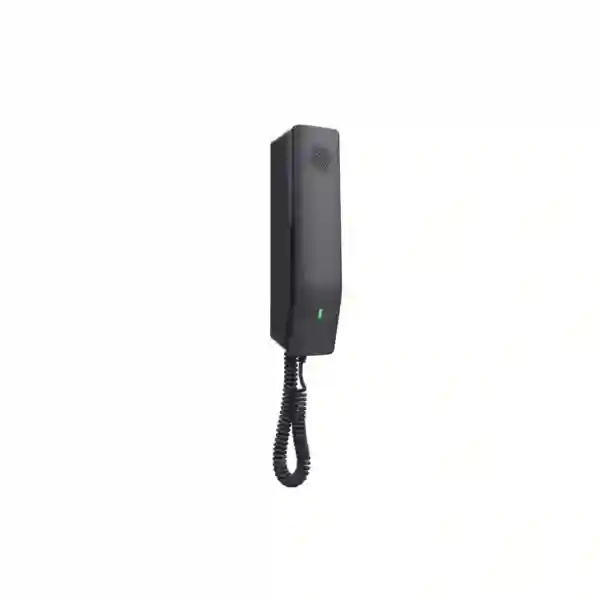
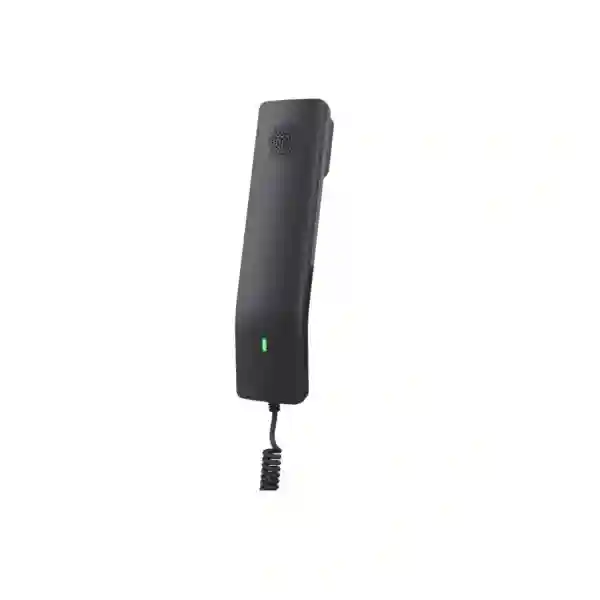
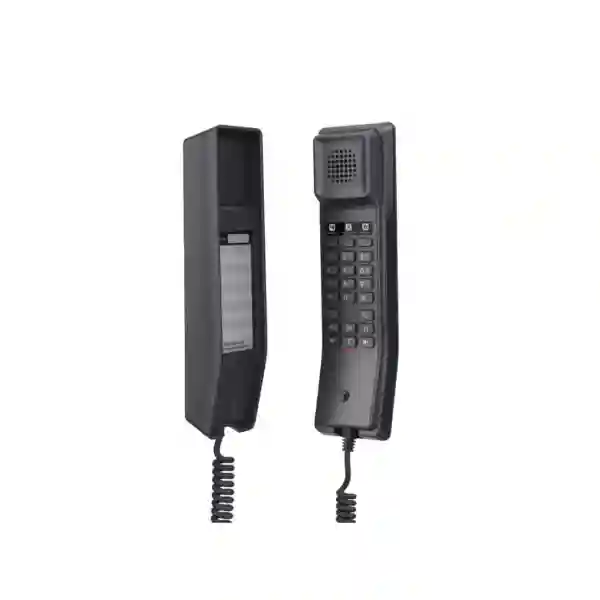
Grandstream GHP611 Compact Hotel IP Phone
The Grandstream GHP611 is a compact black IP phone created for hotel rooms and other spaces where users need straightforward calling while administrators need dependable SIP provisioning and centralized control. Grandstream specifies 2 SIP accounts and 2 lines, an HD handset, 10 speed-dial keys, 3 programmable keys, 3-way voice conferencing, a 10/100 Mbps Ethernet interface with PoE, enterprise-oriented security controls and support for Grandstream Device Management System. The model can be used on a desktop or wall mounted, making it practical for guestrooms, apartments, hospitals, dormitories, retail service points and similar room-based deployments.
Lines: 2 SIP accounts / 2 lines
Network: 10/100 Mbps Ethernet with PoE
Keys: 10 speed dial + 3 programmable
Audio: HD handset, G.722 and full-band Opus support
Management: GDMS and standards-based provisioning
What the Grandstream GHP611 is designed to solve
Guest-room telephony is different from a normal office desk-phone requirement. A hotel often needs a handset that is simple for an unfamiliar user, clearly labelled for reception and service calls, easy to clean, straightforward to mount and manageable across many rooms. The GHP611 addresses that requirement with a screen-free interface, dedicated function keys, programmable service keys and a faceplate that can be customized. Instead of asking a guest to navigate menus, administrators can prepare the handset around the most common actions expected in the room.
The second challenge is operational consistency. One handset may be easy to configure manually, but tens or hundreds of rooms require repeatable provisioning, firmware control and account settings. Grandstream supports the GHP611 through GDMS, allowing administrators to manage compatible endpoints centrally. For buyers in Tanzania planning a hotel, residence, clinic, campus, staff accommodation facility or serviced apartment project, this means the phone should be evaluated as part of the complete voice architecture: SIP PBX, extension plan, PoE switching, voice VLAN, structured cabling, internet or SIP trunk connectivity, backup power and ongoing management.
Simple guest experience
Ten speed-dial keys and three programmable keys let administrators expose frequently used hotel or facility services without a complicated screen-driven workflow.
PoE deployment
The GHP611 provides a 10/100 Mbps Ethernet interface with PoE, which can reduce the need for a separate power adapter when connected to suitable PoE switching.
Central administration
GDMS support is useful when many endpoints must receive standardized account settings, configuration templates and firmware management.
Flexible placement
The compact form factor supports desktop placement or wall mounting, helpful where bedside, desk or wall space is limited.
Verified technical highlights
| Area | GHP611 capability | Buying relevance |
|---|---|---|
| SIP | 2 SIP accounts, 2 lines | Suitable for room extensions and simple multi-line call handling. |
| Networking | One auto-negotiating 10/100 Mbps Ethernet port with PoE Class 2 | Coordinate switch PoE budget and voice VLAN design. |
| Audio | HD handset with G.722, Opus and other common codecs | Match PBX and SIP-provider codec policy to deployment needs. |
| Call features | Transfer, conference, redial, hands-free, voicemail, hold, mute and flexible dial plan | Supports common guest-room and service-call workflows. |
| Security | Secure boot, TLS, SRTP, 802.1X and AES-encrypted configuration support | Useful when voice endpoints are incorporated into a managed security policy. |
| Management | GDMS, TR-069 and encrypted XML provisioning options | Important for repeatable multi-room rollouts. |
Plan the GHP611 as part of the complete voice system
A successful GHP611 project needs more than handsets. The phones need SIP registration, addressing, network access and adequate PoE power. Review the FourTeck Tanzania business technology shop for procurement context, the technology services page for integration planning, the Tanzania solutions overview for IP PBX, IP phones, switching and infrastructure, and the Tanzania contact page when preparing a quotation. For wider regional projects, FourTeck also maintains relevant business-communications resources for Uganda, Kenya, Ghana, Nigeria and UAE.
Grandstream GHP611 Tanzania
For a Grandstream GHP611 Tanzania deployment, the first purchasing question should be how the handset will fit into the property’s voice and network design. Hotels in Tanzania may be replacing analog guest-room phones, opening a new property, modernizing an IP PBX, or standardizing extensions across several buildings. The GHP611 is useful where the room phone should remain visually simple while the administrator retains modern SIP control. Its black finish, compact dimensions, wall-mount option and replaceable faceplate support guest-room presentation, while the programmable and speed-dial keys can be assigned to reception, housekeeping, room service, security or another internal service according to the PBX design. Buyers should define the expected call flow before devices are ordered, because the usefulness of a hotel phone depends on extension planning, dialing permissions, hunt groups, voicemail behavior and emergency-calling arrangements as much as the handset itself.
Network preparation is equally important in Tanzania. The GHP611 uses Ethernet and PoE, so the installation should confirm that every intended room has suitable structured cabling back to a PoE-capable switch with enough power budget. Voice VLANs, DHCP, QoS and firewall policy should be planned where the wider network carries guest Wi-Fi, CCTV, staff traffic and other services. A UPS-backed switching layer can help maintain internal communications through short power interruptions, subject to the rest of the PBX and network also being protected. For properties with many rooms, centralized GDMS provisioning can make onboarding and maintenance more consistent than configuring each phone independently. Procurement teams should include the exact GHP611 model, required quantity, PoE readiness, mounting preference, faceplate labeling requirements, PBX platform, SIP trunk environment and desired support scope in the quotation request. This creates a clearer basis for selecting the right hardware and identifying any network or PBX work required before room-by-room installation begins.
Grandstream GHP611 Dar es Salaam
In Dar es Salaam, the GHP611 can suit city hotels, serviced apartments, clinics, private hospitals, campuses and residential facilities that need a compact SIP endpoint for individual rooms. Larger urban properties often operate multiple digital systems at the same time: guest Wi-Fi, access control, CCTV, IPTV, property-management applications and business telephony. The voice system should therefore be designed as one managed service on the network rather than as an isolated set of phones. For GHP611 deployment, administrators should map room numbers to extensions, reserve service-number shortcuts, define external calling permissions and confirm how incoming calls are transferred from reception. The three programmable keys and ten speed-dial positions can then be assigned consistently across the property so a guest does not need to understand the PBX to reach the services provided by the hotel.
Dar es Salaam projects should also consider network density and supportability. A hotel with several floors may have multiple access switches and uplinks; those switches need sufficient PoE capacity and a documented VLAN design. Cabling to each guest room should be tested before commissioning because a phone that fails to register may have a cabling, switch, DHCP, PBX, credential or firewall problem rather than a handset fault. Centralized configuration through GDMS can reduce repetitive work and make firmware and account changes easier to coordinate. When requesting a GHP611 quotation in Dar es Salaam, include the number of rooms, number of public or service-area phones, existing PBX model, switch model, current cabling status, whether wall mounting is required and whether custom faceplate artwork will be prepared. If the project includes a new PBX or switch refresh, include those requirements in the same design review so endpoint compatibility, PoE capacity and call routing can be validated together rather than after installation.
Grandstream GHP611 Mwanza
Grandstream GHP611 buyers in Mwanza may be planning hotels, lodges, medical facilities, educational residences or apartment properties where room phones need to be uncomplicated and centrally administered. The handset’s value is strongest when the use case is clear: a guest picks up the phone, reaches reception or a defined service quickly, and does not need to navigate an office-oriented screen. The swappable faceplate and dedicated speed-dial area can support clearly identified services, while SIP registration allows the extension to become part of an IP PBX rather than a separate analog line. For properties transitioning from older analog systems, the change should be planned carefully because an IP handset requires Ethernet connectivity and network power instead of a traditional analog pair from a legacy PBX.
For Mwanza deployments, inspect the communications room and room cabling before deciding that phone replacement alone will complete the upgrade. Confirm whether existing cabling is Ethernet-ready, whether switches support the required PoE standard and budget, and whether the PBX can provision the desired extensions and calling rules. If network uplinks are shared with video surveillance or guest internet, QoS and VLAN separation can help keep voice predictable under load. Administrators can use GDMS for consistent provisioning across multiple endpoints, which is particularly useful where phones are distributed across separate wings or buildings. A good procurement specification should list room count, spare-handset requirements, extension numbering, service-key assignments, mounting style, PBX details, desired codec policy and any restrictions on external calls. Planning these details before installation makes it easier to stage the phones, label them, apply templates, test sample rooms and then roll out the remaining units with fewer surprises.
Grandstream GHP611 Arusha
Arusha has hospitality environments ranging from city hotels and conference properties to lodges and accommodation serving tourism operations. The Grandstream GHP611 is relevant where management wants a compact, black, screen-free room phone with SIP functionality and centralized administration. In guest accommodation, simple presentation is often an advantage: the handset can be programmed around the property’s own service model instead of exposing complex business-phone menus. Reception, housekeeping, security, transport desk or other internal destinations can be represented through the speed-dial and programmable-key layout, subject to the configured PBX call plan. The wall-mount option can also be useful where desk space is limited or the phone needs to be positioned at a defined point in the room.
Arusha procurement should account for properties that may combine several buildings, outdoor pathways or separate accommodation blocks. The GHP611 itself is a wired Ethernet device, so each installation point needs appropriate LAN connectivity and PoE. Where buildings are linked by fiber or long-distance network uplinks, the overall LAN design should ensure that voice VLANs, DHCP services and PBX reachability extend reliably to each access switch. Administrators should also define how phones are recovered after switch replacement, network changes or room renovations; a documented provisioning template and GDMS management process can simplify restoration. Before requesting pricing, identify the number of active rooms, planned spare quantity, PBX platform, switch locations, available PoE ports, faceplate wording, installation position and whether the project includes network remediation. A pilot deployment in representative rooms can verify call quality, key behavior, transfer paths and physical installation before the wider rollout, reducing the risk of discovering infrastructure limitations after all handsets have been delivered.
Grandstream GHP611 Dodoma
For Grandstream GHP611 projects in Dodoma, likely use cases include hotels, institutional accommodation, training centers, hospitals, dormitories and managed apartments that need uncomplicated room-level SIP calling. The model provides two SIP accounts and two lines, 3-way conferencing, dedicated function keys and a customizable service-key area without requiring users to navigate a display. That approach can suit environments where the phone is primarily a service endpoint rather than a personal productivity device. Administrators can align extension naming and speed-dial programming to building or room numbering so staff can identify endpoints quickly during support and guests can reach expected services consistently.
A Dodoma deployment should start with an infrastructure survey. Each GHP611 needs Ethernet and PoE, so the number of switch ports and the available PoE budget should be checked against the required handset count. If the network also powers wireless access points, CCTV cameras or access-control devices, reserve sufficient power and capacity rather than assuming every nominal PoE port can support the final design. Voice configuration should cover VLAN assignment, QoS, DHCP, DNS, time synchronization, SIP server access and secure provisioning. The phone supports security mechanisms such as TLS, SRTP and 802.1X, but whether those are used depends on the PBX and network policy. Procurement documents should therefore capture not only handset quantity but also PBX integration, switch readiness, room cabling, labeling and commissioning requirements. For new buildings, include voice cabling and patch-panel organization in the construction handover checklist. For existing sites, test representative cable runs and switch ports before ordering the full quantity, then use a staged rollout to validate provisioning, call routing and user-facing labels.
Grandstream GHP611 UAE
The Grandstream GHP611 UAE use case is strongly aligned with hospitality, serviced residences, staff accommodation, clinics and other room-based IP telephony environments. Buyers evaluating the handset for a new property should distinguish the GHP611 from the GHP611W. The GHP611 is the wired black model and uses a 10/100 Mbps Ethernet interface with PoE; the W version adds wireless connectivity. Where structured cabling is already planned to every room, the wired GHP611 can provide a clean deployment model with network connectivity and power delivered through the Ethernet infrastructure. Its speed-dial label and swappable faceplate can be prepared around the property’s own service directory, and the three programmable keys can support frequently used internal destinations or functions based on PBX configuration.
In UAE projects, procurement teams often coordinate endpoint selection with PBX, switching, structured cabling, racks, UPS systems and property fit-out schedules. The GHP611 should be included early enough for the network design to reserve PoE ports and voice VLAN capacity. Large properties benefit from standardized provisioning templates, staged firmware control and clear naming conventions; GDMS can support centralized endpoint administration. Before bulk deployment, test a sample handset with the selected SIP platform, required codecs, voicemail behavior, call transfers, room-to-room restrictions, front-desk routing and emergency-calling arrangements. If the property uses multiple buildings or towers, validate routing between voice VLANs and the PBX at every distribution point. For regional project coordination, FourTeck’s UAE technology resources can complement the Tanzania project scope where the same hospitality group wants similar room-phone standards across markets. A precise quotation request should include model, quantity, color, mounting plan, PBX platform, switch environment, required faceplate customization and commissioning scope.
Grandstream GHP611 Uganda
A Grandstream GHP611 Uganda deployment can be appropriate for hotels, lodges, hospitals, university residences, apartments and staff accommodation that need room-based SIP phones with a straightforward interface. The phone is especially relevant when administrators want the endpoint to present a small number of clearly defined actions rather than a full office-phone user experience. Ten speed-dial keys can be associated with services such as reception or housekeeping, while three programmable keys give the PBX administrator additional flexibility. Because the GHP611 is a wired PoE model, it is best assessed together with the access-switch and structured-cabling plan.
For multi-room sites in Uganda, the deployment workflow should include endpoint inventory, extension mapping and centralized configuration. Assigning a consistent naming format that matches room numbers or building zones makes troubleshooting easier. Check the PoE budget on every switch, not just the number of available Ethernet ports, particularly when phones share the same switch with access points and cameras. Network segmentation can separate voice from guest and business data, and QoS can be configured where congestion is possible. GDMS can simplify bulk provisioning and monitoring, but the PBX, SIP credentials, routing policy and supported firmware still need to be documented. Procurement teams should specify the exact GHP611 rather than the GHP611W to avoid confusion over connectivity, then include quantity, switch readiness, mounting requirements and the expected integration scope. FourTeck Uganda provides regional context for IP PBX and VoIP projects, while a cross-border group can standardize call-flow templates and room-phone labeling across properties without assuming that telecom services or regulatory requirements are identical in every country.
Grandstream GHP611 Kampala
In Kampala, Grandstream GHP611 buyers may be comparing room phones for business hotels, medical facilities, residences and mixed-use properties where voice extensions must be simple for end users and manageable for IT staff. Kampala deployments can have dense network requirements because the same buildings often run Wi-Fi, surveillance, access control, business applications and VoIP across shared switching infrastructure. The handset’s 100 Mbps Ethernet connection is more than sufficient for its voice role, but reliable call quality depends on the path between the phone and PBX. VLAN design, switch health, DHCP services, QoS and firewall behavior therefore deserve attention alongside the handset specification.
A practical Kampala rollout can start with a floor or small room group. Configure the intended extension pattern, speed-dial services, voicemail handling and transfer behavior, then test calls during normal network load. Confirm that PoE remains available after switch restarts and that phones recover registration automatically. For hotel rooms, prepare a consistent faceplate template and verify that service names are clear to guests. For healthcare or residential environments, define which internal destinations should be one-touch and which external calls should be restricted or permitted. Centralized management through GDMS can reduce manual configuration across a large site and can help administrators monitor many Grandstream endpoints from a common interface. When asking for a quotation, include current PBX details, number of endpoints, expected spare quantity, PoE switch inventory, room cabling condition and installation expectations. This information makes it easier to identify whether the requirement is a handset-only purchase or a wider voice infrastructure project involving PBX, switching, cabling and commissioning.
Grandstream GHP611 Arua
The Grandstream GHP611 can support hotels, guesthouses, hospitals, education facilities and managed residences in Arua that want to move room communications onto a SIP platform. A compact room phone makes sense where the user needs predictable access to a limited set of services and the administrator wants standardized control. The handset has a black finish, an HD handset, configurable speed-dial and programmable keys, and support for two SIP accounts. Rather than selecting it only by appearance, buyers should identify how each room will register to the PBX, which calls are allowed, how reception reaches rooms and how service numbers are presented on the faceplate.
Infrastructure readiness is particularly important where existing properties are upgrading from analog telephony. An analog room-phone cable cannot automatically be treated as an Ethernet run; cable category, termination, path and switch connectivity need to be verified. The GHP611 relies on Ethernet and PoE, so a retrofit may require structured-cabling work and PoE switching before handset installation. Where bandwidth between buildings or network closets is limited, voice traffic should be considered in capacity planning together with other services. A staged deployment can prove the design before full replacement: install a sample group, validate extension registration, call quality, service keys, wall mounting and remote provisioning, then expand. GDMS supports centralized configuration and monitoring, reducing the need to visit every room for common settings. A good Arua quotation request should therefore state whether the project is new-build or retrofit, list room count, PBX platform, switch readiness, cabling condition, mounting style, faceplate requirements and any expected installation or post-deployment support.
Grandstream GHP611 Mbarara
For Grandstream GHP611 Mbarara projects, the phone is a practical candidate where an organization needs an uncomplicated SIP extension in many similar rooms. Hospitality remains the primary use case, but hospitals, student accommodation, staff housing and apartment operations may also value a screen-free endpoint with programmable service access. The phone supports common telephony functions including transfer, redial, hold, mute, voicemail and conferencing, so a property can build familiar call workflows without exposing unnecessary controls. Administrators should decide which functions are user-facing and which are handled centrally through the PBX.
Mbarara buyers should treat switching and power as part of handset sizing. The GHP611 takes PoE from its Ethernet connection, which simplifies the room installation when the network already has suitable PoE access switches. However, large deployments should calculate total switch power demand and include other powered devices such as cameras and wireless access points. UPS capacity should also be reviewed if the property expects voice services to continue during short utility interruptions. On the logical network, VLANs and QoS can help keep voice separated and prioritized, while secure SIP and management policies can be applied according to the PBX environment. GDMS can be used to standardize provisioning across endpoints and reduce configuration drift. Before procurement, document the room list, extension list, target switch ports, patch-panel labels and faceplate wording. This creates a useful handover record and allows future support teams to trace a problem from a specific room handset through cabling and switching to the PBX rather than troubleshooting without a map.
Grandstream GHP611 Gulu
Grandstream GHP611 Gulu deployments can serve hotels, healthcare settings, campuses, residences and other facilities where room communication needs to remain simple. The device’s strength is that it combines a compact physical design with modern SIP administration. Users get direct calling, service shortcuts and familiar telephone functions, while administrators can manage accounts, firmware and settings centrally. For a hotel, the speed-dial label can help make reception and guest services visible at a glance. For a clinic or residence, the same keys can be configured around nursing stations, security, administration or another approved internal destination.
A Gulu project should begin by confirming whether the building network is ready for room-level PoE telephony. Count the required ports on each floor or wing, calculate PoE power, inspect cable routes and identify where voice traffic reaches the PBX. If the network is being upgraded at the same time, create a dedicated voice VLAN and document switch-port templates so each new handset receives consistent settings. The GHP611 supports centralized GDMS management, which is useful when many endpoints must be provisioned together. Before going live, test internal dialing, reception transfers, voicemail behavior, speed-dial destinations and any permitted external calls. Emergency calling must be planned through the SIP service and PBX; the endpoint itself does not replace the need for a properly configured emergency-calling arrangement. Procurement requests should include exact model, handset count, spare quantity, PBX details, switch specifications, installation needs and faceplate customization. A complete scope avoids the common problem of receiving phones before the network and extension plan are ready for them.
Grandstream GHP611 Kenya
The Grandstream GHP611 Kenya use case spans hotels, serviced apartments, hospitals, dormitories and similar properties that require a simple wired SIP handset in many rooms. The black GHP611 is different from the wireless GHP611W, so buyers should confirm the exact model when comparing quotations. The GHP611 connects by Ethernet and receives PoE, making it particularly suitable where structured cabling is already installed or planned. Two SIP accounts, ten speed-dial keys, three programmable keys and three-way conferencing cover common room-telephone requirements without adding an LCD interface that guests may not need.
Kenya deployments should be coordinated with the PBX and LAN design. Before ordering, verify SIP platform compatibility, extension count, codec settings, dial plan, external calling permissions and whether a voice VLAN is in use. At the network layer, confirm switch PoE capacity, VLAN support and uplink bandwidth. Large hospitality sites may choose to stage and provision phones centrally using GDMS, then assign them to rooms according to a documented inventory. This improves repeatability when hundreds of devices share the same base settings but use different extension credentials. For multi-country hotel groups, the GHP611 can also be part of a standardized endpoint policy while each country retains its own telecom services, emergency-calling arrangement and procurement terms. FourTeck Kenya’s business-communications pages provide regional context for VoIP and IP PBX solutions. A useful request for quotation should include quantity, PBX platform, switch model, room cabling status, mounting preference, faceplate labeling, installation scope and desired support, rather than asking only for an isolated unit price.
Grandstream GHP611 Kuwait
For Grandstream GHP611 Kuwait projects, the handset can be considered for hotels, furnished apartments, healthcare facilities and managed accommodation where simple SIP calling is preferred over feature-heavy desk phones. The wired GHP611 uses PoE and a 10/100 Mbps Ethernet interface. This can simplify room installations in buildings where structured cabling terminates at PoE access switches, because the phone does not need a separate local power adapter. Its compact footprint, wall-mount capability and customizable faceplate are useful when interior presentation and standardized guest instructions matter.
Procurement teams in Kuwait should validate the full communication environment before placing a bulk order. The PBX needs enough extension capacity and a clearly defined call plan. The LAN needs adequate PoE budget, VLAN configuration and resilient uplinks. The SIP or telecom service must provide the calling behavior required by the property, including any emergency-calling arrangements. If a hotel group already uses Grandstream endpoints, GDMS can provide a common management layer for configuration and monitoring, which helps reduce manual room visits. Staging phones before installation is a sensible approach: apply firmware policy, register test accounts, validate audio and call features, prepare labels and then deploy room batches. Quotation requests should specify exact GHP611 quantity, whether units will be desk or wall mounted, the number of spare devices, PBX platform, preferred provisioning method, faceplate requirements and whether switches or structured cabling are also part of the project. That information supports a more complete technical review than model and quantity alone.
Grandstream GHP611 Ghana
Grandstream GHP611 Ghana deployments are relevant to hotels, clinics, residences, education accommodation and other properties that need centrally managed SIP extensions with a simple user interface. The handset provides two SIP accounts and two lines, three programmable keys, ten speed-dial keys, HD handset audio and support for three-way voice conferencing. For guest rooms, that combination lets the property expose the services that matter most without requiring guests to navigate a large display. Administrators can use the swappable faceplate to present clear service labels that match the configured key functions.
A Ghana installation should be planned alongside switching, structured cabling and the PBX. The GHP611 is powered through Ethernet, so confirm that every room cable terminates on a suitable PoE switch and that the overall switch power budget is adequate. Where the same network supports cameras, access points and business devices, use segmentation and QoS as appropriate to protect voice behavior. GDMS support can help IT teams maintain configuration templates and monitor many phones centrally. Buyers replacing legacy analog handsets should note that the infrastructure requirements change: SIP endpoints need IP connectivity, addressing and PBX registration. Before procurement, prepare a room and extension matrix, identify switch-port availability, confirm the PBX model and trunk environment, decide which speed-dial services will be used and define how spare phones will be stored and provisioned. FourTeck Ghana provides complementary regional IT and business-telephony context for organizations coordinating similar systems across West and East African locations.
Grandstream GHP611 Nigeria
The Grandstream GHP611 Nigeria use case is suitable for hospitality and managed-room environments where administrators need a scalable SIP endpoint but users need only straightforward calling. Its screen-free layout can be an advantage in rooms because guests see physical service keys rather than a complex menu tree. The phone can be placed on a desk or wall mounted, and its faceplate can be customized to display service information. Two SIP accounts allow the endpoint to participate in a modern IP telephony system, while GDMS provides a centralized option for provisioning and monitoring Grandstream devices.
For Nigerian deployments, power and network resilience should be treated as system-level considerations. The GHP611 receives power from a PoE switch, so if the switch and PBX are protected by suitable backup power, room phones may remain available during short utility interruptions depending on the overall design. Network teams should calculate PoE load across all endpoints and avoid overcommitting switches that also power cameras and access points. They should also document voice VLAN settings, DHCP behavior, PBX addresses and firmware policy. Large hotels can stage phones in batches, assign extensions from a room matrix, test service keys and then install them on prepared ports. When comparing quotations, confirm that the exact wired GHP611 is being supplied rather than the wireless variant, and ask what is included in installation, provisioning and support. For organizations operating in multiple markets, FourTeck Nigeria can support regional business-technology context while endpoint standards remain coordinated with Tanzania or other sites.
Grandstream GHP611 Seychelles
Grandstream GHP611 Seychelles deployments may be particularly relevant to hotels, resorts, guest properties, staff accommodation and managed residences where room aesthetics, simple service access and centralized telephony management all matter. The compact black handset can be wall mounted or placed on a desk, and the configurable speed-dial area allows a property to present services such as reception, housekeeping, concierge or security according to its own operating model. Because the phone is SIP based, those keys ultimately depend on PBX programming; a good deployment therefore starts with the call flows and service destinations before the printed faceplate is finalized.
Island or resort properties should also plan carefully for network topology. Separate guest blocks may be connected by fiber, wireless bridges or distributed switching, and every GHP611 still needs reliable Ethernet, PoE and reachability to the SIP platform. Check switch capacity at each building, provide consistent voice VLAN configuration and ensure that DHCP, DNS, time services and PBX routing work across the entire property. Where network or internet links are shared with guest services, QoS and segmentation can help protect voice performance. GDMS can assist with centralized configuration for a dispersed handset fleet. Before procurement, list room count, building layout, switch locations, PBX platform, available PoE capacity, wall-mount needs, desired faceplate wording and spare-handset policy. Test several representative rooms, including the most remote building, before completing the full rollout. This approach verifies both the phone and the infrastructure path that supports it.
Compatibility, provisioning and deployment guidance
The GHP611 follows SIP standards, but procurement teams should still test it with the exact PBX platform and firmware planned for production. Verify registration, authentication, transfer behavior, voicemail indicators, speed-dial programming, conferencing, DTMF, codec negotiation and any door-opening or paging function the project intends to use. The phone supports multiple provisioning methods and Grandstream’s GDMS platform, giving administrators several ways to manage a fleet. For larger rollouts, establish a baseline template and then apply room-specific extension credentials. Maintain an inventory that records MAC address, room number, extension and switch port so replacements and troubleshooting are systematic.
The wired GHP611 should not be confused with the GHP611W. If a room has no Ethernet path and the project requires Wi-Fi, evaluate the wireless variant rather than assuming the GHP611 provides wireless networking. If Ethernet is available, PoE can make the wired model operationally clean because the network switch becomes the centralized power source. In either case, the PBX, switching, cabling and backup-power environment determine overall service continuity.
Quotation checklist for Grandstream GHP611
Grandstream GHP611 FAQs
Does the Grandstream GHP611 support Wi-Fi?
No. The GHP611 is the wired model with Ethernet and PoE. The GHP611W is the corresponding wireless model. Confirm the exact suffix before ordering.
How many SIP accounts does the GHP611 support?
Grandstream specifies two SIP accounts and two lines for the GHP611.
Can the GHP611 be wall mounted?
Yes. Grandstream lists a wall-mountable base, and the compact format is designed for desktop or wall installation.
Can I manage many GHP611 phones centrally?
Yes. The GHP series is supported by Grandstream Device Management System for centralized provisioning, management and monitoring, and it also supports standards-based provisioning methods.
Is the GHP611 only for hotels?
No. Grandstream also positions the series for environments such as hospitals, apartments, dormitories and retail where a compact and simple IP endpoint is appropriate.
What should I verify before ordering in Tanzania?
Confirm exact model and quantity, PBX compatibility, room extension plan, PoE switch capacity, Ethernet cabling, mounting, faceplate requirements, calling permissions and the installation or support scope. Availability, price, warranty and delivery should be confirmed in the current quotation rather than assumed from a product description.
Decision recap
Choose the Grandstream GHP611 when the project needs a compact black wired SIP hotel phone with PoE, two SIP lines, physical service shortcuts and centralized Grandstream management. Evaluate the GHP611W instead when wireless connectivity is an explicit room requirement. For larger properties, prioritize PBX compatibility, switch PoE budget, structured cabling, VLAN design and provisioning workflow before committing to the full handset quantity.
Talk to FourTeck about your GHP611 requirement
Share the property type, room count, city, PBX platform, current switching, cabling condition and required quantity. FourTeck can use those details to prepare a more relevant product and integration discussion without assuming stock, delivery time or final project scope before quotation.




Reviews
There are no reviews yet.