
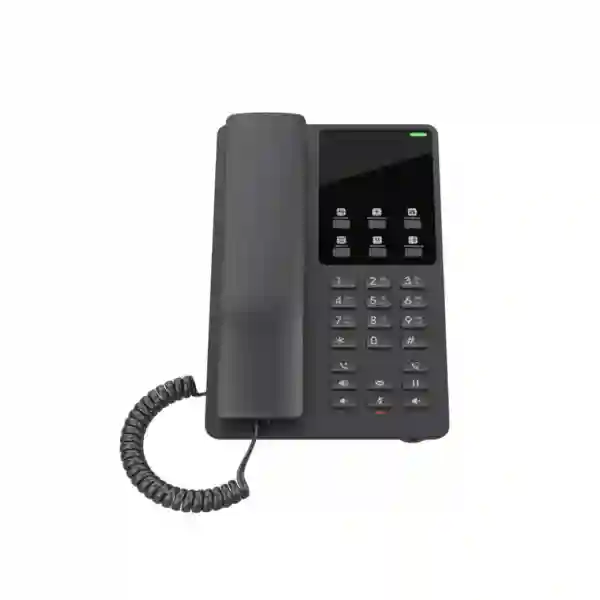
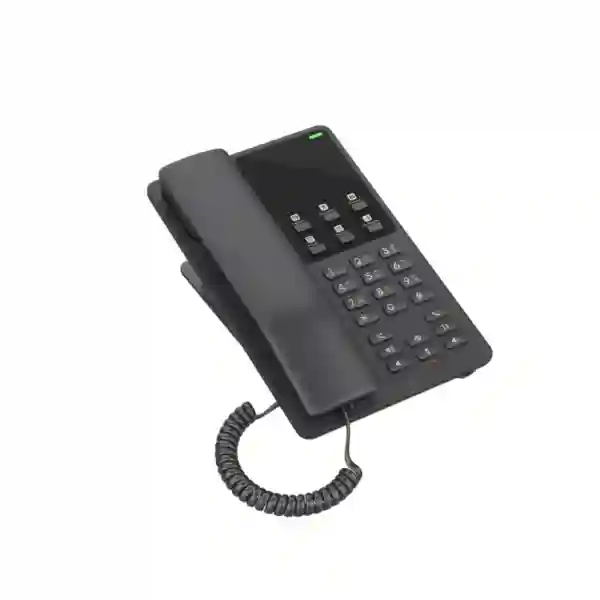
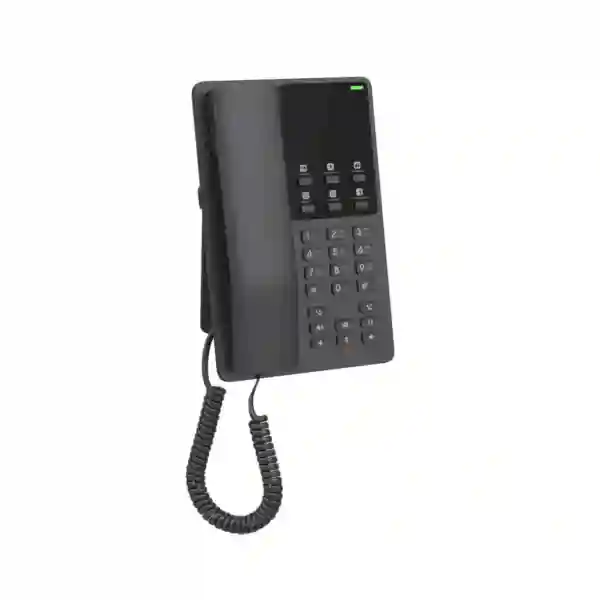
Grandstream GHP621W Compact Hotel Phone
The Grandstream GHP621W is a compact black SIP hotel phone built for guest-room and similar deployments where administrators need straightforward calling, programmable service access, centralized provisioning and built-in wireless connectivity. Grandstream specifies two SIP accounts and two lines, six programmable keys, ten speed-dial keys, HD audio, 3-way audio conferencing, Hearing Aid Compatibility, enterprise-oriented security features and support for Grandstream Device Management System (GDMS). The W variant adds integrated dual-band Wi-Fi, helping properties deploy room telephony where relying solely on a dedicated Ethernet outlet is inconvenient or where a wireless voice design is intentionally planned.
Choose the GHP621W when you need a compact, black, hospitality-focused SIP endpoint with integrated Wi-Fi and centrally manageable room profiles. Before ordering, confirm hardware revision, power method, Wi-Fi standard, PBX/SIP compatibility and the exact accessories included in the quoted package.
Grandstream GHP621W overview
The GHP621W belongs to Grandstream’s GHP62x family of compact hotel phones. It is designed around a familiar desktop telephone format while keeping the interface intentionally simple. That makes it useful not only in conventional hotel rooms but also in serviced apartments, dormitories, hospitals, retail environments, staff accommodation and other locations where users need dependable calling without the complexity of a full executive desk phone. For hospitality operators, the practical value lies in creating a controlled room-phone experience: frequently used services can be mapped to keys, room extensions can follow standard naming and dial-plan conventions, and administrators can manage large groups of endpoints through a centralized platform rather than configuring every device manually.
Grandstream documents two SIP accounts and lines, full-band Opus support, wideband audio, a 3-way conference capability and an advanced jitter-resilience algorithm intended to maintain voice usability under difficult packet-loss conditions. The handset supports HD audio, while the keypad provides six programmable keys plus speed-dial functions that can be used for frequently contacted destinations. This is especially relevant for hotel deployments where guests may need one-touch access to reception, housekeeping, reservations, room service, security or another internal service. The exact button assignments are part of the deployment design and should be programmed to match the property’s call flow rather than treated as fixed factory functions.
Central management is another major reason to evaluate the GHP621W. GDMS can be used to provision, configure, monitor and manage supported Grandstream endpoints. In a multi-floor or multi-property environment, centralized profiles can reduce configuration drift and simplify changes such as SIP credentials, dial plans, firmware policies or service-key behavior. A successful rollout still depends on network quality, voice VLAN strategy where applicable, Wi-Fi design, firewall rules, PBX configuration and operational documentation. The phone is one component in a complete hospitality communications system.
2 SIP accounts / 2 lines
Supports a simple two-line SIP design suitable for room extensions, service access or other approved call flows.
Integrated dual-band Wi-Fi
The GHP621W is the wireless variant. Hardware version matters because Grandstream documents Wi-Fi 6 support for newer revisions.
GDMS centralized management
Useful for bulk provisioning, monitoring, configuration consistency and administration across many hotel rooms or sites.
Hospitality-oriented controls
Six programmable keys and ten speed-dial keys help create a simple guest-facing service layout.
Verified technical highlights and deployment notes
The GHP621W supports SIP-based telephony and multiple standard voice codecs including G.711, G.722, G.723, G.726, G.729, iLBC and Opus according to Grandstream administration documentation. It also supports common voice functions such as hold, mute, redial, voicemail access when provided by the server, flexible dial plans and DTMF methods. Security capabilities documented for the family include secure boot, unique device certificates, encrypted configuration, TLS and SRTP support and 802.1X network access controls. These features provide useful building blocks, but they must be configured correctly and matched with the surrounding PBX, network and security policy.
Buyers should pay particular attention to hardware revision. Grandstream’s recent documentation distinguishes earlier and later GHP62xW revisions: newer hardware adds Wi-Fi 6 capability and changes power/PoE behavior compared with earlier units. For procurement, the safest approach is to request the exact hardware revision offered, verify whether PoE is supported on that revision, confirm whether a power adapter is included or required, and record the chosen powering method in the bill of materials. Avoid assuming that every GHP621W in the channel has identical power behavior merely because the model number is the same.
Wireless deployment also deserves proper engineering. A guest-room handset may be physically close to an access point yet still experience poor voice quality if channel utilization is high, roaming behavior is unstable, airtime is congested or QoS is absent. Properties should validate 2.4 GHz and 5 GHz coverage, capacity and interference, and should use a voice-ready wireless design rather than treating Wi-Fi as a substitute for planning. In newer hardware supporting 802.11ax, Wi-Fi 6 can improve efficiency in appropriate environments, but the result still depends on the full WLAN architecture and client density.
GHP621W for hotel rooms, apartments and institutional accommodation
A hospitality phone serves a different role from an office executive handset. Guests typically need immediate, predictable access to a small set of services, while administrators need the endpoint to remain easy to provision, identify and support. The GHP621W’s compact design and programmable buttons fit that operating model. Service destinations can be mapped consistently across rooms so the guest experience is recognizable regardless of floor or building. For example, a property may reserve keys for front desk, housekeeping, emergency assistance, concierge or another operational function. The PBX then determines how those calls are routed, queued, forwarded or reported.
The same design logic applies to hospitals, dormitories and serviced residences. In a hospital room, the handset may be used for patient or visitor calls while internal workflows remain controlled by the communication platform. In student or staff accommodation, the endpoint can provide straightforward internal dialing and selected external calling. In retail or common areas, it can act as a simple SIP station for service or security communications. The key requirement is to confirm that the intended application aligns with local policies, accessibility needs, emergency-call requirements and PBX capabilities.
Compatibility, PBX and network integration
Because the GHP621W uses SIP, it can be considered for standards-based IP telephony environments, but “SIP compatible” does not guarantee that every PBX feature behaves identically. Before a bulk purchase, test registration, authentication, dial plans, voicemail signaling, transfer behavior, caller ID, DTMF, provisioning, time settings and any guest-service keys against the exact PBX platform and firmware version you intend to use. A small pilot is especially valuable when integrating with an existing hotel PBX, hosted voice service or mixed-brand endpoint environment.
For Grandstream-centric environments, administrators may pair hotel endpoints with appropriate Grandstream IP PBX platforms and use GDMS for endpoint management. For other PBX brands or hosted SIP services, confirm supported authentication, TLS/SRTP requirements and provisioning methods. Firewalls should permit only required signaling and media flows, and remote administration interfaces should not be exposed unnecessarily. Where voice shares infrastructure with guest Wi-Fi, CCTV, IPTV or business data, proper VLAN and QoS planning can help prevent competing traffic from degrading calls.
FourTeck Tanzania’s wider solution portfolio can support the surrounding architecture. Review the FourTeck Tanzania technology solutions overview for integrated IT, telecom and networking planning, browse the FourTeck Tanzania technology shop when the project requires related switches, access points, firewalls or communication hardware, see FourTeck Tanzania services for deployment-oriented assistance, and use the Tanzania contact page to request a quotation or compatibility discussion.
Regional FourTeck resources for multi-country projects
Organizations standardizing hospitality communications across multiple markets can use FourTeck’s regional network as an additional procurement and planning resource. For projects in the Gulf, visit FourTeck UAE; for East African requirements review FourTeck Kenya and FourTeck Uganda; for West African planning see FourTeck Ghana and FourTeck Nigeria. These links are useful when a group wants a consistent product shortlist, extension plan, network standard or documentation model across countries while still validating each site’s connectivity and local procurement conditions.
Grandstream GHP621W Tanzania
For organizations evaluating the Grandstream GHP621W in Tanzania, the first buying question should be whether the property needs a wireless hospitality endpoint or whether a wired model would be operationally simpler. The GHP621W is specifically attractive when guestrooms, serviced apartments, hospital rooms or accommodation areas have usable enterprise Wi-Fi coverage and the deployment team wants to avoid depending exclusively on a dedicated Ethernet drop at each bedside or desk. That flexibility can help in retrofit projects, but it does not eliminate network design. Each room should have predictable signal strength and capacity, and administrators should confirm how voice traffic will be prioritized relative to guest internet use, streaming and other wireless applications.
Tanzania projects often involve a mixture of new construction, existing hotels being renovated, office-to-hospitality conversions and operational properties where downtime must be minimized. A practical GHP621W rollout begins with an inventory of rooms, proposed extension numbers, PBX platform, Wi-Fi coverage, power availability and service-button requirements. Procurement teams should also distinguish between the phone model and the complete deployment package. Depending on hardware revision and site design, that package may include power accessories, PoE-capable switching, wireless access points, PBX licensing or SIP trunks, structured cabling, UPS protection and configuration services.
For Tanzanian hotels, consistent guest experience is generally more valuable than exposing every telephony feature. A simple faceplate, clear service labels and a short dial plan can reduce confusion. Administrators can build standard provisioning templates in GDMS and apply room naming conventions that match the hotel’s operational records. If the property runs multiple buildings or resorts, the same template can be adapted while keeping site-specific SIP credentials and emergency routing separate. Before full deployment, a pilot of several rooms should test voice quality, Wi-Fi stability, power recovery, key programming and the interaction between the handset and the PBX.
When requesting a GHP621W quotation in Tanzania, include quantity, city, PBX brand/model, whether Wi-Fi 6 support is required, preferred power method, any custom faceplate requirement, and whether provisioning or installation assistance is expected. This produces a more useful quote than asking only for unit price because it allows the supplier to identify dependencies and avoid last-minute changes.
Grandstream GHP621W Dar es Salaam
Dar es Salaam hospitality buyers may consider the GHP621W for city hotels, serviced residences, healthcare facilities, student housing and mixed-use properties where wireless infrastructure is already an important part of daily operations. In a dense building, however, Wi-Fi design can become more difficult because many access points, neighboring networks and guest devices compete for spectrum. A hotel phone carries relatively modest bandwidth compared with video, but voice quality is sensitive to delay, jitter and packet loss. That means the GHP621W should be validated on the actual hotel WLAN rather than assumed to work perfectly because a guest smartphone shows a strong signal.
A Dar es Salaam deployment should map rooms to wireless coverage and identify areas with thick walls, lift shafts, service corridors or other construction features that can affect signal propagation. If the property uses separate staff and guest networks, administrators should decide where the phones belong and apply appropriate segmentation, authentication and firewall policy. Because the endpoints are managed devices rather than guest clients, the voice network should be designed for controlled access, predictable addressing and centralized administration. Where newer GHP621W hardware revisions are selected, confirm Wi-Fi 6 capability and power options on the exact stock supplied.
The hospitality workflow should also shape the configuration. Reception may want room extensions grouped by floor, housekeeping may need direct service keys, and after-hours calls may need a different route. The GHP621W’s programmable keys are useful only when the PBX and operational process behind them are clear. For larger city hotels, administrators should document every profile so a replacement phone can be added quickly without rebuilding settings from memory.
When comparing offers in Dar es Salaam, check the complete bill of materials, not just handset price. Ask whether the quotation identifies hardware revision, included power accessory, provisioning scope, compatible PBX assumptions and any site work. A well-prepared project can also include wireless assessment, switch capacity review and UPS protection for the network components that keep room calling available during short power disturbances.
Grandstream GHP621W Mwanza
In Mwanza, the Grandstream GHP621W can fit hotels, lodges, hospitals, residences and other facilities seeking a compact SIP handset that supports centralized administration and wireless deployment. For properties spread across multiple wings, floors or buildings, the most important planning issue is often consistency. Each phone should follow the same extension-naming rules, service-key layout, firmware policy and PBX settings while still connecting reliably from its specific room. Using GDMS can help administrators maintain device profiles and monitor endpoints, but the underlying network must be stable enough to support those devices.
Wireless voice design in Mwanza should consider more than coverage. If a building uses access points primarily for guest internet, peak evening use may create congestion exactly when guests are making calls. A separate SSID or network policy for managed voice devices may make administration clearer, subject to the capabilities of the wireless platform. Properties should evaluate 5 GHz availability, channel planning and roaming behavior and should keep firmware and Wi-Fi configuration under controlled change management. In rooms where wireless conditions are uncertain, a wired alternative may still be preferable, so the model choice should follow a site survey rather than a blanket standard.
For lake-region hospitality operations with multiple facilities, standardization can reduce support effort. A consistent GHP621W configuration can define reception, housekeeping and emergency destinations, while each site uses its own SIP credentials and local routing. Spare-unit strategy is worth discussing as well: keeping a small number of properly documented replacements can shorten recovery when a handset is damaged. Replacement procedures should include MAC registration, provisioning assignment and test calls.
A quotation request for Mwanza should state room count, number of phones, whether wall or desk placement is planned, PBX type, current Wi-Fi architecture and whether custom faceplates are desired. Those details help align the endpoint purchase with installation realities and create a clearer basis for comparing suppliers.
Grandstream GHP621W Arusha
Arusha’s hospitality environment includes hotels, lodges, tour-oriented accommodation and business properties that may value a room phone capable of simple service access without the visual complexity of an office handset. The GHP621W’s compact black design, speed-dial capability and programmable keys can support that use case. A property can create a familiar guest interface for front desk, housekeeping, transport desk or other services while maintaining SIP-based calling behind the scenes.
For Arusha properties serving international visitors, labeling and call-flow design deserve particular attention. Service keys should use clear, universally understandable wording or icons where appropriate, and the PBX should handle calls predictably when departments are closed. The handset’s faceplate customization capability can help align the phone with property branding or service labels, but any customized design should keep critical information readable and avoid clutter. Administrators should also consider accessibility and emergency procedures as part of the broader communication plan.
Wireless deployment may be helpful in renovated lodges or buildings where adding structured cabling to every room is disruptive. Still, the decision should depend on measured coverage and the condition of the property’s WLAN. Guest rooms can have thick walls, decorative materials or detached structures that affect radio performance. If access points are placed mainly in corridors, signal quality inside rooms should be tested at the intended phone location. Where newer GHP621W revisions with Wi-Fi 6 are supplied, the access-point environment should also support the intended standard if those benefits are expected.
Buyers in Arusha should ask suppliers to state whether pricing includes only hardware or also staging, provisioning, installation and post-deployment support. For properties with seasonal occupancy, it is useful to test the network under representative busy conditions, not only during a quiet installation window. This makes the final phone system more resilient when the hotel is full.
Grandstream GHP621W Dodoma
In Dodoma, the GHP621W can be evaluated by hotels, government-adjacent accommodation facilities, healthcare environments, educational residences and organizations that need a simple SIP phone for rooms or shared spaces. Its main strengths are a compact hospitality-oriented interface, integrated Wi-Fi, centralized management and enough programmable control to create a straightforward service experience. The phone should be treated as part of the wider communication architecture rather than as a standalone appliance.
For a new property in Dodoma, planning can begin before finishes are complete. Designers can decide whether each room will use wired Ethernet, wireless connectivity or a combination, and then ensure switch capacity, access-point placement and power infrastructure match that decision. In existing buildings, a wireless model may reduce the need for new data outlets, but the site should still be surveyed for signal quality and interference. Power arrangements must also match the exact hardware revision purchased, because current Grandstream documentation distinguishes newer revisions from earlier GHP62xW units.
From an operations perspective, hotel IT staff should define a provisioning template that includes extension, SIP server, time zone, codec policy, service keys, firmware path and security settings. The ability to manage phones centrally can make expansion easier when new rooms are added. A documented configuration also helps when the property changes PBX provider, updates the Wi-Fi platform or introduces a second building.
When asking for pricing in Dodoma, procurement teams should separate mandatory from optional scope. The core handset may be only one line item, while project success can depend on a compatible PBX, network equipment, power, cabling, wireless access points, licenses or professional services. A supplier that understands the complete requirement can return a quotation with fewer hidden assumptions and a clearer implementation path.
Grandstream GHP621W UAE
For UAE hospitality projects, the GHP621W can suit hotels, serviced apartments, staff accommodation and healthcare properties that want a compact SIP guest-room endpoint with built-in wireless capability. Large properties in Dubai, Abu Dhabi and other emirates often operate complex converged networks carrying guest internet, IPTV, building systems, CCTV, access control and voice. In that environment, the phone’s technical specifications are only one part of the decision. The endpoint should be tested with the selected PBX, wireless platform, security policy and management workflow.
The GHP621W’s two SIP lines, programmable keys and GDMS support can be useful for standardizing room telephony across a property or hotel group. Administrators can create controlled templates and reduce manual configuration. Faceplate customization may support hotel branding and service labels. For projects with multiple towers or properties, a consistent naming convention for devices and extensions can make support easier, particularly when centralized teams are responsible for more than one site.
UAE buyers should verify the exact hardware revision because newer units may provide Wi-Fi 6 and different PoE behavior. Do not assume channel stock is identical across suppliers. Ask for part/revision confirmation, power accessories, compliance documentation where required, firmware status and warranty terms. If the hotel expects the endpoint to connect over Wi-Fi, test it in representative rooms, including corners, suites and areas with high RF density.
Multi-country hotel groups may also use FourTeck UAE for regional technology discussions while maintaining the same phone-profile and procurement standards used in Tanzania. The goal is not to force every property into identical infrastructure, but to make endpoint configuration, documentation and operating procedures repeatable across sites.
Grandstream GHP621W Uganda
Organizations sourcing the Grandstream GHP621W in Uganda can evaluate it for hotels, lodges, serviced residences, hospitals, student accommodation and other environments that need a simple room phone with SIP and wireless connectivity. A useful deployment starts by separating the guest-facing experience from the technical platform. Guests may only see a handset and a few clearly labeled service keys, while administrators manage registration, security, firmware, Wi-Fi and call routing centrally.
For properties with multiple buildings, Wi-Fi coverage should be assessed room by room or by representative room type. Construction materials and access-point placement can produce very different results across the same property. A GHP621W connected over wireless should have stable coverage where it physically sits, not merely somewhere in the room. If the hotel uses many wireless devices for guest services, POS, staff operations or IoT, capacity planning becomes more important than raw signal strength.
Grandstream’s GDMS support can simplify provisioning at scale, but administrators should maintain clear ownership of profiles and credentials. A replacement workflow can specify how a new unit is assigned to a room, receives its configuration and is tested before the old unit is removed from inventory. Security settings such as TLS/SRTP support can be considered when the PBX and network are configured for encrypted voice, while firewall policies should limit access to management interfaces.
For Uganda procurement, request an itemized quotation that identifies phone quantity, hardware revision, power method, configuration scope and any supporting network equipment. Hotel groups operating in both Tanzania and Uganda can also coordinate through FourTeck Uganda while preserving a common handset standard and adapting the network design to each property.
Grandstream GHP621W Kampala
Kampala hotels and serviced-apartment operators may find the GHP621W especially useful in retrofit projects where room communications need modernization without introducing a feature-heavy desk phone. The wireless variant can reduce dependence on dedicated Ethernet in each room, but that advantage should be weighed against the quality and manageability of the existing WLAN. A voice endpoint requires stable latency and low packet loss; a network that feels acceptable for casual web browsing may still deliver inconsistent calls at busy times.
A Kampala deployment should therefore include representative testing during periods of normal occupancy. Engineers can check registration stability, call setup, speech quality, service-key behavior and recovery after power or network interruption. If several access points cover the same floor, roaming and channel overlap should be reviewed. The phones are usually stationary, so predictable association to the intended access point may be more important than fast roaming, but RF design still matters.
The GHP621W’s six programmable keys and ten speed-dial positions can support a clear service map. Rather than exposing a guest to complex menus, hotels can define the few destinations that matter most. That configuration should be backed by PBX call flows that account for busy departments, night service and unavailable extensions. Central provisioning then helps keep every room aligned with the same operational standard.
When sourcing in Kampala, request the exact hardware version and confirm whether the offered units provide the Wi-Fi and power features required by the design. Ask whether staging includes firmware alignment and room-profile creation. If the property already has an IP PBX, provide its make, model and firmware so compatibility questions can be addressed before bulk ordering.
Grandstream GHP621W Arua
For hospitality and institutional properties in Arua, the Grandstream GHP621W can provide a compact wireless SIP endpoint where straightforward room calling is more important than advanced office-phone features. The model is particularly relevant when a facility wants consistent service keys, centralized configuration and the ability to connect over enterprise Wi-Fi. As with any wireless voice project, reliability depends on how the WLAN and internet or PBX path are engineered.
Properties outside major metropolitan centers may place a higher value on easy remote administration because onsite specialist support may not always be immediately available. GDMS can help authorized administrators monitor and manage supported devices centrally, but remote tools work best when the local network is documented. Each room phone should have an identifiable device record, extension, profile and physical location. This allows a support technician to distinguish a configuration problem from a Wi-Fi or power issue without relying only on guest descriptions.
The GHP621W can also support a standardized spare strategy. A property can keep configured or ready-to-provision replacement units and document how they are assigned. That is useful where transporting a replacement from another city would otherwise delay service restoration. Procurement should therefore consider not only the installed quantity but also a sensible spare count based on property size and operational requirements.
Before placing an Arua order, share the planned number of rooms, PBX environment, Wi-Fi design, power method and any requirement for wall mounting or branded faceplates. A supplier can then evaluate whether the GHP621W itself is the best fit or whether a wired GHP621 or another hospitality endpoint would reduce complexity at that particular site.
Grandstream GHP621W Mbarara
Mbarara hotels, hospitals, educational residences and accommodation facilities can use the GHP621W as part of a SIP-based communications design that emphasizes simple user interaction and centralized administration. The phone’s compact format, programmable controls and integrated Wi-Fi can make it practical for guest rooms or bedside locations where a large office handset would be unnecessary. The key is to match the endpoint to the actual network and operational process.
A property planning dozens or hundreds of phones should treat provisioning as a repeatable workflow. Room-number conventions can be reflected in extension names, and service keys can follow the same sequence across every handset. Configuration templates can define codecs, SIP server, time settings and security options. Once a standard is tested, it can be applied at scale through supported management tools. This reduces errors compared with manually programming each handset from scratch.
Wireless performance should be tested in rooms with different layouts, not just in corridors or public areas. If access points are installed for guest internet, verify that the managed phone network has suitable segmentation and that peak traffic does not introduce excessive jitter. Newer GHP621W hardware can support Wi-Fi 6, but the benefit depends on compatible infrastructure and correct configuration. Buyers should record hardware revision in the procurement documentation because mixed revisions may behave differently.
For Mbarara quotations, provide expected quantity, PBX details, desired service-key labels, mounting preference and whether onsite configuration or remote staging is required. This enables the supplier to distinguish hardware cost from project services and helps the customer compare offers on the same scope.
Grandstream GHP621W Gulu
In Gulu, the GHP621W can support hotels, guest houses, institutional accommodation and healthcare facilities that want a manageable SIP handset with integrated Wi-Fi. For these environments, reliability and supportability often matter more than an extensive feature list. A phone that can be centrally provisioned, assigned to a standard room profile and quickly replaced can reduce operational friction for front-desk and IT teams.
Before deployment, map the communication flow. Determine which calls guests are allowed to make, how they reach reception, whether outside dialing is enabled, what happens after hours and how emergency calls are handled. The programmable keys should represent real operational destinations, and those destinations should be tested from different rooms. If a hotel changes department extensions later, a centrally managed profile can help distribute updates consistently.
Wi-Fi quality should be validated where the phone will remain installed. Fixed endpoints are useful test points because they reveal dead zones or congestion that may be less obvious with mobile devices. The design can use 5 GHz where appropriate, while 2.4 GHz may provide different coverage characteristics. The final choice depends on site conditions and the wireless platform. Security teams should also decide how managed phones authenticate and which network resources they can reach.
Procurement in Gulu should include questions about exact hardware revision, power supply or PoE needs, warranty terms, firmware and support scope. For facilities expecting future expansion, request a configuration and documentation approach that can be repeated when new rooms or buildings are added. That makes the handset purchase part of a maintainable communications standard rather than a one-time equipment order.
Grandstream GHP621W Kenya
Kenyan hotel groups and accommodation operators evaluating the GHP621W can use it as a compact SIP endpoint for rooms where built-in Wi-Fi is desirable. In Nairobi, Mombasa, resort properties and multi-site groups, the major benefit of a standardized handset can be operational consistency. A common model makes it easier to maintain service-key layouts, training, spare units and provisioning templates across properties.
Wireless deployment should still be site-specific. A beachfront resort, high-rise hotel and serviced-apartment building can have very different RF conditions. Signal attenuation, neighboring networks, access-point density and client load should all be considered. Where newer hardware provides Wi-Fi 6 support, ensure the procurement specification identifies that requirement rather than relying on a generic GHP621W model description. The same applies to PoE behavior and power accessories.
For PBX integration, run a pilot with the exact telephony platform. Confirm registration, inbound and outbound calls, transfer behavior, voicemail access, DTMF, service keys and management. If the property uses a cloud PBX, internet resilience and firewall settings are particularly important because each room endpoint depends on a stable path to the service. Local PBX deployments reduce that dependency for internal calls but still need secure network design and backup power.
Procurement teams can use FourTeck Kenya for regional discussions while aligning requirements with Tanzania deployments. When requesting quotes, specify quantity, hardware revision, PBX, Wi-Fi environment, power method and whether configuration, installation or after-sales support is part of the scope.
Grandstream GHP621W Kuwait
The Grandstream GHP621W can be considered for Kuwait hotels, serviced residences, healthcare facilities and staff accommodation requiring a compact SIP room phone with integrated Wi-Fi. In large hospitality buildings, centralized endpoint management can be particularly useful because hundreds of room devices may need consistent firmware, SIP settings and service-key mappings. GDMS support helps create that management layer, while the PBX and network provide the actual call routing and connectivity.
Kuwait projects may involve high-density indoor wireless environments where many guest devices are active simultaneously. The handset’s traffic demand is modest, but call quality depends on predictable latency and low jitter. Engineers should validate the chosen SSID, VLAN, QoS strategy and RF coverage during busy periods. Newer GHP621W hardware supporting Wi-Fi 6 can be useful where the surrounding WLAN is designed for it, but the hardware revision must be confirmed explicitly.
Hotel operators should also define a service-key standard that reflects the property’s actual departments. A generic template is a starting point, not a final configuration. Properties may use one key for reception, another for housekeeping and another for emergency or security assistance, with the remaining programmable keys allocated according to local operations. The PBX should have fallback routing so a key still reaches a responsible team when a department is closed.
For procurement, compare complete project scope rather than only device price. Ask about warranty, power accessories, firmware, custom faceplate options, provisioning and delivery terms. Multi-country groups may maintain the same endpoint profile in Kuwait and Tanzania while using different SIP trunks, numbering plans and network settings at each site.
Grandstream GHP621W Ghana
Ghanaian hotels and institutional facilities can evaluate the GHP621W where a compact wireless SIP handset is required for guestrooms, staff residences, hospitals or dormitory environments. For properties undergoing renovation, a wireless model may reduce the amount of new cabling required at the phone location, but only if the existing Wi-Fi network is designed to support managed voice endpoints reliably. A site survey and pilot remain more useful than assumptions based on consumer-device experience.
Central provisioning is valuable for multi-room deployments because configuration changes are inevitable over the life of the property. Service numbers can change, PBX addresses can be updated and firmware policies can evolve. A managed template allows these changes to be distributed consistently. Administrators should still maintain documentation that maps each MAC address, extension and room, because clear inventory data speeds troubleshooting and replacement.
The GHP621W supports standard SIP functionality and multiple codecs, but compatibility should be validated with the exact PBX or hosted telephony service. Where encrypted signaling or media is required, confirm TLS/SRTP configuration on both ends. If phones are placed on a dedicated voice VLAN, ensure access points and switches carry that network correctly and that the firewall allows only necessary traffic.
For Ghana procurement and regional coordination, FourTeck Ghana can complement Tanzania planning. A strong quotation request includes quantity, property type, PBX, Wi-Fi infrastructure, required hardware revision, power approach, branding needs and whether deployment services are expected.
Grandstream GHP621W Nigeria
Nigeria’s large hospitality, healthcare and serviced-residence market can use the GHP621W as a standardized guest-room SIP endpoint where integrated Wi-Fi and centralized management are desirable. For large hotels, the device count itself creates an administrative challenge. A hundred rooms represent a hundred configuration objects, user-facing labels, power points and network clients. Central management and templating therefore become more important as the project grows.
Network resilience deserves close attention. If the phones register to an onsite PBX, internal calling can remain local, but switches, access points and the PBX should be protected by appropriate UPS capacity. If the phones use a cloud service, internet availability becomes part of voice availability. Hotels should document failover behavior and ensure that emergency procedures do not depend on a single untested path. Wi-Fi should be engineered for coverage and capacity, especially in dense urban properties with many neighboring networks.
The GHP621W’s programmable keys can make the room experience simple even when the backend call routing is sophisticated. A guest should not need to know extension numbers for routine services. Administrators can use the faceplate and key labels to present a clear interface while the PBX handles queues, hunt groups, night service and reporting. Changes should be controlled through a configuration standard to prevent rooms from drifting into inconsistent behavior.
For Nigeria procurement, ask suppliers to confirm hardware revision, Wi-Fi standard, PoE/power behavior, included accessories, warranty and configuration scope. Cross-border hotel groups can coordinate with FourTeck Nigeria and FourTeck Tanzania to keep the endpoint standard consistent while adapting call plans and infrastructure to each country.
Grandstream GHP621W Seychelles
Seychelles resorts, hotels, villas and hospitality properties may consider the GHP621W where room telephony must be compact, easy for guests to understand and manageable across a distributed property. Resort layouts can differ significantly from urban hotels: rooms may be spread across separate buildings, villas or landscaped areas, and network links may traverse longer distances. In such cases, the decision to use Wi-Fi should follow careful coverage testing at every representative accommodation type.
Wireless connectivity can be useful where pulling a dedicated data cable to each phone location is difficult, but voice reliability should remain the priority. Access points should have stable backhaul and power, and the property should avoid overloading the same radio network with unmanaged guest traffic. A dedicated managed-device SSID or equivalent policy can simplify security and troubleshooting. The phone’s hardware revision should be documented because Wi-Fi and power capabilities vary between generations.
For island properties where spare-part logistics can take longer, a planned inventory of replacement phones and power accessories can reduce downtime. Administrators can keep standardized configurations in GDMS and maintain a simple replacement checklist. A spare should be tested periodically, and the team should know how to assign it to a room, load the correct profile and verify internal and external calling.
A Seychelles quotation request should include property layout, number of rooms, PBX architecture, WLAN platform, expected service-key functions and whether installation assistance is required. For resorts with multiple buildings, it can also be useful to identify network zones and access-point groups so the supplier understands that the project is more than a single batch of handsets.
Buying and sizing guidance
Before selecting the GHP621W, confirm whether every intended location actually needs Wi-Fi. A wired GHP621 may be simpler where Ethernet and PoE are already available, while the GHP621W can be more suitable for wireless-first or retrofit rooms. Standardizing on one model can simplify spares, but standardization should not override site requirements. Evaluate total quantity, spare ratio, mounting method, power method, PBX capacity, extension licenses, SIP trunk capacity, WLAN design and management responsibilities.
For larger deployments, create a pilot room set that includes several representative locations: a typical room, a corner room, an upper floor, a room far from an access point and any suite or detached unit. Test inbound and outbound calls, service keys, hold, voicemail, DTMF, Wi-Fi reconnect, power recovery and centralized configuration. Record the successful configuration as the production template only after these tests pass.
Procurement should also request lifecycle information. Confirm warranty terms, firmware availability, hardware revision and replacement policy. Avoid mixing unknown hardware revisions within the same project unless the differences are understood and documented. If custom faceplates are ordered, retain the approved artwork and labeling standard so future replacements match existing rooms.
Quotation checklist for Grandstream GHP621W
Grandstream GHP621W FAQ
Is the GHP621W a Wi-Fi hotel phone?
Yes. The W variant is designed with integrated dual-band Wi-Fi. Newer hardware revisions support Wi-Fi 6 according to current Grandstream documentation, so buyers should confirm hardware version when Wi-Fi 6 is a requirement.
How many SIP accounts does the GHP621W support?
Grandstream specifies two SIP accounts and two lines for the GHP62x family, including the GHP621W.
Does the GHP621W have programmable hotel service keys?
Yes. Grandstream documentation for the GHP62x series lists six programmable keys and ten speed-dial keys. These can be configured to fit the property’s approved call flows.
Can the GHP621W be centrally managed?
Yes. The model is supported by Grandstream Device Management System (GDMS), which provides centralized provisioning, configuration, monitoring and management capabilities for supported Grandstream endpoints.
Does every GHP621W support PoE?
Do not assume identical power behavior across all hardware revisions. Grandstream’s current documentation distinguishes newer revisions from earlier GHP62xW hardware. Confirm the exact hardware version, PoE support and supplied power accessories before purchase.
Can the GHP621W work with non-Grandstream PBX systems?
The phone uses standards-based SIP, but feature behavior can vary by PBX. Test registration, dial plan, DTMF, voicemail, transfers, TLS/SRTP and provisioning with the exact platform and firmware before a bulk rollout.
Is it suitable only for hotels?
No. Grandstream positions the GHP series for hotels and similar environments, including apartments, dormitories, hospitals, retail and other locations that benefit from a compact, simple SIP endpoint.
What should I provide for an accurate Tanzania quotation?
Provide quantity, city, PBX platform, expected hardware revision, Wi-Fi environment, preferred power method, programmable-key requirements, faceplate needs and whether configuration, installation and support are included.
Decision recap
The Grandstream GHP621W is best suited to organizations that want a compact black hospitality SIP phone with built-in Wi-Fi, simple programmable service access, HD voice, two SIP lines and centralized endpoint management. The most important purchasing detail is not merely the model name but the exact hardware revision and deployment context. Confirm Wi-Fi generation, power/PoE behavior, PBX compatibility, room coverage and management workflow before ordering at scale. For Tanzania hotels and institutions, a pilot deployment provides the clearest way to validate call quality, room usability and support procedures before rolling out to every room.
Talk to FourTeck about your GHP621W project
Share your property type, number of rooms, city, PBX platform, wireless environment and preferred deployment scope. FourTeck can use that information to prepare a more relevant product quotation and identify the surrounding network, powering, provisioning and integration considerations that should be confirmed before purchase.


Reviews
There are no reviews yet.