
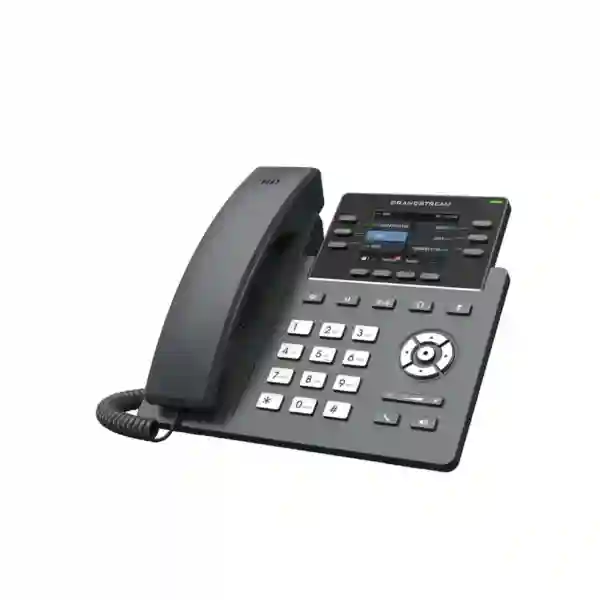
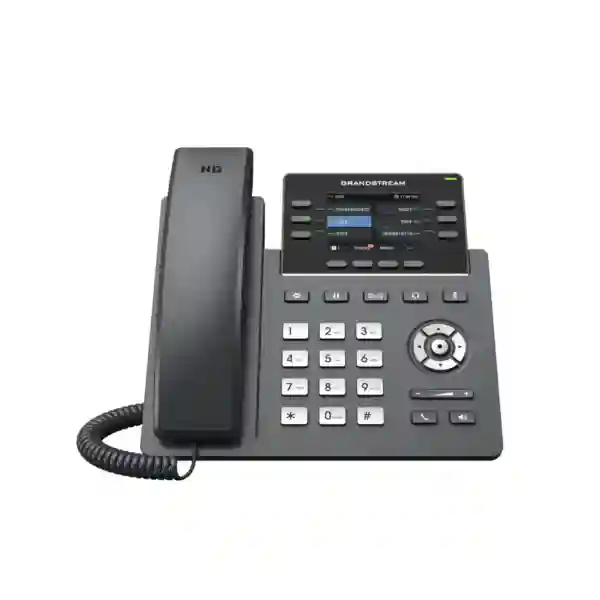
Grandstream GRP2613 IP Phone Tanzania
The Grandstream GRP2613 is a 6-line professional IP phone designed for business desks that need dependable SIP calling, centralized management and fast wired network connectivity. The current GRP2613 supports up to four SIP accounts, six multi-purpose line keys, up to 24 virtual multi-purpose keys, dual 10/100/1000 Mbps Gigabit Ethernet ports with integrated PoE, a 2.8-inch colour LCD, HD audio and Grandstream Device Management System support. For Tanzanian organisations, those capabilities make it a practical endpoint for managed office telephony, branch standardisation, reception support, supervisors and users who handle several call appearances without requiring a large executive phone.
What the GRP2613 is designed to solve
A business desk phone has to do more than place and receive calls. In a growing office it must work with the PBX, register the correct SIP identities, present useful call and presence keys, receive power and data reliably, support consistent configuration, and remain manageable when tens or hundreds of handsets are deployed. The GRP2613 addresses that operational problem with a combination of multi-line call handling, programmable virtual keys, Gigabit Ethernet, PoE and centralized provisioning. Rather than treating every phone as a standalone device, administrators can build repeatable configuration profiles and manage endpoints through Grandstream Device Management System where that platform is part of the chosen design.
For an individual user, the visible benefit is a straightforward colour-screen desk phone with dedicated call-control buttons, HD audio and programmable access to colleagues or frequently used functions. For the IT team, the larger value is standardisation. A consistent extension plan, voice VLAN, QoS policy, firmware baseline, directory method and provisioning profile can reduce configuration drift and simplify moves, additions and changes. This matters in Tanzania where a customer may be planning one main office, several branches, a customer-service team or a phased migration from analogue phones to SIP.
The base GRP2613 should not be confused with the GRP2613W. Grandstream’s current product documentation lists integrated dual-band Wi-Fi 6 and Bluetooth for the GRP2613W variant, while the base GRP2613 is the wired model. Buyers should therefore confirm the exact suffix before ordering. If Wi-Fi or Bluetooth is a mandatory requirement, request the GRP2613W explicitly rather than assuming those radios are present in every unit carrying the GRP2613 family name.
Call handling
Six multi-purpose line keys and up to 24 virtual multi-purpose key positions give users fast access to line appearances, BLF, speed dial and frequently used features. The current GRP2613 supports up to four SIP accounts.
Network ready
Dual switched auto-sensing 10/100/1000 Mbps Ethernet ports support Gigabit desk connectivity, while integrated IEEE 802.3af PoE can power the phone from a compatible network switch.
Managed deployment
GDMS support, TR-069 and encrypted configuration options give administrators practical tools for repeatable provisioning, monitoring and lifecycle management across multi-phone deployments.
Business audio
HD handset and speakerphone audio, wideband codecs including G.722 and Opus, and Grandstream noise-shield functionality are designed to improve intelligibility for everyday office calling.
Verified Grandstream GRP2613 specifications
| Area | Verified specification |
|---|---|
| Lines / SIP | 6 multi-purpose line keys; up to 4 SIP accounts on the current GRP2613 |
| Display | 2.8-inch 320 × 240 TFT colour LCD |
| Programmable keys | Up to 24 digital BLF / virtual multi-purpose keys |
| Ethernet | Dual switched auto-sensing 10/100/1000 Mbps Gigabit Ethernet |
| Power | Integrated IEEE 802.3af PoE; power-adapter requirements should be confirmed with the supplied package and regional variant |
| Audio | HD handset and speakerphone; G.722 and Opus among supported codecs |
| Headset | RJ9 headset interface with EHS support for compatible headsets |
| Management | GDMS, TR-069 and configuration-file provisioning methods supported |
| Security | Secure boot, dual firmware images, encrypted data storage/configuration features, TLS, SRTP and 802.1X support |
| Wireless | Base GRP2613: wired. Wi-Fi 6 and Bluetooth are features of the GRP2613W variant. |
Compatibility, PBX and network planning
The GRP2613 is a standards-based SIP endpoint, but successful deployment still depends on the PBX, SIP service and network design. Before ordering a project quantity, confirm the target PBX or hosted-voice platform, authentication method, codec policy, directory requirement, BLF behaviour and any provider-specific provisioning restrictions. Where a Grandstream UCM system is used, the endpoint can be incorporated into a broader Grandstream voice environment; where a third-party SIP platform is used, a pilot configuration is sensible before a large rollout.
The phone’s dual Gigabit ports allow a workstation to share the desk network connection, but voice and data should still be designed deliberately. Managed switching can provide voice VLANs, QoS and port-level control. PoE simplifies desk installation by removing the need for a separate local power adapter, yet the switch’s total PoE budget has to be calculated for the full phone count. For offices that expect calling to continue during short mains interruptions, the PoE switches, PBX, router and other voice-path devices need appropriate UPS protection; keeping only the handset powered does not preserve service if the upstream network is down.
For broader Tanzania infrastructure planning, review the FourTeck Tanzania integrated IT and telecom overview, browse the Tanzania technology shop for related network and communications requirements, and use the FourTeck Tanzania services page when the project includes installation, configuration or support beyond handset supply.
Who should consider the GRP2613?
The GRP2613 fits users who have outgrown a basic two-line handset but do not need a very large executive endpoint. Typical roles include office managers, department coordinators, sales staff, procurement staff, service desks, supervisors and reception-adjacent positions that monitor several extensions. The 24 virtual key positions can be particularly useful when users want BLF status for colleagues, direct speed-dial access, call-park positions or other administrator-defined functions.
It is also a sensible standardisation candidate for organisations that value centralized endpoint management. A company opening several branches can use a common device profile, naming convention, firmware baseline and extension layout while adjusting user-specific keys where needed. That approach is easier to support than allowing every site to choose unrelated handsets with different menus and provisioning methods.
The GRP2613 is not automatically the correct choice for every user. A simple back-office extension may need fewer programmable keys. An executive who wants integrated wireless connectivity may prefer the GRP2613W or a higher GRP model. A receptionist handling a large number of monitored extensions may need a model with a different key layout or expansion-module support. The most cost-effective design usually assigns phone models by role rather than purchasing the same device for every desk.
Grandstream GRP2613 Tanzania
For organisations sourcing the Grandstream GRP2613 in Tanzania, the buying decision should begin with the voice system rather than with the handset alone. Confirm how many users require desk phones, which users need multiple SIP identities, whether reception or supervisors need BLF monitoring, and whether the existing switches provide sufficient Gigabit ports and PoE capacity. The GRP2613 can then be positioned as a professional mid-range endpoint inside a larger IP telephony design. Its current specification of six line keys, up to four SIP accounts, dual Gigabit Ethernet, PoE, a 2.8-inch colour display and up to 24 virtual multi-purpose keys makes it useful for business desks where call visibility and central management matter.
Tanzanian deployments can vary from a single office to branch networks spread across several cities. In each case, voice quality depends on more than the phone. The LAN should be checked for congestion, VLAN design, QoS, cabling quality and switch resilience. If SIP calling traverses an internet connection, latency, packet loss and service stability also influence user experience. For businesses using cloud PBX or SIP trunks, firewall rules and NAT behaviour should be planned carefully so that phones register reliably and media paths remain predictable. For on-premises PBX projects, rack power, UPS coverage and backup configuration are equally important.
Procurement teams should request the exact model name and confirm whether the requirement is the wired GRP2613 or wireless-capable GRP2613W. This distinction matters because Wi-Fi 6 and Bluetooth are specified for the GRP2613W variant, not the standard GRP2613. A quotation should also state phone quantity, PBX platform, extension count, PoE availability, headset requirement, installation scope and whether centralized provisioning is expected. These details make it easier to compare proposals on a like-for-like basis rather than comparing handset price alone.
FourTeck Tanzania can be approached for product selection as part of a broader office communications requirement. The most useful enquiry includes the number of phones, current PBX or desired platform, office locations, internet or SIP service details, existing switch model, expected call-handling features and growth plans. Customers that need a wider technology scope can also review the FourTeck Tanzania company overview and related networking, structured cabling and business IT capabilities before finalising the telephony bill of materials.
Grandstream GRP2613 Dar es Salaam
Dar es Salaam businesses evaluating the Grandstream GRP2613 often have a mix of high call volumes, busy customer-facing desks and rapidly changing office requirements. A trading company, logistics operator, professional-services firm, hotel office, healthcare administration team or multi-department corporate office may need phones that support fast call transfer, several monitored colleagues and consistent extension layouts. The GRP2613 is relevant in these environments because its six line keys and up to 24 virtual multi-purpose keys can be mapped to line appearances, BLF, speed dial or feature access according to the PBX design.
In Dar es Salaam, a useful pre-deployment review should include the switch infrastructure at each floor or office area. If the phone will share its network connection with a desktop computer, Gigabit switching helps avoid reducing the workstation path to Fast Ethernet. Integrated PoE can simplify desk cabling, but the network team should confirm both per-port PoE capability and the overall switch power budget. When dozens of phones are deployed, the combined PoE demand, uplink capacity and UPS runtime become design parameters rather than minor accessories.
Call quality should also be protected from competing traffic. Voice can coexist with business applications, CCTV and Wi-Fi on the same physical infrastructure when the network is designed correctly, but unmanaged congestion can produce choppy audio or delayed call setup. Managed VLANs and QoS can help separate and prioritize traffic, while consistent DNS, DHCP and NTP settings make device operation easier to troubleshoot. If the site uses a hosted PBX, internet failover planning may be worth considering because an excellent desk phone cannot compensate for a failed WAN path.
For quotation preparation in Dar es Salaam, identify the user roles before choosing quantities. Standard users may not need the same phone as reception or department heads. Note which staff require BLF, which need headsets, and whether any desks require wireless connectivity; those wireless desks may be better served by the GRP2613W or another model rather than the base wired GRP2613. This role-based approach can keep the deployment consistent without overspecifying every extension.
Grandstream GRP2613 Mwanza
Organisations in Mwanza can use the Grandstream GRP2613 as part of a structured migration from analogue telephony or a mixed collection of SIP devices to a more consistent business phone environment. The main advantage of standardising on a managed SIP endpoint is not simply the colour screen; it is the ability to define repeatable settings for extensions, directories, key layouts, firmware and network behaviour. For organisations with more than one Mwanza site, that consistency can simplify user support and make branch expansion easier.
Before deployment, check the physical network path from each desk to the switch. Cabling faults and poorly terminated outlets can produce issues that appear to be phone problems. The GRP2613 supports dual Gigabit Ethernet and PoE, so Cat5e or better structured cabling in good condition is normally appropriate for Gigabit operation. Where the same outlet supports a phone and computer through the handset’s switched PC port, document both devices and the assigned VLAN policy. Clear port labelling helps future support teams locate faults without tracing every cable manually.
Power continuity deserves attention in branches that rely heavily on voice. With PoE, the desk phone can be powered from the network closet, allowing a central UPS to support many handsets at once. However, the effective runtime depends on switch load, PBX, router, firewall and internet equipment. A practical design identifies which voice services must remain available during a short outage and protects the entire call path accordingly. This is especially important where the phone system is used for customer enquiries, reservations, dispatch or internal coordination.
When requesting a GRP2613 quotation for Mwanza, include the exact number of desk users, expected extension plan, PBX type, required programmable keys, PoE availability, headset preferences and whether installation or remote provisioning is needed. If wireless placement is required at certain desks, specify that separately because the standard GRP2613 and the GRP2613W have different connectivity features. Clear scoping at quotation stage reduces substitutions and avoids ordering a model that does not match the deployment plan.
Grandstream GRP2613 Arusha
Arusha organisations in hospitality, tourism administration, professional services, education, healthcare, NGOs and general business environments often need straightforward internal communication combined with reliable external calling. The Grandstream GRP2613 can fit desks where users need multiple line appearances and quick access to colleagues without moving to a much larger executive endpoint. Its programmable virtual keys can be used for BLF or speed dial so staff can see selected extension status and transfer calls more efficiently when the PBX supports those functions.
For hospitality-related offices, a phone deployment may need to integrate with front-desk operations, reservation teams, accounts, management and service departments. The GRP2613 itself is a SIP endpoint, so the broader workflow depends on the PBX and any property-management or call-routing integration chosen by the customer. It is therefore important to map departments, direct-dial numbers, ring groups and after-hours routing before configuring handsets. Designing those call flows first usually creates a better result than programming phones individually and trying to standardise later.
Arusha sites should also review network and power conditions before a multi-phone rollout. PoE can reduce the number of wall adapters at desks, but it moves power dependence to the switch and rack. A properly sized UPS can help preserve the central voice system during short interruptions, while good structured cabling and managed switching can support clear segmentation between voice, office data, guest Wi-Fi and other services. For cloud voice, the WAN connection and firewall settings should be tested under real call conditions before the full handset quantity is deployed.
The purchasing checklist should distinguish the GRP2613 from the GRP2613W. If managers expect Bluetooth headsets or Wi-Fi connectivity, ask for the W variant or another wireless-capable model. If desks already have dependable Ethernet and PoE, the wired GRP2613 may provide the required feature set without adding unnecessary radios. This simple distinction helps align the device specification with actual user behaviour and infrastructure.
Grandstream GRP2613 Dodoma
Businesses, institutions and project offices in Dodoma can evaluate the Grandstream GRP2613 when they need a professional SIP phone that is simple for users but manageable for IT teams. The device’s six line keys, four SIP-account capability on the current base model, Gigabit network interfaces and centralized management support are useful when a deployment must be replicated across departments. A consistent phone platform can simplify extension provisioning, user onboarding and changes when staff move between desks.
For offices with structured procurement processes, the bill of materials should identify more than just the phone model. Check whether wall-mount accessories are needed, whether headsets are required, whether PoE switches have enough ports and power budget, and whether the PBX licenses or SIP subscriptions are already available. If the phone system is being installed alongside a new network, it can be more efficient to design switch capacity, VLANs and UPS requirements at the same time rather than treating telephony as a separate later purchase.
The GRP2613 supports standard SIP technologies and several provisioning methods, but platform-specific behaviour still needs validation. A small pilot can confirm registration, transfer, hold, BLF, directory lookup, voicemail indication and codec negotiation before a large batch is configured. This is particularly useful when the PBX is third-party, hosted by a service provider or connected through a firewall with existing voice policies. Testing a representative user profile reduces the risk of repeating the same configuration issue across many desks.
For a Dodoma quotation, share the current phone-system architecture and desired outcome. The requirement might be a handset-only replacement, a full IP PBX project, branch connectivity, new structured cabling or a combination of these. A clear scope allows the GRP2613 to be evaluated in context: whether it is the right endpoint for the targeted users, whether the network can support it, and whether another GRP model should be assigned to users with different needs.
Grandstream GRP2613 UAE
For UAE projects, the Grandstream GRP2613 is relevant to organisations standardising business desk phones across offices, branches and service teams. The same core buying questions apply: number of SIP identities, line handling, BLF requirements, headset use, PoE availability and centralized management. In offices with established Gigabit switching, the phone’s dual Gigabit ports allow the connected workstation path to remain at Gigabit speed rather than creating a slower desk bottleneck.
Multi-site companies with operations in Tanzania and the UAE can benefit from a repeatable endpoint profile. Extension ranges may differ, but firmware policy, naming, QoS, directory integration and administrator procedures can follow the same template. Centralized device management can further reduce effort when approved configurations need to be deployed to a larger phone estate. Before standardising, verify PBX interoperability and provider requirements in each country because SIP trunk services, numbering and telecom arrangements are not identical across markets.
The base GRP2613 remains the wired model, while the GRP2613W adds Wi-Fi 6 and Bluetooth. UAE offices with hot-desking, executive Bluetooth headsets or difficult cabling may prefer the wireless variant, while conventional Ethernet desks can use the standard model. The correct choice should be based on the physical workplace and management policy rather than treating wireless capability as automatically superior.
Customers coordinating UAE and Tanzania requirements can review FourTeck UAE IT and telecom solutions for regional project context while keeping Tanzania-specific procurement and contact discussions on the Tanzania site. For cross-border standardisation, document model suffixes, firmware baselines, PBX templates, local power accessories and support responsibilities so that identical-looking phones do not end up with inconsistent configurations.
Grandstream GRP2613 Uganda
Ugandan businesses can consider the GRP2613 for managed SIP deployments that need more programmable capacity than an entry-level desk phone. Its six line keys and up to 24 virtual key positions can support supervisors, administration desks, sales staff and customer-facing teams that regularly transfer calls or monitor selected extensions. The dual Gigabit interfaces are useful where phones share a single structured-cabling outlet with desktop computers, and PoE can simplify installation across a planned office network.
For organisations operating both in Uganda and Tanzania, standardising endpoint models can reduce training and support variation. Users see similar controls, administrators work with the same provisioning methods, and spare handsets can be managed under a common configuration approach. Even so, numbering plans, SIP providers and site network conditions need to be documented separately. Standardisation should make support easier without assuming that every branch has identical telecom services.
The phone should be purchased as part of a verified voice design. Check whether the PBX supports the desired BLF and call features, whether VLAN and QoS policies are available on the switches, and whether the WAN connection is suitable for hosted voice. When internet resilience is important, a failover link may be considered at the network level, but the behaviour of active SIP calls during a failover depends on the wider architecture and provider design.
For Uganda-specific project context, customers can review FourTeck Uganda IP PBX, VoIP and networking solutions. A useful cross-border quotation request should state phone quantity per site, PBX type, required extension features, PoE switch availability and whether configuration profiles need to be aligned across the two countries.
Grandstream GRP2613 Kampala
Kampala offices often combine customer-facing departments, administration, finance, sales and branch communication in the same telephony environment. The Grandstream GRP2613 can serve as a standard professional desk endpoint where users need multiple line appearances and programmable access to colleagues. Up to 24 virtual key positions give administrators flexibility to create BLF, speed-dial and feature layouts that match different job roles without changing the underlying handset model.
A Kampala deployment should be planned with the switching infrastructure. PoE can make large phone installations cleaner because the phones draw power from centrally managed switches, but the total power budget must cover all endpoints. If the same switches also power wireless access points or cameras, calculate combined demand rather than counting ports alone. Gigabit uplinks and appropriate VLAN design can help the network carry voice alongside normal business traffic without unnecessary congestion.
For hosted PBX deployments, test SIP registration, media paths and firewall behaviour before mass rollout. For on-premises PBX systems, confirm extension licensing, trunk capacity and backup strategy. The handset’s GDMS support can simplify endpoint provisioning, but it does not replace the need for a clean PBX configuration and documented network. A stable phone estate is created by coordinating all three layers: endpoint, voice platform and network.
Buyers should also classify users before ordering. A receptionist who watches many extensions may need a different endpoint from a general user, while a mobile executive may prefer Wi-Fi and Bluetooth on the GRP2613W. The wired GRP2613 is strongest when Ethernet and PoE are already part of the office design. Matching model to role helps control project cost while keeping the phone environment consistent.
Grandstream GRP2613 Arua
For organisations in Arua, the GRP2613 can be useful where a branch office needs the same professional SIP endpoint used at a headquarters or larger city location. A standard model makes remote support easier because menus, key layouts and firmware are familiar to the central IT team. Centralized provisioning can reduce the need to configure every phone manually at the branch, provided the management and network architecture has been planned securely.
Connectivity planning is particularly important for branch telephony. If the PBX is hosted elsewhere, voice depends on the WAN between Arua and the service platform. Before deploying a full phone quantity, test latency, packet loss, DNS reliability and the behaviour of calls during normal business traffic. QoS can help inside the LAN, but it cannot repair an unstable external connection. A branch design may therefore include sensible WAN resilience and clear fallback procedures for critical calling functions.
PoE can simplify branch installation by allowing phones to be powered from the network rack. To gain resilience from that design, the switch and upstream equipment should be protected by suitable UPS capacity. If only the phones are powered but the router, PBX gateway or internet equipment fails, calls will still stop. Thinking about the complete path gives procurement teams a more realistic understanding of what equipment is essential.
For an Arua quotation, provide a user list or at least role counts: standard office users, managers, customer-facing staff and reception. Note which roles require BLF, headsets or wireless connectivity. This allows the GRP2613 to be assigned where its six line keys and VPK capacity create real value, while simpler or wireless-capable models can be used for other roles where appropriate.
Grandstream GRP2613 Mbarara
Mbarara businesses planning a new office phone system can use the GRP2613 as a mid-range desk endpoint for staff who handle several calls or need one-touch access to colleagues. In a typical deployment, the PBX defines the extension and call-routing logic, while the phone presents that functionality in an accessible user interface. The device’s colour LCD, dedicated function keys and programmable VPK positions can make common actions such as transfer, hold, conference and colleague monitoring more convenient for daily use.
When replacing analogue phones, the network becomes part of the voice system. Each desk needs reliable Ethernet or a different model designed for wireless connectivity. The switch must have sufficient ports and, if PoE is used, adequate power budget. Voice VLANs and QoS are worth considering on managed networks, especially where the same infrastructure carries large file transfers, backups, Wi-Fi and surveillance traffic. The goal is not to create unnecessary complexity but to protect predictable call behaviour.
Centralized configuration is another reason to choose a professional endpoint family. Instead of manually changing each phone, administrators can use supported provisioning methods to apply consistent settings. That reduces errors when extensions are added or when a branch expands. A documented template should cover account settings, firmware, time zone, directory method, programmable keys and security controls, with per-user exceptions clearly recorded.
Before ordering for Mbarara, confirm whether users need the wired GRP2613 or the GRP2613W with Wi-Fi 6 and Bluetooth. Also confirm PBX compatibility, required headsets and any wall-mount needs. A quotation that includes these dependencies gives decision-makers a better basis for comparing total deployment cost than a handset-only price.
Grandstream GRP2613 Gulu
In Gulu, the GRP2613 can support organisations that want a consistent, business-grade desk phone for administration, branch coordination and customer communication. The handset’s programmable line and virtual keys are particularly useful when users need direct access to internal colleagues or frequent call functions. Rather than relying on memorised extension numbers, the PBX administrator can create a logical key layout for departments or commonly contacted staff.
Branch deployment should be designed around maintainability. Every phone should have a documented extension, physical location, user and switch port. Provisioning profiles should use clear names so a remote administrator can identify the correct endpoint. If GDMS is used, access control and administrator credentials should be handled carefully, and firmware changes should follow an approved process rather than being applied unpredictably during working hours.
The network should be tested before blaming the handset for audio problems. Packet loss, duplex issues, faulty cabling, congested uplinks and unstable WAN connections can all affect voice. The GRP2613’s Gigabit interfaces and QoS-related protocol support provide a solid endpoint foundation, but the surrounding network must also be configured correctly. For a remote branch, a small pilot with realistic call traffic can validate the design before deploying every desk.
Procurement teams in Gulu should request a clearly itemised scope covering phones, PoE switching if needed, PBX or hosted service, configuration, cabling changes, headsets and support. This helps avoid a common problem in VoIP projects: purchasing the visible handsets while overlooking the infrastructure and configuration work required to make them operate reliably.
Grandstream GRP2613 Kenya
Kenyan organisations evaluating the Grandstream GRP2613 can use the same endpoint family for office standardisation across Nairobi, regional branches and cross-border operations. Current Grandstream documentation positions the GRP2613 as a six-line professional IP phone with up to four SIP accounts, dual Gigabit Ethernet, PoE, HD audio and 24 virtual multi-purpose keys. Some older reseller listings still show earlier specifications, so buyers should confirm that quotations refer to the current hardware and clearly identify the exact model variant.
For multi-site projects linking Kenya and Tanzania, the value of a common phone platform is operational consistency. IT teams can define shared naming, firmware and provisioning practices while adapting extension ranges and SIP services per country. This can make training easier for staff who move between offices and allow spare units to be prepared using familiar profiles. Nevertheless, local telecom provider requirements and support arrangements should be documented separately rather than assuming a single configuration works everywhere.
Kenyan offices with established Gigabit LANs can use the phone’s PC pass-through port without limiting connected workstations to 100 Mbps. PoE can reduce desk adapters and centralize power protection. As phone quantities grow, check switch port capacity, total PoE budget and UPS size. A switch that has enough physical ports may still be undersized if its power budget also supports access points or cameras.
For Kenya-specific discussions, see FourTeck Kenya VoIP and business IT solutions. When requesting a cross-border quotation, list quantities per site, PBX platform, user roles, headset requirements, PoE availability and any need for synchronized deployment standards across Kenya and Tanzania.
Grandstream GRP2613 Kuwait
Kuwait-based offices and regional procurement teams can consider the GRP2613 when they need a wired professional SIP endpoint with multi-line handling and centralized management capability. The model’s six multi-purpose line keys and up to 24 VPK positions suit users who regularly watch colleague status, use speed dials or manage several active call appearances. Dual Gigabit network interfaces help maintain modern desk connectivity, and PoE allows a compatible switch to provide both data and power over one Ethernet cable.
For organizations standardising across Kuwait and East Africa, define a global endpoint standard and a local telecom profile separately. The endpoint standard can include model, firmware, display preferences, security settings and key templates. The local profile can include SIP server details, number format, outbound routes, emergency calling requirements and provider-specific parameters. This separation gives IT teams a reusable design without overlooking country-specific voice-service differences.
The GRP2613 is a wired model. If a Kuwait office expects desk relocation without Ethernet, integrated wireless headsets or Bluetooth use, compare the GRP2613W or another suitable GRP endpoint. Wireless capability should solve a real workplace need; in fixed desks with structured Ethernet and PoE, wired connectivity remains straightforward to manage and can be easier to troubleshoot.
A quotation request should include the PBX brand or hosted service, number of phone users, required line keys, directory integration, headset types and management method. For large deployments, request a pilot profile and acceptance checklist so that registration, transfer, conference, voicemail indication, BLF and audio quality are validated before every handset is rolled out.
Grandstream GRP2613 Ghana
Ghanaian businesses looking at the GRP2613 can use it as part of a broader IP PBX and business communications rollout. The phone is well suited to desks that need a professional colour display, multiple SIP identities, several programmable line appearances and centralized provisioning. The current base model supports up to four SIP accounts and six line keys, while its virtual key system expands quick-access capacity for BLF, speed dial and other administrator-defined functions.
A successful Ghana deployment should treat voice as an application on the network. Managed switching, VLANs, QoS, PoE and stable uplinks can provide a controlled foundation. The connected PBX or hosted service then supplies call routing, extension features and trunks. The GRP2613 presents those services to the user. If one layer is poorly designed, users may experience registration failures, call drops or inconsistent features even when the phone hardware itself is functioning correctly.
For organisations with operations in both Ghana and Tanzania, a common endpoint family can simplify training and inventory. However, keep country-specific SIP and numbering information separate from the global phone configuration. Use a documented profile hierarchy so that shared settings are updated once while local settings remain controlled. This approach is more scalable than cloning one site’s complete configuration into another country without review.
Customers can explore FourTeck Ghana IP PBX and business telephony solutions for local context. Procurement requests should define exact phone variant, quantity, PBX, PoE environment, headset requirement and whether installation, provisioning or support is included, allowing proposals to be compared on complete deployment scope rather than handset price alone.
Grandstream GRP2613 Nigeria
Nigerian enterprises and growing businesses can evaluate the Grandstream GRP2613 for departments that need a manageable, multi-line SIP handset without moving to a large premium desktop model. The six line keys and up to 24 virtual key positions can support busy sales teams, supervisors, service desks and administrative users. Gigabit Ethernet is useful where a phone shares the workstation network connection, and PoE can reduce local power adapters across a larger deployment.
When many phones are installed, management architecture becomes important. Define firmware policy, provisioning templates, extension naming and administrator access before devices arrive at desks. GDMS support can assist with centralized endpoint management, but organisations should still maintain configuration ownership and change control. A documented phone template also makes replacement easier because a spare device can be provisioned consistently instead of being recreated from memory.
The WAN and SIP-service design should be tested under normal business conditions. Voice quality is sensitive to packet loss and jitter, and busy office networks can change significantly during backups, cloud synchronization or large transfers. QoS inside the LAN can help prioritize traffic, while adequate bandwidth and stable internet service remain essential for hosted voice. For critical sites, resilience planning should include the PBX, router, firewall, switches and power protection rather than focusing only on the endpoint.
For Nigeria-related projects, see FourTeck Nigeria IT and communications solutions. A cross-market quotation covering Nigeria and Tanzania should clearly separate site quantities, local voice services, installation responsibilities and support scope while keeping common endpoint specifications where standardisation is beneficial.
Grandstream GRP2613 Seychelles
Seychelles organisations considering the Grandstream GRP2613 may include hospitality groups, professional offices, administration teams and multi-property operators that want standard SIP desk phones with centralized management. The device’s six line keys, up to four SIP accounts on the current model, Gigabit Ethernet, PoE and programmable virtual keys provide a practical feature set for office users who need more call-handling flexibility than entry-level endpoints.
For hospitality and multi-building environments, define where fixed wired phones are most appropriate. Front office, finance, reservations, management and back-office departments may have structured Ethernet and PoE, making the base GRP2613 suitable. Areas where cabling is difficult may require the GRP2613W or another wireless endpoint. Mixing models by physical requirement is often more sensible than forcing wireless capability onto every desk or, conversely, assuming every location has Ethernet.
If the phone system spans several properties, use consistent extension naming and programmable key templates. Staff who move between properties should encounter familiar controls. Administrators should also document how calls route between sites and what happens when a WAN link is unavailable. The endpoint can support server redundancy and failover mechanisms defined by SIP configuration, but the actual resilience depends on the PBX, DNS, routing and provider architecture.
For procurement, request a complete bill of materials that distinguishes phones, PoE switching, PBX resources, trunks, cabling, headsets, configuration and support. Confirm the exact model suffix and package contents before shipment. This is especially important for regional projects because accessories and packaging can vary; a clear quotation avoids assuming that a power adapter or other item is included when the local deployment is intended to rely on PoE.
Deployment and configuration guidance
1. Define the voice architecture
Confirm on-premises PBX, hosted PBX or SIP service, extension plan, trunks, departments, call queues, ring groups, voicemail and business-hour routing before programming handsets.
2. Audit the LAN
Check Ethernet cabling, switch capacity, PoE budget, VLAN design, QoS, DHCP, DNS and UPS coverage. Voice quality issues are often network issues rather than handset faults.
3. Build a phone template
Create a repeatable baseline covering firmware, time, display preferences, security, account fields, directory, codecs, key layout and administrator controls, then keep user-specific settings separate.
4. Pilot before mass rollout
Validate registration, inbound and outbound calling, transfers, hold, conference, voicemail indication, BLF, directories, caller ID, headset use and recovery after reboot before provisioning all phones.
Buying guidance: GRP2613 vs GRP2613W
Choose the GRP2613 when desks have reliable wired Ethernet, PoE is available or planned, and users do not require built-in Wi-Fi or Bluetooth. It delivers the core professional phone capabilities while keeping the endpoint architecture straightforward.
Choose the GRP2613W when integrated Wi-Fi 6 or Bluetooth is a confirmed requirement. Grandstream’s current documentation also lists six SIP accounts for the GRP2613W compared with up to four on the base GRP2613. Do not assume the two variants are identical apart from wireless connectivity; confirm the exact datasheet and project requirement.
Where different roles have different needs, a mixed deployment is acceptable. For example, most fixed desks can use wired GRP2613 units while a smaller group of mobile or Bluetooth-dependent users receives the GRP2613W. Central standards can still be maintained at the provisioning, security and PBX levels.
Grandstream GRP2613 frequently asked questions
How many SIP accounts does the current GRP2613 support?
Grandstream’s current GRP2613(W) product page and datasheet list up to four SIP accounts for the GRP2613 and up to six for the GRP2613W. Older documentation and reseller pages may show three SIP accounts for earlier hardware, so confirm the current model when sourcing.
Does the GRP2613 have Wi-Fi or Bluetooth?
The standard GRP2613 is the wired model. Integrated dual-band Wi-Fi 6 and Bluetooth are specified for the GRP2613W variant. If wireless features are required, the suffix must be confirmed on the quotation.
Can the GRP2613 be powered by PoE?
Yes. The phone has integrated IEEE 802.3af PoE. Your switch still needs a suitable PoE port and enough total PoE budget for the full device count.
Can I connect a PC through the phone?
Yes. The GRP2613 provides dual switched Gigabit Ethernet ports, allowing one port to connect to the LAN and the other to a workstation in a typical desk arrangement.
What are the 24 virtual multi-purpose keys used for?
They can be configured for functions such as BLF, speed dial, line access and other programmable features supported by the phone and PBX. The exact layout should match each user role.
Does the phone support centralized management?
Yes. The GRP2613 is supported by Grandstream Device Management System and also supports other provisioning methods including TR-069 and encrypted configuration files.
Is GRP2613 suitable for reception?
It can suit moderate call-handling roles because it provides six line keys and up to 24 VPK positions. A very busy receptionist who must monitor many more extensions may need a different phone or expansion strategy, so assess the number of BLF targets before standardising.
Will the GRP2613 work with any SIP PBX?
It is a standards-based SIP phone and is designed for broad interoperability, but feature behaviour can vary by platform. Validate registration, transfer, BLF, voicemail, directory and codec requirements with the specific PBX or service before a large rollout.
Should I buy a power adapter?
If the phone will use PoE, a separate adapter is normally unnecessary. Package contents can vary by market and production batch, so confirm the exact quotation and supplied accessories rather than assuming an adapter is included.
What information should I provide for a Tanzania quotation?
Provide phone quantity, office locations, PBX or hosted-voice platform, SIP account requirements, user roles, BLF needs, headset requirements, PoE switch details, installation scope and whether the standard GRP2613 or GRP2613W is required.
Related Tanzania infrastructure for a complete VoIP deployment
A GRP2613 project may also require managed PoE switches, structured cabling, VLAN configuration, firewall review, UPS protection, PBX capacity and headsets. These are not optional extras in every case, but they should be checked before confirming the handset quantity. The FourTeck Tanzania shop provides a broader view of business technology categories, while the services section is useful when the requirement includes planning, installation or ongoing support.
For regional organisations, consistent endpoint standards can be aligned with network and PBX practices across offices. FourTeck’s regional sites in the UAE, Kenya, Uganda, Ghana and Nigeria provide country-specific context without implying that stock, pricing or support conditions are identical between markets. Cross-border procurement should always identify which entity supplies each site, what local telecom services are used and how warranty or support responsibilities are handled.
If the project is still at the selection stage, avoid choosing a phone only by price. Compare the number of SIP accounts, programmable keys, wired or wireless connectivity, PoE, screen size, headset compatibility, provisioning method and the user role. A phone that costs slightly less but cannot support the required workflow may create more operational cost through workarounds or early replacement.
Quotation checklist
Decision recap
The Grandstream GRP2613 is a strong fit when a business needs a wired, PoE-capable, Gigabit SIP phone with a colour screen, multiple line keys, up to four SIP accounts and flexible BLF/VPK capacity. It is particularly useful for professional desk users who handle more calls than a basic extension but do not require the largest executive phone in the range.
The model should be selected as part of the voice architecture. Check PBX compatibility, PoE capacity, LAN readiness, provisioning method, headset use and user roles. If Wi-Fi 6 or Bluetooth is required, specify the GRP2613W rather than the base GRP2613. For large quantities, pilot the chosen configuration before mass rollout.
FourTeck Tanzania can review the GRP2613 requirement in the context of IP PBX, SIP, networking and business infrastructure. The best enquiry is one that describes the environment, not just the model number. That information makes it possible to identify missing dependencies and produce a more useful quotation.
Talk to FourTeck Tanzania about the GRP2613
Share your quantity, PBX platform, office location, user roles and network details. FourTeck can use that information to discuss whether the GRP2613 is the correct endpoint, whether the GRP2613W or another model better matches some users, and what supporting PoE, network or configuration work should be included.
You can also review the FourTeck Tanzania contact page for the current sales enquiry route.


Reviews
There are no reviews yet.