
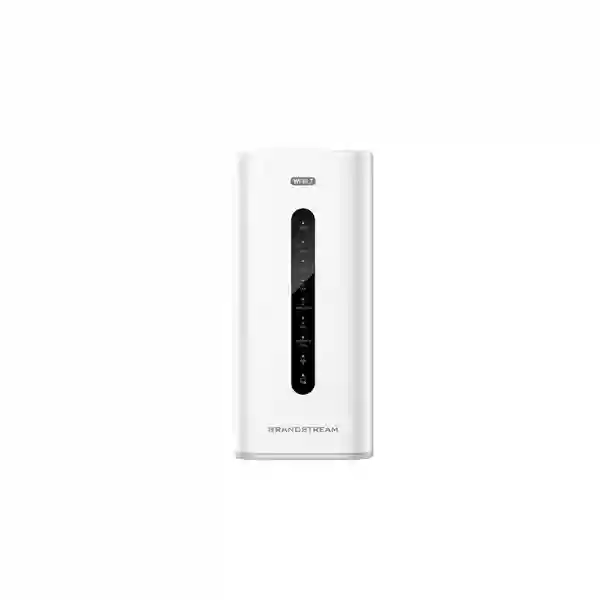
Grandstream GWN7072 Tanzania
The Grandstream GWN7072 is a tri-band Wi‑Fi 7 router designed for households, professional home offices, SOHO environments and small-to-medium businesses that need a stronger foundation for multi-gigabit internet, dense wireless use, secure remote access and modern network management. Grandstream positions the GWN7072 around Wi‑Fi 7 technologies including 4K QAM, Multi-Link Operation, Multi-RU and preamble puncturing, while its radio design spans 2.4 GHz, 5 GHz and 6 GHz bands. For buyers in Tanzania, that combination makes the GWN7072 especially relevant where current Wi‑Fi 5 or Wi‑Fi 6 routers are becoming a bottleneck for newer laptops, phones, workstations, cloud applications, video collaboration, local storage and high-speed internet connections.
The router is not only about wireless speed. Its wired architecture includes a 10GbE combo WAN interface that can use SFP+ or RJ45, one 2.5GbE autosensing WAN/LAN port, three dedicated 2.5GbE LAN ports and USB 3.0. Grandstream states up to 10 Gbps NAT routing, up to 1.2 Gbps IPsec VPN performance, support for as many as 50 VPN tunnels, up to 128 simultaneous Wi‑Fi clients and up to 16 mesh nodes. These capabilities give network planners room to combine high-speed internet, local servers, NAS appliances, VoIP systems, surveillance platforms, cloud services and multiple wireless zones without forcing every use case through a single gigabit interface.
Wi‑Fi 7 Tri-Band
IEEE 802.11a/b/g/n/ac/ax/be support with 2.4 GHz, 5 GHz and 6 GHz operation, including a 320 MHz channel capability on the 6 GHz band where permitted.
Multi-Gig Wired Design
One 10GbE combo WAN, one 2.5GbE WAN/LAN, three 2.5GbE LAN ports and USB 3.0 help reduce common wired bottlenecks.
Secure Connectivity
Firewall functions, content filtering, application control, secure boot and a broad VPN feature set make the platform suitable for business and professional networks.
Flexible Management
Administrators can use the local web interface as well as Grandstream management options including GDMS Networking, GWN Manager, GWN App and Grandstream Home.
Why the GWN7072 matters for modern networks
A router can become the hidden performance ceiling in an otherwise upgraded network. Businesses may invest in fast fiber, multi-gigabit switches, Wi‑Fi 7 endpoints, cloud collaboration and local storage only to discover that an older gateway cannot process traffic fast enough or offers only one-gigabit interfaces. The GWN7072 addresses that issue by combining 10 Gbps NAT routing with a multi-gigabit port layout. This is valuable when internet service exceeds one gigabit, when a local server or NAS needs faster east-west traffic, or when a network is being designed today with several years of growth in mind.
Wireless design is equally important. Wi‑Fi 7 introduces mechanisms intended to improve efficiency, throughput and responsiveness in demanding environments. The GWN7072 supports 4K QAM, Multi-Link Operation, Multi-RU and preamble puncturing. In practical planning terms, these technologies can help compatible devices use available spectrum more effectively and can reduce the impact of congestion or interference. Actual performance still depends on client capability, regulatory limits, channel availability, building materials, distance, interference and uplink capacity, so the best procurement decision should consider the entire network rather than only the router’s headline speed.
For organizations evaluating a broader Grandstream ecosystem, the router can also sit alongside Grandstream access points, switches, IP phones and management platforms. Tanzanian businesses that want a broader regional technology partner can review FourTeck Tanzania for local-market procurement discussions, FourTeck Africa for cross-border project context, and FourTeck Uganda or FourTeck Kenya when network standards need to be aligned across East African branches. For UAE-linked Grandstream projects, FourTeck Grandstream UAE provides an additional regional reference point.
Verified GWN7072 technical highlights
These figures should be interpreted as platform capabilities under vendor-defined conditions rather than guaranteed real-world results. Final throughput depends on endpoint capability, configuration, radio conditions, service-provider capacity, encryption load and the rest of the wired network.
Deployment, compatibility and buying guidance
Before ordering a GWN7072, confirm whether the internet handoff is copper RJ45 or fiber/SFP+, whether the service is below or above 2.5 Gbps, and which local devices need multi-gigabit Ethernet. A 10GbE WAN interface is most useful when the upstream service or connected infrastructure can actually use it. If the office switch remains one-gigabit, wired endpoints connected through that switch will still be limited by the switch port. Similarly, Wi‑Fi 7 benefits are strongest when client devices support newer standards and when local regulations permit the intended band and channel configuration.
For branch connectivity, decide whether the requirement is simple secure remote access, permanent site-to-site tunnels, or a larger multi-branch VPN design. The GWN7072 supports several VPN technologies, which helps organizations match the router to existing security architecture. Procurement teams should record the required number of tunnels, expected encrypted throughput, authentication model, addressing plan, VLAN requirements and whether third-party firewalls or cloud security services remain in the path.
Mesh capability can simplify expansion in homes, villas, retail spaces and smaller offices, but mesh should not replace structured cabling where predictable high throughput is required. Ethernet backhaul usually gives a stronger foundation for critical work areas, while mesh can extend coverage into spaces where new cabling is impractical. A site survey or at least a floor-plan review is recommended for buildings with reinforced concrete, multiple floors, metal shelving, plant rooms or other radio obstacles.
Grandstream GWN7072 Tanzania
For organizations in Tanzania, the Grandstream GWN7072 fits procurement projects where the network gateway needs to keep pace with faster business internet, a growing number of wireless devices and increasing dependence on cloud applications. Typical candidates include professional offices, consultancies, design studios, clinics, hospitality properties, training centers, retail headquarters, technology firms, homes with heavy streaming or work-from-home use, and small businesses moving from consumer-grade routing to more structured network management. The strongest reason to consider the model is its combination of modern Wi‑Fi 7 radios and multi-gigabit wired interfaces. That allows a buyer to plan one gateway for new wireless clients, 2.5GbE endpoints and a 10GbE internet or upstream connection without immediately creating a wired bottleneck at the router.
Tanzanian buyers should begin by checking the internet service delivered at the premises. If the ISP presents a standard RJ45 Ethernet handoff, the 10GbE combo WAN can use copper. Where an optical design or SFP+ handoff is planned, procurement should confirm the transceiver, fiber type and ISP requirements before installation. The secondary 2.5GbE autosensing WAN/LAN interface is useful where dual-uplink planning or a flexible multi-gigabit LAN connection is needed. The three dedicated 2.5GbE LAN ports can serve a fast workstation, switch, NAS, server or other local device directly, but larger offices will normally pair the router with a managed switch.
Wi‑Fi planning is equally important. The GWN7072 supports the 2.4 GHz, 5 GHz and 6 GHz bands and Grandstream lists up to 128 wireless clients. That number should not be treated as a guarantee that every client can run a bandwidth-heavy application simultaneously; traffic mix matters. A network with 100 lightly active phones behaves very differently from a network where dozens of clients are moving large files or holding high-definition video conferences. For reliable procurement, list device types, applications, expected concurrency and floor area. Where one router cannot cover the property consistently, the model supports up to 16 mesh nodes, giving a path for expansion.
For business security, buyers can evaluate the router’s firewall, URL filtering, application control, secure boot and VPN features in the context of existing policy. Organizations with formal compliance requirements should map the router into the broader security architecture rather than assuming any single gateway replaces endpoint security, monitoring, backups or identity controls. FourTeck can use a requirement list covering WAN speed, number of users, VPN needs, building layout, switching and future growth to help prepare a more accurate quotation for a Tanzania deployment.
Grandstream GWN7072 Dar es Salaam
Dar es Salaam buyers often need a router that can serve fast-growing offices where internet, cloud platforms, voice, video and local network traffic all converge on the same gateway. The GWN7072 is suited to that type of design because the platform combines a 10GbE combo WAN port, multi-gigabit LAN connectivity and tri-band Wi‑Fi 7. A professional services company in Masaki, a retail administration office, a creative studio, a small technology team or a high-end residence may all encounter the same basic problem: the internet service improves, more Wi‑Fi devices arrive, but the older router remains limited to one-gigabit Ethernet or congested Wi‑Fi. The GWN7072 provides more headroom for that next stage.
For offices in multi-tenant buildings, radio planning should account for neighboring wireless networks. The 6 GHz band can provide additional spectrum for compatible devices, while Wi‑Fi 7 functions such as Multi-Link Operation and preamble puncturing are designed to improve the way capable clients use available radio resources. Real outcomes still depend on client support, local regulatory availability and physical conditions. Concrete walls, tinted glass, electrical rooms and dense partitions can reduce usable range, so procurement should not assume that a single high-performance router automatically covers every room.
Dar es Salaam deployments should also consider resilience. If the business depends heavily on SaaS applications, cloud telephony, online payments or remote support, a second internet path can be valuable. The GWN7072 includes an additional 2.5GbE autosensing WAN/LAN port, giving planners flexibility when designing alternate uplinks. If mobile-dongle connectivity is being considered through USB, the exact modem and carrier arrangement should be validated before purchase. The router’s VPN capabilities are also useful for branch links and remote workers, with Grandstream listing IPsec, OpenVPN, WireGuard, SSL VPN and other options.
When requesting a quotation in Dar es Salaam, include the current ISP speed, handoff type, number of wired users, estimated Wi‑Fi clients, existing switch model, floor count, important applications and remote-access requirements. That information helps determine whether the GWN7072 should be deployed as a standalone router, used with additional GWN access points or paired with a multi-gigabit managed switch. The result is a network designed around actual traffic rather than only a product specification sheet.
Grandstream GWN7072 Mwanza
In Mwanza, the Grandstream GWN7072 can suit growing businesses that want to modernize a network without building around yesterday’s one-gigabit limitations. A logistics office, healthcare practice, educational facility, lake-region trading company, hospitality property or professional home office may have a mixture of older 2.4 GHz devices, current 5 GHz laptops and newer devices capable of using 6 GHz. Tri-band operation gives the network designer a way to separate different generations and traffic profiles while retaining compatibility with established Wi‑Fi standards. For organizations buying equipment for several years of use, this is often more relevant than simply chasing the highest single speed figure.
The GWN7072’s wired design deserves close attention. Its 10GbE combo WAN interface can support a high-speed upstream connection, while 2.5GbE ports provide useful connections for modern switches, storage and workstations. In a Mwanza office that is introducing local backups, surveillance storage or shared media, traffic between wired systems can become substantial even when internet usage is moderate. Network planning should therefore consider both internet traffic and local east-west traffic. If an existing switch is limited to one gigabit, upgrading only the router may not deliver the expected improvement to wired endpoints.
For a larger property, mesh support provides another option. Grandstream specifies up to 16 mesh nodes, but the choice between wireless mesh and wired access-point backhaul should be based on the building. Wired backhaul is generally preferable for areas with demanding applications, while mesh can be practical where cabling is difficult. The router can be managed through its local interface or through Grandstream management platforms, giving technical teams options for local control, centralized administration and remote visibility.
Security planning should be tied to the actual business workflow. The GWN7072 includes firewall functions, content filtering, application control and multiple VPN methods, which can help create separate user groups, protect guest access and connect remote locations. Before ordering, document whether the network needs site-to-site VPN, user VPN, guest Wi‑Fi, device segmentation, parental controls or centralized policy. A detailed Mwanza quotation should also identify whether installation, switch configuration, access-point expansion or post-deployment support is required alongside the router itself.
Grandstream GWN7072 Arusha
Arusha has a diverse mix of tourism businesses, professional offices, NGOs, education providers, residences and growing service companies, and many of these environments depend on reliable wireless access for both staff and guests. The Grandstream GWN7072 provides a strong platform where a buyer wants a modern router with Wi‑Fi 7, multi-gigabit Ethernet and business-oriented security features. Its tri-band design allows planners to use 2.4 GHz for longer-range or legacy devices, 5 GHz for mainstream modern clients and 6 GHz for compatible high-performance devices, subject to regulatory availability and client support.
Hospitality and guest-oriented networks should be designed around capacity and separation rather than only coverage. A lodge office or small hotel may have staff systems, payment terminals, back-office computers, guest devices, smart TVs and building systems all sharing the same underlying infrastructure. The GWN7072 can provide routing and wireless service, but the network should still use appropriate segmentation, guest policy and managed switching where needed. High client counts also need realistic bandwidth planning. Grandstream states support for up to 128 Wi‑Fi clients, but total user experience depends on the type of traffic generated by those clients and on the internet connection.
Arusha organizations with remote offices or head-office links can use the router’s VPN support to create encrypted connectivity. Grandstream specifies up to 50 VPN tunnels and includes IPsec, OpenVPN, WireGuard and SSL VPN capabilities among its supported methods. When preparing a branch design, document the peer firewall model, expected encrypted throughput, failover expectations, authentication method and internal addressing. This prevents common deployment issues caused by overlapping subnets or mismatched proposals.
A practical buying process should also look beyond the router. Check whether existing cabling supports the intended Ethernet rate, whether access points need wired backhaul, whether a PoE switch is required for additional APs and whether the current internet service can justify a 10GbE WAN. If the site uses cloud voice or video extensively, define QoS priorities before installation. The GWN7072 includes eight QoS queues and application-aware controls, giving administrators tools to prioritize traffic when they are configured according to the organization’s actual applications.
Grandstream GWN7072 Dodoma
For Dodoma offices, institutions, consultancies and professional homes, the GWN7072 offers a path from basic broadband routing toward a more structured multi-gigabit network. This can be useful where teams increasingly rely on cloud document systems, unified communications, video meetings, secure remote access and centrally managed devices. The router’s 10 Gbps NAT capability means it has significantly more forwarding headroom than a traditional one-gigabit home gateway, while the 10GbE combo WAN and 2.5GbE LAN interfaces allow the physical network to make practical use of higher-speed services and local devices.
Government-adjacent contractors, associations, training organizations and service businesses in Dodoma may also value predictable remote connectivity. The router supports several VPN technologies and up to 50 tunnels, allowing it to participate in site-to-site or user-access designs. A secure deployment should still be based on a documented policy: who can connect, which resources they can reach, how credentials are managed, what logging is required and how firmware updates are controlled. The GWN7072 supports secure boot based on digital signatures and provides firmware upgrade mechanisms, but operational security depends on maintaining the device properly after installation.
Wi‑Fi planning should start with the floor plan. Offices with multiple reinforced walls, long corridors or separate buildings may not be served adequately by one router regardless of its radio generation. The GWN7072 supports mesh expansion up to 16 nodes, which can extend coverage, but wired access points should also be considered where cabling is available and high throughput is important. For meeting rooms, executive areas and training spaces, capacity and roaming behavior may matter more than raw range.
When requesting pricing for Dodoma, provide a clear bill-of-requirements rather than only asking for a router. Include current ISP bandwidth, desired future bandwidth, number of locations, user count, Wi‑Fi device count, server or NAS requirements, VPN needs and whether configuration assistance is expected. This makes it easier to determine whether the GWN7072 alone is sufficient or whether the project also needs switches, additional access points, structured cabling and ongoing management.
Grandstream GWN7072 UAE
The Grandstream GWN7072 is also relevant to UAE-linked businesses that want a common router standard across regional offices. Companies with operations in Tanzania and the UAE often benefit from simplifying model selection, configuration practices, VPN architecture and support procedures. A standardized gateway can make it easier for IT teams to document templates, maintain firmware, train administrators and troubleshoot remote branches. The GWN7072’s Wi‑Fi 7 capability, 10GbE WAN option and 2.5GbE LAN interfaces make it suitable for offices where high-speed internet and dense modern endpoint usage are expected.
In the UAE, multi-gigabit internet services and high-density residential or office environments can make the router’s additional capacity particularly useful. However, wireless planning should account for local regulatory rules, building density and client support. High-rise offices and apartments can experience substantial neighboring Wi‑Fi activity, making channel planning important. The 6 GHz band offers additional spectrum for compatible clients, while Wi‑Fi 7 features such as Multi-Link Operation and preamble puncturing can improve efficiency in supported environments.
Businesses linking UAE and East African sites should plan the VPN architecture before deployment. The GWN7072 supports IPsec site-to-site connectivity as well as WireGuard, OpenVPN and SSL VPN functions. A cross-border design should define subnets, DNS, authentication, application routes and failover. It should also consider whether traffic is routed directly between branches or through a central data-center or cloud-security service. The router’s 1.2 Gbps IPsec performance figure is a useful planning reference, but actual encrypted throughput will vary by configuration and packet mix.
Procurement teams should avoid assuming that identical hardware automatically creates an identical user experience at every location. ISP handoffs, local cabling, switches, access points and endpoint generations differ between sites. A useful quotation therefore includes the physical interface required on the WAN, expected number of wired and wireless users, remote management preference and whether the router must integrate with an existing Grandstream ecosystem. Standardization works best when it is combined with site-specific design.
Grandstream GWN7072 Uganda
For Uganda deployments, the GWN7072 can serve businesses that need a modern edge router capable of supporting faster internet, secure branches and a mixed population of legacy and Wi‑Fi 7 devices. Its tri-band architecture gives planners flexibility to place older IoT or office equipment on 2.4 GHz while reserving higher-capacity bands for modern laptops, phones and workstations. This is useful when a business is upgrading gradually rather than replacing every endpoint at once. The platform’s support for up to 128 Wi‑Fi clients provides headroom for small and medium sites, although application intensity should always be considered when sizing.
The router’s multi-gigabit wired interfaces are an important consideration for Ugandan organizations investing in fiber or high-speed wireless broadband. A 10GbE combo WAN interface can avoid a one-gigabit ceiling at the edge, while 2.5GbE ports support modern switches and local systems. If the existing switch, cabling or network adapters are slower, those components may become the new limit. Network procurement should therefore treat the GWN7072 as part of a system rather than as an isolated upgrade.
For organizations with more than one office, VPN features can be central to the business case. Grandstream lists up to 50 tunnels and support for multiple VPN types. This makes the model relevant for secure access to accounting applications, shared services, IP telephony platforms or administration systems between branches. Before deployment, verify the other endpoint’s VPN compatibility and ensure subnets do not overlap. If connectivity resilience is required, document how a secondary internet link should be used and what services must remain reachable during failover.
A Uganda quotation should identify whether the requirement is router-only, a complete wireless refresh or a branch-network project. Include building size, floors, expected client count, critical applications, ISP speed, local server requirements and whether centralized management is preferred. That information can determine whether a standalone GWN7072 is enough or whether additional GWN access points, multi-gigabit switching and professional configuration should be included.
Grandstream GWN7072 Kampala
Kampala businesses frequently operate in busy wireless environments where offices, retail spaces and residential networks sit close together. In that setting, a Wi‑Fi 7 router such as the GWN7072 offers more than a speed upgrade: it provides access to newer spectrum and efficiency mechanisms for compatible clients. The tri-band design includes 2.4 GHz, 5 GHz and 6 GHz operation, and Wi‑Fi 7 features such as Multi-Link Operation, 4K QAM, Multi-RU and preamble puncturing. These capabilities can help a properly designed network handle modern traffic more efficiently, although building materials and neighboring interference remain important.
For professional offices, the multi-gigabit wired interfaces can be just as valuable as the wireless radios. A design may use the 10GbE combo WAN for a high-speed uplink, the 2.5GbE WAN/LAN for an alternate connection or local network, and the dedicated 2.5GbE ports for a fast switch, NAS or workstation. Kampala companies working with large media files, backups or local virtualized systems should map internal traffic paths so those workflows do not become trapped behind one-gigabit equipment elsewhere in the network.
The GWN7072 also supports secure remote access and branch connectivity. This is useful for accounting teams, support staff, managers and distributed offices that need controlled access to internal systems. Rather than selecting a VPN protocol only by name, planners should compare compatibility with the existing firewall, client support, authentication process and expected encrypted traffic. Grandstream’s stated 1.2 Gbps IPsec performance provides a ceiling reference, but real throughput depends on configuration and traffic characteristics.
When buying for Kampala, request a design based on the actual premises. Multi-storey offices may need separate access points even if the router itself has strong radios. Mesh can extend coverage where wiring is difficult, while Ethernet backhaul can provide more predictable capacity for fixed business areas. A quotation should therefore include user count, floor plan, internet speed, existing switches, required VLANs, VPN needs and expected growth over the next several years.
Grandstream GWN7072 Arua
Arua organizations evaluating the GWN7072 may be looking for a router that combines high-speed local networking with flexible internet options and secure connectivity to other sites. The model’s 10GbE combo WAN and 2.5GbE interfaces can support infrastructure upgrades without forcing the network edge to remain at one gigabit. This is useful for businesses introducing faster fiber, high-capacity point-to-point links, modern NAS systems or multi-gigabit switches. Even where current internet bandwidth is lower, the router can provide room for future service improvements.
Wireless performance should be planned around endpoint mix. Many sites will continue to use older 2.4 GHz devices while newer phones and laptops move to 5 GHz or 6 GHz. The GWN7072 can accommodate this mixed environment through tri-band Wi‑Fi 7. For business-critical spaces, however, the correct question is not only whether Wi‑Fi reaches the room, but whether the network can support the required applications at busy times. Video conferencing, cloud backups and software downloads can quickly consume shared capacity.
For branch links, the router’s VPN support can help connect Arua to headquarters or other offices without requiring every application to be exposed publicly. Site-to-site IPsec, WireGuard and other supported VPN methods provide design options. Administrators should plan addressing, routing, authentication and failover before deployment. A strong branch design also includes backup procedures, firmware management and clear responsibility for changes so that the router remains maintainable after installation.
If the premises extends beyond the practical coverage of one router, the GWN7072 can support mesh expansion. Wireless mesh is convenient when new cable routes are difficult, while wired access points may be preferable where stable high throughput is essential. Buyers should include a simple floor plan and wall construction information with the quotation request. This helps determine whether the project requires only the GWN7072 or a broader package with additional access points, switching and cabling.
Grandstream GWN7072 Mbarara
In Mbarara, the Grandstream GWN7072 can be a practical choice for healthcare offices, education providers, hospitality businesses, professional firms and growing commercial organizations that need more capability than a standard consumer router. The product combines business-oriented routing and VPN functions with Wi‑Fi 7 radios, allowing one platform to serve both wired network requirements and modern wireless access. This is particularly relevant where a site is adding cloud services, IP-based applications and more connected endpoints while trying to simplify administration.
The router’s port configuration makes it suitable for staged upgrades. A business can connect a multi-gigabit internet handoff through the 10GbE combo WAN, use the 2.5GbE interfaces for modern local equipment and continue supporting existing lower-speed endpoints through downstream switching. Procurement teams should review cabling categories and switch capabilities because a multi-gigabit router cannot overcome limitations elsewhere in the network. Where there is local storage or a backup server, multi-gigabit links can significantly improve large file movement compared with one-gigabit paths.
Wireless deployment should consider both coverage and concurrency. Grandstream specifies support for up to 128 Wi‑Fi clients and mesh expansion to 16 nodes. A school office or hospitality property may reach a high device count quickly because each person carries multiple connected devices. The planning process should identify peak users, important applications and areas where performance is critical. This helps decide whether to rely on the router’s own radios, add mesh nodes or build a wired access-point layout.
Security features such as firewalls, URL filtering, application control and VPN should be configured to match the organization’s operational needs. For example, guest users should not automatically share the same access as finance systems or management devices. Before requesting a quotation, list the required network segments, remote workers, branch links and monitoring preference. A precise requirements list gives a clearer basis for equipment selection and configuration than buying purely from the advertised Wi‑Fi speed.
Grandstream GWN7072 Gulu
Gulu businesses and institutions that are expanding their digital operations may find the GWN7072 attractive because it combines future-focused Wi‑Fi with strong wired routing capacity. The model is designed for families, SOHO users and SMBs, making it suitable for offices where the network must remain straightforward to manage while still supporting advanced requirements such as multi-gigabit internet, guest access, VPNs and multiple wireless bands. Its 10 Gbps NAT routing specification provides useful headroom for organizations expecting internet speeds and internal traffic to rise over time.
A Gulu deployment should consider how the router fits into the existing local network. If switches are only one gigabit, a 2.5GbE or 10GbE router connection will not automatically upgrade endpoint speeds. If Wi‑Fi coverage is weak because of thick walls or separate buildings, replacing the router alone may not solve the problem. The GWN7072’s support for up to 16 mesh nodes can help extend coverage, but wired access points may be more appropriate for busy fixed locations. A basic survey can save money by placing equipment where it delivers measurable value.
For secure access, the router supports a range of VPN technologies and up to 50 tunnels. This can support remote administration, staff access or permanent links between Gulu and another branch. Organizations should define which systems are reachable over the VPN, how users authenticate and whether traffic should be prioritized. The platform’s QoS capabilities can help protect real-time voice and video traffic when bandwidth is shared with backups or large downloads.
When requesting GWN7072 pricing for Gulu, include the current internet provider speed, physical handoff, number of wired and wireless devices, existing switch type, property dimensions and expected growth. If the network supports point-of-sale, VoIP, video conferencing, surveillance or local servers, mention those applications specifically. That information helps shape a complete network design instead of treating the router as a standalone purchase.
Grandstream GWN7072 Kenya
For Kenya, the GWN7072 suits businesses that want a common gateway platform for high-speed internet, modern Wi‑Fi and secure branch networking. Companies operating between Tanzania and Kenya can benefit from standardizing on a router model when this reduces configuration differences across sites. With a shared platform, IT teams can establish consistent naming, VLANs, VPN policies, firmware processes and documentation while still adapting each branch to its local internet service and building layout.
The 10GbE combo WAN interface is especially relevant where high-capacity fiber is available or where a branch expects to migrate beyond one gigabit. The ability to use SFP+ or RJ45 gives network designers options depending on the provider handoff. A separate 2.5GbE WAN/LAN port and three 2.5GbE LAN ports add flexibility for alternate internet links, local switches or storage. Buyers should confirm transceiver compatibility and physical media rather than assuming any SFP+ module will be suitable.
On the wireless side, Wi‑Fi 7 can improve efficiency and capacity for compatible endpoints, but the best design may still include dedicated access points. A branch with several floors, meeting rooms or high-density work areas should consider a distributed AP design rather than expecting one router to cover everything. Mesh support up to 16 nodes provides a flexible alternative for spaces where cabling is difficult. Management through local or centralized Grandstream tools can then help administrators maintain consistent settings across the deployment.
Cross-border organizations should also decide how branches communicate. The GWN7072 supports multiple VPN options, making it possible to connect Kenyan offices to systems in Tanzania, Uganda or elsewhere. Plan IP addressing carefully so sites do not overlap, document authentication methods and test application performance over encrypted links. A procurement request should state whether the router will be integrated into an existing firewall environment or serve as the primary edge gateway, because those two designs have different configuration and support needs.
Grandstream GWN7072 Kuwait
Kuwait deployments may use the GWN7072 in professional offices, premium homes, retail administration, small businesses and regional branch networks that need current-generation Wi‑Fi and multi-gigabit wired connectivity. The product’s tri-band Wi‑Fi 7 architecture can serve a mixed estate of devices while providing a 6 GHz option for compatible clients. In dense urban environments, the availability of additional spectrum can be valuable, although actual channel use must follow local regulations and endpoint capabilities.
High-speed internet services can expose limitations in older gigabit routers. The GWN7072 addresses that with up to 10 Gbps NAT routing and a 10GbE combo WAN port. Buyers should still check the complete path from ISP to endpoint. If the modem, switch, cable or network adapter is slower, the end user will not see the full potential of the gateway. For a new office fit-out, it can therefore be sensible to align router, switch and access-point capabilities from the beginning.
Kuwait-based branches connected to East Africa may use the router’s VPN features for secure access to shared services. IPsec, WireGuard, OpenVPN and SSL VPN support provide several design choices. The best option depends on what must connect at the other end, how users authenticate and what throughput is required. Grandstream lists up to 1.2 Gbps IPsec performance, but real-world encrypted traffic should be tested against the expected application mix.
A quotation should define whether the buyer needs hardware only or a configured solution. Important details include ISP handoff type, number of users, number of floors, guest Wi‑Fi requirements, remote access, branch connectivity, local storage and centralized management. For businesses with multiple regional offices, using the same model can simplify support, but configuration should still be adjusted for local bandwidth, regulatory conditions and physical layout.
Grandstream GWN7072 Ghana
Ghanaian businesses considering the GWN7072 are often planning for a network that must support cloud applications, collaboration, fast local transfers and secure remote access at the same time. The router’s multi-gigabit design helps avoid a common upgrade problem where new fiber service is installed but the gateway remains limited to one gigabit. A 10GbE combo WAN and multiple 2.5GbE interfaces allow the edge network to match faster infrastructure where it is available.
Wi‑Fi 7 adds another dimension. The GWN7072 uses 2.4 GHz, 5 GHz and 6 GHz bands and includes technologies such as MLO and 4K QAM. These are most beneficial when users have compatible devices and the radio environment is planned correctly. In offices with many older endpoints, Wi‑Fi 7 still provides forward compatibility, but procurement should not expect every existing client to gain the same performance improvement. For this reason, a device inventory is useful before purchase.
For distributed organizations, VPN is often essential. The GWN7072 can support branch-to-branch tunnels and remote-user connectivity using several protocols. A finance office, professional service firm or retail group can use encrypted links to reach internal systems without exposing those services directly to the public internet. The design should include routing, DNS, authentication, access policy and recovery procedures. If the network carries latency-sensitive traffic such as voice, configure QoS based on application priorities.
Ghana procurement teams should also evaluate management requirements. Local web management may be enough for one site, while organizations with several locations may prefer centralized tools such as GDMS Networking or GWN Manager. A complete quotation request should mention the number of sites, administrators, expected client count, WAN capacity, switching environment and whether mesh or dedicated access points will be needed. This creates a better basis for comparing the GWN7072 with alternative router designs.
Grandstream GWN7072 Nigeria
Nigeria presents many use cases where a high-capacity router can add value, from technology offices and professional services to hospitality, retail, home businesses and multi-branch organizations. The GWN7072 combines Wi‑Fi 7 with a multi-gigabit wired platform, giving buyers room to design around current high-speed services as well as future upgrades. Its 10GbE combo WAN interface can accept copper or SFP+ connectivity, while 2.5GbE interfaces support faster local switching and devices.
Resilience is often a major part of network planning. The GWN7072 has a 2.5GbE autosensing WAN/LAN port in addition to the 10GbE WAN interface, which gives designers options for multiple uplinks. The actual failover strategy should be tested with the intended providers, addressing method and applications. For example, cloud applications may recover quickly from a WAN change, while active VPN sessions or hosted services may need additional planning. If USB-based connectivity is considered, modem compatibility should be confirmed before deployment.
Wireless capacity should be designed around real workloads. Grandstream lists up to 128 simultaneous Wi‑Fi clients and support for 16 mesh nodes. That can serve a substantial small-business environment, but client count alone does not define performance. A network with large file transfers, online meetings and backups needs more airtime and internet bandwidth than one with mostly messaging and web browsing. For larger offices, dedicated access points with Ethernet backhaul can provide a more predictable architecture.
Security and remote management should be part of the purchasing decision from the start. Firewall features, content controls, secure boot and multiple VPN protocols give administrators useful tools, while centralized management can simplify oversight across branches. A Nigerian buyer should document WAN speeds, branch count, VPN peers, wireless density, local servers, switching and desired support scope before requesting pricing. This ensures the GWN7072 is sized and configured for the operational environment rather than selected only on specifications.
Grandstream GWN7072 Seychelles
In Seychelles, the GWN7072 can serve hospitality, professional offices, premium residences and small businesses where reliable wireless service and strong local networking are important. Island properties and guest environments often combine staff devices, guest phones, smart TVs, payment terminals, cloud systems and local management equipment. A router must therefore do more than provide basic internet sharing. The GWN7072’s Wi‑Fi 7 radios, multi-gigabit interfaces, VPN functions and management options give network planners a flexible starting point.
Hospitality-style deployments should pay careful attention to physical layout. Villas, separate guest buildings, reinforced construction and outdoor transitions can all affect Wi‑Fi coverage. The GWN7072 supports up to 16 mesh nodes, providing one expansion path, but Ethernet-connected access points may be preferable for heavily used areas. A site survey can identify where cabling is possible and where wireless backhaul is more practical. The goal should be consistent user experience rather than the smallest possible hardware count.
The router’s 10GbE WAN capability can be useful for high-capacity internet or local upstream designs, while 2.5GbE ports help connect modern switches and storage. Where WAN bandwidth is more limited, those faster LAN ports can still benefit local backups, media systems or server access. Buyers should compare the router’s capabilities with the actual internet service so that expectations remain realistic. No router can create bandwidth that the provider does not deliver.
For remote administration, VPN connectivity can allow authorized staff or service teams to reach internal systems securely. Management platforms can also help organizations maintain multiple properties or sites. A Seychelles quotation should include the property layout, user and device count, internet handoff, local server requirements, guest network needs and whether centralized monitoring is desired. These details determine whether the GWN7072 is best used as a standalone gateway, a mesh controller or part of a broader wired and wireless network.
Selection checklist before you buy
- Confirm current and planned internet speed, plus whether the ISP handoff is RJ45 or SFP+.
- Count wired endpoints that need 2.5GbE or faster connectivity.
- List Wi‑Fi clients by generation so expectations for Wi‑Fi 7 benefits are realistic.
- Record floor area, floors, wall construction and critical coverage zones.
- Define site-to-site and remote-user VPN requirements, including peer devices.
- Decide whether local web management or centralized Grandstream management is preferred.
- Identify guest networks, VLANs, application controls and QoS priorities.
- Check whether existing switches and cabling can support the desired multi-gigabit speeds.
Frequently asked questions
Is the GWN7072 really a Wi‑Fi 7 router?
Yes. Grandstream identifies the GWN7072 as a tri-band Wi‑Fi 7 router supporting IEEE 802.11be along with earlier Wi‑Fi standards. It includes 2.4 GHz, 5 GHz and 6 GHz operation and Wi‑Fi 7 functions such as MLO, 4K QAM, MRU and preamble puncturing.
Does the GWN7072 support 10GbE?
Yes. The router includes one 10GbE combo WAN interface that can use SFP+ or RJ45. It also includes one 2.5GbE autosensing WAN/LAN port and three dedicated 2.5GbE LAN ports.
How many wireless clients can it support?
Grandstream states up to 128 simultaneous Wi‑Fi client devices. Actual user experience depends on application mix, RF conditions, client capabilities and internet bandwidth.
Can I use the GWN7072 for branch VPN connectivity?
Yes. Grandstream specifies up to 50 VPN tunnels and support for IPsec site-to-site and client-to-site, WireGuard site-to-site and peer-to-site, OpenVPN server, SSL VPN, L2TP client and PPTP client.
Can it be expanded with mesh nodes?
Yes. Grandstream states support for up to 16 mesh nodes. Whether mesh or wired access points are better depends on building layout, cabling availability and required throughput.
Does Wi‑Fi 7 mean every device will become faster?
No. Older clients continue to operate using the standards and bands they support. The strongest Wi‑Fi 7 gains require compatible client devices, suitable spectrum and a well-designed radio environment.
Decision recap
Choose the Grandstream GWN7072 when you need a modern tri-band Wi‑Fi 7 router with a 10GbE WAN option, multiple 2.5GbE ports, substantial routing headroom, secure VPN services, mesh expansion and flexible management. It is particularly attractive for new office networks, premium homes, SOHO environments and SMB sites where one-gigabit routing may become a near-term limitation.
Do not choose it only because the headline wireless speed is high. Confirm that your internet service, switches, cabling and client devices can use the available capacity. For larger or complex buildings, treat the GWN7072 as the gateway in a broader design that may include managed switches and additional access points. This produces a more reliable network and makes future expansion easier.
Request a GWN7072 quotation
For the most useful quotation, provide your location, internet speed, ISP handoff type, number of users, approximate Wi‑Fi client count, number of floors, existing switch model, VPN requirements and any need for mesh or additional access points. If this is a multi-branch project, include the other office locations and existing firewall or router models so compatibility can be assessed.
FourTeck can use those details to frame the GWN7072 as a standalone router purchase or as part of a wider network refresh involving switching, wireless coverage and secure branch connectivity.



Reviews
There are no reviews yet.