
Grandstream GWN7700P Tanzania
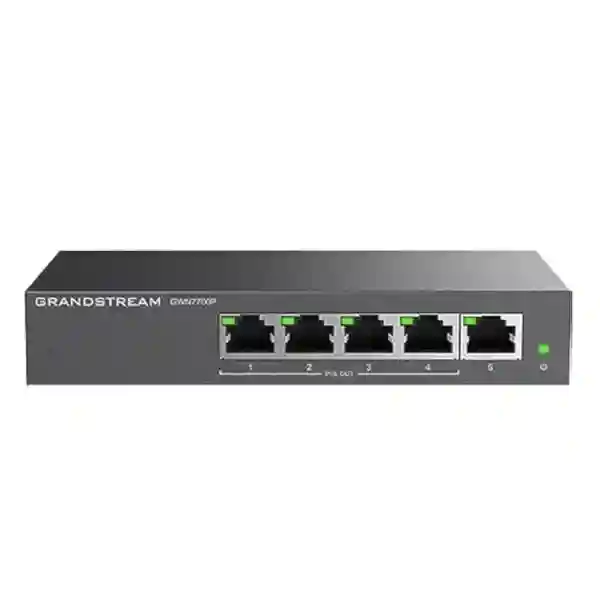
The Grandstream GWN7700P is a compact five-port Gigabit unmanaged network switch designed for businesses that need simple wired expansion plus Power over Ethernet. Four of its five 10/100/1000 Mbps RJ45 ports support IEEE 802.3af/at PoE and PoE+, allowing the switch to power compatible IP phones, wireless access points, IP cameras and other Ethernet-powered endpoints while carrying data over the same cable. Grandstream specifies a maximum of 30W on each PoE port and a 60W total PoE budget, making the model particularly useful for small branch offices, reception areas, meeting-room clusters, retail counters, clinics, classrooms and compact surveillance or Wi-Fi deployments.
Choose the GWN7700P when you need a small unmanaged Gigabit switch that can power up to four compatible PoE devices and you do not need switch-side VLAN configuration, SNMP monitoring or a managed web interface.
Typical uses include a few IP phones, one or two wireless access points, compact IP-camera groups, small office edge connections and branch sites where plug-and-play operation is preferred.
The four PoE ports share a 60W total budget. A device may draw up to 30W on one supported port, but the combined connected PoE load still needs to stay within the switch budget.
What the Grandstream GWN7700P solves
Small networks often need only a handful of wired endpoints, yet several of those endpoints may also need electrical power. Without PoE, an installer may have to place a power adapter beside every access point, phone or camera, locate nearby electrical outlets, manage additional cables and support several small power supplies. The GWN7700P combines Ethernet connectivity and standards-based PoE on four ports, reducing that clutter while keeping deployment uncomplicated. Because the switch is unmanaged, it does not require a controller, a local configuration session or policy setup before basic forwarding begins.
That simplicity is useful when the network design is already handled upstream by a router, firewall or managed core switch and the requirement at the edge is simply to connect and power a small group of devices. For example, a branch can use an upstream firewall for routing and security while the GWN7700P provides local Gigabit connectivity to desk phones and a Wi-Fi access point. A small CCTV installation can use it to power a few compatible cameras, provided the total PoE load and network design fit the model. A reception or meeting area can use the switch as a compact edge point for an IP phone, access point and other wired equipment.
The important buying decision is therefore not whether the GWN7700P has the longest feature list. It is whether an unmanaged, five-port, four-PoE-port design matches the site. Buyers who require VLAN creation on the switch, detailed port monitoring, link aggregation, advanced access-control policies or remote switch configuration should compare managed alternatives rather than forcing an unmanaged product into a role it was not built to perform.
Verified GWN7700P specifications
| Item | Grandstream GWN7700P |
|---|---|
| Switch type | Unmanaged Gigabit Ethernet switch |
| Gigabit ports | 5 × 10/100/1000 Mbps RJ45 |
| PoE ports | Ports 1–4, IEEE 802.3af/at |
| PoE output | Up to 30W per PoE port; 60W total PoE budget |
| Switching capacity | 10Gbps |
| Jumbo frame | 9KB |
| MAC address table | 2K |
| Port behavior | Auto-negotiation and Auto MDI/MDIX |
| QoS / traffic functions | IEEE 802.1p/DSCP QoS, IEEE 802.3x flow control, IGMP functions and automatic MAC learning/aging |
| Mounting | Desktop or wall mount |
| Enclosure | Metal |
| Operating temperature | 0°C to 40°C |
| Dimensions | 145 × 80 × 27 mm |
| Unit weight | 0.26 kg |
Specification planning note: connected PoE endpoints should be checked against both their individual power requirement and the 60W shared PoE budget. Environmental conditions, cable quality and upstream network design also matter in real deployments.
Features that matter in a small business deployment
Four PoE+ ports
Ports 1 through 4 can power IEEE 802.3af/at compatible endpoints. This can simplify installations for desk phones, wireless access points and many IP cameras by reducing the need for local power adapters.
Gigabit on all five ports
All RJ45 interfaces support 10/100/1000 Mbps auto-negotiation, so the switch can connect common Ethernet devices while using Gigabit links where the connected equipment supports them.
Plug-and-play operation
As an unmanaged model, it is intended to forward traffic without administrator configuration. That reduces commissioning steps for small sites that do not require managed switching features at this layer.
Compact metal chassis
The metal enclosure and desktop/wall-mount format suit compact offices, reception counters, cabinets and edge locations where a full rack-mount access switch would be unnecessarily large.
Traffic handling functions
Grandstream lists IEEE 802.3x flow control, 802.1p/DSCP QoS, MAC auto-learning/aging and IGMP-related functions, giving the unmanaged switch useful baseline traffic behavior without exposing a management interface.
Automatic cabling adaptation
Auto MDI/MDIX helps simplify Ethernet cabling by automatically handling crossover requirements, which is useful when a technician is adding the switch to an existing router, firewall or LAN.
PoE sizing: check watts, not only ports
A four-port PoE switch is not automatically suitable for every four-device combination. The GWN7700P can provide up to 30W on an individual supported port, but its total PoE budget is 60W. That means the total maximum demand of the connected powered devices must be considered together. Four modest-power IP phones may fit comfortably. Two access points and two cameras may also fit if their combined requirement stays inside the budget. Four devices approaching the maximum 30W class would not fit inside a 60W total budget at full demand.
For procurement, list each endpoint model, its PoE standard and expected maximum draw. Add reasonable headroom rather than assuming average draw will always remain low. If the total requirement is close to the 60W limit or the site is expected to expand, selecting a larger PoE switch can be more practical than operating with little spare capacity.
Compatibility and integration guidance
The GWN7700P is suitable for standards-based Ethernet networks and can sit behind routers, firewalls or managed switches. It can be used with Grandstream and non-Grandstream endpoints provided Ethernet and PoE requirements are compatible. Typical powered-device categories include IP phones, wireless access points and IP cameras. The switch itself does not create VLANs or enforce sophisticated segmentation. If a business needs separate voice, guest, surveillance or staff networks, those policies should be designed on managed switching and routing infrastructure that supports the required VLAN architecture.
For a small branch, one practical pattern is to use a managed core or firewall upstream and the GWN7700P only as an edge power-and-connectivity device. This keeps the local wiring compact while preserving central policy control elsewhere. For a larger office, the model may serve a small isolated cluster, but administrators should consider whether a managed access switch would provide better monitoring and troubleshooting. The right answer depends on how important visibility, segmentation, redundancy and remote administration are to the site.
FourTeck Tanzania’s business technology shop provides a broader purchasing context for network switches, Wi-Fi, firewalls, IP phones and supporting infrastructure, while the services overview is useful when the requirement includes installation, configuration, structured cabling or multi-system integration rather than a standalone hardware purchase.
Where the GWN7700P fits—and where it does not
Good fit
Small sites with up to four PoE endpoints, simple Gigabit edge expansion, IP phone clusters, compact Wi-Fi or camera deployments, reception areas, home offices and branch spaces where no switch configuration is required.
Consider a managed alternative
Networks requiring configurable VLANs on the access switch, detailed port statistics, SNMP, remote switch configuration, link aggregation, advanced security policies, extensive PoE capacity, redundancy or centralized switch-management workflows.
Grandstream GWN7700P Tanzania
For Tanzania businesses, the Grandstream GWN7700P is best evaluated as a compact edge switch for locations where a few devices need dependable Gigabit connectivity and PoE without the complexity of a managed access switch. A small professional office may need two or three IP phones plus a ceiling access point. A clinic reception may need an IP phone, an access point and one or two cameras. A shop counter might require a phone, a wireless access point and a network camera while preserving a fifth port for the uplink. These are the kinds of deployments where the five-port layout can be practical because the requirement is small, clear and unlikely to outgrow the switch immediately.
Procurement teams in Tanzania should begin with device count and PoE demand. The GWN7700P has four IEEE 802.3af/at PoE ports with a shared 60W budget. That makes endpoint power planning important. A quotation request should therefore include the exact phone, camera or access-point models wherever possible, not only a statement such as “four PoE devices.” The combined maximum demand determines whether 60W offers enough headroom. If the business expects more endpoints within the next year, moving to a larger PoE switch from the start may avoid replacing the unit after a short growth cycle.
Network architecture matters just as much as the switch. Because the GWN7700P is unmanaged, it does not provide configurable VLANs or a management dashboard. Tanzania customers building a voice-ready or surveillance network should decide where segmentation will be enforced. In many small designs, a managed upstream switch or firewall can carry that responsibility while the GWN7700P acts as a simple local extension. In more complex sites, especially offices with many departments, guest Wi-Fi, surveillance, servers and multiple uplinks, a managed access switch is usually the cleaner choice because administrators gain better control and visibility.
Installation planning should also consider cable quality, distance, equipment placement, ventilation and power protection. A compact metal switch still benefits from a clean, dry, ventilated location and stable electrical supply. Where business continuity matters, the switch and upstream router or firewall can be included in UPS sizing so powered endpoints remain available through short interruptions. For customers building a wider regional standard, the FourTeck Uganda site and FourTeck Kenya site can support related East African planning conversations without assuming identical site conditions across markets.
Grandstream GWN7700P Dar es Salaam
In Dar es Salaam, the GWN7700P can suit compact offices, professional services firms, retail counters, clinics, training rooms and small branch environments where several IP devices are concentrated in one area. The city’s business environments range from modern office suites to mixed-use premises, so the value of a small PoE switch is often practical rather than theoretical: it can remove separate power adapters from a desk cluster, power a ceiling-mounted access point where an electrical socket would be inconvenient, or support a few IP cameras near an entrance or customer-facing area.
A Dar es Salaam buyer should determine whether the site really needs an unmanaged switch. If the office already has a managed network core and the GWN7700P is only extending connectivity to a few endpoints, the design can be efficient. If the switch will become the primary access layer for staff, voice, Wi-Fi and surveillance traffic, managed switching may offer better long-term control. The absence of a configuration interface is an advantage only when no configuration is required. It should not be mistaken for a substitute for VLAN design, network monitoring or security policy.
PoE calculations are especially important where multiple device types share the four powered ports. A wireless access point can have a different power profile from a desk phone, and an IP camera may draw more when infrared illumination or other functions are active. Grandstream allows up to 30W per PoE port but only 60W in total, so the combined load determines suitability. When preparing a Dar es Salaam quotation, list every intended powered device, cable run, expected uplink and future endpoint. This makes it easier to decide whether the GWN7700P is the right size or whether an eight-port or higher-budget model is more appropriate.
Physical installation should be planned as part of the network. Place the switch where ventilation is reasonable, where cable routes are tidy and where it can share appropriate power protection with the router, firewall or modem. Avoid turning a compact switch into a loose desktop junction surrounded by unlabelled cables and unsupported adapters. A small wall-mounted cabinet, labeled patching and simple documentation can make a five-port switch much easier to maintain. For businesses seeking broader integration, FourTeck Tanzania can align switching with IP phones, Wi-Fi, firewalling, cameras and cabling rather than treating each endpoint as an independent purchase.
Grandstream GWN7700P Mwanza
For businesses in Mwanza, the GWN7700P can be a practical choice when the network edge is small but PoE is useful. Examples include a front office with several IP phones, a small hospitality reception with an access point and camera, a retail branch, a clinic or an administrative room that needs a few Ethernet devices without a full rack-mounted switch. Its five Gigabit ports provide enough connectivity for a compact group, while four PoE/PoE+ ports can reduce the number of local power supplies required by supported endpoints.
Mwanza buyers should approach the model from a lifecycle perspective. The initial requirement may be only three devices, but another camera, phone or access point could be added later. With five total ports and four PoE ports, expansion headroom can disappear quickly. The correct comparison is therefore not only the purchase price of the GWN7700P versus a larger switch, but also the likely number of devices over the expected deployment period. If the site is stable and intentionally small, the compact model can be efficient. If a branch is expected to grow, a higher-port-count switch may deliver better value by postponing the next upgrade.
Power budget planning remains central. A total 60W PoE budget is generous for many combinations of standard IP phones and modest-power endpoints, yet it is not equivalent to four ports each delivering 30W simultaneously. Procurement should capture the maximum PoE requirement of each connected device and retain headroom. This is particularly useful for Wi-Fi and surveillance projects, where new endpoint generations can have higher power demand than older models. Cable condition also matters because PoE and Gigabit Ethernet rely on correct copper installation, termination and distance limits.
The GWN7700P should also be placed in the right architectural role. If a Mwanza site needs separate staff, guest, camera and voice networks with configurable policies at the access layer, use managed switching. If those policies are already handled upstream and the edge simply needs to connect a small cluster, an unmanaged PoE switch can keep the design simple. A quotation should state the upstream device, endpoint list, cabling status and whether UPS protection is required so the network can be assessed as one system rather than as a box-only purchase.
Grandstream GWN7700P Arusha
Arusha organizations often operate in office, hospitality, education, tourism and service environments where a small edge switch may need to support both business communications and local connectivity. The Grandstream GWN7700P fits projects that need a limited number of wired ports with PoE, such as a reception area using an IP phone, a wireless access point and a few cameras, or a small administrative office extending Ethernet from an existing network core. Its unmanaged operation reduces setup steps when the site does not need switch-side configuration.
Hospitality and visitor-facing environments should pay particular attention to network segmentation. An unmanaged GWN7700P can forward traffic, but it does not replace a managed architecture where staff, guest Wi-Fi, cameras and operational devices must be isolated. In a well-designed site, the GWN7700P may be used behind a managed switch or firewall that defines the required VLANs and access rules. In a small single-purpose area, that may be sufficient. In a larger lodge, hotel, campus or multi-building property, managed PoE switches and fiber uplinks may be more appropriate because monitoring and expansion become more important.
PoE requirements should be documented before equipment is ordered. The four powered ports support IEEE 802.3af/at, with up to 30W per port and a total budget of 60W. Access points, phones and cameras should be checked by model, not assumed to consume the same amount. If a site has outdoor or high-performance wireless equipment, pan-tilt-zoom cameras or other higher-draw devices, their power requirements may make a larger PoE platform a better choice. The GWN7700P is strongest when the endpoint mix is modest and predictable.
Arusha deployments also benefit from careful physical planning. Use quality structured cabling, keep the switch in a dry and ventilated position, label ports and record which powered device connects to each port. Where short power interruptions would disrupt phones, Wi-Fi or cameras, include the switch and upstream network equipment in UPS calculations. These steps are simple, but they make troubleshooting easier and reduce dependence on memory. For multi-country organizations, the same procurement template can be reused while still adjusting device count, power, cabling and support needs for each site.
Grandstream GWN7700P Dodoma
In Dodoma, the GWN7700P is suitable for small administrative offices, branch environments, meeting areas, clinics, educational facilities and professional workspaces that need a compact combination of Gigabit Ethernet and PoE. The product is especially useful when the objective is to connect and power a few endpoints without adding a managed switch interface that nobody at the site needs to administer. Four PoE-capable ports can serve compatible IP phones, cameras or access points while the fifth Gigabit port is commonly used for an uplink or non-PoE device.
For public-sector, institutional or structured procurement, model selection should be linked to documented requirements. A specification should state the number and type of PoE endpoints, required Ethernet speed, total PoE budget, mounting method and whether managed features are needed. The GWN7700P delivers 10Gbps switching capacity, 9KB jumbo frame support, a 2K MAC address table, flow control and other baseline functions, but it remains an unmanaged switch. Procurement documents should avoid describing it as a remotely managed access platform or assuming it provides configurable VLAN features.
Future growth is another consideration in Dodoma branch projects. A five-port switch is compact because it has little unused capacity. If a site is likely to add more phones, cameras or access points, planning for eight or more ports may reduce later rework. Likewise, if the site will introduce separate networks for guest users, staff, CCTV and voice, managed switching can provide a more sustainable foundation. The GWN7700P works best where scope is deliberately narrow and an upstream device already handles routing and security policy.
Installation should include quality Ethernet cabling, secure mounting or desktop placement, appropriate ventilation and clean power. The switch’s PoE feature simplifies endpoint power delivery, but the switch itself still depends on its supplied power adapter and the upstream network path. Where IP phones or security cameras are operationally important, UPS protection may be worth including. A complete quotation should therefore cover the switch, endpoint models, cables or patching, upstream connectivity and any required power protection instead of treating the switch as the whole solution.
Grandstream GWN7700P UAE
For UAE businesses and project buyers, the Grandstream GWN7700P offers a compact way to power and connect a small group of Ethernet endpoints in offices, retail sites, clinics, meeting areas and branch locations. Four PoE+ ports are useful when IP phones, access points or cameras need both power and Gigabit data over a single cable, while the fifth port can serve as an uplink to the router, firewall or upstream switch. The model’s unmanaged design is often attractive for straightforward edge use because no switch configuration is necessary for basic operation.
UAE deployments commonly place significant emphasis on centralized IT standards. In that context, the GWN7700P should be used only where an unmanaged edge device is consistent with policy. A managed core can provide VLANs, routing, security controls and monitoring while the GWN7700P delivers simple local PoE. However, if the branch standard requires every access switch to be remotely monitored, centrally configured or segmented at port level, a managed Grandstream GWN switch or another enterprise managed platform is the better match.
Power calculation remains a procurement checkpoint. The four PoE ports support IEEE 802.3af/at, but the total PoE budget is 60W. Buyers planning several access points or cameras should add their maximum power requirements and leave operating headroom. Device quantity alone is not enough to confirm suitability. The UAE project team should also confirm copper category, cable length, mounting, cabinet temperature and power protection, especially when the switch is placed in a communications cupboard rather than an open office.
For UAE-specific Grandstream sourcing and broader voice/networking context, buyers can also consult the FourTeck Grandstream UAE resource. When equipment is intended for several countries, keep the technical standard consistent but verify local commercial terms, shipment scope, power accessories, installation responsibilities and support arrangements separately for each destination. A repeatable bill of materials is useful only when it still matches the actual site.
Grandstream GWN7700P Uganda
Uganda businesses can consider the GWN7700P for compact edge networking where four or fewer PoE endpoints need to connect to an existing LAN. Small offices, clinics, shops, schools, branch counters and security installations may use the model to support IP phones, wireless access points and cameras without separate injectors. Its five Gigabit ports and 10Gbps switching capacity provide a simple wired foundation for a small device group, while automatic negotiation and Auto MDI/MDIX reduce manual port setup.
The decision should begin with network role. If the Uganda site requires only a local extension behind a managed router or firewall, an unmanaged switch may be entirely appropriate. If administrators need port-level VLAN configuration, remote diagnostics or switch monitoring, the GWN7700P should not be selected merely because it has PoE. Managed requirements should be met with a managed product. This distinction is especially important for organizations standardizing branch networks because visibility and remote support may be more valuable than the lower complexity of an unmanaged switch.
PoE planning should document both standards and watts. Each of the four supported ports can supply up to 30W to an IEEE 802.3af/at device, while the total budget across all powered ports is 60W. A combination of low-power phones can be very different from a combination of higher-performance access points or cameras. Buyers should calculate the worst-case total and leave spare capacity. If the load is close to the limit, a larger switch may provide more reliable expansion headroom.
For regional continuity, the FourTeck Uganda website can be used for market-specific discussions, while a shared corporate network standard can still define preferred endpoint classes, PoE headroom, labeling, VLAN conventions and documentation. This combination of standardization and local validation helps procurement teams avoid assuming that every branch has identical cabling, rack space, power conditions or endpoint counts.
Grandstream GWN7700P Kampala
In Kampala, the GWN7700P can be effective in office suites, retail environments, clinics, professional practices and small branch networks where a few IP devices need PoE. A common layout may use one port for the uplink and the four powered ports for a mix of desk phones, an access point and one or two cameras. The compact metal enclosure makes the switch easier to place than a rack-sized device when there is no dedicated communications room, although cabling and power should still be organized professionally.
Kampala organizations with centralized IT teams should confirm whether unmanaged access devices fit their support model. The GWN7700P provides simple switching and baseline traffic handling, but no configurable management interface. If remote staff need to disable ports, inspect detailed port status, reconfigure VLAN membership or monitor the switch over a network-management platform, a managed model is preferable. If the branch only needs transparent edge connectivity under the control of an upstream firewall or managed switch, the simplicity can reduce deployment overhead.
For PoE, the 60W total budget is the key number. Four ports do not mean four simultaneous 30W loads. Before buying, record each powered device’s maximum requirement and compare the combined value with the available budget. Add future devices only if there is both port capacity and power headroom. This is especially important for wireless upgrades because newer access points can demand more power than older generations, even if the number of physical devices stays the same.
A good Kampala quotation should state quantities, endpoint models, cable distances, uplink device, rack or wall-mount preference and whether UPS support is required. That information allows the switch to be assessed in context. A low-cost device that creates a future power or port bottleneck is not automatically economical. Conversely, overspecifying a fully managed high-density switch for four simple endpoints may add cost and administration without useful benefit. The objective is fit, not maximum specification.
Grandstream GWN7700P Arua
For smaller offices and branch sites in Arua, the GWN7700P can help keep local network deployment compact. A site that needs an IP phone at reception, a Wi-Fi access point and a pair of cameras can potentially combine those connections and PoE power on one small switch, provided the total power demand stays within the 60W budget. The switch’s unmanaged operation also means a technician can install it without building a separate configuration for basic Ethernet forwarding.
That ease of installation should be paired with disciplined planning. Cabling should be tested and labeled, the uplink should be clearly identified, and the switch should be placed where heat, dust, accidental disconnection and moisture are controlled as far as practical. When the site depends on connected phones, wireless coverage or cameras, consider how the switch and upstream router will behave during a power interruption. A UPS may be more important to business continuity than adding features the site does not need.
Arua buyers should also consider support distance and future growth. If the site is remote from the organization’s main IT team, remote management may be valuable. The GWN7700P itself is unmanaged, so detailed remote diagnostics are limited compared with a managed switch. Organizations that need centralized visibility across branches should compare a managed platform even if the current device count is small. If the branch is simple and stable, the GWN7700P can reduce complexity precisely because it has no configuration layer to maintain.
The most useful procurement question is therefore: what will connect here over the next two to three years? Count phones, cameras, access points and any wired PCs or printers; reserve the necessary uplink; then calculate PoE demand. If the result leaves comfortable port and power headroom, the GWN7700P can be a sensible compact choice. If the plan already consumes every port or almost all 60W, moving up in capacity at purchase time can reduce future site visits and equipment changes.
Grandstream GWN7700P Mbarara
Mbarara businesses evaluating the GWN7700P should focus on compact branch and edge applications. The model can support a small collection of PoE devices without the additional wall adapters that would otherwise be needed for each phone, camera or access point. This can be useful in retail, clinic, office, education and hospitality spaces where there may be only a few network endpoints in one zone and where a full managed rack switch would be disproportionate to the requirement.
The five-port layout should be mapped before purchase. One port is often used to connect back to the router or upstream switch, leaving four ports for local equipment. Because those four ports are the PoE-capable interfaces, the physical layout aligns well with four powered endpoints. However, businesses adding a fifth local device would need another connection path. If growth is likely, compare larger models early instead of creating a daisy-chain of small unmanaged switches later. A clean network topology is easier to document and troubleshoot.
Power calculation is equally important. Grandstream specifies up to 30W per PoE port and 60W total. A low-power IP phone and a higher-power access point should not be treated as equivalent loads. Gather endpoint datasheets or maximum PoE ratings, total them, and include margin. If camera heaters, infrared functions or high-performance radios increase load, the result may change. Selecting by actual power data avoids unexplained resets or the need to add injectors after deployment.
Finally, decide where policy and monitoring will live. The GWN7700P will not replace a managed switch in an environment requiring configurable VLANs, port security, remote management or advanced diagnostics. It can, however, complement an upstream managed network by acting as a simple edge extension. For a Mbarara branch with a clear and limited role, that division of responsibility can create a network that is both economical and straightforward to support.
Grandstream GWN7700P Gulu
In Gulu, the GWN7700P is relevant to organizations that need to connect a small set of PoE endpoints at the edge of an existing network. A local office, training room, clinic, retail site or security post may need only a few powered network devices, making a compact five-port switch easier to justify than a larger chassis. Because the unit is plug-and-play, basic deployment focuses on correct power, cabling and uplink connections rather than switch configuration.
Branch reliability still depends on the surrounding infrastructure. The Ethernet cabling should meet distance and termination requirements, the switch should have suitable ventilation and protection, and the upstream router or firewall should be stable. If the switch powers an access point and IP phones, a failure in its local power source can affect multiple services at once. Where continuity matters, the UPS design should include both the switch and the devices that keep the WAN and routing path operational.
Gulu buyers should also distinguish between connectivity and management. The GWN7700P provides connectivity, PoE and baseline switching features. It does not provide a configurable management plane for administrators. Organizations managing many branches may prefer managed switches because they can obtain remote status and standardized configurations. On the other hand, a simple branch with no need for local VLAN changes can benefit from fewer configuration dependencies. The correct choice depends on the operational model, not on whether “managed” sounds more advanced.
When requesting a quote, include the number of IP phones, cameras and access points, their PoE requirements, whether a wired computer or printer also needs a port, and the uplink design. If the branch already needs all four PoE ports on day one, consider whether expansion capacity should be purchased now. The difference between a well-sized switch and an undersized switch often appears only after the first office expansion, so growth assumptions should be explicit rather than left to chance.
Grandstream GWN7700P Kenya
For Kenya branch networks, the GWN7700P can serve as a compact unmanaged PoE edge switch when only a few endpoints need local power and data. It fits small offices, shops, clinics, reception areas and meeting spaces where a router, firewall or managed core already provides the wider network services. Five Gigabit interfaces give the site fast wired connectivity, while four IEEE 802.3af/at ports can power compatible phones, cameras and access points without separate injectors.
Kenya organizations that operate several branches should decide whether they value simplicity or centralized switch visibility more. The GWN7700P is easy to deploy because it is unmanaged, but that also means it cannot be configured remotely like a managed switch. If the IT team needs a consistent VLAN template, port-level changes, statistics or centralized monitoring at every branch, a managed model may reduce support friction even for smaller sites. If branch policy is enforced upstream and the local switch is just a short extension, unmanaged operation can be a reasonable design choice.
The shared 60W PoE budget should be incorporated into bill-of-material calculations. Four PoE ports are available, but endpoint loads vary. A set of desk phones may use much less than four performance-oriented access points. Project teams should compare the maximum demand of each endpoint and retain headroom for startup behavior and future changes. If the total approaches 60W, a switch with a larger budget gives more flexibility and avoids relying on optimistic average-power assumptions.
For Kenya-specific procurement context, the FourTeck Kenya site can support local requirements, while regional IT teams can use the same technical checklist across markets: endpoint count, PoE budget, uplink, cabling, mounting, UPS, segmentation and management. Standardizing the checklist is often more useful than blindly standardizing one model, because branch sizes and physical conditions can differ substantially.
Grandstream GWN7700P Kuwait
In Kuwait, the Grandstream GWN7700P can support small offices, retail counters, clinics and communications areas where a limited number of powered Ethernet endpoints need Gigabit connectivity. Four PoE+ capable ports allow compatible IP phones, cameras and access points to receive power through the same cabling used for data. The fifth port can connect upstream to a firewall, router or managed switch. This compact topology is useful where the network requirement is intentionally small.
Environmental placement deserves attention. The official operating range is 0°C to 40°C, so equipment cabinets and rooms should be kept within appropriate conditions. Network hardware should not be placed in locations exposed to excessive heat or poor ventilation simply because the switch is physically small. A communications cabinet with organized cabling and suitable cooling is preferable to an improvised shelf near heat sources. Power protection can also be planned alongside the router and other critical devices.
Kuwait buyers should verify whether local IT policy permits unmanaged switching. The GWN7700P is designed for plug-and-play use, not for administrators who need configurable VLANs, remote switch management or port-level analytics. A managed upstream device can still control routing and segmentation for a simple edge cluster, but some enterprise standards require all access switches to be managed. In that case, the buying decision should move toward a managed model rather than adding workaround complexity later.
PoE budget is the final sizing checkpoint. The switch offers a 60W total budget across four powered ports, with up to 30W on an individual port. For a quotation, list the exact endpoints and their maximum PoE needs. If a project includes several higher-draw access points or cameras, a larger power budget may be required even when the port count appears sufficient. Good selection balances port quantity, power, management, environment and future growth instead of comparing switches on port count alone.
Grandstream GWN7700P Ghana
For Ghana businesses, the GWN7700P is a compact option for small edge networks that need PoE for a few devices. An office reception, clinic, classroom, retail branch or small surveillance area may need several Ethernet connections but not the management overhead of a larger switch. Four powered Gigabit ports can connect compatible IP phones, wireless access points and cameras, while the fifth Gigabit port supports the local uplink or another non-PoE endpoint.
A Ghana deployment should be sized from the endpoint list. The 60W PoE budget is often enough for modest mixes, but the project should not assume that any four PoE+ devices will fit. Up to 30W may be available on a port, yet the total remains 60W. IT teams should check maximum device consumption, especially where access points and cameras have higher power requirements than standard desk phones. Leaving spare capacity improves flexibility when endpoints are replaced with newer models.
Network-management needs should also be explicit. The GWN7700P is not a configurable managed switch. It therefore suits sites where VLAN and security policy are handled upstream or where segmentation is not required at this local edge. For multi-department offices, larger CCTV networks, hospitality guest networks or sites that require remote monitoring, a managed switch can offer better operational visibility. Choosing the correct class of switch can reduce support problems more effectively than choosing the smallest available hardware.
Physical deployment should include tested copper cabling, clear port labels and appropriate power protection. Where the switch powers Wi-Fi or phones, it becomes part of the availability chain for those services. Include it in UPS calculations if short power interruptions should not immediately disconnect users. Procurement teams should also confirm what is included with supply, how installation will be handled and whether endpoint configuration or network changes are in scope. Clear boundaries make quotations easier to compare and reduce last-minute installation gaps.
Grandstream GWN7700P Nigeria
Nigeria organizations can use the GWN7700P in small branch and edge scenarios where a few IP devices need both connectivity and PoE. Its four PoE/PoE+ ports can simplify desk-phone, access-point and camera installations, while Gigabit Ethernet avoids creating a 100 Mbps access-layer bottleneck for modern devices. The compact metal chassis is suitable for desktop or wall-mount use when a site does not justify a full rack switch.
Power resilience can be an important part of network planning. Because several endpoints may depend on the switch for both power and data, a switch power interruption can simultaneously affect phones, Wi-Fi and cameras. Where continuity is important, project teams should consider UPS support for the GWN7700P, upstream router or firewall and internet equipment. The UPS should be sized from actual load and desired runtime rather than assuming a small switch requires negligible planning.
The 60W shared PoE budget should be checked carefully. Four standard phones may present a modest load, while several access points or cameras can use significantly more. Up to 30W can be available on an individual port, but that does not multiply into a 120W total. Record the maximum requirement of each powered endpoint, add the figures and preserve reasonable spare capacity. If the project approaches the budget on day one, a higher-capacity PoE switch may be the safer investment.
Nigeria businesses with distributed branches should also decide whether remote management is necessary. The GWN7700P’s unmanaged design is simple, but it does not provide centralized switch configuration. If branch networks need standardized VLANs, port monitoring, access controls or remote troubleshooting, a managed switch may better match the support model. If the branch has only a few fixed endpoints and the main policy controls sit upstream, the GWN7700P can provide an efficient edge layer without unnecessary administrative complexity.
Grandstream GWN7700P Seychelles
For Seychelles businesses, the GWN7700P can fit smaller hospitality, office, retail and service environments where a few PoE endpoints are grouped in one location. A reception area may need a phone, an access point and cameras; a small office may need several IP phones and a wireless device; a back-office communications point may need to extend an existing network. In these cases, a five-port unmanaged Gigabit switch can provide enough local connectivity without a larger physical footprint.
Hospitality and guest-facing networks often need segmentation, however, so the unmanaged nature of the switch should be considered carefully. The GWN7700P can be used behind a managed network layer, but it does not itself provide configurable VLANs. Properties that separate guest, staff, surveillance, voice and building systems may be better served by managed PoE switching at the access layer. The GWN7700P is strongest in small, clearly defined edge clusters where the upstream architecture already handles policy.
PoE capacity is another design factor. Four ports support IEEE 802.3af/at and the switch provides a total budget of 60W. If the site intends to power several Wi-Fi access points, check each model’s maximum requirement and retain headroom. The same applies to cameras with higher-power functions. Port count and power count should be treated as separate dimensions. A switch can have enough physical ports but still lack sufficient total PoE power for the chosen endpoints.
Seychelles procurement should also account for replacement planning and installation scope. A compact branch site may prefer standardized spare hardware, clear port labeling and documented cable routes so support can be handled efficiently. Confirm whether the quotation includes only hardware or also cabling, mounting, configuration of upstream equipment and endpoint commissioning. The switch itself is simple; the surrounding network still benefits from professional documentation. When requirements expand beyond five ports, plan a clean move to a larger platform rather than building an unmanaged chain that becomes difficult to trace.
Buying and quotation checklist
List every IP phone, camera, access point, PC, printer and uplink that will use the switch.
Record the PoE standard and maximum watts for each powered device, then compare the total with 60W.
Confirm whether unmanaged operation is acceptable or whether VLAN, monitoring and remote control require a managed switch.
Check copper category, termination quality, cable distance, patching and any wall or cabinet mounting requirements.
Decide whether the switch, router and internet equipment should be connected to UPS protection.
Estimate endpoints over the expected life of the site; five ports leave limited expansion room.
Frequently asked questions
Is the Grandstream GWN7700P a managed switch?
No. It is an unmanaged Gigabit Ethernet switch designed for plug-and-play operation. Buyers needing configurable VLANs, remote switch management or detailed port monitoring should compare managed switch models.
How many PoE devices can the GWN7700P power?
It has four PoE/PoE+ ports. Whether all four devices can be powered simultaneously depends on their combined consumption staying within the 60W total PoE budget and each port remaining within its supported limit.
Can each PoE port deliver 30W?
Grandstream specifies up to 30W on each supported PoE port, but the switch has a 60W total budget. Four 30W devices therefore cannot all receive 30W simultaneously from this switch.
Can the GWN7700P power Grandstream IP phones and Wi-Fi access points?
It can power compatible IEEE 802.3af/at devices, including many IP phones and wireless access points. Always verify the exact endpoint’s PoE standard and maximum wattage before deployment.
Can I use the GWN7700P for IP cameras?
Yes, if the cameras use compatible Ethernet PoE standards and their total power demand fits the switch budget. Camera bandwidth, recording design, VLAN policy and uplink capacity should also be considered.
Does the GWN7700P support Gigabit Ethernet?
Yes. It provides five 10/100/1000 Mbps RJ45 ports with auto-negotiation and Auto MDI/MDIX.
Can I configure VLANs on this switch?
The GWN7700P is unmanaged, so it does not provide a management interface for configuring VLAN membership. If VLAN control is required at the switch, choose a managed model.
Is it suitable for a large office?
It can serve a small edge cluster inside a large office, but five ports and unmanaged operation are usually not enough for a full large-office access layer. Larger managed PoE switches may offer better scalability and administration.
What should I send for a quotation?
Provide quantity, location, endpoint models, number of PoE devices, approximate cable runs, upstream router or switch details, mounting preference and whether cabling, installation or UPS protection is required.
Decision recap
The Grandstream GWN7700P is a strong fit when the requirement is deliberately simple: five Gigabit ports, four PoE/PoE+ endpoints, no need for local switch configuration and a combined PoE demand within 60W. Its value comes from reducing cable and power clutter while giving small networks straightforward Gigabit connectivity.
Choose a larger or managed switch when the project needs more ports, more PoE headroom, VLAN configuration, centralized switch monitoring, advanced security controls or expected growth beyond a small edge cluster. Matching the switch class to the operational requirement is more important than buying by port count alone.
Consult FourTeck for the complete network requirement
A small PoE switch can be part of a much larger business system. IP phones depend on PBX and voice-network design. Access points depend on RF planning and wired uplinks. Cameras depend on recording, storage and security policy. All of them depend on cabling, power and an upstream router or firewall. FourTeck can help buyers evaluate the GWN7700P in that broader context so the selected switch fits the actual endpoint count, PoE load and management model.
When requesting a quotation, include the exact site, quantity, connected device models and whether the requirement is hardware-only or includes cabling, installation, configuration or integration. That information makes it possible to distinguish a simple product purchase from a complete network deployment and to recommend a larger managed alternative when the GWN7700P would be undersized.



Reviews
There are no reviews yet.