
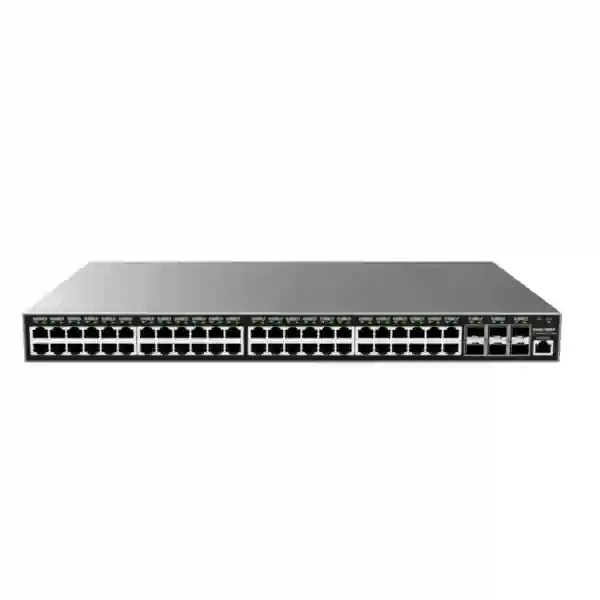
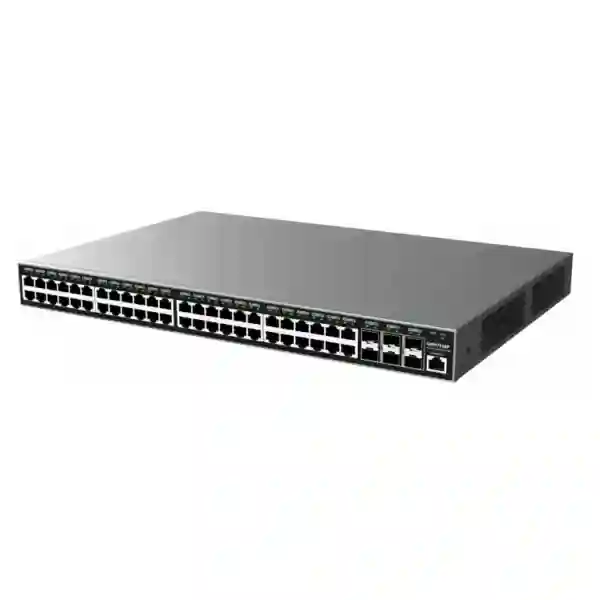
Enterprise Layer 2+ Managed PoE Switching
Grandstream GWN7806P Tanzania
The Grandstream GWN7806P is designed for businesses that need a high-port-count access or aggregation switch with integrated PoE/PoE+, fast uplinks, segmentation, traffic control and centralized management. It provides 48 Gigabit Ethernet ports with PoE/PoE+ output, six 10 Gigabit SFP+ uplinks and a total PoE budget of 400W, allowing one rack-mounted switch to connect and power IP phones, wireless access points, IP cameras and other compatible endpoints while maintaining structured network control.
Direct answer
Choose the GWN7806P when you need many powered edge ports, 10G fiber or DAC uplinks and Layer 2+ controls in one business switch. It is especially useful where phones, cameras and access points share the same structured cabling environment but need separate VLANs and traffic policies.
Verified capacity
Grandstream specifies 108Gbps total non-blocking throughput, 216Gbps switching capacity and a forwarding rate of 160.704Mpps. The PoE model supports IEEE 802.3af/at with up to 30W per PoE port and a maximum total PoE output of 400W.
Management choices
The switch can be managed through its local web interface and CLI, while Grandstream also supports centralized operation through GDMS Networking, GWN Manager and compatible GWN Series routers. This gives IT teams options for local, cloud and on-premise administration.
Why the GWN7806P fits demanding business LANs
A large office network is rarely a collection of identical endpoints. Staff computers generate ordinary data traffic, IP phones need low latency, access points carry multiple wireless SSIDs, surveillance cameras can produce sustained video streams and management interfaces must remain protected. The GWN7806P provides a practical way to keep these workloads on one switching platform without treating every connected device as if it belonged in the same logical network. VLAN capabilities, 802.1Q tagging, voice VLAN support, QoS, access controls and multicast features help administrators divide and prioritize traffic according to business function.
For physical connectivity, the 48 Gigabit copper ports suit dense endpoint environments while the six 10G SFP+ ports give designers room for faster uplinks toward a server rack, firewall, distribution layer or another switch. Grandstream specifies support for 10G single-mode and multimode modules, with DAC cable support up to five metres. This uplink flexibility matters when a building has multiple floors, a large camera estate, busy wireless access points or servers that would otherwise create bottlenecks on single-gigabit trunks.
The PoE budget should still be calculated rather than assumed. A 400W total budget is substantial, but forty-eight connected devices can have very different consumption profiles. Low-power desk phones may leave ample headroom, while a mix of multi-radio access points, PTZ cameras and other higher-draw endpoints can use the budget quickly. A good quotation therefore records the model and expected PoE class of each powered device, applies a safety margin and confirms where separate power may be required.
Grandstream GWN7806P technical highlights
| Copper ports | 48 × Gigabit Ethernet | PoE | 48 × IEEE 802.3af/at, up to 30W per port |
| Uplinks | 6 × 10G SFP+ | Total PoE output | 400W maximum |
| Switching capacity | 216Gbps | Non-blocking throughput | 108Gbps |
| Forwarding rate | 160.704Mpps | MAC table | Up to 32K MAC addresses |
| VLANs | Up to 4K VLANs | Static routing | 32 IPv4 / 32 IPv6 entries |
| Management | Web UI, CLI, GDMS Networking, GWN Manager, GWN Series Routers | Form factor | 440 × 301 × 44mm, desktop or rack mount |
The specification table above reflects Grandstream documentation for the GWN7806P. Always confirm transceiver type, PoE draw, firmware requirements and network design before deployment because compatibility depends on the complete environment rather than the switch alone.
Network control, security and resilience
The GWN7806P includes enterprise-oriented controls that go beyond basic port connectivity. Grandstream documents support for port-based VLANs, 802.1Q tagging, MAC-based and protocol-based VLANs, QinQ, voice VLAN functions, link aggregation and several spanning-tree modes. These features allow a network designer to separate business departments, voice endpoints, cameras, guest services and infrastructure management while keeping the physical cabling environment efficient. A properly planned VLAN structure also makes firewall policy and troubleshooting easier because the function of each subnet is clear.
Security features include 802.1X and MAC authentication, RADIUS and TACACS+ AAA, port isolation, port security, sticky MAC, IP and IPv6 source guard, ARP inspection, DHCP/DHCPv6 snooping, DoS protections and loop safeguards. These capabilities do not replace a firewall or a complete security architecture, but they can reduce risk inside the LAN by restricting unauthorized devices, preventing common spoofing techniques and limiting the impact of accidental loops or broadcast storms.
Operational resilience also depends on how the switch is integrated. Link aggregation can combine multiple uplinks for bandwidth and redundancy, spanning tree can help prevent switching loops and the six 10G interfaces can support diverse upstream designs. Grandstream documents dual-boot and redundant system-file capabilities, fault detection and environmental protections. Network teams should complement those device functions with configuration backups, tested firmware procedures, UPS protection, rack ventilation and clear port documentation.
Planning PoE, uplinks and device density
Port count and PoE budget should be planned together. A 48-port switch can appear to have enough capacity based only on cable count, yet the powered-device requirement may tell a different story. For example, a branch with twenty IP phones, twelve cameras and eight access points uses forty PoE ports but can still have a very different power profile from a site with forty low-power desk phones. The safest method is to list each powered endpoint, identify its maximum expected draw and compare the total against the 400W budget with operating headroom.
Uplink design is equally important. A 1Gbps uplink can become the bottleneck when many edge devices send traffic to servers, recording systems, cloud services or another floor. The GWN7806P offers six 10G SFP+ interfaces so the network can use fiber or supported direct-attach connectivity where higher bandwidth or longer distances are required. If multiple switches are deployed, uplinks should be sized according to the real traffic pattern rather than simply mirroring the access-port speed.
For buyers who are comparing the GWN7806P with smaller managed switches, the practical decision is whether the extra ports and uplink capacity will be used within the expected lifecycle. A 48-port model can reduce the number of chassis in a rack and simplify management, but a smaller switch may be more appropriate for a compact branch. Expansion plans, rack space, power, cooling, fiber availability and spare-port policy should all be reviewed before purchase.
Useful FourTeck Tanzania resources
For a wider view of business technology planning, visit the FourTeck Tanzania technology solutions homepage, which explains how switching, Wi-Fi, IP telephony, CCTV, servers and security infrastructure fit together. Buyers evaluating the GWN7806P can also browse the Tanzania FourTeck shop for current product categories and related hardware.
Projects that include configuration, cabling, deployment or support can be discussed through the FourTeck Tanzania services page. If procurement teams need background on the business and its broader technology scope, the About FourTeck Tanzania page provides additional context.
For model selection, quantity, transceiver requirements, PoE planning or a formal quotation, use the FourTeck Tanzania contact page. Include the number of endpoints, expected PoE devices, uplink type, rack location, existing switches and any VLAN or redundancy requirements so the discussion starts with the information that affects the design.
Grandstream GWN7806P Tanzania
For organizations in Tanzania, the Grandstream GWN7806P is relevant when a site needs to consolidate many powered network endpoints into a centrally managed switching layer. Typical examples include offices with IP phones and Wi-Fi access points, schools with multiple classrooms, hotels with distributed wireless coverage, healthcare facilities with segmented user and device networks, warehouses with cameras and operational terminals, and multi-floor buildings where 10G uplinks can reduce congestion between access and distribution layers. The 48 PoE/PoE+ ports allow one chassis to power compatible endpoints without relying on separate adapters at every desk or ceiling location, while the six SFP+ interfaces create options for fiber uplinks across racks, floors or buildings.
A Tanzania deployment should begin with a bill of connected devices rather than a switch model alone. List every IP phone, camera, access point, controller and other Ethernet endpoint, then mark which devices need PoE and their maximum power requirements. Compare this against the 400W switch budget and retain operating margin. The same exercise should identify where 10G uplinks are useful, especially if camera traffic, backup jobs, virtualization or wireless user density creates sustained load. For branch or campus networks, VLANs can separate business users, voice, surveillance, guest access and infrastructure management, while QoS can protect delay-sensitive traffic such as voice and video.
Power and environmental conditions are also important. The switch should be installed in a secure rack or controlled communications area with adequate ventilation, grounding and suitable UPS protection. Grandstream specifies an operating range of 0°C to 45°C and non-condensing humidity conditions, so rack temperature should be monitored rather than assumed. In areas where power quality is variable, upstream protection and a properly sized UPS can help reduce avoidable outages, but the complete electrical design should be matched to the site.
When requesting a quotation in Tanzania, provide the exact model GWN7806P, quantity, expected PoE device count, required SFP+ optics or DAC cables, rack details, desired management method and whether installation or configuration is needed. This information helps distinguish a straightforward hardware purchase from a complete LAN upgrade and reduces the chance of missing transceivers, patching, rack accessories or power requirements.
Grandstream GWN7806P Dar es Salaam
Dar es Salaam businesses often need switching that can support dense user environments, expanding wireless networks and an increasing number of IP-based services. The GWN7806P can suit headquarters, commercial offices, hospitality properties, retail environments, clinics, warehouses and education sites where phones, cameras and access points share structured cabling. Its 48 Gigabit PoE/PoE+ ports provide a high endpoint count in one rack unit, while six 10G SFP+ interfaces can link the switch to servers, another floor, a core switch or a firewall environment where higher throughput is needed.
In a busy Dar es Salaam office, the main design question is often not whether there are enough ports but whether traffic remains predictable when several applications operate at once. Cloud collaboration, VoIP, CCTV streams, Wi-Fi clients, ERP systems and backups can compete for uplink capacity. VLAN separation and QoS provide a way to organize these workloads. Voice can be placed in a dedicated VLAN, guest wireless can be kept away from internal resources, camera traffic can be isolated and network-management interfaces can be restricted. The six 10G uplinks provide room to move high-volume traffic off the access layer without forcing all traffic through one gigabit trunk.
Procurement teams should also check the physical deployment. If the switch is replacing an older 24-port platform, the rack may need additional patch-panel capacity, cable management and UPS load. If it is part of a new site, the copper cabling standard, fiber routes, rack ventilation and labeling scheme should be agreed before equipment arrives. A 400W PoE budget is useful, but it must be tested against the exact powered endpoints. Multi-radio access points and certain cameras can draw considerably more power than basic phones, so nameplate maximums should be included in planning.
For a Dar es Salaam quote, include building type, number of floors, endpoint count, existing switch brands, uplink distances and whether fiber is already terminated. If configuration is requested, also provide the required VLANs, IP ranges, voice requirements and any existing firewall or router that will perform Layer 3 policy. That creates a much clearer scope than requesting only a 48-port PoE switch.
Grandstream GWN7806P Mwanza
In Mwanza, the GWN7806P can be considered for organizations that are consolidating communications, Wi-Fi and security devices onto a managed Ethernet infrastructure. A typical site might include administrative users, IP phones, indoor and outdoor cameras, wireless access points and a small server or recorder environment. The switch provides enough copper ports to serve a substantial device count from one rack, and its six 10G SFP+ interfaces are useful where a building has a fiber backbone, multiple communications rooms or traffic that must move quickly to centralized storage.
For surveillance-heavy deployments, planners should model both PoE demand and bandwidth. Camera quantity alone does not define network load; resolution, frame rate, compression, recording method and whether streams cross an uplink all matter. A camera VLAN can simplify traffic policy and keep surveillance endpoints separate from user PCs. IGMP and MLD snooping can also be relevant where multicast applications are present. If the site uses IP phones, voice VLAN and QoS configuration can help protect call quality from large file transfers or backup traffic.
Mwanza projects may also involve physical distance between buildings or floors. Copper Ethernet has practical distance limits, so fiber uplinks should be considered when connections exceed those limits or where electrical isolation and higher capacity are beneficial. The GWN7806P supports 10G SFP+ uplinks, but the selected transceiver must match the installed fiber type and distance. Single-mode and multimode designs should not be mixed casually, and connector type, fiber strand availability and optical budget need to be confirmed before ordering optics.
A useful procurement request therefore includes a port schedule, PoE device list, fiber details, rack environment, required management method and expected growth. If a branch expects to expand from thirty endpoints to more than forty within a few years, the GWN7806P may offer cleaner headroom than deploying several small unmanaged switches. The value comes from the complete managed design, not from port count alone.
Grandstream GWN7806P Arusha
Arusha organizations in hospitality, tourism, education, professional services and administration often operate networks that mix guest access with business-critical services. The GWN7806P can provide a structured switching layer for these environments because it combines forty-eight powered Gigabit ports with six 10G uplinks and granular management features. A hotel or lodge, for example, may have staff devices, guest Wi-Fi, IP phones, cameras, access-control devices and back-office systems on the same cabling plant. The switch can help separate those functions into distinct VLANs while powering compatible edge equipment.
For hospitality-style networks, segmentation is particularly important. Guest devices should not share unrestricted access with reception systems, cameras or management interfaces. Wireless SSIDs can map to dedicated VLANs, while access points receive PoE from the switch. QoS can prioritize voice or selected business applications, and 10G uplinks can provide additional bandwidth between access switching and upstream services. If multiple switches are installed across a property, consistent naming, VLAN IDs and port profiles make support much easier than ad hoc configuration.
Physical resilience should also be included in the Arusha design. Rack rooms need suitable ventilation, secure access, clean patching and UPS coverage sized for the switch plus all connected network equipment. Because the GWN7806P can deliver up to 400W of PoE output, the upstream power design should account for the switch’s own consumption and the load passed through to endpoints. A UPS selected only from the switch chassis rating may be undersized if many powered devices are active.
When requesting pricing for Arusha, include whether the switch will serve a single rack, multiple floors or a distributed property. Mention the number and model of access points, phones and cameras if known, plus any existing fiber. This allows the quotation to account for optics, patch cords, rack accessories and installation needs rather than treating the switch as an isolated item.
Grandstream GWN7806P Dodoma
For Dodoma offices, institutions and multi-department facilities, the Grandstream GWN7806P offers a way to standardize high-density edge switching while retaining centralized management. Forty-eight Gigabit PoE/PoE+ ports can support desk phones, access points and cameras from one chassis, and six SFP+ interfaces provide a path to 10G uplinks for server rooms, distribution switches or cross-building fiber. This is useful when the organization wants to avoid a collection of small unmanaged switches that are difficult to document and troubleshoot.
A structured Dodoma deployment should define user groups and services before configuration. Administration, finance, voice, CCTV, guest Wi-Fi and infrastructure management may each require a separate VLAN. The switch’s VLAN, QoS, authentication and access-control features can support that design, while the firewall or routing layer applies policy between networks. This division is valuable because a network fault or security incident in one area is less likely to affect every endpoint when the architecture has intentional boundaries.
The GWN7806P also supports operational tools such as SNMP, RMON, LLDP/LLDP-MED, syslog, port mirroring and diagnostics. These features matter for IT teams responsible for many ports because they improve visibility. LLDP can help identify connected network devices, syslog can centralize events and port mirroring can assist troubleshooting. However, monitoring should be planned rather than enabled without structure; management IPs, credentials, logging destinations and backup procedures should be documented.
For procurement, Dodoma customers should state whether they require only the hardware or a complete deployment that includes VLAN configuration, uplink setup, rack mounting, patching and testing. If the switch will be part of an existing Grandstream GWN environment, mention the current management platform so adoption can be planned. If the environment uses another vendor at the routing layer, provide those details so interoperability is considered from the start.
Grandstream GWN7806P UAE
Businesses with operations in the UAE may evaluate the GWN7806P for branch offices, hospitality sites, warehouses and commercial properties that need many powered access ports and fast uplinks. The model’s forty-eight PoE/PoE+ Gigabit ports can reduce reliance on separate power adapters for phones, cameras and access points, while the six 10G SFP+ ports provide capacity for high-speed links toward servers, distribution switches or security appliances. For companies managing both Tanzania and UAE locations, standardizing on a common switching platform can simplify documentation and spares where it fits both sites.
Regional standardization should still allow site-specific design. A UAE office tower may have different fiber pathways, cooling conditions, rack standards and internet architecture from a Tanzania branch. Port profiles, VLAN naming and management policy can be standardized, but PoE loads, optics and uplinks should be sized from each site’s endpoints. The GWN7806P supports multiple VLAN and security functions that can be applied consistently across branches, helping IT teams use repeatable templates without assuming identical physical conditions.
For cloud or centrally managed environments, Grandstream’s GDMS Networking platform can support remote administration, while GWN Manager provides an on-premise option. This can be useful where IT teams are responsible for more than one country. Remote management does not remove the need for secure local installation: management access should be restricted, credentials protected, firmware controlled and configuration backups maintained. Network teams should also define who can make changes, how changes are approved and how failed changes are rolled back.
A UAE quotation should specify the switch quantity, PoE endpoint list, SFP+ modules, rack requirements and whether the deployment must integrate with existing firewalls, wireless controllers or IP telephony. Where procurement is coordinated across Tanzania and the UAE, keeping one bill-of-materials template with site-specific quantities can make comparison and support planning much clearer.
Grandstream GWN7806P Uganda
The GWN7806P can suit Ugandan businesses that need a high-density managed PoE switch for converged data, voice, wireless and surveillance networks. Forty-eight Gigabit ports make it practical for medium-sized offices and larger branches, while six 10G SFP+ uplinks provide options for fiber backbones and higher-speed links to core infrastructure. The 400W PoE budget can support a substantial number of compatible powered devices, but buyers should calculate the actual load because cameras, access points and phones have different consumption levels.
For multi-site organizations operating in Uganda and Tanzania, consistent VLAN and port-profile standards can simplify support. A standard configuration might define separate networks for staff data, voice, cameras, guest wireless and device management. Those logical networks can then be adapted to different subnet ranges at each branch. The switch’s 802.1X, source-guard, DHCP-snooping and port-security capabilities can help strengthen access-layer controls, while the firewall remains responsible for broader inter-network and internet security policy.
Connectivity between racks or buildings should be assessed carefully. The six SFP+ interfaces support 10G connections, which can be useful for fiber links across larger facilities or for aggregation of traffic from multiple edge switches. Optics must match the installed fiber. If the site uses single-mode cabling, the selected transceivers should be appropriate for that medium and distance; if multimode is installed, the optics and patching must match. The switch also supports DAC for short supported connections within a rack or nearby equipment.
Uganda procurement requests should identify the exact deployment environment, not just the required port count. Include site type, number of endpoints, powered-device models, expected traffic, uplink medium, rack and UPS availability, and whether centralized management is required. This information helps determine whether one GWN7806P is enough, whether a second switch is needed for resilience or growth, and which accessories belong in the complete solution.
Grandstream GWN7806P Kampala
Kampala offices and commercial environments can use the GWN7806P where endpoint density has outgrown smaller switches or where network teams want to consolidate PoE and management in the rack. A headquarters floor with dozens of desk phones, access points, meeting-room devices and cameras can consume ports quickly. The GWN7806P supplies forty-eight Gigabit PoE/PoE+ ports, so one chassis can serve a substantial access layer while retaining six 10G SFP+ interfaces for upstream capacity.
The main design benefit for a Kampala business is control. Managed VLANs allow finance, operations, voice, guest and security devices to be separated. QoS can prioritize voice and video traffic. Port security and 802.1X can add admission controls for wired devices. DHCP snooping and ARP inspection can help protect against certain spoofing techniques inside the LAN. These features are most effective when they are part of a documented policy, because overly complex configuration can create its own operational risk if no one understands the rules later.
For growth planning, reserve some copper ports and some PoE headroom rather than designing at exactly one hundred percent utilization. A switch filled on day one gives little room for new staff, additional cameras or replacement devices. Similarly, if the network is expected to add more access switches, consider the uplink design early. Multiple 10G links can be aggregated for bandwidth or resilience where the surrounding equipment supports the chosen design.
A complete Kampala bill of materials may therefore include the GWN7806P, compatible SFP+ optics, fiber or DAC cables, rack patching, cable managers and UPS capacity. If the project is a migration from unmanaged switching, plan an implementation window for VLAN changes and endpoint testing. Phones, cameras and access points may need corresponding configuration changes when they move to segmented networks.
Grandstream GWN7806P Arua
For Arua businesses, institutions and branch environments, the GWN7806P is most relevant when one site has a large number of Ethernet devices or when several services need reliable PoE from a central rack. The forty-eight powered Gigabit ports can serve phones, wireless access points, surveillance cameras and other standards-compatible endpoints, while the six 10G SFP+ ports provide flexibility for backbone links. This combination can reduce the need to cascade many small switches, which often makes troubleshooting and documentation harder.
Branch deployments should be sized for supportability, not only initial cost. A single high-density managed switch can make remote diagnosis easier because port status, VLAN assignment and endpoint information are available from one management system. Grandstream supports local web and CLI management as well as centralized platforms. If remote administration is required, management access should be protected with strong credentials, secure protocols and firewall restrictions rather than exposed broadly to the internet.
Where connectivity between buildings or distant wiring areas is needed, fiber may be preferable to long copper runs. The GWN7806P’s SFP+ interfaces can support 10G optical links, but site surveys should verify cable type, termination, distance and available fiber cores. For branch designs with a small server or recording system, a faster uplink can also reduce contention when many cameras or users access the same resources.
Arua buyers should prepare a simple port and power worksheet before ordering. Record every device, its location, whether it needs PoE, expected power draw and target VLAN. This makes it easier to decide whether the GWN7806P has enough capacity and whether the 400W budget is comfortable. Add the required SFP+ modules, rack mounting, UPS and cabling to the quotation so the project can be evaluated as a complete network component rather than as a standalone box.
Grandstream GWN7806P Mbarara
The Grandstream GWN7806P can fit Mbarara sites that are expanding from basic networking into a more structured LAN. Medium-sized offices, campuses, retail operations and hospitality properties may already have separate switches for phones, cameras and wireless access points. Consolidating those devices onto a managed PoE platform can make port use, VLANs and troubleshooting more consistent. With forty-eight Gigabit PoE/PoE+ ports and six 10G SFP+ uplinks, the switch offers both endpoint density and higher-speed backbone options.
When consolidating, pay attention to failure domains. Moving every endpoint onto one switch simplifies management but also makes that switch important to many services. UPS protection, configuration backup, spare strategy and a clear replacement procedure become more valuable. In critical environments, the network design may use multiple switches or redundant paths rather than putting all services behind a single chassis. The correct balance depends on uptime requirements and budget.
Traffic segmentation is another reason to use a managed platform. A guest Wi-Fi network can be separated from internal business applications, cameras can be isolated from ordinary users and voice can receive appropriate QoS. If a device should never communicate directly with another class of endpoint, that policy should be enforced at the right network layer rather than relying only on user behavior. The GWN7806P provides the access-layer controls, while routing and firewall policy complete the design.
For a Mbarara quotation, specify whether existing patch panels and racks will be reused, whether fiber uplinks are already installed and which PoE devices will connect. If the switch is part of a new office fit-out, include cabling and labeling requirements. A documented port map at handover is especially useful because it allows future technicians to understand which desk, access point or camera corresponds to each switch port.
Grandstream GWN7806P Gulu
Gulu organizations that operate busy campuses, offices, health facilities or commercial sites can consider the GWN7806P where managed PoE switching and high-speed uplinks are required. The switch’s forty-eight Gigabit ports can support a broad mix of wired users and powered endpoints, while six 10G SFP+ ports can connect to an upstream core, storage network or remote communications room. This makes the model suitable for a central rack serving many edge devices without sacrificing faster backbone connectivity.
The 400W PoE budget should be treated as a shared resource. When a site combines cameras, access points and phones, create a device inventory and calculate the expected total. Grandstream also supports port prioritization and scheduled PoE controls, which can be useful operationally, but these functions should not replace correct sizing. A design that requires the switch to operate continuously at the very edge of its PoE budget leaves little flexibility for higher-draw devices or future expansion.
For larger networks, the GWN7806P’s Layer 2+ features help organize traffic across departments and systems. Static routing can provide limited inter-VLAN routing where appropriate, although many businesses will still use a firewall or dedicated router for policy enforcement. Link aggregation can combine interfaces for resilience or capacity, spanning-tree protocols can help prevent loops and monitoring features can support fault diagnosis. These capabilities become most useful when configuration standards are documented and applied consistently.
A Gulu deployment request should include endpoint quantities, uplink distances, PoE requirements, expected VLANs and whether the switch will operate as an access or aggregation device. If remote support is important, confirm the preferred Grandstream management platform and the site’s internet connectivity. This gives the project team enough context to decide how the switch should be adopted, monitored and backed up after installation.
Grandstream GWN7806P Kenya
In Kenya, the GWN7806P can support offices, schools, healthcare environments, hospitality businesses, warehouses and retail sites that need a 48-port managed PoE access layer. The six 10G SFP+ interfaces are particularly useful for organizations with fiber between floors or buildings, because they allow the access switch to feed a faster distribution layer. For businesses operating across Kenya and Tanzania, a common Grandstream switching standard can simplify training and configuration where the model fits each site’s capacity requirements.
Standardization should include configuration templates rather than just hardware model numbers. Define VLAN IDs, voice settings, management access, logging, NTP, naming conventions and backup procedures. A repeatable template reduces the time required to deploy another branch and makes troubleshooting more consistent. The GWN7806P’s centralized management options can complement this approach, but branch-specific details such as IP addressing, fiber type and PoE loads still need to be documented individually.
Kenyan deployments with high camera counts or many wireless users should pay special attention to uplinks. Forty-eight edge devices can easily generate more than one gigabit of aggregate traffic, even if each device rarely reaches line rate. Ten-gigabit uplinks help avoid an obvious bottleneck, but the upstream firewall, router or core switch must also support the required capacity. Performance planning should therefore follow the full path from endpoint to application, not stop at the access switch.
For procurement, include switch quantity, powered-device models, optics, rack space, UPS requirements and desired support scope. If the GWN7806P is being introduced into an existing multi-vendor network, provide current VLAN and spanning-tree details. This helps reduce migration risk and ensures that the new switch participates correctly in the existing topology rather than being configured in isolation.
Grandstream GWN7806P Kuwait
Kuwait businesses can use the GWN7806P in commercial offices, hospitality properties and structured IT environments where a large number of PoE endpoints must be powered and managed from the rack. The switch combines forty-eight Gigabit PoE/PoE+ ports with six 10G SFP+ interfaces, allowing access devices to connect at the edge while faster links carry aggregated traffic upstream. The hardware is best suited to environments where VLANs, QoS, security controls and monitoring are part of normal network operations.
Environmental planning is important in hot-climate regions even when equipment is installed indoors. Network racks should be placed in conditioned, ventilated spaces rather than exposed service areas where temperature may exceed the supported operating range. The GWN7806P uses active cooling, and rack airflow should not be obstructed by poor cable management or densely packed equipment without ventilation planning. UPS and grounding should also be designed according to the rack’s complete load.
For converged networks, the ability to separate voice, surveillance, wireless and user traffic is a major operational benefit. The GWN7806P supports voice VLAN, 802.1Q VLANs, QoS, link aggregation and security functions such as DHCP snooping and ARP inspection. These features help create a controlled LAN, but policy should remain understandable. Complex rule sets that are undocumented can slow support, so port profiles and VLAN purposes should be described in the handover documentation.
A Kuwait purchasing request should state whether the GWN7806P will be used as an access switch or as part of a wider distribution design. Include transceiver types, fiber distances, PoE endpoint quantities, rack and power details, plus any integration with IP PBX, CCTV or Wi-Fi systems. When these items are known early, the quotation can cover the accessories and implementation tasks required for a complete deployment.
Grandstream GWN7806P Ghana
The GWN7806P is relevant to Ghanaian organizations that need a managed PoE switch with enough capacity for a growing collection of phones, cameras, wireless access points and wired users. Forty-eight Gigabit ports provide substantial edge density, while six 10G SFP+ ports give network designers a faster route to servers, storage, firewalls or a distribution layer. This combination is useful for offices and campuses that are moving beyond simple flat networks toward segmented and centrally managed infrastructure.
For a Ghana deployment, growth planning is often as important as today’s port count. If a site currently uses thirty ports but expects additional cameras, staff or access points, keeping spare ports and PoE headroom avoids an early replacement. The GWN7806P’s 400W PoE budget can power many devices, but high-draw endpoints must be checked individually. A detailed port schedule makes this straightforward and can also record the destination VLAN, patch-panel port and device location.
Managed security features can strengthen the access layer. 802.1X can help authenticate users or devices, DHCP snooping can distinguish trusted DHCP sources, ARP inspection can reduce certain spoofing risks and port security can limit unexpected MAC activity. These controls should be introduced carefully, particularly on networks with older devices that may not support modern authentication. A staged rollout and test environment can prevent a security improvement from accidentally disrupting production systems.
For pricing, Ghana customers should include the exact model, switch quantity, PoE requirements, SFP+ optics, cabling and management preference. If a centralized management platform will be used, specify whether the organization prefers cloud administration or an on-premise manager. If the project also includes wireless, IP phones or CCTV, a combined scope can reveal shared requirements such as VLANs, PoE capacity and uplinks.
Grandstream GWN7806P Nigeria
Nigerian enterprises, branch networks and commercial sites can consider the GWN7806P when a single high-density switch is preferable to several smaller access switches. The forty-eight Gigabit PoE/PoE+ ports support phones, cameras and wireless access points directly, while six 10G SFP+ uplinks can connect to core infrastructure at higher speed. For sites with CCTV recording, large file transfers or many Wi-Fi users, those faster uplinks can be especially important because the aggregate traffic from dozens of edge ports can exceed a single-gigabit trunk.
Power resilience should be part of the Nigerian deployment conversation. A PoE switch becomes a power source for many business systems, so an outage at the rack can simultaneously affect phones, cameras and Wi-Fi. A correctly sized UPS, stable electrical installation and documented recovery procedure can therefore be as important as the switch specification. UPS sizing should include the expected PoE load, other rack devices and the runtime the business actually needs.
From a network-control perspective, the GWN7806P offers VLANs, QoS, authentication, source guard, DHCP snooping, ARP inspection, spanning tree and link aggregation. These functions let administrators create a deliberate topology instead of a flat LAN. Where multiple branches are involved, common templates can standardize voice VLANs, camera networks and management access. A central monitoring platform can then give IT teams visibility across locations while local rack documentation remains available for on-site work.
A Nigeria quotation should identify the number of switches, actual powered endpoints, required uplink speeds, fiber type and whether configuration or deployment is included. If the switch will replace an older unit, capture the existing VLAN and IP structure before migration. This reduces the risk of losing important device connectivity during cutover and makes it easier to test phones, cameras, access points and servers systematically.
Grandstream GWN7806P Seychelles
In Seychelles, the GWN7806P can be useful for hospitality properties, offices and multi-building sites where wired devices, Wi-Fi, IP phones and surveillance equipment must share a managed infrastructure. The model’s forty-eight Gigabit PoE/PoE+ ports support a substantial number of powered endpoints from one rack, while the six 10G SFP+ interfaces can serve fiber uplinks between communications areas or connect to upstream equipment at higher speed. This can be particularly useful for properties where the network extends across several floors or operational zones.
Coastal and island environments make physical installation discipline important. Network equipment should be kept in clean, controlled indoor racks with suitable ventilation and power protection. Copper and fiber pathways should be chosen based on distance and environment, and outdoor links or devices should use appropriate cabling and protection. The switch itself should not be treated as outdoor equipment. Rack humidity, temperature and airflow should remain within the vendor’s specified conditions.
Hospitality-style deployments often need strong traffic separation. Guest Wi-Fi should be isolated from administrative systems, cameras and network-management interfaces. Staff devices may require access to internal applications, while IP phones need predictable QoS. VLANs and access-layer controls on the GWN7806P can support this structure, while the upstream firewall applies internet and inter-network policy. Centralized management can also help technical teams monitor remote properties without visiting the rack for every configuration check.
For Seychelles procurement, include property size, number of buildings or floors, existing fiber, required PoE device models and any environmental constraints. If the switch will serve cameras and Wi-Fi together, calculate both the PoE draw and expected uplink traffic. A detailed scope can then include the correct optics, patching, rack accessories and UPS requirements, producing a solution that is ready for deployment rather than just a switch shipment.
Compatibility, deployment and migration guidance
The GWN7806P uses standards-based Ethernet, PoE and VLAN functions, which makes it suitable for many mixed-vendor networks, but compatibility should still be verified at the device and design level. PoE endpoints should support IEEE 802.3af or 802.3at and remain within the switch’s per-port and total power limits. SFP+ modules should match the required 10G standard, fiber type and distance. DAC connections should follow Grandstream’s supported length guidance. Where an existing spanning-tree topology is already in place, the new switch’s mode and priorities should be coordinated with the rest of the network.
A migration from an unmanaged switch should be planned carefully because introducing VLANs changes how endpoints receive IP addresses and reach services. Before cutover, record current IP ranges, gateways, DHCP sources, static addresses, phones, cameras and wireless networks. Build the new switch configuration, test a small set of devices, then move the remaining ports in controlled groups. For IP phones, verify voice VLAN behavior and call quality. For cameras, confirm both live viewing and recording. For access points, check that each SSID maps to the intended VLAN and that client roaming remains stable.
After deployment, save a configuration backup, document the firmware version, record the switch management address and label uplinks clearly. Keep a port map that associates switch ports with patch-panel ports and endpoints. These simple practices often provide more long-term value than adding another feature because they reduce the time required to diagnose future changes or faults.
Quotation checklist for Grandstream GWN7806P
1. Quantity and location: number of switches, site names, floors and racks.
2. Port plan: current copper-port count, expected growth and reserved ports.
3. PoE devices: phones, cameras, access points and maximum expected wattage.
4. Uplinks: fiber type, distance, transceiver speed and DAC requirements.
5. Network design: VLANs, voice, CCTV, Wi-Fi, management and routing details.
6. Deployment scope: hardware only, rack mounting, configuration, testing or migration.
Frequently asked questions
Does the GWN7806P provide PoE on all 48 Gigabit ports?
Yes. Grandstream specifies 48 PoE ports on the GWN7806P with IEEE 802.3af/at support, up to 30W per port and a maximum combined PoE output of 400W. The total connected load must remain within the overall budget.
How many 10G uplinks does the GWN7806P have?
It has six 10G SFP+ ports. These can be used for fiber uplinks or supported DAC connections, subject to transceiver, media and distance compatibility.
Can the GWN7806P separate voice, cameras and guest Wi-Fi?
Yes. The switch supports VLAN features including 802.1Q tagging and voice VLAN. A complete design can place voice, cameras, guest wireless, staff data and management on separate networks, with routing and firewall policy controlling communication between them.
Can the switch be managed remotely?
Grandstream supports local Web UI and CLI management as well as centralized options including GDMS Networking and GWN Manager. Remote administration should be secured with appropriate access controls and documented operating procedures.
Is the GWN7806P suitable for IP phones and CCTV cameras?
Yes, provided the connected devices support compatible Ethernet and PoE standards and the aggregate PoE load remains within the switch budget. VLAN separation and QoS should be configured according to the network design.
What information is useful before requesting a quote?
Provide the switch quantity, number and type of PoE devices, required uplink media and distance, rack location, existing network details, VLAN requirements and whether installation or configuration is needed. This makes the quotation more complete and reduces accessory omissions.
Decision recap
The Grandstream GWN7806P is a strong fit when a business needs a 48-port managed PoE+ access switch with substantial power capacity, six 10G uplinks and enterprise-oriented Layer 2+ controls. Its combination of 400W PoE, VLANs, QoS, link aggregation, security features and multiple management methods suits converged networks carrying voice, Wi-Fi, CCTV and business data.
The correct buying decision depends on the complete design. Confirm the number of powered devices, their wattage, uplink traffic, fiber type, VLAN architecture, rack cooling and UPS capacity. If those requirements align with the GWN7806P’s capabilities, the model can provide a clean, scalable foundation for a dense business LAN.
Consultation panel
Need help deciding whether the GWN7806P is the right size for your network? Prepare your endpoint count, PoE device list, uplink requirement and existing rack details. FourTeck can use that information to discuss the switch, related optics and the deployment scope without making unsupported assumptions about your site.

Reviews
There are no reviews yet.