
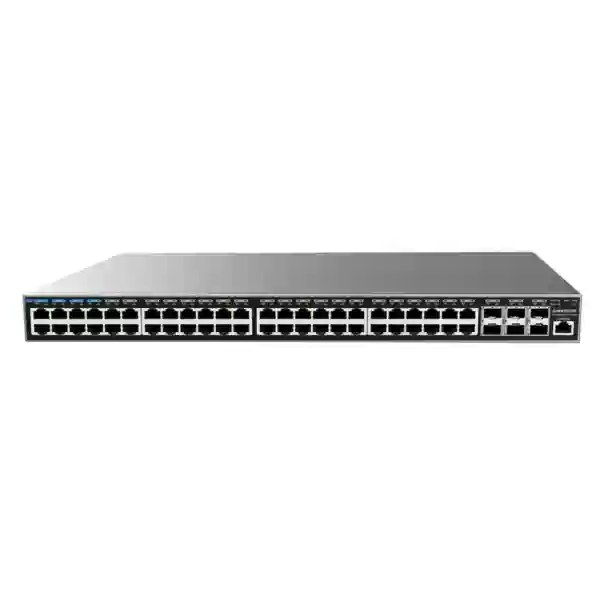
Grandstream GWN7816 Tanzania
The Grandstream GWN7816 is a 48-port enterprise Layer 3 managed network switch designed for medium-to-large organisations that need a scalable wired network with high-capacity uplinks, advanced VLAN control, routing, multicast handling, security functions and centralized administration. It is especially relevant for offices, campuses, schools, hospitality environments, data-heavy business sites and distributed organisations that want a clean path from access switching toward a more structured core or aggregation design.
For procurement teams in Tanzania, the key distinction is simple: the GWN7816 is the non-PoE model. It offers 48 Gigabit Ethernet access ports and six 10Gigabit SFP+ uplink ports, but it does not supply PoE to endpoints. Where a project needs to power IP phones, IP cameras or wireless access points directly from the switch, the separate GWN7816P should be evaluated instead. This difference should be confirmed early because it changes power planning, UPS sizing, endpoint design and total project cost.
Fast specification view
48 × Gigabit Ethernet ports for user, server, appliance and downstream-switch connectivity.
6 × 10Gigabit SFP+ ports for high-bandwidth fiber or compatible direct-attach uplinks.
216Gbps switching capability with 108Gbps total non-blocking throughput and 160.704Mpps forwarding rate.
Layer 3 routing with static and dynamic routing functions including RIP, RIPng, OSPF, OSPFv3 and BGP.
Flexible management through embedded web management, CLI, GDMS Networking, GWN Manager and supported GWN routing platforms.
What the GWN7816 solves
Businesses often outgrow small access switches long before they outgrow their applications. More users, more servers, more cameras, more wireless access points and more cloud traffic place increasing pressure on the switching layer. The Grandstream GWN7816 addresses that growth with a dense 48-port design, six high-speed SFP+ uplinks and Layer 3 capabilities that can move routing decisions closer to the LAN when the architecture calls for it. This can reduce reliance on a single upstream device for every inter-VLAN traffic flow and gives network teams a more flexible way to separate departments, services and security zones.
The switch is also useful when a company wants network policy rather than simple connectivity. Advanced VLAN functions help divide voice, data, surveillance, guest, server and management traffic. QoS can prioritize important traffic. Link aggregation can combine compatible links for additional bandwidth or resilience. Spanning-tree functions help manage Layer 2 loop risk. DHCP snooping, ARP inspection, IP source guard, port security and related controls can strengthen access-layer trust. These features do not replace a firewall, but they help create a more disciplined internal network.
Verified GWN7816 technical capabilities
Port density
Forty-eight 10/100/1000 Mbps RJ45 Ethernet ports provide a dense wired access layer for endpoints and downstream network segments.
10GbE uplinks
Six SFP+ ports provide 10Gbps-capable uplinks for fiber backbones, server connectivity, aggregation or inter-switch links, subject to transceiver and design compatibility.
Switching performance
The platform is specified for 216Gbps switching capacity, 108Gbps total non-blocking throughput and 160.704Mpps forwarding rate.
VLAN and Layer 2 control
The GWN7816 supports advanced VLAN functions, voice VLAN, link aggregation and multiple spanning-tree methods for segmented and resilient LAN design.
Layer 3 routing
Routing features include IPv4 and IPv6 support, static routing and dynamic protocols such as RIP, RIPng, OSPF, OSPFv3 and BGP.
Security controls
Controls include 802.1X and MAC authentication, RADIUS and TACACS+, DHCP snooping, ARP inspection, IP source guard, port isolation, storm control and DoS protection functions.
Management options
Administrators can use the switch web interface, CLI, GDMS Networking and GWN Manager, providing a choice between direct, cloud-oriented and on-premise management approaches.
Power-supply resilience
The GWN7816 ships with a 70W power supply and supports an additional separately purchased hot-swappable power supply for 1+1 redundancy and load sharing.
| Decision point | GWN7816 | GWN7816P |
|---|---|---|
| Gigabit Ethernet ports | 48 | 48 |
| 10Gigabit SFP+ ports | 6 | 6 |
| PoE output | No | Yes, 48 PoE ports with PoE/PoE+/PoE++ support by port capability |
| Switching capability | 216Gbps | 216Gbps |
| Best fit | Networks where endpoints have separate power or PoE is provided elsewhere | Networks that need to power phones, cameras, APs and other compatible endpoints directly from the switch |
Do not choose between these models only by purchase price. For a non-PoE environment, the GWN7816 can be the cleaner choice because it avoids paying for unused PoE capability. For a voice, surveillance or wireless deployment, however, a PoE-capable switch can simplify power distribution and centralize UPS protection. The correct option depends on endpoint quantity, endpoint power requirements, rack power, UPS design and how the network will expand.
Compatibility, deployment and buying guidance
The GWN7816 should be selected as part of a network architecture rather than as a stand-alone port-count decision. Start by documenting the number of wired devices, their locations, traffic patterns, VLAN requirements, uplink distances and any need for fiber between racks, floors or buildings. The six SFP+ interfaces are valuable when a site needs multiple 10Gbps uplinks, but the transceiver type, fiber type, distance and remote-side port capability must still be matched correctly.
For inter-VLAN routing, decide whether routing belongs on the switch, firewall or another Layer 3 device. Keeping every routed flow on the firewall can simplify security policy, while routing selected internal networks on the switch can improve local performance and reduce unnecessary north-south traffic. The design should reflect trust boundaries, inspection requirements and operational skills. Likewise, dynamic routing protocols are powerful but should only be enabled where the network design needs them and administrators understand the implications.
Rack planning also matters. The GWN7816 is a full-size enterprise switch with active cooling, so allow for rack depth, front-to-rear cable management, ventilation and reliable AC power. If power-supply redundancy is required, confirm the optional compatible hot-swappable PSU and feed arrangements. Network equipment should ideally be protected by an appropriately sized UPS, but UPS capacity must be calculated from the total rack load rather than from the switch alone.
Grandstream GWN7816 Tanzania
For organisations searching for the Grandstream GWN7816 in Tanzania, the most important procurement question is whether the switch matches the full LAN design. A 48-port managed switch can consolidate many access connections in one rack, but its real value appears when the site also needs structured VLANs, 10Gbps uplinks, Layer 3 routing, traffic prioritisation and stronger access-layer controls. Tanzanian businesses with multi-department offices, large schools, hospitality facilities, warehouses, government-style administrative environments, healthcare sites and growing enterprise campuses may find this class of switch useful where smaller 24-port models would require multiple units or provide fewer high-speed uplink options.
Before requesting a quotation in Tanzania, document the number of current and planned devices, the mix of copper and fiber connections, whether existing server or firewall interfaces support 10Gbps, and whether any connected phones, cameras or access points require PoE. The GWN7816 does not provide PoE output, so a design that expects one switch to power dozens of endpoints should instead evaluate the GWN7816P or another PoE switching design. This distinction also affects UPS sizing and rack power budgets because PoE loads can be significant when many endpoints are powered from the same chassis.
Tanzania projects can also vary widely in power quality, cooling, rack standards and fiber availability. A good deployment therefore includes rack ventilation, grounding, surge considerations, correct fiber transceivers, patch-panel organisation, port labeling and configuration backups. For branch networks, administrators should decide whether to manage the switch locally or use centralized tools such as GDMS Networking or GWN Manager. Centralized management can make firmware, monitoring and troubleshooting easier when several Grandstream network devices are deployed.
FourTeck Tanzania’s integrated business technology overview explains how switching, Wi-Fi, firewalls, IP telephony and security systems interact. That broader view is useful for GWN7816 buyers because the switch often becomes the common transport layer for several systems. A quotation should therefore reflect not just one switch but the dependencies that determine whether the finished network will be stable, supportable and ready for expansion.
Grandstream GWN7816 Dar es Salaam
Dar es Salaam organisations frequently operate in dense commercial environments where network growth arrives through additional staff, floor expansions, new cameras, VoIP rollouts, wireless upgrades, cloud applications and branch connectivity. The Grandstream GWN7816 can suit a larger office or building distribution point when the network needs forty-eight Gigabit access ports plus multiple 10Gbps SFP+ uplinks. The switch’s Layer 3 functions, VLAN features and security controls give administrators options for separating departments, guest networks, server traffic, surveillance and management interfaces while maintaining a single structured switching platform.
For a Dar es Salaam office, a useful design exercise is to map traffic by floor or business function. A large office may connect desktop users, printers, conference rooms, IP phones, cameras, Wi-Fi access points and server infrastructure. Some of those endpoints may require PoE, which the GWN7816 itself does not supply. If existing access switches already provide PoE, the GWN7816 can act as a higher-capacity aggregation or core layer. If the GWN7816 is expected to connect the powered endpoints directly, compare the GWN7816P instead and calculate the required PoE budget.
Fiber uplinks can be especially valuable between floors, server rooms or separate areas of a facility. The six 10Gbps SFP+ ports create room for higher-capacity connections, but transceiver type and fiber specification must be confirmed before ordering. Single-mode and multimode designs serve different distance and cabling scenarios, while direct-attach options have their own distance limitations. Buyers should also review the existing firewall and server interfaces so that a 10Gbps-capable switch is not unintentionally connected to a lower-speed bottleneck.
For Dar es Salaam procurement, the FourTeck Tanzania technology shop provides broader buying guidance for switches, firewalls, Wi-Fi, telephony and infrastructure. Use the GWN7816 quotation stage to confirm rack space, UPS capacity, fiber modules, patching, configuration scope, installation responsibilities and expected future port growth rather than comparing only the base switch price.
Grandstream GWN7816 Mwanza
Businesses in Mwanza may need a switching platform that can support a main office, warehouse, educational site, hospitality property or regional branch while still leaving room for growth. The Grandstream GWN7816 offers a dense 48-port form factor with Layer 3 management and six 10Gbps SFP+ ports, making it suitable for sites where the network is becoming too important for unmanaged switching or small isolated devices. VLANs can separate operational systems from staff traffic, QoS can prioritize time-sensitive applications, and Layer 3 features can support more structured routing where appropriate.
In Mwanza, procurement should consider how network equipment will be supported over time. A strong design includes clear interface descriptions, IP addressing plans, VLAN documentation, configuration backups and a defined firmware process. The GWN7816 can be managed directly through its local interface or CLI, while Grandstream management platforms can help centralize administration. Centralization is particularly valuable when the same organisation operates more than one branch or uses several Grandstream switches and networking devices.
Physical infrastructure deserves equal attention. A 48-port switch can attract a large number of patch leads, so rack layout and cable management should be planned before installation. Patch panels should be labeled logically, fiber jumpers protected from sharp bends and network equipment provided with adequate cooling. Where the site depends heavily on the LAN, UPS protection and power-supply redundancy can improve resilience. The optional additional hot-swappable PSU supported by the GWN7816 can be evaluated where continuous operation justifies the extra hardware and the rack power design supports redundant feeds.
When requesting a Mwanza quotation, specify whether the switch will function as access, distribution or core equipment. Also include expected copper-port usage, SFP+ uplink count, fiber distances, management method and whether any attached endpoints require PoE. This avoids a common error in which the non-PoE GWN7816 is ordered for a project that expects the switch to power phones, cameras or wireless access points.
Grandstream GWN7816 Arusha
The Grandstream GWN7816 can be a practical option for Arusha organisations that need a high-port-count managed switch for offices, hospitality operations, educational institutions, tourism-related businesses or multi-building environments. Its 48 Gigabit ports provide a consolidated wired access layer, while six 10Gbps SFP+ ports give network designers flexibility for faster inter-switch links, server connections or fiber backbones. The Layer 3 feature set supports routing and segmentation for networks that have moved beyond simple flat-LAN requirements.
Hospitality and guest-facing environments in particular benefit from clear segmentation. Staff systems, guest Wi-Fi, cameras, building systems, voice devices and management interfaces should not automatically share unrestricted Layer 2 access. VLAN design on the GWN7816 can help create logical separation, while upstream firewalls and access policies enforce security between zones. Multicast controls such as IGMP and MLD snooping can also be relevant where video, streaming or discovery-heavy applications generate multicast traffic.
For an Arusha deployment, network resilience should be planned at several levels. Link aggregation can combine compatible interfaces, spanning-tree features can help manage redundant Layer 2 paths, and the GWN7816 supports a separately purchased hot-swappable power supply for additional PSU resilience. None of these features replace a complete continuity design, so administrators should also consider redundant uplinks, firewall availability, UPS runtime, spare transceivers and configuration backups according to business importance.
Buyers should also distinguish between switching capacity and endpoint power. The GWN7816 handles data switching but does not deliver PoE. If a hotel, office or campus intends to connect many access points, cameras or IP phones directly to this switch, the GWN7816P or another PoE layer should be considered. A clear bill of materials should therefore include transceivers, patch leads, rack hardware, UPS requirements and management scope alongside the base switch.
Grandstream GWN7816 Dodoma
For Dodoma organisations planning larger administrative, institutional or enterprise networks, the Grandstream GWN7816 offers a structured alternative to chaining multiple small switches without clear routing or uplink design. Forty-eight Gigabit access ports can serve a substantial number of wired endpoints, while six SFP+ interfaces provide room for 10Gbps fiber or compatible high-speed connections. Layer 3 routing, VLAN support, QoS and security functions make the platform suitable for networks that require policy, segmentation and visibility in addition to raw port count.
A Dodoma project may benefit from separating business services by risk and operational role. User workstations, servers, voice, cameras, guest devices and network management can each occupy dedicated VLANs. The GWN7816 can participate in the routing architecture, but the design should determine which traffic needs firewall inspection and which routes may remain internal. This distinction is important because a Layer 3 switch can route efficiently, while a firewall provides deeper policy and security inspection. The two devices often complement each other rather than replace one another.
For public-facing or multi-department environments, authentication and access-layer security can also matter. The switch supports functions such as 802.1X, MAC authentication, RADIUS, TACACS+, DHCP snooping, ARP inspection and port security. These features should be implemented deliberately, with tested fallback procedures, because poorly planned access controls can disrupt legitimate users. Network administrators should document port purpose, VLAN membership, authentication policy and uplink dependencies before enforcement.
Procurement teams in Dodoma should ask for the exact model, confirm that GWN7816 means non-PoE, verify the required SFP+ modules and include installation or configuration services where internal skills are limited. FourTeck Tanzania’s technology services overview is relevant for organisations that want switching integrated with firewall, Wi-Fi, telephony, cabling and lifecycle support rather than treated as an isolated purchase.
Grandstream GWN7816 UAE
The Grandstream GWN7816 is relevant to UAE businesses that need dense Gigabit access switching with multiple 10Gbps uplinks and enterprise Layer 3 control. Offices, warehouses, hospitality environments, education, retail groups and multi-site businesses can use a 48-port switch to consolidate wired infrastructure while retaining VLAN, routing, QoS and security features. The six SFP+ ports are especially useful where access switches feed a faster aggregation layer or where server and storage traffic benefits from higher-capacity links.
In UAE projects, structured cabling and rack standards are often well established, so the key design task is matching switch capability to traffic and endpoint requirements. Determine whether the GWN7816 will sit at the access layer, act as an aggregation point or provide selected Layer 3 functions. If the switch connects users only, 1Gbps access may be appropriate. If it aggregates multiple downstream switches or high-traffic systems, the 10Gbps SFP+ ports should be allocated carefully to avoid oversubscription and provide resilience where needed.
The non-PoE nature of the GWN7816 must be considered early. Many modern UAE office projects use PoE for access points, cameras, desk phones and room devices. Where those endpoints connect directly to the same switch, compare the GWN7816P. If PoE access switches already exist downstream, the standard GWN7816 can still be a suitable distribution or aggregation component. The final choice should consider not only capital cost but also rack power, UPS load, heat, cabling simplicity and future expansion.
Regional buyers can also review FourTeck’s broader Middle East and Africa network resources when projects cross borders. The FourTeck Kenya and FourTeck Uganda sites illustrate the wider regional technology scope, which can be useful for businesses standardising switching, telephony, Wi-Fi and security across several countries.
Grandstream GWN7816 Uganda
Ugandan organisations considering the Grandstream GWN7816 are typically looking for more than a basic 48-port switch. The value of this model lies in combining port density with six 10Gbps SFP+ uplinks, advanced VLAN functions, Layer 3 routing, QoS, multicast controls and access-layer security. That combination can support a head office, campus, hotel, school, healthcare facility, warehouse or multi-service business network where data, voice, cameras, Wi-Fi and servers need clearer separation and higher-capacity backbone connections.
A Uganda deployment should start with a physical and logical network inventory. Count copper connections, identify devices that require PoE, map existing fiber paths and record firewall, server and uplink speeds. Because GWN7816 is non-PoE, powered endpoints need injectors, downstream PoE switches or a different switch model such as the GWN7816P. This matters particularly for surveillance and wireless projects where a large share of connected devices may rely on PoE and where central UPS-backed power is an operational benefit.
The GWN7816 can also support a more structured branch architecture. VLANs can separate users, guest traffic, cameras, phones and management. Static or dynamic routing can be used where the design requires Layer 3 functions at the switch. Security features such as DHCP snooping, ARP inspection, IP source guard, port security and authentication can strengthen control at the edge. These controls should be introduced with documented policies, testing and rollback procedures rather than enabled all at once without operational planning.
For Ugandan projects that also require local network, telephony, security or infrastructure context, the FourTeck Uganda technology site provides a regional reference point. When requesting a GWN7816 quotation, include the expected role of the switch, desired transceivers, rack details, power arrangement, management preference and whether configuration, migration or post-installation support is required.
Grandstream GWN7816 Kampala
Kampala businesses often need network infrastructure that can scale with office growth, additional branches, cloud applications, surveillance, VoIP and denser Wi-Fi. The Grandstream GWN7816 can serve as a capable 48-port Layer 3 managed switch where a simple unmanaged design no longer provides enough control. Its six 10Gbps SFP+ ports can be used for high-speed uplinks to other switches, server environments or fiber backbones, while VLAN and routing features support cleaner segmentation between business systems.
For a Kampala headquarters or multi-floor office, switch placement should follow the cabling topology. Copper Ethernet runs have distance limits, so it may be better to use access switches on separate floors and connect them back to the GWN7816 over fiber rather than pulling every endpoint to one distant rack. The six SFP+ interfaces give designers several options for this kind of topology, but fiber type, optics, remote switch capability and redundancy requirements must be verified before purchase.
Operational visibility is another reason to choose a managed platform. Administrators can monitor interfaces, configure VLANs, apply QoS, manage access controls and collect diagnostic information. Central management through Grandstream platforms can simplify repeated tasks where several compatible network devices are deployed. However, centralized management should still be paired with a documented configuration standard, role-based administrator access and backups so the environment remains supportable even during staff changes.
Kampala buyers should also review the power model. The GWN7816 itself does not provide PoE, so it is best where endpoints have independent power or PoE is supplied by downstream equipment. If the project includes many desk phones, cameras or Wi-Fi access points, comparing the GWN7816P may simplify deployment. A complete quotation should account for the switch, optics, fiber patching, rack hardware, UPS protection, configuration and any migration work required to move from an existing network without unnecessary downtime.
Grandstream GWN7816 Arua
For organisations in Arua, a 48-port enterprise switch can provide a more orderly foundation for a growing LAN than a collection of small unmanaged devices. The Grandstream GWN7816 combines forty-eight Gigabit Ethernet ports with six 10Gbps SFP+ uplinks and Layer 3 features, making it suitable for sites that need centralised wired connectivity, segmentation and room for a faster backbone. Schools, healthcare environments, administrative offices, hospitality properties and regional business facilities can benefit from a design that treats switching, routing and security as coordinated functions.
Arua deployments should put extra emphasis on maintainability. When technical support resources are not always on site, clear labeling, diagrams, configuration backups and standardized port assignments reduce troubleshooting time. Administrators can use the local web interface or CLI, while Grandstream management platforms can support centralized monitoring where internet connectivity and organisational policy allow. Remote management should be secured carefully and should never depend on weak default credentials or unnecessary exposure of management interfaces to the public internet.
Power and environmental planning should also be part of the purchase. The GWN7816 uses active cooling and should be installed in a suitable rack with ventilation and protected power. An appropriately sized UPS can help during short interruptions, while the optional secondary hot-swappable power supply can add device-level PSU redundancy where justified. The overall design should consider firewall, router, server and access-point power needs as well so that the UPS is sized for the entire critical network chain.
Finally, confirm endpoint power. GWN7816 is not a PoE switch. If Arua users plan to connect cameras, phones or access points directly and expect the switch to power them, the requirement points toward a PoE model such as GWN7816P or separate PoE access switches. Recording this distinction in the bill of materials prevents installation surprises and makes the quotation easier to compare against alternatives.
Grandstream GWN7816 Mbarara
Mbarara organisations expanding beyond entry-level networking can use the Grandstream GWN7816 as a higher-capacity managed switching platform for office, institutional, hospitality or industrial environments. The switch’s 48 Gigabit ports support dense wired connectivity, while six SFP+ uplinks provide a path to 10Gbps backbone connections. This is useful where traffic from many users, servers, cameras or access-layer switches needs to converge without forcing every uplink through 1Gbps interfaces.
Network segmentation is an important planning area. Rather than placing every device in one broadcast domain, a managed Layer 3 design can separate business users, guests, servers, surveillance, voice and management networks. The GWN7816 supports VLAN and routing features that can participate in this architecture. Security-sensitive traffic can still be directed through an upstream firewall when inspection and access policy are required. The decision should be made deliberately so administrators know which device owns each default gateway and where security controls are enforced.
For Mbarara sites with multiple buildings or long cable distances, fiber may be a better backbone medium than copper. The SFP+ interfaces make the GWN7816 suitable for this, but transceivers must be selected according to fiber type and distance. It is also worth planning spare capacity. Using all six uplink ports on day one may limit future flexibility, so the topology should leave room for expansion where possible.
The switch should also be selected according to endpoint power architecture. GWN7816 is a non-PoE model. A project dominated by wireless access points, IP cameras or phones may be better served by a PoE-capable access layer, while the GWN7816 functions as aggregation. Procurement teams should include rack size, UPS, optics, cabling, management, configuration and support scope in the quotation so the final comparison reflects the complete working solution rather than just hardware cost.
Grandstream GWN7816 Gulu
The Grandstream GWN7816 can support Gulu businesses and institutions that require a larger, centrally managed LAN with clear separation between different services. Forty-eight Gigabit access ports provide capacity for a substantial number of wired devices, and six 10Gbps SFP+ ports can connect distribution switches, servers or fiber backbones. The platform’s Layer 3 capability also enables routing functions when the design benefits from moving selected inter-VLAN traffic at the switch instead of sending all internal traffic to an upstream router or firewall.
For education, healthcare, hospitality or administrative sites in Gulu, network traffic may come from very different device types. Staff PCs, student or guest devices, cameras, phones, wireless access points, servers and building systems should be assessed separately. VLANs can reduce unnecessary mixing of these services, while QoS can prioritize selected traffic. Multicast controls may help in environments where discovery protocols or streaming traffic would otherwise spread too broadly across the LAN.
A managed switch also creates operational responsibilities. Someone must own firmware updates, configuration backups, administrator credentials, monitoring and documentation. Grandstream provides local and centralized management choices, but the organisation should decide who is authorised to make changes and how those changes are recorded. This governance is just as important as the feature list because unmanaged configuration drift can make a technically capable switch difficult to support.
For Gulu procurement, confirm that GWN7816 does not include PoE output. If the access layer must power endpoints, either use PoE-capable downstream switches or compare the GWN7816P. Also confirm optics, fiber distance, rack space, UPS requirements and whether an additional hot-swappable PSU is needed for redundancy. A well-scoped quotation should list these supporting items so decision-makers can compare complete deployment cost and not just the switch chassis.
Grandstream GWN7816 Kenya
Kenyan enterprises evaluating the Grandstream GWN7816 may be looking for a high-density managed switch that can sit between basic access switching and more complex enterprise campus platforms. With 48 Gigabit ports and six 10Gigabit SFP+ interfaces, the model can connect many wired endpoints while providing faster uplinks for aggregation, servers or fiber backbones. Its Layer 3 routing, VLAN, QoS, multicast and security features make it suitable for offices, schools, healthcare facilities, hotels, warehouses and multi-site organisations that need stronger network control.
In Kenya, buyers should first decide whether the GWN7816 is being used as an access switch or a distribution/core device. As an access switch, the absence of PoE is important because phones, cameras and access points may require a separate power solution. As a distribution switch, non-PoE can be entirely appropriate because the device may primarily connect other switches, firewalls and servers. The six SFP+ ports offer flexible 10Gbps links, but design teams should still calculate expected traffic and redundancy rather than assume every uplink needs to run at maximum speed.
For organisations with branches, centralized management can simplify monitoring and standardization. Grandstream’s management options allow administrators to work locally or use broader network-management platforms. The organisation should create a common template for VLAN IDs, management subnets, interface descriptions, logging and firmware so that each site follows the same operating model. This can be particularly useful when different branches are supported by different technicians.
The FourTeck Kenya solutions site provides additional regional context for organisations working across networking, telephony and security. A GWN7816 quotation should specify the exact model, required optics, fiber type, rack details, PSU redundancy needs, UPS design and configuration scope. This helps procurement teams compare proposals on equivalent assumptions and prevents accidental comparison between the non-PoE GWN7816 and the PoE-capable GWN7816P.
Grandstream GWN7816 Kuwait
Kuwait businesses can consider the Grandstream GWN7816 when they need a 48-port managed Layer 3 switch with several high-speed uplinks for office, hospitality, retail, education or multi-site network designs. Forty-eight Gigabit Ethernet ports provide dense wired access, while six 10Gbps SFP+ interfaces can serve high-capacity uplinks to aggregation switches, servers or fiber backbones. Advanced VLAN, QoS, routing and security functions give administrators more control than unmanaged or basic smart-switch platforms.
Thermal and rack planning are particularly important in equipment rooms. The GWN7816 uses active cooling and should be installed in a properly ventilated rack with organised cable management. Reliable power and UPS design are also important, especially where the switch carries business-critical traffic. The model supports a separately purchased hot-swappable power supply for additional PSU resilience, but the broader network remains dependent on upstream firewalls, routers, servers and internet circuits, so continuity planning should address the entire service chain.
For a Kuwait deployment, consider whether routing should occur on the GWN7816 or on an upstream security appliance. Internal routing on the switch may improve efficiency for trusted VLANs, while firewall routing can provide deeper inspection and policy between sensitive zones. A hybrid approach is often appropriate, but it requires clear documentation of gateways, routes and security boundaries. Dynamic routing protocols should only be enabled when the topology and operational team genuinely need them.
The non-PoE design is another key purchasing factor. If the network directly connects many access points, cameras, desk phones or room systems, the GWN7816P may be more appropriate. If PoE already exists on downstream access switches, the standard GWN7816 can function effectively at distribution or aggregation. Quotations should include transceivers, patching, rack accessories, UPS requirements, installation and configuration so total deployment cost is visible.
Grandstream GWN7816 Ghana
Ghanaian organisations looking for the Grandstream GWN7816 are generally planning a larger managed LAN where connectivity, segmentation and backbone capacity must be considered together. The switch provides 48 Gigabit copper ports and six 10Gbps SFP+ interfaces, giving businesses room to connect many endpoints while retaining faster uplink options for distribution, server rooms or fiber-connected areas. Its Layer 3 capabilities can support routing within a structured network, while VLANs and security controls help separate device groups and reduce unnecessary trust.
For offices, schools, hotels, healthcare sites and warehouses in Ghana, traffic may include standard business applications, voice, surveillance, Wi-Fi and cloud services. The switching design should estimate how much of that traffic crosses uplinks rather than focusing only on port count. A network with many cameras or large backups can consume substantial bandwidth even when individual user devices appear light. The six 10Gbps SFP+ ports provide capacity options, but the topology should be planned so critical links are not oversubscribed and redundancy is introduced where justified.
The GWN7816’s management choices can also be valuable for multi-site operations. Local administration supports direct control, while Grandstream platforms can help centralize device monitoring. Whichever method is chosen, the organisation should define naming standards, VLAN IDs, administrator roles, firmware policy and configuration-backup procedures. These operational details make future troubleshooting and expansion much easier.
A Ghana quotation should clearly note that GWN7816 is non-PoE. Where cameras, phones and access points require switch power, choose a PoE-capable access layer or compare the GWN7816P. Also specify required optics, fiber distances, rack depth, UPS expectations, PSU redundancy and configuration services. This produces a more realistic project price and reduces the risk of discovering missing accessories during installation.
Grandstream GWN7816 Nigeria
Nigeria’s large business environments can place significant demands on the switching layer, particularly when a site combines office users, surveillance, wireless access, VoIP, servers and multiple internet services. The Grandstream GWN7816 provides a 48-port Layer 3 platform with six 10Gbps SFP+ uplinks and enterprise-oriented controls for VLANs, routing, QoS, multicast and security. It can therefore suit organisations that need more than simple port expansion and want a network that can be segmented, monitored and scaled systematically.
For Nigerian head offices, campuses or multi-floor facilities, the 10Gbps uplinks can be used to interconnect access switches or attach high-traffic systems. Fiber is often appropriate between floors and buildings because of distance and electrical-isolation benefits, but optics must match the fiber plant. Network teams should confirm whether existing switches, servers and firewalls support 10Gbps so the GWN7816 is integrated into a balanced architecture rather than connected through avoidable lower-speed bottlenecks.
Power resilience is also a practical design consideration. The switch supports an optional additional hot-swappable PSU, and network racks should use appropriately sized UPS protection where continuity matters. However, resilience at the switch alone is insufficient if the firewall, router or upstream internet equipment remains on a single unprotected feed. A complete continuity plan should identify which network services must remain available and size power protection accordingly.
Procurement teams should verify that GWN7816 is the non-PoE model. If the design requires direct power for phones, cameras or access points, the GWN7816P is the closer variant to compare. A formal quotation should include optics, patching, rack hardware, UPS requirements, implementation services and management expectations. Those details help Nigerian buyers compare complete solutions rather than hardware-only figures that may conceal the cost of missing infrastructure.
Grandstream GWN7816 Seychelles
Seychelles businesses, hospitality properties and multi-building sites may require managed switching that is compact in administration but strong in segmentation and uplink capacity. The Grandstream GWN7816 provides 48 Gigabit Ethernet ports and six 10Gbps SFP+ interfaces, making it useful for hotels, resorts, offices, schools and service businesses that need to connect many wired systems while retaining faster backbone links. Layer 3 routing, VLANs, QoS and security functions support a structured architecture where guest, staff, operational, surveillance and management traffic can be kept logically separate.
In hospitality environments, segmentation is especially important because guest networks should not have unrestricted access to operational or management systems. A GWN7816 can participate in VLAN separation, while the firewall enforces policy between security zones and internet access. Wi-Fi access points and cameras may require PoE, however, and the standard GWN7816 does not provide it. Resorts or hotels that want to power endpoints from the same switch should evaluate the GWN7816P or use dedicated PoE access switches closer to the devices.
Fiber uplinks can help connect buildings or distant racks, but marine and coastal environments also make physical infrastructure quality important. Fiber termination, rack protection, power conditioning, cooling and cable routing should be designed for the actual site conditions. The switch’s six SFP+ ports provide flexibility, yet correct optics and fiber type remain essential. Keeping spare compatible optics and documented port maps can also reduce recovery time when support resources are not immediately available.
For Seychelles procurement, include site topology, building count, expected endpoint numbers, uplink distances and network-service separation in the request for quotation. Also identify whether centralized management is preferred and whether configuration support is needed. A detailed scope lets suppliers recommend the correct GWN7816 accessories and avoids a hardware-only purchase that does not account for optics, rack infrastructure, power protection or future growth.
Use cases for the GWN7816
Enterprise office core
Use the GWN7816 as a structured switching layer for departments, servers and uplinks where 48 copper ports and several 10Gbps connections are useful.
Campus distribution
Aggregate access switches from different floors or buildings over SFP+ links while applying VLAN and routing policy centrally.
Server and application network
Connect servers and infrastructure through a managed environment where link aggregation, QoS and Layer 3 functions can support defined traffic patterns.
Multi-service business LAN
Separate data, voice, guest, surveillance and management traffic with VLANs while preserving a common physical switching platform.
GWN7816 quotation checklist
1. Confirm exact model: Grandstream GWN7816, non-PoE, rather than GWN7816P.
2. Define switch role: access, distribution, aggregation or selected Layer 3 core functions.
3. Count endpoints: present copper ports plus realistic growth and spare capacity.
4. Define SFP+ needs: number of 10Gbps uplinks, fiber type, distance and compatible transceivers.
5. Plan VLANs and routing: user, server, voice, CCTV, guest, wireless and management networks.
6. Check power design: rack AC, UPS, grounding, cooling and whether the optional redundant PSU is required.
7. Define service scope: supply only, configuration, migration, installation, testing, documentation and post-deployment support.
Frequently asked questions
Does the Grandstream GWN7816 support PoE?
No. The GWN7816 is the non-PoE model. The separate GWN7816P provides PoE capability for compatible endpoints. Confirm the exact model in every quotation because the two switches share the same 48-port and six-SFP+ form factor but differ significantly in endpoint power capability.
How many 10Gbps ports does the GWN7816 have?
The switch provides six 10Gigabit SFP+ ports. These can be used for fiber uplinks or other compatible SFP+ connections. The chosen optics, fiber type and remote-side interface must match the required distance and network design.
Can the GWN7816 perform Layer 3 routing?
Yes. The platform supports Layer 3 functions including static routing and dynamic routing protocols such as RIP, RIPng, OSPF, OSPFv3 and BGP. Use only the routing features required by the design and document how the switch interacts with upstream firewalls and routers.
How can the GWN7816 be managed?
Management options include the local web user interface, CLI, GDMS Networking, GWN Manager and supported Grandstream routing platforms. The best method depends on the number of sites, administrator workflow, security policy and whether cloud or on-premise management is preferred.
Is the GWN7816 suitable for IP phones and cameras?
It can carry their network traffic, but it cannot supply PoE power. If phones or cameras receive power from another source or from downstream PoE switches, the GWN7816 can still be part of the design. If direct PoE from this chassis is required, compare GWN7816P.
What should I include when requesting a GWN7816 price in Tanzania?
Include quantity, switch role, required SFP+ optics, fiber distances, rack and UPS requirements, management preference, configuration scope and expected future growth. This allows the quotation to reflect a working deployment rather than only the base hardware.
Decision recap
Choose the Grandstream GWN7816 when you need a high-density 48-port non-PoE Layer 3 managed switch with six 10Gbps SFP+ uplinks, advanced VLAN functions, routing capability, strong access-layer controls and flexible local or centralized management. It fits best where endpoint power is already handled elsewhere or where the switch primarily serves aggregation, distribution or non-PoE wired devices.
Choose the GWN7816P instead when the same general switching profile is needed but the switch must also power compatible IP phones, cameras, wireless access points or other PoE devices. The correct model should be confirmed against endpoint count, PoE demand, rack power, UPS design and future expansion.
FourTeck can help build a quotation around the complete requirement: switch hardware, SFP+ optics, fiber or copper connectivity, rack infrastructure, UPS planning, VLAN and routing configuration, firewall integration, migration and documentation. This approach makes the purchase easier to compare and reduces the risk of missing small but essential deployment components.
Consultation panel
For the most useful GWN7816 recommendation, share the number of users and wired devices, whether the site uses IP phones, cameras or Wi-Fi access points, the current firewall and switch models, expected fiber distances, number of floors or buildings, internet speed, planned VLANs and whether you need central management. These details help determine whether the standard GWN7816 is the right fit or whether a PoE-capable or different-capacity model is more appropriate.
You can also review FourTeck Tanzania’s shop and services resources to understand related switching, firewall, Wi-Fi, telephony, cabling and infrastructure dependencies before finalising the bill of materials.



Reviews
There are no reviews yet.