
Grandstream GWN7832 Tanzania
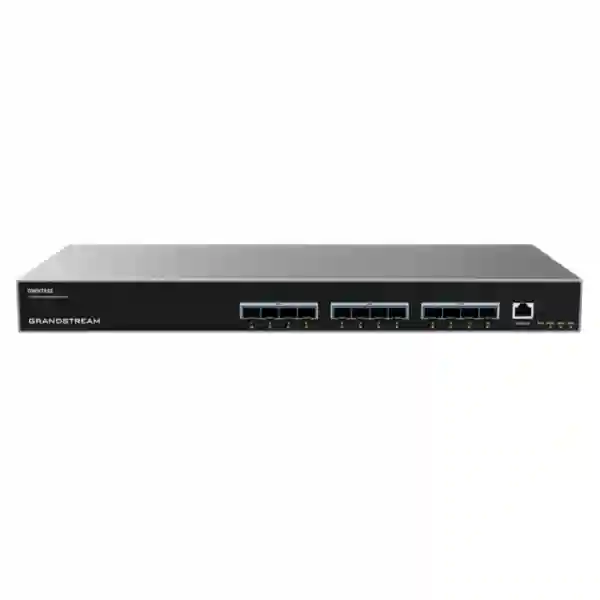
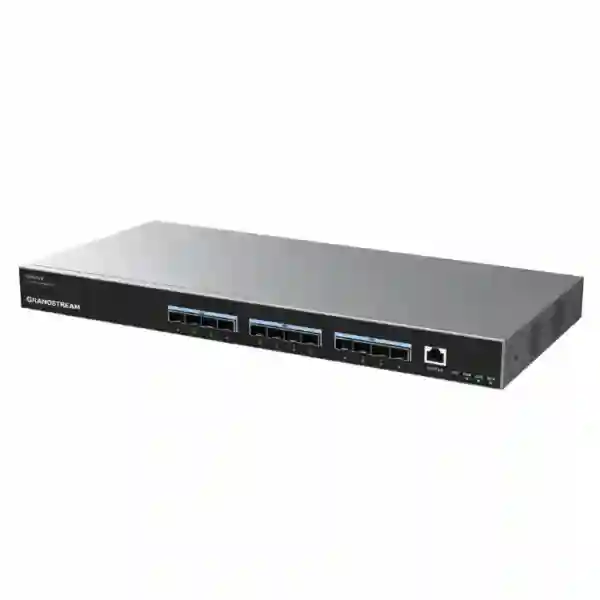
The Grandstream GWN7832 is a Layer 3 aggregation managed network switch built for medium-to-large organizations that need high-speed fiber aggregation, structured routing, traffic segmentation and centralized network administration. Its defining hardware characteristic is a bank of 12 SFP+ ports supporting 10Gbps connectivity, backed by a published switching capacity of 240Gbps. This makes the GWN7832 a strong fit for aggregation layers that collect traffic from access switches, servers, storage-connected segments or building uplinks where ordinary 1Gbps switching can become a bottleneck.
For organizations evaluating the GWN7832 in Tanzania, the important question is not only whether 12 high-speed ports are enough. A reliable design should also consider optical module type, fiber distance, topology, routing requirements, VLAN structure, redundancy, rack power, cooling and the capacity of the switches or servers connected on each side. Fourteck Tanzania can help translate those requirements into a practical bill of materials and deployment plan without assuming that every port needs the same transceiver or that every site requires identical routing features.
What is the Grandstream GWN7832?
The GWN7832 is the highest-capacity model in Grandstream’s GWN7830 family of aggregation switches. Grandstream positions this series for enterprise and medium-to-large business networks that require greater network capacity and control. The GWN7832 differs from conventional copper access switches because its front-panel data interfaces are 12 SFP+ slots rather than a large group of RJ45 access ports. In practical terms, it is designed to sit higher in the network hierarchy, where multiple uplinks, distribution switches, servers or other high-bandwidth devices can converge.
The platform supports advanced VLAN functions, Quality of Service, IGMP/MLD snooping and a broad set of security mechanisms. Routing capabilities include static routing and published support for dynamic routing protocols including RIP, RIPng, OSPF and OSPFv3, with Grandstream documentation also listing BGP in the current GWN7830 series feature set. Network administrators can manage the unit through its local web interface and command-line interface, while centralized options include GWN.Cloud and GWN Manager. This gives IT teams choices ranging from direct device administration to broader multi-device management.
A GWN7832 purchase should be planned together with transceivers and cabling. Grandstream’s datasheet lists support for single-mode and multimode 10GbE optical modules, along with a limited number of RJ45 10GbE modules, and notes that supported direct-attach cables should be no longer than 5 metres. The correct module depends on the connected equipment, fiber type, distance and link design. Fourteck therefore recommends confirming those details before finalizing a quotation.
Verified GWN7832 technical highlights
| Specification | GWN7832 |
|---|---|
| Data ports | 12 x 10Gbps SFP+ ports |
| Switching capability | 240Gbps |
| Total non-blocking throughput | 120Gbps |
| Packet buffer | 16MB |
| MAC addresses | Up to 32K static, dynamic and filtering MAC addresses |
| VLAN | Up to 4K VLANs with 802.1Q and advanced VLAN functions |
| Routing | Static and dynamic routing including RIP/RIPng and OSPF/OSPFv3; current series documentation also lists BGP |
| Security | 802.1X, RADIUS/TACACS+, port security, sticky MAC, IP source guard, DoS prevention, ARP inspection and DHCP snooping |
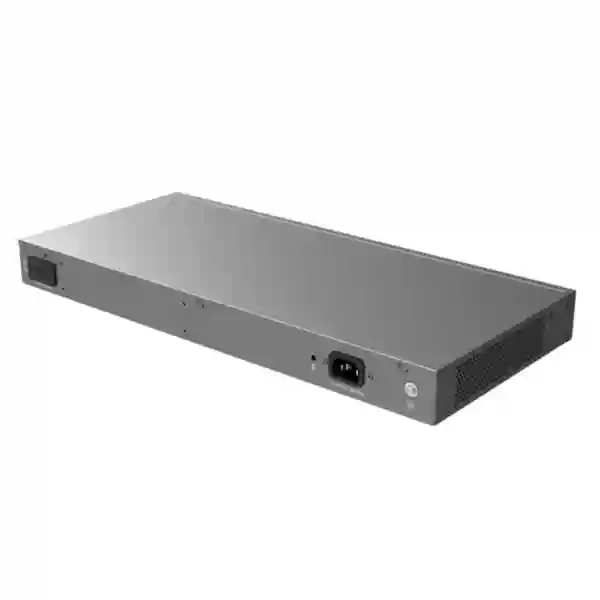
| Power | 60W integrated power supply; optional 12V/60W external redundant power supply support |
| Cooling | 2 fans |
| Management | Local web UI, CLI, GWN.Cloud and GWN Manager |
Why choose an aggregation switch with 12 SFP+ ports?
Aggregation switches solve a different problem from edge switches. An access switch connects endpoint devices; an aggregation switch concentrates the traffic coming from those access layers and provides higher-speed paths toward servers, firewalls, routers or other network segments. The GWN7832’s twelve 10Gbps-capable SFP+ interfaces create room for multiple high-capacity links without requiring a chassis system. A business can use those interfaces for building-to-building fiber, rack-to-rack connections, aggregated switch uplinks or direct high-speed interfaces where the connected equipment supports the required transceiver and protocol.
The value of 10GbE becomes clearer when many 1GbE endpoint connections converge on the same uplink. A floor switch may serve dozens of users, phones, access points or cameras. If several access switches feed a single core at only 1Gbps, peak utilization can constrain applications even though the local edge ports are functioning correctly. Moving aggregation links to 10Gbps provides more headroom, but the topology should still be sized around actual traffic, redundancy goals and oversubscription. Link aggregation can add capacity and resilience when both ends support a compatible configuration.
Fiber also offers distance and electrical-isolation advantages for links between racks, floors and buildings. Single-mode and multimode choices should not be mixed casually; transceiver wavelength, fiber type and connector path need to match. The GWN7832 therefore works best as part of an engineered network rather than as an isolated purchase.
VLAN and segmentation
Advanced VLAN functions allow administrators to separate departments, voice, cameras, wireless guest traffic, management networks and server zones. Segmentation can reduce unnecessary broadcast domains and creates clearer policy boundaries when paired with appropriate routing and firewall controls.
Layer 3 routing
Layer 3 functionality lets the aggregation layer participate in IP routing instead of forwarding every inter-VLAN flow to an external router. Whether routing should occur on the switch, a firewall or another core device depends on the security architecture and inspection requirements.
Traffic prioritization
Grandstream includes Quality of Service tools such as port priority, priority mapping, queue scheduling, traffic shaping and rate limiting. These capabilities can help preserve predictable treatment for voice, collaboration or other priority applications when configured as part of an end-to-end QoS plan.
Security controls
Features such as DHCP snooping, ARP inspection, source guard, 802.1X, storm control and port security give administrators tools to reduce common LAN risks. These controls are most effective when deployment policies, identity sources and network documentation are maintained consistently.
GWN7832 deployment and transceiver planning
The GWN7832 uses SFP+ interfaces, so the switch should be quoted together with the correct modules or DAC cables unless compatible optics are already available. Grandstream lists a maximum of 12 supported single-mode 10G or 12 multimode 10G modules, and up to six supported RJ45 10G modules. The vendor also notes that RJ45 modules should be inserted with spacing requirements and that DAC support is limited to cables of 5 metres or less. Those details matter when a design mixes copper and optical uplinks.
Before deployment, document each planned port, its peer device, interface speed, media type, fiber distance, VLAN role and redundancy relationship. This avoids purchasing optics that do not match the installed cable plant. For rack deployment, the quick installation guide specifies installation in a standard 19-inch rack and recommends sufficient space for heat dissipation. Airflow should not be arranged so that the switch intake directly faces the exhaust of another device.
Power design is equally important for a core or aggregation device. The GWN7832 has an internal power supply and supports Grandstream’s RPS-60W-B external redundant power supply, sold separately. Redundant power can reduce exposure to a single power-supply failure, while the rack itself should still be protected by appropriately sized UPS and power-distribution equipment where business continuity requires it.
Fourteck Tanzania network planning resources
For a wider view of switching, routing, Wi-Fi, firewall and infrastructure planning, visit the Fourteck Tanzania business technology overview. It explains how network switches fit alongside firewalls, access points, servers, IP telephony and structured infrastructure.
Customers building a bill of materials can review the Fourteck Tanzania technology shop for related equipment categories and product procurement options. For projects that require installation, configuration or wider systems work, the Fourteck Tanzania services page provides context on integration and support activities.
Organizations assessing supplier capability can also read About Fourteck Tanzania. For this GWN7832 specifically, the most useful quotation request includes intended link count, 10GbE media type, fiber distances, connected switch models, routing requirements, redundancy expectations and whether an external RPS is required.
Grandstream GWN7832 Tanzania
For enterprises in Tanzania, the GWN7832 is best evaluated as a high-speed aggregation platform rather than a general desktop access switch. Its twelve 10Gbps SFP+ ports are suited to designs where traffic from multiple access switches, floors, server racks or building links needs to converge without forcing every uplink through a 1Gbps bottleneck. Organizations modernizing an older LAN can use this architecture to create a clearer separation between access, aggregation and security layers. That structure becomes particularly valuable when Wi-Fi, surveillance video, IP telephony, business applications and server traffic share the same physical infrastructure but require different VLANs, priorities and security boundaries.
Procurement in Tanzania should start with a topology. Count the uplinks that genuinely need 10Gbps, identify which links are single-mode or multimode fiber, record link distances and check the interface capabilities of each peer device. A GWN7832 with twelve empty SFP+ slots is only one part of the solution: optical modules, patch leads, fiber termination, rack power and upstream connectivity determine whether those ports can actually be used. For an existing campus or multi-floor office, documenting the installed fiber before ordering can prevent avoidable transceiver mismatches.
Tanzanian businesses that expect growth should also decide whether the aggregation layer will perform inter-VLAN routing or whether sensitive traffic will continue through a firewall. The switch supports Layer 3 routing, but security policy may require inspection between selected networks. A practical design can route trusted internal segments efficiently while directing higher-risk or regulated flows through the appropriate security control. The available QoS, multicast and access-control features can then be aligned with applications rather than enabled without a clear purpose.
When requesting a quotation, specify the number of sites, racks, access switches and 10GbE links; desired redundancy; current fiber types; management preference; and whether the RPS-60W-B is required. Fourteck Tanzania can use those details to prepare a more accurate equipment and deployment scope instead of treating the GWN7832 as a one-line hardware purchase.
Grandstream GWN7832 Dar es Salaam
Businesses in Dar es Salaam often operate from office towers, commercial compounds, warehouses, hospitality properties or multi-building sites where network traffic can converge quickly at the central rack. In such environments, the GWN7832 can serve as an aggregation point for high-speed fiber links from access switches located on different floors or in remote communications rooms. Using 10GbE uplinks does not automatically improve every application, but it can remove a common bottleneck when many 1GbE endpoints share the same upstream path.
A Dar es Salaam deployment should pay close attention to physical infrastructure. Before selecting optics, verify the fiber route and termination between equipment rooms. Multimode fiber may be appropriate for shorter internal runs where the installed plant supports the required standard, while single-mode optics can suit longer links. The transceiver type at each end must match. Where existing copper is the only available medium, the GWN7832 can support a limited number of compatible 10G RJ45 modules, but thermal and module-spacing considerations make fiber preferable for many aggregation scenarios.
Operational resilience is another useful planning point. A central aggregation switch carries traffic for many downstream users, so failure has a wider impact than failure of one edge port. The GWN7832 supports an optional external redundant power supply, but continuity planning should also include UPS runtime, rack cooling, patching discipline, configuration backups and documented recovery procedures. If two paths exist between major network blocks, spanning-tree, link aggregation or routed redundancy should be configured deliberately to prevent loops and unclear failover behavior.
For quotations in Dar es Salaam, organizations should provide floor count, access-switch inventory, available fiber cores, expected 10GbE link count, VLAN list, server and firewall interfaces, and anticipated growth. Fourteck can then help determine whether the GWN7832 is an appropriate aggregation switch and identify the optics, cabling and related network components required for a complete deployment.
Grandstream GWN7832 Mwanza
Organizations in Mwanza considering the Grandstream GWN7832 may be planning a larger office, education site, healthcare facility, hospitality property, distribution operation or other network where several access layers need to feed a central core. The switch’s twelve SFP+ ports allow high-speed fiber aggregation without consuming a large number of copper access interfaces. That is useful when the network design already places user connectivity at the edge and needs a more capable device at the center for uplinks and Layer 3 control.
For Mwanza projects, capacity planning should include more than user count. Video surveillance can create sustained upstream traffic, Wi-Fi systems can aggregate many mobile clients behind a small number of access-point uplinks, and local servers or backup jobs can produce bursts that are very different from ordinary web traffic. If several such workloads share the same central links, moving the aggregation layer to 10GbE can provide useful headroom. QoS can prioritize selected traffic, but it should not be used as a substitute for insufficient bandwidth.
Fiber design is central to the purchase. Record the current cable type and connector path before choosing SFP+ modules. A long-distance single-mode link requires different optics from a short multimode run. The connected switch or server must support compatible speed and optics. It is also sensible to keep a port map that identifies each building, floor or subsystem so maintenance teams can isolate problems without tracing unlabeled fibers during an outage.
The GWN7832 also supports centralized management through GWN.Cloud and GWN Manager, as well as local web and CLI administration. A Mwanza organization with multiple Grandstream networking devices may value the ability to monitor and manage equipment through a consistent platform. Before selecting a management approach, define who owns configuration changes, how backups will be maintained and how administrator access will be secured. A quotation request that includes those operational requirements will produce a more useful deployment scope than hardware quantity alone.
Grandstream GWN7832 Arusha
The GWN7832 can suit Arusha businesses that need an aggregation layer for a campus, hospitality environment, corporate office or multi-building network. Twelve 10Gbps SFP+ ports offer a practical way to collect high-bandwidth fiber links into one managed switch while preserving room for redundant uplinks or server connectivity. The switch is not designed primarily to connect desk users directly; its value is highest when edge switches already handle endpoint access and the core needs greater throughput, routing and policy control.
Hospitality and guest environments, for example, can generate several distinct traffic classes: staff systems, guest Wi-Fi, IP phones, cameras, building systems and management interfaces. Advanced VLAN capabilities on the GWN7832 can keep these services logically separated even when they use common fiber infrastructure. Layer 3 routing can then provide efficient connectivity between approved segments, while traffic that requires deeper policy enforcement can be directed through a firewall. The correct boundary should be decided during design rather than after the network is already live.
Arusha sites with separate buildings should verify whether the inter-building fiber is single-mode or multimode, how many cores are available and what distances are involved. Optical links also require consideration of patch panels, cleanliness, connector condition and transceiver compatibility. If the existing fiber was installed for 1GbE, testing or documentation may be needed before assuming it will support the intended 10GbE service over the required distance.
When preparing a GWN7832 request, include the number of buildings or racks, desired topology, current access-switch models, planned uplink speeds, VLAN requirements and any high-availability goals. If voice or video applications are business critical, identify them so QoS design can be planned end to end. Fourteck can then assist with a configuration-oriented quotation that considers optics, fiber paths, redundant power and related network components instead of supplying the aggregation switch in isolation.
Grandstream GWN7832 Dodoma
In Dodoma, the Grandstream GWN7832 can be considered for organizations that are consolidating network traffic from several departments, floors or buildings into a central communications room. Its 12 SFP+ interfaces provide high-speed connectivity for fiber-based aggregation, while Layer 3 functions allow the switch to participate directly in routing where the architecture requires it. This can be valuable for administrative campuses, education environments, commercial offices and other installations where growth has pushed the network beyond a simple flat LAN.
A structured migration is preferable to replacing a core switch without examining the surrounding network. Start by documenting VLANs, IP subnets, trunk links, spanning-tree roles, default gateways and existing routing dependencies. Identify which interfaces are carrying critical services and whether any legacy devices depend on unusual VLAN tagging or static routes. The GWN7832 provides extensive switching and routing features, but the migration plan should preserve required behavior while removing obsolete configurations rather than copying every old setting blindly.
Power and environmental planning also deserve attention. The GWN7832 uses two fans and should be installed with adequate ventilation. A rack that already contains servers, firewalls, UPS units and other switches needs sufficient airflow and power distribution. Where continuity matters, the optional redundant power supply can reduce one class of failure, while a properly sized UPS and documented restart sequence can address broader power events.
For a Dodoma quotation, provide the current network diagram if available, the number and type of fiber links, desired routing approach, anticipated 10GbE peers and any required authentication systems such as RADIUS or TACACS+. Security controls such as DHCP snooping, ARP inspection and source guard should be aligned with the addressing model and access policies. Fourteck can help turn those details into a deployment scope that is easier to test and support after commissioning.
Grandstream GWN7832 UAE
For UAE businesses, the GWN7832 offers a compact 10GbE aggregation option for offices, hospitality properties, campuses, warehouses and server-room environments that need multiple SFP+ links. Its twelve high-speed interfaces can connect distribution switches, servers or other network devices when the peer equipment and transceiver selection are compatible. Organizations with several floors or buildings can use fiber uplinks to centralize traffic while preserving logical separation through VLANs and routing.
The procurement process should distinguish between device capability and project requirement. A 240Gbps switching capability is meaningful only when uplinks and workloads are designed to take advantage of it. Identify application traffic, expected peak utilization, redundancy expectations and the number of simultaneous high-speed links. For a server-heavy environment, check network-interface speed and bonding capabilities. For access-switch aggregation, verify each downstream switch’s SFP/SFP+ options and whether link aggregation will be used.
UAE organizations may also benefit from standardized management across multiple Grandstream network devices. The GWN7832 supports local administration, CLI, GWN.Cloud and GWN Manager. Selecting one operational model and controlling administrator permissions helps keep configuration consistent across sites. Where identity-based access is required, published support for 802.1X, RADIUS and TACACS+ can fit into a broader access-control architecture when the authentication infrastructure is properly designed.
Customers coordinating UAE and Tanzania requirements can review Fourteck UAE technology solutions for regional project context. For GWN7832 quotations, list required optics, fiber type, link distances, rack environment and power redundancy. Avoid assuming that modules are interchangeable between all vendors and distances; matching the transceiver to both the switch and optical path is an essential part of a stable 10GbE deployment.
Grandstream GWN7832 Uganda
Organizations in Uganda can consider the GWN7832 where an existing network has outgrown 1Gbps aggregation or where a new site is being designed with fiber uplinks from the start. The switch provides twelve SFP+ ports for 10Gbps links and Layer 3 functions for more structured control of internal traffic. This can support multi-floor offices, institutional networks, hospitality environments and other sites where several managed edge switches need a common high-capacity aggregation point.
A useful design exercise is to map every downstream switch to its expected traffic source. A switch serving surveillance cameras may produce steady upstream traffic, while an office access switch may be burstier. A Wi-Fi access layer may carry a large number of clients behind fewer physical interfaces. Understanding these patterns helps determine whether each uplink needs 10GbE, whether some links can share an aggregation group and where redundant paths are justified. The GWN7832 provides tools for QoS and multicast optimization, but topology and capacity should be solved first.
For Uganda deployments, fiber condition and documentation can make or break the project. Confirm cable type, available strands, patch-panel routing, connector condition and actual distance. Where network diagrams do not exist, creating a basic port and fiber schedule before deployment is worthwhile. The GWN7832’s centralized management options can then provide better visibility into the active configuration, but physical documentation remains essential during outages.
For broader regional networking assistance, customers can review Fourteck Uganda IT and networking solutions. A quotation request should state the number of aggregation links, required optics, connected device models, VLANs, routing protocols and power-resilience requirements. This information helps distinguish a straightforward hardware supply from a project that also needs migration planning, configuration, testing and documentation.
Grandstream GWN7832 Kampala
Kampala businesses building higher-capacity LANs can use the GWN7832 as a central aggregation switch between access-layer equipment and core services. Twelve 10Gbps SFP+ ports provide flexibility for multiple floor switches, server uplinks, firewall-connected segments or redundant paths. The architecture is particularly relevant when an organization has accumulated several standalone switches and wants a more deliberate hierarchy that is easier to monitor, document and expand.
The first step is to decide what the GWN7832 should do. If its primary role is Layer 2 aggregation, VLAN trunks, spanning tree and link aggregation will dominate the configuration. If it will also provide Layer 3 gateway functions, routing tables, dynamic routing protocols, ACLs and inter-VLAN policy need to be planned. Some networks benefit from routing at the aggregation layer for performance, while others deliberately route through a firewall for inspection. There is no single correct choice independent of the organization’s security and application requirements.
Kampala sites that rely on multiple internet, voice or cloud services should also consider operational visibility. The GWN7832 supports monitoring and management through local and centralized interfaces. Administrators should define configuration ownership, backup routines, alert handling and change-control procedures. A powerful switch can still become difficult to support if undocumented changes accumulate over time.
For procurement, include a link schedule showing each SFP+ port’s destination and intended media. This helps identify how many single-mode, multimode, DAC or supported copper modules are actually required. Also specify rack size, available UPS capacity and whether the optional redundant power supply is needed. A complete quote can then account for the real infrastructure around the switch rather than leaving transceivers and power resilience as last-minute additions.
Grandstream GWN7832 Arua
For organizations in Arua, the GWN7832 can provide a high-speed aggregation layer when a network spans several communications rooms, buildings or groups of access switches. The product is most relevant where fiber is available or planned and where multiple traffic sources need more upstream capacity than conventional 1GbE links provide. With 12 SFP+ ports, the switch can accommodate a mix of high-speed uplinks and redundancy while retaining Layer 3 control for structured routing.
Remote or distributed-site deployments benefit from careful support planning. If an aggregation switch carries most of a site’s traffic, troubleshooting information should be available even when the original installer is not on site. Maintain a current port map, VLAN list, IP addressing plan, administrator-access procedure and configuration backup. Use clear names for interfaces and connected switches. Centralized management through GWN.Cloud or GWN Manager can help with visibility, but it works best when the physical network is also documented.
Arua buyers should avoid ordering optics based only on connector appearance. The fiber type, wavelength, distance and peer transceiver must be compatible. If the link travels between buildings, confirm the actual optical path and any patch-panel transitions. Where DAC cables are used inside a rack or between adjacent equipment, Grandstream specifies support for compatible DAC lengths up to 5 metres. For longer runs, the appropriate fiber solution is normally the cleaner approach.
Power continuity should also be considered in proportion to the switch’s role. The GWN7832 supports an optional external redundant power supply, but redundancy at the device does not replace UPS planning for the overall rack. Include network importance, expected outage tolerance and recovery process in the project brief. Fourteck can use that information to help shape a quotation around reliable operation rather than simply supplying the switch chassis.
Grandstream GWN7832 Mbarara
Mbarara organizations planning an office, campus, hospitality site or institutional network can consider the GWN7832 where several access switches or high-bandwidth segments need to converge. The unit’s twelve 10Gbps SFP+ ports make it suitable for a compact aggregation layer, while Layer 3 functions provide options for routing between internal networks. This combination can reduce dependence on multiple small intermediate switches and create a clearer central point for network policy and monitoring.
Traffic design should reflect actual applications. For example, CCTV recording traffic may flow continuously from access switches toward an NVR or server, while user traffic may be dominated by cloud applications and file transfers. Voice is sensitive to latency and loss even though it uses relatively little bandwidth. Wi-Fi can introduce large bursts from many clients. The GWN7832’s QoS and multicast features are useful tools, but good results still depend on placing gateways, servers and uplinks in a topology that avoids unnecessary hairpin traffic.
Security controls can also be applied at the switch layer. DHCP snooping and ARP inspection can help protect local segments when configured correctly, while 802.1X and AAA integration can support stronger administrative or endpoint-access policies. These features should be tested before full rollout because security mechanisms that do not match the addressing or authentication design can interrupt legitimate users.
For a Mbarara quotation, list the access switches, fiber routes, transceiver types, VLANs and any services that need priority handling. If the network will be migrated from an existing core, include the current gateway IPs and routing behavior. Also identify whether installation, configuration or documentation is required in addition to hardware. This creates a clear project boundary and allows the GWN7832 to be evaluated as part of an operating network rather than as an isolated line item.
Grandstream GWN7832 Gulu
In Gulu, the GWN7832 is relevant to organizations that require a high-speed fiber aggregation point for multiple LAN segments. Its 12 SFP+ ports can connect compatible distribution or access switches at 10Gbps and can also provide high-speed server or security-appliance links where supported. The product is particularly useful when an organization wants to move from a flat or daisy-chained switching layout to a more predictable star or hierarchical architecture.
A hierarchical design simplifies troubleshooting because each access block has a known upstream path. It can also make capacity planning easier: administrators can measure the load on each uplink and expand specific areas without replacing the entire network. The GWN7832’s 240Gbps switching capability provides substantial internal capacity, while the actual end-to-end performance will still depend on connected devices, optics, fiber, protocol configuration and application behavior.
For Gulu sites, consider resilience at both the logical and physical level. Dual uplinks between network blocks can provide alternative paths, but they must be controlled with spanning tree, link aggregation or routing to prevent loops. Redundant power is available through the optional RPS-60W-B, but the rack also needs suitable UPS protection, cooling and cable management. If fiber links are critical, spare transceivers and documented fiber assignments can reduce recovery time after a module failure.
A useful procurement brief includes the desired topology diagram, port count, distances, fiber mode, connected switch models, VLAN requirements, management method and service-critical applications. The GWN7832 can then be specified with the correct accessories and configuration scope. Planning these details before supply is usually more efficient than discovering after installation that the optical modules, patch leads or routing assumptions do not match the real site.
Grandstream GWN7832 Kenya
Kenyan enterprises evaluating the Grandstream GWN7832 can position it as a Layer 3 aggregation switch for networks that require multiple 10GbE fiber connections in a compact form factor. Its twelve SFP+ ports suit deployments where access or distribution switches, servers and security appliances need high-speed interconnection. The ability to use VLANs, routing, QoS and multicast controls means the device can participate actively in network architecture rather than acting as a simple unmanaged concentrator.
For multi-branch organizations, standardization can be as important as raw capacity. Using a consistent switching platform can simplify configuration templates, administrator training and spare-part planning. However, each branch should still be sized independently. A headquarters or data-rich site may justify the GWN7832, while a smaller branch could need fewer 10GbE ports. Model selection should be based on uplink demand and topology rather than standardizing on the largest model everywhere.
Kenya deployments should also consider integration with existing network-management processes. The switch supports GWN.Cloud, GWN Manager, local web administration and CLI. Teams that already use SNMP, syslog or centralized monitoring can incorporate the GWN7832 into broader operational visibility. Configuration backup, role-based administration and AAA services should be aligned with the organization’s change-control practices.
Customers managing projects across East Africa can review Fourteck Kenya IT and networking solutions alongside the Tanzania offering. For an accurate GWN7832 quote, specify the optical link count, fiber type and distance, peer equipment, redundancy design and whether the 60W external RPS accessory is required. Including transceiver and patching requirements at the quotation stage helps avoid a common procurement gap where the switch arrives before the media needed to connect it.
Grandstream GWN7832 Kuwait
The Grandstream GWN7832 can suit Kuwait organizations that need a high-capacity aggregation layer between access networks and central services. Twelve 10Gbps SFP+ interfaces provide room for multiple fiber uplinks, while the 240Gbps switching capability supports substantial internal traffic movement. Typical use cases can include multi-floor offices, hospitality properties, education environments, warehouses and server-room networks where endpoint traffic converges through several access switches.
Because Kuwait deployments often place dense equipment in dedicated racks, thermal and power design should be considered early. The GWN7832 uses active cooling with two fans and should have adequate airflow. Rack layout should avoid placing exhaust from adjacent equipment directly into its air intake. Critical installations can add the supported external redundant power supply, while the complete rack should still be connected to appropriately sized power protection based on required runtime and load.
Optical planning remains one of the most important purchasing tasks. Twelve SFP+ slots do not mean every link should use the same module. Select single-mode or multimode optics according to the installed fiber and distance; use compatible DAC only for short supported connections; and check peer interfaces before ordering. If 10GBASE-T modules are needed, follow Grandstream’s stated module limits and spacing guidance. Recording the intended module for each port in the bill of materials reduces commissioning delays.
For regional procurement and project coordination, see Fourteck Kuwait IT solutions. A complete GWN7832 requirement should also identify VLANs, routing expectations, authentication integration, network monitoring and migration needs. That information helps determine whether the scope is straightforward supply or a wider project involving staging, configuration, installation, testing and documentation.
Grandstream GWN7832 Ghana
Businesses in Ghana can consider the GWN7832 when they need to aggregate several high-speed network paths into a single managed Layer 3 platform. Twelve SFP+ ports create a useful concentration point for fiber uplinks from access switches or high-speed links to servers and other infrastructure. The switch’s advanced VLAN, routing, QoS, multicast and security capabilities support more structured enterprise designs than a basic Layer 2 access device.
A Ghana deployment should begin with a requirement map showing where traffic originates and where it must go. If a surveillance network sends most traffic to an NVR in the same server room, the shortest path may differ from ordinary user internet traffic. If different departments require segmentation, gateway placement and security inspection should be decided before VLANs are created. If branches use dynamic routing, the selected routing protocol and route summarization strategy should be documented so the aggregation switch fits cleanly into the wider WAN or campus architecture.
The GWN7832’s management options can simplify administration when used consistently. GWN.Cloud supports cloud-based management, while GWN Manager supports on-premise management, and the switch can also be configured locally. Whichever method is selected, organizations should use controlled administrator accounts, preserve configuration backups and maintain a change record for critical modifications. Security features such as AAA, 802.1X and DHCP snooping should be integrated with existing identity and IP-addressing systems rather than enabled in isolation.
For wider technology planning in Ghana, review Fourteck Ghana business IT solutions. For the GWN7832 specifically, include transceiver quantities, fiber specifications, connected equipment, power redundancy and installation expectations in the request. This helps ensure that the quotation reflects an operational system, not just the switch chassis.
Grandstream GWN7832 Nigeria
Nigerian organizations with larger office, campus, hospitality, education or distributed enterprise networks can use the Grandstream GWN7832 as a high-speed aggregation switch. Twelve SFP+ ports are useful when multiple access networks need 10GbE uplinks or when high-bandwidth servers and network appliances must connect through a common Layer 3 switching platform. The switch supports both IPv4 and IPv6, allowing organizations to retain existing IPv4 designs while preparing for dual-stack or future IPv6 requirements.
Power resilience deserves particular attention because an aggregation switch is a shared dependency for many users. The GWN7832 supports a separate external redundant power supply, but a sound design should consider the full power chain: utility input, UPS, power distribution, grounding, rack cooling and restart behavior. Configuration backups should be stored outside the device so replacement hardware can be restored more quickly after a failure.
Network security can be improved by combining VLAN segmentation with the switch’s access controls. DHCP snooping can help establish trusted DHCP paths, ARP inspection can reduce certain local spoofing risks, and source guard can restrict unexpected address use when properly configured. These features require accurate port roles and addressing information. In complex networks, a staged rollout is safer than enabling several controls simultaneously across all production VLANs.
For regional solution context, visit Fourteck Nigeria IT services and solutions. A useful GWN7832 quotation request should include network diagrams, required SFP+ links, optical distances, fiber type, connected device models, VLAN and routing requirements, management preference and desired redundancy. Those details make it easier to prepare the right combination of hardware, optics and implementation support.
Grandstream GWN7832 Seychelles
For organizations in Seychelles, the GWN7832 can act as a compact aggregation switch in business, hospitality, institutional or multi-building networks where fiber uplinks and reliable centralized control are important. Twelve 10Gbps SFP+ ports allow multiple access switches or infrastructure devices to connect at high speed. This can be especially useful when separate building zones, guest services, administration, security cameras and voice systems all generate traffic that converges at a central rack.
Island or distributed-site environments benefit from designing for maintainability. A switch with many critical uplinks should have clear port labels, documented transceiver types and readily accessible configuration backups. Keeping compatible spare optics for the most important links can shorten recovery time if a module fails. The GWN7832’s cloud and on-premise management choices can support remote visibility, but physical tasks such as replacing a patch lead or cleaning a fiber connector still depend on good site documentation.
Environmental conditions inside the communications room also matter. Networking equipment should be installed in a stable rack with adequate cooling, clean power and suitable grounding. The vendor specifies ventilation requirements and uses active fans in the GWN7832. The optional external RPS can provide power-supply redundancy, while UPS protection can address broader interruptions according to the site’s continuity requirements.
When requesting a Seychelles quotation, include the number of buildings or racks, expected uplink traffic, installed fiber type, optical distances, redundancy needs and whether the switch will perform inter-VLAN routing. If the deployment supports hospitality or guest networks, define which segments must remain isolated and which services require controlled access. Fourteck can then help assess the GWN7832 alongside compatible optics and the wider switching architecture, reducing the risk of purchasing a high-capacity switch without the media and design needed to use it effectively.
GWN7832 buying checklist
Grandstream GWN7832 FAQs
How many 10Gbps ports does the GWN7832 have?
The GWN7832 provides 12 SFP+ ports supporting 10Gbps connectivity. The ports require compatible optical modules, supported RJ45 modules or supported DAC cables according to the connection design.
What is the GWN7832 switching capacity?
Grandstream publishes a switching capability of 240Gbps for the GWN7832 and total non-blocking throughput of 120Gbps.
Is the GWN7832 a PoE switch?
No. The GWN7832 is an SFP+ aggregation switch rather than a copper PoE access switch. PoE endpoints such as access points, IP phones or cameras would normally connect to suitable PoE access switches, which can then uplink to the GWN7832.
Can the GWN7832 perform Layer 3 routing?
Yes. Grandstream documents static and dynamic routing capabilities including RIP, RIPng, OSPF and OSPFv3, with current series documentation also listing BGP. The exact routing design should be matched to the wider network architecture and firmware in use.
How can the GWN7832 be managed?
It can be managed through the local web user interface and CLI, and Grandstream also supports centralized management through GWN.Cloud and GWN Manager.
Does the GWN7832 support redundant power?
The GWN7832 has an integrated 60W power supply and supports the separately available RPS-60W-B 12V/60W external redundant power supply.
Which SFP+ module should I order?
Module choice depends on the fiber type, wavelength, distance, peer interface and required speed. Confirm whether each link uses single-mode or multimode fiber and verify the connected device before ordering. For DAC, Grandstream notes support for compatible cables up to 5 metres.
Can the GWN7832 be rack mounted?
Yes. Grandstream’s installation guide documents mounting in a standard 19-inch rack. Adequate ventilation and safe grounding should be provided.
Decision recap: when is the GWN7832 the right fit?
Choose the GWN7832 when your design genuinely needs a 10GbE-focused aggregation layer with up to twelve SFP+ connections, Layer 3 routing, advanced VLAN control and centralized management. It is particularly appropriate when several managed access switches, server segments or building uplinks converge into a central rack and 1GbE aggregation would constrain growth.
Before ordering, validate optics and fiber, confirm gateway and routing design, decide the required security controls and document power-resilience expectations. The best purchase is not simply the switch with the highest published capacity; it is the model whose interfaces, management and network role match the site’s real architecture.
Request a GWN7832 consultation and quotation
To prepare a useful quotation, send the number of GWN7832 units required, your target city or country, the number of SFP+ links, fiber type and approximate distance, peer-device models, VLAN and routing needs, and whether installation or configuration is required. Include the current network diagram when available.
For a direct sales request, use the Fourteck Tanzania contact page. Availability, lead time, pricing and warranty terms should be confirmed in the current quotation rather than assumed from online listings.




Reviews
There are no reviews yet.