
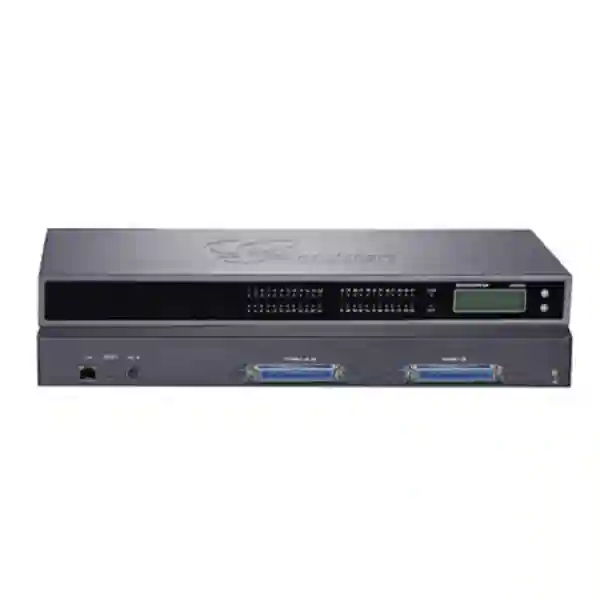
Grandstream GXW4248 V2 Tanzania
The Grandstream GXW4248 V2 is a high-density FXS VoIP gateway built for businesses that need to keep proven analog phones, fax devices or legacy analog extensions while moving call control to a modern SIP environment. The platform gives administrators a practical bridge between analog endpoints and IP-based telephony, helping organizations modernize at the network and PBX layers without replacing every endpoint at once. For Tanzania deployments, that makes the GXW4248 V2 particularly relevant to hotels, hospitals, universities, government facilities, apartment or hospitality properties, factories, large offices and institutions where dozens of analog lines may already terminate in a central telecom room.
Grandstream positions the GXW4200 V2 family as high-density Gigabit gateways. The GXW4248 V2 is the 48-line model and uses two 50-pin RJ21/Telco connectors rather than individual front-panel RJ11 sockets. It provides one Gigabit Ethernet interface, four SIP server profiles, an independent SIP account for each FXS line, secure communications capabilities such as SRTP, TLS and HTTPS, wideband codec support including Opus and G.722, simultaneous three-way conferencing per port, and V2 security enhancements that include secure boot, unique device certificates and randomized default credentials. These capabilities make it suitable for carefully planned analog-to-SIP migration, centralized extension consolidation and high-density voice access projects.
Analog FXS lines presented through two 50-pin RJ21/Telco connectors for high-density structured telephony.
A single 10/100/1000 Mbps Ethernet interface connects the gateway to the IP network and SIP infrastructure.
Multiple SIP server profiles allow administrators to organize registrations and routing across different voice environments.
Secure boot, device certificates, randomized default passwords, TLS, SRTP and HTTPS support strengthen deployment hygiene.
What the Grandstream GXW4248 V2 is designed to solve
Large analog telephone estates can make VoIP migration unnecessarily disruptive when the project is treated as an all-or-nothing endpoint replacement. A hotel may have analog guest-room phones that still work reliably. A hospital may have analog phones distributed through wards and back-office spaces. A university or public institution may have existing copper runs that terminate centrally. A factory may use rugged analog handsets in operational areas where a full IP handset refresh does not yet make financial or operational sense. The GXW4248 V2 lets these endpoints participate in a SIP environment through a centralized FXS gateway, giving the organization a staged path toward IP communications.
The gateway should be viewed as part of a complete voice architecture, not as a standalone telephone system. It typically sits between analog endpoints and a SIP-based IP PBX, softswitch or hosted voice platform. Each analog line can be associated with a SIP account, while dialing rules, codec choices, caller-ID behavior, fax handling, security parameters and provisioning policies are managed at the gateway and PBX layers. The design therefore begins with the existing endpoint count, cable termination method, required call concurrency, PBX or service-provider compatibility, SIP registration model and network readiness.
Because the GXW4248 V2 exposes its 48 FXS circuits through RJ21/Telco connectors, structured termination matters. The gateway is well suited to telecom rooms where a patch panel, distribution frame or organized cable field is already part of the building design. Planning should identify how each analog extension maps from the gateway to its final wall outlet or device. Good labeling and documentation are essential because 48 lines create a dense environment: a single poorly documented pair can turn a simple move or fault into a time-consuming troubleshooting exercise.
Verified GXW4248 V2 capabilities
High-density analog access
The GXW4248 V2 is the highest-capacity model in the GXW42xx V2 family. It supports 48 FXS telephone interfaces and 48 SIP accounts, presented through two RJ21 connectors. This density helps centralize many analog endpoints in one rack-friendly unit rather than deploying dozens of individual analog telephone adapters.
SIP interoperability
Grandstream states that the series is designed and tested for interoperability with leading IP PBXs, softswitches and SIP-based environments. Four SIP server profiles per system provide flexibility when accounts, departments or services need different SIP destinations or configuration policies.
Wideband voice
The V2 platform supports wideband voice technologies including Opus and G.722 as well as commonly used narrowband codecs. Actual call quality still depends on the analog endpoint, codec negotiation, PBX policy, WAN quality and end-to-end media path.
Voice resilience tools
The platform includes echo cancellation, jitter management, packet-loss concealment and related voice-processing capabilities designed to support stable analog-to-packet voice conversion. These functions are useful in real networks where timing and packet delivery are not perfectly uniform.
Security controls
Support for SRTP, TLS and HTTPS helps protect signaling, media and management traffic when the surrounding PBX or service platform is configured accordingly. V2 hardware also adds security-oriented platform features such as secure boot, unique certificates and randomized default device passwords.
Provisioning and management
Organizations managing many extensions benefit from repeatable provisioning. Grandstream documentation supports centralized configuration approaches including TR-069 and XML-based provisioning, while current V2 documentation also includes operational tools such as SNMP and Syslog options for management visibility.
Grandstream GXW4248 V2 technical planning guide
| Planning area | GXW4248 V2 consideration |
|---|---|
| Analog capacity | 48 FXS interfaces, with an independent SIP account available per line. |
| Physical telephone connection | Two 50-pin RJ21/Telco connectors. The GXW4248 V2 does not provide 48 individual front-panel RJ11 sockets. |
| Network | One 10/100/1000BASE-T Ethernet interface for connection to the LAN and SIP infrastructure. |
| SIP structure | Four SIP server profiles, allowing organized registration and policy mapping across groups of ports. |
| Concurrent calls | Grandstream documentation lists up to 48 concurrent calls except when using SRTP; sizing should always be validated against the chosen codec, PBX and security policy. |
| Fax | T.38 fax support is available. Fax reliability depends on the complete SIP path, media handling and service-provider configuration. |
| Mounting | Desktop and rack deployment are supported, which is useful for telecom rooms and centralized distribution points. |
| Operating environment | Current Grandstream documentation lists V2 operating temperatures up to 45°C, but adequate rack ventilation, clean power and safe cable routing remain essential. |
A technical specification is only one part of a successful deployment. Before purchase, document the number of active analog extensions, expected future growth, fax or modem-like devices, extension numbering, PBX platform, SIP trunk architecture, VLAN design, DNS and NTP sources, firewall policies, UPS coverage and patching method. For a 48-line gateway, spending time on these inputs is usually more valuable than focusing only on the headline port count.
Deployment, integration and migration considerations
The GXW4248 V2 works best when analog migration is treated as a structured project. Start by identifying every analog endpoint and its business purpose. A standard telephone, fax machine, emergency phone, lift phone, gate intercom or legacy device may all use analog signaling, but they do not necessarily behave identically over a VoIP conversion layer. Requirements such as caller ID, DTMF, fax relay, line voltage, ring characteristics, extension restrictions and failover expectations should be reviewed before ports are bulk configured.
Next, map the analog cable plant. Because the gateway terminates through RJ21 connectors, the cable path often passes through a patch panel, punch-down block or distribution frame. Create a port schedule that records gateway port, cable pair, destination room or device, SIP extension, display name and any special dialing rule. This documentation becomes the operational reference for future moves, additions and troubleshooting. In hospitality or campus environments, where rooms may be renumbered or repurposed, a clean port schedule prevents the telephony layer from becoming opaque.
On the IP side, place the gateway on a managed LAN with predictable addressing and appropriate voice segmentation. A dedicated voice VLAN is commonly used to simplify policy, QoS and troubleshooting, although the final design depends on the existing network. Ensure the gateway can resolve its SIP server and NTP sources, and verify firewall behavior for SIP signaling and RTP media. Avoid exposing the management interface directly to the public internet. Where remote administration is required, use secure network access and strong authentication practices.
PBX configuration should be staged. Build a pilot group first, validate inbound and outbound calls, DTMF, transfer, hold, caller ID, voicemail access, three-way calling and any fax use case, then expand to additional ports. This method is especially helpful when replacing an analog PBX or moving services from one carrier to another, because it gives administrators a controlled point to compare behavior before all 48 ports are activated.
For related infrastructure planning in Tanzania, FourTeck’s Tanzania IT and telecom solutions overview explains how IP PBX, switching, cabling and support can be coordinated as one environment. Customers with regional operations can also review FourTeck Uganda, FourTeck Kenya and FourTeck UAE when projects cross country boundaries and require a consistent technology-planning approach.
Grandstream GXW4248 V2 Tanzania
In Tanzania, the GXW4248 V2 fits projects where a large installed base of analog handsets must be retained while the organization upgrades the call-control platform to SIP. This is a common architectural requirement in hotels, campuses, hospitals, public institutions, residential properties and larger offices where copper extension cabling already reaches many rooms. Replacing the PBX can be straightforward compared with replacing every endpoint and recabling every floor. A high-density FXS gateway lets the organization separate those decisions: the PBX and network can be modernized first, while analog devices remain connected through a managed migration layer.
A Tanzania buyer should begin by confirming the number and type of analog endpoints rather than simply ordering a 48-port gateway because 48 sounds sufficient. List active ports, dormant ports that may be reactivated, expected expansion, fax lines and any specialty analog device. If the current total is close to 48, consider whether a single gateway leaves enough spare capacity for growth or maintenance. If the estate is substantially smaller, compare the GXW4248 V2 with lower-capacity models in the same family so capital is aligned with real port requirements.
Network quality is equally important. Voice traffic itself is usually modest in bandwidth, but call quality depends on latency, jitter, packet loss and correct prioritization. The gateway’s Gigabit interface removes a local access bottleneck, yet the broader LAN and WAN still need to be designed correctly. Managed switching, VLANs, QoS, reliable DNS and NTP, appropriate firewall rules and UPS protection should be included in the deployment plan. Where SIP services traverse internet links, the project should define how connectivity failures affect inbound and outbound calling and whether there is an alternate routing strategy.
Physical installation in Tanzania should also account for rack conditions, clean power and grounding. Grandstream’s installation guidance recommends lightning protection and surge-protection measures, while the gateway itself includes over-voltage protection and surge immunity. In sites with long copper runs, outdoor cable pathways or unstable power, these considerations are important for the entire voice plant, not only the gateway. A well-sized UPS, organized rack, proper earth connection and documented patching scheme are basic reliability measures.
For procurement, request a quotation that identifies the exact V2 model, required cables or patching components, rack accessories, PBX integration scope, configuration scope, testing requirements and any support options. Do not assume that a 48-port gateway quote automatically includes every connector or cabling component required for the building. A precise bill of materials helps the customer compare proposals on the same basis and reduces delays when the unit is ready to deploy.
Grandstream GXW4248 V2 Dar es Salaam
Dar es Salaam organizations often operate from multi-floor commercial buildings, hotels, clinics, campuses, warehouses and mixed-use facilities where voice services must connect many rooms without creating a separate IP handset project for every endpoint. The GXW4248 V2 can serve as the analog access layer in these environments, allowing existing telephone wiring and analog devices to register into a SIP-based PBX architecture through a centralized gateway. This can be useful during phased upgrades, office moves, PBX replacement or consolidation of multiple legacy analog systems.
The most important design question for a Dar es Salaam deployment is where the analog pairs terminate. If building cabling already converges in a main distribution frame or telecom room, the two RJ21 connectors on the GXW4248 V2 can integrate efficiently with structured pair distribution. If analog cables are scattered across floors without centralized termination, the project may require additional cross-connect work before the gateway can be used cleanly. Site survey results should therefore inform the bill of materials rather than assuming the gateway alone completes the migration.
For businesses using a hosted or remotely located SIP platform, internet resilience needs to be evaluated. A gateway can maintain analog endpoint connectivity to the LAN, but a cloud PBX still depends on the WAN path. Organizations with high call criticality may choose dual internet circuits, controlled failover or a local call-survivability strategy depending on their PBX platform. The right choice depends on how long the organization can tolerate loss of external calling and whether internal calling must continue during a WAN outage.
Security policies should cover both the SIP layer and the management plane. Use encrypted signaling and media when supported end-to-end, restrict gateway administration to trusted networks, maintain current firmware, disable unnecessary services and document administrative credentials securely. The V2 platform provides modern security capabilities, but they must be configured in a way that matches the PBX and network. A secure-capable gateway does not automatically create a secure deployment if management is exposed or default policies remain unchanged.
When requesting a Grandstream GXW4248 V2 quotation in Dar es Salaam, provide the existing PBX model, number of analog extensions, extension range, expected concurrent calls, rack location, cable termination format and whether installation or configuration is required. This enables a more useful proposal than asking only for a unit price. It also helps identify whether switching, UPS, rack, patching or PBX configuration work belongs in the same project.
Grandstream GXW4248 V2 Mwanza
For organizations in Mwanza, a high-density FXS gateway can be valuable where analog infrastructure remains widespread across a property but management wants the flexibility of SIP call routing, centralized PBX administration and modern network-based voice services. Larger hospitality sites, education facilities, healthcare environments and administrative campuses may have dozens of analog endpoints that are inexpensive to keep but difficult to integrate directly with a new IP PBX. The GXW4248 V2 provides a structured transition point between those two technology generations.
The selection process should distinguish endpoint count from call concurrency. Forty-eight analog ports do not necessarily mean 48 simultaneous external calls, and many organizations have a much lower busy-hour call profile. However, internal calls, room-to-room communication and service desks can create their own concurrency patterns. Reviewing actual use helps the PBX, SIP trunk and WAN capacity to be sized properly. The gateway should be considered within that broader capacity model rather than treated as the only voice component that matters.
Mwanza deployments with longer analog cable paths should pay attention to cable condition, labeling and surge exposure. Old copper may work acceptably with an analog PBX but reveal weaknesses when a migration project changes termination points or rack layout. Before commissioning, test representative lines for continuity and quality, confirm how pairs are mapped, and inspect distribution points for poor joints or undocumented changes. Doing this early can prevent the gateway from being blamed for problems that actually originate in the building cable plant.
Power protection deserves similar attention. Voice systems may be expected to remain available during short utility interruptions, so the gateway, PBX, switches, router and any media-conversion equipment should be evaluated as one UPS load. Protecting the gateway while leaving the upstream switch or router unprotected does not provide useful continuity. Define the required runtime and make sure battery capacity matches the total communications stack.
A good Mwanza implementation plan includes configuration backups, a port map, SIP account inventory, firmware version record and change-control notes. These simple documents allow technicians to restore service more quickly after equipment replacement or configuration changes. For multi-site organizations, using the same naming conventions and provisioning principles across each branch can also reduce operating complexity as the voice network grows.
Grandstream GXW4248 V2 Arusha
Arusha has a strong mix of hospitality, tourism, education, non-governmental, professional and institutional organizations, many of which operate buildings where analog room or desk telephones remain serviceable. The Grandstream GXW4248 V2 can support a phased communications upgrade by connecting those endpoints to a modern SIP platform without requiring every analog phone to be replaced immediately. This is particularly practical in hotels or campuses where a single telecom room may serve many rooms through established copper distribution.
Hospitality projects should map telephony requirements to operational workflows. Guest-room phones may need reception, housekeeping, emergency and external calling rules that differ from administrative extensions. A SIP PBX can provide these call-control features, while the GXW4248 V2 acts as the analog interface. When planning a hotel migration, test message-waiting behavior, caller ID, wake-up call workflows if handled by the PBX or property system, and any integration between the communications platform and hospitality software. These functions depend on the complete solution, so they should be validated rather than assumed from the gateway specification alone.
Arusha organizations with distributed buildings should decide whether to centralize analog gateways in one main equipment room or place gateways closer to each cable distribution zone. Centralization simplifies management but may increase analog cable length. Distributed placement can shorten analog runs but creates additional rack, power and network requirements. The right architecture depends on building layout, existing pathways and the ability to provide secure equipment space at each location.
The V2 model supports secure SIP and management technologies, and those should be incorporated into the network design where the PBX supports them. Use a controlled management subnet, current firmware, encrypted access, limited administrator reachability and secure credential storage. If the gateway registers to a cloud platform, firewall rules should be based on the provider’s documented requirements rather than broad internet exposure.
For Arusha procurement, include a commissioning checklist with port-by-port testing. Verify dial tone, inbound and outbound call behavior, transfer, DTMF, hold, ring cadence, caller ID and special devices. A port that passes a simple extension-to-extension call may still fail a fax or application-specific workflow. Testing against the actual business use case is the best way to confirm readiness before the old PBX or carrier service is retired.
Grandstream GXW4248 V2 Dodoma
Dodoma offices, institutions and public-sector environments can use the GXW4248 V2 when the communications strategy requires modern SIP call control while preserving installed analog extension wiring and handsets. A central gateway is often easier to manage than dozens of small analog adapters because administrators can work from one device, one network connection and one organized cable field. This density is valuable when the physical plant already terminates many copper pairs in a central room.
Governance and documentation are especially important in larger institutional deployments. Each of the 48 ports should have an assigned extension, user or location, destination cable pair and service profile. Administrative credentials, configuration backups and firmware records should be stored according to the organization’s IT-control process. If multiple departments share the gateway, changes should be logged so that one team’s adjustment does not unintentionally affect another department’s calling behavior.
The gateway supports four SIP profiles, which can be useful when accounts are grouped by service or call-control requirement. Even so, the final configuration depends on the PBX and service-provider design. Some organizations will use one profile for all extensions, while others may need separate registration groups, redundant servers or departmental settings. These choices should be documented at the solution-design stage and tested under expected failure conditions.
Network preparation in Dodoma should include stable addressing, NTP, DNS, VLAN configuration where appropriate, QoS policy and UPS support. If voice crosses a WAN between branches, confirm that the link can maintain acceptable latency and packet loss during busy periods. An office may have enough nominal bandwidth but still experience call-quality problems when backups, cloud synchronization or large file transfers saturate the link. Monitoring and prioritization help distinguish raw bandwidth from usable voice quality.
When obtaining a quotation, specify whether the requirement is equipment supply only or a complete migration service. A complete project may include gateway configuration, PBX programming, rack installation, cable cross-connect, line labeling, user testing, documentation and post-migration troubleshooting. Defining scope clearly is more important than choosing the lowest hardware price because the cost of an incomplete migration can exceed the difference between equipment quotations.
Grandstream GXW4248 V2 UAE
In the UAE, the GXW4248 V2 is relevant to hotels, serviced residences, healthcare groups, education campuses, warehouses and enterprise facilities that retain significant analog endpoint infrastructure. High-density FXS conversion can support a controlled migration from older PBX hardware to SIP while preserving room phones, analog fax devices or other compatible endpoints. For organizations with both UAE and East African operations, using a consistent gateway family can also simplify technical standards, spares planning and administrator familiarity across sites.
UAE deployments often take place in structured telecom environments with established racks, patch panels and building distribution frames. The GXW4248 V2’s pair of RJ21 connectors fits this type of centralized design, but project teams should confirm connector pinout, patching method and the physical route to each extension before installation. The objective is not only to connect 48 lines but to create a maintainable cable system where each port can be identified and serviced quickly.
Cloud communications and SIP trunk adoption are common drivers for analog gateway projects. When the gateway registers through a firewall to an external service, the security design should follow the provider’s documented SIP and RTP requirements. Avoid broad port forwarding and uncontrolled management access. Use TLS and SRTP when interoperable with the service platform, lock administration to trusted sources, and maintain firmware at a supported level after testing changes in a controlled window.
Because business continuity expectations can be high, test failure scenarios before go-live. Confirm what happens if the internet link fails, if the SIP server is unreachable, if the gateway reboots or if power to the voice rack is lost. A UPS protects against short power events, but WAN or provider failures require their own strategy. The correct continuity plan may involve redundant connectivity, alternate routing, mobile fallback or local survivability depending on the PBX architecture.
Organizations comparing supply and integration options can review FourTeck UAE technology solutions for broader networking and communication planning. For a GXW4248 V2 quotation, provide the exact analog line count, PBX platform, required rack location, cross-connect details, configuration scope and expected commissioning schedule so procurement and technical teams work from the same requirement.
Grandstream GXW4248 V2 Uganda
Ugandan businesses with analog telephone estates can use the GXW4248 V2 as a migration bridge into SIP communications. The product is especially relevant where replacing a legacy PBX is practical but replacing every analog endpoint at the same time is not. Hotels, schools, hospitals, public facilities and multi-building sites can preserve existing endpoints while gaining the routing, administration and integration benefits of an IP PBX.
Start with a physical audit. Count active analog devices, identify cable termination points, document the longest runs and note any lines used for fax or special-purpose equipment. Then compare that audit with the gateway’s 48-line capacity. If multiple buildings are connected through campus copper, consider whether the analog path should remain centralized or whether gateways should be distributed closer to each building. Network reach, equipment security, power availability and maintenance access all influence the choice.
For branch networks, voice traffic may cross MPLS, SD-WAN, VPN or ordinary internet links. The gateway itself provides the analog conversion, but end-to-end call quality depends on the network. Measure latency, jitter and loss during normal and busy periods, and verify that WAN policies prioritize real-time traffic without starving business applications. If a cloud PBX is used, confirm that the internet service and firewall can support the expected number of simultaneous calls.
The GXW4248 V2 provides security options suitable for modern SIP deployments, but operational discipline remains necessary. Change and protect administrator credentials, restrict management access, use secure protocols, keep configuration backups and review release notes before firmware upgrades. Grandstream specifically distinguishes V2 firmware from V1, so administrators should verify the model label and follow the correct upgrade path rather than applying files intended for older hardware.
Customers with projects in Uganda can review FourTeck Uganda for regional IT, PBX, networking and infrastructure context. A useful request for quotation should identify the PBX, extension count, analog cable termination, installation location, desired call features and whether configuration, installation, training or support is required.
Grandstream GXW4248 V2 Kampala
Kampala organizations often combine older buildings, newer network infrastructure and growing demand for centralized communications. The GXW4248 V2 can bridge these environments by keeping analog phones on existing copper while moving call processing to SIP. That makes it a practical option for hotels, offices, medical facilities, schools and institutions where dozens of analog endpoints remain functional but the existing PBX no longer meets requirements for routing, administration or remote connectivity.
A Kampala deployment should include a network-readiness review before cutover. Confirm that the LAN switch port used by the gateway is correctly configured, that addressing is stable, that DNS and NTP are reachable and that the PBX path is free of avoidable NAT or firewall problems. If voice traffic is carried over a congested internet connection, additional gateway hardware will not solve jitter or packet loss. Network monitoring and QoS policy should be part of the project where call quality is business-critical.
The 48-line density also creates a need for organized operations. Label gateway ports and patch points consistently, back up configuration after commissioning and keep a current extension map. When staff changes or rooms are repurposed, update the documentation at the same time as the PBX. Without that discipline, the convenience of a high-density platform can become a troubleshooting challenge because many services depend on one device.
Security should be applied in layers. Use the gateway’s secure management capabilities, enable encrypted SIP where supported, place the device on a controlled network and prevent public access to its administration pages. On the PBX side, use strong extension credentials, restrict unnecessary international or premium routing and monitor for abnormal registration or call patterns. Voice security is not only about media encryption; it also includes fraud prevention and administrative control.
During procurement, ask suppliers to state clearly what is included beyond the GXW4248 V2 itself. Required RJ21 cabling, distribution hardware, rack accessories, UPS capacity, configuration and testing may be separate line items. A transparent quotation gives the IT team a better basis for comparing solutions and makes it less likely that installation stops because a small but essential cross-connect component was missed.
Grandstream GXW4248 V2 Arua
In Arua, the GXW4248 V2 can support organizations that want to modernize voice services without forcing an immediate replacement of a large analog endpoint base. Institutions with central administrative buildings, clinics, schools, hospitality properties or operations sites may already have copper extension wiring that continues to serve its purpose. A high-density FXS gateway allows that physical layer to remain in service while SIP provides the call-control layer.
Remote-site planning should emphasize maintainability. The device can centralize 48 lines, so configuration backups, port documentation and spare-cable planning are important. If local technical resources are limited, a clear handover pack can reduce future support effort. Record the gateway management address, firmware version, PBX profile assignments, extension-to-port mapping, network VLAN, physical rack position and contact details for escalation. These details make remote troubleshooting far more effective.
Connectivity should be assessed realistically. If the SIP server is hosted in another city or country, internet latency and stability become part of the voice design. A stable 10 Mbps link can provide better voice performance than a much faster but highly variable link, because real-time media is sensitive to jitter and loss. Where the site depends on wireless or shared connectivity, test during busy hours rather than assuming headline bandwidth guarantees call quality.
Power continuity may also influence deployment success. Place the gateway, access switch, router and PBX-related devices on coordinated UPS protection. Consider how long the site requires telephony to remain available and whether generator transfer time affects equipment. Clean shutdown and controlled restart procedures can prevent unnecessary configuration or hardware problems after extended outages.
Arua buyers should request a solution based on their endpoint map and call flows. If only 20 lines are active, a 48-port unit may be selected for planned growth, but that decision should be deliberate. Conversely, if 46 lines are active, there may be insufficient spare capacity for expansion. Proper sizing combines current use, realistic growth and resilience rather than purchasing only on today’s exact count.
Grandstream GXW4248 V2 Mbarara
Mbarara businesses and institutions can use the Grandstream GXW4248 V2 to integrate large groups of analog phones with a SIP-based communications platform. The model is useful for phased PBX replacement, property upgrades and branch standardization where existing handsets and copper runs still have operational value. With 48 FXS lines in one gateway, the device reduces the number of individual analog adapters that would otherwise need power, network ports and separate management.
High density is beneficial only when the physical cabling is controlled. Before installation, trace and label analog pairs, confirm which extensions remain active and identify any wiring faults. If the previous PBX uses proprietary termination blocks, determine how those pairs will be cross-connected to RJ21. Planning the cross-connect in advance minimizes downtime because the migration team can prepare cable schedules before the cutover window.
For organizations that use fax, do not assume every fax workload will behave identically over SIP. The GXW4248 V2 supports T.38, but the PBX and service provider must also handle fax correctly. Test representative devices, especially if they are used for important administrative workflows. Where fax is mission-critical, document fallback options and make sure line settings are not optimized only for voice.
The same principle applies to DTMF-driven systems, door phones or other analog devices. Validate real workflows rather than relying only on a dial-tone test. Use a pilot group first, confirm the functions users need, then migrate the remaining ports in logical batches. This staged approach reduces the impact of configuration errors and provides time to adjust dialing plans or PBX policies.
When comparing quotations in Mbarara, ask whether configuration templates, firmware preparation, installation, line testing and handover documentation are included. Hardware-only pricing can look attractive but may leave the customer responsible for integration tasks that require specialist knowledge. A clear scope allows procurement teams to compare complete outcomes instead of comparing only appliance prices.
Grandstream GXW4248 V2 Gulu
For Gulu deployments, the GXW4248 V2 offers a way to connect a substantial analog telephone estate to modern SIP infrastructure while preserving existing wiring and devices where they remain appropriate. This is valuable for schools, medical facilities, accommodation properties, NGOs, public institutions and business campuses that want centralized call management but cannot justify replacing every handset during the first phase of a communications upgrade.
The gateway’s 48-line capacity can consolidate analog interfaces into one rack position, which simplifies inventory but increases the importance of resilience. If many departments depend on one device, keep a tested configuration backup and document restoration procedures. Consider whether the operational impact of a single gateway failure justifies holding a spare unit or designing multiple smaller gateways across critical groups. The correct resilience model depends on the number of users and the cost of voice downtime.
Gulu sites with constrained or variable WAN connectivity should assess whether the PBX should be local or cloud-based. A cloud platform can simplify centralized management, but it depends on WAN availability for call control and media unless the solution provides survivability features. A local PBX can reduce dependency on external connectivity for internal calls but introduces local server or appliance management. The GXW4248 V2 can participate in either architecture provided the SIP design is compatible.
Operational security should include firmware review, secure administration, credential management and access restrictions. Grandstream’s V2 platform uses a device-specific password and secure-boot architecture, which improves the baseline compared with older designs. Administrators should still create a documented patch process and avoid making production firmware changes without reviewing release notes and maintaining a rollback or recovery plan.
A successful Gulu project ends with a handover, not only an installation. Provide the customer with a port map, extension list, network settings, administrator-access process, backup file, basic troubleshooting flow and escalation path. These items make the system maintainable even when the original installer is not immediately available.
Grandstream GXW4248 V2 Kenya
Kenyan enterprises with large analog endpoint populations can deploy the GXW4248 V2 as the access bridge between legacy telephones and a SIP-based communications platform. The product can be useful in hospitality, healthcare, education, manufacturing, property management and multi-branch organizations that need to retain analog handsets while standardizing call control on IP. A single high-density gateway can reduce device sprawl compared with many small ATAs and provides a centralized point for configuration and monitoring.
Because many Kenyan organizations operate multiple branches, standardization is a strong buying consideration. Using consistent gateway models, port-labeling schemes, VLAN policies and PBX templates across sites can make support easier. However, each branch still needs its own site survey because cable layouts, internet reliability, rack space, power conditions and endpoint counts differ. A template should speed deployment, not replace local validation.
For SIP trunk or cloud PBX integration, define the concurrency requirement based on actual call behavior. The GXW4248 V2 can support a large number of endpoint registrations, while external channel count may be much smaller. Buying a trunk with 48 channels solely because the gateway has 48 ports may be unnecessary; conversely, under-sizing trunks can cause busy conditions at peak times. Analyze busy-hour usage, receptionist traffic, outbound campaigns and internal call patterns.
Physical security matters when the gateway controls many extensions. Place the unit in a restricted rack or telecom room, organize RJ21 cabling, keep a current patch schedule and protect upstream switches and routers with UPS. If the location is exposed to electrical instability or long copper runs, use appropriate grounding and surge-protection practices across the installation.
Regional buyers can review FourTeck Kenya for related PBX, networking and security solution context. For a GXW4248 V2 project quotation, provide the exact site location, PBX or service platform, analog extension count, termination method, target cutover date and required implementation scope so the proposal reflects the real deployment rather than only the appliance.
Grandstream GXW4248 V2 Kuwait
In Kuwait, the GXW4248 V2 is suited to organizations that maintain analog extensions across hotels, residential properties, hospitals, schools, offices and industrial facilities but want modern SIP call control. Large facilities frequently have substantial copper distribution already embedded in walls and risers. Reusing that plant through a high-density gateway can reduce disruption and allow a PBX migration to proceed independently from an endpoint-refresh project.
The product should be installed in a climate-controlled telecom environment with proper rack ventilation. Although the V2 hardware is designed for business deployment, rack rooms still need stable temperature, clean power and controlled dust. A gateway serving 48 lines can affect many users if the equipment room is poorly maintained, so facility conditions should be considered part of voice reliability.
Kuwait projects may involve integration with enterprise IP PBX systems, hosted services or SIP trunks. The GXW4248 V2 provides standard SIP functionality and four server profiles, but interoperability should be tested with the exact platform and firmware version used in production. Build a small pilot first and validate call transfer, caller ID, DTMF, voicemail access, fax and any hospitality or building-system workflow before committing all lines.
Security configuration should align with corporate policy. Enable TLS and SRTP where supported end-to-end, use HTTPS for administration, restrict access to management networks and maintain unique credentials. If the enterprise uses centralized logging or monitoring, the gateway’s Syslog and SNMP capabilities can contribute operational visibility, although alerting and retention should be defined by the wider monitoring platform.
A procurement specification should call out the V2 model explicitly because V1 and V2 firmware are different. It should also define required RJ21 cabling, rack accessories, PBX integration, patching and testing. Avoid treating “GXW4248” as sufficient identification when firmware planning and security features depend on the hardware generation.
Grandstream GXW4248 V2 Ghana
Ghanaian organizations modernizing legacy telephony can use the GXW4248 V2 to preserve analog endpoints while adopting SIP. The high-density design is useful where many rooms or departments connect back to one telephone distribution point. Hotels, campuses, hospitals, administrative facilities and businesses with large analog extension counts can migrate call control without turning the project into an immediate building-wide handset replacement.
Capacity planning should include spare ports. A 48-line gateway is attractive when an organization has 35 to 45 analog endpoints and expects growth, but a customer already using all 48 lines should think about how future additions or maintenance will be handled. Multiple gateways can provide additional scale, but the PBX and network architecture must accommodate the extra registrations, call paths and management requirements.
For sites that rely on internet-based SIP services, test network stability as part of acceptance. Measure voice quality during periods of heavy data use, verify that routers and firewalls handle RTP predictably, and apply QoS where appropriate. If the WAN is unreliable, document an outage process and decide whether users need alternate routes or mobile fallback. A gateway solves the analog interface requirement; it does not remove dependency on the rest of the communications chain.
Security and lifecycle management should be planned from the beginning. Record the installed firmware version, subscribe to vendor update information, maintain configuration backups and set a maintenance window for tested changes. The V2 platform’s secure boot and unique credentials provide a good baseline, while administrator practice determines whether those features are used effectively.
For Ghana procurement, ask for a scope that distinguishes hardware supply from installation and integration. The project may require RJ21 cabling, distribution blocks, rack space, switching, UPS capacity, PBX configuration and port-by-port commissioning. Clarifying these items in the quotation gives decision-makers a more accurate project cost and reduces the likelihood of unplanned work at go-live.
Grandstream GXW4248 V2 Nigeria
Nigeria has a wide range of enterprise, hospitality, education, healthcare and property environments where analog extension networks remain in service even as organizations move core communications to IP. The GXW4248 V2 can provide the transition layer, connecting up to 48 analog lines to SIP-based call control through one managed gateway. This allows a migration project to prioritize the PBX, network and call-routing requirements without forcing immediate replacement of every analog device.
Power design is often a critical part of voice availability. The gateway, PBX, switch, router and internet equipment should be included in a coordinated backup-power plan. If a generator is available, the UPS should cover the transfer interval and condition short power disturbances. If the site relies primarily on inverter or battery systems, calculate runtime using the entire communication rack load rather than the gateway alone.
Network security is equally important because SIP systems can be targets for toll fraud and unauthorized registration. Use strong account credentials, limit management access, avoid unnecessary public exposure, enable encrypted protocols where interoperable and apply PBX dialing restrictions according to business need. Monitoring unusual call patterns can reveal compromised credentials faster than waiting for billing anomalies.
For multi-site Nigerian organizations, consider centralized provisioning and consistent templates. The GXW4248 V2 supports automated provisioning approaches that can reduce manual configuration effort. Even with templates, keep each site’s extension map and network details separate so changes at one branch do not overwrite another branch’s configuration. Configuration management should include version control or at least dated backups before major changes.
During selection, distinguish V2 from older GXW4248 hardware. V2 identification and firmware path matter for lifecycle management, and the newer platform introduces security and voice improvements. A procurement request should use the exact model name “Grandstream GXW4248 V2” and should ask the supplier to quote any required cabling, integration and commissioning separately so scope is transparent.
Grandstream GXW4248 V2 Seychelles
Seychelles hotels, resorts, institutions and business properties may have a particular need to preserve analog room phones and established building cabling while upgrading central communications. The Grandstream GXW4248 V2 can connect a dense set of analog endpoints to a SIP platform and is therefore well suited to phased modernization in hospitality and multi-building environments. Reusing functional room phones can reduce the operational disruption associated with replacing endpoints across occupied properties.
Island and resort environments also make maintainability important. A single high-density gateway reduces the number of separate adapters, but it concentrates many lines in one device. Keep a configuration backup, accurate port map and clear spare strategy. Organizations with strict uptime requirements may choose to hold compatible spare equipment or split critical areas across more than one gateway so one hardware fault does not affect every analog extension at the property.
Cable quality and surge protection deserve attention where lines run between buildings or through exposed pathways. Grandstream documents over-voltage protection and surge immunity on the GXW42xx family, while installation guidance also recommends proper grounding and lightning-protection measures. These protections should complement, not replace, a broader building electrical and telecom protection design.
If the SIP platform is hosted off-island or in a remote data center, WAN behavior becomes part of call quality. Review latency, packet loss and failover options, especially for guest-service or emergency-related calling. A secondary internet path may improve availability, but only if the firewall, routing and SIP platform are configured to handle failover cleanly. Test the full scenario rather than assuming a second circuit automatically provides voice continuity.
For procurement, define whether the gateway will serve guest rooms, back-office extensions or both. This affects call permissions, voicemail, class-of-service and integration needs. A detailed requirement lets the installer create separate extension groups and test the workflows that matter most to the property before the old telephony platform is decommissioned.
How to choose between GXW4216 V2, GXW4224 V2, GXW4232 V2 and GXW4248 V2
Grandstream’s GXW42xx V2 family is built around a common high-density FXS gateway concept with model choice driven primarily by analog-port requirement and physical connectivity. The GXW4216 V2 provides 16 lines, the GXW4224 V2 provides 24, the GXW4232 V2 provides 32 and the GXW4248 V2 provides 48. The lower-capacity models include individual RJ11 interfaces in addition to RJ21 arrangements, while the 48-line model relies on dual RJ21 connectors. This distinction can influence installation labor and patching design as much as the number of ports.
Choose the GXW4248 V2 when the analog endpoint count and cabling layout justify its density. A hotel with 42 room and service phones may benefit from one 48-line unit with a few spare ports. A small office with 12 analog devices usually does not. Oversizing is not automatically wrong—spare capacity can support growth—but it should be a conscious choice based on forecasted requirements, rack capacity and resilience strategy.
Also consider failure domains. One 48-line gateway is simple and compact, while two smaller gateways can divide users so a single hardware issue affects fewer extensions. Multiple units require additional switch ports, power outlets, rack space and management, so resilience must be balanced against complexity. There is no universally correct model count; the appropriate design depends on the value of availability to the organization.
Buying and quotation checklist
Before requesting price
Confirm the exact model name, analog endpoint count, PBX or hosted voice platform, number of active and spare ports, expected simultaneous calls, fax requirement, rack location, network VLAN, internet path and physical RJ21 termination plan.
Ask what the quote includes
Clarify power supply, rack accessories, RJ21 cables, patching hardware, PBX configuration, gateway configuration, firmware preparation, installation, line testing, documentation, user handover and any post-deployment support.
Prepare migration data
Supply an extension list with user or room name, current cable pair, calling permissions, voicemail requirement, special dialing rule and device type. This data can become the basis for a repeatable configuration and test plan.
Frequently asked questions about the Grandstream GXW4248 V2
How many analog phones can the GXW4248 V2 connect?
The GXW4248 V2 supports 48 FXS analog interfaces. Unlike the lower-capacity models, the 48-line model uses two 50-pin RJ21/Telco connectors rather than 48 separate RJ11 jacks. The cable plant therefore needs an appropriate RJ21-to-distribution arrangement.
Can it connect analog phones to an IP PBX?
Yes. That is the central use case of the GXW42xx series. The gateway converts analog FXS endpoint traffic into SIP so existing telephones can operate with compatible IP PBXs, softswitches or SIP platforms. Interoperability and required features should be tested with the exact PBX and firmware combination.
Does the GXW4248 V2 support fax?
Grandstream documentation lists T.38 fax support. Reliable faxing requires compatible handling across the gateway, PBX, SIP trunk or carrier and the receiving side. Always test the actual fax workflow before migration if fax is operationally important.
What is the difference between GXW4248 V1 and V2?
Grandstream distinguishes V2 hardware by the model label and a device-specific password printed on the unit. V2 uses different firmware from V1 and introduces current-generation security and voice enhancements. Administrators should never assume V1 and V2 firmware files are interchangeable.
Does it have Gigabit Ethernet?
Yes. The GXW4248 V2 has one 10/100/1000 Mbps Ethernet interface. Call quality still depends on the complete network path, including LAN congestion, WAN quality, QoS, firewall behavior and SIP provider connectivity.
Can it be rack mounted?
Grandstream documentation supports desktop and rack deployment. Rack installation is normally preferred for high-density projects because it keeps the gateway, switching, UPS, PBX equipment and structured cabling organized in one managed location.
Does it support encrypted VoIP?
The platform supports TLS for SIP signaling, SRTP for media and HTTPS for secure administration. These protections depend on compatible configuration at the PBX or SIP service. Encryption should be implemented as part of an overall security design rather than enabled in isolation.
Is the GXW4248 V2 suitable for hotels?
It can be a strong fit for hotels with many analog guest-room or service phones, especially where existing copper cabling converges in a central telecom room. Hotel-specific workflows such as wake-up calls or PMS integration are functions of the wider PBX solution and should be tested with the selected software platform.
What information is needed for a Tanzania quotation?
Provide the exact endpoint count, current PBX or target SIP platform, existing analog cabling and termination, installation city, rack availability, network details, expected call concurrency and whether you need supply only or complete configuration and migration. This gives the sales and technical teams enough information to scope the project properly.
Decision recap: when the GXW4248 V2 is the right choice
Choose the Grandstream GXW4248 V2 when your organization has a substantial analog endpoint estate, wants to move call control to SIP, has or can create structured RJ21 termination, and values centralized management over many individual analog adapters. It is particularly attractive when 32-port models would be too small but a 48-line gateway gives enough capacity for current use plus sensible growth.
Do not choose it solely because it is the largest model. A successful design considers cabling, PBX compatibility, call concurrency, network quality, power resilience, security, operational support and future expansion. If these inputs are documented before purchase, the gateway can become a clean migration layer rather than a temporary workaround.
For Tanzania projects, FourTeck can evaluate the gateway alongside IP PBX, switching, cabling, UPS and network requirements so the voice solution is planned as a connected system. The same approach is useful for organizations standardizing communications across East Africa or the wider region.
Plan your GXW4248 V2 migration with a complete requirement
A productive consultation starts with facts: how many analog devices are active, where their cables terminate, which PBX or SIP service will be used, what special devices must work, how much downtime is acceptable and what level of installation support is required. With those answers, the gateway, network and migration tasks can be scoped together.
Use the verified FourTeck Tanzania contact page to request pricing, availability guidance or a project discussion for the Grandstream GXW4248 V2.




Reviews
There are no reviews yet.