
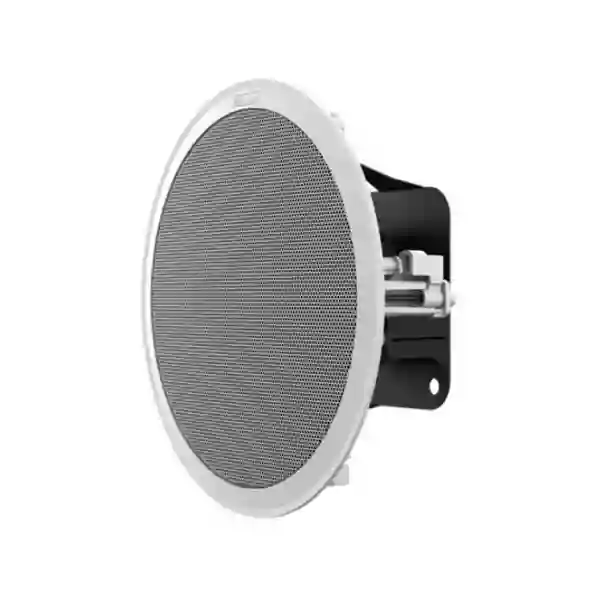
Hanwha SPA-C200W IP Ceiling Speaker
A white PoE-powered IP ceiling speaker with built-in 10W Class D amplification for thoughtfully planned indoor announcement systems. Evaluate SIP and IP-audio workflows alongside ceiling coverage, network design and power availability.
Important regional suitability check
Hanwha’s shared quick guide labels the SPA-C200W as KOR only. This is not proof of official distribution, language support, local warranty or approvals in Tanzania. Confirm exact regional suitability and procurement support with the supplier before relying on this model for a project.
SPA-C200W technical overview
| Exact model | SPA-C200W, white; manufacturer quick guide identifies variant as Korea-only |
|---|---|
| Product type | IP ceiling speaker |
| Amplification | Built-in 10W Class D |
| Ethernet | 10/100 Base-T |
| Network power | IEEE 802.3af PoE / IEEE 802.3at PoE+ |
| Internal storage | 1 GB |
| External storage | microSD / SDHC provision listed; verify supported media and application |
| Speaker range | 120 Hz–20 kHz at −10 dB |
| Published maximum SPL | 96 dB with PoE; 100 dB with PoE+ |
| Sensitivity | 90 dB at 1 W |
| Coverage specification | 90° at 1 kHz; 60° at 4 kHz |
| Speaker construction | Two-way; 8-inch LF and 2-inch HF drivers |
| Dimensions / weight | Ø269 × 142.5 mm (H); approximately 1.8 kg |
| Operating limits | −20°C to +50°C; 10–85% RH, non-condensing |
| Interfaces | Manufacturer lists SIP, SUNAPI and ONVIF Profile S; confirm current firmware |
| Ingress-protection rating | No IP code listed in reviewed specification; do not treat as weatherproof |
Specifications summarize Hanwha Vision’s published product information. Confirm the final shipped variant and current documentation before engineering approval.
What is the SPA-C200W and who should consider it?
The Hanwha SPA-C200W is a white, network-connected ceiling speaker intended for managed IP audio and public-address workflows. Rather than being a conventional passive ceiling loudspeaker that relies on a separate rack amplifier and analogue speaker cabling, it combines a speaker, built-in 10W Class D amplifier, Ethernet network interface and PoE power options in one endpoint. This architecture can simplify the distribution of intelligible messages throughout an appropriately planned building, particularly where a structured network and centrally managed communication workflows are already part of the project.
A suitable buyer might be designing an office announcement system, an administrative building, a reception or circulation area, an educational facility or another indoor environment where announcements must reach defined zones. It may also interest system integrators evaluating audio alongside network cameras, SIP telephony or facility event workflows. Suitability is not determined by product category alone: acoustic coverage, building layout, power budget, the source of announcements and regional availability all influence the result. Specify the purpose of every proposed speaker before selecting quantity or mounting positions.
This exact model needs an additional procurement check in Tanzania. Hanwha’s shared quick guide labels SPA-C200W as a Korea-only variant. That label should not be interpreted as evidence of standard local supply, supported Swahili text-to-speech, a Tanzania warranty or approval for a particular deployment. Ask for confirmation of the exact model and regional support before committing to the design or purchase.
How the network speaker changes an audio design
The main architectural difference between an IP speaker and a traditional analogue public-address endpoint is the delivery path. An analogue ceiling speaker receives an amplified electrical audio signal from another device. The SPA-C200W instead participates in an Ethernet environment and incorporates its amplifier. An announcement source, compatible application or properly configured integration sends supported audio through the network, while the Ethernet infrastructure provides the speaker with power through a qualifying PoE connection. This means the network is part of the sound system, not merely a convenience for setup.
For a project designer, that has several consequences. Endpoint placement must follow acoustic needs but also remain within a serviceable network-cabling design. Every speaker needs a switch port or suitable power injection arrangement, an addressing plan and ongoing configuration management. Where audio must continue during a power outage, the upstream switch and supporting network services require an appropriately sized backup-power strategy. A single powered speaker does not ensure that the entire communication chain remains operational.
The advantage of this approach is potentially more granular management and integration. The tradeoff is that failures in switching, VLAN access, routing, credentials, audio sources or power can interrupt communication. Assess those dependencies openly when comparing an IP architecture with an existing analogue system. For life-safety or statutory evacuation requirements, obtain a design using the specific certified equipment and compliance process applicable to that project; an ordinary network speaker should not automatically be presented as a certified emergency voice-alarm system.
Verified product specifications and how to interpret them
Hanwha lists the SPA-C200W with a 10W Class D amplifier, 10/100 Base-T Ethernet, 1 GB internal memory, and support for power over Ethernet using IEEE 802.3af or 802.3at. Its detailed speaker section gives a 120 Hz to 20 kHz frequency range at minus 10 dB and 90 dB sensitivity at one watt. These figures help engineers compare the endpoint with other IP-audio designs, but they do not by themselves establish speech intelligibility in a room filled with people, machinery or reverberation.
The manufacturer presents maximum sound-pressure output separately for its power modes: 96 dB on PoE and 100 dB on PoE+. A general feature summary elsewhere on the same product page also uses 99 dB, so projects should reference the mode-specific figures when estimating performance and should reconfirm current firmware, datasheet and measurement conditions before contract specification. Sound pressure at a listening position depends on distance, speaker direction, room absorption, mounting and background noise; do not treat the published figure as a guaranteed level in every corner.
The published dimensions are approximately 269 mm in diameter by 142.5 mm high, with a listed weight of 1.8 kg. Hanwha indicates operating conditions of minus 20 to plus 50 degrees Celsius and 10 to 85 percent relative humidity without condensation. These are operating limits, not permission to expose the speaker to rainfall, humidity condensation or outdoor weather. The manufacturer’s published IP-code field does not state an ingress-protection rating.
PoE versus PoE+: decide before estimating coverage
Both PoE and PoE+ are named as supported power methods, but specifying them as interchangeable without review can create a disappointing installation. The manufacturer distinguishes maximum output by mode, with PoE+ associated with the higher published sound-pressure figure. A design that needs strong announcements above substantial ambient noise should verify the exact PoE budget, switching capability and achievable acoustic result rather than assuming every 802.3af port provides the same practical output as an 802.3at connection.
Begin with the switch inventory. Record each planned speaker port, its negotiated power classification, the switch’s total available PoE budget and any other devices that already consume that budget. Cameras, access points and network phones may share the same infrastructure. A switch can have many PoE-capable ports while still having insufficient total power for simultaneous peak demand. Include budget headroom, port-level monitoring and a clear plan for replacement or expansion.
Next consider continuity. If an announcement is operationally important, the speaker’s power source and all dependent components should be considered together. A UPS-backed switch might protect local endpoints, but the announcement console, upstream network path and relevant controller may also need backup. Confirm the electrical installation with qualified personnel and follow the manufacturer’s power and cabling instructions. Never bypass the specified PoE standards or assume an arbitrary DC adapter is an approved substitute.
Assessing real speech intelligibility, not just loudness
The aim of most ceiling-announcement projects is not to reach the highest possible sound-pressure figure; it is to make the intended message understandable at the places where people listen. Speech can become indistinct in large reflective rooms even when it is loud. Reverberation, competing conversations, mechanical noise, the height of the ceiling and the direction of the speaker’s coverage influence the result. A site survey should therefore describe where listeners will stand and what noise is present during actual operating conditions.
For an initial layout, distinguish low-noise offices from crowded halls, retail floors, corridors and noisy service areas. Compare the planned microphone announcements or audio files against the expected environment and verify coverage through a practical test. More widely spaced loudspeakers may appear economical on a floor plan but can produce uneven intelligibility. A greater number of sensibly positioned endpoints at moderate output can sometimes be preferable to trying to cover an entire floor from one location.
The SPA-C200W’s specification includes an approximate coverage pattern of 90 degrees at 1 kHz and 60 degrees at 4 kHz. Those frequency-dependent values are not a universal cone for every voice frequency. Consult the latest manufacturer information and project-specific acoustic calculations for final positioning. Verify the speaker sound in the real room before duplicating a pilot installation across a larger facility.
Room, ceiling and mounting requirements
Ceiling installation needs both acoustic and mechanical planning. Inspect the proposed ceiling material, access space above it, route for Ethernet cabling and the location of existing electrical or mechanical services. The published body dimensions are useful at an early stage, but the final ceiling opening, fixing method and allowable structure must follow the correct installation documentation for the exact product. Never determine a cut-out size by guessing from the outer face diameter alone.
Hanwha’s quick guide calls for secure mounting to an appropriate surface and identifies a site capable of supporting at least five times the equipment weight. Its safety information also advises against exposure to moisture, water, heavy oil mist, harsh chemicals and unsuitable heat sources. An indoor office ceiling is a different environment from a semi-open loading bay or a food-preparation area. Do not use this unit as a substitute for a weather-rated horn or other environment-specific speaker without documented suitability.
Installers should plan how the unit can be inspected or serviced without damaging finishes, how the network cable will be supported and labelled, and how the relevant switch port can be identified later. Include drawings showing speaker identification, room name, network outlet and zone assignment. This documentation becomes important when staff report a quiet area, an unexpected message or an endpoint that has stopped responding.
Networking: Ethernet, addresses and traffic paths
The SPA-C200W has a 10/100 Base-T network interface. The important procurement question is therefore not whether the building uses the newest access-switch speed, but whether the network design supports the speaker’s power, management and audio requirements. A dedicated or logically separated audio network may be sensible in a larger project. The network team should agree on addressing, DHCP policy, DNS where required, time synchronization, routing, segmentation and monitoring before installation.
If a switch, firewall or routing policy will sit between announcement sources and speakers, verify the exact traffic flows for the chosen audio application. Multicast systems require particular attention: switches and routing infrastructure must handle group delivery correctly if the project intends to use multicast zoning. Unicast behavior may be different, especially as the number of receiving devices increases. Design choices that work with three speakers in a demonstration may not behave the same way with dozens across several buildings.
Hanwha lists network and management protocols including IPv4, HTTP, HTTPS, SIP and related network services in its product information, although detail pages show some differences in their protocol summaries. For a procurement specification, validate the current release for the exact shipped firmware rather than relying solely on a marketing bullet. Keep the project interface inventory precise: source IP, destination IP, allowed service, purpose, authentication method and responsible maintainer.
SIP integration: useful but not plug-and-play
The manufacturer’s published integration section describes SIP-related capabilities and notes tests with selected SIP clients and PBX arrangements. That makes the SPA-C200W worth evaluating for announcements originating from compatible telephony workflows, but a SIP logo or a broad standards statement does not guarantee that it will register to every phone system or implement every paging feature that administrators expect. Registration, codec selection, DTMF handling, dial-plan rules and call behavior must be checked on the target deployment.
Create a short acceptance script before purchase. It should confirm how a user starts a page, whether the call connects to a single endpoint or a zone, what happens if two people try to make announcements simultaneously, how the message is ended and how failures are reported. Test the audio codecs actually enabled by the PBX. Check whether the desired design requires a server, controller or separate microphone rather than assuming a speaker alone provides a complete enterprise paging service.
Site teams should also decide who owns telephony credentials and configuration. If SIP accounts are required, issue each one through the approved administration process, restrict its permissions and avoid embedding credentials in public documentation. Any proposed use with an existing business phone platform should be confirmed in a controlled pilot using that platform’s current software version. Treat vendor interoperability examples as starting points for testing, not a blanket compatibility guarantee.
SUNAPI, ONVIF and wider system integration
Hanwha’s product specification names SUNAPI and ONVIF Profile S as integration interfaces. These can be relevant where audio endpoints participate in a broader IP surveillance or building-operations environment. They should not, however, be interpreted as a promise that every network-video recorder, camera-management platform or event engine will automatically display full speaker controls, support broadcast scheduling or provide synchronized paging across every zone.
Start with the business workflow. Perhaps a receptionist needs to make an announcement to a waiting area, a facility manager wants to send a pre-recorded message to a particular zone, or an operator wants an audio response after a verified camera event. For each workflow, record the event source, supported integration method, target speaker or group, priority, acknowledgment expectations and the person responsible for supervision. Review whether any third-party platform requires a particular license or firmware level before promising that functionality.
The best integration proof is an end-to-end demonstration using the selected speaker variant and the exact systems intended for purchase. Test ordinary operation, network outages, credential changes and recovery. Confirm that the interface provides enough logging for troubleshooting. Where security procedures apply, integrate speaker actions only after appropriate review so that automated messages do not create unnecessary alarm or expose sensitive operational information.
Messaging, stored audio and operational workflow
The listed internal memory capacity of 1 GB creates opportunities for audio-file workflows, subject to the supported system software and file formats. Hanwha lists WAV and MP3 support in its audio specification, with file parameters and sample rates that must be respected. Do not assume that any music file or recording copied from a computer will play correctly without conversion or validation. Standardize recordings, names, versions and approval rules before deployment.
Useful announcements can include a scheduled opening notice, a queue-management instruction, a temporary access-route reminder or an operational update. These are examples of possible project workflows, not a promise that this speaker independently schedules them. The actual triggering system may be a supported audio server, configured integration, SIP client or another approved source. Document which component is responsible for each action so failures can be diagnosed efficiently.
Voice quality matters as much as file compatibility. Record important messages in a controlled environment, choose a consistent speaking pace and review wording with people who understand the local audience. In Tanzania, English or Swahili recordings may be relevant depending on the facility, but a recording played as a file is distinct from on-device text-to-speech language capability. For this Korea-only model, verify exactly which languages, menus and speech services are supported before designing around generated voice announcements.
Korea-only designation and Tanzania procurement
A decisive point for this listing is the manufacturer’s quick-guide description of SPA-C200W as a white Korea-only model. That wording does not establish that the product is forbidden for a Tanzanian buyer; equally, it does not confirm local market release, official channel supply, local service support or that an alternative language version exists. An informed purchase process must resolve those matters through the actual seller and manufacturer before payment or tender award.
Ask a proposed supplier to confirm the exact manufacturer model printed on the quotation, the region of the offered unit, firmware and administrative interface language, accessory and documentation package, and the route for technical support. Request a clear written statement of warranty arrangements and any practical limits that apply to an imported or region-specific product. Do not rely on a photograph of a similar white ceiling speaker or on a listing for SPA-C100W as evidence of SPA-C200W specification or support.
Buyers should also describe what must work in their location: live paging, pre-recorded announcements, SIP integration, security-system interactions, English or Swahili message management, and long-term firmware maintenance. If the exact Korea-only SKU cannot be supported, compare an officially available alternative on technical merits rather than silently substituting another model. Any change of model should trigger a fresh review of the power, acoustic, management and integration design.
Planning around Tanzania facility conditions
For an indoor deployment in Tanzania, the engineering priorities depend on the actual site rather than a generic city label. A multi-storey commercial building might prioritize controlled announcements across departments; an education site may need distinct teaching and common-area zones; a reception space may need low-volume, intelligible instructions in a noisy environment. The SPA-C200W can only be assessed against these goals after the project team confirms who sends announcements, who receives them and what the operational timetable looks like.
Heat, ventilation, building humidity, access for maintenance and the condition of communications infrastructure deserve attention. Even when a device’s specified operating temperature seems broad enough, condensation or exposure to moisture can defeat an indoor design. For older buildings, test the available cable paths and power arrangements rather than assuming the existing network is ready for IP audio. Ensure all new cabling and electrical works follow the site’s applicable requirements.
Internet access should not be confused with the internal LAN. Many audio workflows can be designed around on-site infrastructure, but particular integrations may depend on servers, licensing or services beyond the building. Document those dependencies, decide whether local announcements must remain available during a wide-area network outage, and design the supporting services accordingly. No claim of Tanzania-wide installation coverage, local stock or response time is implied by this product description.
Zones and groups: organizing announcements
Speaker zoning is useful when different parts of a building need different messages. For example, a reception zone may receive visitor instructions while a staff-only zone receives an internal operations update. Hanwha describes multi-source dynamic public-address control with multicast and unicast zone handling in its technical specification, but the numbers listed are system-function parameters rather than a universal assurance that any third-party application can manage every zone on its own.
A practical plan should start with a room-by-room zone schedule. For each zone, list its normal source, announcement priority, operator permissions, volume policy and any periods when messages should be restricted. Review overlaps between physical acoustic areas: a person standing near an open door may hear announcements from two adjacent zones. If that is undesirable, adjust boundaries and timing during commissioning.
When the design uses a central manager, verify that each speaker and group is visible and can be maintained through the chosen platform. Test what happens if an endpoint drops offline or is reassigned after maintenance. Keep zone names stable and understandable to staff rather than relying on technical port numbers during an urgent announcement. Where there are safety-critical needs, integrate only with an appropriately engineered and validated system.
Monitoring, test functions and maintenance
The manufacturer’s product information refers to audio monitoring with a graphical level meter and built-in speaker-test functionality, as well as connection and logging checks. Those functions are helpful operational indicators, not a substitute for listening tests. A network endpoint may report as online even though a room has become difficult to hear because of new machinery, a changed layout or an obstructed speaker.
Create a maintenance procedure that links the speaker’s network identity to its physical location and zone. A periodic inspection can confirm the enclosure is secure and clean, that the network device is reachable, and that a test announcement is intelligible at representative listening positions. Agree on a suitable testing schedule with building users so that maintenance announcements do not create confusion or disruption.
Version management also matters. Record the installed firmware and configuration, review manufacturer release information and test changes on a limited group before applying them across a large site. Restrict access to administration interfaces and retain approved configuration backups when the relevant management platform supports them. A service log that records installation date, technical changes, faults and verification results is generally more useful than a bare statement that the system is operational.
Security controls for network audio
An IP speaker is a managed network endpoint and should be treated accordingly. Decide which administrators may change settings, who may initiate an announcement and which systems are permitted to send audio. A configuration that allows unnecessary network access could expose the system to accidental misuse or malicious broadcast. Use the manufacturer’s current hardening guidance and the site’s accepted IT security standards when planning credentials and network segmentation.
Where the speaker or its management tools offer password protection, secure management transport, logging or other protective features, enable and validate them for the shipped version. Change any initial credentials during commissioning, protect administrative accounts and keep the device on a defined maintenance schedule. Do not expose a management interface to the public internet merely to make setup more convenient. Remote administration, when required, should be arranged through approved secure access controls.
Operational governance is equally important. Keep an authorized list of message types, owners and initiation methods; review any automation that can announce to occupied areas; and preserve sufficient audit information to investigate incidents. Separate broadcast permission from general network administration wherever the actual system supports it. This reduces the likelihood that an everyday configuration change will unexpectedly change who can speak to an entire building.
Choosing placement for offices and reception areas
Office and reception projects often have low to moderate background noise, but large glass surfaces and hard floors can produce substantial reverberation. Rather than specifying speaker counts by floor area alone, walk the proposed route of a listener: entrance, waiting chairs, service desks, circulation areas and quieter rooms. Identify which positions need announcements and which should remain undisturbed. The quantity and level of endpoints should reflect those distinctions.
The SPA-C200W’s ceiling form factor and white finish may visually suit a typical light-coloured interior, although aesthetic match should be confirmed against drawings or samples. A good installation balances unobtrusive appearance with service access and correct orientation. The loudest central location is not necessarily the clearest place to listen. Test speech with everyday occupancy and with the actual background music or equipment noise, if present.
For reception communication, prepare the expected words and assess whether the communication should be one-way announcements or a conversation. This product is an IP ceiling speaker; although the documentation refers to an embedded microphone for sound-level-related functions, do not promise a full duplex intercom or conversation workflow without verified end-to-end support. If a user needs two-way conversation, specify and validate the complete system explicitly.
Educational and institutional deployment questions
Education and institutional sites can involve classrooms, administration offices, corridors and larger gathering spaces with different audio needs. Begin by mapping messages to audiences. A general closing announcement may require broad coverage, while a classroom-specific instruction should ideally avoid unnecessary disturbance elsewhere. Zoned IP audio can be worth evaluating because such needs are organizational as well as acoustic.
The right design also considers human factors. Teachers and staff may need simple controls, clear names for announcement targets and permissions that prevent mistakes. A system that requires a technical administrator for routine daily messages may not suit the intended operating model. A quick pilot should demonstrate whether the institution’s chosen microphone, telephone or control interface is easy enough for actual users.
Avoid assuming that any single ceiling-speaker model meets a school or institutional emergency-notification obligation. The distinction between routine announcements and formally required emergency communication must be resolved at specification stage. If evacuation messaging is in scope, ask the responsible specialists to identify the required approved equipment, redundancy, monitoring and acceptance tests. The SPA-C200W’s functional networking features do not by themselves establish statutory compliance.
Commercial, retail and customer-service environments
Retail and service businesses may want straightforward queue messages, customer information or staff notices. The SPA-C200W could be considered where managed indoor audio and network infrastructure fit the operational requirement. Yet customer comfort is affected by far more than maximum volume. Poorly chosen announcements can interrupt normal conversation, and excessive levels may make a shop less pleasant even while remaining technically audible.
Develop a message plan that distinguishes scheduled information from manual announcements. Decide what source owns each message, how volume will be controlled and who may change content. If the site already plays music, establish whether a compatible integration can pause or reduce it during a voice announcement. Do not assume automatic ducking, mixing or priority control is present without testing the selected system.
Staff should hear a demonstration before the final design is approved. Use representative recordings, not only a short test tone, and evaluate the sound during busy operating periods. For multi-site buyers, document a repeatable configuration standard but allow placement and output settings to vary between buildings. A repeatable network design is valuable only when the acoustic design remains appropriate to each location.
Comparison with passive ceiling and wall speakers
A passive ceiling speaker is typically driven by a separate amplifier and may be appropriate where an existing distributed public-address system already exists. Its cabling, zone controls and maintenance practices differ from those of an IP endpoint. Selecting the SPA-C200W instead involves assessing whether dedicated switch ports, PoE budgeting and IP management are beneficial enough to justify the network dependencies. The correct architecture depends on the site, not on the assumption that network-connected is always newer and therefore better.
Wall-mounted speakers can be useful where ceiling construction or height is unsuitable; pendant speakers may be more practical in some open-ceiling environments; and horn speakers often serve applications where different projection patterns or higher acoustic output are required. These are design categories, not interchangeable substitutes. If another Hanwha model is proposed, request its exact published power, dimensions, environment limits and integration documentation.
A thoughtful comparison includes equipment, cabling, setup, power backup, software, administration, testing and future maintenance. Ask how easily a failure can be located and repaired. For one small room, a simpler approach may be sufficient. For a facility with many independently managed zones, the centralized capabilities of an IP-audio design may offer value. Choose the solution that satisfies a documented use case and acceptance criteria.
Comparing SPA-C200W with similar-looking variants
Hanwha has sold several ceiling speaker variants with similar names and appearances. Model suffixes matter. The SPA-C200W is the white C200 model identified in the manufacturer’s Korea-focused material. The SPA-C200B is the black counterpart, while products in the C100 or C110 family have their own specification and regional documentation. A quotation for one model must not silently inherit the feature list of another.
Before approving a purchase order, compare three things line by line: the model on the seller’s quotation, the model on the manufacturer datasheet and the exact model intended in the proposed technical drawings. Confirm the finish, audio output assumptions, power standard, physical dimensions and integration expectations. A purchasing team may regard a model-number change as minor, but the installer may discover significant differences when the ceiling has already been prepared.
If the supplier recommends an alternative because the SPA-C200W is Korea-only, request a clear explanation of why the alternative is supported for the intended market and how it meets each required function. A better available model is not merely one with a similar appearance. It should be evaluated for acoustic performance, system compatibility, management features, manufacturer documentation and support arrangements using the same acceptance checklist.
Project documentation and a useful bill of materials
A good quote for a network speaker project should describe the system, not simply multiply the unit price by the number of rooms. Identify the speaker model and quantity; required Ethernet cabling and termination; PoE switch or injector infrastructure; UPS arrangements, if needed; announcement source; controller, server or software, if applicable; and the installation and configuration work. Allow for testing, user training and documentation.
Create a speaker schedule with one line per proposed endpoint. Useful columns include room or area, speaker ID, zone, expected background noise, cable route, switch/port, power class, VLAN, management address and commissioning result. The schedule also provides a way to trace a fault later without relying on the memory of the installation team. For buildings that are still being designed, keep ceiling coordination and network room drawings consistent with the schedule.
Budget comparisons should account for the full working system. A lower per-speaker offer can cost more overall if it requires additional management software, unplanned cabling changes or support from a different supplier. Conversely, a more capable system may not be justified for a tiny installation with minimal requirements. Ask each bidder to identify exclusions, dependencies and assumptions so offers can be compared fairly without inventing a local list price.
Pre-installation checklist for procurement teams
Confirm the intended communication requirement before selecting hardware. Write down whether the system must support live announcements, recorded files, scheduled messages, SIP calls, event-triggered announcements, or a combination. Identify the operators, the required zones and what happens if the network becomes unavailable. This initial definition is often more important than a long catalogue of possible product features.
Next confirm the exact SPA-C200W variant, its Korea-only designation and whether a supported supply route exists for the intended Tanzania project. Verify local and manufacturer support arrangements in writing. Review the language requirements for any TTS service, interface or recorded content. Confirm that any optional system component is actually included in the proposed scope; the speaker is not a complete paging-control room on its own.
Finally, review practical readiness: PoE switch capabilities, spare ports and total power headroom; ceiling access and fixing; cable-path feasibility; acceptable room conditions; network security policy; configuration responsibilities; training requirements and measurable commissioning tests. Keep these points in the purchase specification and compare supplier replies against them. A confident order should be based on resolved constraints, not an assumption that unresolved details can always be fixed later.
Pilot testing before a full rollout
Install a small representative group of speakers before purchasing or deploying a complete multi-zone system. The pilot should include at least one area that is acoustically straightforward and one area where everyday noise or room geometry makes communication difficult. Use the exact model, firmware, switch arrangement and announcement source proposed for the main project. A successful pilot of another Hanwha speaker is not direct proof that every SPA-C200W feature will behave identically.
Test sound with real announcements at practical listening positions. Check volume, distortion, intelligibility and whether speech from adjacent zones interferes. Verify switch negotiation, PoE mode, network reachability, credential handling, zone membership and any telephony integration. If an audio file is used, test the file encoding that the production workflow will actually generate. Document the configuration rather than relying on an undocumented demonstration.
Run failure tests that match the intended operating importance. Disconnect a speaker from the network, interrupt the upstream announcement source, restore power and inspect the resulting behavior. If the site depends on a controller or software license, include those components in the pilot. Acceptance should be based on agreed observable results. When an issue is found, revise the design before replicating it across more rooms.
Commissioning, handover and staff training
Commissioning should establish that the delivered system matches the agreed requirements, not merely that equipment powers up. Verify each speaker’s identity, room assignment and correct physical position. Confirm that all relevant speakers respond to their intended announcement sources and that messages do not unintentionally reach unrelated zones. Carry out a documented listening test in each representative area at realistic operating noise levels.
The handover package should include an as-built speaker list, network and power topology, approved configuration record, administrator access procedure, audio-source inventory, zone map, maintenance checklist and support escalation contacts. For security, credentials should be transferred through an approved secure method rather than printed into a freely circulated manual. State clearly who is responsible for future firmware updates and who can modify announcement content.
Train routine operators using the actual control interface. Show them how to choose the correct zone, start and end an announcement, confirm that a message was sent and report a fault. Give technical staff enough information to distinguish a speaker hardware issue from a network or controller failure. A usable support procedure is a real deliverable: it reduces the chance that a minor fault becomes a prolonged service interruption.
What this product does not prove by itself
A technical specification is evidence about published product capabilities, not a guarantee about every deployment. The SPA-C200W’s IP-audio features do not establish that it is waterproof, suitable for exposed outdoor use, certified for emergency evacuation or automatically compatible with every phone and surveillance platform. The manufacturer’s Korea-only designation is particularly relevant to the assumptions that should not be made about Tanzania procurement.
Likewise, 1 GB internal storage does not reveal how much usable capacity a particular firmware exposes to the user’s workflow, and listed protocol support does not determine the exact functions an application can access. A maximum output figure does not substitute for a speech-intelligibility survey. A built-in microphone reference in documentation does not justify advertising the product as a full-featured intercom without confirming that behavior.
If any of those capabilities is central to the project, treat it as a requirement to be demonstrated and written into the accepted specification. The most reliable buying process joins manufacturer documentation, supplier confirmation and site-specific testing. This approach protects buyers from paying for technically impressive features that do not actually satisfy the intended operating need.
Requesting a suitable quote for Tanzania
To obtain a meaningful proposal, provide the intended quantity, building type, rough layout or floor plan, ceiling construction and a description of the required announcements. Explain whether the project has a suitable PoE/PoE+ network already or expects the supplier to include switches and cabling. State whether SIP telephony, a Hanwha management environment, a separate paging controller or another event source is part of the system.
Also state any mandatory language and operator-interface requirements, including whether messages will be played from recorded files or generated through a text-to-speech service. Because the SPA-C200W is identified as a Korea-only variant, ask the supplier to confirm regional availability, exact delivered model, support route and any suitable alternatives before presenting a firm solution. No price, stock position or installation schedule is asserted in this listing.
Request a technical review or quotation for the Hanwha SPA-C200W IP ceiling speaker with a short account of your building and integration needs. A responsible quote should confirm the product’s regional suitability, show the components required for a complete working system and state how performance will be accepted on site. This makes procurement more predictable and gives the eventual operators a system designed around their real communication needs.
Frequently asked questions about Hanwha SPA-C200W
Is the SPA-C200W a ceiling speaker or a network camera?
It is an IP ceiling speaker, not a camera. Its role is to deliver audio through an appropriately configured network system. It can be evaluated alongside video-surveillance infrastructure through documented integration interfaces, but those interfaces do not make it a video camera or guarantee compatibility with a specific recorder. Check the complete workflow, controller and software before selecting it for security operations.
Does the SPA-C200W need an external amplifier?
Hanwha lists a built-in 10W Class D amplifier, so a conventional separate power amplifier is not required for the speaker’s basic amplification function. It still requires a compatible network-audio source or controller arrangement for the intended announcement workflow. Confirm whether any paging server, microphone console, PBX service or software component is required by the selected design.
Does it support both PoE and PoE+?
Yes. The manufacturer lists IEEE 802.3af PoE and IEEE 802.3at PoE+ power methods. It also distinguishes published maximum sound-pressure levels by power mode. Check each switch port’s power negotiation and the switch’s aggregate power budget, especially when cameras or access points share the switch. Use approved power equipment and the exact manufacturer’s installation guidance.
Can it be used in Tanzania?
The model is identified in a Hanwha quick guide as Korea-only. That does not independently establish local product availability, supported language options, warranty service or regional approval. A buyer in Tanzania should request written confirmation of the exact supplied variant, supply route, support arrangements and suitability for the intended site. Where confirmation is unavailable, evaluate a different manufacturer-supported regional model.
Can it make announcements in Swahili?
Playing a correctly prepared and supported recorded audio file is a different question from generating speech through on-device text-to-speech. Hanwha’s documentation contains language-related information that should be checked for the exact firmware and Korea-only variant. Do not assume built-in Swahili TTS support. Define your language workflow and validate it with a real recording or approved generation source before procurement.
Is it waterproof or suitable for outdoor ceilings?
The reviewed product specification does not provide an IP ingress-protection code, and the installation safety material cautions against water and moisture exposure. Treat it as an indoor ceiling speaker unless the manufacturer provides specific documentation for the proposed environment. For open-air, wet, washdown or otherwise demanding locations, specify equipment that is expressly rated and approved for those conditions.
Will it work with any SIP phone system?
No universal compatibility should be assumed. The manufacturer describes SIP capabilities and certain interoperability tests, but platform versions, codecs, call behavior, account settings and paging workflows can differ. Validate the exact PBX or SIP client, call setup, user experience and any central paging component before considering the integration complete. Record the successful configuration and test failure recovery.
Can multiple SPA-C200W speakers form separate zones?
Hanwha describes multicast and unicast zone-control capabilities in its system integration information. Actual zoning depends on the selected controller, network arrangement, speaker configuration and operational permissions. Build a zone schedule and test announcements into adjacent areas, including priority and overlap rules. The presence of a zone-related number in product documentation is not proof that every third-party application implements the same capacity.
Does the speaker have internal storage?
Hanwha lists 1 GB of built-in memory and an external microSD provision in its technical details. That does not confirm which storage functions an installer may access through a given software version or exactly how many minutes of audio can be stored for a particular encoding. Validate storage behavior, file format, management and backup requirements through a pilot.
What are the speaker dimensions?
The manufacturer lists an approximate 269 mm diameter, 142.5 mm height and 1.8 kg weight. These help with early coordination but should not be used as a guessed ceiling cut-out measurement. Use the exact installation drawing to verify opening size, fixing requirements, access space and structure suitability. Ensure that the ceiling can safely support the mounted equipment.
Does ONVIF Profile S guarantee operation with my VMS?
No. The specification lists ONVIF Profile S and SUNAPI as integration interfaces, but real software workflows depend on the functions each side implements. Confirm whether your chosen VMS can discover, monitor, select and trigger the speaker in the required way. Use an end-to-end demonstration and check license and firmware dependencies rather than assuming identical functions across platforms.
Can it replace a certified emergency voice-alarm system?
Do not make that substitution without a specialist compliance review. The published IP-audio and speaker features do not establish certification for a project’s emergency-communication requirements. If evacuation or another mandatory safety function is in scope, involve qualified designers and obtain equipment and acceptance documentation appropriate to the governing requirements. Routine facility announcements and life-safety systems should be specified distinctly.
What should be included when requesting a price?
Share the precise SPA-C200W model, required quantity, site layout, cable and PoE infrastructure, announcement sources, required zones, languages, system integration and support expectations. Ask for the full bill of materials and regional suitability confirmation. Prices, local stock, installation fees and warranty terms should be stated by the prospective supplier in a specific quote, not inferred from overseas catalogues.
Request a configuration and regional-suitability review
Ask FourTeck Tanzania about the exact SPA-C200W model, the communication workflow you need and whether a suitable supported variant can be supplied for your project. Share your floor plan, proposed speaker zones, PoE infrastructure and system-integration requirements so a quotation can describe the complete solution. Regional availability, price, warranty and any local approvals must be confirmed individually.
Request a tailored Hanwha IP audio quotation.




Reviews
There are no reviews yet.