
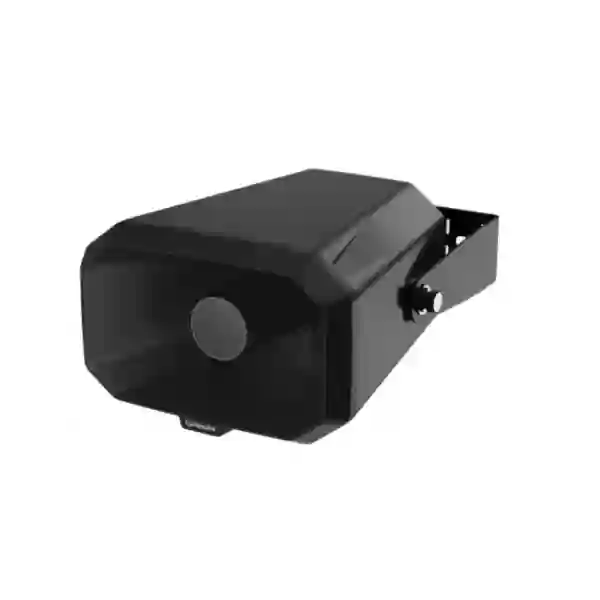
Hanwha Vision / IP audio / Black horn
Hanwha SPA-H200B IP horn speaker for directed speech
Understand the hardware, PoE installation, integration choices and critical Korea-only regional limitation before evaluating this network horn for a facility in Tanzania.
Key technical characteristics
Published specifications and limitations
| Exact model | Hanwha Vision SPA-H200B, black |
|---|---|
| Type | Network horn loudspeaker |
| Amplifier | Built-in 10W Class D |
| Maximum SPL | 125 dB (2026 manufacturer lineup) |
| Frequency response | 650 Hz–5.3 kHz |
| Power | IEEE 802.3af Class 3 PoE; IEEE 802.3at Class 4 PoE+ |
| Onboard memory | 1 GB; no microSD slot documented |
| Ingress protection | IP66 (Hanwha H200 presentation) |
| Dimensions | 241 × 155 × 307 mm |
| Mass | Approximately 3.7 kg |
| Region note | Korea-only documented; overseas guarantee excluded |
| Built-in TTS | Korean documented; other languages require confirmation |
What the Hanwha SPA-H200B is designed to do
The Hanwha SPA-H200B IP horn speaker is a black network-connected loudspeaker intended for directed voice communication. Its horn enclosure and built-in amplifier make it relevant when announcements must reach a defined listening area rather than provide pleasant music across a room. Possible design scenarios include a managed vehicle entrance, loading-bay approach, yard checkpoint or external operational zone. These examples describe potential applications, not guaranteed site coverage or proof of suitability. A buyer should begin with a clear message purpose, the people expected to hear it and the action they should take. Once those conditions are known, an installer can evaluate whether a horn speaker and the related IP audio system are the appropriate tools.
This product is not simply a conventional passive horn for connection to an arbitrary amplifier. It belongs to Hanwha Vision’s IP audio family, with a network interface, integrated amplification, internal memory and software-controlled functions. That can reduce the need for separate analogue loudspeaker runs, but places greater importance on an adequate PoE network, configuration, cybersecurity and system monitoring. The exact device model, firmware version and operating mode affect the finished installation. A successful quotation should cover both the physical speaker and the route by which an approved message reaches the correct zone. Without that larger view, a technically impressive device may be purchased without the means to use it reliably.
Tanzania regional status: verify before procurement
The H200-series manual identifies the device as a Korea-only product and says the manufacturer’s quality guarantee does not extend overseas. For Tanzanian procurement, this is a major consideration. A device may technically run on a standard Ethernet network while still lacking manufacturer-backed regional sales, repair or firmware support. Do not interpret the existence of a product brochure or an overseas retailer’s listing as confirmation that the exact SPA-H200B can be purchased and supported under local terms. Seek written clarification from a suitable authorized channel regarding the permitted country of use, applicable warranty, software branch, access to spares and support escalation path.
A procurement specification should state that the intended place of operation is Tanzania and ask suppliers to confirm whether a regionally supported alternative is more appropriate. Identify the full model and the support conditions of the unit that would actually be shipped. Require a written answer rather than relying on a generic promise that all Hanwha devices are internationally compatible. This page does not assert local price, stock, delivery arrangements, official authorization or country-specific warranty. These commercial facts remain unverified. When service continuity is important, regional availability may outweigh a narrow difference in published audio output, because a device that cannot be supported is a risk to the complete announcement system.
Verified performance characteristics
Hanwha’s 2026 lineup describes the SPA-H200B and white SPA-H200W with a 10W Class-D amplifier, a published maximum sound-pressure level of 125 dB, frequency response from 650 Hz to 5.3 kHz and 1 GB of internal memory. The same materials list IEEE 802.3af Class 3 PoE and IEEE 802.3at Class 4 PoE+ power. Another manufacturer presentation identifies IP66 ingress protection and dimensions of 241 by 155 by 307 millimetres, at roughly 3.7 kilograms. These figures help an integrator shortlist equipment, establish mounting loads and plan network power. They are manufacturer product characteristics, not a statement that a specific installation will achieve a given coverage radius or acoustic result.
Some independent seller descriptions give 124 dB, which differs slightly from the 125 dB figure in the more recent manufacturer lineup. The manufacturer figure is used here, but any project depending on a precise acoustic threshold should verify the current datasheet and measurement conditions. It is also important not to confuse the 10-watt amplifier rating with a ten-watt PoE switch allocation or with the sound-pressure value. Electrical input, acoustic output and listening distance are different engineering quantities. The correct design process reviews each separately, then validates actual speech intelligibility on site. A printed performance number is a starting point for calculations and tests, not the acceptance test itself.
Speech projection versus music reproduction
The published frequency range and horn enclosure point toward a speech-focused application. Short spoken instructions can benefit from directed acoustic energy in areas where ambient machinery and vehicle noise are present. Background music, however, places different demands on low-frequency reproduction, tonal balance and even listening coverage. Do not select this device as the default speaker for a restaurant, reception room or general music system simply because it has a high maximum sound-pressure rating. A ceiling, wall or pendant network speaker may better suit those tasks. The correct selection begins with whether the content is occasional speech, continuous programme audio or a mix that must satisfy both requirements.
A horn should be aimed at a planned listening area rather than toward a nearby person at maximum level. The sound at a point directly in front of the unit can differ substantially from what a listener hears near the edge of the intended zone or behind an obstacle. Volume alone cannot overcome every acoustic problem. Noise with similar frequencies to speech can mask words, while walls and canopies can create reflections. A practical listening test with the intended recording or microphone source is therefore more revealing than playing a single tone. The goal is understandable information at a responsible volume, not merely the loudest possible output.
PoE and PoE+ electrical planning
The H200B’s PoE and PoE+ capability can combine data and power on an appropriately provisioned Ethernet link. Hanwha publishes IEEE 802.3af Type 1 Class 3 and IEEE 802.3at Type 2 Class 4 support. Choose a compatible powered network switch or suitable injector and verify the per-port power allocation and the total supply budget. A multi-speaker system also needs headroom for other connected devices and any planned growth. The manufacturer general speaker configuration guidance recommends PoE+ where available. Check the actual operating mode and product documentation before assuming the maximum published acoustic output is available under every power condition.
For a remote gate, one Ethernet run can be simpler than installing a conventional loudspeaker amplifier circuit, but the cable must still be designed and protected. The product documentation describes a 10/100BASE-T RJ45 connection and Category 5e cabling, with a nominal copper run limit of 100 metres under the specified conditions. Long distances, exposed runs and poor terminations can create intermittent failures. If the mount is beyond a suitable link distance, redesign the topology using engineered network equipment instead of extending the cable indiscriminately. Power backup for the switch and upstream controller should also be considered where continuity matters, because PoE alone does not protect against an outage.
IP66 protection and installation integrity
Hanwha’s H200 product presentation lists IP66 ingress protection. This rating is relevant to dust and water jets under defined conditions and may make the enclosure suitable for some exposed locations. It is not a blanket statement about complete installations, chemical resistance, marine corrosion, submersion or lightning protection. Cable entries, plugs, gaskets, terminal covers and mounting points must all be installed according to current instructions. An exposed connector outside the protected enclosure can remain a weakness even when the speaker itself is rated IP66. Consider the whole assembly, including the upstream PoE equipment and any junction box, when reviewing environmental suitability.
The manufacturer’s illustrated manual identifies a wall bracket, waterproof cable entry, enclosure gasket, terminal cover, audio module and grounding terminal. These parts have practical consequences for service and maintenance. The installer should inspect seals before closure, avoid trapping cables, protect wall penetrations and retain the required cable bend radius. Grounding and surge protection should be specified by qualified personnel for the actual facility; the presence of a ground terminal is not proof of immunity to nearby lightning. Corrosive industrial atmospheres and unusual environmental exposures warrant separate engineering review. After commissioning, inspect exposed mounts and seals at appropriate intervals, particularly following nearby construction or severe weather.
The wider IP audio architecture
An IP horn speaker is one endpoint in a message-delivery path. Audio may originate from a suitable microphone, a controller-mode device, stored-file schedule, SIP system or configured event, depending on the installed architecture and version. Hanwha’s H200-family manual illustrates speaker and controller modes along with related audio functions. An integrator must establish which device acts as controller, which equipment supplies recordings, how zones are assigned and what the operator uses to initiate a page. A locally playing file does not establish that a facility-wide paging configuration is ready. The network diagram should show the full dependency chain from the triggering user or system to the listener.
System planning should also establish ownership. A security team might control live announcements, while an operations team approves scheduled messages and an IT team maintains the switch and firmware. Without clear responsibilities, common failures can go unnoticed. For every control path, define how an operator knows that a message was accepted, what occurs when two announcements coincide and whether the message should be logged. If a site has multiple buildings or separate networks, account for routing and permitted communication. Confirm scalability and compatibility for the actual control system instead of inferring them from unrelated product-family capacity figures.
SIP phone announcements and PBX links
The manufacturer’s H200-family manual documents SIP accounts and an example in which an IP PBX or VoIP phone calls an IP speaker. This provides a legitimate basis for evaluating telephone-originated paging. It does not establish universal compatibility with every PBX or the presence of all imaginable paging features. The integrator should verify registration behaviour, authentication, supported audio formats, call termination, priorities and expected firmware. A successful test with the actual office phone system is more valuable than a claim that both devices use SIP. Keep paging credentials separate from ordinary user access and restrict who can reach a broadcast zone.
Before buying, specify whether the use case is an individual announcement, a group page or a site-wide message. Test how the system behaves when an operator talks for a long time, disconnects unexpectedly or calls while a recorded announcement is playing. Decide whether calls must time out, whether a dedicated extension is required and who can override routine messages. A site can run into operational problems despite technically successful SIP registration if its call-flow rules are not defined. Document the approved dialling procedure for staff and test it after network or PBX upgrades. The exact H200 regional firmware must remain part of that verification.
Recorded files and audio-library management
The Korean H200-series manual documents WAV and MP3 audio management, chime functions and scheduled playback. That can be useful for recurring operational instructions without needing someone to speak each time. For an entrance, a recorded notice could explain where a vehicle should stop. For a yard, a schedule might identify a routine changeover or closed working area. The messages should be concise, actionable and approved by the person responsible for the process. Avoid long scripts that are difficult to understand amid background noise. Keep the source files as well as the versions uploaded to the speaker or controller.
Hanwha lists 1 GB of internal storage, and the product manual indicates that this horn variant does not support a microSD slot. The capacity does not tell a buyer exactly how many usable announcements can be stored without considering formats and lengths. The manual provides specific file constraints and upload options; verify them for the installed firmware. An audio library should record the content owner, language, approval date, revision and intended trigger for every file. Replacing an obsolete instruction can be as important as adding a new one. A device that plays an old procedure clearly can still mislead people.
English and Swahili language requirements
The manufacturer’s Korean H200 manual describes Korean built-in text-to-speech. English or Swahili text-to-speech must not be advertised for the SPA-H200B without exact-model confirmation. This distinction matters because typed phrases in a configuration menu are not necessarily spoken correctly by a given language engine. A Tanzania project should list every required operating language at the start of procurement. If operators need to type new English or Swahili sentences every day and hear immediate generated speech, the project may need a different manufacturer-supported product or a separately verified compatible system.
Where the announcement wording changes infrequently, a professionally prepared recorded file in English or Swahili may be a practical candidate. However, file playback, trigger behaviour and intelligibility must be tested rather than assumed. Check names, place references and pronunciation with actual intended listeners. Consider whether multilingual announcements become too long or repetitive at the target location. Important instructions might also require signs, radio communications or visual alerts. Language choices are an operational design decision, not simply an optional feature of the loudspeaker. Do not promise built-in multilingual speech generation based on the wider Hanwha IP audio family.
Event-triggered announcements
Hanwha’s IP speaker guidance describes playing an audio file in response to an alarm input, and the H200-family manual illustrates alarm connections. This makes event-led audio a possible design topic for a suitable control system. The integrator must confirm wiring ratings, contact type, required isolation and exact firmware settings before connecting any external equipment. An access-control or monitoring event can be the source of a trigger, but the speaker itself does not thereby become an access-control reader, video analytics camera or independent alarm sensor. Every external integration must be specified and tested on its own.
Useful event design includes more than choosing a sound file. Define the condition that starts the message, the delay, repetition limit, priority, stopping rule and what happens if the condition persists. An entrance alarm that repeats without limits can make people ignore warnings; a zone that plays an unrelated message can create confusion. Testing should include normal triggers, false triggers, controller outages and return to service. Keep a record of which systems are permitted to initiate announcements. When a trigger is safety-related, consult responsible safety professionals rather than treating an ordinary IP paging feature as automatic evidence of emergency-system compliance.
Scheduling and time configuration
A scheduled announcement is only useful when the clock and business calendar are correct. The H200-family manual describes scheduled playback functions and device time settings. A Tanzania installation should be configured and tested against its actual local working hours, including shift patterns, public holidays and exceptional operating days where relevant. An announcement at the wrong time can obstruct operations or cause unnecessary concern. Define the person allowed to change the schedule, and retain documentation showing when the last configuration review took place. Do not assume that every imported device ships with appropriate regional defaults.
Establish how operators pause, override or change a scheduled message when circumstances change. A delivery yard may have an unscheduled closure, while a facility entrance may operate different hours during an event. Verify whether local and central schedules can conflict, and decide which system has authority. Test behaviour after a power interruption and check that old alarms do not replay unexpectedly. A small written operations procedure is usually more helpful than a complicated schedule that only its installer understands. Scheduling should support real working processes, not merely demonstrate that the speaker has memory and a clock.
Surveying a noisy location
Before specifying the number of horn speakers, walk the intended listening area with the site owner. Identify background noise, moving vehicles, machinery, loading activity, reflective surfaces and physical obstacles. Mark where people normally stand or move when an instruction is needed. Drivers may be inside vehicles, and staff may wear approved hearing protection. These conditions can make messages difficult to understand even when the loudspeaker is powerful. Measure or evaluate noise during representative busy periods rather than making a decision during a quiet site visit. A simple site sketch and a set of listener positions can make an acoustic proposal much more meaningful.
Test voice with the real message type and an appropriate volume. Include listeners close to the horn, at the planned edge of coverage and behind common obstructions. Check whether the initial words are heard, whether consonants remain clear and whether the instruction can be understood without repeated listening. Avoid assuming a universal range based on the quoted maximum sound-pressure level. If speech clarity is poor, investigate aiming, height, quantity of zones, noise exposure and alternative speaker locations. Increasing volume indefinitely can produce discomfort or nuisance without fixing intelligibility. A successful acoustic installation means understandable information reaches the intended listeners.
Mounting height, orientation and structure
The Hanwha presentation describes the H200 body as approximately 241 by 155 by 307 millimetres and 3.7 kilograms, and its manual shows a bracket mount. A qualified installer must establish that the supporting wall or structure can carry the unit and withstand the expected environmental loads. Select fasteners for the actual substrate and verify maintenance access. Where mounting occurs above a public path or vehicle lane, prevent falling-object hazards during work. Cables should be planned before drilling, with enough clearance for access to the enclosure. A tidy installation also allows seals and mounting bolts to be inspected later.
Orient the horn toward the identified audience rather than allowing the convenient bracket position to dictate acoustic coverage. Consider reflections from hard building faces, barriers and low canopies. Avoid unnecessarily directing repeated announcements toward neighbouring properties or staff stations. Aiming should be confirmed through a practical sound test after the unit is secured. Record the final settings and photograph the installation for maintenance documentation. If the site layout changes, the original coverage assessment may no longer apply, so retest after new barriers, buildings or machinery alter the listening environment. Physical positioning is an engineering decision with ongoing consequences.
Ethernet cabling and network segmentation
The speaker uses a network connection and should be managed as part of the facility’s IT infrastructure. Assign an address plan and identify which authorized microphone, controller or management workstation needs access. Avoid placing its administration interface openly on the public internet. The network team should confirm relevant protocol flows using the exact firmware documents and allow only what the deployment requires. If network segmentation is used, test the intended traffic paths instead of presuming that a speaker connected to a powered switch can communicate with a controller elsewhere. Device discovery and ordinary message delivery are separate things to validate.
Outdoor Ethernet cabling must be protected from mechanical damage, moisture, unsuitable routing and accidental disconnection. Plan termination, strain relief, proper power-source placement and environmental protection for all intermediate equipment. Establish whose responsibility it is to restore the link if a switch is changed or a cable is repaired. For any crossing of buildings or exposed property boundaries, consult a qualified network professional about suitable media and surge arrangements. The project should record switch port numbers and device addresses, but keep sensitive topology details in secured operational documents. A correctly documented network makes future failures easier to isolate.
Cybersecurity and access management
Treat the H200B as an addressable device with configuration credentials rather than as a passive appliance. During commissioning, change or establish secure administrative credentials, document authorized accounts and review which personnel can trigger announcements. If SIP paging is used, its credentials and access restrictions deserve the same care as other business communications systems. Record the installed firmware and any approved update route for the exact Korea-region model. Because the H200 has a country-specific designation, do not blindly load firmware intended for a similar international model without manufacturer confirmation.
Consider how the speaker will be managed after staff changes, contractor handovers or network maintenance. An operator’s ability to issue a site-wide message is a permission worth controlling. Back up the configuration and maintain a current list of authorized devices and workflows. Where the firmware offers logs, incorporate them into troubleshooting and incident review as appropriate. Test the device again after significant firewall, PBX or controller changes. Strong passwords alone do not compensate for unnecessary internet exposure or an unclear ownership model. A responsible installation includes technical controls and operating procedures suited to the message’s potential impact.
Power loss and business continuity
PoE simplifies supply but places the speaker’s availability on the network power source. If the switch loses power, a reachable and intact horn may become silent. A control server, local router or origin microphone can also interrupt a message even when the speaker remains powered. A site with important announcement requirements should map these dependencies and decide which parts need backup power. Calculate expected UPS runtime against the full connected load rather than claiming that PoE makes the device resilient. Keep ordinary operational announcements separate from any special emergency system requirements that demand additional engineering.
A continuity test should examine what happens during a temporary network disconnection, a switch restart and restoration of power. Confirm the speaker reconnects to its intended controller, clock settings remain appropriate and required files can still be played. Establish a practical manual fallback for staff if IP paging is unavailable. For a large facility, consider whether different zones share a single point of failure and whether alternate communications are needed. The answer depends on the business impact of a missed message. The maximum sound-pressure figure does not say anything about system availability or recovery behaviour.
Scenario: vehicle entry or security checkpoint
A vehicle gate illustrates why message design and speaker placement matter. The desired instruction may be to stop at a line, wait for an operator or move to a different inspection lane. The speaker must address the correct approach, and the message should be short enough for drivers to understand before they reach a decision point. Cabins, closed windows, nearby engines and moving vehicles can reduce audibility. A site trial should include normal traffic conditions. A horn can be a useful candidate for this targeted task, but no claim of universal coverage through vehicle glass should be made without testing.
Plan the announcement source and operating rule. A guard might make a live page, or an approved access-system event might trigger a recording if the integration is verified. Decide what happens when a vehicle waits at the barrier, when two lanes become busy and when a temporary instruction changes. Staff should be able to prevent an obsolete automatic message. The operational design should also consider people on foot near the gate so that close listeners are not exposed to unnecessarily high levels. This example shows how a speaker decision connects to the whole traffic process.
Scenario: warehouse yard or industrial perimeter
In a warehouse yard, acoustic coverage can change as trailers, stacked goods and machinery move. Start with specific zones such as the loading approach, a controlled crossing or a designated assembly point rather than trying to cover a large property from an arbitrary high wall. A horn’s directional output may be useful, yet obstructions, engine noise and ear protection can reduce understanding. Operators should identify the action associated with each message and how staff will know which area it concerns. A general-purpose audio system is not a substitute for appropriate physical controls and safety procedures.
Differentiate routine reminders from urgent warnings. Routine content might be scheduled or played by an operations supervisor, while any safety-critical trigger should be evaluated under the relevant safety-system requirements. Do not claim that this model provides certified evacuation broadcasting merely because it can play a loud recording. Where people cannot reliably hear a warning, consider signs, visual alerts or other approved communication paths. The speaker may be one element in a broader operational system. Surveying the site and testing representative messages helps prevent a well-intentioned installation that is technically active but operationally ineffective.
Scenario: campus or multiple buildings
Facilities with several buildings often need zones, controlled user permissions and agreed message priority. One department may page a loading area while another needs to reach an outdoor entrance. A network audio design can organize those destinations if the selected controller, topology and supported speaker firmware are compatible. Establish which staff can call individual zones and who may broadcast site-wide. A requirement for synchronized large-scale paging must be validated using the entire proposed system rather than inferred from the speaker’s catalogue entry. Document the tested design before making a large order.
Not every location on a campus needs a horn. Indoor corridors may benefit from ceiling or wall speakers, while exposed entrances may require a directionally mounted unit. A mixed system should maintain a consistent operator procedure even as the hardware changes by zone. The H200B’s Korea-only designation makes regionally supported alternatives particularly important for long-lived, distributed projects in Tanzania. Ask the supplier to show a proposed architecture with exact supported models, power distribution, controller versions and a pilot acceptance plan. A single successful demonstration is useful but does not confirm indefinite support at every location.
Choosing between H200, H100 and other speaker styles
Hanwha groups H200B and H200W together as black and white finishes of the H200 horn series in the reviewed materials. The H100 horn family appears in international manufacturer catalogues, whereas the H200-series manual states a Korea-market limitation. This distinction should be considered before selecting an otherwise similar-looking unit. Do not transfer firmware support, built-in languages, warranty terms or certification from one model family to another. If the Tanzanian application can be fulfilled by a manufacturer-supported alternative, evaluate that alternative on its own documented features and regional terms instead of assuming model interchangeability.
Speaker form should follow the room or area. A horn is often considered for aimed speech over an exposed approach; a ceiling speaker may be more appropriate where many indoor listeners require even distribution; a wall or pendant model can suit other mounting geometries. The evaluation should compare speech clarity, mounting constraints, ingress protection, power requirements, control integration and the support path. Avoid selecting purely on output watts or one decibel number. A total-system quotation with accepted testing criteria gives more purchasing confidence than an isolated equipment comparison. The colour of the enclosure is generally a later decision.
Procurement specifications and quotation scope
An effective enquiry names the exact requested product, operating country and intended use. For SPA-H200B, explicitly ask whether a Korea-only device can be supplied and supported in Tanzania, and request a supported alternative if not. State the number of intended announcement zones, approximate listening areas, background-noise conditions and whether the messages will be live, recorded, scheduled or event triggered. Identify the language or languages listeners require. Include existing PoE+ capacity and the intended control or PBX platform where known. These details help a supplier provide an engineered response rather than a generic product price.
A quotation should separate loudspeakers, network power equipment, control or microphone hardware, required software, cabling, protective accessories, commissioning, training and any maintenance arrangement. Require written regional warranty and support conditions. Do not treat a seller’s price in another country as a valid Tanzanian selling price, or infer stock from a public specification brochure. Ask who prepares and approves announcements, who tests site coverage and what the acceptance criteria will be. Where local taxes or delivery terms matter, those should be verified through an actual quotation, not estimated from unrelated overseas listings.
Commissioning checklist and acoustic acceptance
Before a device is handed over, verify the model label, enclosure condition, mounting security, power-source compatibility and correct network termination. Establish the approved IP address, time settings, administration credentials and firmware version. Confirm that the intended controller or call origin can reach the speaker. Inspect cable entries and gaskets for proper closure. Recording a photograph and a simple port-to-device map can help future maintenance. The installer should not regard a link light or audible test tone as proof that the required announcement service has been commissioned. Each planned operating path requires its own controlled test.
Play an approved local file, make an authorized live announcement if one is required and test any scheduled or event-led message. Verify correct zone selection and sensible response when messages overlap. Walk representative listening positions while the site operates normally and adjust aiming or output as needed. Document any position where the words are not understood and resolve the problem before acceptance. Then test recovery after a restart and confirm the responsible personnel know how to report faults. For urgent communication, involve the appropriate qualified safety reviewer. Good commissioning validates human understanding as well as technical connectivity.
Ongoing inspection and content changes
A functioning network speaker can become unreliable when cables are moved, switches are replaced or configuration settings drift. Establish regular reachability and audio checks according to the importance of the service. Review external brackets, weather seals, cable sheaths and exposed junctions for deterioration. If the device is near construction or heavy vehicle movement, inspect after changes that could alter coverage. Keep firmware information and configuration backups controlled. Maintenance should involve both IT staff and the facility owner because network health and audible performance are different dimensions of reliability.
Every recording should have an owner and a review date. An outdated gate instruction or old evacuation-route message may be more harmful than silence. When site procedures change, update and re-test the relevant file and remove obsolete copies from local storage or control servers. Revoke paging access when staff responsibilities change. Confirm that schedules remain suitable after operating-hour changes. Retest audio after replacing a device or adjusting its bracket. These practical measures keep the system aligned with its real purpose: providing clear and appropriate spoken information when people need it.
Frequently asked: is it suitable for outdoors?
The H200-series enclosure is listed by Hanwha at IP66 and the horn form is relevant to some exposed voice-paging applications. Suitability depends on correct installation, environmental conditions, acoustic coverage and network protection. IP66 does not cover every cable joint or establish corrosion resistance. For Tanzania the Korea-only support limitation must be resolved as a separate purchasing issue. Use a site survey and an actual listening test rather than claiming an arbitrary maximum range.
Can the speaker work on PoE? Yes: Hanwha publishes PoE and PoE+ support, although the switch power budget and expected performance mode need verification. Does it include an amplifier? The manufacturer describes a built-in 10W Class-D amplifier. Neither fact establishes compatibility with a particular external controller, microphone or telephone system. Specify the whole audio path and confirm it during commissioning. An IP horn is more than a passive loudspeaker but still needs suitable network infrastructure.
Frequently asked: languages, files and PBX
Does SPA-H200B have native English or Swahili text-to-speech? The reviewed Korean H200 manual documents Korean for its integrated text-to-speech; other languages should not be assumed. Prepared English or Swahili recordings may be evaluated through the documented audio-file features, but the exact file and trigger workflow must be tested. Can files use a microSD card? The manual says this horn does not support a microSD-card slot and relies on internal storage. Keep backup copies of approved recordings outside the device.
Can it receive SIP paging from an office phone? The manufacturer’s H200-family manual documents SIP accounts and a VoIP/PBX announcement scenario. Test compatibility with the specific telephone system, firmware, authentication and priority requirements. Can an alarm contact trigger playback? Manufacturer speaker guidance describes alarm-input audio workflows, subject to exact-model wiring and configuration verification. None of these capabilities means that an arbitrary third-party device will integrate without work, or that the speaker is a certified life-safety controller.
Frequently asked: warranty, price and safety use
What does the SPA-H200B cost in Tanzania? No exact FourTeck Tanzania price or availability has been verified, so a quotation is required. What warranty applies? The Korea-only documentation says quality is not guaranteed overseas; the buyer should obtain written country-specific terms rather than assuming a domestic Korean warranty travels with the product. What is the distinction between H200B and H200W? Hanwha publishes the pair as black and white variants of the H200 horn family. Confirm the exact proposed unit and firmware.
Is the H200B approved as a fire evacuation speaker? No certification for such a Tanzania deployment has been established by this research. A loud horn, stored files and alarm connections do not by themselves constitute a certified emergency voice-alarm system. Safety-critical applications may require approved equipment, monitoring, redundancy and project-specific design by qualified specialists. Request evidence for the whole system and the relevant local rules. The sensible purchasing path is to verify regional support, languages, acoustic design and operating obligations together rather than make a decision from one marketing number.
Next step: request a supportable project proposal
If your facility needs directed IP voice announcements in Tanzania, send the prospective supplier a short brief describing the area, listener positions, noise environment, preferred languages, number of zones and desired audio trigger. Ask for a written response on whether the Korea-market Hanwha SPA-H200B IP horn speaker is eligible for use and support at the intended site. If it is not, request an appropriate regionally supported alternative. A full proposal should state the actual equipment and firmware, country-specific service terms, network power requirements, integration approach and a practical commissioning test.
FourTeck Tanzania’s verified enquiry process can be used to request a technical suitability review and project-specific quotation. No local stock, office location, service coverage, delivery time or warranty is promised by this informational page. The objective is to specify the right communication system and ensure the intended audience can understand the correct message in real working conditions. Before ordering, confirm compatibility and the complete bill of materials with the responding supplier. Never send administrative passwords, SIP credentials or sensitive network configuration details through an unverified public channel.
Request a technical suitability review
Share the site conditions and intended languages through FourTeck Tanzania’s verified contact route. Ask for written confirmation of the supported region, warranty, network power, control workflow and site-testing plan before purchase.




Reviews
There are no reviews yet.