
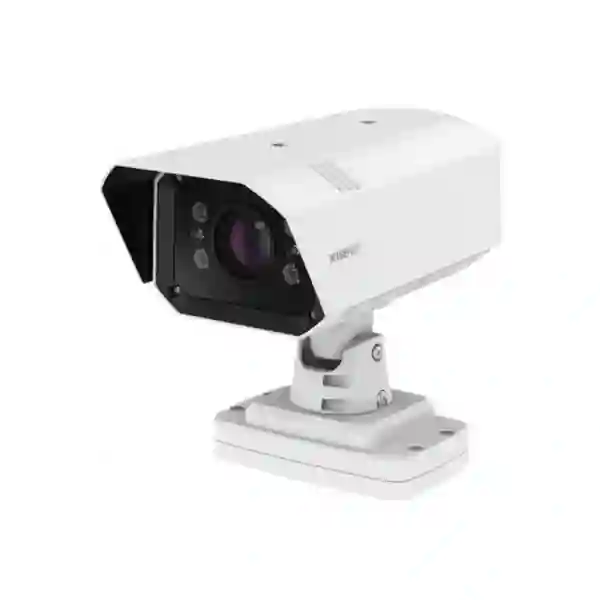
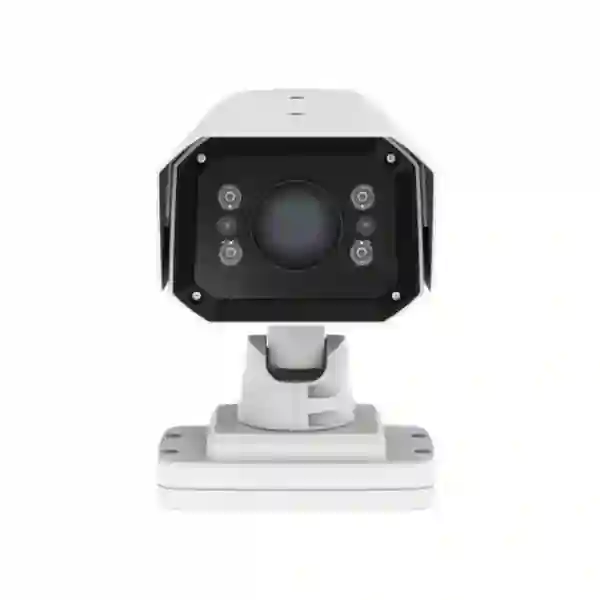
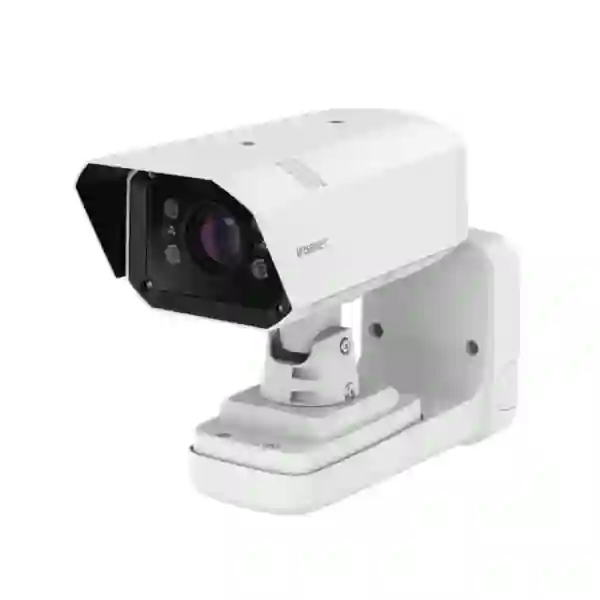
Hanwha TNO-7180RLP 3MP high-speed LPR camera
A purpose-built network camera for vehicle and plate image capture, with a 3MP global-shutter sensor, 18x motorized lens, integrated infrared and Wisenet Road AI application. Because Hanwha has discontinued this model and Tanzania is not on its published Road AI recognition-country list, confirm lifecycle and local plate recognition before relying on automated ANPR.
Important before ordering
Manufacturer status: discontinued; named successor: PNO-A9311RLP. The published supported-country list for this model’s Wisenet Road AI application does not list Tanzania. Request written regional compatibility confirmation and a representative demonstration before specifying automatic recognition of Tanzanian registration plates. No local price, stock, warranty or deployment service is represented here.
Technical highlights at a glance
What this camera is—and what a Tanzania buyer must verify
The Hanwha TNO-7180RLP is a specialist, high-speed network bullet camera designed around vehicle and number-plate capture rather than general scene coverage. Hanwha Vision specified a three-megapixel global-shutter imaging system, a motorized long-range lens, infrared illumination and a preinstalled Wisenet Road AI application. In a region supported by the relevant application license, its intended role is to record vehicle passages and make searchable details available to an operator. Its specifications make it interesting for projects that need a tightly framed view of moving vehicles rather than a wide overview of a car park or roadway.
There are two critical checks before a Tanzanian buyer plans an installation around this exact model. Hanwha Vision marks the TNO-7180RLP as discontinued and identifies the PNO-A9311RLP as its replacement. Furthermore, Tanzania does not appear in the published country list for the TNO-7180RLP’s Wisenet Road AI number-plate recognition capability. This is not proof that no solution can be engineered, but it does mean automatic recognition of Tanzanian plates must not be promised. Ask for current manufacturer confirmation, license and firmware applicability, and a sample-plate demonstration before purchasing or approving an ANPR project.
Choosing for plate capture rather than general surveillance
A normal surveillance camera may provide excellent pictures of a street yet fail to produce characters that a recognition engine can reliably interpret. Plate capture requires a predictable target size, exposure suited to the vehicle’s speed, controllable lighting, and a view that does not excessively distort the plate. The TNO-7180RLP approaches those requirements with dedicated optical and imaging hardware. It is appropriate to evaluate when the desired evidence is a passing vehicle at a known point, such as an access approach or road segment, rather than everything occurring across a broad yard.
Start procurement by specifying the actual task. Does the organization need a legible plate image for a human to review, automated text extraction, a vehicle classification estimate, or an event that triggers another system? These are related but different deliverables. A sharp stored image does not establish that an OCR engine supports the country’s plate format. An analytics event does not prove that barrier access is integrated. Document the minimum result, operating hours, vehicle direction, lane arrangement, image retention and response workflow before selecting the camera and software together.
Three-megapixel global shutter: why it matters
The camera uses a 1/1.8-inch CMOS imaging device with a global shutter and offers a maximum listed resolution of 2048 by 1536 pixels. With a global shutter, the frame is exposed together rather than progressively scanned from one edge to the other. That design is helpful when fast objects pass through a controlled viewing area and skew or distortion would make plate characters harder to inspect. It should be treated as an enabling characteristic, not an automatic guarantee of readable characters at every speed, weather condition or installation angle.
Exposure selection remains fundamental. The published shutter-speed range reaches 1/12,000 second, although practical settings depend on illumination and the recognition objective. A very short exposure can reduce motion blur but also reduces captured light. Raising image gain may brighten the result while adding noise, particularly when plates and headlights create difficult contrast. A commissioning technician should inspect actual vehicles by day and night, adjust focus and exposure under moving conditions, and confirm that both the vehicle context and plate region remain usable. Static showroom images are a poor substitute for field validation.
The 6.8–120 mm motorized varifocal lens
The optical system spans 6.8 to 120 millimetres with an 18-times motorized zoom ratio. Hanwha specifies a horizontal angle of view from approximately 54.5 degrees at the wide end to 3.4 degrees at the telephoto end. This substantial range allows the installer to tune the capture area without moving the camera for every adjustment. At a distant road approach, a narrower field may put more plate pixels on the sensor; at a closer position, a wider setting can help include the target vehicle and lane.
More zoom is not always better. A narrow view can cause vehicles to pass through the frame too quickly, omit useful vehicle context or make mounting vibration more visible. A wide view may include too many pixels that do not contribute to plate recognition. The right setting depends on distance, target dimensions and the direction of travel. Establish a marked capture zone, test vehicle paths and verify that plates occupy sufficient image detail throughout the zone. The lens specification is a configuration resource, not a promise that every roadside location can be covered.
Frame rate and practical motion handling
The published detailed specification lists H.265 and H.264 recording at up to 55 or 50 frames per second in the 3MP mode, depending on frequency setting, and up to 60 or 50 frames per second in the 2MP mode. The manufacturer’s brief feature banner uses a broader 60 fps claim, so buyers should use the detailed mode-specific figures when sizing the deployment. MJPEG has a lower listed maximum of five frames per second. These figures describe supported video modes, not the number of successfully recognized plates per second.
A higher frame rate gives more chances to capture a passing vehicle during the available window, but the setup still depends on shutter speed, illumination, network throughput and application processing. Verify that the preferred codec and resolution are supported by the recorder or video-management platform, and that the installation can retain the required data. For technical acceptance, check a stream using the actual chosen profile. Avoid assuming that the headline frame-rate figure and every advanced analytical feature will operate at maximum settings simultaneously.
What Wisenet Road AI is intended to provide
The TNO-7180RLP has a preinstalled Wisenet Road AI application intended for number-plate recognition and vehicle make, model and colour analysis in supported regions. The manufacturer also describes event lists and search by recognized attributes. This is a more specific workflow than asking an operator to rewind hours of video and visually scan traffic. An adequately configured system can be assessed for its ability to connect a captured passage with vehicle details and searchable evidence.
Feature availability is conditional on the licensed application, relevant regional package and the accuracy of the underlying recognition. Detection, character reading, vehicle classification and record search should be verified separately. A vehicle could be detected even when the plate is unreadable; a clear plate image could exist where the recognition package does not support the local format. Operators should retain a route for manual review and correction, especially for disputed incidents or operational decisions. Do not use unverified analytics output as the sole basis for automated enforcement or denial of entry.
The Tanzania recognition limitation is a procurement gate
Hanwha Vision’s published TNO-7180RLP specification includes an explicit list of countries supported by its Wisenet Road AI application. Tanzania is absent from that list. Accordingly, a project in Tanzania should treat this device’s built-in automatic plate-text recognition as unverified for Tanzanian registrations. The distinction matters because recognizing letters and numbers in a demonstration using another country’s plates does not establish coverage for local layouts, spacing, fonts, reflective finishes or registration patterns.
Before a purchase order, request written confirmation from the manufacturer or qualified technology provider identifying the exact camera firmware, Road AI application version, license territory and plate formats in scope. Ask for an acceptance demonstration on representative Tanzanian vehicles, including common plate variations and difficult lighting. If the intended use is only video capture, define that separate goal explicitly and do not pay for an assumed OCR capability. If automatic recognition is mandatory, evaluate an appropriately supported alternative or a separately verified processing solution rather than assuming an unsupported configuration will work.
High-speed roads and the published capture envelope
For the high-speed use case, Hanwha’s published parameters describe up to two lanes, an indicated vehicle speed capability of up to 200 kilometres per hour, and a forward capture distance of approximately 27 to 46 metres. The guidance also lists maximum horizontal and vertical viewing angles of 15 degrees, a horizontal offset up to four metres, and a camera height up to seven metres. These are manufacturer-stated reference conditions for the relevant solution profile; they are not unconditional performance guarantees for a real roadway.
Treat these dimensions as a starting geometry for engineering, not a template to copy blindly. Actual traffic may occupy an uneven lane width, approach at changing angles, or include buses and trucks whose plates appear at different heights. A site drawing should mark the expected vehicle paths, camera mounting point, capture region and possible obstructions. If a location cannot meet the suggested geometry safely, rethink the placement or technology rather than relying on software corrections to repair severely angled or undersized plate images. Any relevant road-owner permissions must also be resolved before physical works.
When two-lane coverage is not the right design
The stated upper limit of two lanes should never be read as proof that one device will reliably identify every vehicle in two arbitrary lanes. Occlusion, speed variation, following distance, vehicle size, changing shadows and lane crossings can all reduce useful image opportunities. A large vehicle in the near lane may obscure the plate of a smaller vehicle behind it. At night, a mixture of headlights and reflective plates can create additional exposure tradeoffs. These practical effects must be observed rather than inferred from a catalogue table.
Where failure to capture an event would have a high operational cost, compare a single-camera concept with separate cameras for individual lanes or travel directions. Multiple views may improve capture opportunities but add power, network, mounting and recording costs. Decide how duplicate observations will be handled and whether timestamps from the devices are synchronized. The decision should follow a site-specific trial with representative traffic, not a generic claim about lane count. Confirm all regional recognition dependencies independently from the physical camera coverage.
Infrared illumination and night capture
Hanwha lists built-in 850-nanometre infrared LEDs with an IR viewable length of 50 metres. Integrated lighting can support imaging when ambient light is low, but the stated distance is not a guarantee of reading a licence plate at every position within that radius. Reflective plate materials, the orientation of a vehicle, dirty covers, rain, glare and nearby lights can change the apparent contrast dramatically. Exposure settings suitable for plate characters may also make the surrounding vehicle or scene appear darker.
Night commissioning should include real movement, not just an inspection of a stationary plate. Test a range of typical vehicles, travel directions and speed profiles. Check whether headlights cause flare, whether retroreflective plates are washed out and whether dust or insects near the illuminator create distracting reflections. Mounting position and optical alignment often solve more problems than increasing brightness. If supplemental lighting or separate overview cameras are considered, design them as a coordinated system and check electrical and maintenance implications before approving the final equipment list.
Outdoor construction and environmental constraints
The camera housing is listed with IP66 ingress protection and IK10 impact resistance, alongside NEMA 4X and NEMA TS 2 references on the manufacturer’s specification. Its published operating range is minus 40 to plus 55 degrees Celsius with non-condensing humidity conditions. These ratings provide useful evidence for assessing an outdoor enclosure. They do not remove the need for appropriate cable sealing, surge protection, secure mounting or inspection after exposure to dust and storms.
For a Tanzanian installation, assess the specific microclimate rather than relying on a national generalization. Consider direct sunshine, rooftop heat, salt exposure at a coastal location, persistent dust near a road, drainage around the cable entry and wind loading at the pole. The stated environmental ratings do not represent a locally verified regulatory approval. An enclosure can meet a published ingress rating while a poorly installed junction or connector becomes the weak point. Include cleaning access and safe maintenance procedures in the physical design so the optical window and mount remain usable over time.
Power input: PoE++ or 12 V DC
Hanwha lists two power options: PoE++ to IEEE 802.3bt Type 3, Class 6 and a 12-volt DC input. The detailed specification gives a maximum power figure of 50 watts for PoE and 47.5 watts for 12-volt operation. It also expressly notes that a suitable high-power PoE power supply is not included. This means that a familiar basic PoE switch should not automatically be assumed to power the unit, particularly when the infrared illumination and other functions are active.
Create a power budget for the complete installation, including the camera, any injector or switch, fibre equipment, network cabinet and upstream backup power. Check the actual supplied voltage and power class under load, cable length, conductor quality and installation method. Where intermittent electricity could interrupt a security workflow, define the desired backup duration and event recovery behaviour. Make any backup-power promise contingent on the chosen battery or generator system. Procure mounting hardware and power accessories only after confirming exact compatibility with the equipment and location.
Network video, codecs and storage architecture
The TNO-7180RLP provides gigabit-capable RJ-45 connectivity and lists H.265, H.264 and MJPEG encoding. WiseStream II is included among the available video-stream technologies. It also supports multiple profiles and common video-network protocols, so an integrator has options for separating an operator preview from a recording stream. The benefit of this flexibility depends on the actual recorder, available bandwidth, chosen frame rate, retention requirements and network configuration.
Design for the evidence the organization needs to preserve. Some operators may only require selected vehicle-event images, while others need continuous footage around each event for context. These choices affect storage volumes and retrieval speed. Define how video is time-stamped, where clips are retained, how data is backed up and who can export a record. Consider the connection between the roadside location and the control room, including outages and network segmentation. Estimate bandwidth using a real test profile, not an unsupported universal megabits-per-second number.
On-camera microSD is not unlimited video retention
Hanwha specifies a preinstalled 32 GB microSD card and describes support for up to 10,000 LPR or vehicle images. This is a useful edge-storage facility, but it is important to understand what is being counted. A capacity claim for selected captured images is not the same as a guarantee of continuous high-resolution video retention for a given number of days. Image size, event frequency, overwrite policy and the selected application all affect what remains available.
Before commissioning, agree on how long event images and associated metadata must be retained. Confirm whether an event remains searchable after local storage fills, how the system handles temporary disconnection and whether recovery or export is required. A network video recorder or central archive may be justified where organizations need long investigations or auditable evidence chains. Regularly test retrieval, not merely recording. Any retention period must follow an approved business purpose and applicable privacy requirements; this page does not assume a particular legal retention rule for a Tanzanian operator.
Integrating with video management and third-party systems
The manufacturer lists ONVIF Profiles S, G and T, as well as SUNAPI and an open-platform environment. These interfaces make interoperability worth evaluating, but protocol support does not prove that a particular access-control package, checkpoint database or security-management dashboard can consume every specialized Road AI event. Video connectivity and structured vehicle-data integration should be specified and tested as separate deliverables. A recorder accepting an RTSP stream, for example, may still need additional integration work for plate-search workflows.
Ask an integrator to demonstrate the exact actions required: receiving a vehicle event, presenting a plate image, searching by approved metadata, linking the event to the corresponding video clip and exporting evidence with timestamps. If an organization wants to trigger a barrier or alert, test latency, duplicate events, mismatched reads and safe behaviour during network failure. For Tanzania, ensure that the core recognition question is resolved before designing operational automations around its output. Document who maintains each interface and how upgrades will be evaluated.
Cybersecurity and accountable access
Hanwha’s technical listing names security features including secure boot, signed firmware, device certificates, encrypted credentials and HTTPS-related communications. These capabilities can support a controlled deployment, but their presence alone does not make an installation secure. Configuration, credential hygiene and the surrounding network remain decisive. An exposed management interface, shared account or outdated recorder can undermine otherwise capable camera hardware.
Plan individual operator accounts, role-based access to recordings, secure administrative procedures, change logs and periodic account review. Keep cameras on appropriately segmented networks and avoid unnecessary internet-facing access. Confirm available firmware and application support for a discontinued model before committing to long-term operation; published firmware files do not establish indefinite future maintenance. Agree who is responsible for updates, configuration backups and incident response. If plate records are personally or operationally sensitive, limit their access and document how exports and deletions are authorized.
Use case: controlled vehicle entry and industrial checkpoints
An industrial gate or logistics checkpoint often presents a defined lane where vehicles slow down, allowing the project team to control the viewing angle and lighting more easily than on an open road. The TNO-7180RLP can be evaluated for high-detail image capture at such a point, particularly when a number plate and a vehicle overview need to be associated with a movement record. A gate project should still begin with the physical arrangement, vehicle queue and the customer’s decision workflow.
If a site expects automatic plate recognition for Tanzanian registrations, the unsupported-country caveat remains critical even at low speed. Do not treat a gate environment as a workaround for unverified character recognition. Consider manual verification by a guard, an appropriately supported plate-reading product, or a validated separate recognition component where the operating requirement demands searchable plate text. A successful installation plan must also account for pedestrian safety, visitor processes, emergency access and a manual fallback if the camera, network or integration is unavailable.
Use case: road traffic observation and incident review
For road observation, the value may lie in obtaining detailed visual records of vehicle passages rather than triggering immediate access decisions. Dedicated plate capture can complement a wider-area overview camera, with the two perspectives answering different questions. The specialist unit is aimed at a defined vehicle target area; an overview camera documents roadway context, incidents, pedestrians or activity outside the narrow capture zone. The appropriate mixture depends on the investigation and operational objectives.
A road project needs additional care with camera placement, permissions, maintenance access and any applicable rules for collecting vehicle data. Clarify whether the intended users are security staff, a facility operator or an authority acting under its own governance requirements. Define how evidence is reviewed, how errors are challenged and whether information may be shared externally. Do not infer that a camera’s headline speed capability authorizes its use for speed enforcement. The presence of a plate-reading feature also does not confer legal authority to operate an enforcement system.
Use case: campus, parking and multi-building vehicle records
A campus or large premises may need to trace vehicle arrivals and departures for security review, incident investigation or visitor coordination. In such deployments the difficulty is often not peak speed but lane layout, dense traffic, glare from nearby lighting and multiple possible routes through a site. Before choosing hardware, map how vehicles really enter and leave, including staff gates, delivery routes and occasional changes during events or maintenance.
For a parking application, decide whether the organization needs an image archive, exact registration text, an approved-access list or a count of vehicles. Each outcome has different software requirements. The TNO-7180RLP’s listed application includes recognition and allow/deny concepts for supported regions, but those functions should not be assumed valid for Tanzanian plates without confirmation. A well-defined deployment also needs procedures for damaged or covered plates, temporary registrations, manual overrides and vehicles that do not pass through the expected capture zone.
How to build a useful pilot before committing budget
A pilot should reproduce the intended installation conditions rather than showcase the camera under ideal lighting in a conference room. First, choose one representative lane or passage point and document the mounting geometry. Second, establish the precise success criteria: legible saved image, correctly recognized text, searchable event, integration response or a combination. Third, obtain manufacturer confirmation of regional application support. Fourth, test during representative daylight, dusk and night periods with the actual types of vehicles expected on site.
Create a simple results log that distinguishes missing captures, unclear images, unreadable plates, wrong characters and incorrect vehicle attributes. Include borderline conditions such as headlights, dust, closely spaced traffic and partial obstruction where safe to test. Capture both successful and unsuccessful examples so the team can tune the lens, exposure and mounting location using evidence. Agree pass criteria before the test begins and have the people who will actually operate the system review the interface. If core regional recognition support cannot be established, stop short of approving an automated plate-reading requirement.
Commissioning and acceptance checklist
Good commissioning begins with an as-built diagram and a record of the device model, firmware, application version, network settings and power source. Confirm that the mounting is secure, cables are protected, illumination reaches the intended zone and the time source is accurate. Test every expected recording and search pathway using real movement. Verify that the camera and any central system recover correctly after temporary loss of power or network communication, since those events are common causes of gaps in evidence.
Acceptance documentation should state exactly what worked and what remains excluded. Do not sign off on ANPR merely because the camera delivered a sharp vehicle image. If a local registration is read successfully, test enough additional examples to avoid treating an isolated success as proof of general coverage. Record what happens when recognition confidence is low and who decides whether a result is actionable. Where the system interfaces with gates or alarms, test manual overrides and safe default behaviour. Preserve the final configuration and training materials so future support staff can reproduce the validated results.
Daily operation, maintenance and service planning
Roadside optics need periodic inspection. Dust, water marks, insects, vibrations and accidental changes to a pole can degrade results gradually while the video stream continues to appear operational. Create a schedule for cleaning the lens window safely, inspecting power and cable connections, confirming time synchronization and examining representative plate images. Trend a small set of practical measures such as image clarity and event retrieval success rather than relying only on an online/offline status indicator.
Maintenance should include checking available storage space, verifying backup or export routines and ensuring that operators can find a past event without special assistance. Keep documentation for any adjusted zoom, exposure or analytics zone so troubleshooting begins from a known baseline. Because this model is discontinued, ask the responsible supplier about obtainable spare parts, application licensing status and the implications of any firmware changes. Do not promise replacement stock, manufacturer warranty coverage or support timelines unless they are confirmed for the exact purchase and service agreement.
Discontinued model versus the named successor
Hanwha Vision explicitly identifies the PNO-A9311RLP as the replacement model for the TNO-7180RLP. That makes lifecycle status central to the buying decision. If the requirement is a new, long-term installation, assess the successor’s current documentation and regional support before treating the older product as the default specification. The correct choice is not simply the product with the highest resolution or most recent release date; it is the equipment and application combination that has a confirmed path to delivering the stated recognition or evidence workflow.
Do not assume the replacement has identical optics, power requirements, mounting accessories, application licences, country coverage or integration behaviour. Each must be verified from its own technical information and through the target deployment. If a buyer already owns TNO-7180RLP cameras, a service or replacement evaluation can begin with the installed base and its historical configuration. If procurement seeks an entirely new batch, request a side-by-side statement of lifecycle, regional ANPR support and project acceptance conditions. This helps avoid investing in hardware before the essential software fit is established.
Quote preparation: information a buyer should supply
A useful enquiry should contain the intended location type, not merely the model name. State whether the installation is on a highway, private road, logistics yard, campus or gate, and whether traffic passes in one direction or both. Provide estimated vehicle speeds, the number of lanes, mounting constraints, day/night operation and the minimum capture distance. Where possible, supply a site sketch with the lane orientation and expected plate position. This allows a technical reviewer to identify geometry or power issues before equipment is ordered.
Also specify the desired outcome: readable plate pictures, automated Tanzanian plate-text recognition, searchable vehicle attributes, access-control triggers or centralized recordings. Include planned storage duration, network availability, any existing video-management system and the required commissioning test. Ask separately about manufacturer lifecycle, territorial licence rights, replacement model suitability, compatible power equipment and physical accessories. Stock, price, delivery, installation service and warranty are matters for a verified quotation, not assumptions made from the camera’s published specification. A precise enquiry makes a more useful and accountable proposal possible.
Questions buyers ask
Is the Hanwha TNO-7180RLP still a current model?
No. Hanwha Vision’s current listing marks the TNO-7180RLP discontinued and names the PNO-A9311RLP as its replacement. A quotation for the older unit should confirm whether the exact hardware is obtainable and what support or replacement arrangements apply. The manufacturer designation is not evidence of local stock.
Will its built-in ANPR read Tanzanian number plates?
That outcome has not been verified. Tanzania is not included in the manufacturer’s published supported-country list for this camera’s Wisenet Road AI application. Require written confirmation of the appropriate license and representative Tanzanian plate tests before making automatic recognition a contractual requirement.
Can the camera still capture vehicle images without verified local OCR?
The device is designed to produce video and vehicle images, subject to normal installation and configuration. Image capture and automated recognition of plate characters are distinct functions. If visual review is sufficient, define an image-quality acceptance test without implying automatic local number-plate recognition.
How many traffic lanes can one camera cover?
The manufacturer lists up to two lanes for its specified high-speed solution conditions. That number is not a guarantee for any site. Vehicle occlusion, offsets, mounting angle, lane separation, speed and lighting can justify a different layout or additional views.
What recognition speed is advertised?
Hanwha publishes an upper vehicle speed figure of 200 km/h for the stated high-speed, two-lane profile. It is a condition-specific technical figure, not a promise that every plate will be correctly read at that speed. The intended mounting geometry and regional recognition support must both be verified.
What optical zoom does it have?
It has a 6.8–120 mm motorized varifocal lens with an 18x zoom ratio. The installer uses this adjustment to frame the target capture region. The correct focal length depends on distance and lane geometry, not solely on the longest available zoom setting.
Does the camera support night operation?
The specified built-in infrared viewable length is 50 metres, and the camera provides day/night functionality. A practical night test remains necessary because reflective plates, headlights, environmental conditions and shutter settings affect the usefulness of captured images.
Does a regular PoE switch provide enough power?
Not necessarily. The listed input is PoE++ to IEEE 802.3bt Type 3, Class 6, or 12 V DC, with maximum power requirements higher than many basic PoE ports. The manufacturer notes that the high-power PoE supply is not included. Verify the exact network power budget.
Does the included 32 GB card replace a recorder?
Not automatically. Hanwha describes the preinstalled card as edge storage supporting up to 10,000 LPR or vehicle images. It does not establish a fixed number of days of continuous video. Decide retention, export and central recording requirements separately.
Can it connect with my existing VMS?
The technical listing includes ONVIF Profiles S, G and T and other network interfaces, which can help video integration. However, the actual recorder’s support for video streams and specialized recognition metadata must be tested as separate requirements. Do not infer integration from a logo alone.
Should a new Tanzania project use the replacement instead?
The PNO-A9311RLP is the manufacturer’s stated successor and deserves consideration for a new deployment. That does not automatically confirm local number-plate recognition, accessory compatibility or software entitlements. Evaluate the successor’s current regional support and sample plate results before making a choice.
What should an enquiry include?
Provide lane count, traffic speed, mounting distance, day/night conditions, desired recording or OCR outcome and any existing network or VMS. Explicitly ask for local plate-format verification and a lifecycle statement. These details support a realistic technical comparison and avoid assumptions about stock or readiness.
Request a technical suitability and lifecycle review
Planning a vehicle-monitoring or plate-capture project in Tanzania? Request an assessment of the intended lane geometry, traffic speed, day/night conditions, power and recording needs, and—where required—verified recognition of Tanzanian registration plates. Ask for confirmation of the TNO-7180RLP lifecycle position and a comparison with the currently identified successor before committing to equipment or automated access workflows.
Next step: send the site requirements and ask for a written compatibility review and a quotation subject to confirmed availability. No unverified order or booking link is supplied.




Reviews
There are no reviews yet.