
Thermal perimeter security • Tanzania product guide
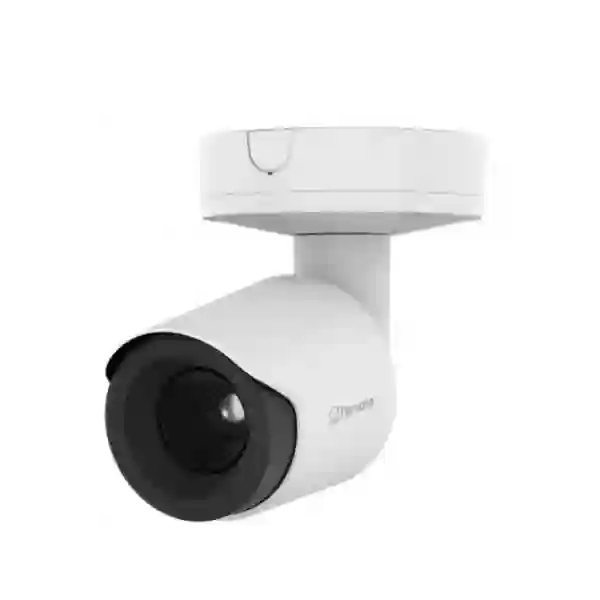
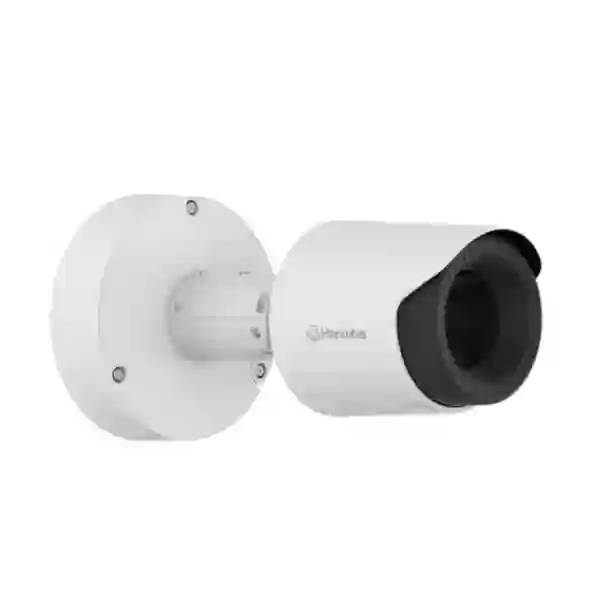
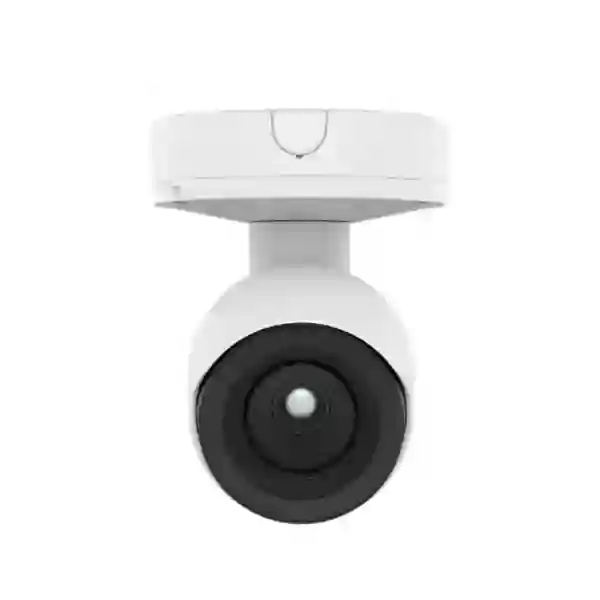
Hanwha Vision TNO-C4040T AI Thermal Bullet Camera
See thermal movement more clearly across critical boundaries with a 13 mm fixed lens, native VGA thermal sensing and on-camera classification of people, vehicles and vessels. Plan the right coverage before you buy.
Verified technical specifications
Exact-model figures from Hanwha Vision’s detailed TNO-C4040T specifications. Reference detection distances must be validated on site.
| Thermal sensor | Uncooled microbolometer; native 640 × 480 |
|---|---|
| Lens and view | 13 mm fixed F1.0; 49.1° H / 36.4° V |
| Thermal sensitivity | ≤16 mK NETD at 25 °C, F1.0 |
| AI object classes | Person, vehicle and vessel |
| AI reference distance | Person up to 108 m; vehicle 153 m; vessel 366 m |
| Video | H.265 / H.264 / MJPEG; up to 30 fps at 60 Hz |
| Network and integration | Gigabit-capable RJ-45; ONVIF S / G / T / M; SUNAPI |
| Edge recording | One microSD slot; up to 1 TB supported |
| Power | PoE IEEE 802.3af Class 3 or 12 V DC |
| Outdoor ratings | IP66 / IP67, IK10, NEMA 4X |
| Dimensions and mass | Approx. Ø107.3 × 275 mm; 2.0 kg |
| Operating conditions | −40 °C to +60 °C; 0–95% non-condensing RH |
A practical answer for perimeter-security buyers
The Hanwha TNO-C4040T thermal camera is intended for teams that must recognize activity at a boundary even when ordinary visible-light images are difficult to interpret. It combines a native 640 × 480 uncooled thermal sensor, a 13 mm fixed lens and edge-based classification of people, vehicles and vessels. Instead of depending on scene illumination, the camera forms an image from long-wave infrared energy. That makes it useful for assessing a dark access route, open yard, shoreline approach or other area where the operator needs early warning of movement. The appropriate next step is to check the viewing geometry and alarm objective before requesting an equipment quotation.
This model is best evaluated as one part of a security system, not as a complete autonomous solution. A thermal image is especially useful for discovering an object against its surroundings, while a visible-light camera may still be needed to determine colour, read markings or collect identifying detail. An effective design asks what the operator must decide after an alert: whether anyone entered a defined zone, whether a vehicle crossed a boundary, or whether a vessel moved into a monitored approach. That decision determines camera positioning, analytic rules, recording requirements and how the alarm is verified.
For a Tanzanian organization comparing surveillance options, the useful purchasing question is not simply how far a thermal camera can see. It is whether the specified lens covers the real site, whether the subject will occupy enough pixels for the intended analytic task, whether the infrastructure can support reliable recording, and whether night-time operation improves the existing security process. This product page provides verified model specifications alongside deployment considerations. Stock, local service arrangements, pricing and installation scope should be confirmed separately in a written quotation rather than inferred from the technical description.
How the thermal image differs from a conventional camera
An ordinary CCTV camera records reflected visible light; the TNO-C4040T uses an uncooled microbolometer that responds to energy in the 8–14 micrometre spectral band. Its purpose is to reveal differences in apparent thermal radiation, not to recreate a natural-colour photograph. A warm person on a comparatively cool background can be conspicuous, but the contrast changes as the background warms, the weather shifts or the person moves near similarly warm surfaces. Thermal surveillance therefore benefits from testing both the easiest and hardest conditions likely to occur at the site. The image should be treated as operational evidence of a scene rather than a direct reading of identity.
The manufacturer’s specification identifies native detector dimensions of 640 × 480 pixels and lists video output options including 1280 × 960. Buyers should distinguish the native thermal information from an upscaled video stream; a larger output frame does not create new independent detector detail. With a maximum listed stream rate of 30 frames per second in 60 Hz settings or 25 frames per second in 50 Hz settings, the camera can deliver moving thermal video suitable for monitoring. Actual recording smoothness and retained evidence quality still depend on configuration, transport, bitrate and recorder capacity.
Thermal imaging can reduce dependence on floodlighting and provide information when visible-light contrast is poor, but it has boundaries. Dense weather, heavy rain, obstacles, glass and clutter can degrade or block useful observation; many common glass panes are not transparent to long-wave thermal imaging. A tree or fence can hide part of a subject, while hot machinery, sun-warmed walls and reflections may complicate classification. The correct expectation is stronger detection capability in selected challenging scenes, not guaranteed vision through every obstruction. Design the system around observed results and supplement it with conventional cameras where visual identification matters.
The 13 mm lens and the coverage decision
The specific TNO-C4040T model uses an athermalized 13 mm fixed-focal-length lens with an F1.0 aperture. Hanwha Vision lists a horizontal field of view of 49.1 degrees, a vertical field of view of 36.4 degrees and a diagonal field of view of 62.3 degrees. This wider coverage can be attractive for open approaches, medium-distance yards and areas where a single fixed camera must observe a broad section of perimeter. However, a wider view distributes the same native pixels across more of the scene. A distant target can consequently appear smaller than it would with a longer lens aimed at a narrower zone.
The right lens starts with a plan drawing or a measured site visit. Record the nearest and farthest relevant distances, the width of the corridor or boundary to be covered, the mounting elevation, potential obstructions and the approximate size of the target class. Then decide whether the objective is detection, classification, recognition or later investigative interpretation. The manufacturer’s minimum object distance is 5 m, but that figure is not a promise that a particular analytic rule will work at every distance beyond five metres. The required pixel coverage for a distant person and the camera’s field of view must be considered together.
If a location involves a narrow long-range approach, the 13 mm variant may not be the most economical or effective fit even though its image has the correct resolution. Hanwha’s thermal range contains other lens options, and a different focal length or an additional camera may offer better target size in the scene. Conversely, using a long lens across a broad entrance can leave important blind spots. Ask for a coverage plan that marks the actual camera position, target route and intended detection zone. This is more useful than treating lens focal length as a simple higher-is-better specification.
Interpreting manufacturer detection distances correctly
Hanwha publishes AI detection-distance reference figures for this 13 mm model of up to 108 m for a person, 153 m for a vehicle and 366 m for a vessel. These figures refer to specified reference target sizes and the manufacturer’s test or modelling conditions. They are not a guarantee that every human, car or boat will be classified at those distances on a real Tanzanian site. Background contrast, mounting angle, occlusion, subject size, movement, lens condition and analytic settings all affect the result. When a security design has a critical boundary, an on-site trial at that boundary is the appropriate way to validate performance.
The same product documentation separately lists Johnson-criteria detection, recognition and identification distances. Those calculations are not interchangeable with the AI classification figures. A target may meet an image-based detection threshold without being reliably classified by an algorithm, and a classified thermal object is not automatically identifiable as a particular person or vehicle. Confusing these different measures can lead to expensive gaps in coverage. Procurement documents should state the exact objective at each important line: for example, an alert when a person crosses a fence-side zone, followed by an operator checking a complementary camera.
The word ‘up to’ matters because the reference target may be taller, wider or more thermally distinct than the real object at the installation. A crouching person, a partly obscured vehicle or a small vessel seen at an unusual angle may present different geometry from the reference. Equally, a target approaching directly toward the camera may cross fewer lateral pixels than one moving across the scene. Practical acceptance criteria should describe realistic target types, approach directions, distances and operating periods. A field test should record both missed events and nuisance alerts rather than relying only on a manufacturer range graphic.
AI classification: person, vehicle and vessel
The TNO-C4040T uses Hanwha Vision’s Wisenet 8 platform for on-camera analytics. Its supported classified object categories are person, vehicle and vessel, which makes the model relevant to both land-perimeter and selected waterside scenarios. Classification adds context to a change in thermal pixels. Rather than notifying an operator about every warm moving pattern, a configured event can focus attention on an object category relevant to the site. It remains an automated assessment and must be evaluated under the same scene conditions in which the security team will rely on it.
Consider the difference between a yard with moving equipment and a pedestrian-only boundary. A generic motion rule may be triggered frequently by harmless activity, whereas a person-based rule at a properly configured virtual line may create a more relevant alert. On a quay or waterfront approach, vessel classification can help distinguish a watercraft from background movement if the scene and target satisfy the analytical requirements. Neither application eliminates the need for operator judgement. A useful workflow specifies who receives the alert, what evidence opens automatically, and which action is justified by the information available.
Buyer evaluation should include potential false positives, false negatives and the consequences of each. A rule tuned for sensitivity may create additional investigations, while an overly restrictive rule may miss smaller or partially visible targets. Background objects, overlap between people and machinery, animals, changing weather and atypical vessel silhouettes should be included in testing where relevant. The camera does not provide identity recognition or proof of intent merely by assigning an object class. Its value is to prioritize observation and help operators make more informed decisions during routine patrols and real incidents.
Turn detections into meaningful alarm events
Supported analytics include AI-based object detection, virtual line crossing and direction, and virtual-area events such as intrusion, entry, exit and loitering. The camera also lists conventional events such as tampering, shock detection, audio detection and temperature-change detection. That range is useful only when the rules reflect a real security policy. A crossing line beside a public path should not be configured like a restricted loading area, and a loitering zone should exclude staff spaces where people routinely stop. Good analytic design begins with defining what is unauthorized, not with enabling every feature.
For a perimeter deployment, place virtual lines in relation to actual boundaries and expected approach directions. Define whether an alert should occur on entry only, both directions, or after a subject remains inside an area. Establish a simple response chain: event creation, recorder bookmark or clip, operator notification, visual verification, dispatch or acknowledgement, and incident closure. The model supports event-based recording and network notifications, but the exact actions that work will depend on the configured recorder, network policies and management platform. Every part of the event path should be tested before sign-off.
An alarm that never reaches a responsible person adds little protection. Teams should decide how events are prioritized during quiet shifts, network interruptions and maintenance work. They should also document how to temporarily suspend a zone for authorized activity without permanently weakening security. For multi-camera systems, overlapping coverage or PTZ handover can be valuable, but integration and preset behaviour must be verified with the chosen equipment. Periodic reviews of recorded alerts can reveal badly placed lines, changing vegetation and other sources of noise. The result should be an alerting system operators trust enough to use.
When thermal surveillance is a strong fit — and when it is not
A strong fit is an area where the main requirement is to detect the presence or movement of a thermal target across a defined corridor, especially at night or in low visible-light contrast. Examples can include external industrial boundaries, equipment yards, agricultural access routes, fenced storage, utility compounds and waterside approaches. These are application examples, not claims about any existing project or local installation. The thermal camera can supply an early indication that something needs attention, while the site’s operational response and supporting sensors determine what happens next.
The model is a weaker standalone choice when the objective is reading a licence plate, determining clothing colour, recognizing a face, reading a badge or producing conventional photographic evidence. Those tasks ordinarily call for appropriately positioned optical cameras or other specialized systems. Thermal imagery may also be a poor single-sensor solution where heavy visual obstructions fill the scene, target and background temperatures are similar, or the protected area is much closer or farther than the lens design supports. A realistic proposal should explain these limitations rather than selling thermal imaging as a replacement for all other CCTV.
Temperature-change detection should not be confused with a calibrated temperature-measurement service or a certified fire-alarm system. The manufacturer’s page for this exact model describes temperature-change analytics but does not establish the accuracy, measuring range and approvals required for a specific industrial thermography or life-safety claim. Buyers who need certified temperature monitoring, predictive maintenance measurements or fire detection should state those requirements separately and verify a product explicitly specified for them. Security monitoring and safety instrumentation can complement one another, but they are different design problems with different acceptance tests.
Outdoor construction and environmental planning
The manufacturer’s detailed environmental specification lists IP66 and IP67 ingress protection, IK10 impact resistance and NEMA 4X housing classification. These ratings support consideration for demanding outdoor locations, but they do not eliminate the need to design the mount, cable entry and electrical connections correctly. Water can enter through an improperly sealed gland even when the camera enclosure is appropriately rated. A project should specify suitable brackets, conduit, grounding and drainage, and it should confirm that all associated junction boxes and power equipment are appropriate for the exposure.
The documented operating temperature range is -40 °C to +60 °C with non-condensing humidity up to 95 percent. A specification range is not a promise that any installation will remain within it. Direct sun, enclosed cabinets, rooftop heat, salty air and moisture around cable entries can create site conditions that require special attention. For waterside deployment, review corrosion risks for the complete assembly, not only the camera housing. Cleaning access and safe maintenance position are also important because a dirty or obstructed front window can reduce the benefit of a high-quality thermal detector.
The mechanical details matter when retrofitting an existing pole or wall. Hanwha lists approximate dimensions of 107.3 mm in diameter by 275 mm long and a weight of 2.0 kg for the camera. The completed installation will also include any mounting hardware, adapters, connection protection and cable allowance. Structural capacity should account for wind exposure, corrosion and access by authorized maintenance personnel. Before ordering, ask the installer to show a mounting detail on the site drawing and confirm whether additional manufacturer-compatible accessories are required.
Power design without legacy-model assumptions
For the exact TNO-C4040T, the manufacturer’s detailed specification identifies IEEE 802.3af Class 3 Power over Ethernet and a 12 V DC option. It reports maximum power consumption of 7.8 W over PoE and 8.1 W on 12 V DC. These figures help a network engineer estimate switch power budgets, but a real design also allows for power distribution, cable length, connectors, surge protection and future equipment. Confirm the actual power input on the delivered unit and matching technical documentation before connecting a supply.
Some high-level product-page feature blocks appear to retain generic or legacy references to 24 V AC power, 256 GB cards and other details that conflict with the current exact-model specification table. This page follows the more specific detailed values rather than presenting incompatible options together. In a quotation or submittal, the supplier should identify the exact model, hardware revision where applicable and matching manufacturer datasheet. Procurement teams should not transfer assumptions from the older TNO-4040T model simply because its designation looks similar.
Site continuity is a system requirement, not a camera feature. If surveillance must operate during a power outage, design and test an appropriate UPS or backed-up electrical supply for the camera, switching equipment, recorder, monitoring workstation and communications path. Outdoor runs may need professional surge-protection and earthing design. Where a solar or remote-power system is considered, calculate the full day-and-night energy budget rather than multiplying the camera’s nominal consumption alone. Include the network uplink, charging losses, reserve time and maintenance conditions so the actual incident workflow remains available when it is needed.
Video formats, bandwidth and evidence retention
Hanwha lists H.265, H.264 and MJPEG video compression and up to five streaming profiles for the TNO-C4040T. H.265 can offer efficiency where the recorder and monitoring software support it, but compression must be matched to the purpose of the recording. An aggressive bitrate cap may save storage at the expense of detail around small or fast-moving thermal targets. For every deployment, choose a stream resolution, frame rate, codec and bitrate after reviewing test footage of real target movement at the important distances.
The detailed specification lists a single microSD, microSDHC or microSDXC edge-storage slot supporting up to 1 TB. That maximum does not mean the camera includes a card, provides unlimited retention or guarantees a specific number of days. Retention depends on whether recording is continuous or event-based, how much activity occurs, the encoded bitrate, the card’s usable capacity and any recorder settings. Storage media should be selected for the operating conditions and intended duty cycle, with periodic health checks and a documented replacement procedure.
For centralized recording, the network should carry the required concurrent video streams and events without depending on a fragile best-effort link. Decide whether local edge recording is a primary evidence source, a fallback during uplink outages, or only a convenient diagnostic tool. Verify time synchronization, retention policy, export procedure and permissions for each record type. If an incident matters, an operator should be able to locate the correct clip, establish when it occurred and preserve it securely. This is an end-to-end evidence requirement rather than a storage-capacity number printed on a camera box.
Networks, integrations and control-room workflow
The model provides wired Ethernet networking and lists support for ONVIF Profiles S, G, T and M as well as Hanwha Vision SUNAPI. These interfaces can make the camera a candidate for existing video-management environments, but protocol support is not equal to full feature compatibility with every third-party recorder. Live viewing may work while specialized analytics metadata, alarm events, edge search or device configuration require a different integration level. Before issuing a purchase order, the system integrator should validate the selected VMS version, recorder firmware and exact event functions.
A successful integration test should cover live view, recorded playback, multi-stream selection, time synchronization, event notifications, user rights and exports. If analytics are central to the security case, test the metadata or alarm path specifically rather than assuming the recorder will automatically understand every event. The camera’s configurable alarm I/O and network-event options may support additional workflows, subject to the chosen devices and wiring. Record what has been tested and what remains unsupported so the control-room team does not discover an integration gap during an incident.
For distributed organizations, remote access requires design choices about authentication, segmentation, encrypted connections and bandwidth. Avoid exposing the device directly to an unrestricted public network merely to make it reachable from another site. Prefer a managed, documented access path that the customer’s IT and security teams approve. The manufacturer lists direct-cloud-connection capability, but any cloud service subscription, regional handling, feature entitlement and data-retention arrangement must be confirmed for the intended deployment. A proposed design should distinguish on-camera functionality from functions that depend on a separate software or service platform.
Cybersecurity and responsible device administration
The manufacturer’s specification includes secure boot, signed or encrypted firmware protections, HTTPS and SRTP support, IEEE 802.1X options, device certificates, audit logs and encrypted microSD partition capability. These capabilities help a technical team build a more controlled camera environment; they are not a substitute for configuration. An administrator still has to create appropriate accounts, protect credentials, choose supported encrypted protocols, limit management access and maintain a clear inventory. The camera should enter the organization’s patch, backup and incident-response processes like any other network-connected appliance.
A practical deployment checklist includes a dedicated network segment where appropriate, documented IP addressing, restricted administrative rights, secure time settings, regular account review and event logging. Disable unused access mechanisms after confirming the recording and maintenance requirements. Check the manufacturer’s released firmware and change notes for the exact TNO-C4040T before upgrading. A firmware update should follow a staged procedure with configuration backup, an approved maintenance window and verification of camera streams, alerts and storage afterward. Avoid assuming firmware packages for similarly named models are interchangeable.
Operational security also concerns who can view, export or share surveillance footage. Decide whether local guards, supervisors, IT administrators and outside contractors need different rights. Create a retention and export process suited to the organization’s legal obligations and site policy, and keep access records where possible. Cybersecurity is particularly important for critical boundaries because an attacker who interrupts the video or changes analytic rules may undermine the very monitoring the camera was purchased to deliver. Effective protection combines supported device controls, disciplined configuration and human accountability.
Mounting, scene geometry and site survey
A useful pre-installation survey walks the actual protected route from both sides of the intended boundary. Mark how people, vehicles or vessels can approach, where they may stop, and which objects could hide their thermal silhouette. Assess the camera’s field of view from the proposed elevation rather than relying on a straight-line plan view. A high mounting position can reduce some obstructions but may make a subject smaller in the image or cause perspective problems. A low position may offer useful lateral target profiles but can be vulnerable to blockage or tampering.
The installer should plan the mounting location around maintenance access, the shortest practical protected cable route and a repeatable field of view. Keep the most important alert line away from persistent sources of nuisance movement when possible, without creating an unmonitored route around it. Check nearby heat sources, vents, machinery, reflective surfaces, vegetation and traffic patterns. These details can matter more to field performance than a small difference in advertised camera specifications. The proposal should include annotated views showing what the camera is meant to cover and what remains outside its view.
Commissioning must occur after final positioning, with actual site activity rather than a static demonstration only. Walk the relevant routes, move vehicles at realistic speeds where safe, and verify different approach directions and distances. For a shoreline scene, test a representative watercraft when practical and authorized. Repeat checks when the background conditions change significantly. Document the acceptance results, software versions, lens setting, mounting location and rule coordinates. Those records give maintenance staff a starting point if alerts later change because of site work or environmental conditions.
Example deployment patterns for Tanzanian organizations
An industrial or logistics site may need early indication of a person moving along an external fence after normal working hours. The thermal camera could be aimed across a defined corridor, while a separate visible-light camera supplies recognisable scene details near an access point. A virtual line event can trigger a short verification workflow rather than prompting a guard to watch every stream continuously. Before specifying this arrangement, the site must confirm distances, lighting, staff movement and the locations of legitimate entrances. The example illustrates a design pattern rather than a guaranteed result.
An agricultural or remote facility may prioritize observation of access routes, storage yards or machinery compounds where installing bright lighting everywhere is undesirable. In that situation, the engineering challenge often includes outdoor power, long cable runs, connectivity and staff response arrangements. The camera’s power profile and edge-storage capability are relevant, but a full solution still requires an adequate communication path and a plan for outages. The buyer should ask what happens when the uplink is lost, who checks an alert during the night, and how evidence is retrieved after the link is restored.
A waterfront or port-adjacent security team may consider vessel classification for a defined approach or restricted water boundary. The installer should examine boat size, viewing angle, movement against the horizon, shoreline structures and changing weather. Vessel detection is a security analytic, not a substitute for marine navigation equipment, collision avoidance, coastguard procedures or safety monitoring. In every Tanzanian use case, the objective is to match the technology to the actual risk and site constraints without presuming local stock, permits, installation capacity or service coverage that has not been independently confirmed.
False-alarm management and verification design
An effective thermal alarm is one the operator can understand quickly and act upon proportionately. Too many nuisance alarms lead to alert fatigue; too few alerts may indicate that thresholds are overly restrictive or that critical routes were left outside the detection geometry. Start with a clearly stated use case, then tune analytics while collecting representative events. Record whether alerts arise from people, vehicles, animals, weather effects, machinery, vegetation or other scene changes. Use these observations to adjust the rule boundaries and response procedure rather than indiscriminately reducing sensitivity.
Classification is useful for filtering, but an operator should still verify context. An authorized worker may be correctly detected as a person without representing a security incident. A vehicle crossing a line may be expected during loading hours but suspicious overnight. Pair the alert with schedule information or operational rules when the selected management system supports that workflow. Where the consequence of a missed event is high, consider overlapping cameras or independent sensors, and test the resulting alert load. Redundancy should close meaningful gaps rather than merely duplicate the same scene.
Define an acceptance period and make the success criteria measurable for the actual location. For example, specify representative crossing points and subject types, the number of trials, expected notification behaviour and the procedure for recording any misses. Do not treat a single successful demonstration as proof of all-weather performance. Continue reviewing results as vegetation grows, structures are added and access patterns change. Alarm management is a continuing operational practice: rules that were appropriate at commissioning can gradually become noisy or ineffective as the environment and security requirements evolve.
Planning the total system cost instead of only the camera
The correct project budget includes more than the thermal camera body. A complete design may require mounting accessories, cable protection, compatible power supplies or PoE switches, surge protection, network uplinks, recording resources, operator displays, video-management licences, secure remote access and commissioning work. Which items are required depends on the customer’s existing infrastructure and the proposed architecture. Avoid comparing quotes only by equipment model price when one proposal includes a complete working detection-to-response path and another covers the camera alone.
Operational costs deserve similar attention. Video retention consumes storage, network equipment uses electricity, maintenance requires access to the unit, and software may have lifecycle obligations. If the deployment depends on remote connectivity, the reliability and recurring cost of that connection matter. Plan for periodic inspections, firmware maintenance, card replacement if used, cleaning of the front window and recalibration of analytic zones after physical site changes. These are ordinary lifecycle considerations rather than model-specific service promises.
For procurement in Tanzania, request a written quote that identifies the precise TNO-C4040T variant, included accessories, taxes where applicable, delivery terms, installation work if offered, and the applicable warranty terms. Do not assume a price, stock status, lead time or local certification from this informational page. A useful supplier response should also confirm what evidence is available for the required detection geometry, which third-party devices have been tested, and who is responsible for resolving integration issues. The most defensible buying decision compares the delivered security outcome and support responsibilities, not just a headline specification.
Comparison with ordinary CCTV and longer-lens thermal options
A visible-light bullet camera generally offers colour images and potentially high optical detail when lighting and conditions are suitable. The TNO-C4040T serves a different purpose: detecting thermal contrast and classifying relevant moving objects without depending on visible illumination. When an investigation requires identifying a person or reading a vehicle plate, a suitable optical camera may be essential alongside the thermal unit. Combining complementary viewpoints can produce both early warning and usable confirmation. The decision should reflect the security team’s required evidence rather than a claim that one imaging technology is universally superior.
Within Hanwha Vision’s thermal line, a wider-angle 13 mm option can cover a broader foreground region, while a longer focal length tends to concentrate pixels over a narrower angular field. Choosing between them requires the actual scene dimensions and a realistic target size. A camera that has the longest nominal detection distance may miss side entrances because of a narrow view; a wider model may see the whole fence but leave far targets too small. It can be better to use two carefully placed cameras than one expensive camera at a poorly chosen compromise angle.
Generic motion-only surveillance differs again from AI-classified thermal monitoring. A basic motion event can be useful, but it does not necessarily distinguish the category of the object that moved. The TNO-C4040T provides AI classes and structured event conditions that may reduce investigative work when carefully configured. That benefit depends on the quality of the site survey and integration. Compare proposed systems using the same representative test scenes, recording conditions and response objectives. Avoid assigning a value to a feature merely because it appears in a brochure without a defined use in the operation.
Commissioning, handover and maintenance
A commissioning plan should verify the exact model and associated documentation when the unit arrives. Confirm that physical mounting, weather sealing, cable routing, power supply and network connection match the approved design. Establish the image angle, image palette, clock and time zone, recording profiles, event zones, storage configuration, access controls and event handover. Walk through test incidents from target entry all the way to operator acknowledgement and evidence retrieval. Sign-off should be based on the final system, not only a live image on an installer laptop.
Handover documentation should contain a diagram of the location and field of view, the tested alarm rules, device and recorder inventory, support contacts established by contract, administrative access ownership and a maintenance procedure. Passwords and other secrets should be transferred through secure means, not printed in ordinary project notes. Train authorized staff to distinguish an analytic alert from a confirmed incident, use the relevant recorded footage and report changes in behaviour. A camera can have excellent specifications yet deliver poor operational value when the staff do not understand its limits or controls.
After installation, periodically check the physical window, mounts, cable entry points, storage health, camera clock, firmware status and sample alerts from the important boundaries. Review whether new structures, parked equipment, changing vegetation or altered routes have introduced blind spots. Retest after major configuration changes or recorder updates. Where the site requires high availability, document a fault escalation and replacement plan compatible with the contracted support arrangement. These practices help preserve the original security objective across the product’s working life without assuming a specific maintenance interval or warranty coverage.
A structured buying checklist before requesting a quote
Start with a drawing of the intended monitoring area and one sentence describing what successful detection would look like. Specify the object categories, the critical distances, approach direction, size of each zone and whether operation must continue without visible lighting. Note all obstacles and sources of heat or movement. This information lets a supplier assess whether the 13 mm field of view is appropriate. It also helps avoid selecting an unsuitable camera merely because an online listing describes it as long-range or AI-enabled.
Next, identify the existing network switches, power arrangements, recorder or video-management platform, bandwidth, retention policy and cyber requirements. Include the intended number of simultaneous viewers and whether recording is continuous, event-driven or a combination. Ask for confirmation of supported ONVIF functions and the exact events that can reach the chosen system. If the use case needs a different imaging technology, longer lens, extra camera or specialist sensor, that should be identified before the commercial quote is finalized.
Finally, request a clearly scoped proposal that identifies the exact equipment, accessories, installation assumptions, test procedure and support boundaries. Require an explanation of every critical detection-distance claim and a plan for verifying it at the site. Confirm commercial terms independently, including local availability, warranty, supply and installation arrangements. The goal is a documented decision that answers three practical questions: what the camera can observe, how the security team will respond, and how the system will be kept usable. Those answers matter more than a long unqualified feature list.
Frequently asked questions
Is the TNO-C4040T a 13 mm or 19 mm model?
The TNO-C4040T is the 13 mm model with a manufacturer’s listed 49.1-degree horizontal field of view. The similarly named older TNO-4040T is a different product associated with a 19 mm lens. Confirm the exact model code on quotations and product documentation.
Does 1280 × 960 video mean the thermal detector is 1280 × 960?
No. The native thermal detector is 640 × 480. The product can output a 1280 × 960 video frame, but this does not change the native sensor pixel count. Evaluate target detail using the detector resolution, lens and actual scene geometry.
Can it identify a particular person at night?
Its thermal analytics can classify a detected object as a person when conditions permit. It is not a face-identification or conventional photographic recognition system. A suitable visible-light or other verification camera may be required for identity and forensic detail.
Will it work in rain, fog or complete darkness?
It does not need visible light, and thermal imaging may retain useful contrast in some challenging conditions. Performance can still be reduced by severe weather, obstructions and low contrast between target and background. Test the actual site rather than assuming immunity to environmental effects.
What are the published AI detection distances?
Hanwha’s reference figures for this model are up to 108 m for a person, 153 m for a vehicle and 366 m for a vessel, for specified target assumptions. These are not guaranteed site results or the same thing as recognition and identification distances.
Which power options are specified?
The detailed TNO-C4040T specification lists IEEE 802.3af Class 3 PoE and 12 V DC. It lists up to 7.8 W over PoE and 8.1 W over 12 V DC. Have the installer confirm the delivered unit and the compatible power design.
Does the camera include recording?
A built-in microSD slot supports edge storage up to 1 TB according to the detailed specification. A memory card is not assumed to be included. Full-system recording and retention may require a compatible recorder or VMS, suitable media and a verified capacity calculation.
Can I use it with an existing NVR or VMS?
It supports ONVIF Profiles S, G, T and M and Hanwha’s SUNAPI, but exact functions vary by the chosen recorder and software. Test live view, recording, metadata, analytic alarms and event search with the intended platform before purchasing.
Can it measure machinery temperature or replace a fire alarm?
The exact-model information lists temperature-change detection; that does not establish calibrated temperature-measurement accuracy or approval as a certified life-safety detector. Specify and verify a dedicated solution if those are the primary requirements.
Is a Tanzania price or delivery date available?
No verified local price, stock count, delivery time or installation coverage is stated in this content. Request a written, model-specific quotation and confirmation of commercial terms before ordering.
Request a model-specific Tanzania quotation
Ask FourTeck Tanzania about the Hanwha TNO-C4040T thermal camera for your site. Share a simple plan, target distances, intended object categories, existing recording platform and power or network constraints. Request confirmation of exact product variant, commercial availability, included accessories, compatible integrations, warranty conditions and the scope of any proposed commissioning. No price, stock status or installation service is implied by this product guide.
Next step: Request a TNO-C4040T project quote and coverage review.




Reviews
There are no reviews yet.