
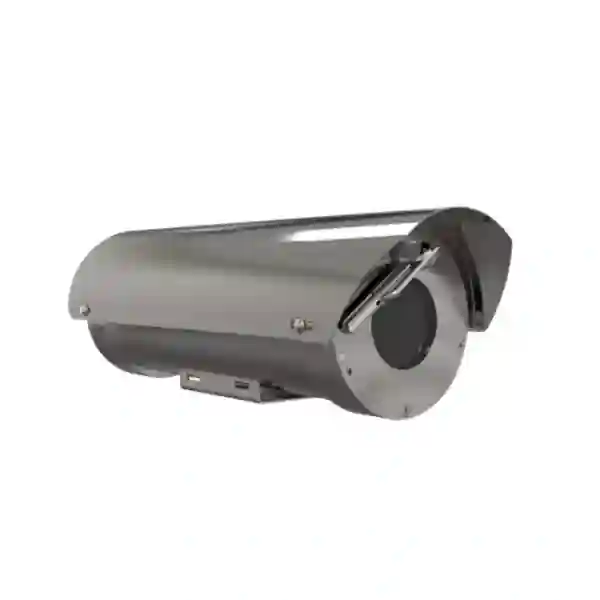
Hanwha TNO-X6320E1WT1-C Explosion-Proof Zoom Camera
Choose a surveillance camera that answers the engineering question first. This 2MP Hanwha Vision model combines 32× optical zoom, an integrated wiper and a 316L stainless-steel explosion-proof housing for specialist industrial monitoring projects. Discuss the exact hazardous-area classification, 24V AC supply, camera position and recording system before procurement.
Request a project-specific quotation that accounts for certification, mounting, cable-entry components, power and video-management requirements. Local stock and price must be confirmed separately.
An important distinction before you buy
The Hanwha TNO-X6320E1WT1-C is an explosion-proof visible-light fixed-view zoom camera. It is not a thermal camera, not a pan-tilt-zoom camera and not a PoE-powered camera. Those distinctions affect coverage, image expectations, wiring and total project cost. Ask an appropriately qualified engineer to verify the area classification and exact product certification before installation.
Technical specification at a glance
Use this summary for initial screening. The final submittal should include current model-specific manufacturer documentation and a signed-off installation design. The -C suffix and the exact equipment markings require verification for the intended hazardous area.
| Imaging | 1/2.8-inch CMOS; 2MP Full HD; H.265 / H.264 / MJPEG |
|---|---|
| Optics | 4.44–142.6 mm; 32× optical zoom; autofocus; 16× digital zoom |
| Field of view | Horizontal approximately 61.8° wide to 2.19° tele |
| Image processing | 150 dB WDR; day/night ICR; gyro-supported stabilization; defog |
| Storage and network | Two card slots, up to 256GB each; wired Ethernet; ONVIF S/G/T |
| Outdoor assembly | 316L stainless steel; integrated wiper; listed IP66/IP67 |
| Power and environment | 24V AC; 37W max; operating range −40°C to +60°C |
| Size and weight | Approximately 176 × 154 × 480 mm; 15 kg |
A practical four-stage selection path
- Classify the site. Collect the hazardous-area drawing, ambient conditions, camera duty and any internal approval requirements. Verify the exact model marking and certificate conditions rather than relying on a family description.
- Design the view. Define the target, lighting, field of view, mounting height, zoom position and acceptable evidence quality. Check whether a fixed zoom camera or a moving PTZ system is actually needed.
- Engineer the infrastructure. Specify 24V AC supply, approved cable entries, mounting structure, network route, recorder integration, storage and safe maintenance access.
- Verify and hand over. Test day and night scenes, alerts, wiper operation, secure user access, recording retrieval and controlled maintenance procedures before operational acceptance.
Purpose-built monitoring for demanding industrial sites
Industrial cameras are often chosen because a general-purpose model is visually impressive, yet a hazardous work area creates a different procurement problem. The first question is whether the enclosure and its certification suit the location, not simply whether the image looks sharp. The Hanwha TNO-X6320E1WT1-C brings Full HD network imaging into a stainless-steel explosion-proof camera assembly and pairs it with a remotely adjustable zoom lens. It deserves consideration where operators need to observe a defined process, gate, vessel area or access corridor from a fixed mounting position. Buying teams should still ask their hazardous-area engineer to approve the exact configuration, cable entries and installation method. The result is a more defensible selection process than treating the words explosion-proof as permission to install a camera anywhere.
What the term explosion-proof does and does not mean
Explosion-proof equipment is designed and assessed for particular hazardous-area conditions under stated protection concepts and certifications. It does not mean the enclosure can withstand every explosion, remove the need for safe working practices, or operate in every gas or dust atmosphere. The actual product marking, certificate schedule, temperature class, permissible ambient range, and installation limitations must be matched to the project’s area classification. In procurement documents, avoid replacing that review with broad phrases such as suitable for all refineries or universally certified. The exact -C model suffix matters because other Hanwha versions within the family have different certification designations. Before purchase, request the certificate and installation documentation that correspond to the model being quoted, then have competent personnel confirm that the proposed application is permitted.
The right buyer and the right application
This camera is most relevant to industrial security managers, plant engineering teams, EPC contractors, system integrators and specialist buyers assembling fixed-view surveillance networks. Its value emerges when an operator wants both a hardened camera housing and the ability to adjust optical framing without repeatedly visiting a difficult mounting point. Think about a known pump area, a section of processing equipment, a controlled entry, a marine-side structure or a monitored corridor. Those are illustrative use cases, not declarations of approval for any particular hazardous zone. The final camera position must provide a useful line of sight and suitable illumination. If the scene needs continuous tracking in several directions, a true PTZ model may be more appropriate than a fixed camera with optical zoom.
When a different camera may be more suitable
This is not the automatic choice for every industrial site. For a wide yard where several areas must be watched at once, one narrow field of view can create coverage gaps. For a moving target that must be followed around corners, a fixed-view device cannot substitute for motorized pan and tilt. If the requirement is temperature measurement, heat signatures or imaging through complete darkness, a genuine thermal system should be evaluated rather than assuming this visible-light camera performs those tasks. A site requiring PoE power may also need a different variant, because this model is specified for 24V AC. Selection should therefore begin with a coverage drawing, operating conditions, hazardous-area documentation and recorder requirements rather than a feature-only comparison.
Full HD image detail and frame-rate planning
The camera’s 1/2.8-inch CMOS sensor supports 1920 by 1080 video and up to 60 frames per second with H.265 or H.264 under stated frequency settings. That provides a useful starting point for examining machinery movement, site access and operational events. However, a higher frame rate is not automatically the best recording setting. It increases bandwidth and storage demands, and may be unnecessary for scenes with limited movement. A procurement specification should describe what an operator must actually recognize at the relevant distance. Compare sample views at the intended mounting height and illumination, then select resolution, frame rate and exposure for those tasks. Do not promise identification at a particular range without calculations and representative scene testing.
How the 32× optical zoom helps
The specified 4.44–142.6 mm optical lens delivers a 32× zoom range with autofocus, manual focus and one-shot autofocus options. At the wider end, the horizontal view is approximately 61.8 degrees; at the telephoto end it narrows to about 2.19 degrees. The operational trade-off is important: optical zoom makes a distant point larger, but it also reduces the area visible at any one time. It can be helpful for refining a predetermined inspection view from the control room, while poor planning can leave nearby activity outside the picture. Define the normal home framing and any expected alternative views during design. Treat digital zoom separately from optical zoom because enlarging existing pixels does not reveal detail that the sensor never captured.
Coverage, mounting distance and recognition tasks
Zoom ratio alone does not tell a security manager whether a person, instrument or label will be recognizable. Image usefulness depends on target size in pixels, distance, contrast, lighting, weather, perspective and camera stability. Start with a simple sketch showing the intended target, the proposed camera height and the direction of traffic or process movement. Identify whether the task is general observation, event verification, recognition of personnel or reading a specific display. Ask the integrator to work backward from that requirement using field-of-view calculations and practical site images. A telephoto view may look excellent in a catalogue but become unhelpful when a nearby handrail blocks the line of sight or vibration moves the target out of frame.
Understanding low-light capability
Hanwha lists minimum illumination at approximately 0.05 lux in colour and 0.005 lux in black and white at the manufacturer-defined test setting. These figures help characterize the sensor; they are not a promise of usable evidential detail at every dark site. Exposure time, moving machinery, reflections, artificial lighting and required frame rate all affect performance. The day-and-night mechanism uses an automatic infrared-cut filter arrangement, yet that statement alone does not establish that the camera contains an integrated infrared illuminator. If the site lacks sufficient light, the design may need suitable external illumination selected and approved for the location. Always test night scenes under representative conditions rather than relying on a single lux number.
Lighting design is part of camera design
An industrial lighting assessment can be as valuable as the camera specification. Metal surfaces, vehicle headlamps, floodlights and vapour can create contrast problems that make objects difficult to interpret. Consider where the sun rises or sets relative to the chosen view and whether nearby structures cast deep shadows. Night lighting must support the desired evidence, not merely make the scene look bright on a monitor. In potentially hazardous areas, any additional luminaires require their own installation and suitability review. The TNO-X6320E1WT1-C should be evaluated as part of a complete imaging system, with the scene, fixtures and control-room expectations agreed before procurement. A documented acceptance view makes later commissioning and troubleshooting much easier.
Managing strong contrast with wide dynamic range
The manufacturer specifies 150 dB wide dynamic range, supported by backlight and highlight compensation functions. This matters when a single scene contains both bright outdoor openings and dark areas under roofs or near industrial structures. Wide dynamic range can improve the balance between these regions, but cannot guarantee flawless footage under welding arcs, direct glare or extremely uneven lighting. Adjustments may involve choosing between maximum highlight retention and preserving shadow detail. During commissioning, look at the same scene across changing light conditions and verify that the intended objects remain interpretable. Record the final configuration in the handover documentation so subsequent maintenance changes do not unintentionally degrade the evidence standard.
Stabilization and environmental image processing
The camera supports digital image stabilization using a built-in gyro sensor as well as a defog processing function. These features can be useful where mounting structures are subject to modest vibration or where visibility is reduced by atmospheric haze. They should not be used to excuse an inadequately engineered bracket or to promise clear video through thick fog, smoke or spray. A stable mechanical installation remains essential, particularly when the lens is zoomed toward its telephoto end and even small movements become obvious. Discuss the expected frequency and amplitude of vibration with the site engineer. Plan a trial with machinery running where feasible, and check whether processing settings affect fine detail needed for the actual surveillance task.
Integrated wiper and cleaning strategy
A built-in wiper is one of this model’s distinctive features. It provides a means of removing some water or contamination from the viewing window, which can reduce the frequency of avoidable visibility interruptions. It is not a guarantee against every type of salt, dust, grease or chemical deposit, and it does not replace a maintenance plan. Hanwha separately lists a washer tank accessory in the product family; do not assume that this accessory is included in the camera package. The project should establish how the wiper is controlled, what cleaning procedure is permitted and whether extra accessories are required. The maintenance team should use approved methods and follow the enclosure instructions instead of improvising access to sealed components.
Stainless-steel housing, ingress protection and durability
The stated housing material is 316L stainless steel, and the manufacturer lists IP66 and IP67 ingress protection. This makes the unit worth evaluating for wet, dusty or otherwise demanding industrial locations. Nevertheless, environmental resistance depends on the complete installed assembly, including cable glands, seals, mounts and correctly tightened fittings. An ingress protection rating does not establish chemical compatibility with every atmosphere or long-term resistance to every cleaning agent. Buyers in corrosive environments should tell the supplier about salts, process chemicals and wash-down practices so that materials and maintenance procedures can be assessed. Inspect the chosen mounting arrangement for drainage, potential contamination traps and access for safe cleaning before the equipment is ordered.
Hazardous-area classification and approvals
The manufacturer lists multiple standards and certification families across its explosion-proof camera range, while the -C suffix is associated with a cLC CSA designation in Hanwha’s model information. That does not automatically establish acceptance under every country’s local regulations or for every classified location. The responsible designer should compare the actual certificate, product label, protection concept, gas or dust group, temperature class, ambient rating and any special conditions with the site documentation. It is also important to check the permitted cable entry method, glands, blanking elements and accessories. This page deliberately does not claim Tanzania-specific regulatory approval. A buyer should ask for the exact documentation package and obtain approval from the competent engineering and regulatory parties before installation.
Networking options and stream management
The camera has a wired RJ-45 Ethernet interface and the manufacturer lists up to ten streaming profiles. It supports common network and streaming protocols including RTSP, HTTP and HTTPS, together with unicast and multicast capabilities. This flexibility helps integrators create different streams for live viewing, recording and remote supervision. It does not eliminate the need to verify what each recorder, client and security policy actually supports. For remote industrial sites, design separate paths for local recording and management access where appropriate, and examine congestion or intermittent connectivity. Avoid presenting multi-stream support as proof that unlimited operators can view the camera simultaneously. User counts, bitrates and the wider network architecture all influence reliable operation.
Compression choices and bandwidth estimates
H.265, H.264 and MJPEG are listed video compression formats, and Hanwha’s WiseStream II feature is intended to help with bandwidth efficiency. Actual data use depends on motion, detail, codec selection, scene noise, frame rate and quality targets. A camera looking at a calm corridor has a different traffic profile from one covering moving machinery, rain and vehicle lights. Establish average and peak bitrates through practical scene testing when possible. Then calculate recording storage and available headroom rather than using a single optimistic marketing number. Keep recorder compatibility in mind: an older VMS may support H.264 reliably but lack particular H.265 capabilities. Choose a configuration that gives usable evidence first and compression savings second.
Dual memory-card slots and edge recording
The camera supports two microSD, SDHC or SDXC slots, with up to 256GB per slot and a total manufacturer-listed capacity of 512GB. This provides an option for supported edge recording, subject to compatible media and configured event rules. It should not be mistaken for an unlimited archive or a guarantee of redundancy. Retention depends on the recorded bitrate, schedule and event activity, while recording media have endurance and environmental limits. Establish whether the operational requirement calls for local failover, event clips, central recording or a combination. Check card selection, replacement procedures, access control and footage retrieval during commissioning. If evidence retention is mandatory, document how storage health and recording failures will be monitored.
Recorder and video-management integration
Hanwha lists ONVIF profiles S, G and T, SUNAPI and its open-platform capabilities for the model. These interfaces may simplify the integration discussion, but a profile label is not a substitute for testing exact recorder firmware and required functions. A VMS may show live video while lacking the desired control of zoom, wiper, events or edge-recording playback. Prepare a requirement matrix covering discovery, authentication, recording, time synchronization, event handling, retrieval and audit logs. Request confirmation of compatibility for the proposed platform and software version. During a bench test, check each function that the operator will actually use instead of stopping after a successful live-picture demonstration.
Video analytics: useful triggers, not infallible decisions
The listed analytics include motion detection, tampering, fog detection, face detection, shock detection and configurable virtual-line or virtual-area events such as crossing, intrusion and enter or exit. These can help direct an operator’s attention and reduce unnecessary routine checking. They are not a guarantee that every incident will be detected or that a particular event can be conclusively identified. Rain, steam, shadows, insects and moving process equipment can all contribute to nuisance triggers. Define a modest number of well-scoped rules matched to the actual scene, then evaluate their performance through a representative operational cycle. Build a sensible response procedure so that alarms lead to proportionate verification rather than automatic assumptions.
Privacy masking and responsible video handling
The product specification lists configurable privacy masking, which may be useful where the camera view includes areas that do not need to be monitored. A privacy mask should be placed deliberately and verified at the zoom settings used in operation. Depending on the system workflow, administrators may also need to consider account permissions, recordings, exports, access logs and retention periods. The legal and organizational requirements will vary by project and should be assessed separately. A good handover includes a clear statement of the purpose of each camera, who can view footage and when it may be retained or shared. Technical capabilities help implement that policy but do not replace a well-designed governance process.
Cybersecurity and access control
Manufacturer-listed security functions include HTTPS, 802.1X network authentication, IP-based access control and audit logging. These features provide useful building blocks, but safe deployment depends on how the broader surveillance network is configured. Change default credentials, assign individual administrator access where supported, restrict unnecessary services and keep device-management traffic within an appropriate network segment. Review firmware using official model-specific guidance and the site’s tested change-control process. A camera at a remote plant is still an IP endpoint and should not be exposed to unrestricted internet access merely for convenience. Check time synchronization and the preservation of access logs, because they can become important when investigating events or diagnosing outages.
24V AC supply: an essential purchasing checkpoint
This exact model is specified for 24V AC input, with a maximum power consumption of 37 watts. It is not listed as PoE powered, and an ordinary Ethernet switch should not be assumed to supply its operating power. Determine the correct supply type, cable length, voltage drop, protective devices and electrical isolation arrangement with the installation engineer. The power design must also reflect any hazardous-area requirements applicable to the route and equipment. Where continuous surveillance is required, discuss backup power and restart behaviour for both camera and recorder. A quotation that includes a camera but omits the appropriate power supply, approved fittings or maintenance access may not represent the real cost of an operational system.
Mounting loads, dimensions and access
Hanwha lists dimensions of approximately 176 × 154 × 480 mm and a camera weight of about 15 kg. That is significant for brackets, poles and maintenance access, especially where wind, vibration or elevated mounting positions are involved. Confirm load limits of the support structure and use a mounting design appropriate to both the weight and local site conditions. The manufacturer lists mounting bracket and wall-mount accessories within this product family, but accessories should be confirmed separately for the exact installation. Allow sufficient clearance to use the wiper, service the enclosure and maintain an unobstructed field of view. A compact-looking drawing should never replace a structural and access assessment for a hazardous industrial environment.
Cable entries and enclosure integrity
Cable glands and enclosure penetrations are critical details in hazardous-area equipment. The responsible installer must select permitted components and installation techniques based on the applicable certificate and manufacturer’s instructions. Do not assume that standard outdoor CCTV glands, adapters or spare parts are suitable. Review conductor size, segregation, terminations, shielding, mechanical protection and the placement of junction boxes before work begins. Each opening must be addressed according to the approved design, including unused entries. A camera can have a robust certified enclosure yet become unsuitable through an incorrectly selected cable-entry arrangement. Include these details in the bill of materials and installation drawings, then inspect them during commissioning rather than leaving decisions to the final day on site.
A site survey that prevents expensive surprises
Before procurement, a useful survey should include the scene objective, mounting coordinates, target distances, light sources, obstruction risks, power source, network path and maintenance access. In industrial settings it should also record the formal hazardous-area classification and the process conditions that affect safe work. Photograph candidate positions from approximate camera height where permission and site rules allow. Identify whether nearby pipes or moving equipment could block a zoomed view. Check route lengths and any boundaries between operational networks or facilities. Discuss what the control room needs from the camera during normal operation and during an incident. A survey prepared this way turns product selection into an accountable design decision and makes supplier quotations more directly comparable.
Surge protection, earthing and continuity
Outdoor industrial surveillance often depends on long conductive routes, exposed structures and power systems shared with other equipment. The electrical design should therefore consider grounding, bonding and suitable surge protection according to project standards and the manufacturer’s instructions. The exact protective arrangement must be engineered rather than guessed from the camera’s headline specification. Confirm that the power source and network equipment are protected to the level required by the site and that maintenance teams can isolate them safely. UPS or other continuity provisions may be appropriate where loss of video would create an unacceptable operational gap. Test recovery after an authorized power cycle and verify time synchronization, network reconnection and recording restoration.
Tanzania deployment considerations
For projects in Tanzania, local site conditions should shape the specification more than a generic climate label. Some locations may face heavy rainfall, airborne dust, saline exposure or elevated ambient temperatures; the exact exposure must be documented for the installation site. The camera’s published operating range of −40°C to +60°C and non-condensing humidity limit should be evaluated against actual enclosure temperatures and condensation risks. Check whether nearby process equipment creates heat beyond the local weather conditions. Network backhaul, power quality and maintenance access may also differ across sites. Do not infer local stock, certification acceptance, installer coverage or delivery schedules from the existence of a product description. Ask the supplier to confirm these commercial and project-specific items separately.
Safe installation and change control
A hazardous industrial camera should be installed and maintained only under the site’s authorized safety procedures and by appropriately competent personnel. Work permits, isolation, access equipment, inspection and sealing requirements may all be relevant. Changes to a mount, cable route, gland or enclosure component should not be treated as routine cosmetic alterations; they may affect both operational reliability and hazardous-area suitability. Maintain approved drawings and the exact equipment identification in the asset register. Before energizing the camera, confirm that the installation matches the approved documentation and that required inspections have been completed. This page is selection guidance, not a replacement for Hanwha’s installation manual, the relevant certificate conditions or site-specific engineering instructions.
Commissioning: verify an entire system
A successful commissioning test should prove more than a live image. Check the actual power arrangement, network addressing, user access, time settings, frame rate, codec, zoom control, focus and configured wiper operation. Confirm the planned scene under daylight and representative poor-light conditions. Test event alerts and verify that the recorder can retrieve footage with a timestamp that matches the operational log. Where local SD recording is part of the design, check supported storage and retrieval behaviour. Review image quality while nearby machinery is operating. Record the final configuration, camera identifier, firmware version, installation photographs and acceptance criteria in a handover pack. This creates a baseline for resolving future faults or assessing requested changes.
Routine maintenance and inspection
The stainless-steel assembly and integrated wiper do not make this a maintenance-free camera. Plan periodic visual inspection according to the environment, site risk and manufacturer’s instructions. Confirm that the viewing window remains clear, that the wiper works as intended and that the mechanical support shows no signs of damage or unusual movement. Inspect approved cable-entry arrangements and seals only under the required safe-working conditions. Review device health, storage status, recording continuity, time synchronization and account access without unnecessarily opening the enclosure. Any suspected damage or certification-related defect should be escalated to competent personnel. A well-documented maintenance routine protects both the intended image quality and the integrity of the installed system.
Troubleshooting poor images and missing events
If the camera delivers a blurry or unhelpful picture, begin by determining whether the problem is optical, environmental or network related. Check focus and the selected zoom position, then consider window contamination, scene lighting, vibration and compression settings. If live video looks normal but recorded footage is poor, compare recorder settings and playback behaviour. For missing analytics, inspect zone placement, sensitivity, schedule, event routing and time synchronization. Network dropouts call for a separate check of power, link status, switches and traffic. Avoid opening certified equipment as an initial troubleshooting step. Escalate physical or electrical interventions under the site’s applicable procedures, preserving evidence of the original fault and any configuration changes.
Choosing the right scene for operational monitoring
A fixed zoom camera is especially valuable when the operator knows which asset or corridor matters. In a plant, it may be used to observe a defined valve area or a section of loading infrastructure, subject to the site’s engineering approval. Near an access point, it may provide a clearer framed view of a controlled approach rather than attempting to cover an entire yard. In a port or coastal industrial facility, the stainless-steel housing may be a relevant material consideration, but the site must still assess corrosion exposure and cleaning requirements. Frame each intended view in a design drawing and note what events should be observable. Do not use a long zoom specification as a substitute for a documented surveillance objective.
Fixed zoom versus PTZ, panoramic and thermal cameras
Each camera class solves a different problem. A fixed-view zoom camera offers adjustable magnification along a chosen direction; a PTZ camera can also turn to survey new directions but needs an operating strategy to avoid missing unattended scenes. Panoramic cameras emphasize broad-area visibility, often at the cost of pixels on a distant target. Thermal cameras detect infrared energy rather than the normal visible-light image captured by this model, and suit different detection or process needs. These distinctions matter in technical specifications because apparently similar industrial housings can serve very different roles. Ask which surveillance questions must be answered before comparing prices. More sophisticated movement or sensing functions are not automatically better if the actual requirement is stable continuous observation.
Preparing a defensible request for quotation
An effective quotation request should list the exact model TNO-X6320E1WT1-C and distinguish the manufacturer part number from any seller-specific SKU. Include site classification, ambient conditions, supply voltage, preferred mounting position, target scene, VMS platform and expected quantities. Ask the supplier to identify included and separately priced components such as mounting hardware, approved entries, accessories, power supplies and commissioning support. Request the applicable model-specific certification documentation, regional availability and warranty terms without assuming any of these are already verified. Where several contractors bid, require each response to describe exclusions and dependencies. This approach makes it easier to compare the real delivered solution rather than comparing a camera-only amount against a complete engineered installation.
The commercial questions beyond camera price
Total project cost may include engineering review, mechanical supports, compliant cable infrastructure, electrical work, network capacity, recording licences, storage, commissioning and periodic maintenance. These items depend on the site and should not be fabricated into a single universal price. The availability of a manufacturer model does not prove that a particular unit is in stock in Tanzania or ready for immediate delivery. Ask for the exact currency and quotation validity, the identified product variant, the included accessories and any conditions attached to supply. Where the project must comply with corporate purchasing or hazardous-area rules, confirm the required documentation at the beginning. A lower equipment price is not a saving if necessary components were omitted from the initial scope.
Documentation and handover deliverables
For an industrial security installation, documents are part of the deliverable rather than an optional afterthought. A sensible handover can include the approved model and serial identifiers, mounting drawings, network diagram, power schematic, tested scene views, firmware inventory and relevant certification paperwork. It should also explain how administrators control access, how recordings are retained and where authorized maintenance instructions are kept. A failure log and clear escalation contacts help operational teams diagnose issues without unnecessary site visits. Require final settings to be documented after commissioning so support personnel do not rely on memory or guesswork. This is especially useful where contractors, safety officers and security operations share responsibility for the equipment.
Planning for future changes
Industrial operations evolve. A new structure may obstruct the view, a process line may be reconfigured or security teams may ask for additional evidence. Plan how changes will be assessed before physically altering the camera installation. A small zoom adjustment may be straightforward through the management interface, but moving the enclosure or adding wiring can require renewed safety and design review. Retain the original camera objective and acceptance images so the team can tell whether a change improves coverage or weakens it. Monitor recorder capacity as more cameras are added and check that software upgrades continue to support required functions. A documented change process helps protect the value of an otherwise capable camera throughout its working life.
What a buyer should verify before approval
Before authorizing an order, confirm the exact suffix, intended certification scope, published performance, accessories, installation route and operational duties. Check the proposed mounting surface against the listed 15 kg mass and consider whether the 24V AC supply can be delivered safely. Establish how video will be encoded, stored, viewed and protected against unauthorized access. Define the expected scene in both daytime and low-light conditions, including the acceptable zoom and focus settings. Ensure the use of 316L stainless steel, a wiper and IP ratings matches the actual environmental concern rather than simply sounding reassuring. Ask for a written statement of included items, project assumptions and the remaining approvals required. That final review reduces avoidable engineering and commercial surprises.
Frequently asked questions
Is the TNO-X6320E1WT1-C a thermal camera?
No. Hanwha specifies a visible-light 1/2.8-inch CMOS sensor with Full HD colour and black-and-white video. It should not be purchased as a temperature-measurement camera or a substitute for a thermal imaging device. If detection must work without visible illumination, review the required sensing technology and the scene conditions separately.
Does this model pan and tilt?
No. It is described as an explosion-proof zoom camera with a fixed general viewing direction and a motorized 32× optical zoom lens. Optical zoom changes magnification and field of view; it does not provide the same coverage as an independently motorized pan-and-tilt assembly. Choose a PTZ model if the camera must routinely move between widely separated directions.
Can the camera run from a PoE network switch?
The exact -C variant is specified with a 24V AC power input and maximum consumption of 37W. Ethernet is used for networking, not as a stated PoE power source for this model. Confirm the approved supply and cable design before ordering, especially where hazardous-area rules govern connections.
What image resolution and frame rate are available?
The manufacturer lists 1920 × 1080 resolution and a maximum of 60 frames per second for the stated H.265 and H.264 conditions. Actual recorder settings may use a lower frame rate to meet storage or bandwidth goals. Set these parameters using the required observation task rather than assuming every scene must run at its maximum.
Does the built-in wiper include a washer system?
The camera includes a wiper. Hanwha also lists a washer tank as a separate accessory in the related product family, so inclusion should not be assumed. Ask for the exact accessory bill of materials and ensure the chosen cleaning arrangements are suitable for the installation.
What do the IP66 and IP67 ratings mean for installation?
They are manufacturer-listed ingress-protection classifications relevant to dust and water exposure under their respective test conditions. They do not replace inspection of glands, cable entries, seals or mechanical installation. Nor do they prove suitability for every chemical atmosphere or operating method. Review the complete installed assembly and the manufacturer’s instructions.
Is the -C suffix automatically approved for all hazardous areas?
No. Manufacturer material associates the -C suffix with a cLC CSA certification designation, but actual suitability depends on the exact certificate, area classification, protection concept, equipment marking, ambient range and installation conditions. Country-specific acceptance should be checked with the responsible engineering and regulatory parties. Do not assume that one certification covers every jurisdiction or atmosphere.
Can it connect to an existing video management system?
Hanwha lists ONVIF profiles S, G and T, RTSP and other integration interfaces. These are useful indicators for an initial compatibility review, not proof that every feature works on every VMS version. Test live video, recording, zoom control, wiper control, analytics and playback on the intended system before approving an integration.
How much local recording storage is supported?
The manufacturer lists two microSD, SDHC or SDXC slots with up to 256GB each, for a total of 512GB. Actual retention depends on the selected codec, image quality, event frequency and recording schedule. Confirm compatible card specifications, supported workflows and monitoring of recording health during project design.
Does it have built-in infrared lighting?
The published manufacturer specifications confirm day-and-night image operation but do not establish a built-in IR illuminator for the exact model. Do not assume active night illumination is supplied. Evaluate low-light performance at the site and, if additional lighting is required, assess the suitability of that equipment independently.
What information is needed for a Tanzania quotation?
Provide the exact model, quantity, site type, hazardous-area classification, installation conditions, preferred mounting position, camera-to-target distance, available power, networking and recording platform. Ask for an itemized quotation, exact model-specific approval documents and clear details about what is included. Local stock, price, warranty and delivery must be confirmed separately.
What maintenance should the site plan?
Maintenance should cover the viewing window, wiper function, mechanical condition, recorded video quality, network health and authorized account access. Work on an explosion-proof assembly must follow the relevant manufacturer instructions and site permit or isolation procedures. The interval will depend on local exposure, site risk and the approved maintenance programme.
Request a Hanwha industrial camera quotation
For a Tanzania project, contact FourTeck Tanzania with the exact model, quantity, proposed application and site classification. Include mounting, power, recording, lighting and certificate requirements so the request can be assessed as a complete system. Ask for confirmation of current availability, applicable documentation, supplied accessories, commercial terms and any additional engineering steps. No local price, stock level, delivery time, installation coverage or regulatory approval is assumed by this description.
Next step: Request a project-specific quotation and technical documentation for TNO-X6320E1WT1-C.




Reviews
There are no reviews yet.