
Industrial security • Tanzania product enquiry
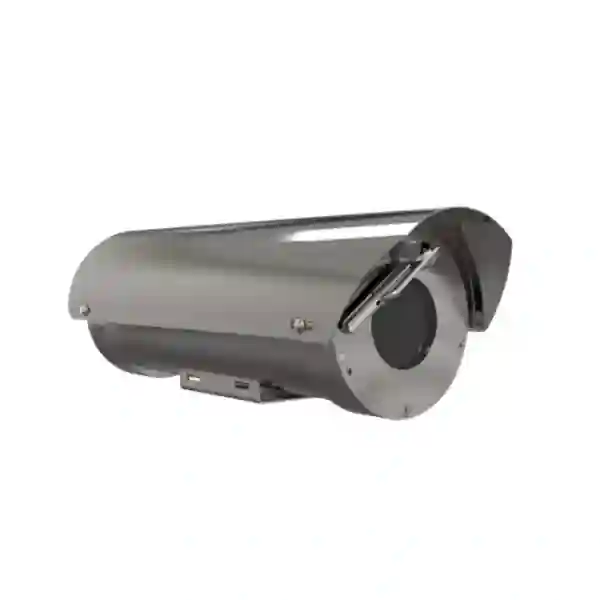
Hanwha Vision TNO-X6320E1WT1-M Explosion-Proof Zoom Camera
Need an industrial IP camera with optical reach, a rugged enclosure and a defined fixed sightline? The Hanwha TNO-X6320E1WT1-M offers Full HD video, 32× optical zoom, an integrated wiper and 24 VAC operation. Its hazardous-area suitability must be confirmed for the exact installation. Request a specification review and project quotation before procurement.
Before you specify this camera
This is a visible-light, fixed-direction optical zoom model—not a thermal or motorized pan-tilt camera. Treat the exact enclosure certificate, hazardous-area classification, lens coverage, 24 VAC electrical design and network compatibility as procurement checks. Regional availability, pricing and installation services require separate confirmation.
Technical specifications at a glance
| Model | TNO-X6320E1WT1-M |
|---|---|
| Type | Explosion-proof fixed-direction optical zoom IP camera |
| Video | 1920 × 1080; up to 60/50 fps H.265/H.264 |
| Sensor | 1/2.8-inch CMOS |
| Lens and zoom | 4.44–142.6 mm; 32× optical zoom; autofocus |
| Field of view | 61.8°–2.19° horizontal |
| Wide dynamic range | 150 dB |
| Encoding | H.265, H.264, MJPEG; WiseStream II |
| Networking | RJ-45 10/100BASE-T; ONVIF S, G, T |
| Edge storage | 2 × microSD slots, up to 256 GB each |
| Power | 24 VAC; max. 37 W |
| Construction | STS316L stainless steel; built-in wiper |
| Ingress protection | IP66, IP67 |
| Operating temperature | −40°C to +60°C |
| Dimensions and weight | 176 × 154 × 480 mm; approximately 15 kg |
Specifications reflect Hanwha Vision’s exact-model product information. Verify current model-specific documentation and any regional variation before installation.
Designed for industrial surveillance decisions
The Hanwha TNO-X6320E1WT1-M is intended for projects that cannot be specified by image quality alone. A buyer may need to observe process equipment, monitor a perimeter, or examine an access point while meeting a facility’s hazardous-area requirements. This model combines a fixed-position network camera with a powerful motorized zoom lens and an explosion-proof enclosure. It is a candidate for review in demanding industrial environments, not a universal answer for every classified area. The first purchase decision should be whether the exact enclosure marking, installation method and site classification match. The second should be whether its field of view, lighting and network design meet the actual surveillance task.
If you are building a Tanzania industrial CCTV bill of materials, use this page as a technical starting point and seek a model-specific quotation with your site’s hazardous-area drawings and video requirements. No assumption is made here about local inventory, lead times, installation coverage or regulatory acceptance.
What the camera is—and what it is not
This is a visible-light IP camera with a 32× optical zoom lens. It is not a thermal camera: its CMOS sensor forms images using available visible illumination and relevant imaging adjustments. It is also not a motorized pan-tilt-zoom camera. Although the lens can change focal length and focus, the installed housing does not provide the moving pan and tilt functions of a PTZ model. That distinction is important when a control-room operator expects to follow a moving vehicle across several directions.
A correctly positioned fixed zoom camera can work well when the critical scene is already known, such as a valve bank, gate, loading area or process line. If the site needs a 360-degree patrol or multiple changing sightlines, compare a suitable explosion-proof PTZ model instead. If detecting heat signatures in darkness is the objective, evaluate a separately specified thermal imaging device.
Full HD video and frame rate
The manufacturer’s published maximum image resolution is 1920 × 1080 pixels, commonly described as Full HD or 2 MP output. The camera supports up to 60 frames per second with H.265 or H.264 in the appropriate 60 Hz setting, and up to 50 fps in its 50 Hz setting. MJPEG has a published maximum of 30 fps. A higher frame rate may help operators review fast movement, but it generally consumes more bandwidth and storage than a slower stream at comparable encoding settings.
Plan frame rate by task rather than treating the maximum as a fixed requirement. A security overview may prioritize days of retention, whereas a critical process checkpoint may need smoother footage. Confirm the recorder, network, decoding client and configured resolution can support the selected frame rate together. Recording performance depends on the wider system; a camera’s maximum output alone does not guarantee identical results at every workstation.
32× optical zoom and lens reach
The built-in lens covers 4.44 mm to 142.6 mm and supplies 32× optical zoom, autofocus, manual focus and one-shot autofocus. Optical zoom changes the image captured by the lens rather than only enlarging existing pixels. That is valuable when an operator wants an overview during one event and a closer view of the same fixed sightline during another. The manufacturer’s listed 32× digital zoom is separate; digital enlargement should not be mistaken for additional optical detail.
At a long focal length, the camera shows a much narrower portion of the scene. Small mounting vibrations, focus errors, glare and atmospheric haze also become easier to notice. Consider both the widest view necessary for awareness and the tightest view necessary for identification or inspection. A commissioning test at the real mounting position is better than estimating usefulness from a zoom ratio alone.
Field of view and placement
Hanwha lists a horizontal viewing angle from about 61.8 degrees at wide to 2.19 degrees at telephoto, with vertical coverage from 36.2 to about 1.24 degrees. These figures help explain why the same camera can show a broad section of industrial equipment or a very narrow target. They do not by themselves prove that a particular face, vehicle plate or gauge will be identifiable at a specified distance.
Begin the design with a site plan showing the target, camera location, expected motion and obstructions. Decide whether the required result is detection, observation, recognition or identification, and then check pixel density for the real distance. Include room for future equipment, parked vehicles or temporary barriers that might obstruct the view. A narrowly zoomed camera can miss events elsewhere in its original wide scene.
Focus, aperture and close-range limits
The lens has a published maximum aperture ratio of F1.6 at its wide end and F4.4 at telephoto. This change is relevant to low-light design: maximum telephoto does not necessarily deliver the same light-gathering conditions as the widest setting. The manufacturer’s product page gives a minimum object distance of 1.5 m, so verify the required working distance if the camera will look closely at nearby machinery.
Autofocus is useful when an operator changes the zoom level; manual and one-shot options may suit stable scene configurations. Commission the lens during the actual day and night conditions expected at the installation. Reflective metalwork, rain on the window, steam and changes in process lighting can affect perceived image quality even when the camera itself operates within its stated limits.
Day and night visibility
The camera features automatic day/night switching using an infrared-cut filter mechanism. Its published minimum illumination is 0.05 lux in colour and 0.005 lux in black and white under specified test conditions. These are sensitivity reference figures, not a promise of equally clear operational footage in every low-light scene. The product listing does not establish a built-in infrared illuminator, and users should not assume the camera can image completely unlit areas without suitable light.
Assess lighting around the required subject rather than relying only on an illumination reading at the camera. Consider distance, contrast, moving objects, backlighting and any restrictions on additional lighting in the classified area. Appropriate external illumination, if needed, must be selected and approved for the relevant environment as a separate design matter.
Wide dynamic range for difficult contrast
A published 150 dB wide dynamic range capability is one of the model’s defining imaging features. WDR is useful when bright openings, floodlights or sunlit areas share the frame with darker processing equipment. For example, an access opening may face the sky while the interior wall remains shaded. Camera configuration can help maintain detail across those contrasting regions.
WDR is not a substitute for good placement or correct exposure. Very bright reflections, dust, fog and highly variable artificial lighting still require on-site review. During acceptance testing, check the important subject at the time of day when glare is strongest. Operators should be able to distinguish the information they need, not merely see an attractive overall image.
Defog, noise reduction and image stabilization
Hanwha specifies digital defog, SSNR V noise reduction and digital image stabilization using a built-in gyro sensor. These functions can help manage certain visibility and motion challenges in industrial scenes. Defog is an image-processing aid for reduced contrast; it does not remove real smoke, dust or moisture from the line of sight. Noise reduction can make darker scenes easier to view but may also affect how fine moving detail appears when configured aggressively.
Digital stabilization is valuable where small vibrations affect the image, especially at high zoom, but it cannot correct unsafe mounting or structural movement beyond the system’s capabilities. Include a physical vibration assessment for platforms, gantries and equipment structures. Tune image functions against recorded test footage rather than enabling every enhancement at its strongest setting.
Built-in wiper and outdoor care
An integrated wiper is included in the TNO-X6320E1WT1-M configuration. Its practical purpose is to help clear water from the viewing window and maintain a usable sightline when conditions are wet. This can be important at outdoor industrial installations where regular access to the housing is inconvenient or restricted. The wiper is not a guarantee of unobstructed video under every weather or contamination condition.
Mineral deposits, oil mist, salt residue and adhesive dust can still require planned cleaning. Confirm the required wiper operation and any supporting cleaning arrangement from the exact installation documentation. Do not assume an external washer tank is included or electrically compatible without checking the accessories and approved hazardous-area installation design. The surveillance maintenance plan should account for safe access to the enclosure.
316L stainless steel construction
The camera housing material is specified as stainless steel STS316L. This alloy is commonly considered for demanding outdoor and industrial exposure, including locations where corrosion resistance is a design priority. Hanwha lists a silver finish and a substantial enclosed-camera construction, distinct from a lightweight office or retail security camera. Its material choice is one reason an engineer may shortlist the model for aggressive plant environments.
Corrosion resistance does not mean zero maintenance or automatic suitability for every chemical. The severity of salt, process vapours, cleaning agents, surface deposits and material contact varies by site. Verify mounting hardware, fixings, cable-entry components and adjacent metals as a complete assembly. A high-quality enclosure can still be compromised if the associated installation materials are selected without regard to exposure.
Ingress protection and ambient conditions
The manufacturer identifies IP66 and IP67 ratings under IEC 60529. These ratings describe tested protection against specified dust and water conditions; they should not be read as a universal guarantee against pressure washing methods, chemical attack or every possible immersion scenario. The published operating range is −40°C to +60°C, with non-condensing humidity from 0% to 90%. Its storage temperature range is listed as −50°C to +60°C.
For Tanzania installations, do not judge suitability from general climate labels alone. Enclosures exposed to direct sun, hot equipment, wind-driven rain or coastal salt may experience very different local conditions. Calculate or assess actual ambient and radiant heat at the proposed mounting point, and maintain the required seals and cable glands. A weather rating and a hazardous-area approval address different questions; both have to be considered.
Explosion-proof terminology and approval scope
The manufacturer describes this family as explosion-proof and lists certifications and standards including INMETRO, cLCus Class I Division 1 and cLC CSA on its product page. Model suffixes and regional documentation matter: the exact -M designation is associated with INMETRO in Hanwha’s product-identification material. These labels do not automatically establish that the camera is permitted in every hazardous zone or by every Tanzanian site authority.
Hazardous-area selection requires comparison of the exact unit’s nameplate and current certificate with the installation’s classification, gas or dust group, temperature class, ambient limits and protective concept. The engineer responsible for the facility must verify the approved cable entries, seals, earthing, mounting and maintenance procedures. Do not use a general marketing statement as the sole basis for an explosion-protection decision. Ask for current model-specific certification documents before ordering.
A practical hazardous-area selection process
Start by obtaining the site’s hazardous-area classification drawings and the equipment schedule. Identify the location of each camera, the substances or dusts involved, any zone or division designation, and the required temperature limits. Then request current documentation for the precise model and proposed accessories. Confirm that the product variant, marked protection concept and approved installation conditions fit the designated location.
Only after those safety-related checks should the project team finalize viewing angle, zoom range, recorder configuration and commercial quantities. An explosion-proof housing is not a detection device for an explosion and does not eliminate the need for safe plant procedures. Installation and servicing must follow the manufacturer’s instructions and applicable site rules, carried out by personnel qualified for the environment.
Size, weight and mounting engineering
Hanwha lists dimensions of approximately 176 × 154 × 480 mm and a weight of 15 kg. Those dimensions and mass are material to the design of poles, walls, brackets and structural attachments. Wind loading, vibration, corrosion and the ability to maintain the unit safely may be more important than the camera’s footprint alone.
Check that the bracket and support arrangement are suitable for both the weight and the installed environment. Identify any site-specific approved mounts and required fasteners before the order is finalized. Leave enough space for the enclosure, its cable route, future servicing and safe access. Do not treat a bracket appearing in a product-family catalogue as automatically included with the camera or approved for the exact site.
24 VAC power and electrical design
The TNO-X6320E1WT1-M is specified for 24 VAC input with maximum power consumption of 37 W. This is a significant purchasing detail because many routine IP camera installations rely on Power over Ethernet. For this exact configuration, do not assume the RJ-45 network port also supplies PoE power. A compatible and appropriately engineered 24 VAC source is required.
The electrical design should account for cable length, voltage drop, circuit protection, isolation, backup-power requirements and any hazardous-area installation restrictions. Confirm the manufacturer’s connection and grounding instructions. If the power source is remote, check the voltage reaching the equipment under load rather than only the transformer nameplate. Include power arrangements for any separately selected accessories.
Wired Ethernet connection
For networking, Hanwha lists an RJ-45 10/100BASE-T Ethernet interface. It is a wired network device, so projects should plan the physical data path from the camera to approved industrial switching or recording equipment. A hazardous-area installation may need carefully specified routing, terminations, protection methods and transition points outside classified spaces.
Do not describe the model as a Wi-Fi or fibre-optic camera without confirming a separate approved system design. Its listed interface is copper Ethernet, whereas other models in the explosion-proof family may differ in power and communications architecture. The chosen connectivity must fit both the IP-video capacity and the safety requirements of the installed location.
Video compression and storage efficiency
The supported encoding options are H.265, H.264 and MJPEG. H.265 can be attractive when bandwidth and storage efficiency matter, while H.264 may be preferable for compatibility with older software or recorders. WiseStream II and configurable bitrate controls are published features. Actual results depend on scene detail, movement, lighting, profile settings and the downstream system.
A single static daytime image is a poor basis for estimating required recording capacity. Test the scene at night, during equipment motion and in rainy conditions. Review whether the chosen VMS can decode the intended codec at the desired frame rate. Where a facility has limited uplink capacity, design the local recording and remote viewing workflow together rather than assuming compression alone will solve connectivity constraints.
Multiple streams and operator workflows
The camera supports up to ten streaming profiles and a published unicast connection capacity of up to twenty users, with multicast also supported. Multiple profiles let a system provide different resolutions, bitrates or frame rates for separate purposes when configured appropriately. For example, a control room may consume a higher-quality stream while a remote monitoring interface receives a lower-bandwidth overview.
This is a capability of the camera, not an automatic guarantee of twenty simultaneous high-resolution clients under every network condition. Assess the recorder, switches, workstation decoders and remote links together. Avoid unnecessary direct clients if the video management system can distribute views more efficiently. Document which profile is recorded and which is used only for live viewing.
VMS and interoperability considerations
The manufacturer’s listed interoperability includes ONVIF Profiles S, G and T, SUNAPI and the Hanwha Vision Open Platform. These standards and interfaces can simplify evaluation of integration with recording systems and management software. They do not mean every application will expose every advanced feature in exactly the same way. Analytics configuration, wiper control, storage access and event mappings may differ among platforms.
Before procurement, test or confirm support for the exact firmware and VMS versions planned for the project. List required functions, not just ‘ONVIF compatibility’: live video, playback, event reception, access control, zoom commands and edge-recording support may each need separate checks. If the project depends on a particular vendor integration, obtain explicit confirmation from the relevant software provider.
Dual microSD edge storage
Two microSD/SDHC/SDXC slots are integrated, each supporting up to 256 GB according to Hanwha, for a combined stated maximum of 512 GB. Edge storage offers a possible way to retain events or maintain a local copy of selected footage, depending on configuration. The quantity of usable days or hours cannot be derived from capacity alone.
Retention depends on codec, bitrate, frame rate, continuous versus event-triggered recording, card performance and any overhead imposed by the system. Select endurance-rated media appropriate to the recording duty and follow the manufacturer’s supported-card guidance. Edge storage should be part of a planned resilience strategy, not a substitute for a verified evidence retention and backup policy where those are required.
Intelligent video analytics
Listed analytics include motion detection, tampering, fog detection, face detection, shock detection, virtual line crossing and direction, as well as virtual-area events such as loitering, intrusion, enter/exit and appear/disappear. These features can help focus operator attention on pre-defined changes in a scene. They are not a substitute for trained operators, safety instrumentation or reliable incident response procedures.
Assess event rules on the real site. Steam, rain, changing lights, vehicle headlights and moving machinery can all influence practical alarm behaviour. Set detection zones and schedules around the actual security objective. Where events are used to initiate important operational actions, require a validation and escalation process rather than assuming a camera-generated alert proves a particular incident occurred.
Alarm actions and event workflows
The camera supports responses to selected events, including notifications, storage recording and network messages, according to the manufacturer. This makes it possible to design workflows in which an event is recorded, sent to a monitoring platform or used by a supervisory system. Exact handling depends on configuration and support within the chosen VMS or integration layer.
For reliable operations, define who receives the notification, which camera view they should review, what response is expected and how repeated false alarms are treated. Include test cases for disconnected network links and interrupted power. Event delivery should be verified during commissioning and again after major firmware or VMS changes. An alarm that is technically generated but never received is not useful security coverage.
Privacy masking and responsible monitoring
Hanwha lists support for up to 24 rectangular privacy-masking zones. Privacy masking can help administrators avoid displaying parts of a scene that do not belong in the surveillance objective, such as sensitive neighbouring areas or unrelated private spaces. The exact behaviour of masks under zoom changes should be tested in the installed system.
Define camera purpose, access privileges, retention limits and review authority in the organisation’s surveillance policy. Restrict who can change camera settings or export recordings, and keep records of those changes where supported. Technical capability to capture a broad scene is not itself a reason to record everything that the lens can see.
Cybersecurity and access control
The camera’s published security features include digest user authentication, IEEE 802.1X options, IP-based access controls and management logs. Hanwha also lists protocols such as HTTPS and SNMP options. These capabilities support a more deliberate security configuration, but they do not replace network segmentation, account management and patch governance.
Before handing the installation over, set unique strong credentials, remove unnecessary services where possible, apply appropriate time synchronization and record the approved configuration. Restrict management access to authorised devices and administrators. Confirm secure remote access through the organisation’s own network design instead of exposing the camera directly to the public internet. Review firmware through official support channels, noting that update compatibility should be checked for the exact model.
Network resilience and remote monitoring
An industrial surveillance network should be designed for the recording task even when the internet connection is slow or temporarily unavailable. Keep essential video paths within the local facility where practical, and identify which services depend on an upstream connection. Use bandwidth estimates based on selected camera profiles and expected peak activity, then validate them during a representative site test.
Power continuity, switching resilience, time synchronization and cybersecurity are part of the same operating design. If a remote stakeholder must see footage, define whether they need a live stream, alerts, periodic snapshots or evidence after an event. Each option has a different bandwidth and operational impact. Do not assume remote access or cloud recording is included with the camera purchase.
Applications at oil and gas facilities
Oil and gas operators may use hazardous-area video surveillance to observe certain fixed points such as entry routes, equipment compounds, process boundaries and loading areas. The 32× zoom lens may be useful when the observation point must remain outside a restricted area while still allowing a closer view along its fixed direction. The stainless steel enclosure and wiper make the model worth evaluating where outdoor exposure is a concern.
The camera is not a gas sensor, flame detector, process-control safeguard or emergency shutdown device. Design it as part of a defined security or operational monitoring function, and confirm the plant’s classification and the product’s exact marking separately. Where an operator must follow moving targets through different directions, a different type of approved camera may be more suitable.
Industrial manufacturing and chemical processing
At manufacturing or chemical-processing sites, possible surveillance objectives include watching the approach to equipment enclosures, observing process areas and documenting activity at predefined checkpoints. A fixed-position optical zoom camera can be particularly appropriate when the view is narrowly specified and the operator benefits from varying magnification.
Before selection, identify the site’s actual hazardous substances and electrical classification rather than assuming the presence of chemicals automatically dictates one camera type. Review glare from stainless equipment, lighting transitions during shifts, washdown practices and any strong vibration sources. Video can support situational awareness, but it should never be presented as a replacement for compliant process instrumentation or established operational safety systems.
Storage, terminals and loading operations
Bulk storage facilities and controlled loading or unloading areas often combine long sightlines, intermittent vehicle activity and exposure to rain or dust. A zoom lens offers flexibility when the critical view is a gate, tanker connection point, fenced boundary or fixed transfer location. In an appropriately engineered system, live views and event recordings may help staff investigate particular movements.
Consider whether vehicle traffic may block the sightline and whether the camera must operate during poor weather or low light. Build the viewing plan around the expected subject size and speed. Do not assume that a single 32× camera replaces a broad perimeter system; long-range inspection and continuous wide-area coverage can be conflicting objectives.
Ports, coastal and exposed industrial sites
For an exposed port or coastal installation, corrosion-resistant materials, wind effects and access for maintenance may affect total project cost as much as the camera’s resolution. The STS316L housing is a relevant product characteristic, but its environment rating should be considered with mounting materials, cable-entry components and the site’s maintenance regime.
If the camera will be located where spray, high humidity or airborne deposits are common, arrange a realistic cleaning and inspection plan. Check available lighting and the possibility of backlight from open water or bright yards. Some port environments are hazardous areas and others are not; approval needs are determined by the precise location, not by the broad industry label.
Suitability for Tanzanian project planning
Tanzania projects may span industrial yards, processing sites, energy infrastructure and transport facilities with very different environmental and electrical conditions. The appropriate use of this model must therefore be established for each project location. Avoid assuming uniform regional weather, a particular communications provider, or any locally approved certification status.
For procurement, identify the exact facility location, the intended observation purpose, a site classification drawing where applicable, the proposed mounting position and the recording system. Ask the supply and engineering teams to verify local supply arrangements and any import or approval requirements rather than relying on an overseas price list. No local stock, service presence, delivery promise or installed price is claimed on this page.
Comparing fixed zoom and explosion-proof PTZ
This model provides optical zoom but not motorized pan and tilt movement. An explosion-proof PTZ camera is worth evaluating when operators must change viewing direction or run preset patrols across several separated targets. A fixed zoom configuration may be better suited to a stable sightline and a narrowly defined surveillance purpose.
Compare options by required coverage, approved environmental rating, cable architecture, mechanical complexity, maintenance access and software controls. A PTZ can be pointed away from one target while viewing another; a fixed camera maintains its mounted direction. Some projects use multiple fixed views rather than one movable view for this reason. Product selection should be made from the coverage plan, not simply from whichever model has the longest feature list.
Comparing visible-light and thermal imaging
A visible-light camera such as the TNO-X6320E1WT1-M is designed to produce familiar scene images, potentially including colour detail in appropriate light. A thermal camera observes thermal radiation instead and is evaluated for different tasks, environmental conditions and resolution metrics. The two technologies are not interchangeable merely because both may be offered for industrial security.
If the operational requirement is to inspect appearance, activity, markings or objects under suitable lighting, optical imaging may be appropriate. If the goal is temperature-related anomaly observation or seeing heat contrast where visible illumination is inadequate, consider a separately specified thermal system. A thermal option also requires verification of measurement capability; not every thermal video camera provides calibrated temperature readings.
Procurement checks before a quotation
A useful quotation request should include more than the model number. State the planned quantity, project purpose, delivery destination in Tanzania, supply voltage, network architecture, mounting conditions, required accessories and any hazardous-area classification documents. Identify the recorder or VMS that must receive the streams. Ask the supplier to identify the exact suffix and current documentation for the offered unit.
Clarify whether the quotation includes only the camera or also approved brackets, power equipment, cable-entry accessories, storage media and commissioning services. Request transparent information about taxes, import arrangements, warranty terms and lead time rather than assuming any of those are standard. Verify the scope of delivery and relevant certificates before placing an order.
Installation and commissioning checklist
Before energising the camera, confirm the relevant personnel have reviewed the installation instructions and site permits. Verify the exact model identity, enclosure and certification markings, approved mount, environmental condition, power source and cable-entry system. Confirm the 15 kg load is adequately supported, there is safe access for maintenance and the intended line of sight is unobstructed.
Then validate the image at both ends of the zoom range, autofocus behaviour, day/night transitions, WDR in difficult lighting, wiper operation and event rules. Test the selected recording codec, frame rate, edge-storage behaviour, access controls and clock synchronization. Check live viewing and recorded playback with the actual VMS, including a simulated network interruption where appropriate. Store commissioning settings and evidence within the facility’s document process.
Maintenance and lifecycle considerations
Maintenance planning should reflect the enclosure’s location, access restrictions, weather exposure and criticality of the video coverage. Inspect window cleanliness, housing condition, fasteners, corrosion, cable-entry integrity and mounting stability using procedures approved for the installation. Confirm that the wiper remains effective and that no unusual vibration or obstruction has developed.
A regular software review is also useful. Check recording continuity, event behaviour, account permissions and approved firmware support. Schedule any service requiring entry to a classified area through site safety procedures; enclosure work must not be improvised. Keep model-specific manuals and certification records with the asset register so future technicians do not mistakenly apply instructions for a similar but different suffix.
How to choose the right recording design
There is no universal recording duration for this camera because storage demand changes with resolution, frame rate, codec, scene complexity and recording schedule. Decide how long relevant footage must be retained, how quickly it must be retrieved, and who may export it. Then size the recorder, network and any edge media for those goals with a reasonable operating margin.
Review the value of event-triggered recording against continuous coverage. Critical incidents may begin before a motion rule is triggered, so pre-event recording and wider context can matter. Use realistic recorded samples to estimate storage needs and test the worst case during busy operations. Ensure that retention and access arrangements align with the organisation’s applicable obligations.
What to send for an informed specification review
For a productive product discussion, send a simple camera schedule listing target locations, the expected subjects and approximate viewing distances. Include the required image purpose, day and night lighting, hazardous-area classification if relevant, and any weather or contamination issues. Specify whether remote users need a live view or only event playback.
Also include the available 24 VAC arrangement, the route for wired Ethernet, the current recording platform and any existing video standards. With those details, the project team can evaluate whether the Hanwha TNO-X6320E1WT1-M is appropriate or whether a different optics, power, housing or camera movement configuration is needed. A specification review should lead to an exact bill of materials rather than a broad claim of compatibility.
Frequently asked questions
Is this a thermal camera?
No. This model is an optical, visible-light network camera with a CMOS imaging sensor and 32× optical zoom. It should not be selected where the actual requirement is thermal detection or calibrated temperature measurement. Review a dedicated thermal camera specification for those uses.
Does the camera pan or tilt remotely?
No motorised pan or tilt function is specified for this fixed-position zoom camera. Its optical zoom and autofocus do not make it a PTZ model. Choose a correctly approved PTZ solution if the camera must turn to follow targets around different sightlines.
Does it use PoE?
The exact TNO-X6320E1WT1-M is specified for 24 VAC input and a maximum 37 W draw. Its Ethernet port is listed for network communications. Do not plan a PoE-only power arrangement for this model without separate, authoritative evidence of compatibility.
What recording resolution and zoom are supported?
Hanwha lists Full HD 1920 × 1080 output at up to 60 fps in the appropriate H.265 or H.264 configuration, together with a 4.44–142.6 mm lens and 32× optical zoom. Actual recorder settings and performance must be checked as part of the full system.
Can it be used in a hazardous area in Tanzania?
It may be a candidate for evaluation, but suitability cannot be established from the product name alone. Compare the exact nameplate and current model-specific certificates with the facility classification, conditions of use and any applicable local acceptance requirements before purchase and installation.
What is special about the -M suffix?
Hanwha’s product-identification material associates the -M variant with INMETRO. The suffix is not a substitute for examining the exact unit’s marking, certificate scope and installation instructions. Do not infer that other regional or hazardous-area approvals automatically apply.
How much footage can the SD cards hold?
The manufacturer lists two slots with up to 256 GB each, or 512 GB combined. A reliable retention estimate requires the codec, bitrate, frame rate, recording schedule and event activity. Storage size alone does not specify how many days the camera will record.
Can the built-in wiper remove every obstruction?
No. The integrated wiper can assist with moisture on the viewing surface, but it does not eliminate every contaminant or atmospheric condition. Dust, deposits, oily films and other sources of obscuration may still require a maintenance and cleaning plan.
Will it work with an existing VMS?
The published interface list includes ONVIF Profiles S, G and T, along with Hanwha APIs. Verify the exact VMS version, firmware, required analytics, zoom control, event integration and recording functions before treating compatibility as confirmed.
How do we request pricing for a Tanzania project?
Request a model-specific quotation with the quantity, installation location, hazardous-area documentation where applicable, mounting, 24 VAC power and network needs. Ask for the precise scope of supply, availability, warranty and delivery terms to be confirmed in writing; none is presumed here.
Request a Tanzania project quotation
Share the required quantity, installation environment, hazardous-area classification where applicable, viewing distance, recording platform and 24 VAC power plan. Ask for the current certificate and exact model suffix to be checked, together with mounting and cable-entry accessories. A tailored specification review is the safest next step before placing an industrial CCTV order.
Contact FourTeck Tanzania to request product details and a quotation.




Reviews
There are no reviews yet.