
Hanwha Vision | Industrial Video Surveillance | Tanzania
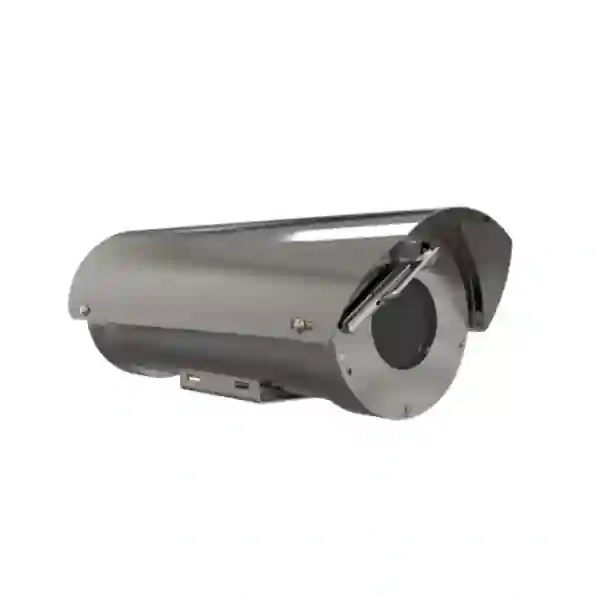
Hanwha TNO-X6320E2F2WT2-C Explosion-Proof Zoom Camera
For industrial security teams that need to assess a protected camera for a potentially explosive location, this Hanwha model combines Full HD video, 32x optical zoom, integrated wiper and network-video features. Its selection depends on the exact hazardous-area classification, local electrical design and system integration. Request a project-specific technical review before ordering.
At a glance: is it the right camera?
Consider this product for a specified fixed observation point where long optical reach, industrial housing construction and wiper functionality are valuable. Before purchase, verify the exact protection documentation for the hazardous location, plan a compliant 110V AC supply, review the fibre and software interfaces, and confirm how the camera will be mounted, accessed and maintained. These checks are essential elements of the design rather than optional extras.
- Primary task: defined industrial observation and evidence recording
- Deployment gate: classification and certification acceptance
- Electrical gate: engineered 110V AC supply at the site
- System gate: compatible networking, VMS and storage
- Next step: request a technical and commercial evaluation
Verified technical overview
| Model | TNO-X6320E2F2WT2-C |
|---|---|
| Manufacturer | Hanwha Vision |
| Camera type | Explosion-proof zoom network camera; fixed viewing direction |
| Max video resolution | 1920 × 1080 (Full HD) |
| Max H.265 / H.264 frame rate | Up to 60 fps (frequency-dependent) |
| Image sensor | 1/2.8-inch CMOS |
| Lens | 4.44–142.6 mm; 32x optical zoom |
| Horizontal viewing angle | Approximately 61.8° to 2.19° |
| Video formats | H.265, H.264 and MJPEG |
| Networking | Listed RJ-45 Ethernet and fibre capability; verify exact interface |
| Software interfaces | ONVIF Profiles S, G and T; SUNAPI |
| Storage | Dual microSD/SDHC/SDXC slots; up to 256 GB each |
| Environmental features | Wiper, STS316L stainless-steel housing; IP66/IP67 listed |
| Input supply | 110V AC; max listed consumption 37 W |
| Approximate size and mass | 176 × 154 × 720 mm; 21 kg |
| Certifications referenced | cLCus Class I, Division 1 and cLC CSA; verify exact certificate and site acceptance |
Technical summary based on Hanwha Vision’s exact-model public specifications. Some historical regional documents conflict on temperature limits and other figures; obtain the current unit-specific datasheet and certification schedule for engineering sign-off.
Purpose-built observation for risk-managed industrial sites
A camera used in or near a potentially explosive atmosphere needs a different procurement conversation from a camera on a normal office wall. The question is not simply whether the picture is sharp. Project teams must determine whether the precise equipment assembly, its protection method, electrical connections and installation conditions are acceptable for the classified location. The Hanwha TNO-X6320E2F2WT2-C is an explosion-proof zoom camera intended for that more demanding evaluation. It offers an unusually specific combination of optical reach, protected construction, network video and an integrated wiper, which is useful where an operator must inspect a distant scene from a predetermined viewpoint.
For a buyer in Tanzania, the right first step is to assemble the hazardous-area dossier and basic system design. The documents should identify the site activity, zone or division classification, gas or dust group where applicable, permitted temperature class, ambient extremes, cable route, supply arrangement and intended recording platform. Procurement can then ask whether the exact manufacturer variant is appropriate. This is a candidate product to be evaluated by qualified designers, not a substitute for site classification or formal approval.
What the camera delivers in practical terms
This model records video at resolutions up to 1920 by 1080 pixels, with H.265 or H.264 frame rates up to 60 frames per second under the stated frequency conditions. That is a useful combination for watching movements of people, mobile plant or processes that benefit from smoother video than a low-frame-rate overview. Resolution is not the same as identification certainty, however. Camera position, scene distance, lighting, compression, movement and the target’s size in the image all influence whether an operator can reliably interpret an event. A design review should therefore define the required level of detail before treating any camera specification as sufficient.
The 32x optical zoom brings selected distant areas into the frame without relying solely on digital enlargement. Autofocus helps adjust the view when zoom changes, while manual or one-shot focus provides alternative setup choices. Zoom does not mean the entire housing pans or tilts. Fixed mechanical orientation and the available field of view must be assessed with the plant layout. For continuous coverage of several directions, a different positioning camera or multiple viewpoints may be necessary.
Why zoom and field of view should be planned together
At the wide end, the manufacturer’s lens specification is approximately 4.44 mm, with a horizontal field of view around 61.8 degrees. At the telephoto end the focal length reaches approximately 142.6 mm and the view narrows to about 2.19 degrees. This gives the system designer a wide framing option for general context and a narrow option for selected detail. It does not guarantee that every relevant activity will remain in sight. A telephoto setting can make a distant valve, loading platform or access point easier to examine while excluding a large portion of the surrounding scene.
Before buying, decide whether the primary task is broad situational awareness, inspection of a known asset, forensic review of a distant object or a combination of these. Set a realistic viewing distance and target size. Account for poles, pipe racks, fences, vehicles and temporary equipment that can block the optical path. Consider how a chosen zoom setting affects recording and operator workflow: if it is continually zoomed in, the overview may be lost. An approved camera-location drawing and sample pixel-density calculation are more useful than relying on optical zoom alone.
A wiper for an exposed viewing window
A built-in wiper is a distinctive feature of the TNO-X6320E2F2WT2-C. In an outdoor industrial setting, dust, spray, rain and deposited contaminants may reduce the clarity of the front viewing window. The wiper can form part of a maintenance and observation strategy by helping move some material away from the optical surface. It should not be described as a self-cleaning guarantee. Sticky chemicals, salt deposits, heavy grime, surface damage or unsuitable cleaning methods can still create visibility problems and require planned service by competent staff.
If a project operates around conveyors, marine structures, process areas or exposed pipework, the maintenance plan should specify who inspects the glass, how access will be controlled and which cleaning practices the equipment manufacturer permits. Check whether additional washer equipment is needed, whether it is approved for the location, and how it will be powered or controlled. The camera’s wiper is not evidence that an optional washer system is included. The condition of the viewing window matters because degraded images can undermine an otherwise correctly designed surveillance system.
Stainless-steel housing and exposure conditions
Hanwha identifies the housing material as STS316L stainless steel. That is relevant to buyers dealing with coastal air, process facilities, washdown exposure or outdoor equipment where corrosion resistance has operational value. It is nevertheless important not to treat a material designation as proof that the camera will resist every chemical or every maintenance practice. Real-world service life depends on contaminant type, concentration, cleaning agents, temperature, joint details, galvanic interfaces and mounting hardware. A corrosion assessment should cover the complete assembly rather than only the camera body.
The published product information identifies IP66 and IP67 environmental protection. These ratings concern ingress conditions established by the relevant test methods; they are not an unlimited submersion claim and do not independently determine hazardous-area suitability. Cable entries, seals, glands, mounting interfaces and installation workmanship can affect the final protection of the installed system. Where users require a particular ingress rating, request the current exact-model documentation, mounting instructions and any relevant accessory details. Document any additional site testing or inspection requirements through the project engineer rather than relying on a broad description such as weatherproof.
Hazardous-area certification is a project decision
The Hanwha product listing references cLCus Class I, Division 1 and cLC CSA within its certification information. Those are useful identifiers when a technical reviewer checks the device against the facility’s hazardous-area requirements. They must not be presented as automatic approval for every explosive atmosphere or for installation anywhere in Tanzania. Different projects may apply different classification systems, authority requirements, certificate scopes and documentation procedures. Suitability may depend on exact product marking, ambient limits, gas group, temperature class and any special conditions attached to the certification.
Ask the owner or responsible hazardous-area engineer to compare the actual camera nameplate and current certificate schedule with the installation location. The review should include the associated cable glands, conduit, termination enclosure, earthing approach, mechanical attachments and accessories. Where the site’s documents use IECEx or ATEX terminology, the project team must establish whether this particular variant has an acceptable certification pathway rather than assuming one standard is interchangeable with another. Do not install or energize the unit in a classified area until the responsible specialists have completed that determination.
The critical 110V AC electrical check for Tanzania
Hanwha specifies a 110V AC input for this exact camera and a maximum listed power consumption of 37 watts. Tanzania’s ordinary low-voltage distribution is generally 230V phase to neutral, so a direct connection to a typical local supply would be an inappropriate assumption. This difference belongs at the top of the project checklist, not in small print after a purchase. The electrical designer must establish an approved way to provide the rated camera input from the available site system, accounting for protection, isolation, earthing, frequency, voltage tolerance and the classified-area rules.
A proposed transformer, dedicated supply, UPS circuit or other power arrangement requires review as a whole system. It should be located and enclosed appropriately for the environment, use suitable protective devices and meet the facility’s drawings and maintenance procedures. Do not assume PoE will power this 110V AC model merely because it is a network camera. Confirm the exact power connector and manufacturer installation instructions, especially if other camera variants have different voltages. The right supply design can determine whether this SKU is practical for a Tanzanian deployment at all.
Fibre networking and system architecture
The model is presented with fibre connectivity, which can be relevant when a camera is a considerable distance from a control room or when the surveillance design uses a plant fibre backbone. A network designer should confirm the exact optical interface, fibre type, connector arrangement, supported reach and any transceiver or conversion requirements from current documentation for the ordered assembly. Describing a product as fibre capable is not sufficient to specify a complete optical link. Distances and losses must be assessed along with the actual physical route, splice count, connector condition and available spare fibres.
The product specification also lists an RJ-45 10/100BASE-T network interface. Do not interpret the presence of an Ethernet specification and a fibre feature as permission to make arbitrary simultaneous connections. Verify the expected physical wiring method, the hazardous-area boundary and the equipment at the far end. Segregation of signalling and power, lightning or surge exposure, grounding and protected cable routing may all be important for an industrial campus. Specify the network architecture on a drawing before ordering interface components, so the camera, switch, optical plant and recorder form one tested solution.
Compression, video profiles and bandwidth planning
H.265 and H.264 compression help make Full HD video manageable across a network, while MJPEG remains available for workflows that specifically require it. The camera also supports multiple streaming profiles and WiseStream II. These are flexible system capabilities, not fixed bandwidth guarantees. Actual traffic depends on image detail, compression choice, frame rate, quality settings, changes in the scene, analytics overlays and the number of simultaneous viewers or recording streams. A busy process scene with moving objects can demand very different bitrates from a static yard.
Before deployment, define a high-quality recording stream, the live-view stream required by the control room and any lower-bandwidth remote or mobile stream. Ask the integrator to model peak aggregate traffic at the uplink, distribution switch, recorder and storage network. The manufacturer lists up to ten streaming profiles, but this does not mean every profile should be used simultaneously at its maximum settings without design checks. Agree a retention target, event-handling policy and a verification test that measures video under representative operating conditions. Bandwidth needs to be engineered, not inferred from the codec name.
Recording on network storage and at the edge
The manufacturer lists two microSD, SDHC or SDXC slots with a stated maximum of 256 GB per slot, for up to 512 GB total. This can provide useful edge-recording capability when a project requires local footage support or event capture at the device. It should not be treated as a replacement for a properly designed central recording system without reviewing operational needs. Recording time depends heavily on bitrate, motion, frame rate, encoding settings and retention mode, so a headline capacity figure alone cannot prove the number of days available.
Projects should define whether recording will be continuous, event driven, centralized, locally buffered or some combination. Consider how the system behaves when network connectivity is interrupted, when storage fills, and when a card fails or is removed for servicing. The specification mentions recording to network-attached storage under relevant events, but the exact workflow needs verification with the selected recorder or video-management platform. Choose surveillance-grade media where appropriate, test media compatibility and document access permissions, clock synchronization, evidence export and chain-of-custody expectations for incident investigations.
Video analytics that support operations
Built-in video analytics can contribute to alarms and event searches. Hanwha lists functions such as motion detection, tampering, fog detection, shock detection, virtual-line crossing and virtual-area events including intrusion and entry or exit. These functions can help a surveillance team focus on changes in a defined scene instead of continuously scanning every display. They should be viewed as configurable assistance rather than a guarantee that all safety or security incidents will be detected. Lighting variation, occlusions, reflections, vibration and moving machinery can alter the results.
For reliable use, identify a clear event objective before enabling a rule. A virtual line might monitor a controlled approach, while tampering detection could flag an unexpected loss or obstruction of view. Each rule needs scene-specific testing, suitable sensitivity, clear operating procedures and periodic retesting after camera maintenance or layout changes. Separate a security notification from any process-safety interlock: camera analytics should not be assigned an unsupported safety-integrity function. The control-room response plan should define who receives an alert, what evidence is retained and how false alarms are investigated and tuned.
Day, night and challenging light
The model includes automatic day and night switching using an infrared-cut filter, together with backlight and wide-dynamic-range functions. These features can help balance scenes containing strong highlights and darker areas, such as a sunlit opening against shaded industrial equipment. They do not eliminate the need for lighting design. A camera positioned against direct glare or an unlit target may still fail to show the required detail. Hanwha lists low-light sensitivity figures for defined test conditions; field results depend on lens position, exposure time, movement and installation conditions.
Plan the illumination of the target, not just the illumination around the camera. Evaluate night-time activity, seasonal sun angles, artificial floodlights, vehicle headlights and any optical obstructions. If supplemental lighting is required, use equipment that is acceptable for the relevant environment and avoids glare or reflections into the viewing window. Do not assume an integrated infrared illuminator is part of this variant without explicit confirmation. Conduct a day and night acceptance test at the zoom levels that operators will actually use, and preserve reference images as part of the commissioning record.
Image stability, vibration and defog
Industrial cameras may share structures with motors, pumps, conveyors or vehicle movements. Hanwha lists digital image stabilization using a built-in gyro sensor and a defog function for this camera family. These features can improve usability in some difficult scenes, yet they cannot correct an unstable bracket, poor focus or serious atmospheric obscuration. In long-range zoom views, even small structural movements can shift the target significantly within the narrow field of view. Bracket stiffness and foundation behavior therefore deserve attention before relying on electronic compensation.
The installation review should consider vibration sources, expected wind loads, mounting height and whether normal plant operations introduce periodic movement. Qualified engineers should verify the mounting arrangement for both the camera’s mass and the site’s structural conditions. The manufacturer lists the product at approximately 21 kilograms, so lifting access and support capacity matter. Defog image processing may help with reduced contrast from atmospheric haze, but it is not a heating, drying or cleaning system. Mechanical stability, optical cleanliness and suitable lighting remain basic requirements for dependable results.
Cybersecurity and managed access
Connecting a hazardous-area camera to an industrial or corporate network introduces ordinary cybersecurity responsibilities even though the camera is installed in a special enclosure. Hanwha lists secure communication through HTTPS, digest-based authentication, IEEE 802.1X network authentication, IP-based access control and audit logging. These capabilities help support a controlled deployment when configured correctly. They are not substitutes for a documented site policy, a secure management network, properly assigned roles and timely operational review. Factory-default access or shared accounts can undermine otherwise capable equipment.
The owner should define who can view live video, change settings, export footage, administer firmware and respond to cybersecurity events. Where practical, isolate camera traffic through appropriate network segmentation, restrict exposed services, review time synchronization and maintain a register of approved devices. Firmware and configuration changes should follow a tested maintenance process, especially in facilities where unplanned camera outages can affect operations. The integrator should confirm current vendor guidance for this exact model and the chosen management platform. No universal claim of complete cyber protection should be made from a feature list.
ONVIF and video-platform integration
The manufacturer’s published interfaces include ONVIF Profiles S, G and T, alongside Hanwha SUNAPI and its Open Platform. Those descriptions can be helpful when the buyer wants to connect the camera to a video-management system, network recorder or broader operations platform. However, ONVIF profile support does not guarantee that every software release exposes every specialized camera function. Basic live video may be straightforward while wiper controls, camera events, edge-recording search or alarm handover require additional integration work.
Request a compatibility test with the actual recorder or VMS version planned for the site. Check live stream selection, authentication, time synchronization, motion or analytics events, footage playback, storage behavior and video export. If the operational plan relies on the camera wiper or zoom controls, make those functions explicit in the acceptance criteria. Different software packages may map manufacturer-specific settings in different ways. A demonstration using an unrelated Hanwha model is not a substitute for verifying the exact TNO-X6320E2F2WT2-C and the software environment that will be delivered.
Tanzania site-use examples and their limits
Potential use cases in Tanzania include observation points at industrial processing facilities, fuel-handling infrastructure, chemical storage areas and other locations where a competent specialist has identified a potential explosive atmosphere. A long-reach optical view could be useful when operators need to examine a distant asset from a designated position. At a marine or coastal installation, corrosion exposure and maintenance access might also be important. These are examples of design problems, not claims that every such site requires, permits or already uses this model.
A facility may have both ordinary and hazardous locations within the same perimeter. Cameras placed outside the classified boundary can sometimes use a different equipment strategy from cameras physically inside it. That distinction can materially change the budget and technical choice. A buyer should establish whether the camera really needs to be in the classified zone, what surveillance outcome is required and how the route back to the monitoring room will be built. A site-specific assessment prevents overspecification while also preventing the dangerous assumption that a standard outdoor camera is always acceptable.
Selecting between a fixed zoom view and true PTZ
One common specification mistake is equating 32x optical zoom with a full pan-tilt-zoom camera. This product is described as an explosion-proof zoom camera, with the viewing direction established by the mounted assembly. The optical zoom can change framing, but buyers should not assume powered horizontal and vertical repositioning of the entire housing. If the operator needs to swing between multiple tanks, gates or loading areas, the design may call for a suitable explosion-proof PTZ product or several cameras at separate viewpoints.
This choice should be based on coverage diagrams and operational behavior. A fixed view is useful when the critical asset or approach remains in the same direction. An actively positioned camera may be useful when operators must inspect different directions, but it introduces its own coverage and configuration tradeoffs. Neither arrangement automatically gives continuous evidential coverage of every area. Draw the required fields of view, specify whether simultaneous observation matters and document any blind spots. The correct recommendation may be a mixed arrangement combining fixed overview cameras with specialized long-range observation where the site classification allows it.
Procurement checklist before requesting a quotation
A useful quotation request should include the full manufacturer model string rather than a shortened family name. Similar-looking Hanwha explosion-proof variants may differ in power, environmental range, wiper, optical connection or certification marking. The buyer should attach the site’s hazardous-area classification summary, approved cable-entry design, network arrangement, required operating temperature, mounting method and the intended surveillance objective. If any of those inputs are not yet available, request a technical scoping discussion before asking suppliers to confirm suitability.
For commercial clarity, obtain a written breakdown of the camera, required accessories, mounting hardware, termination and power equipment, network interfaces, installation works, testing, documentation and training. Confirm whether the chosen camera variant and every accessory are approved by the responsible design authority. Ask separately about the price, availability, shipping, local duties, warranty and service arrangements, because those details cannot be safely inferred from the manufacturer specification. A quotation is most useful when it separates the essential hardware from optional system elements and records assumptions that still need resolution.
Mounting, weight and mechanical access
Hanwha lists the camera dimensions at approximately 176 by 154 by 720 millimetres and the weight at about 21 kilograms. This is substantially more demanding than a small wall-mounted security camera. Project engineers should confirm the structural capacity of brackets, poles or platforms, along with loading from wind, vibration, corrosion and service access. The camera must be placed where its lens can achieve the intended view without compromising access routes or creating an avoidable impact hazard. The product’s long housing shape also affects clearances and bracket positioning.
An installation plan should include lifting or handling arrangements, safe access for inspection, any required isolation procedures and the manner in which personnel will work near active plant. Never assume that a generic CCTV bracket is adequate. Accessories should be selected from compatible manufacturer guidance and checked for the classified environment where applicable. Keep sufficient clearance for the wiper’s normal operation and for future maintenance. The mechanical drawing and work method should be approved before installation, not improvised after the equipment arrives at a remote site.
Cable entries and hazardous-area boundary management
The electrical and communication connections deserve the same attention as the camera enclosure. A protected housing can lose its intended safety characteristics if cable entries, seals or terminations are incorrect for the certified assembly and installation method. The project engineer should review the required gland types, conduit fittings, cable characteristics, earthing, bonding and termination arrangements against current manufacturer instructions and the site classification. The equipment’s protection marking does not grant permission to substitute convenient general-purpose accessories.
The cable route may cross from a classified area into a safe area or pass through other equipment rooms. Each boundary should be shown on drawings and assessed under the site’s applicable rules. Where fibre is used, the full link and associated powered devices still require appropriate engineering; fibre does not make every part of the system automatically safe. Provide room in the design for testing, identification labels and future service. A clean cable schedule reduces the risk of installers having to make late changes that compromise either reliability or hazardous-area compliance.
Power resilience and planned downtime
Industrial surveillance can lose value when a camera restarts during a supply disturbance or when its recorder is unavailable. A resilience review should consider the camera’s 110V AC input, the local power architecture, any approved transformation equipment, protection devices and the power required by connected network components. If the project uses uninterrupted power, the designer should define what must remain operational and for how long. A UPS specification must include its own environmental placement and compliance review; it is not part of this camera’s standard headline specification.
The design should also make maintenance practical. Operators need to know whether a failed power unit affects only one camera or an entire group. The responsible team should maintain an as-built schematic, circuit identification and a controlled restart procedure. Testing should cover recovery after a planned outage, time synchronization after restoration and the recording platform’s response to short interruptions. Power continuity is a system outcome involving the camera, fibre or network devices, storage, monitoring and maintenance response, not a promise inherent in any single camera model.
How to estimate storage and retention realistically
Retention planning starts with a policy decision: what footage is needed, for what incident types and for how long? A long-retention system recording 24 hours a day can require much more storage than event-driven recording. Estimate storage using the actual chosen bitrate, number of cameras, hours per day, days of retention and a reasonable engineering overhead. Include differences between a full-quality evidence stream and a lower-quality live-view stream. Motion, night-time noise and changes in the scene can alter the amount of data generated.
Edge storage has a finite capacity and its own failure considerations. A dual-card specification should not be interpreted automatically as mirrored redundancy. Determine how each slot is configured in the actual software and how footage is retrieved after connectivity returns. A centralized recorder should be checked for sustainable ingest bandwidth, usable capacity after storage protection, export performance and access controls. Review whether the facility’s policies require protected clocks, synchronized event logs or longer retention following a reported incident. Calculation and field testing are preferable to promising a number of recording days based on card capacity alone.
Commissioning and acceptance criteria
A thorough commissioning process should demonstrate that the installed system does what the buyer originally requested. Begin with documentation: correct model and label, applicable certificates, mounted accessories, approved electrical drawings, cable schedules and the completed site inspection record. Verify the supply arrangement and any protections using qualified personnel. Then check network connectivity, recording, live view, operator permissions and system clocks. Test the wiper and optical zoom through the actual operator interface rather than assuming the feature works because it appears in a brochure.
Image acceptance should use representative day and night scenes at the specified observation points. Test focus, vibration, view obstructions, alert logic, recorded playback and the ability to export footage for investigation. Simulate reasonable faults, such as a controlled network interruption, to check how the surveillance team discovers and responds to problems. Record the settings and baseline screenshots for later comparison. The acceptance document should identify unresolved items and the responsible party rather than declaring the complete installation compliant merely because a video feed is visible.
Maintenance, cleaning and operating ownership
Industrial CCTV performance changes over time. Glass becomes dirty, vibration can loosen fittings, network settings evolve and nearby structures may obstruct views that were previously clear. Define a maintenance schedule based on the site’s risk assessment and manufacturer instructions. It should include safe visual inspection, permitted window-cleaning methods, inspection of mounting and cable arrangements, review of recorded image quality and verification of critical event alerts. Maintenance of explosion-protected equipment must be carried out by appropriately competent personnel using the required isolation and access procedures.
The owner should maintain a clear record of the installed model, firmware, configuration, certificate files, commissioning results, accessories and service history. When a component is replaced, check whether the replacement affects the original protection concept or approved design. Avoid casual substitution of glands, seals, covers or power components. Give operators a method for reporting declining picture quality so that a problem is logged before a critical event occurs. Routine maintenance is part of preserving the intended surveillance outcome and safe condition of the complete installation.
Understanding the actual environmental range
The currently displayed manufacturer specification provides an operating-temperature figure, while some historical catalogue descriptions for closely named versions show different limits. For engineering procurement, the most defensible approach is to request the latest exact-variant datasheet, certification schedule and nameplate information for the unit that will be supplied. The permitted installation temperature may be constrained by certification conditions or by the assembled system even when a general product page shows a broader environmental figure. Do not use the most favourable number from an old or different regional listing.
This matters at sun-exposed industrial locations as well as in cold-storage or unusually hot process environments. Assess ambient temperature at the mounting position, solar load, proximity to heated equipment, ventilation and any specific approval limitations. Also verify operating humidity and cleaning exposure. A protected enclosure does not remove the need to consider temperature-related image behavior, electronic reliability or the work conditions of service personnel. Record the approved environmental range in the technical submittal and installation documentation before buying the model for an exceptional operating environment.
Comparing alternatives on engineering value
A good comparison does not begin by ranking cameras only by resolution or optical zoom. Start with the site classification and determine which exact devices are eligible for the environment. Compare the target coverage, fixed or moving field of view, lighting, enclosure construction, approved temperature range, electrical supply, connectivity, maintenance access and software integration. A model with more pixels may be the wrong choice if its certification, power input or cable-entry method does not fit the installation. Conversely, an expensive explosion-proof assembly may be unnecessary where the actual camera location is outside the classified boundary and ordinary equipment is permitted.
Ask suppliers to respond to the same requirements schedule and identify every deviation. Include the cost of approved mounts, accessories, networking, power transformation, installation, testing and service, not just the camera body. The Hanwha TNO-X6320E2F2WT2-C may be attractive when its 32x fixed-view zoom, fibre-oriented architecture and wiper match the need, provided the safety and power checks pass. A transparent compliance matrix is better procurement evidence than unqualified claims about being the best industrial CCTV camera.
What to include in an enquiry to FourTeck Tanzania
A productive enquiry can begin with the facility type, camera quantity, desired observation points and an explanation of what operators need to see. Include the exact model identifier and clarify whether this is an expansion of an existing CCTV system or a new installation. If the project already has drawings, share the relevant camera schedules, hazardous-area classification documents and high-level network architecture through an appropriate business channel. Do not send sensitive network passwords, administrative credentials or confidential security layouts through an uncontrolled public form.
The next conversation should clarify required certificates, 110V AC supply planning, fibre compatibility, mounting accessories, selected recorder or VMS, retention targets and commissioning scope. Ask for written confirmation of local commercial details such as order feasibility, price, delivery, warranty and support rather than assuming any of those are available by default. Where key design inputs are missing, request a technical review before a firm purchase commitment. Clear project information allows a quotation to distinguish the camera itself from the engineering and integration work needed to use it responsibly.
Decision summary for project owners
The main strength of this model is the combination of protected industrial construction with practical video capabilities: Full HD at a high frame rate, long optical zoom, a wiper, networking and event functions. Its potential value is greatest when a fixed-view surveillance point is already defined and a specialist has established that the exact protected assembly can be considered for the relevant installation environment. The camera is not a general-purpose consumer product, a turnkey hazardous-area system or an automatic substitute for a qualified design.
Before approving procurement, secure answers to five questions: is the precise variant acceptable for the classified area, can its 110V AC input be supplied safely, is the optical and network design suitable, will the chosen software support the needed controls, and can the facility maintain the installation? The strongest purchase decision is one supported by current manufacturer documentation, a site-specific compliance review and a tested system plan. Use these points to evaluate the Hanwha TNO-X6320E2F2WT2-C with the project team and request a specification-led quotation.
Frequently asked questions
Is this a standard outdoor CCTV camera?
No. It is marketed by Hanwha as an explosion-proof zoom network camera for applications requiring specialist equipment evaluation. It should not be selected solely because a site is outdoors, industrial or dusty. The responsible engineer must establish whether the exact model’s protection marking and conditions match the installation. IP environmental ratings and explosion protection address different concerns. A normal outdoor camera may be appropriate outside a classified area, while equipment installed inside a hazardous location can require additional measures and formal review.
Can it connect directly to Tanzania’s usual 230V supply?
Do not make that connection. The manufacturer’s product information specifies 110V AC input for this model, whereas ordinary Tanzanian low-voltage service is typically 230V. A qualified electrical designer must specify the safe, approved supply arrangement, including any transformation or isolation and the rules applicable to the installation location. The required equipment and any approval conditions should be confirmed before procurement. A network connection does not mean this model is powered using standard Power over Ethernet.
Does 32x optical zoom make it a PTZ camera?
Not by itself. The product is a fixed-position explosion-proof zoom camera with optical control. Zoom changes how much of the distant scene fills the image; it does not prove that the housing can pan and tilt to cover multiple directions. A site requiring movement across separate locations should compare a verified PTZ alternative or multiple fixed viewpoints. Draw the intended fields of view so that the system does not lose essential overview coverage while zoomed in.
Can the camera record if the network link is interrupted?
The device includes two microSD card slots, providing an edge-storage option, and manufacturer specifications reference recording functions. Whether the planned installation will buffer the right footage during a particular failure depends on configuration, available media, recording mode and the wider VMS or network design. Test the intended outage scenario during commissioning. Do not assume that edge storage, central recording and automatic backfill work in every software combination without explicit verification.
Is it compatible with every NVR or VMS?
No universal compatibility should be assumed. Hanwha lists ONVIF Profiles S, G and T, which can help interoperability, as well as manufacturer-specific interfaces. Live video, analytics metadata, event search, zoom and wiper controls may have different levels of support in a third-party application. Confirm the exact VMS version and perform a functionality test. Integration acceptance should cover all functions required by security operators, not just the appearance of a live picture.
Does its certification automatically cover a Tanzania hazardous area?
No. The published cLCus Class I, Division 1 and cLC CSA references must be checked against the actual certificate, unit marking, classification system, ambient requirements and the facility’s acceptance process. Some projects use IECEx or ATEX-based requirements and need a specific compliance evaluation. Local acceptance and any applicable legal obligations should be determined by the project owner and competent specialists. Do not interpret an online product description as an installation permit.
Is the camera suitable for coastal or chemical facilities?
The stainless-steel construction and published ingress protection can be relevant to challenging settings, but suitability is not guaranteed for every corrosive substance, salt exposure, cleaning chemical or operating temperature. Check compatibility of the full assembly, including supports, glands, fasteners and cables. A coastal installation may also involve wind loading, lightning exposure and safe service access. Have the responsible engineers assess these factors before selecting equipment.
How much footage fits on the microSD cards?
Hanwha specifies two slots supporting up to 256 GB each, but usable retention time cannot be determined from capacity alone. Video bitrate, frame rate, motion, quality settings and recording schedule all influence consumption. Work from the site’s retention policy and an estimated or measured stream bitrate. Check how the actual firmware manages the two slots and what happens when space runs out. Central recording and backups may still be needed.
Can the wiper replace maintenance?
No. The integrated wiper may help clear some water or contaminants from the front window, but it cannot guarantee a clean image in all weather and process conditions. Window inspection, safe cleaning, seal checks and verification of image quality remain important. A washer system should never be assumed included. Any additional equipment must be checked for compatibility with the installation and the relevant hazardous-area requirements.
What information is needed for a quotation?
Provide the full model number, desired quantity, facility environment, location classification, expected viewing distance, available power, fibre or network design, mounting requirements, chosen VMS and retention target. Ask for the latest technical documentation and a breakdown of required accessories and installation work. Price, stock, delivery, warranty and service coverage must be quoted for the actual Tanzania project; none should be inferred from an international catalogue.
Does the product include an IR illuminator?
The manufacturer lists day-and-night functionality and low-light capabilities but the reviewed model information does not establish that a separate integrated IR illuminator is included. Treat required night visibility as a lighting-design question. If supplemental lighting is needed, select equipment that is approved for the location and verify its effect on glare, reflection and recognition at the chosen distance.
What should be verified before installation begins?
Review the exact camera variant and nameplate, current certificate documents, the hazardous-area dossier, power and cable-entry design, suitable mount, fibre interfaces and network protections. Confirm that the chosen software supports the necessary recording, zoom, alarm and wiper workflows. Prepare a safe work method and acceptance-test plan using competent installers and engineers. The installation should not proceed merely because a product is described as explosion-proof.
Request a specification-led quotation
Tell FourTeck Tanzania the exact model, quantity, classified-area requirements, 110V AC power plan, fibre-network arrangement and preferred video-management platform. Ask for current documentation, compatibility review and a project-specific commercial response. Pricing, availability and supply terms must be confirmed rather than assumed.
Contact FourTeck Tanzania to discuss your project requirements.




Reviews
There are no reviews yet.