
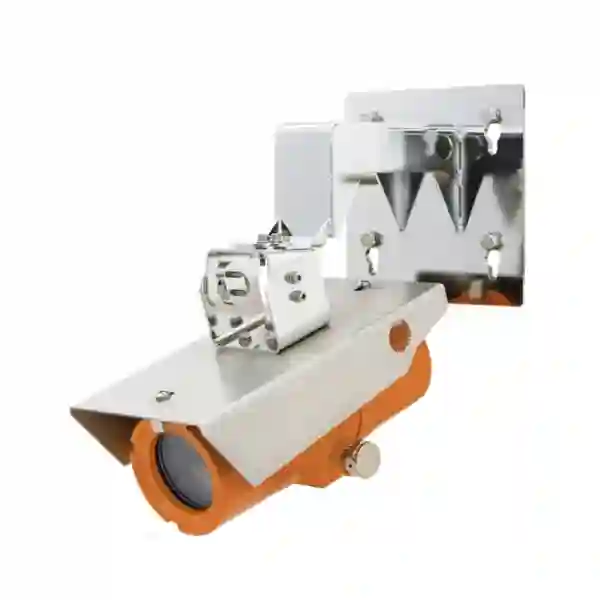
Hanwha Vision TNO-X6322EPT1-Z Explosion-Proof Zoom Camera
For industrial surveillance where ordinary outdoor camera construction is not an adequate selection basis, this Hanwha Vision model combines a documented explosion-protected housing with detailed network zoom imaging. The correct buying decision starts with site classification, field of view, installation method and integration—not a headline camera specification alone.
Request a technical review and project quotation for Tanzania. Confirm current product status, applicable certification documents, mounting accessories, the power arrangement and suitability for your exact installation before purchase. No local price, stock or regulatory acceptance is implied by this page.
Verified features at a glance
Technical values reflect the reviewed Hanwha manufacturer datasheet; scope and usable configuration depend on the supplied revision and installation. The exact-model datasheet contains conflicting figures for some secondary specifications, so disputed values are not asserted as universal facts.
What this industrial camera is designed to solve
The Hanwha TNO-X6322EPT1-Z brings optical zoom and IP-network video into an enclosure intended for selected hazardous industrial locations. In facilities where flammable atmospheres or combustible dust may be present, selecting an ordinary outdoor CCTV camera solely because it has a weatherproof rating is not enough. The camera assembly, entry system, electrical interfaces and installation practices must all be appropriate to the classified area. This model is for teams evaluating a certified enclosure and a detailed zoom view as part of a broader engineered safety and surveillance system.
The commercial question is not simply whether the image is sharp. Buyers need to know whether a fixed viewpoint with variable optical magnification will cover their chosen target, whether the documented certification markings match the specific plant classification, and whether the available power and network design are practical. Those decisions influence the number of cameras, mounting positions, cable routes, commissioning tests and total installed cost. Asking those questions early can prevent purchasing a technically impressive camera that does not suit the actual hazard or viewing geometry.
This page helps security managers, instrumentation engineers, electrical contractors, procurement teams and systems integrators assess the model before requesting a quote for a project in Tanzania. It presents manufacturer-documented capabilities separately from site-specific engineering decisions. It does not imply that the model has been approved by any Tanzanian authority, is available from local stock, or can be installed in every hazardous zone.
Quick capability summary and buying interpretation
The core imaging specification is a 2MP, 1920 × 1080 output with a manufacturer-listed maximum of 60 frames per second using H.264 or H.265. The lens covers approximately 4.44 to 142.6 mm and provides 32× optical zoom. That range allows an operator or configured workflow to change from a relatively broad image to a much narrower detailed view, provided the camera has been correctly aimed at the area of interest. It does not turn one fixed mount into an all-direction scanning system.
The published feature set includes day/night switching, wide dynamic range, gyro-assisted digital image stabilization, multiple streaming profiles, H.265, H.264, MJPEG and WiseStream II. The housing is described as powder-coated aluminium with IP66 and Type 4X ingress protection. Hanwha documentation identifies hazardous-location markings including cFMus and IECEx/ATEX-related classifications. Every one of these characteristics should be tied to a real project requirement instead of being treated as a general promise that the device fits all operating environments.
For procurement, the most important unresolved details are often outside a headline spec sheet: precise hazardous-area certificate schedule, current supply status, power accessories, mounting bracket choice, wiring method, permitted ambient range with the selected power arrangement and compatible recording platform. Request those particulars alongside the exact complete model string. A quote should cover the installed solution rather than only the camera body.
A zoom camera is not the same as a mechanical PTZ
The model name is easily confused with mechanically pan-tilt-zoom variants in Hanwha’s explosion-protected range. TNO-X6322EPT1-Z is described by Hanwha as an explosion-proof zoom camera. Its lens can change optical magnification, and the specification mentions digital pan-tilt-zoom functions within the image, but the documentation does not establish a motorized pan-and-tilt head for this exact model. Do not promise patrol sweeps, mechanical presets around a site or physical auto tracking as though they were built into this unit.
That distinction matters when defining surveillance coverage. A fixed installation aimed at a loading valve, transfer point, pump seal, process vessel or access route can benefit from optical zoom because the operator can inspect a smaller part of a known scene without relocating the housing. If an operator must turn toward multiple different work areas, the project might instead require several fixed cameras or a separately specified hazardous-area PTZ. Optical magnification and mechanical direction control solve different problems.
Before ordering, sketch the horizontal and vertical coverage required at wide angle, then identify what the operator needs to see at full zoom. Check whether any high-priority objects fall outside the camera’s physical pointing direction. A design that depends on movement the camera does not provide will leave blind spots regardless of its video resolution. Ask the integrator to demonstrate the intended coverage on the site drawings rather than interpreting a catalogue’s generic camera category as proof of movement.
Planning the 32x optical lens for useful evidence
A 32× optical zoom lens provides a change in image magnification through the optics before image pixels are recorded. This is valuable where an operator sometimes needs context and sometimes needs to examine a particular distant component. Hanwha lists the approximate horizontal field of view from 61.8 degrees at the wide end down to about 2.19 degrees at telephoto, with a corresponding vertical change from roughly 36.2 to 1.24 degrees. Such a narrow telephoto view can be useful for inspection, but it covers only a small part of the original scene.
Distance alone is not a sufficient way to promise recognition or identification. Actual results depend on target dimensions, scene contrast, vibration, mounting height, illumination, focus, compression and the number of image pixels occupied by the target. A reflective metal label, moving vehicle or dimly lit instrument may look very different from a static object under test conditions. Treat sample images and a site-specific viewing calculation as more useful than an unsupported claim about an exact number of metres for identification.
When planning, define the target in operational terms: an overview of an unloading area, observation of an operator’s approach to equipment, inspection of a gauge location, or review of movement near a perimeter interface. Test each at the required zoom setting during day and night conditions. A wide view should still allow personnel to understand the scene, while a narrow view should retain enough stability and light for a meaningful image. If simultaneous overview and close inspection are essential, consider a second camera rather than asking one stream to do both jobs continuously.
Day, night and difficult-light performance
The manufacturer’s detailed specification identifies a 1/2.8-inch CMOS image sensor and minimum illumination figures of 0.05 lux in colour and 0.005 lux in black and white under stated test conditions. These numbers describe controlled sensitivity measurements, not guaranteed operational image quality in every plant environment. Poor contrast, fog, glare, vibration and subject movement can still reduce the information visible in recorded video. A commissioning test is therefore important whenever the camera will be used in low light or for incident evidence.
Day/night operation uses an infrared-cut filter mechanism, while wide dynamic range helps manage scenes containing bright and dark areas. Examples include an equipment bay with sunlit openings, a bright floodlight near a shaded walkway or an inspection point backlit by daylight. Digital noise reduction and defog functions are also listed. Their practical value depends on adjustment: aggressive processing can make an image appear cleaner while concealing fine moving detail. Settings should be chosen for the actual operational objective, not merely a pleasing demonstration image.
The documentation reviewed is inconsistent about the numeric WDR value, so this listing deliberately describes WDR capability without presenting one unqualified decibel figure. Neither a built-in infrared illuminator nor an integrated physical wiper is established for this exact model. Do not assume either is included. If the site requires night lighting, glare control, a clear window after rain, or regular cleaning, specify those provisions explicitly and ensure any associated equipment is acceptable within the classified installation.
Video compression, frame rate and network bandwidth
The camera supports H.265, H.264 and MJPEG video encoding. H.265 can improve compression efficiency for suitable systems, but actual storage savings depend on motion, lighting, scene complexity, frame rate, bit rate targets and the software used for recording. H.264 may be easier to integrate with an established recorder. MJPEG may have a role in limited legacy or integration tasks, but should not be presumed to be the preferred recording format for continuous high-resolution streams. Codec choice belongs in the recorder compatibility and retention plan.
Hanwha lists up to 60 fps for H.264/H.265 and up to 30 fps for MJPEG, with multiple streaming profiles. The capacity to send different streams can help separate an operator’s live-view requirement from a lower-bandwidth remote display, although actual profile count, concurrent loading and quality need validation under the chosen configuration. More frames are not automatically better: a plant monitoring a largely static valve may prioritize readable detail and retention, while a moving conveyor or vehicle corridor may benefit from faster temporal sampling.
Record a sample at the intended installation settings, review the file in the chosen video-management software and calculate storage using measured or conservatively estimated bit rates. Include peak traffic, network overhead and event bursts, not just the average rate shown on a demonstration screen. Where connectivity between plant areas is constrained, plan local recording, resilient switching and appropriate segmentation instead of assuming the full stream can continuously traverse an unreliable shared link.
What explosion-proof and hazardous-area markings mean
Explosion-proof is a defined engineering concept, not a synonym for weatherproof, fireproof or impossible to damage. Hanwha’s materials identify a hazardous-rated assembly with cFMus-related Class I, II and III Division 1 group references and IECEx/ATEX-related gas and dust markings. Those markings are a starting point for technical selection. Whether they apply to a project depends on the exact supplied unit, its certificate, any stated conditions of use, allowable ambient range, gas or dust group, temperature class and the applicable hazardous-area classification scheme.
A site with gas vapours, a dust-handling installation and a marine or chemical-processing location may require different equipment assumptions even when all are described informally as hazardous. The customer’s area-classification drawings and competent electrical engineer should identify what is required. A camera that has one valid approval in one jurisdiction does not automatically satisfy a different country’s acceptance rules, and the manufacturer’s international marking should not be reinterpreted as an assertion of Tanzanian regulatory approval.
Before procurement, obtain the current certificate copies and check the complete nameplate and installation instructions against the site schedule. Confirm whether brackets, cable glands, stopping plugs, conduits, seals, bonding, surge protection and external connections must meet specific requirements. Only a qualified professional should determine the permitted method and perform hazardous-area installation and inspection. Do not modify the enclosure or substitute entries and accessories based on an ordinary commercial CCTV installation practice.
Enclosure, weather exposure and physical installation
The published enclosure is powder-coated aluminium and is rated IP66, with a Type 4X designation also given in the datasheet. IP66 relates to dust ingress protection and strong water-jet exposure under defined test conditions. It does not mean the camera is suitable for permanent underwater service, every chemical atmosphere or unlimited pressure washing. Corrosion, vibration, airborne deposits, cleaning chemicals, solar loading and mechanical impact may still affect the installation. Site-specific environmental review remains necessary.
The datasheet gives approximate dimensions of 7.2 by 5.97 by 13.85 inches and a mass of about 6.35 kg. These are relevant to mounting strength, safe access and alignment, but bracket design must include cable loading, wind and any site vibration. Hanwha identifies optional mounting accessories, including wall, pole and corner arrangements. A bracket being offered in a catalogue does not by itself prove compatibility with every mounting surface or every project’s hazardous-area conditions; confirm exact accessory part numbers and mechanical drawings.
Choose a position with an unobstructed view, safe installation access and enough space to reach connections for approved maintenance. Consider water drainage, process spray, steam, potential deposits on the window and how often the camera can be inspected without interrupting plant operations. Fixing a camera where a maintenance crew cannot safely reach it can make even basic cleaning expensive. The design should minimize interference with equipment operation and preserve a clear method to isolate electrical power when required.
Power design: camera PoE and heater considerations
The detailed Hanwha datasheet describes PoE under IEEE 802.3af for camera power and lists a camera power consumption of up to 7.5 W. It also lists a separate 12–24 V DC heater connection and heater power of 25 W. That distinction deserves a direct engineering check because summary materials sometimes use broad phrases such as PoE-powered or PoE only. Do not assume that the PoE connection alone supplies an external or separate heater circuit, or that every deployment needs the heater enabled.
For the actual project, confirm the exact power-terminal arrangement, whether heating is required for the local operating conditions, which temperature specification applies to that arrangement, and how the circuits must be routed and protected. The published environmental table includes conditions that require careful reading, rather than supporting a single universal operating-temperature claim for every configuration. A project drawing should make the camera feed, any auxiliary heater feed, protection devices and isolation points unmistakable.
Power architecture also affects network availability. Check switch port capability, cable length, voltage drop, surge exposure, earthing and any permitted isolation barriers or approved wiring arrangements. Where continuous monitoring is a business requirement, decide whether the network switch, video recorder and relevant supporting systems need battery-backed power. In a classified area, electrical convenience must never override the approved installation method and the engineering authority responsible for safety.
Networking and VMS integration
The manufacturer lists a 10/100BASE-T RJ-45 Ethernet interface, IP network protocol support, ONVIF Profile S/G and Hanwha SUNAPI integration interfaces. These features provide possible pathways to third-party recording and management platforms; they do not certify that every feature will function with every recorder version. Basic live video may work through a standardized profile while analytics, two-way audio, event metadata, recording health or configuration controls require additional integration and testing.
A purchasing team should ask which video-management system and firmware versions will be used and who is responsible for proving interoperability. A short bench test can confirm discovery, main and substreams, frame rates, day/night behaviour, timestamps, alarms, edge-storage support and playback. The test should also include user roles and credential handling. Integration questions should be resolved before a camera is installed in a hazardous location where physical access is restricted and changes can be costly.
If the facility spans multiple buildings or operational networks, plan IP addressing, network segmentation, quality-of-service where appropriate, secure time synchronization and recorder capacity. Remote viewing must be designed in accordance with the organization’s cybersecurity and privacy requirements. Connectivity should not require exposing the camera’s management interface directly to the public internet. A well-designed system includes a controlled management path, documented credentials, firmware maintenance procedures and an accountable owner for monitoring device health.
Onboard recording and continuity strategy
The detailed specification lists SD-family edge storage and network-attached or computer recording options. However, the manufacturer’s own summary and detailed tables differ on the stated maximum memory capacity. For that reason, the page does not promise a specific removable-card capacity or number of days’ retention. The supported media type, number of usable slots and maximum configuration should be confirmed for the actual supplied hardware and firmware before the recording design is finalized.
Edge storage can support continuity during an intermittent recorder connection, but it should not be treated as a complete resilience solution without testing. Determine what triggers local recording, how files are protected, what happens when a card is full, whether corrupted media is detected and whether video can be reconciled after network recovery. The practical value depends on system configuration and integration with the chosen management platform. Critical incidents may require central recording and additional redundancy rather than reliance on a single local medium.
Retention requirements are a business, legal and operational decision. Define the recording schedule, motion or event triggers, image quality, backup procedures, access controls and deletion policy with the project owner. The power and network design should be reviewed alongside recording because an unpowered camera cannot benefit from onboard media. Document the final capacity assumptions and run an endurance test before making any promise about how much historical video operators can retrieve.
Analytics and alarm workflow
Hanwha’s detailed technical table lists functions such as motion detection, tampering, loitering, direction-based detection, defocus, fog detection, virtual line, entry and exit, appearance or disappearance detection, audio-related detection and other event functions. These tools can help direct an operator to video worth reviewing when configured for a suitable scene. Their presence does not guarantee autonomous hazard recognition, industrial process diagnosis or an acceptable false-alarm rate at every location.
In an industrial environment, moving vapour, reflections, vibration, rotating equipment and changing lighting can all challenge scene-based analytics. Start by identifying one actionable event, the person who will respond and the threshold for escalation. Configure only the functions that are relevant to that scene, then observe their performance over normal operating cycles. A useful event might flag movement in a defined restricted walkway; the resulting response should still be governed by the plant’s authorized procedures.
Digital tracking or digital PTZ language must not be mistaken for a claim of physical pan-and-tilt motion. When an event occurs outside the fixed field of view, image-based software cannot recover a scene the optical system never captured. Document what each alarm means, how it reaches the VMS, who acknowledges it and how a false alarm is handled. This makes the surveillance system more valuable than enabling every analytic feature without an operational plan.
Practical deployment scenarios for Tanzania projects
Oil and gas handling facilities may need visual awareness of valve approaches, hose connections or transfer areas where a documented hazardous-area camera assembly is required. The zoom lens can help an operator examine a selected point within a planned field of view. The site engineer must decide whether the area’s classification, lighting and process exposure are compatible with the proposed model. The camera does not replace leak detection, gas detection or any process safety interlock.
Petrochemical and chemical-processing plants may use video to support access monitoring near defined equipment zones or to review activity after an alarm. Here the design challenge is balancing hazardous-area compliance with scene visibility, maintenance access and reliable communications. An installation positioned for a convenient network cable route but aimed through steam or persistent glare may provide little useful evidence. Location and window-maintenance planning deserve the same attention as codec settings.
Industrial material handling and dust-generating operations may have specific dust-related classifications. The engineer should match the exact dust group and temperature constraints rather than relying on a broad explosion-proof label. Where the scene includes conveyors, moving loaders or personnel, the required frame rate, shutter behaviour and observation distance should be assessed against actual movement. Always keep monitoring separate from the safety systems that stop machinery or prevent hazardous conditions.
Tank farms, energy infrastructure and restricted processing areas can also benefit from an engineered fixed viewpoint with adjustable optical zoom. These are examples of possible applications, not evidence that this model has been deployed at any named Tanzanian facility or is suitable for every such location. The right choice emerges from the site’s classification drawings, intended operational coverage and approved maintenance practices—not from an industry label alone.
Who should choose a fixed explosion-proof zoom camera?
Choose this style of device when the target area is known, a stable mounting direction is practical and occasional changes in optical magnification will help inspection or incident review. Its full-HD video, long-range zoom flexibility and published integration options make it a candidate for defined monitoring points where hazardous-location engineering is part of the specification. It is especially important that a close view of one object does not quietly sacrifice required coverage of another area.
Consider a different configuration if operators must physically scan around a vessel, cover several unrelated directions from one mount or follow objects beyond the fixed field of view. A true explosion-protected PTZ model may better serve such tasks, subject to its own certifications, power and environment limits. A multi-camera design may still be preferable when uninterrupted simultaneous coverage is necessary. The right comparison should include what the operator can actually see at the exact time an incident occurs.
A higher resolution or wider-angle camera is not automatically a better alternative either. A 4K fixed view might capture more pixels across a broad scene, but the required field of view and target distance determine the useful detail. Likewise, adding illumination does not solve a misaligned lens. Ask the integrator to explain why this exact combination of enclosure, viewpoint, zoom and recording configuration is the least complicated solution that meets the defined monitoring objectives.
A procurement checklist before requesting a quote
Start with the full manufacturer model name, the purpose of each camera and the site’s hazardous-area classification information. Supply a drawing or clear description of the intended mounting point and sight lines, together with distances to the critical objects. Include both daytime and night-time requirements. Without these details, a quote may describe a camera that fits the broad product category but fails to produce the necessary operational image.
Next, record the environmental exposure, permissible installation method, available power circuits, switch location, network infrastructure and video recorder or VMS. State whether a heater is required, whether a physical wiper is expected, what mounting arrangement is preferred and how access for cleaning or maintenance will be managed. The standard manufacturer materials do not establish that a wiper or infrared illumination is included with this model; these must not be casually bundled into the description.
Ask the quotation to distinguish confirmed items from assumptions: camera model, firmware or supplied revision where relevant, approval documents, accessories, protective equipment, installation labour, commissioning, integration and operator training. Availability, lead time, applicable commercial terms and post-sale support should be confirmed against a live offer. This listing does not provide a verified Tanzania sale price, stock quantity, delivery guarantee or warranty promise.
Mounting, cabling and commissioning responsibilities
Hazardous-area surveillance installations require cooperation between security design and electrical or instrumentation disciplines. The security team can define the operational scene, but the qualified hazardous-area engineer must approve placement, electrical equipment selection and the method of wiring. This includes the entire installation boundary, not only the camera enclosure. A suitable camera combined with inappropriate cable entry hardware or undocumented connections does not create an acceptable finished installation.
The contractor should review the load-bearing structure and approved accessory drawings before drilling or fabricating a bracket. Cable routing needs to account for mechanical protection, local conditions and isolation. Any network equipment, surge devices, auxiliary power or connection boxes must be addressed within the applicable classification requirements. The inspection plan should confirm correct identification, approved entries, seals and bonding without treating the camera as an ordinary plug-and-play office device.
Commissioning should prove both technical operation and the user’s actual monitoring objective. Test focus at wide and telephoto settings, day/night transitions, image stabilisation where relevant, remote viewing, recorded playback, alarm behaviour and recovery after a network interruption. Capture the final settings and a representative sample of video. The facility owner should receive an as-built schedule, approved documentation, configuration backup and a safe-maintenance procedure tailored to the final installation.
Cybersecurity and evidence handling
A camera on an industrial network is an operational endpoint that must be managed deliberately. The manufacturer lists security features including authenticated access, HTTPS and network access controls, but their existence is only useful when configured and maintained. Decide who administers the device, who may export video, how authentication is handled and how accounts are changed when contractors leave. Use network separation and restricted management access suited to the organization’s policies and the wider plant architecture.
Firmware changes should follow a controlled change process. Compatibility, camera settings, analytics behaviour and recorder interoperability can change when software is upgraded, so validation belongs in the maintenance plan. Never rely on an unsupported assumption that a camera will receive indefinite firmware support. If the site uses remote maintenance, define the authorized path, logging and approval procedure. A device that is working today still needs a documented owner for configuration and security updates.
Where recordings support incident investigation, establish who can view, retain or disclose them. Verify time synchronization across cameras and recorders, protect exported files from casual alteration and maintain a clear incident-handling procedure. Local requirements and company policies may affect notices, access and retention. This camera is one component of the evidence chain; video quality, timestamps, storage integrity and operator procedures must all work together to create useful records.
Acceptance testing: what a successful installation demonstrates
A good acceptance test uses measurable scenes rather than statements such as excellent clarity or long-range performance. Before equipment arrives, agree on representative targets and lighting conditions. During commissioning, capture wide-angle context, the narrow optical-zoom view and recorded playback from the production VMS. Compare what can be seen with the actual operational requirement: detecting a person entering a designated area, distinguishing a vehicle movement or observing a fixed equipment point.
Test under normal changes in operation, including lighting transitions, routine mechanical vibration and the movement expected near the equipment. Review compression artefacts and motion blur, not only a static still frame. Confirm that alarm events arrive where intended and that the operator can find the corresponding footage. Verify that any local recording behaviour works as specified if the central recorder becomes unavailable. Fault conditions should be simulated only through approved safe procedures.
The installer and site owner should also sign off documentation rather than treating a sharp picture as evidence of a compliant hazardous-area installation. Confirm the exact model and marking, power arrangements, mounting hardware, entry method, configuration and inspection records. Establish who will handle future maintenance, lens cleaning, firmware updates and replacement decisions. A clear acceptance record protects both the buyer and integrator from disagreements over capabilities that were never explicitly defined.
Operational upkeep and long-term ownership
A hazardous-location camera should be planned as a maintained asset, not an installation that will never be touched. Establish an inspection interval appropriate to the environment and applicable maintenance rules. Visual obstructions, accumulated deposits, vibration loosening, corrosion and repeated washdown can affect the housing or image path over time. The permitted maintenance procedure must follow the manufacturer’s instructions and the site’s hazardous-area work controls. Do not open, alter or service a protected assembly through ordinary CCTV troubleshooting methods.
Monitor recording health and actual image quality as well as basic network reachability. A camera may respond to a ping while providing a blocked view or unusable recording. Periodically review representative day and night clips and check that storage retention and alarms still match policy. After changes to lighting, pipework, barriers or equipment positions, revisit the field of view. Industrial sites evolve, and a once-useful fixed viewpoint can become partially obstructed.
For replacements, record the complete model designation and the approved configuration rather than ordering a vaguely similar enclosure. Manufacturer product families change, and model revisions can introduce different power requirements, accessories or certificate conditions. Verify the current offering and any supported successor with the supplier before specifying a like-for-like swap. The lifetime cost of a camera includes safe access, servicing, integration and documentation, not only the original purchase invoice.
How to compare it with other hazardous-area cameras
Begin with the classification requirement, because a camera with a different approval cannot be substituted solely on the basis of a better image specification. Then distinguish optical zoom, fixed viewpoint, mechanical PTZ, panoramic coverage and infrared or thermal imaging. They are different ways to answer different monitoring questions. TNO-X6322EPT1-Z is an optical network zoom model; do not describe it as a thermal imager, a built-in-IR unit or a mechanically sweeping PTZ without evidence for those functions.
Next, compare image details in realistic conditions. Full HD at high frame rate may suit one scene, while more pixels, a different lens or dedicated illumination might matter more elsewhere. Also assess manufacturer-supported protocols and the precise VMS integration pathway rather than assuming all ONVIF devices behave identically. Mounting availability, safe maintenance access and a properly specified power budget can outweigh a small difference in image processing features.
Finally, compare the installed system and the availability of exact documentation. Ask whether the supplier can provide current product status, required accessories, a complete certificate set, firmware information and site-specific commissioning assistance. One public reseller describes this exact model as discontinued and suggests a successor, but that is not proof of global or Tanzania lifecycle status. Confirm current manufacturer or authorized-channel status before treating this part number as orderable or choosing a replacement.
A site-ready quote request
A productive enquiry should say what the camera must observe and what limitations the facility imposes. Include the site classification, installation drawings, approximate target dimensions and distances, lighting conditions, network and recording platform, desired retention and the available power arrangement. If the intended use includes inspecting one small object at a distance, make that objective explicit so the integrator can assess the optical field of view rather than guessing from the zoom ratio.
Request a documented technical response identifying the exact supplied camera and revision, certification evidence, compatible mount and cable-entry solution, electrical arrangement, expected integration method and all exclusions. Ask the supplier to identify any items that must be supplied by the facility or a qualified hazardous-area contractor. This establishes accountability for the whole design while avoiding unsupported assumptions about installation accessories or approvals.
For a Tanzania project, FourTeck can be asked to review these requirements for quotation and suitability, without this page claiming local stock, nationwide installation coverage or guaranteed supply. The next step is a verified enquiry with project documents, followed by a technical and commercial offer. Do not release a purchase order based only on a generic product summary when hazardous-area certification and integration form part of the acceptance criteria.
Frequently asked questions
Is the Hanwha TNO-X6322EPT1-Z a PTZ camera?
It is identified in manufacturer material as an explosion-proof zoom camera. It has 32× optical lens magnification, but that should not be represented as mechanical pan-and-tilt movement. If you need the camera to rotate toward different areas, ask for a separately specified hazardous-area PTZ product and check the complete model designation.
What is the recording resolution and frame rate?
Hanwha documents Full HD 1920 × 1080 video, with up to 60 fps for H.264 and H.265 under supported conditions. Actual settings and delivered performance depend on stream configuration, network resources and recorder compatibility. Agree on a tested recording profile for the intended scene rather than assuming the maximum frame rate will always be selected.
Does explosion-proof mean the camera can be installed in any hazardous zone?
No. The complete markings, certificate conditions, gas or dust classification, temperature class, permitted ambient environment and installation method must match the specific site. An engineer competent in hazardous-area equipment should verify suitability. International certificate markings should not be treated as automatic evidence of any separate Tanzania-specific approval.
Does it have a built-in wiper or infrared light?
The reviewed exact-model manufacturer material does not establish an integrated wiper or IR illumination, and model-family brochures can describe different devices. Do not assume either is included. If rain, dust, darkness or window deposits create a need, define the requirement and confirm a compliant product or accessory configuration with the supplier.
Can the camera run from PoE?
The technical datasheet lists IEEE 802.3af PoE for the camera and separately identifies a 12–24 V DC heater supply. The complete electrical arrangement and whether heating is used must be verified for the exact supplied unit and site. A generic PoE claim should not replace a site-specific wiring and load assessment.
Is the enclosure suitable for outdoor use?
The manufacturer lists an IP66 and Type 4X enclosure, which is relevant to dust and water ingress protection. That does not prove suitability for every chemical, corrosive atmosphere, washdown process or mechanical exposure. Review material compatibility, mounting, ambient conditions and safe maintenance access for the intended plant.
Will the camera work with an existing NVR or VMS?
The listed network interfaces include ONVIF Profile S/G and Hanwha SUNAPI. Those capabilities can support integration, but live view, recording, analytics and event features need to be tested with the selected software and firmware. Provide the recorder make, version and desired functions before committing to an order.
How much storage does the camera support?
The manufacturer’s own feature list and detailed table provide different maximum card-capacity figures, so a definitive maximum is deliberately not quoted here. Confirm the shipped revision, card compatibility and supported recording mode with current manufacturer documents. Size the full retention system from tested bit rates and the required number of days.
Can it monitor an entire industrial yard?
One camera can cover only what its physical direction and lens field of view permit. At long optical zoom the image becomes much narrower. If several unrelated directions need continuous observation, a multi-camera design or a properly selected mechanical PTZ may be necessary. A field-of-view study and demonstration should determine the camera count.
Is a price or delivery date available for Tanzania?
No verified Tanzania listing price, stock position or delivery time has been provided for this request. Exact commercial terms, current lifecycle status and any successor product must be confirmed in a live quotation. Ask for a complete offer that includes accessories, documentation and any engineering or integration work required.
What should a buyer send with a technical enquiry?
Supply the exact model requested, hazardous-area classification documents, mounting location, target distance, lighting information, power availability, network design and recording system details. Describe the operational purpose of the video and whether continuous overview or occasional zoom is needed. Those inputs allow a much more meaningful suitability review than an enquiry that provides only the model number.
Request a hazardous-area camera suitability review
For a Tanzanian industrial project, ask FourTeck to assess the Hanwha TNO-X6322EPT1-Z against your area-classification documents, viewing objectives, network and power arrangements. Include drawings and the current equipment schedule so any quotation can distinguish supplied products, required accessories and specialist installation responsibilities.
Next step: request an exact-model technical and commercial quote, including confirmation of current availability, certification evidence, supported configuration, accessory requirements and any appropriate successor if the specified part number cannot be supplied.




Reviews
There are no reviews yet.