
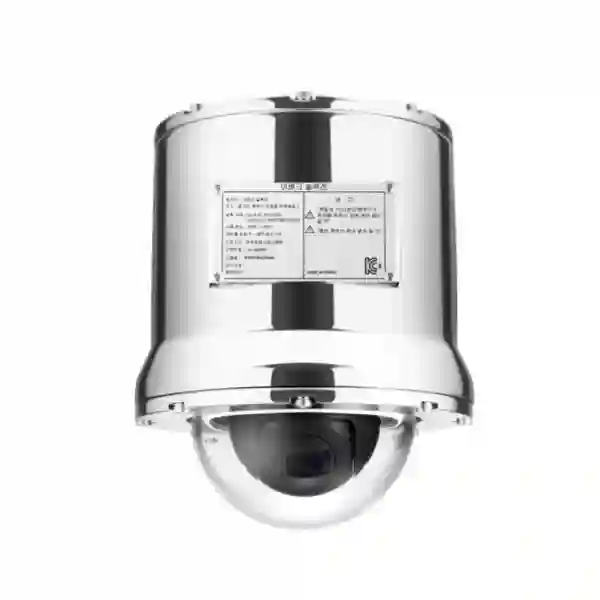
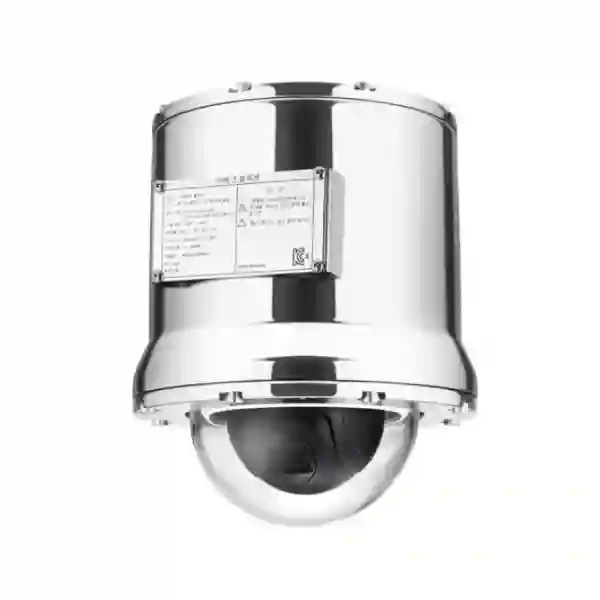
Hanwha TNU-L2040EAVEC-ExDome-M 2MP Explosion-Protected Camera
For an industrial site where the atmosphere may be hazardous, selecting a camera means evaluating more than image quality. The Hanwha TNU-L2040EAVEC-ExDome-M combines a 2MP imaging platform and 4.3× optical zoom with published gas and dust explosion-protection markings. Hanwha Vision lists polished SUS316L stainless steel, IP68 ingress protection, day-and-night operation, 150dB WDR and gyroscope-based stabilisation. This guide explains what these facts mean for viewing tasks, safety reviews, installation planning and procurement in Tanzania. Suitability for a particular classified area always depends on the exact certificate conditions, site assessment and complete installed assembly.
Verified model highlights
Manufacturer-listed potential zones are 1, 2, 21 and 22. Only qualified site assessment and review of all documentation can determine installation suitability.
Best-fit purchasing question
Does your camera position require the stated hazardous-area markings, and can a 2MP lens with moderate optical zoom show the details your operators need? If both answers are supported by the site assessment and the proposed viewing plan, this model deserves technical evaluation. If a project demands a different equipment protection level, much longer optical reach or an unverified lighting feature, the requirements should be reconsidered before placing an order.
Choose the correct camera for a classified area
The first question in an industrial CCTV project is whether the proposed mounting point is a classified hazardous location. If it is, a conventional weatherproof camera should not be assumed suitable just because its image quality or enclosure looks robust. The Hanwha TNU-L2040EAVEC-ExDome-M is an explosion-protected model with published gas and dust markings. It combines an industrial enclosure and a two-megapixel camera, giving buyers a way to consider both protection requirements and the actual surveillance task.
Selection begins with the site’s classification drawings, the substances that may be present and the competent engineer’s equipment requirements. Those documents should be checked against the exact model’s certificates and instructions. A classification label alone cannot approve an installation; mechanical fixing, cable entries, environmental conditions and any special conditions of certification also matter. A careful review helps avoid ordering a camera that looks appropriate on a product page but cannot be installed in the proposed location.
What the exact model provides
Hanwha Vision lists a 1/2.8-inch 2MP CMOS image sensor, a 2.8–12mm lens, 4.3× optical zoom and 24× digital zoom. The stated horizontal field of view changes from 119.5 degrees at the wide end to 27.9 degrees when zoomed in. Its imaging specifications include day-and-night operation with infrared-cut filter switching, a 150dB wide dynamic range function and stabilisation using a gyroscope sensor. These are manufacturer-stated features rather than assumptions borrowed from another model.
The published physical details include polished SUS316L stainless steel and IP68 ingress protection. Hanwha Vision also identifies a TTA-certified XNP-6040HG camera within the assembly. The advertised gas marking is Ex db IIC T6 Gb, and the dust marking is Ex tb IIIC T85°C Db. Manufacturer information lists potential application in Zones 1, 2, 21 and 22. The complete product documents and local project requirements must be reviewed before these statements are applied to a particular site.
Plan the field of view before procurement
The wide end of the lens can give operators context across a working platform, access route or compact industrial bay. Zooming toward the telephoto end concentrates more of the available pixels on a smaller portion of the scene. That choice affects what an operator can understand from a live view and what an investigator can see in a recording. A camera that shows all the equipment at once may lack sufficient detail at a distant point, while a closer view may hide activity on the edges.
Make a drawing of the proposed camera position and identify the closest and farthest subjects. Clarify whether the team needs to detect movement, observe a work process, recognise a person or read a small label. These objectives call for different image detail. Verify the angle of view at the actual mounting distance, considering obstructions and lighting. Neither a 4.3× zoom claim nor a sample marketing image proves that every viewing goal can be met.
Understand two-megapixel image detail
A 2MP image can be useful for an industrial overview, a controlled-access point or a defined observation zone when the camera is located appropriately. Resolution alone does not determine the clarity of a small subject. The farther away it is and the wider the scene, the fewer image pixels may represent it. Optical zoom can allocate more of the sensor’s available detail to a narrower view, but the camera cannot simultaneously preserve an equally wide context at that setting.
Define an acceptance test around what staff must see, not simply whether the recorder displays a picture. For example, ask whether an operator can distinguish movement around a nominated valve platform or recognise whether a gate is open from the proposed viewpoint. Check representative footage after compression and recording. Motion blur, light reflections, rain, dust and heat distortion can reduce detail even when the nominal resolution remains unchanged. Trial footage is particularly valuable before large industrial deployments.
Lighting, WDR and day-and-night operation
Industrial images often contain bright lamps, deep shadows, reflective metal and backlit doorways. Hanwha Vision publishes a 150dB wide dynamic range feature for the model, intended to help handle scenes containing substantial differences in brightness. Day-and-night operation with an infrared-cut filter supports changing illumination conditions. These features can improve a difficult viewing task, but they do not replace a lighting assessment or guarantee clear images in every situation.
The day-and-night feature should not be confused with a verified built-in infrared illuminator. No infrared range is promised on this page. If the scene has insufficient light, the designer should determine how it can be illuminated appropriately. Any additional electrical light in a classified area needs its own engineering review. Test the image at night, during strong daylight and when vehicles or machinery create glare. A setting that looks good in a quiet daytime test may not be the right setting during normal production.
Using stabilisation responsibly
The manufacturer states that a gyroscope sensor supports image stabilisation. This can be relevant when minor movement affects a view near industrial equipment. However, electronic image correction is not a structural reinforcement, a substitute for suitable brackets or a solution to excessive vibration. The complete installation must remain secure under the actual mechanical loads expected at the proposed position. The camera’s mounting arrangement is therefore part of the video-quality decision as well as the physical safety design.
Identify nearby motors, pumps, pipework, vehicle movements and structures that may transmit vibration. Review the support point with the relevant engineer and choose a position that limits unnecessary movement. During commissioning, compare the picture under normal operation with a recorded sample to see whether instability affects the evidence. If the image becomes unusable, diagnose the mount, scene and system configuration before assuming that a stabilisation function can compensate for all problems.
Stainless steel and exposure conditions
The polished SUS316L stainless-steel construction is an important characteristic of this industrial camera. Corrosion resistance can be valuable around certain industrial and coastal environments, but material selection must account for the particular chemicals, cleaning agents and exposure conditions involved. It should not be treated as proof of unrestricted chemical resistance. Likewise, the IP68 marking is an ingress-protection classification; it does not provide unlimited permission for immersion or aggressive washdown outside the manufacturer’s defined conditions.
Ask the site team to describe weather, spray, airborne contamination, cleaning frequency and access for inspection. The condition of seals, fasteners and cable entries matters as much as the housing material. Do not drill, open or alter a certified assembly except as permitted by the manufacturer and applicable work procedure. A durable material supports a well-engineered installation, but ongoing inspection and care remain necessary to maintain both picture quality and enclosure condition.
Read the gas marking accurately
The exact published gas marking is Ex db IIC T6 Gb. The characters have distinct meanings: an explosion-protection designation, a flameproof enclosure protection concept, a gas grouping, a temperature class and an equipment protection level for gas atmospheres. They should be considered as a connected specification rather than as a generic badge saying safe anywhere. The manufacturer’s information lists Zones 1 and 2 among the potential applications, subject to the appropriate documents and installation conditions.
Zone 1 generally concerns an explosive gas atmosphere that may occur occasionally during normal operation. Zone 2 generally concerns an atmosphere not expected in normal operation but possible briefly. A qualified person must classify the specific facility and decide whether the model’s complete marking matches it. Do not infer suitability for Zone 0 from a Zone 1 statement. Review ambient limits, certificate conditions and the installed accessories before the equipment is accepted into the project.
Read the dust marking accurately
The manufacturer’s published dust marking is Ex tb IIIC T85°C Db. It identifies a dust ignition-protection concept, a dust group, a temperature designation and equipment protection level. Hanwha Vision includes Zones 21 and 22 among the stated potential applications. These definitions do not mean that every location with visible dust is automatically a combustible-dust zone. The material, process and operating conditions must be evaluated by the responsible team.
In general, Zone 21 concerns dust clouds that may arise occasionally in normal operation, whereas Zone 22 concerns clouds not normally expected but possible briefly. The assessment should consider dust characteristics, deposits, housekeeping and the complete electrical installation. Ask for the relevant manufacturer certificates and conditions of use rather than interpreting a short product summary as a full safety approval. The camera and every associated component must be fitted in a way that maintains the required protection.
Certification is not a blanket site approval
Hanwha Vision refers to IECEx, ATEX and KCs documentation for the explosion-protected camera assembly. Those references are meaningful evidence for technical evaluation, but they must not be confused with a confirmed approval of every proposed installation or with a Tanzania-specific regulatory decision. Certificates are tied to defined equipment and conditions. A project engineer should review the current exact-model documents, relevant labels, any special conditions and the facility’s hazardous-area requirements.
The site may also have its own engineering standards, permit systems and contractor qualifications. Determine which people are responsible for classification, electrical design, procurement approval, installation inspection and handover. These responsibilities should not be replaced by a sales claim. If a required parameter is absent from available literature, request clarification or documentation rather than inferring it from a similar product. This distinction protects the buyer’s investment and the integrity of the installation.
Do not confuse surveillance with process safety
An explosion-protected camera provides visual observation when correctly selected and installed. It is not the same as a gas detector, fire detector, automatic emergency shutdown device or process measurement instrument. Clear video cannot demonstrate that a vessel, pump or chemical handling operation is safe. Operators must continue to rely on the plant’s validated monitoring, alarms and control procedures for those purposes. Surveillance can add useful context without replacing specialised protective systems.
Before approving the camera, state which human decision the image supports: checking an access route, observing personnel movement, reviewing an incident or verifying a visible activity. Avoid promising that the camera will predict incidents or prevent all hazards. The description of its protection concept does not mean the whole industrial site is protected from explosion. A sensible security design respects the boundaries between image capture, engineering controls and emergency response.
Oil and gas observation scenarios
One application to evaluate is a pump platform, valve bay or pipe-rack area where the site has identified a relevant hazardous classification. A camera may help staff observe movement and the visible state of a selected location without requiring continuous attendance at that exact viewpoint. The wider lens setting can preserve context; a narrower setting may place more detail on a chosen access point. The final camera position should be selected by line of sight and the formal zone assessment together.
Provide the project team with a site plan, proposed mounting height, known obstructions and the distance to the main subject. Consider steam, sunlight, reflective surfaces and any equipment that moves across the scene. Define who responds to unusual activity observed on video and which existing safety systems remain authoritative. The product should not be described as suitable for every oil and gas installation without checking its exact certificates, accessories and application conditions.
Chemical transfer and loading areas
Loading and transfer zones may require an overview of access, vehicle movement and visible procedures around selected equipment. Where the site assessment calls for suitable explosion-protected equipment, the Hanwha camera can be screened against that requirement. The adjustable lens provides a choice between scene context and a tighter frame. Choosing the useful setting is a design question that depends on the bay geometry, vehicle positions and operators’ actual information needs.
Some events happen behind tankers, barriers or temporary equipment. A single camera should not be expected to see through obstructions. Consider whether complementary viewpoints are required and whether each proposed mount sits in the same hazardous zone. Review chemicals and washdown procedures for material compatibility. A useful procurement brief specifies what must remain visible during routine work, rather than relying on a broad statement such as full coverage of the loading facility.
Powders, grain and combustible dust
Industrial processes that handle combustible powders can create a different hazardous-area challenge from flammable gas operations. The camera’s published dust marking makes it a possible candidate for a defined Zone 21 or Zone 22 position after engineering assessment. It may support visual observation of a transfer point, working platform or controlled-access area. The site must determine whether combustible dust is actually present and what protection conditions apply; a dusty appearance by itself is not sufficient.
Dust may also build up on the viewing surface and gradually reduce picture quality. Plan safe cleaning and inspection access at design stage. The approved procedure should identify who can perform work, when equipment must be isolated and which components can be handled. A camera can remain electrically connected while the view becomes ineffective, so image-quality checks deserve a place in the maintenance plan. Do not assume that one dust-rated device authorises the use of ordinary lighting or wiring accessories alongside it.
Marine and coastal industrial positions
Coastal and marine facilities may expose equipment to salt-laden air, moisture, spray and difficult maintenance access. SUS316L stainless steel and an IP68 listing are relevant attributes to evaluate, but neither removes the need to check the actual environment. The camera’s explosion protection is a separate requirement from corrosion and ingress performance. A location can be physically demanding without being a classified hazardous zone, and the right equipment choice depends on both issues.
Review the support structure, fasteners, exposure to cleaning chemicals, cable route and means of safely reaching the camera later. Consider how frequently the viewing surface may need attention and whether a more accessible position could offer an equivalent image. Avoid unsupported claims about indefinite corrosion resistance or any submersion depth. The site team should verify the manufacturer limits and treat long-term maintainability as part of the buying decision.
Access control and working-area oversight
An industrial plant may want video of routes leading toward process equipment or restricted working areas. At a suitable position, the camera could provide a useful view of gates, entry activity or nearby machinery. The optical range offers framing flexibility, but image detail falls as scene width and subject distance increase. Clarify whether the main requirement is a broad overview, a close view of one entrance or a record suitable for investigating a specific event.
Not every entry point requires explosion-protected equipment. When a camera can be mounted outside a classified zone while still seeing the required area, a different solution may be appropriate. Conversely, a convenient mounting point should not be used for an ordinary camera if it is classified. Document the classification and viewing objective for each position individually. This prevents both avoidable expenditure and inappropriate substitution of devices based solely on their appearance.
Build a useful camera schedule
A camera schedule should connect each installation location to a measurable purpose. Include the location code, hazard classification, scene objective, maximum subject distance, mounting height, lighting conditions and expected recording system. Add the approval owner for each technical decision. The model number is then assessed against the schedule rather than treated as proof that every camera position is covered. This method is especially useful when a project contains locations with different gas, dust or environmental requirements.
Separate confirmed facts from matters awaiting verification. For example, 2MP and 4.3× optical zoom are published model features; the proposed compatibility with an existing recorder may still need testing. Mark the latter as pending. Request that every supplier respond to the same assumptions so quotations can be compared fairly. A clear schedule also helps installers avoid changes that solve one problem, such as an easier cable route, while introducing a different problem, such as a blocked view or a mount within an unsuitable zone.
Check power and hazardous-area cable entries
Power and cabling decisions must be based on the exact installation instructions and approved components. Do not choose a supply or network arrangement merely because a related camera accepts a familiar connector. Review power requirements, protective devices, circuit isolation and cable routing before procurement. Cable entries, glands, boxes and fittings in the installation must preserve the specified protection concept and satisfy the site’s requirements. Their details are as important as those of the camera body.
Ask suppliers for an itemised scope identifying which components come with the assembly and which are optional. Confirm that brackets and accessories are suitable for the exact version of the product and the proposed location. In a hazardous area, an unapproved substitution is not a minor administrative issue. The completed system should be inspected by competent personnel, and the relevant records should accompany the handover. This planning avoids discovering late in the project that essential installation materials were excluded from the quote.
Integrate with the intended video system
The value of the video depends on the route from camera to network, recorder and operator. Determine whether the project requires continuous recording, scheduled review or live monitoring. Verify the actual NVR or video-management platform and the functions it supports with the intended camera version. A visible live stream alone does not prove that all control, playback, alarm or maintenance functions will work as required. An integrator should check documentation and test important workflows before final acceptance.
Plan operator access, device health monitoring, network reliability and a recovery process for outages. Define which team owns system configuration and who can authorise changes. Avoid assuming that compatibility follows automatically from the fact that products are network-connected. Where more advanced functions are requested, ask the supplier to demonstrate them with the actual software versions and configuration. This is more dependable than promising generic interoperability without evidence for the deployment.
Size storage and network capacity
Recording requirements can change the cost and usability of an installation. Estimate video retention, expected scene activity, simultaneous viewing demand and the capacity required for planned recordings. Frame rate, compression settings and scene motion all influence data use. A quiet access corridor and a busy loading zone may generate different recording loads even when the camera’s nominal resolution is the same. Storage should be calculated from representative configuration assumptions with appropriate operating headroom.
The recordings also need trustworthy timestamps, controlled access and a defined export procedure. Establish what happens when storage fills or the network fails, and how staff learn that a camera has stopped recording. Do not infer a particular memory-card capacity or codec from literature for a related camera unless the exact model documentation confirms it. An effective CCTV project combines adequate images with a reliable method of storing and retrieving those images when required.
Protect the connected camera network
A network camera in an industrial facility requires a clear cybersecurity owner. Include secure commissioning, unique credentials, user permissions and appropriate controls over remote access in the project plan. Confirm the relevant manufacturer guidance for maintenance and firmware changes. Coordinate technical updates with plant change-control procedures because even a routine configuration change may affect recording, operational availability or the way a site investigates an incident.
Physical explosion protection does not automatically provide cyber protection. Conversely, network administrators should not request unsafe physical intervention in a certified assembly to solve a connection problem. The asset register should contain the approved configuration, support responsibilities and recovery procedure. Review the whole path from camera to viewing station, including any external management access. Good system ownership is especially important after contractors have left and the operations team becomes responsible for day-to-day service.
Design the mechanical mounting carefully
A useful installation drawing identifies the attachment point, support structure, orientation, working clearances, cable route and maintenance access. It should account for vibration, vehicle movement, accidental impact and potential obstructions to the view. Check the proposed sightline after major equipment is installed, not only during construction. The camera needs to be placed where its adjustable lens can serve the intended operational task without the view being routinely blocked by pipework or temporary structures.
The strength of an existing structure cannot be inferred from the camera’s enclosure specification. Appropriate engineers should check the load and mounting arrangement for the conditions expected at the site. Plan safe access for inspection, cleaning and authorised work. A hard-to-reach location can create high future maintenance costs even if the first images look excellent. Mechanical quality, certified accessories and video performance should be reviewed together rather than in separate disconnected work packages.
Commission the whole installed assembly
Acceptance testing has two parts: the protected equipment must be installed and inspected according to the applicable requirements, and the video must demonstrate the intended observation task. The first requires competent electrical and hazardous-area personnel. The second requires input from the people who will use the image. Check focus, framing, exposure, representative motion, live monitoring and recorded playback. Test in the conditions most likely to matter during ordinary site operation.
Create a handover record showing the installed model, location, relevant certificates, installation checks, software settings and sample-image results. Record any incomplete work and its responsible owner. Do not declare hazardous-area compliance from video quality alone; the physical assembly and documentation need their own checks. If a camera cannot see a critical subject, address the viewing design before the system is signed off. A documented baseline helps future maintenance teams recognise when performance has changed.
Maintain the enclosure and the image
Industrial camera maintenance should consider both the condition of the certified assembly and the quality of the resulting video. Follow approved procedures for inspection of mounts, cable entries, seals, contamination, corrosion and damage. Clean the viewing surface only by permitted methods. Image checks should cover live and recorded quality, time accuracy and any new obstructions. The schedule should reflect actual site exposure and the manufacturer’s instructions rather than an arbitrary universal interval.
Problems may come from lighting changes, dirty optics, network faults, mounting vibration or modified recording settings. Investigate methodically, observing all site safety rules. Do not open the protected enclosure or substitute parts without the appropriate instructions and authority. Keep a change log for repairs, replacements, firmware and configuration adjustments. This discipline supports evidence quality and helps preserve the basis on which the hazardous-area equipment was originally selected.
Compare the complete solution, not one number
Another camera with a longer zoom lens might be attractive for distant subjects, while the 4.3× range of this model may better suit a wide industrial view. Neither statement is a universal recommendation. The right comparison includes the required image detail, scene width, location classification, certified enclosure, mounting constraints and recording workflow. Compare exact model documentation; do not assume that cameras from the same family share identical ratings or functions.
It is also possible that more than one viewpoint is needed for an effective view of a large process area. Check whether equipment and vehicles will hide the scene during routine work. The camera count should follow practical coverage requirements, not a claim that one product can see an unlimited area. A thoughtful design may combine an overview with an additional targeted view, provided every installed component is appropriate for its actual location.
Prepare a quotation that can be evaluated
A good request for quotation states the exact model, quantity, proposed location, intended video task and the site’s zone classification. Include environmental conditions, mounting information, the existing recording platform and any access restrictions. Ask the supplier to identify required approved accessories, the latest product documents and the intended installation and testing scope. Every offer should distinguish included items from assumptions that still need engineering confirmation.
Do not infer Tanzania pricing, stock or lead time from a seller in another country. Request written commercial terms for the proposed delivery and configuration, including any necessary logistics, taxes, installation, commissioning and support. Ask which documents will accompany the supplied goods. A lower camera-only price may be misleading if essential brackets, fittings or engineering are excluded. Comparing complete offers on the same basis is more useful than comparing a single figure without a defined scope.
Control total cost over the project life
The camera price is only one part of industrial video-system expenditure. Engineering review, protected cabling, mounting, network infrastructure, recording capacity and maintenance access can all affect the completed cost. Consider the lifetime implications of a position that is difficult to inspect or of a video view that regularly becomes blocked. A sound buying decision reduces unnecessary rework without pretending that any camera guarantees zero maintenance or uninterrupted availability.
Build a simple cost schedule separating equipment, installation, testing and recurring operation. Record which assumptions may change after the site survey. Think about how footage will be managed, who will maintain the devices and which components could require safe replacement later. Sometimes an alternative location outside a classified zone can serve the same imaging objective with a simpler camera. That question belongs in a competent engineering review rather than being decided on purchase price alone.
Tanzania project planning and next steps
For a project in Tanzania, begin with the facility’s classification documents and the responsible safety and engineering personnel. Map the camera locations and define the images the operations or security team needs. The exact environmental and electrical conditions should be written down rather than inferred from the site’s industry. This creates a clear basis for deciding whether the published gas or dust protection markings match each installation point and whether the available optical range is useful.
The applicable local safety framework and any regulatory conditions should be reviewed by qualified project advisers. IECEx or ATEX references are not asserted here as proof of any Tanzania-specific product approval. No local stock, fixed price, delivery promise, office location or installation coverage is claimed. Buyers can request an exact-model quotation supported by the current manufacturer documentation, a suitable accessory schedule and a transparent statement of what remains subject to site confirmation.
Frequently asked questions
Is this an ordinary outdoor dome camera?
No. Hanwha Vision presents this as an explosion-protected industrial camera and publishes specific gas and dust markings. This is different from a standard dome with weather protection alone. The complete installation must still be checked against the site’s zone and relevant certificate conditions, including the parts used for mounting and electrical connections.
Which gas zones are named by the manufacturer?
The manufacturer lists Zones 1 and 2. That listing supports screening the model for an applicable project, but it is not permission to install it without assessment. Verify gas group, temperature limits, location classification, certificate conditions and the installed configuration with the responsible engineer.
Which combustible-dust zones are named?
The manufacturer includes Zones 21 and 22 and publishes Ex tb IIIC T85°C Db. Only a proper hazardous-area assessment can establish whether these requirements match the site. Dust type, deposits, environment and the complete accessory arrangement all need review.
What is the optical zoom range?
The published lens is 2.8–12mm, giving 4.3× optical zoom. The horizontal view runs from approximately 119.5 degrees at the wide end to 27.9 degrees at the telephoto end. Choose the framing based on subject distance and the actual viewing task, rather than assuming a specific identification range.
Does digital zoom add optical detail?
No. The camera lists 24× digital zoom, but digital enlargement is different from increasing optical image detail. It may help an operator examine a displayed region, yet the final evidence still depends on the captured pixels, lens framing, lighting and recording quality.
Does it include its own IR illuminator?
Day-and-night functionality is stated, but a built-in IR illumination range has not been established for this exact offering. Do not assume night visibility in complete darkness. Verify site lighting and ensure that any additional lighting equipment is suitable for the classified location.
Does IP68 allow any cleaning process?
No. IP68 must be interpreted within the manufacturer’s testing and installation conditions. It is not blanket approval for any pressure, immersion depth or chemical cleaning agent. Approved maintenance methods and intact seals and cable entries remain important.
Can this replace a gas or flame detector?
No. A camera supports visual observation, not the specialised detection and emergency functions of dedicated process-safety systems. Continue using the required detectors, alarms, interlocks and emergency procedures. Video may provide context but should not be assigned unverified safety-critical functions.
Will it work with our NVR or VMS?
Compatibility depends on the exact camera and software versions and the features required. Ask the integrator to verify documentation and test recording, playback, control and relevant event workflows. A successful live display alone does not prove every operational function is supported.
What is needed for a reliable image?
Start with a clear monitoring objective, good camera placement, a suitable field of view and an appropriate lighting assessment. Consider glare, obstructions, vibration and the recording configuration. Test footage under representative conditions before accepting the system.
Who should approve the installation?
Competent personnel responsible for hazardous-area classification, electrical design and site safety should review the equipment and installation documents. The video-system operator should separately approve the image objectives. An attractive product description is not a substitute for these checks.
Is a Tanzania price shown?
No verified Tanzanian selling price, local stock or delivery time is presented. Commercial details should be requested for the actual quantity, configuration and destination. The supplier should clarify the accessories, logistics, installation and support included in an offer.
What should we send with a quotation enquiry?
Provide the exact model and quantity, a camera-location schedule, hazardous-area classification, approximate subject distances, mounting conditions and the intended recorder or video platform. Share environmental concerns and request relevant certification and installation documents. This gives the supplier a basis for a meaningful, reviewable proposal.
What checks follow installation?
The project should document physical and electrical inspection, compliance with applicable instructions, video framing, recorded image quality and handover responsibility. Assign maintenance and cybersecurity ownership. Preserve records of the accepted configuration so later changes can be assessed against it.
Request a documented camera quotation
Share your Tanzania project location, the required quantity, hazardous-area classification, intended views, mounting details and recording-system requirements. Request current exact-model manufacturer documents and confirmation of the permitted installation configuration. Pricing, availability, certification applicability and accessories require confirmation for the proposed project.
Request a Hanwha Vision explosion-protected CCTV quotation from FourTeck Tanzania.




Reviews
There are no reviews yet.