
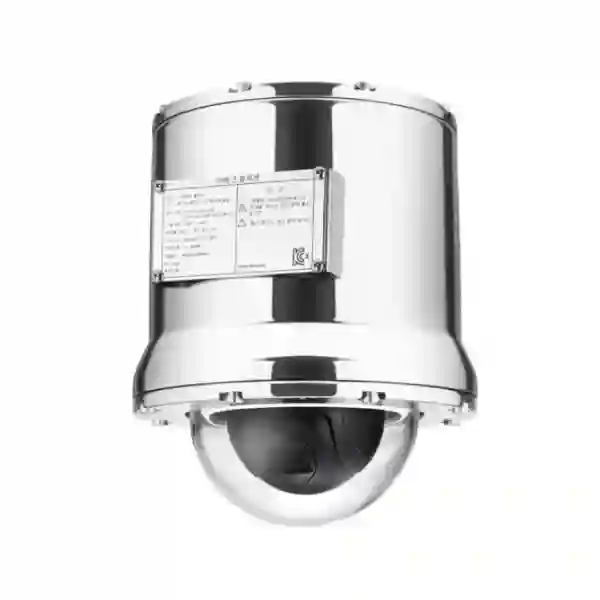
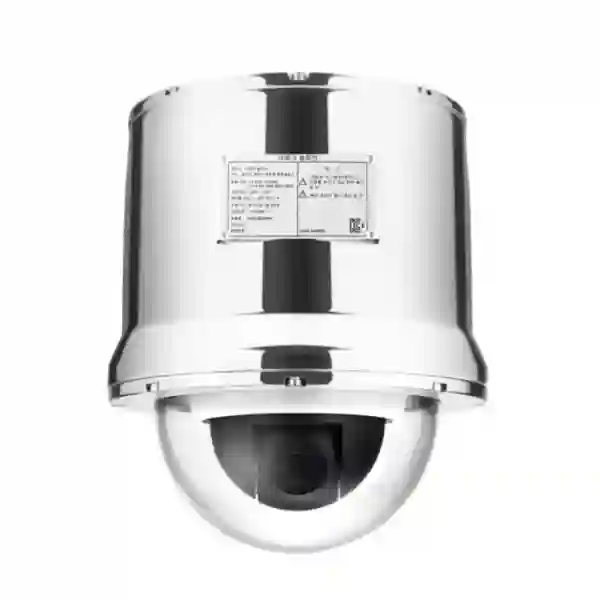
Hanwha TNU-L2120E 2MP Explosion-Protected PTZ Camera
Inspect critical industrial scenes with a 2MP network camera offering 12× optical zoom, manufacturer-listed explosion protection and a polished SUS316L enclosure. For projects in hazardous environments, technical fit depends on the classified area, the viewing objective and a correctly engineered installation.
Planning a project in Tanzania? Request a technical quotation with the proposed site classification, camera positions, recording needs and documentation requirements. Price, stock, lead time and installation scope require separate confirmation.
Technical specifications
| Manufacturer / model | Hanwha Vision / TNU-L2120E |
|---|---|
| Camera type | 2MP explosion-protected PTZ network camera |
| Image sensor | 1/2.8-inch 2MP CMOS |
| Optical lens / zoom | 5.2–62.4mm / 12× optical zoom |
| Digital zoom | 32× digital zoom |
| Imaging features | Day/Night (ICR), 150dB WDR, gyro-assisted image stabilization |
| Enclosure | Polished SUS316L stainless steel |
| Ingress protection | IP68; installation conditions still apply |
| Published protection marking | Ex d IIC T6 Gb; Ex tb IIIC T80°C Db |
| Manufacturer-listed zones | 1, 2, 21 and 22, indoor/outdoor; subject to certificate and site verification |
| Tanzania price / listing SKU | Not supplied or independently verified |
Technical highlights are taken from Hanwha Vision’s exact-model product information. Final supply specifications, certification applicability and project integration must be checked against the latest documentation for the ordered unit.
Why choose this camera for a hazardous industrial location?
Ordinary security cameras can be suitable for warehouses, offices or general perimeter areas, but their construction should not be assumed appropriate for every industrial atmosphere. A location in which flammable gas, vapour or combustible dust may be present requires equipment chosen using the facility’s documented hazardous-area classification. The TNU-L2120E offers an industrial explosion-protected camera option with a remotely adjustable view. That combination is useful when operations teams need to examine activity without repeatedly moving people or portable devices into a controlled area.
The commercial decision is not simply whether a camera can withstand weather. Buyers must decide what needs observing, how the view will be controlled, whether the relevant explosion-protection documents align with the installation, and whether the network can securely deliver recorded evidence. A technically appropriate camera installed in the wrong place or without suitable cabling can fail the purpose of the project. FourTeck Tanzania can use a clear site brief to review the camera requirement and prepare a quotation, without assuming every industrial location has the same hazards.
At a glance: manufacturer-verified features
Hanwha Vision describes this model as a 2MP, 12× lightweight explosion-protected camera. The published product information identifies a 1/2.8-inch 2MP CMOS imager, a 5.2–62.4mm optical lens, 32× digital zoom, mechanical day/night operation using an infrared-cut filter, wide dynamic range specified at 150dB, and gyro-assisted image stabilization. These are meaningful attributes for operators who need both a broader context view and closer inspection of specific equipment.
The manufacturer also specifies a polished SUS316L stainless-steel body, IP68 ingress protection and explosion-protection markings including Ex d IIC T6 Gb and Ex tb IIIC T80°C Db. It identifies possible installation contexts as Zones 1, 2, 21 and 22, indoors or outdoors. Those published descriptions are a starting point for engineering verification, not a substitute for matching the exact certificate, temperature class, ambient conditions, accessories and wiring methods to the site.
- 2MP 1/2.8-inch CMOS imaging sensor
- 5.2–62.4mm lens with 12× optical and 32× digital zoom
- Day/Night (ICR), 150dB WDR and gyro-based stabilization
- Polished SUS316L stainless-steel enclosure and IP68 rating
- Manufacturer-listed hazardous-area markings and zone guidance require project verification
What explosion protection actually means
An explosion-protected camera is specified for a different risk environment from an everyday weather-resistant CCTV device. The relevant design and certification relate to how equipment may behave where an explosive atmosphere could occur. The marking must be interpreted in relation to gas or dust group, equipment protection level, temperature classification and the installation location. Terms such as flameproof enclosure do not mean an operator can disregard site safety procedures or use arbitrary fittings.
Hanwha’s model information gives the gas marking Ex d IIC T6 Gb and the dust marking Ex tb IIIC T80°C Db. These markings convey different protection concepts and conditions. Engineers should check the exact certification files and any special conditions before specifying cable entries, mounting assemblies and other accessories. The camera is one element in a complete protected installation. Its approval markings do not automatically validate a recorder, switch, power supply, connector, gland or every accessory placed nearby.
Understanding Zones 1, 2, 21 and 22
Hazardous-area zone designations describe the likelihood or duration of particular explosive atmospheres. Zones 1 and 2 relate to gas or vapour atmospheres, while Zones 21 and 22 relate to combustible dust atmospheres. The facility’s qualified area-classification assessment determines which areas are actually within those categories and how boundaries are defined. A product description that mentions several zones must never be used as the sole basis for assigning a camera to a position.
The manufacturer lists this family member for indoor or outdoor use in Zones 1, 2, 21 and 22. Before issuing an equipment order, compare the supplied certificate and installation instructions against the project’s gas or dust group, expected surface and ambient temperatures, mounting arrangement and local approvals. Obtain a decision from the appropriate site engineer or hazardous-area specialist. Use the same discipline for any junction boxes, cabling and protective devices whose location may place them within the classified area.
What the TNU-L2120E is not
This camera is not described by Hanwha Vision as a thermal camera. Its 2MP CMOS sensor captures visible-light imaging, supported by Day/Night operation; it should not be presented as equipment that measures heat, detects leaks or provides thermal fire detection. Thermal monitoring requires a camera and system specifically designed and verified for that purpose. A visible-light PTZ may help an operator visually assess a process, but it cannot replace dedicated safety instrumentation.
Nor should the word explosion-protected be interpreted as a guarantee against every site hazard. The published IP68 rating describes ingress protection under the relevant test conditions, not complete protection from arbitrary chemicals, high-pressure cleaning, corrosion, lightning, mechanical impact or improper installation. Procurement and safety teams should separate the camera’s evidenced capabilities from additional project requirements and avoid specifying functions that the model information does not support.
The value of 12× optical zoom
Zoom matters when the desired detail varies across a large working area. At the wider end of the 5.2–62.4mm lens range, an operator can keep more equipment or movement within the frame. At the telephoto end, the same camera can isolate a smaller scene region for closer visual assessment. Optical zoom changes the lens view rather than merely enlarging already recorded pixels. That distinction makes optical capability valuable in industrial monitoring where distant details are part of the use case.
The correct zoom level depends on actual distance, mounting height, target size and the amount of surrounding context the operator needs. A long lens cannot compensate for fog, glare, vibration, dirty glass or an obstructed sightline. High magnification also narrows the view and magnifies movement, so the project should define whether the objective is overview monitoring, event verification or inspection of a specific activity. Confirm expected images from a representative mounting position before relying on a theoretical zoom number.
Optical versus digital zoom
The model lists 12× optical zoom and 32× digital zoom. These figures describe different mechanisms and should not be added together to promise a particular evidence quality. Optical zoom adjusts the lens to capture a narrower scene using the camera sensor. Digital zoom enlarges part of the image electronically; depending on the circumstances, visible pixelation and reduced effective detail can result. Digital magnification may be convenient during live viewing, but it is not a substitute for adequate optical image scale.
In a procurement discussion, ask for a realistic target: an operator should be able to see whether a gate is open, distinguish movement at a pump station, or visually check a defined process area. Specify the viewing distance and sample target dimensions. This allows the lens selection and camera position to be evaluated against the purpose of the image rather than against a zoom multiplier alone. When identification is critical, require an explicit image-quality assessment and test rather than relying on general marketing language.
Wide dynamic range for mixed lighting
Industrial scenes frequently contain bright external light and deep shadows within the same field of view. A doorway opening into sunlight, a reflective metal surface or a floodlit work area may challenge an ordinary camera. Hanwha lists wide dynamic range of 150dB for this model. WDR is relevant because it is intended to preserve more useful image information across contrasting bright and dark parts of a scene when conditions support the feature.
That figure does not guarantee equally clear video at every exposure or under every lighting arrangement. Strong reflections, moving headlights, vapour, smoke and rapidly changing illumination may still limit visibility. During design, study where light sources sit relative to the proposed camera, whether the subject will be backlit, and whether luminaires or shields can improve the image. Include testing under real operating conditions, especially if operators are expected to read labels or recognize small movements.
Day and night operation without exaggerated promises
The published imaging features include Day/Night using an infrared-cut filter. This feature helps the camera adapt its imaging mode as lighting changes, but it does not by itself prove that the device has built-in infrared illumination or can see clearly in complete darkness. If the intended location is unlit overnight, the buyer should verify whether the lighting design or a different camera solution can meet the scene requirements.
Night-time performance must be judged against more than a laboratory sensitivity figure. Look at target contrast, distance, pollution, rain, headlights and the position of nearby industrial luminaires. Agree with operators on what constitutes a usable image at night: confirmation of personnel movement, recognition of equipment status, monitoring an access route or evidence of an incident. A documented night-time acceptance test avoids buying an otherwise suitable camera that cannot serve the actual shift pattern.
Gyro-based image stabilization
Hanwha lists vibration-related image stabilization using a gyro sensor. This is particularly relevant when cameras are mounted near equipment, structures or outdoor supports that may experience small movements. At longer optical zoom settings, modest physical movement can cause noticeable image shift and make detailed inspection frustrating. Stabilization can assist viewing, but it should be treated as a supporting imaging feature rather than a replacement for sound mechanical design.
Mounting structures still need appropriate stiffness, anchoring and vibration assessment. Wind, nearby machinery and maintenance access can all influence the final result. The installer should avoid positions where movement of the support consistently dominates the image, and should check the live view across anticipated zoom positions. If there is a measurable vibration or shock requirement, request the relevant manufacturer limits and have the mounting engineer evaluate them. Do not infer an unsupported shock rating simply from the presence of electronic stabilization.
SUS316L stainless-steel enclosure and ingress protection
The product page specifies polished SUS316L stainless steel and an IP68 rating. Stainless steel can be useful where ordinary housings would face demanding environmental exposure, and a specified ingress rating supports enclosure selection for dust and water exposure. The exact suitability still depends on local contaminants, salt, chemical contact, cleaning chemicals, installation details and maintenance. The term stainless is not a promise that corrosion can never occur.
IP68 is not a universal specification for depth, duration, chemical resistance or cleaning techniques; designers should check the manufacturer’s test and operating conditions. A correctly rated enclosure can be undermined by incompatible cable entries, seals, mechanical damage or poor installation. Confirm gasket inspection practices, allowable cleaning methods and the appropriate maintenance schedule. In locations with airborne dust or chemical deposits, plan a safe method of keeping the viewing window clean without disrupting plant operations.
Choosing a camera position
Good camera selection begins with a drawing or marked photograph of the proposed scene. Identify the main subject, likely obstructions, minimum and maximum observation distances, the direction of sunlight and the location of industrial structures. Note whether a remotely controlled PTZ view is genuinely needed or whether the task requires continuous coverage from a fixed viewpoint. A single movable camera can inspect different angles, but it does not record every direction with equal detail at the same instant.
Before approving the mounting position, consider the hazardous-area boundary, access for certified installation, maintenance access, permitted cable routes, nearby heat sources and physical protection from accidental impact. The camera should be located so its view has operational value without obstructing personnel, plant movement or emergency access. The proposed position and mounting hardware should then be assessed against current manufacturer documentation and the site’s structural and hazardous-area requirements.
PTZ operation versus continuous fixed coverage
A remotely adjustable pan-tilt-zoom camera helps a control-room operator inspect selected regions. That is different from a fixed camera designed to watch one scene continuously. In an incident investigation, a PTZ camera may have been looking elsewhere when an event occurred. For critical gates, emergency exits or other points requiring uninterrupted observation, the design may need dedicated fixed views in addition to the movable camera. The exact combination depends on the risk assessment and operational procedure.
Define who may control the camera, when presets may be changed, whether there is a default home view, and how control rights are managed. If multiple teams share a video system, simultaneous PTZ requests can conflict. A sensible operating policy clarifies priority and records which scenes must never be left without coverage. Before buying, confirm the model’s actual PTZ control, recording and integration behaviour against current product documentation and the proposed management platform rather than assuming every PTZ implementation works identically.
Planning the monitoring objective
A buyer can save considerable redesign by translating ‘we need CCTV’ into a small set of observable outcomes. For example, the project may require an overview of loading operations, the ability to inspect equipment bays from a control room, or retrospective video of routine activity. Each outcome has different requirements for image detail, hours of use, view direction, recording retention and operator interaction. The camera’s verified 2MP resolution and lens range should be evaluated against those outcomes.
Create an acceptance statement for each target area using plain language. Describe what a supervisor must be able to see, how quickly the view must be available, whether video must be recorded, and which environmental conditions are normal. A camera that provides useful situational awareness may still be unsuitable for reading very small text at a long distance. Differentiating those tasks early is more important than selecting a high specification on paper and hoping it will satisfy every future request.
Hazardous-area documentation before purchase
Industrial buyers should request the current product datasheet, installation manual and the exact applicable explosion-protection certificates for the supplied configuration. Hanwha’s product resources include certification documentation; the purchaser must confirm that the revision and marking correspond to the ordered unit. The site’s qualified engineer should compare these with the area-classification document, ignition temperature requirements, environmental conditions and any special conditions stated in the certificate.
Ask the contractor to confirm the permitted mounting orientation, certified cable entries, grounding and bonding requirements, isolation arrangements and inspection procedures. The required documents for acceptance may differ by industry, client policy and applicable local rules. Do not assume a certificate from one jurisdiction, a Korea-specific verification, or an equipment family automatically satisfies every approval requirement in Tanzania. Written project approval by the responsible technical and safety parties remains essential.
Mounting brackets, glands and mechanical installation
An industrial camera order may require more than the camera body. Mounting, supports, fasteners, certified cable-entry components, protective routing and access equipment can account for significant design work. Accessories must be chosen for the exact model, installation direction, environmental exposure and hazardous-area classification. A convenient third-party bracket may be mechanically strong yet inappropriate for a particular certified installation, so compatibility requires documentary verification rather than visual similarity.
Site engineers should address support loading, corrosion exposure, vibration, clearance for camera movement and safe servicing. Cable glands and any adapters are especially important to an explosion-protected installation; each must align with the approved protection concept and the actual cable construction. The installer should record the final components and certificates. If original accessories are replaced during maintenance, verify the substitutes before fitting them and update the installation record.
Power supply and wiring design
Do not assume a general-purpose camera power source is sufficient for this unit or for a classified location. The exact input requirements, permitted wiring arrangement and any network-power option must be checked against the current manufacturer manual for the selected configuration. Power distribution may need to be located outside the hazardous area or provided through an engineered arrangement appropriate to the classification. These are design decisions, not details to discover once installation begins.
Document the source of power, cable route, protection devices, grounding, surge protection and any backup-power expectations. Clarify what must happen when mains power is interrupted: whether a camera may stop, whether video recording should continue, and whether restarting requires operator intervention. If continuity is important, design it across the camera, network and recorder rather than assuming that an uninterruptible supply for one device protects the entire monitoring chain.
Network connectivity and practical bandwidth planning
The TNU-L2120E is an IP network camera, so the path between camera and recorder is central to system reliability. Plan where switches, fibre connections, copper runs and management equipment will be installed, and keep the requirements of classified locations distinct from ordinary IT closets. Available bandwidth should reflect the intended video quality, frame rate, scene motion, compression configuration and number of simultaneous viewers. Do not invent a fixed bitrate or storage figure without a defined recording profile.
Industrial sites can experience electromagnetic interference, physical damage to cables and long distances between observation points. The network design should therefore include suitable cabling, route protection, redundancy where justified and monitoring of connectivity failures. Before integration, ask the network team to reserve addresses and clarify routing, firewall rules and traffic separation. Live viewing and video recording should be tested together, because a usable live image does not necessarily demonstrate dependable long-term recording.
Recording, video management and evidence quality
The camera is only one part of the video solution. Buyers also need a recording destination, management software or recorder, appropriate licenses if required, and operating procedures for retrieving events. The exact compatibility of a particular VMS, NVR or feature set should be confirmed through the relevant vendors’ current documentation and, where possible, a practical integration test. Do not rely on an unverified claim that every ONVIF profile or advanced camera function will work with every recorder.
Specify a recording strategy that suits the operational objective. Continuous recording may be relevant in some areas; event-triggered capture may meet others, but its detection logic must be understood and validated. Ensure that PTZ controls, device time synchronization, footage export permissions and user audit needs are defined. For investigations, agree on how evidence will be protected from accidental overwriting, how it will be retrieved, and who is authorized to share it.
Retention and storage without invented estimates
Storage calculations depend on the chosen resolution, configured frame rate, compression settings, scene complexity, daily recording duration and desired retention period. Because these parameters are project-specific, a page listing a camera model cannot responsibly promise a certain number of days on an unspecified hard drive. A recording design should show the assumptions, include a safety margin, and allow for realistic peaks such as increased movement or multiple operators reviewing streams.
An effective quotation asks the customer for the number of cameras, intended retention period, recording hours, playback requirements and whether exported footage will be retained separately. It should consider the resilience of storage and the impact of network failure. Retention policies should follow the organization’s own privacy, safety and evidence requirements and any applicable law, without implying that a single standard period is appropriate for every industrial business.
Cybersecurity and access control
Network cameras connect the physical environment to an IT system, so access rights and device maintenance deserve attention from the outset. Operators generally need permission to view or control images, while administrators manage configuration and updates. A useful security baseline includes unique credentials, restricted administrative access, appropriate network segmentation, secure remote-access methods and routine review of firmware advisories. Actual supported security controls must be checked for this model and its firmware.
Place video equipment under the customer’s cybersecurity policy rather than exposing it openly to the internet for convenience. Record the people responsible for account management, backup of configuration, update approval and incident response. Review any remote viewing requirement before purchase so it can be implemented without bypassing plant security boundaries. Where separate operational technology and corporate networks exist, involve both teams in deciding how the video system communicates and how access is logged.
Industrial operations: practical scenarios
A camera at a process or utility installation may support visual confirmation of routine activity, observation of equipment areas, remote inspection of a selected scene or review of an incident after the fact. Those uses are distinct from automatic process shutdown, gas detection or condition monitoring. The TNU-L2120E should be positioned as a visual surveillance device; any safety-critical automation must use appropriate validated instrumentation and approved procedures.
In a loading area, an operator may want an overview most of the time and closer views during particular operations. In a maintenance zone, the need may be to inspect work progress from a remote position when authorized. For an industrial access route, PTZ flexibility may be helpful, but continuous evidence of entry or exit could still require a fixed companion camera. Each scenario should be evaluated with the responsible operations and safety teams.
- Process facilities: visually observe selected equipment areas from an authorized monitoring point
- Industrial logistics: check a working zone without promising automated hazard detection
- Utilities and infrastructure: review selected outdoor scenes subject to the site classification
- Maintenance operations: supplement procedures with visual context, never replace safety supervision
A practical approach for Tanzanian projects
Facilities in Tanzania may combine hazardous industrial spaces with ordinary control rooms, offices and external approach areas. This creates an opportunity to design a mixed camera system instead of treating every position as equally hazardous. The zone classification should determine which devices require explosion-protected construction, while the monitoring objective determines where a movable camera is helpful. A tailored design may control unnecessary expense without compromising the engineering requirements of a classified area.
FourTeck Tanzania’s quotation discussion should begin with the proposed site, contact requirements and a technical brief. Confirm actual serviceability, procurement route, regional supply, documentation language, import arrangements and delivery expectations before commitments are made. Do not assume this product is locally stocked, immediately deliverable, installed by a specific team, or approved by a Tanzanian authority merely because this page is intended for Tanzania. Those commercial and regulatory matters require separate verification for each order.
Selecting between this model and a higher-zoom option
Twelve-times optical zoom is a practical specification, but the correct choice depends on the scene. When the object of interest occupies a small portion of a very distant view, a longer optical lens might be worth evaluating. When the priority is broad situational awareness and the ability to zoom into nearby equipment, the TNU-L2120E may be an appropriate candidate. The decision should use target dimensions, camera distance, viewing geometry and required detail rather than choosing the largest optical-zoom number.
Hanwha has other industrial camera models with different fields of view and capabilities. A buyer considering alternatives should compare current datasheets, certification details, mounting requirements and system compatibility on a like-for-like basis. Avoid assuming that products in the same family share identical certificates, environmental limits or accessory compatibility. A better comparison uses a short list of actual site objectives and explains which camera and combination of views will meet them.
When a fixed camera may be a better fit
A fixed camera can be preferable when a critical point must always remain under continuous observation or when operators do not need to change viewpoint. It also avoids the possibility that an actively controlled PTZ is pointed away from an important event. A system designer may combine fixed coverage with a PTZ for follow-up inspection. Whether that arrangement is necessary depends on the risk assessment, the number of observation points and the consequence of an image gap.
Camera choice also affects installation cost and maintenance. Compare the number of coverage points, required cables and brackets, networking, recording channels, control-room interfaces and long-term servicing. For hazardous locations, compare only cameras whose protection markings and configuration are appropriate for the site. The lowest initial hardware price is not automatically the lowest total project cost if it causes rework, inadequate evidence or repeated access to a difficult maintenance location.
Pre-installation site survey checklist
An effective survey verifies both what the camera should see and what the installer must safely do to place it there. Obtain drawings or photographs, identify the proposed mounting position, collect distances to key targets, note the day and night lighting conditions, and mark areas that could obstruct the view. Record planned cable routes and network termination points, then review them against the area-classification documentation. If a drawing is outdated, arrange confirmation by the site team before ordering.
Also establish permitted work windows, permit-to-work requirements, access equipment, shutdown needs, isolation procedures and ownership of project approvals. Include maintenance access in the initial layout. A high mounting position may look attractive for viewing but become unnecessarily expensive to inspect or clean. Agree on who signs off the final camera view and how image performance will be demonstrated before the contractor leaves the site.
- Documented area classification and required certificates
- Photos, layout plan, mounting height and camera-to-target distances
- Day, night and adverse-weather image objectives
- Approved electrical, cable-entry and network design
- Named personnel for commissioning, evidence review and technical approval
Commissioning and acceptance testing
Commissioning should demonstrate that the installed solution works safely and produces the images the customer actually requested. Start with the approved component list and installation records; confirm that the model, enclosure, accessories, cable entries and markings match the design. The qualified installer should follow the manufacturer’s inspection requirements and the site’s hazardous-area work procedures. Then test live video, network stability, intended PTZ movement and the required day and night views.
Record sample scenes at the expected working distances and zoom settings. If recording is required, verify playback, timestamps, export quality and appropriate operator permissions. Check the response to planned power interruption or network loss where this forms part of the specification. Obtain the customer’s acceptance against agreed objectives, not against a vague claim of clear video. Deliver the necessary configuration records and a handover document so later service work can preserve the approved installation.
Maintenance and lifecycle planning
Regular maintenance is more than cleaning a viewing window. Industrial camera sites may require inspection of corrosion, cable routing, enclosure condition, fittings, fasteners and supporting structures. The inspection schedule should be developed from the manufacturer’s instructions, the applicable hazardous-area practices and the actual exposure at the installation. Only authorized personnel should perform work within classified locations, and maintenance must not undermine the certified assembly.
On the software side, record device identity, firmware version, configuration ownership and any approved update process. During servicing, check that the camera still delivers the intended views and that recordings can be retrieved. When a replacement part is needed, confirm model compatibility and certification before substitution. Include a process for documenting changes to camera position, cable entries, network configuration or operational use; unrecorded changes can make later troubleshooting and assurance difficult.
Environmental and operational trade-offs
IP68 and polished stainless steel are valuable published attributes, but they do not remove the need to design for site conditions. Direct sunlight can challenge exposure, wind can affect supports, spray can dirty viewing surfaces, and industrial deposits can obstruct visibility. Electrical storms and cable-related surges may require system-level protection, while harsh chemicals need specific materials-compatibility review. No unverified temperature range, chemical-resistance claim or cleaning-pressure rating should be inferred from the available summary.
Consider operator behaviour too. Excessive PTZ movement can make recordings hard to interpret, a complex interface can slow response, and insufficient training can reduce the benefit of a well-selected camera. Agree on routine presets, access rights, incident workflows and maintenance responsibilities before handover. The best deployment is the one that produces consistent, useful visual evidence in the real working environment, not merely the one that maximizes specifications on a product comparison sheet.
Information to provide for a meaningful quotation
An accurate request for quotation starts with the model name Hanwha TNU-L2120E and the proposed application. Identify the number of units and whether the project requires an individual camera, an integrated CCTV package or installation-related engineering. Provide the hazardous-area zone, relevant gas or dust classification, environmental exposure, desired viewing distances and whether the operator must pan, tilt or zoom during normal work. State any documentation standards the project’s technical reviewer requires.
Include the desired recording period, whether an existing VMS or NVR is in use, network constraints, power source, proposed mounting arrangement and expected commissioning responsibilities. Ask the supplier to separate confirmed product supply terms from optional services and third-party components. Pricing in Tanzanian shillings, delivery dates, warranty terms, local support and installation coverage should be confirmed through the formal quote; they are not established by this informational product description.
- Exact model and quantity
- Hazardous-area drawings, protection requirements and ambient conditions
- Camera location, distance, target visibility and illumination
- Recorder/VMS details, storage objectives and access policy
- Mounting, power, cabling, commissioning and documentation scope
Questions to resolve before placing an order
Several details can materially change the right configuration even when the desired camera model is already known. Confirm the latest manufacturer instructions and certificate conditions for the supplied unit. Verify the approved mounting arrangements, compatible accessories and exact power requirements. Confirm whether the selected recorder and management software support the workflows the operator expects. Review the available light and sightlines rather than assuming published camera features eliminate environmental limitations.
On the commercial side, obtain written confirmation of the actual product offered, included accessories, lead time, location and scope of delivery, support responsibilities, warranty conditions and any import or installation requirements. An official quote should also state what is excluded, such as network switches, cabling, storage or site permits. These checks make comparisons more useful and reduce the risk of purchasing a capable camera that does not form a complete, approved operational system.
Product identity, documentation and model accuracy
The exact model designation matters when requesting documentation or comparing quotations. TNU-L2120E is the model used in Hanwha Vision’s published information. A product family or similar-looking model should not be treated as interchangeable without checking its lens, control capabilities, enclosure design and relevant certificates. Likewise, a manufacturer’s model number is not necessarily the unique stock-keeping unit used by an individual retailer, installer or FourTeck product listing.
No listing-specific FourTeck Tanzania SKU was provided for this request, so none should be manufactured from the model name. A formal seller quotation can identify the appropriate orderable code and any kit components after the exact listing has been confirmed. Keep the manufacturer model, any accessory references and site project number distinct on procurement documents. This reduces confusion between the core camera, a certified assembly, an installation package and unrelated accessories.
How this page helps procurement and engineering teams
Procurement teams need a quick understanding of what the model does, what it costs to complete the project, and which facts require confirmation. Engineers need a credible starting specification, a clear line between verified camera features and project assumptions, and a checklist for hazardous-area compatibility. Operations managers need to know whether the camera can support their actual monitoring objectives. Bringing those perspectives together is more useful than a long feature list without a deployment plan.
Use the technical highlights above to build an initial shortlist and then share the proposed site details for review. The verified product characteristics are useful for a first discussion; they do not replace a full datasheet, certified installation manual, engineering approval or project-specific quote. If the proposed scene calls for fixed 24-hour coverage, specialized thermal imaging or additional safety automation, ask for those functions separately so that the CCTV design does not accidentally claim to perform tasks outside its scope.
Frequently asked questions
Is the Hanwha TNU-L2120E an explosion-proof PTZ camera?
Hanwha Vision identifies the TNU-L2120E as a 2MP lightweight explosion-protected camera with 12× optical zoom. It is intended for suitable industrial applications, including manufacturer-listed hazardous-area zones. The suitability of any specific installation still depends on the exact certificate, area classification, accessories and approved installation method. The wording explosion-proof should not be used as a substitute for an engineering assessment.
What is the optical zoom and focal-length range?
The published optical lens range is 5.2–62.4mm, corresponding to 12× optical zoom. The model also lists 32× digital zoom. Optical and digital magnification are different, and digital enlargement cannot restore detail that was never captured. To determine whether the image will meet a monitoring objective, provide the target size, camera-to-target distance and needed visual detail.
Does this camera provide thermal imaging or temperature readings?
No thermal-imaging or temperature-measurement capability is established in the manufacturer product information reviewed for this model. The TNU-L2120E is described using a 2MP CMOS image sensor and normal imaging features. If the project requires temperature measurement, thermal anomaly monitoring or specialized fire detection, ask for a solution specifically designed and verified for that function rather than treating a visible-light PTZ as equivalent.
Can it be used in Zones 1, 2, 21 and 22?
Hanwha Vision lists indoor or outdoor use in Zones 1, 2, 21 and 22. That statement does not independently approve a location. Confirm the exact explosion-protection certificate, gas or dust group, surface temperature marking, ambient conditions, cable entries and required local authorization against the documented classification. The responsible site engineer and qualified installer should make the final suitability decision.
Does IP68 mean it is maintenance-free?
No. IP68 describes a level of ingress protection under specified test conditions, while ongoing suitability depends on the installed assembly and environment. Deposits, seal wear, cable-entry damage, corrosion and an obscured viewing window can still affect service. Plan inspections and cleaning according to manufacturer guidance and site procedures, especially in classified areas where maintenance access requires additional controls.
Will it record video without a separate system?
A complete recording solution should be defined separately from the camera specification. Confirm the chosen recorder, storage, video management software and recording settings for the intended site. The exact combination determines retention, playback, export and user access. Do not assume that every recorder supports every control or event feature without compatibility testing. Ask for a system-level specification when recordings are part of the project.
Is infrared illumination included for completely dark scenes?
The reviewed manufacturer highlights confirm Day/Night with ICR, but do not establish an integrated infrared-illuminator range for this exact model. Therefore an infrared night-vision distance should not be advertised without additional product evidence. For sites that become completely dark, evaluate the lighting design and verify night-time imaging with the proposed camera and installation before approving purchase.
Can the camera be integrated with our existing CCTV software?
Potential integration should be evaluated against the particular recorder or VMS, its software version, the camera firmware and the needed features. Basic live viewing, PTZ commands, event handling, audio and other functions may have different integration requirements. Share your existing platform details and intended operating workflow with the quotation request. A documented compatibility assessment or practical test is more dependable than a general assumption of universal support.
How much video storage will we need?
There is no responsible universal storage answer without specifying the frame rate, encoding, recording hours, scene complexity, retention period and number of cameras. Share these requirements so the recording solution can be sized with an appropriate margin. A quotation should also explain assumptions, allow for evidence exports and define how the system behaves if a recorder, storage device or network connection is unavailable.
What should I verify about the power and cable installation?
The exact camera input specification, accepted cabling and connection arrangement should be checked in the current manufacturer installation manual. Hazardous-area work may also require certified cable entries, bonding, grounding and specific work practices. Verify every accessory and connecting device, not just the enclosure. An appropriately qualified project engineer should approve the design before equipment is fitted in a classified location.
Is it suitable for outdoor industrial environments in Tanzania?
The manufacturer lists indoor or outdoor use and specifies an IP68-rated SUS316L enclosure. Outdoor suitability for an individual Tanzanian facility also depends on site temperature, chemicals, rain, dust, wind, support vibration, lighting and approved installation details. Do not treat an outdoor rating as a guarantee of corrosion resistance under every condition, or as confirmation of local availability and service coverage.
What is the price in Tanzania?
No verified FourTeck Tanzania selling price has been supplied for the exact listing. A valid project price depends on the camera configuration, required accessories, procurement and delivery conditions, and any design, installation or commissioning services. Request a written quotation in the relevant currency with included and excluded items clearly identified. No retail or manufacturer price from another country is a substitute for a local project quotation.
Does this listing confirm available stock or delivery time?
No. The manufacturer notes that supply may vary by region, and this product description does not establish FourTeck Tanzania inventory, confirmed lead time or local warehousing. Availability, shipment terms and delivery commitments should be verified through the quotation process. A product description is not proof that a specific unit is on hand, that an order has been accepted or that an installation date is reserved.
What documents should accompany a hazardous-area camera order?
Ask for the current manufacturer datasheet, exact applicable explosion-protection certificates, installation and operating instructions, and a list of approved accessories. Project documentation may also include hazardous-area classification drawings, an electrical design, mounting details, inspection records, commissioning evidence and the final as-built configuration. Agree on document language and revision requirements with the engineering reviewer before procurement.
Why might a project need both fixed and PTZ cameras?
A PTZ camera can inspect multiple scene regions, but the image at any moment reflects where it is pointed. A fixed camera can continue watching a critical entrance or process point while an operator zooms the PTZ elsewhere. Mixed arrangements may provide better evidence for some projects. Coverage design should follow the defined monitoring objective and risk assessment rather than an assumption that one movable camera can continuously observe an entire facility.
How do I request the correct model and scope?
Specify Hanwha Vision TNU-L2120E by its exact model name and provide the unit quantity, proposed site conditions, zone classification, target distances, required camera views, recording objectives, network constraints, mounting needs and documentation requirements. Ask FourTeck Tanzania for a technical quotation and written confirmation of price, supply, included items and any support services. Do not treat the model number as an unverified seller SKU.
Request a Hanwha TNU-L2120E technical quotation
For an industrial surveillance requirement in Tanzania, tell FourTeck the number of cameras required, the designated hazardous-area zones, the viewing distances, the proposed mounting locations and the expected recording or control-room integration. A useful quotation should identify the exact camera configuration, appropriate supporting components, required documentation and scope of supply. It should also confirm product availability, price, lead time and any installation or commissioning services without making assumptions about the site.
This page is a procurement and planning guide, not a certificate of site suitability. Before purchase, obtain approval from the relevant project engineer or hazardous-area specialist and check the latest manufacturer instructions. Ask FourTeck Tanzania to discuss the specification and prepare a written, project-specific quotation.
Next step: Contact FourTeck Tanzania to request a technical quotation and confirm availability.




Reviews
There are no reviews yet.