
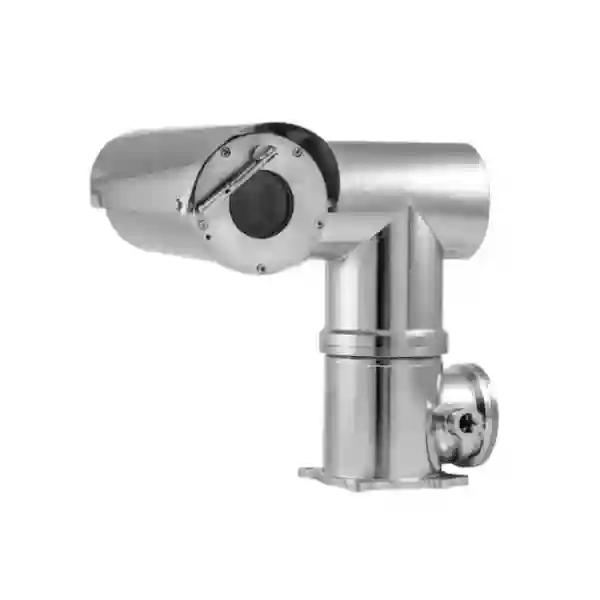
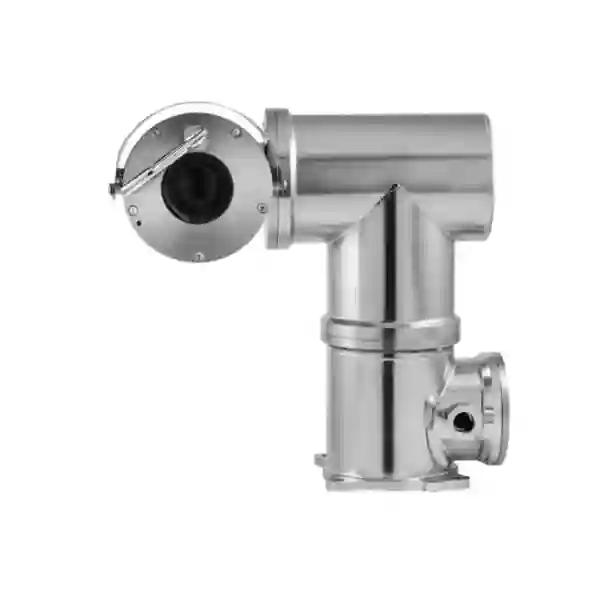
Hanwha TNU-X6320A1F2WT2-C Explosion-Proof PTZ Camera
For engineers and security teams evaluating surveillance in hazardous industrial facilities, the Hanwha TNU-X6320A1F2WT2-C is a specialist 2MP explosion-proof PTZ camera station with a 32x optical lens, integrated wiper, stainless-steel enclosure and single-mode fiber network option. Its 24VAC power requirement and cLC CSA identification make exact-model engineering verification essential. This page explains the documented capabilities and the design decisions that matter before requesting a quotation for a Tanzania project.
Key specifications at a glance
| Brand / model | Hanwha Vision / TNU-X6320A1F2WT2-C |
|---|---|
| Camera type | Explosion-proof network PTZ station |
| Video | 2MP, 1920 × 1080; up to 60 fps in supported mode |
| Optics | 4.44–142.6 mm; 32x optical, 16x digital zoom |
| Pan / tilt | 360° pan range; −90° to +90° tilt |
| Imaging features | Day/night ICR, 120 dB WDR, gyro-based digital stabilization |
| Codecs | H.265, H.264, MJPEG; WiseStream II |
| Storage | 2 microSD-family slots; 256 GB per slot maximum |
| Networking | F2 duplex single-mode fiber, 9/125 μm; 10/100 Mb class |
| Interoperability | ONVIF Profiles S and G; SUNAPI |
| Power | 24VAC; 80 W maximum stated |
| Housing | Electro-polished 316L stainless steel, toughened-glass window |
| Environmental protection | IP66 / IP67; integrated wiper |
| Dimensions / mass | 418 × 457 × 401 mm; approximately 33 kg |
| Certification family | cLC CSA (-C variant); confirm actual device marking and site acceptance |
| Temperature note | Published +40°C / +60°C upper-limit discrepancy: obtain written clarification |
Specifications are manufacturer-published and may change; confirm the current exact-model documentation, certified environmental limits, and installation conditions before order placement.
A specialist camera for hazardous-area projects
Selecting surveillance for a hazardous industrial location is different from choosing an ordinary outdoor security camera. The camera must deliver useful evidence, but the enclosure, electrical installation, mechanical loading and hazardous-area approval are equally important. The Hanwha TNU-X6320A1F2WT2-C combines a full-HD network PTZ camera with a purpose-built explosion-protected station. It is intended for project teams planning observation of exposed process equipment, industrial perimeter approaches, loading areas, marine installations and other difficult operating environments. The exact installation location must still be assessed by the responsible engineering and safety team.
This model is most relevant where operators need to change viewing direction and zoom in on distant activity without placing a fixed camera at every point of interest. It is not an automatic replacement for a complete hazardous-area surveillance design. Before requesting a commercial quote, establish the classified area, viewing objectives, required identification detail, communication path, power arrangement and accepted certification. These decisions will determine whether this exact model, a different variant or several fixed cameras deliver the better engineering outcome.
Confirm the certification before choosing a mounting point
The manufacturer describes this as an explosion-proof PTZ camera and identifies the -C variant with cLC CSA certification. That is valuable specification information, but it is not a blanket statement that the camera can be installed in every potentially explosive atmosphere. The applicable gas or dust group, protection concept, temperature class, ambient limits, certificate conditions and jurisdictional acceptance must be checked against the actual product markings and current certificate documents. A generic marketing description is not a substitute for hazardous-area equipment selection.
Ask the project safety professional to match the proposed device and every associated gland, enclosure entry, conduit and accessory to the site's area-classification drawings. The installation method must be appropriate for the designated zone or division and local rules. In Tanzania, do not treat an overseas certificate as proof of a particular local regulatory approval. Approval of a complete installation depends on the competent authority and project requirements. Record the equipment nameplate and certificate references in the technical submittal before procurement.
32x optical zoom is for changing observation scale
The integrated 4.44–142.6 mm lens provides 32x optical zoom, together with a stated 16x digital zoom option. Optical zoom changes the amount of scene detail reaching the image sensor, so it is a practical tool for inspecting equipment and observing more distant movements. Digital zoom enlarges existing image information and cannot create detail that the sensor did not capture. The difference matters when a project specification asks for recognition of people, reading markings or monitoring a small component from a long distance.
At the wide end, the stated horizontal angle is about 64.44 degrees, while the telephoto end narrows to about 2.29 degrees. This large change is useful but creates a design trade-off: a distant close-up covers a much smaller area. Determine target distance, object size, expected movement, required pixels on target and the time operators can spend steering the view. Use a site drawing and field-of-view calculation rather than assuming that the largest zoom number guarantees identification at any distance.
Understand what 2MP video can and cannot do
The camera outputs 1920 × 1080 full-HD video and uses a 1/2.8-inch CMOS imaging device. Hanwha lists up to 60 frames per second with H.265 or H.264 in the relevant system mode, and MJPEG support at a lower maximum rate. A higher frame rate can help operators follow fast movement and reduce the gaps between recorded frames. It does not automatically improve small-object detail, poor lighting, obstructed sightlines or recording-system capacity.
A useful camera design begins with the operational question: is the purpose general awareness, observing a machine sequence, identifying an entrant or reviewing a suspected incident? Each question calls for a different image scale and recording plan. Set resolution, frame rate, focus behaviour, shutter, compression and exposure against the target task. Where evidential quality matters, test with real subjects at the expected distances. Avoid specifying this model as a thermal imager or a 4K camera; neither capability is established for this exact product.
Manage glare, darkness and backlit scenes
Industrial sites often place bright work lights beside dark pipes, tanks or structures. Hanwha lists 120 dB wide dynamic range, day-and-night operation using an infrared-cut filter, digital noise reduction and defog support. These features provide tools for tuning difficult scenes, but their actual effectiveness depends on the position of lights, reflections from metal, weather and camera configuration. The listed minimum illumination is 0.05 lux in colour and 0.005 lux in black-and-white under specified test conditions, not a promise of usable identification in every dark location.
During design, review the site by day and during the least illuminated operating period. Check headlights, rotating machinery, steam, shadows and reflected floodlights, especially when the PTZ turns toward different directions. Provide suitable external scene lighting when required by the surveillance objective and hazardous-area design. The lens and image processing can help, yet a camera cannot see through dense smoke, opaque spray or a physically blocked window. Set realistic acceptance criteria based on actual sample footage.
PTZ positioning for operators and patrols
Pan and tilt allow one station to examine several selected areas. The published specification gives a 360-degree pan range and a tilt range from minus 90 to plus 90 degrees, with listed preset speeds of up to 45 degrees per second for pan and 24 degrees per second for tilt. Those values help define the movement envelope and expected response, but a designed view is also constrained by pipework, support steel, cables and weather exposure. Map important targets before deciding on the base position.
Preset views can support operator workflows such as checking a pump skid, moving to a loading connection and then examining the access route. However, one PTZ observes only the scene toward which it is pointed at a given instant. For continuous evidence of multiple critical assets, consider fixed cameras in addition to this unit. Specify who may steer the camera, which presets are protected and how PTZ movement is logged. A sensible patrol plan should improve awareness without leaving an essential location unobserved.
Single-mode fiber should be designed as a system
The F2 version is identified by Hanwha with a duplex single-mode 9/125 micrometre fiber interface for network transport. Fiber can be attractive in electrically noisy installations or where distance and plant layouts make a conventional copper connection difficult. That does not eliminate the need to check the complete communications path. Optical termination, patching, compatible interfaces, distribution equipment, enclosure penetrations and network protection must all be included in the design.
Do not assume the camera's network interface will plug directly into any fiber switch without a compatibility review. Confirm connector type, available optical module details, optical budget, cable route, bend radius and maintenance access from the current approved installation documentation. The published network transport is in the 10/100 Mb class, so build the bandwidth plan around actual configured streams rather than assuming gigabit camera throughput. Record the final fiber allocation, port mapping and test results in the handover package.
Plan 24VAC power and electrical protection
This particular configuration is specified for 24VAC input, with the manufacturer's table giving maximum power consumption of 80 W. It should not be treated as a PoE camera or connected to a 110VAC supply merely because another model in the wider series uses a different voltage. The power design needs a correctly specified source, conductors, voltage-drop calculations, protection, isolation provisions and any site-required backup. Long cable runs and startup loading should be reviewed by an electrical professional.
Because the camera is installed in an industrial and potentially hazardous environment, power decisions also involve certified wiring practices and safe maintenance arrangements. Assess the transformer or power supply location, protection from transients, bonding requirements and procedures for isolating equipment before work. Where recording is security-critical, plan what happens when plant power or the network fails. Never promise uninterrupted operation simply because the imaging device includes edge storage; power continuity and the wider system need their own resilience design.
Why 316L stainless steel matters
Hanwha identifies electro-polished 316L stainless steel for welded housing assemblies and a toughened-glass camera window. This construction is relevant where a conventional indoor housing would be unsuitable for exposed industrial conditions. The listed ingress-protection ratings are IP66 and IP67. These ratings describe specified dust and water protection tests, not an assurance that the camera is resistant to every chemical, cleaning method, impact or long-term marine condition.
Site teams should consider airborne salts, process chemicals, cleaning agents, condensation, abrasive dust and proximity to hot equipment. Corrosion performance depends on the complete assembly, including fasteners, seals, mounts and maintenance methods. When the site has an unusually aggressive atmosphere, request a materials-compatibility review before selecting the position. An industrial enclosure can be robust without being universally appropriate. Inspect for damage after installation and keep the viewing window and protective surfaces in the condition required by the manufacturer's maintenance instructions.
What the integrated wiper adds
An integrated wiper is a practical feature when rain, spray or deposited moisture repeatedly obscures the viewing window. Instead of expecting an operator to work around a blurred image, the maintenance and control plan can include a method of clearing the glass. The wiper does not remove every kind of industrial residue, nor does it replace routine cleaning of surfaces exposed to oil mist, salt, stubborn dust or chemicals. Confirm the approved operating and cleaning procedure for this explosion-protected assembly.
Related washer accessories may be available within the broader camera-station family, but any tank, pump, cabling or mount should be reviewed as a separately specified item. Do not assume an optional accessory is included with the camera. For remote or difficult-to-access positions, decide who will monitor window contamination and how the team will perform maintenance safely. Good image quality over time depends as much on inspection access and preventive care as on the camera's initial resolution.
Video compression and recording capacity
The camera supports H.265, H.264 and MJPEG, with WiseStream II listed by the manufacturer. These options let integrators choose a balance between compatibility, bitrate and useful recorded detail. Actual storage consumption depends on motion, scene complexity, chosen codec, quality settings, resolution, frame rate, retention period and the number of streams. A nominal bandwidth figure from another site should not be reused without testing the proposed image settings.
Prepare a storage estimate for the specific surveillance objective and then apply a practical margin. For example, a view dominated by constantly moving machinery, rain or spray can create a different compression load from a quiet yard. Check the capabilities of the intended recording software, not only the camera. If the client needs long retention or several continuous streams, validate server and disk capacity as a complete system. Recording quality should be checked after deployment, because aggressive compression may hide the details the operator was meant to inspect.
Local storage is useful, but is not a full recorder
The specification identifies two microSD/SDHC/SDXC card slots, with a stated maximum of 256 GB per slot and 512 GB in total. Edge storage can contribute to recording workflows and may provide a useful local source of events when the chosen system supports the required configuration. Card presence, card selection, formatting, recording rules and retention settings still need to be defined. Local media is not equivalent to a centrally managed, redundant recording platform.
In high-value industrial applications, establish who can retrieve evidence, how loss of network connectivity is detected and what happens if media reaches its limit or fails. Test the complete event and archive workflow against the actual video management system. Avoid interpreting a stated storage capacity as a fixed number of days of recorded footage; retention depends on the settings and content. Include secure access control and a documented procedure for media maintenance, especially where equipment access is controlled by hazardous-area work permits.
Event analytics support awareness, not certainty
Hanwha lists analytics that include motion detection, tampering, fog detection, shock detection, virtual-line crossing and virtual-area events such as intrusion, entry or exit. These tools can help operators prioritize review rather than continuously watch every stream. Their effectiveness depends on the scene and configuration. Steam plumes, moving vehicles, vegetation, rain, rotating equipment and camera movement can all complicate event interpretation.
Design event rules around a specific operational need. A line crossing an entrance has a different purpose from a virtual area covering a safety-critical machine. Determine the acceptable balance between missed events and nuisance notifications, and test across day and night conditions. A conventional analytics event should not be presented as a certified personnel-safety detector or a guarantee of threat recognition. Confirm whether third-party software can receive the chosen events, then document operator actions when a relevant alert occurs.
Integration with an existing security platform
Published integration information includes ONVIF Profile S and G, Hanwha SUNAPI and network streaming protocols such as RTSP. These interfaces are useful starting points when planning integration with a recorder, video management system or control-room workstation. However, an advertised interface does not prove that every advanced feature, wiper command, preset, analytics event or storage function will operate identically across different software products.
Ask the intended platform vendor or integrator for a compatibility check against the camera model, firmware and planned feature set. Validate live video, recording, PTZ commands, preset recall, time synchronization, user rights and event handling. Where site policy requires a particular management system, test with that platform before committing to a large deployment. Integration review should include software licensing, network segmentation, audit records and ongoing ownership of configuration changes, not only whether a preview picture appears.
Secure the camera as an industrial network endpoint
The manufacturer's feature list includes HTTPS, SRTP, 802.1X authentication, IP-based access controls and audit logging. These are useful building blocks, but they provide value only when enabled and maintained as part of a site security policy. Treat the camera as an IP-connected industrial asset. Place it in an appropriate network segment, give users defined privileges and control access to configuration functions that could change the evidence collected.
Before commissioning, establish unique credentials, approved firmware, time synchronization, certificate handling, remote-access rules and a backup of the final settings. Decide who is responsible for monitoring security advisories and applying updates during safe maintenance windows. Avoid directly exposing management interfaces to the public internet. Where the camera is on a plant network, coordinate with the operational-technology team so troubleshooting, packet filtering and scheduled changes do not unintentionally disrupt other systems.
Check structural loads and the viewing envelope
The published size is approximately 418 × 457 × 401 mm and the listed product weight is 33 kg. These values have a direct effect on the support structure, handling plan and access equipment. A mounting point should be evaluated for static loads, vibration, corrosion, wind exposure and maintenance access. The site engineer must also consider clearances around the moving station, the sweep of the PTZ and the route used to bring the assembly safely into position.
Do not select a wall bracket or pole adapter solely because its appearance seems suitable. Confirm the required mounting hardware and any optional explosion-proof accessories from current manufacturer documentation. Verify that steelwork, anchors and cable routing do not obstruct the image or moving parts. Where the camera is installed high above operating equipment, plan lifting arrangements and future safe access before ordering. Good placement reduces both blind spots and the cost and risk of later maintenance.
Cable entries and installation workmanship
The wider explosion-protected station family is described with two cable entries in its base, intended to support managed cable termination. The exact thread and fitting arrangement should be confirmed from the latest model-specific installation drawing; documentation across the series is not a substitute for inspecting the supplied unit. Cable glands, conduits, seals and installation techniques must match the certified protection method and the site's environmental requirements.
Have suitably qualified personnel follow the manufacturer installation instructions and any special conditions of certification. Do not modify the explosion-protected enclosure, improvise holes, substitute hardware or use an unapproved gland simply to complete a network connection. Record the installed cabling, sealing arrangement and relevant inspection results. After installation, verify that cables have strain relief, the mount is stable and service access remains possible. These details are essential to the safety case even though they are not visible in a normal camera demonstration.
A practical Tanzania project assessment
For a project located in Tanzania, start with the actual facility rather than a generic national assumption. A coastal terminal may have salt-laden air and difficult access, while an inland processing site may have dust, heat, vibration or long equipment runs. The camera's weather protection and stainless-steel construction make it relevant to evaluating such environments, but they do not establish suitability for a particular location without a detailed site survey.
Check the highest expected ambient temperature at the mounting location, including radiant heat from nearby equipment and exposure to direct sunlight. This is important because the manufacturer's short feature summary for the exact model lists minus 60 to plus 40 degrees Celsius, while a separate technical table lists an upper limit of plus 60 degrees Celsius. Treat the upper rating as unresolved until the manufacturer or project-approved document confirms the applicable certified limit. Do not design solely around the more favourable figure.
Use cases where a PTZ station can add value
Consider a tank-farm perimeter where personnel need a broad view of an approach road and occasional close inspection of a distant connection. A controllable optical lens may help the operator examine a selected feature without installing a new camera at each distance. At a marine loading position, a PTZ can be useful for looking between a jetty approach, the connection area and adjacent structures. Both cases require careful line-of-sight studies because a single camera cannot watch every direction simultaneously.
Another possible setting is a heavy industrial plant with elevated structures or difficult access, where the operator needs to revisit known equipment views from a safer control location. In these examples, the camera is an observation component, not a substitute for engineered process alarms or safety interlocks. Choose acceptance tests that mirror the actual use: identify the required object, distance and lighting, and decide what operators must do when visibility is reduced. This is more useful than a broad claim that a PTZ camera covers an entire industrial site.
Plan bandwidth with the network engineer
Network design should cover live monitoring, recorded streams, analytics communication and maintenance traffic. The camera supports multiple profiles, so different viewers may receive distinct resolutions and bitrates. The available uplink still has to carry the resulting traffic. Determine how many people may view the feed simultaneously, whether the stream is recorded continuously and what happens if a distribution path fails. Do not infer guaranteed performance from the codec name alone.
On a large site, fiber routes may pass through intermediate cabinets or control systems. Check network topology, compatible optics, VLAN policy, switch power, monitoring and the management network's fault response. Time synchronization is particularly important when video must be compared with access-control logs or plant events. Set a realistic test that includes viewing and playback under normal and busy network conditions. A stable design can be more valuable than selecting the highest possible video setting without considering transmission capacity.
Acceptance testing before operational handover
At commissioning, verify the model label, enclosure condition, approved mounting, safe electrical supply and network connection. Then check live image quality at the planned day and night viewpoints. Test optical zoom, focus, presets, pan and tilt travel, wiper operation and time synchronization. Confirm expected events reach the monitoring platform and that operators can retrieve a recorded clip using their assigned permissions.
Include a practical demonstration at the exact distances and viewing angles defined in the project requirements. The integrator should document camera settings, firmware version, network addresses, storage configuration, access roles and maintenance contacts. If a feature depends on the recorder or software edition, establish that dependency before acceptance. Capture exceptions and re-test them after corrections rather than signing off on a checklist that only confirms the unit powers up. A complete handover makes the investment easier to support after the project team leaves.
Routine maintenance and long-term image reliability
Inspect the window, wiper, housing, cable entries, structural supports and visible signs of deterioration at intervals appropriate to the site's risk and environment. Verify that presets still point at their intended assets, video is still being recorded and the time display agrees with site systems. The maintenance method must preserve hazardous-area protection; an operator should not open or alter the enclosure without the required isolation, permit and qualified personnel.
Include software maintenance as well as physical inspection. Review event quality, storage health, network status, security logs and any vendor firmware advisories. After plant modifications, repeat the line-of-sight survey because new pipes, vessels or machinery may block an important view. Keep a current spare-parts and service plan where downtime would have an operational impact, without assuming a specific spare or warranty is included. A well-maintained camera may be more useful than an impressive specification that becomes unreadable through poor housekeeping.
Choosing between this unit and another configuration
This exact model is worth evaluating when the project calls for an explosion-protected PTZ, 24VAC power, single-mode fiber networking and a built-in wiper. It may not be the right variant if the site requires a different recognized certification, a different input voltage, a different ambient rating or another communications interface. Manufacturer model suffixes matter, and similar-looking part numbers can represent meaningful engineering changes. Quote requests should always repeat the full exact model.
A fixed explosion-protected camera can be preferable where permanent simultaneous coverage of one critical location is more important than variable views. A thermal camera serves a different imaging requirement and should not be assumed equivalent to this visible-light 2MP model. For a very large site, a combination of fixed and PTZ units may provide better evidence than relying on a single moving camera. Evaluate lifecycle costs such as approved mounting, power, fiber, recording, commissioning and safe maintenance—not only the hardware line item.
What to provide with a quotation request
A useful technical enquiry includes the exact Hanwha model, the proposed installation country and site environment, hazardous-area classification and accepted certificate type. Attach the target viewing distances, desired evidence standard, mounting height, available 24VAC supply, fiber network design and recording platform details. Also identify whether the project needs optional mounting or cleaning accessories. These inputs allow an engineering review to focus on the actual application instead of relying on a generic feature comparison.
Where documentation is incomplete, request the current manufacturer datasheet, the exact certification schedule, the model-specific installation instructions and confirmation of the applicable upper ambient limit. Ask separately about commercial price, procurement lead time, delivery terms, warranty and support; none should be inferred from a product specification. The goal is to determine whether the offered equipment can be installed safely, integrated effectively and maintained reasonably throughout its intended service life.
Operating procedures make technical features useful
The best installation includes clear instructions for the people who use the camera. Define priority presets, what operators may change, when to activate the wiper and how to report a blocked view. A trained control-room team should understand that digital zoom cannot restore missing detail and that a PTZ facing one direction leaves other directions outside the frame. Include guidance on logging incidents and exporting evidence in accordance with organizational policy.
Escalation procedures matter especially where recorded footage intersects with plant operations or safety investigations. Decide who reviews alerts, how long footage is retained, which personnel have administrative rights and when the system owner is contacted after a failure. Make the work instructions consistent with the certified equipment maintenance procedures. This helps the camera function as a dependable part of an overall monitoring workflow rather than as a stand-alone piece of hardware with many unused settings.
Frequently asked questions
These answers address the decisions that commonly affect hazardous-area camera selection, system integration and procurement.
Is this model a standard outdoor CCTV camera?
No. It is an explosion-protected PTZ network camera station intended for specialist industrial applications. Its housing, certification and installation requirements make it materially different from a general-purpose outdoor unit. The correct selection depends on the hazardous-area classification, approved installation method, visibility objective and complete system design.
Does it record in 4K?
No. The published output resolution is 2MP, or 1920 × 1080. That may be suitable for many monitoring objectives, especially when the optical zoom is used appropriately, but users needing 4K detail should assess a different model. Specify the detail required at the actual distance rather than choosing solely by resolution.
Does 32x optical zoom mean 32x digital enlargement?
No. The lens itself provides 32x optical zoom. Hanwha separately lists a 16x digital zoom function. Optical zoom changes framing at the sensor, whereas digital zoom enlarges image pixels already captured. The two are not interchangeable in evidential detail or target-identification planning.
Can it be powered by a PoE switch?
The published requirement for this exact model is 24VAC, not PoE. Its fiber networking also does not remove the need for a separate correctly engineered power source. Do not rely on another series variant's voltage. Confirm the supply, protection and cable route before procurement.
Is a fiber module included with this version?
The F2 version is specified with duplex single-mode 9/125 micrometre fiber networking. The project should still confirm termination details, compatible optical equipment and accessories from the current model-specific documents. Fiber interfaces require end-to-end planning, including the switch or converter at the other end.
Can this camera watch all directions at the same time?
No. A PTZ camera changes which direction it views. While it can be steered across a wide range, the current recorded view is still limited to the direction and zoom selected. Add fixed cameras or other coverage where simultaneous continuous observation of several critical locations is required.
Does its explosion-proof designation approve every hazardous site?
No. The exact certificate, marking, ambient rating and special installation conditions must match the area classification and applicable rules. Approval or acceptance in one jurisdiction does not automatically establish acceptance for a Tanzanian project. Have qualified engineering and safety personnel review the complete installation.
What is the maximum operating temperature?
This requires written confirmation for the exact unit. Hanwha's summary for this model identifies a minus 60 to plus 40 degrees Celsius range, while another technical table presents minus 60 to plus 60 degrees Celsius. The correct certified and supported upper ambient limit should be established from the current nameplate, certificate and manufacturer clarification before design approval.
Will it integrate with an existing NVR or VMS?
The manufacturer lists ONVIF Profiles S and G and other network interfaces. This supports a compatibility assessment but does not guarantee every advanced function on every recorder. Confirm the intended recorder version, PTZ controls, events, authentication, recording modes and firmware combination through a practical interoperability test.
How much storage is available inside the camera?
The manufacturer specifies two microSD-family card slots with a stated maximum of 256 GB per slot, or 512 GB total. This is a hardware capacity statement, not a promised recording duration. Codec settings, frame rate, scene motion and recording policy determine how long footage can be retained.
Is the wiper enough for maintenance-free use?
No. The wiper can help clear certain moisture from the window, but inspection and safe cleaning may still be required. Industrial deposits, seal condition, mounting integrity, software updates and recording health should all be included in a site maintenance program. Access must follow hazardous-area procedures.
How do I request pricing for a Tanzania installation?
Provide the exact model number, location type, classified-area requirements, intended viewing distances, power and fiber details, mounting plan and recording platform. Request a reviewed quotation that separates the camera from accessories, installation and system integration. Stock, lead time, service coverage, warranty and local price must be confirmed for the specific offer.
Important technical confirmation
The exact Hanwha TNU-X6320A1F2WT2-C should be checked against the current manufacturer document, certification label and project specifications. In particular, the published upper ambient temperature differs between the manufacturer’s feature summary and technical table. Neither a global certification reference nor an ingress-protection rating by itself establishes approval for a particular hazardous location or country.
Request a project-specific technical quotation
Ask FourTeck Tanzania to review the exact camera model against your classified-area requirements, optical coverage, fiber network, power supply and video-management platform. Share a project brief so specifications, accessory scope and commercial terms can be confirmed before procurement. This is an enquiry invitation, not a claim of local stock, approval, service coverage or delivery commitment.




Reviews
There are no reviews yet.