
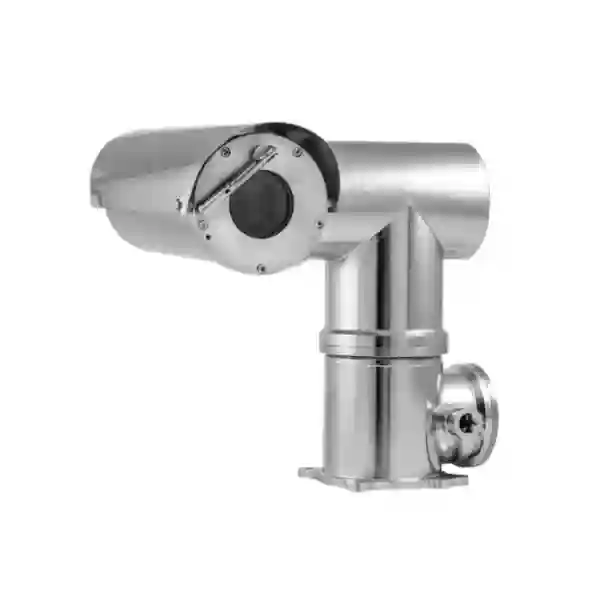
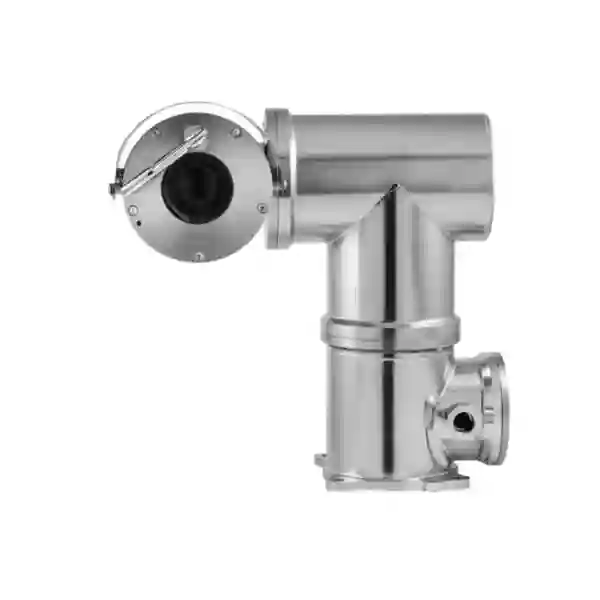
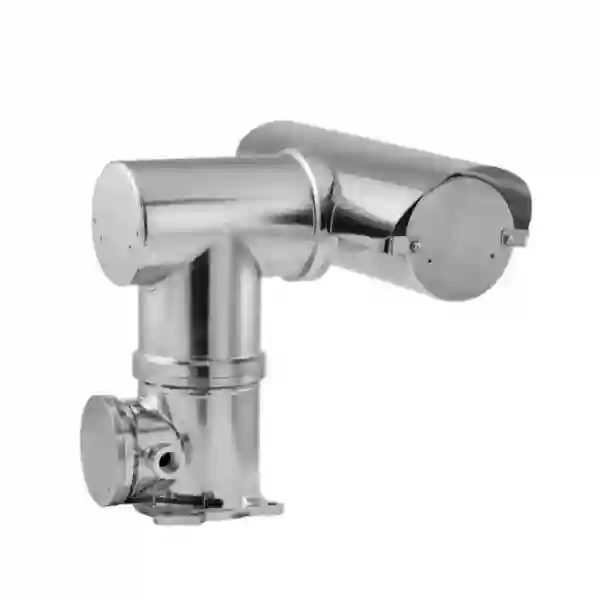
Hanwha TNU-X6320A1WT2-C Explosion-Protected PTZ Camera
For industrial CCTV projects where a conventional camera cannot simply be installed in a classified hazardous location, the Hanwha TNU-X6320A1WT2-C offers a specialist explosion-protected, remotely positionable network camera. It combines 2MP Full HD video, 32x optical zoom, a robust 316L stainless-steel enclosure, an integrated wiper and IP66/IP67 ingress protection. It uses 24VAC power and is designed to support controlled viewing of industrial equipment, perimeter approaches and operational activity. The exact hazardous-area certification must be checked against the site’s classification and the manufacturer documentation for this specific -C variant before selection or installation.
Before you request a quote
For a Tanzania project, begin with the site survey rather than the camera specification alone. Establish the classification of the mounting location, what operators must actually see, available power and network paths, the mounting structure, environmental exposure, recording policy and required approvals. FourTeck Tanzania can be approached for a project-specific quotation and compatibility review; price, local stock, delivery, installation services and warranty terms are subject to confirmation. The information below explains the camera’s verified capabilities, practical trade-offs and the questions worth resolving before procurement.
Technical specification at a glance
Use these details as a selection guide; confirm the latest exact-model documentation and certificates before engineering approval.
| Specification | Manufacturer-listed detail / purchasing note |
|---|---|
| Camera type | Explosion-protected IP positioning / PTZ camera |
| Manufacturer / exact model | Hanwha Vision / TNU-X6320A1WT2-C |
| Image output | 2MP Full HD, up to 1920 × 1080 |
| Lens and zoom | 4.44–142.6mm; 32× optical and 16× digital |
| Pan / tilt | 0–360° pan; -90° to +90° tilt |
| Day/night and WDR | ICR day/night; 120dB WDR |
| Compression | H.265, H.264, MJPEG; WiseStream II |
| Video stabilisation | Digital, with built-in gyro sensor |
| Edge recording | 2 microSD slots, up to 256GB each |
| Networking | 10/100BASE-T RJ-45; ONVIF Profiles S and G |
| Power | 24VAC; up to 80W stated maximum |
| Housing / cleaning | 316L stainless steel; integrated wiper |
| Ingress protection | IP66 and IP67 |
| Size / weight | Approx. 418 × 457 × 401mm; 33kg |
| Variant certification | -C designates cLC CSA; verify exact certificate |
| Ambient temperature | Manufacturer overview and table differ; verify exact limit |
A camera for the right industrial problem
The purpose of an explosion-protected PTZ camera is not merely to produce video in an outdoor area. The intended location may contain flammable gases or other hazards that require certified equipment, controlled cable entry and installation practices appropriate to the classified zone. At the same time, security personnel may need to examine valves, access routes, transfer points or equipment at different distances without sending someone into the area. This model addresses the video side with motorized positioning and optical zoom inside a purpose-built industrial housing.
It should be specified as one part of a broader safety and surveillance design. Camera selection does not replace site hazardous-area studies, electrical engineering, approved installation methods, emergency procedures or operational risk controls. A technically strong camera can still be the wrong purchase if its exact marking, ambient envelope, mounting arrangement or interfaces are unsuitable for the actual location. Buyers should make these checks before placing an order, particularly for projects with formally documented safety requirements.
Identify the exact -C configuration before ordering
Hanwha uses a family naming structure for its TNU-X6320A explosion-protected positioning cameras. Different members of that family can have different supply voltages, temperature designations, optical-fibre options and certification suffixes. The requested TNU-X6320A1WT2-C is the 24VAC, wiper-equipped T2 configuration with the -C designation associated with cLC CSA. It is important to preserve the complete suffix when preparing specifications, tender schedules and purchase orders.
Do not assume that a similarly named -Z, -M, F2 or 110VAC unit is interchangeable. Such variants may differ in their supported approvals, network media and electrical requirements. A substitution offered for commercial or logistical reasons should be independently reviewed by the project engineer against the same performance, environmental and compliance schedule. The exact model is more useful than a generic phrase such as “Hanwha explosion-proof PTZ” when requesting documents, confirming cable and power arrangements or comparing quotations.
What explosion-protected means in a project
Explosion-protected equipment is engineered for deployment under defined hazardous-area conditions; that description does not mean a camera can tolerate any explosion, nor that every hazardous environment automatically accepts it. The project needs to know the nature of the atmosphere, the classification method, equipment protection expectations, temperature class, ambient range and applicable local approval framework. The enclosure and certified cable-entry arrangements form part of the safety case, not a decorative protective shell.
Request the manufacturer certificate and installation instructions applicable to this part number, and have a qualified hazardous-area professional compare their markings with the site documentation. That review should include the complete equipment assembly, seals, glands, earthing and any accessory affecting installation. A product listed with an industrial certificate somewhere in a catalogue is not by itself evidence of acceptance for every Tanzanian facility. Treat certification matching as a formal engineering approval before construction or energisation.
Certification suffixes are not interchangeable
Hanwha’s published series information identifies cLC CSA, cLCus Class I/Division 1 and INMETRO as certification routes that depend on model. The final -C suffix identifies the cLC CSA variant rather than granting all possible family approvals automatically. The manufacturer’s overview may mention multiple series certificates together, so a buyer should examine the certificate for this exact configuration and its complete marking rather than infer coverage from a headline feature list.
For a project using a zone-based classification, ask how the accepted certificate and protection concept correspond to the installation drawings. For a division-based classification, follow the site’s separate requirements and do not assume this -C option carries a -Z designation. The purchasing team should keep certified documents within the project handover pack so installers, inspectors and maintenance staff can verify precisely which equipment was selected. Confirmation must be obtained from the appropriate competent parties, not inferred from marketing language.
Why the 316L stainless-steel construction matters
The camera enclosure uses electro-polished 316L stainless steel on its welded assemblies, a relevant material choice for installations exposed to industrial weather, humidity, salt-laden air or potentially corrosive conditions. Compared with a typical light commercial dome housing, the mechanical concept is directed toward difficult environments where the enclosure is central to reliable operation and protective design. The toughened-glass viewing window is another functional detail for industrial exposure.
However, stainless steel does not mean that every chemical environment is harmless. Review the actual atmosphere, potential cleaning agents, splash or spray exposure, galvanic interaction with supports and the expected maintenance regime. Fasteners, mounting hardware, conduit and glands may have different material requirements from the main housing. An otherwise suitable camera can deteriorate prematurely if its supporting installation is not matched to the location. A site-specific corrosion review is especially useful before committing to marine, coastal or process-plant installations.
Understand IP66 and IP67 correctly
Hanwha lists IP66/IP67 protection for the TNU-X6320A1WT2-C. These ingress-protection designations relate to dust and water test conditions, not to hazardous-area ignition protection, camera image quality or unlimited resistance to immersion. The rating is valuable when rain, spray, airborne dust and routine environmental exposure influence camera selection. It should be read alongside installation details, sealing systems and maintenance instructions rather than treated as a guarantee of protection under every possible condition.
The assembled system remains important: a correctly rated enclosure does not make poorly selected cable glands, damaged seals or unsuitable entries acceptable. Check whether your method of cleaning creates pressures or exposures outside the equipment’s intended envelope, and make sure access covers are closed in accordance with the manual. Confirm the IP ratings of any linked accessories independently. For buyers, the practical question is whether the entire installed arrangement preserves its protection over the planned maintenance life.
Integrated wiper: a practical visibility aid
An integrated wiper can be a valuable feature on an industrial PTZ camera, particularly when the viewing window is repeatedly exposed to rain or residue. Instead of relying only on operators to wait for conditions to improve, an approved cleaning sequence may help restore the image through the enclosure window. Hanwha identifies a wiper as part of this requested configuration. It complements the toughened-glass window and mechanical enclosure rather than replacing inspection and cleaning.
A wiper is not a universal answer for oil films, stubborn dust, chemical deposits or salt crusts. The site should establish what deposits are expected and whether a compatible washer system or manual cleaning procedure is necessary. Do not assume an optional washer tank is supplied with the camera; confirm any accessories separately. Operators also need clear rules for when to use the wiper and how to report a failed cleaning cycle, because dirty glass can undermine even a high-quality sensor and lens.
32x optical zoom and the viewing task
The 4.44–142.6mm lens provides 32x optical zoom, allowing a wide scene to be viewed and then narrowed onto a specific feature. This flexibility suits a camera overlooking a process yard, access route or equipment cluster where several surveillance tasks share a viewpoint. Optical magnification is more useful for distant detail than relying solely on digital cropping, but the actual result depends on target size, camera distance, lighting, vibration, air quality and recording settings.
Define the required view before installation: is the goal general observation, recognising an activity, reading a label or identifying a person? Those are different design problems. Use a field-of-view and pixel-density study where evidential detail matters. A narrow long-zoom view can exclude nearby activity while the operator examines one target, so the wider surveillance plan may still need fixed cameras. Avoid describing the 32x ratio as a promised identification distance because no such distance is universally valid.
Full HD video and frame-rate planning
This model delivers up to 1920 x 1080 video, commonly described as 2MP Full HD. The manufacturer’s specification lists up to 60/50 frames per second for H.265 or H.264, according to the 60Hz or 50Hz mode, with MJPEG limited to a lower maximum. Frame rate, codec, exposure and network settings interact, and the practical operating configuration should be proven during commissioning. Higher frame rates can help operators follow movement, but they generally increase recording and network requirements.
Full HD is not the same as high-resolution coverage of an entire large facility. When the lens is set wide, small distant objects may occupy only a few pixels. When zoomed in, the camera sacrifices scene width. Identify the evidence requirements and then test the camera against actual reference targets under normal and challenging lighting. Retain both broad situational coverage and detailed views where the security design requires them, rather than depending on one moving camera for all tasks.
Day/night performance and real illumination
Hanwha specifies automatic infrared-cut-filter day/night functionality and low-light sensitivity values for the camera module. The published figures include approximately 0.05 lux in colour and 0.005 lux in black and white under the manufacturer’s stated test conditions. These figures indicate capability under reduced illumination but do not guarantee usable evidence in every unlit industrial scene. Motion, shutter settings, fog, reflective surfaces and the difference between laboratory conditions and the installed scene all affect results.
The product description does not establish that an infrared illuminator is included, and the model should not be sold as a thermal camera. If a plant requires observation at night, plan appropriate scene lighting and test the target areas after dark. Lighting must itself be evaluated for the environment’s safety requirements. A camera can remain technically operational in low light while still failing a real-world task such as reading a sign or following rapid motion.
Managing backlight with 120dB WDR
The listed 120dB wide dynamic range is intended to help when bright and dark elements coexist, such as a shaded loading area viewed against a bright exterior or a doorway facing strong sunlight. Related image controls include backlight compensation and highlight compensation. These features can improve the balance of a challenging scene, although their visual effect should be judged against the specific installation and the event the operator needs to see.
No electronic exposure function can recover unlimited detail from smoke, glare, reflected sunlight or an obstructed viewing window. During commissioning, test representative daytime and night-time scenes rather than reviewing only a convenient demonstration image. Where necessary, alter the mounting angle or adjust lighting to avoid persistent glare. The goal is dependable operational detail, not simply a camera specification with a high dynamic-range number.
Gyro-assisted digital stabilisation
A built-in gyro sensor supports digital image stabilisation, which can be useful when the mounting structure experiences modest vibration. This matters for long-lens views because small movement can become much more noticeable when the lens is zoomed toward distant equipment. Stabilisation is a support function, not a substitute for a rigid pole, properly engineered bracket or structural review. Severe vibration can still affect image usefulness, positioning and equipment longevity.
Specify the mounting surface with the full camera weight and local environmental loads in mind. Consider machinery vibration, access-platform movement and wind-induced oscillation. Test both wide and telephoto views during acceptance because weaknesses that are invisible at wide angle may be evident at maximum optical zoom. If the proposed structure is unsuitable, improving the support is usually more dependable than expecting digital correction to compensate indefinitely.
PTZ movement and operator coverage
The manufacturer’s specification gives a 0–360 degree pan range and a -90 to +90 degree tilt range, with preset movement speeds up to 45 degrees per second for pan and 24 degrees per second for tilt. These values describe positioning capability, not the effective area that can be monitored simultaneously. A PTZ camera can look at one direction at a time, and its usefulness depends on presets, operator decisions, clear sight lines and how quickly it can reach an area of interest.
Prepare a sightline drawing showing potential obstructions from tanks, gantries, pipes and structures. Define priority views, alarm-driven positions and the expected procedure when two incidents occur at different locations. Establish whether the control room needs manual control, scheduled tours or event-triggered handover, and verify these functions with the chosen management software. Preset positions should be tested for framing and repeatability after the final mount is secured.
Built-in video analytics: where they help
Hanwha lists analytical events such as motion, tampering, fog, shock, face detection and rule-based virtual lines and areas. A properly chosen rule can direct attention toward a gate, crossing line or restricted area without requiring constant manual watching of the entire feed. It is important to describe these as manufacturer-listed analytical functions rather than claim an advanced AI classification system that has not been verified for this model.
Analytics depend on perspective, target size, environmental conditions, scene movement and configuration. In a busy industrial area, vapour, shadows, wildlife or moving equipment can create unwanted alerts. Agree on the operational purpose of every rule, then assess false alerts and missed events during a representative trial. The intent is useful operator assistance, not autonomous hazard detection or a guaranteed safety shutdown function. Safety-critical logic must stay within properly engineered control and protection systems.
Event workflows and useful alarm design
The camera supports events that can lead to notifications, uploads, recording actions and PTZ preset handover under supported configurations. Such options are more useful when a clear response procedure exists. For example, a virtual line at an approach route might prompt an operator to inspect a preset view and determine whether the situation needs escalation. The configured action should match the purpose of the control room, data retention rules and available communication paths.
Avoid creating many loosely defined alerts that operators stop trusting. Record why each event matters, who receives it and what happens if the network is unavailable. Check whether an alarm should initiate video bookmarking, local recording, a message to the video management platform or another approved action. Test end-to-end behaviour, including time synchronisation and recovery after an interruption. Do not equate an event notification with confirmed intrusion detection or a personnel safety system.
H.265, H.264 and bandwidth decisions
The camera supports H.265, H.264 and MJPEG video compression, together with Hanwha’s WiseStream II. These options allow system designers to balance image quality, bandwidth and storage consumption. H.265 can be attractive for bandwidth-conscious deployments, while H.264 remains useful where established recording or viewing systems have specific codec support. The best codec is the one that provides acceptable visual evidence through the entire selected network and recording chain.
Actual bandwidth varies with frame rate, resolution, movement, noise, compression settings and scene complexity. Do not calculate a project’s total network demand using an unverified single fixed bitrate from a product title. Ask the system designer to evaluate busy and quiet scenes, concurrent viewer demand, recording profiles and uplink capacity. Codec compatibility should be checked at the recorder, browser, VMS and any remote display before finalising settings.
Practical storage and retention planning
The published specification identifies two microSD/SDHC/SDXC slots, up to 256GB each, for a maximum combined 512GB of supported edge storage. Edge recording can assist with local event capture or a considered resilience design, but it does not automatically provide a complete enterprise archive. Retention duration depends heavily on the selected profile, actual scene bitrate, recording schedule and whether storage is used continuously or only for events.
Determine how long footage must be kept, who can retrieve it, how it is protected and what happens when capacity is full. A site may require a central NVR, VMS or NAS arrangement in addition to camera-level recording. Local cards should be approved for the camera and assessed for endurance and environmental suitability. During acceptance, confirm playback, export, timestamp integrity, recording after a restart and any intended failover process. Never substitute the storage-capacity figure for an evidence-retention calculation.
Network connectivity and architecture
The standard published network interface is 10/100BASE-T Ethernet over RJ-45; the broader product family also has certain F2 fibre variants. The requested suffix does not establish that an F2 fibre module is fitted. If the project expects a fibre connection, specify and verify the exact variant or a separately engineered networking arrangement. Network topology matters particularly in industrial facilities with long runs, outdoor transitions, control-room segmentation and electromagnetic interference.
Plan routing, permissible cable lengths, switching, surge protection and the boundary between hazardous and non-hazardous installation areas. Network design should consider latency for PTZ control and usable video, not only whether a link comes up. A resilient path and monitoring strategy may be appropriate for critical surveillance, but those are system decisions rather than built-in guarantees. Document IP addressing, time sources, uplink capacity and approved remote-access routes as part of commissioning.
Video management and ONVIF integration
Hanwha lists ONVIF Profiles S and G, SUNAPI and its camera platform interfaces in the model’s network details. These capabilities may help integration with suitable third-party video systems, but a published protocol does not prove that every recorder supports every PTZ, analytics or edge-storage feature. Profiles indicate classes of interoperability, while software versions and vendors determine the exact supported functions.
Before purchase, provide the VMS or NVR make, model and software version for compatibility checking. Test live view, optical zoom, pan and tilt, presets, recording, event handling, time synchronisation and export. Clarify whether the control room requires desktop, web or mobile viewing and which connections are permitted under the site’s cybersecurity policy. If a specialised function is critical, require a demonstration with the specific device and platform instead of relying on a general “ONVIF compatible” statement.
Cybersecurity must be part of the design
The manufacturer identifies security capabilities including HTTPS, SRTP, network authentication through IEEE 802.1X options, IP-based access control and log management. These are useful building blocks for a managed CCTV network, but security depends on configuration and ongoing administration. The team must avoid leaving factory credentials, broadly reachable management interfaces or unnecessary services in place. Industrial surveillance often connects to facilities where operational continuity and access control deserve particular attention.
Agree on account ownership, unique credentials, least-privilege roles, firmware governance, logging, backup configuration and an approved patch process. Separate camera traffic from unrelated business or control networks where the site architecture requires it. Confirm who may control PTZ movement and who may export recordings. Keep changes traceable and test recovery after configuration errors. Security controls should be written into the acceptance checklist and maintenance contract rather than handled only after the camera is commissioned.
24VAC supply and electrical coordination
This precise configuration uses 24VAC power. Hanwha’s detailed specification lists maximum consumption of 80W. That makes the supply design a first-order buying issue: the unit should not be represented as a standard PoE camera. The engineering team needs an appropriate, approved 24VAC source with sufficient capacity and allowance for cable loss, starting conditions and connected components. The supply arrangement must also meet the protection and isolation requirements of the hazardous installation.
Confirm available voltage at the proposed camera location under load, transformer or supply suitability, protective devices and any continuity requirement. Where surveillance must remain available during an outage, the wider power architecture may need backed-up supply equipment; such equipment is not implied to be included with the camera. Qualified electrical personnel should review terminations, earthing and local installation practices. A mismatch in voltage or wiring is a procurement and safety risk that should be eliminated in the design stage.
Weight, dimensions and structural support
The listed mechanical dimensions are approximately 418 x 457 x 401mm, with a product weight of approximately 33kg. This is a substantial industrial assembly, not a lightweight plastic dome. The mounting support needs to be assessed for the camera and its chosen accessories, including maintenance access and environmental loading. The camera’s viewing objective may demand height or offset, but the best optical position is not always the best structural position.
Ask for mounting drawings and verify bolt patterns, clearances, bracket suitability and the final installation envelope. Consider lifting and handling arrangements before scheduling work. Confirm there is enough space to service entries and access the enclosure according to the manufacturer instructions. The installation plan should address working at height, isolation requirements and any permit conditions. A sound support structure protects both the picture and the long-term integrity of the installed equipment.
Cable entries, sealing and workmanship
Hanwha’s series description highlights cable-entry arrangements designed to support industrial conduit installations. The exact entry details, suitable glands and any blanking elements should be checked against the current manual and approved drawing for TNU-X6320A1WT2-C. Cable termination is not simply an IT task in a hazardous-area installation: entry systems and assembly workmanship can affect the equipment’s approved protection concept.
Use competent installers familiar with the facility’s classification, permit-to-work rules and inspection requirements. Verify that the selected cables meet electrical, network, environmental and mechanical needs. Plan service loops, strain relief, weather protection and identification so future work can be undertaken safely. Do not substitute general-purpose glands because they appear physically to fit. Keep installation records, inspection results and changes to the certified arrangement in the handover documentation.
Ambient conditions and the rating discrepancy
The model’s T2 designation refers to the family’s low-temperature configuration. Hanwha’s product overview gives an operating range of -60°C to +40°C, while another environmental table on the same manufacturer page lists -60°C to +60°C. These published figures are not fully aligned. For procurement, the correct approach is to obtain the current exact-model datasheet, applicable certificate and manufacturer clarification before specifying a maximum ambient temperature or accepting a design at the boundary.
Tanzania installations are unlikely to need the extreme low-temperature end in ordinary conditions, but the upper ambient limit, direct solar exposure and local microclimate can still matter. Check the heat around machinery, enclosures and nearby surfaces as well as general weather. A certified ambient range is not interchangeable with a generic electronics operating range. Do not approve a site on the basis of the more generous number without verifying which limit governs this exact configuration.
Tanzania industrial and coastal deployment considerations
A Tanzania-focused evaluation should begin with the proposed facility and environmental exposures, not an unsupported promise that the product is stocked or approved locally. Possible projects include industrial processing, energy operations, marine-related infrastructure and facilities where a hazard study demands specialised camera equipment. These are application examples rather than claims about specific customers, service territories or completed installations.
For sites with persistent rain, heat, wind, airborne particles or salt exposure, examine mounting, sealing, maintenance and visibility over a full operational cycle. For remote facilities, test the availability of network backhaul, power continuity and qualified maintenance access. Determine who approves the equipment and which project standards apply. Before buying, request a written confirmation of commercial availability, shipping, documentation and installation responsibilities. No Tanzania-specific certification, customs status, price or service coverage should be assumed from an overseas product listing.
Control-room workflows and camera ownership
A PTZ system is most effective when operational teams agree how it will be used. Decide whether the camera supports routine inspection, perimeter verification, incident assessment or a combination of those functions. Assign ownership for presets, camera tours, event responses and the decision to interrupt routine monitoring. This avoids a common practical failure in which a technically capable unit is installed but there is no agreed method for using its moving view.
Create a simple operating plan showing normal views, high-priority targets and the response to concurrent requests. Staff should know how to return the unit to a default position after investigation. Monitor image quality, network status and recording health, and provide a route for reporting mechanical or optical issues. Where procedures depend on CCTV evidence, use fixed coverage or overlapping positions to reduce the gaps caused when a PTZ camera points away from an area.
Privacy, permissions and evidence handling
Industrial cameras may record employees, visitors, contractors and public-facing approaches. The project should evaluate applicable policies and legal requirements for the actual premises before choosing fields of view, retention periods and user access. The camera includes privacy masking options, but a masking feature alone does not establish that the deployment is lawful or appropriately governed. Select viewing areas that serve the defined operational and security purposes.
Document who can view live footage, move the camera, review archives and share exports. Keep evidence access auditable and protect stored data through the chosen recorder and network architecture. If a surveillance zone changes, reassess masking and permissions. Site communication, signage and internal processes may be relevant depending on the circumstances. A controlled evidence workflow is just as important as picture quality when video may later be used to investigate an incident.
Maintenance planning for long-term performance
The camera’s specialist enclosure and motorised components merit a planned inspection regime. Tasks may include checking external condition, cleaning the viewing window using approved methods, assessing the wiper, looking for corrosion at fixings, checking mounting integrity and reviewing alarms or system logs. Any opening, inspection or repair must follow the hazardous-area safety procedures and manufacturer instructions. Maintenance should not compromise seals or replace certified parts with unapproved substitutes.
Coordinate the inspection schedule with site shutdowns, access restrictions and environmental exposure. Check whether the camera returns reliably to presets, whether images are still sharp at maximum zoom and whether recording and time settings remain correct. Include a process for firmware evaluation and configuration backup. A clear maintenance plan reduces the risk of discovering an unusable image only when footage is urgently required.
How to compare it with a conventional PTZ
A conventional commercial PTZ may offer different resolutions, zoom ranges or a smaller physical footprint at a different cost. Those comparisons are relevant only after identifying whether the proposed camera location is a classified hazardous area. If certified explosion protection is required, an unapproved ordinary PTZ is not an equivalent just because its image specifications are similar. The appropriate comparison set starts with devices having suitable markings and environmental performance.
Within that set, evaluate lens coverage, actual image detail, power, network media, enclosure material, wiper functions, installation burden, software compatibility and documentary requirements. Consider whether the surveillance objective is better met by one PTZ plus fixed cameras than by a single moving viewpoint. Compare complete installed system cost rather than unit price alone. The best choice is the one that satisfies the site’s protection requirements and measurable surveillance tasks together.
Optical PTZ is not a thermal or gas detector
The TNU-X6320A1WT2-C is a visible-light network camera with day/night capability. Its Full HD imaging, WDR, zoom and listed analytics may assist security and operational observation, but the product is not presented as a dedicated thermal imager, combustible-gas sensor, flame detector or certified process safety instrument. This distinction prevents unsuitable substitution in critical facility designs.
If the project requires temperature measurement, flame detection or automatic process protection, specify those functions separately with the necessary approvals and performance requirements. Do not assume a motion event or face-detection function can detect a process hazard. A surveillance camera may supply useful visual context to authorised personnel while specialised safety systems perform their own functions. Combining the systems can be an engineering decision, not a capability implied by the camera model number.
Tender documentation and selection checklist
A good request for quotation should specify the complete manufacturer model and variant, the intended hazardous-area classification, the installation environment and the business purpose of each camera. Include the number of units, mounting position, relevant drawings, supply voltage, expected video quality, recording platform and network connectivity. Ask bidders to identify deviations and any optional items rather than allowing assumptions to enter the tender.
The technical schedule should request current datasheets, matching certification documentation, installation manual, interface and electrical details, recommended accessories and a proposed integration approach. Commercial questions should cover itemised pricing, lead time, shipping, local support arrangements and warranty terms, all confirmed in writing. This process makes it easier to compare compliant offers fairly and prevents a quotation for a similar-looking model from being mistaken for the exact required equipment.
Factory and site acceptance tests
Acceptance criteria should be agreed before commissioning. Start by confirming the nameplate and supplied documents match the ordered model and certification requirements. Inspect the physical enclosure, mounting, cable entries and relevant electrical installation records. Functional tests should then address live video, lens zoom, PTZ positioning, preset recovery, day/night operation, wiper movement, the intended codec and local or central recording.
Run tests in representative site conditions rather than relying entirely on a clean workshop image. Check difficult backlit scenes, long-zoom vibration, operator control latency and the timing of event notifications. Confirm what happens after power and network interruption and whether authorised staff can retrieve an export with reliable timestamps. Record failures and retest after corrective action. A signed acceptance record provides a clear boundary between product capability, integrator responsibility and ongoing maintenance.
Budgeting beyond the camera price
An industrial explosion-protected camera may require specialist brackets, certified entry components, power supplies, network infrastructure, appropriate lifting equipment and qualified installation labour. These items can materially change the deployed cost. Depending on the site, engineering documentation, testing, access permits and planned maintenance may be as important to the budget as the camera itself. An incomplete quote can appear attractive while leaving essential elements outside scope.
Ask for a bill of materials and services separating the camera, accessories, engineering, installation, commissioning, software and ongoing support. Clarify exclusions such as civil works, cable routes, network switches, storage hardware and travel. Avoid publishing an unverified local price or converting overseas dealer pricing into a Tanzanian selling price. A dependable budget is built on the actual installation method and procurement terms, not a generic catalogue figure.
What to send with a FourTeck Tanzania enquiry
A useful enquiry identifies the complete TNU-X6320A1WT2-C model, intended quantity and approximate installation scenario. Include site classification documents where sharing is authorised, environmental conditions, camera distances, available 24VAC supply, preferred network media and the intended recorder or VMS. Explain whether the application is operational viewing, perimeter security, incident assessment or another defined purpose. This allows a technical discussion about suitability rather than only a product-code price request.
Request confirmation of the exact variant, current product availability for the intended market, required approvals, compatible accessories and any manufacturer clarification needed about the upper temperature limit. Ask for a written quotation that separately identifies optional items and services. Do not share confidential facility plans through an unverified channel. FourTeck Tanzania can be contacted for a project-specific product enquiry; no price, stock, delivery date or guaranteed technical service scope is stated on this page.
Frequently asked questions
Is the Hanwha TNU-X6320A1WT2-C an ordinary outdoor PTZ camera?
No. It is a specialist explosion-protected positioning camera intended for appropriately designed hazardous-area installations. Its IP66/IP67 rating also describes ingress protection, but waterproofing and explosion protection are different engineering considerations. A buyer should obtain the exact variant’s certificate and installation manual and compare them with the site’s classification. The use of an industrial enclosure does not make the equipment universally suitable for every gas, dust or ambient condition. If the project only needs a general outdoor camera in an unclassified area, evaluate whether a conventional PTZ could satisfy the video requirements more economically.
Does the camera produce 4K video?
No. The published maximum video resolution for this model is 1920 x 1080, commonly called Full HD or 2MP. It supports a 32x optical zoom lens for changing the field of view, but optical magnification does not turn the sensor into a 4K camera. For a project requiring fine evidence over a large scene, assess pixel density at the required distance and consider supplementary viewpoints. Actual evidence quality also depends on exposure, motion, compression and the quality of the recording chain, not simply the resolution printed on the specification sheet.
Does the model include a wiper?
Yes. The exact model includes an integrated wiper as listed by Hanwha Vision. It helps address water or residue on the viewing window but should not be treated as a substitute for appropriate cleaning and inspection. If a washer tank or other accessory is required, confirm that it is compatible and separately included in the quoted package. Establish a maintenance procedure appropriate to the site’s atmosphere and manufacturer guidance. An integrated wiper improves the range of operational cleaning options; it does not guarantee a clear window in every industrial exposure.
Can it run from a PoE network switch?
The specified TNU-X6320A1WT2-C requires 24VAC power, and the published maximum consumption is 80W. Do not assume an ordinary PoE port can supply it. Arrange an engineering review of supply capacity, voltage drop, approved wiring and the electrical requirements of the hazardous installation. Ethernet provides data connectivity, while the camera’s power requirement is a separate design consideration. If a proposed installation has only PoE available, resolve the supply architecture before purchasing rather than expecting a standard network switch to solve the power requirement automatically.
Does this -C version include optical fibre?
The standard network specification includes RJ-45 Ethernet. Hanwha describes an optional single-mode fibre implementation for designated F2 models in the wider series. The exact TNU-X6320A1WT2-C identifier does not specify F2 fibre. Where the project requires optical fibre for distance or network architecture, ask the supplier to confirm an appropriate product configuration and approved installation solution. Do not infer that all versions in the same family share the same physical interfaces. Compatibility with the site network should be established through a documented equipment schedule.
Will it work with an existing NVR or VMS?
It may integrate with suitably compatible systems through supported interfaces including ONVIF Profiles S and G, but full function compatibility depends on the recorder, VMS version and integration method. Ask the system vendor to verify live viewing, recording, PTZ control, presets, analytics and export behaviour for the exact combination. A basic ONVIF connection does not automatically expose every manufacturer-specific function. For high-consequence sites, test the combination before acceptance and document software and firmware versions. The project should also validate time synchronisation and network security.
How much video can the camera store internally?
Hanwha lists two microSD/SDHC/SDXC card slots supporting up to 256GB per slot, for a total of up to 512GB. That capacity is not a fixed number of days of recording. Retention depends on codec, configured bitrate, motion in the scene, frame rate, resolution and recording schedule. Choose suitable supported media and verify recording and playback during commissioning. For formal evidence retention, consider the wider NVR, VMS or storage design and the site’s policies. Edge storage is a capability, not a replacement for a properly specified archive.
Can it detect gas leaks or measure equipment temperature?
No such capability is established for this visible-light PTZ model. It is not offered here as a thermal imaging camera, gas detector or safety-instrumented device. Its image and supported analytics may provide useful visual information, but hazardous-process monitoring must use equipment and systems designed and approved for those functions. Security teams should avoid using a camera’s motion or event features as a substitute for dedicated hazard detection. If the project needs multiple functions, specify the required sensing systems independently and develop the interfaces under the site’s engineering process.
What ambient temperature range should be used?
This detail needs exact-model clarification. Hanwha’s product overview lists -60°C to +40°C, while a detailed environmental table lists -60°C to +60°C. Because the published information is inconsistent, do not choose the higher upper limit without checking the latest certificate and receiving manufacturer confirmation. The site engineer should also assess solar heating and local industrial conditions. The project’s final approved ambient range should be recorded in its equipment schedule. The range quoted for a different family configuration must not be copied to this model without validation.
Is the camera available in Tanzania with a local warranty?
Availability, quotation pricing, lead time, import arrangements, installation services and warranty terms have not been verified for the target listing. They should be requested and confirmed in writing for the exact model and planned destination. Hanwha notes that regional product availability can vary. Before ordering, check whether the supplied certificate and documentation satisfy the project’s requirements and who will provide technical assistance, repairs and spare parts. This page does not promise an in-country stock position, delivery time or local manufacturer authorisation.
How should a project choose a mounting point?
Begin with the classified-area plan and the operational viewing objective. Check whether the proposed height and orientation provide clear sight lines across tanks, piping and structures, and whether long-zoom vibration is acceptable. Then confirm structural support for the approximately 33kg camera and any approved accessories, plus safe maintenance access. The mounting design should account for the site’s environmental and safety requirements, cable entries and power provision. A location selected only for its broad view may later prove unsuitable for servicing, protection compliance or stable evidence-quality imagery.
What information is needed to request a quote?
Supply the full model number, quantity, site environment, hazardous-area classification, power availability, network requirements, desired zoom distances and recording system. State whether approved brackets, washer accessories, certified entry components or engineering services are expected in the scope. Request the current manufacturer documents and exact variant certificate for technical review. If the site has procurement deadlines, ask for a quoted lead time rather than relying on an advertised figure. A complete enquiry makes it easier to identify omissions and evaluate whether the supplied configuration is appropriate.
Request a project-specific Hanwha camera quotation
For a Tanzania industrial surveillance enquiry, specify Hanwha TNU-X6320A1WT2-C and share the installation requirements through an approved contact channel. Request the exact certification documents, confirmation of suitability, compatible accessories and written commercial terms. Supply, stock, delivery, warranty and installation scope must be confirmed for the project; no local commercial guarantee is implied.
Contact FourTeck Tanzania for a tailored quotation and technical review.




Reviews
There are no reviews yet.