
Industrial security • Tanzania buying guide
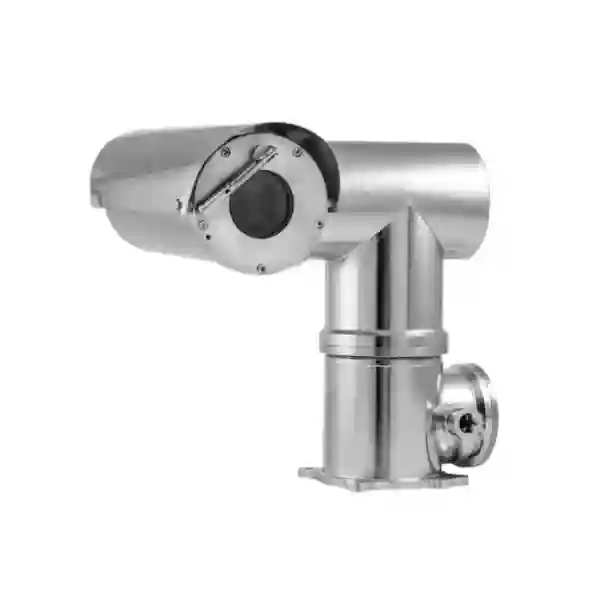
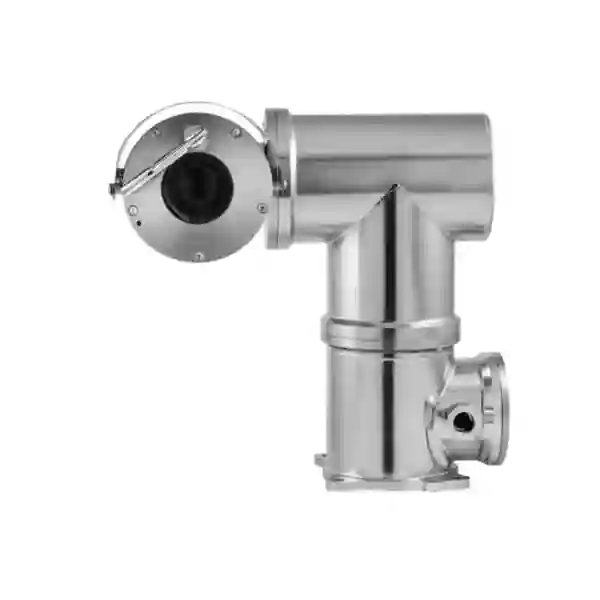
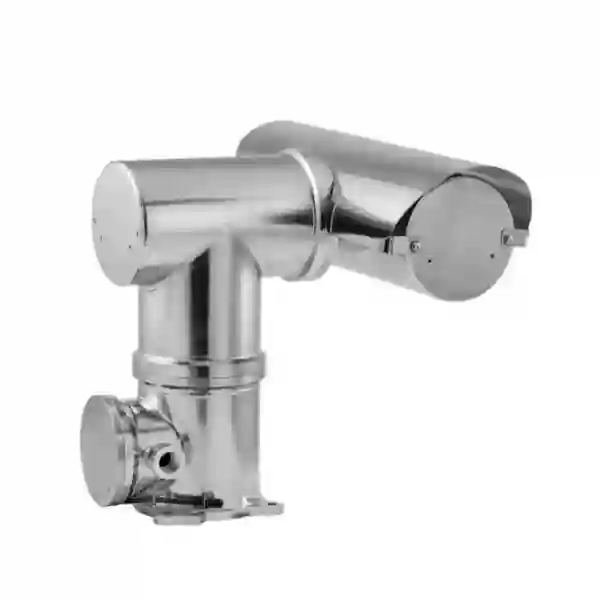
Hanwha Vision TNU-X6320A2F2WT1-M Explosion-Proof PTZ Camera
2MP Full HD positioning camera with 32× optical zoom, single-mode fibre networking, integrated wiper, 316L stainless-steel construction and a 110V AC input. Designed for project-by-project evaluation in industrial hazardous-area surveillance.
Before ordering in Tanzania, verify certification suitability, approved installation methods, power compatibility and the complete system design.
At a glance: verified exact-model specifications
| Video | 2MP, 1920 × 1080; H.265, H.264 and MJPEG |
|---|---|
| Lens | 4.44–142.6mm; 32× optical and 16× digital zoom |
| Movement | 360° pan; −90° to +90° tilt |
| Imaging | Day/night ICR, 120dB WDR, gyro-assisted digital stabilisation |
| Networking | Duplex single-mode 9/125µm fibre module; 10/100Mb Ethernet |
| Enclosure | Electro-polished 316L stainless steel; toughened-glass window; wiper |
| Environment | IP66/IP67; −40°C to +60°C operating temperature |
| Electrical | 110V AC input; maximum 80W |
| Memory | Two microSD/SDHC/SDXC slots, up to 256GB each |
| Dimensions and mass | 418 × 457 × 401mm; approximately 33kg |
| Certification selection | -M: INMETRO variant; verify exact certificate and local acceptance |
Published specifications describe the camera itself, not guaranteed recognition distance, local stock, regional approval or installation performance. Review current manufacturer documents before construction.
Who should consider this model?
When security coverage must extend into a hazardous industrial zone, selecting a camera is not simply a matter of choosing resolution and zoom. The equipment must fit the site’s assessed atmosphere, electrical design, communications route and maintenance plan. The Hanwha TNU-X6320A2F2WT1-M brings an explosion-protected positioning camera station together with Full HD imaging, strong optical reach, single-mode fibre communications and a built-in wiper. It is a candidate for engineered projects where ordinary commercial PTZ housings may be inappropriate.
For buyers in Tanzania, the first purchasing decision is whether the exact -M configuration is acceptable for the classified area and whether its 110V AC requirement can be accommodated safely. The product’s published INMETRO and other listed certifications do not, by themselves, establish approval for a particular Tanzanian installation. Request a technical assessment with your hazardous-area documentation, power information, fibre design and required monitoring distances before finalising a quotation.
Start with the monitoring problem, not only the camera model
Industrial video projects often begin with a broad request to watch a process unit, loading area, transfer point or remote perimeter. A more useful brief identifies what operators must see, how quickly they need to reposition the view, whether the scene is illuminated and what may obstruct the lens. The TNU-X6320A2F2WT1-M offers a moving visible-light view and long optical zoom, but it is not a substitute for specifying the task. Detection of a person at a distant gate, checking a valve position and documenting a vehicle event can require different framing and evidence quality.
Define camera-to-target distances, target size in the recorded image, mounting elevation, expected movement, lighting variations and operational response. Include whether the video is viewed continuously or investigated after an incident. With this information, an integrator can assess whether 2MP resolution and 32× optical zoom give enough useful pixels for the actual scene. The camera can then be evaluated as one component in a complete surveillance system, rather than treating its headline specifications as a guarantee of identification or process visibility.
Understand the explosion-protected equipment category
An explosion-protected camera station is intended for sites where equipment selection must consider potentially flammable gases, vapours or dust. Ordinary weatherproof cameras are not automatically suitable for such environments. The Hanwha unit is part of the TNU-X6320A positioning series described for hazardous-area industrial, offshore, marine and onshore applications. Its construction and product certification information matter because electrical and mechanical equipment in a classified location must be assessed against the specific installation conditions.
The term explosion-proof should not be read as permission to install this model in every hazardous location. Protection concepts, gas or dust groups, temperature classes, installation methods and equipment certificate conditions can differ. A site’s responsible electrical and safety professionals should compare the exact supplied model’s markings and certificate documents with the area classification and applicable local requirements. If those details do not match, select a different certified configuration or revise the engineered solution rather than relying on the general product family description.
Why the exact -M suffix matters
The full model designation distinguishes this product from closely related Hanwha variants that may share the same optical camera. The TNU-X6320A2F2WT1-M is the 110V AC, single-mode-fibre, wiper-equipped configuration associated with the -40°C operating-temperature class and the -M certification variant. It should not be confused with 24V AC models or with suffixes representing different certification selections. Two units that look alike in a catalogue can impose substantially different demands on the power and compliance package.
Put the entire model string on drawings, equipment schedules, purchase requests and commissioning records. Ask for an exact-model quotation and certification package, not a quotation covering only the TNU-X6320A family. The manufacturer notes that product availability varies by region, so the part number appearing in a global catalogue does not establish stock or availability in Tanzania. Confirm the complete ordered configuration and any accessories in writing before the procurement team issues an order.
Full HD image detail for industrial evidence
The camera provides up to 1920 × 1080 output resolution, commonly described as 2MP Full HD. This delivers a useful overview of machinery, vehicles or work areas when the field of view is selected carefully. It can also support reviewing visible changes between events, subject to scene conditions and recording quality. Resolution alone cannot guarantee that small lettering, a distant face or a number plate will be legible. Those outcomes depend on lens position, angle, distance, light, motion and the pixels allocated to the subject.
Use sample views or a documented pixel-density assessment when an image must support a defined task. Ask whether operators need to detect movement, recognise a vehicle type, observe a process or identify a specific detail. These objectives are not interchangeable. A higher zoom setting narrows coverage, while a wide view preserves context but allocates fewer pixels to distant targets. Define acceptable evidence at both extremes, especially where a single camera is expected to serve several operational teams.
What 32× optical zoom actually helps you do
Hanwha specifies a 4.44–142.6mm lens with 32× optical zoom and an additional 16× digital zoom. Optical zoom changes focal length to enlarge distant subjects without relying on digital enlargement alone. For a wide industrial site, it can allow a control-room operator to start with broad context and then inspect a selected area. The manufacturer lists an approximate horizontal viewing-angle change from 64.44 degrees at wide to 2.29 degrees at telephoto, illustrating how much the scene narrows at maximum reach.
Plan zoom around monitoring priorities rather than expecting one position to show everything simultaneously. At high magnification, wind-driven movement, mounting vibration, atmospheric haze and focus changes become more apparent. Digital zoom can help enlarge the display but does not restore detail missing from the underlying sensor image. If operators need continuous awareness of several distant points, a set of fixed cameras or multiple PTZ stations may be more appropriate than relying on one operator-controlled zoom view.
Pan, tilt and positioning coverage
This model has a full 360-degree pan range and a tilt range stated as −90 to +90 degrees. Hanwha specifies maximum preset movement speeds of 45 degrees per second for pan and 24 degrees per second for tilt. These figures support rapid changes between defined views, but they do not establish that the camera is always looking at the right point when an event begins. Operators must consider travel time, obstacles and the possibility that another area becomes unwatched during repositioning.
Create useful preset positions around genuine operational tasks such as entry points, loading interfaces, process equipment and access routes. Review the mechanical field of movement against nearby pipes, structural steel, cable runs and any mounted accessories. A camera can have impressive nominal movement specifications yet still suffer blind spots because of its physical placement. Test the actual installed view rather than treating a digital drawing or laboratory specification as a guarantee of line-of-sight.
Day and night operation without overpromising
The TNU-X6320A2F2WT1-M uses a day/night imaging system with an infrared-cut filter mechanism. The manufacturer lists low-light sensitivity figures of 0.05 lux in colour and 0.005 lux in black-and-white under specified test conditions. This describes visible-light camera sensitivity; it does not make the device a thermal imager and does not mean every unlit industrial scene will produce usable evidence. Reflections, glare, mist, moving targets and insufficient illumination can still compromise interpretation.
Ask the project team to document normal, emergency and night-shift lighting conditions. If the scene becomes dark when plant lighting is shut down, evaluate a compliant illumination strategy separately. Any lights or other electrical equipment installed in a hazardous zone require their own appropriate engineering and approval. For evidence-critical applications, agree on expected shutter settings, target movement and exposure before handover. Test during the hours and operating conditions when the footage will actually be needed.
Manage strong contrasts with 120dB WDR
Industrial scenes frequently include bright floodlights, welding glare, reflective metal, doorways opening onto sunlight and equipment under deep shade. Hanwha specifies 120dB wide dynamic range, alongside backlight and highlight compensation controls. These functions help the camera balance areas with different illumination levels, but they cannot guarantee perfect exposure in every backlit or rapidly changing scene. A field test remains important when a critical target is next to a bright source.
During commissioning, compare the wide dynamic range setting with the actual tasks. A setting that makes one access door easier to view may alter noise, contrast or motion rendition elsewhere. Establish whether operators need to see an object silhouette, read a label or verify a person’s movement. Avoid positioning the camera directly toward recurring glare if a better mounting angle is available. Good lighting geometry is often more reliable than depending entirely on image-processing features.
Stabilisation for exposed structures
The camera includes digital image stabilisation supported by a built-in gyro sensor. This can help reduce visible effects of motion, an especially relevant consideration for elevated mounts exposed to wind or mechanical vibration. Stabilisation is an image feature, not a replacement for a correctly designed bracket, rigid supporting structure or vibration assessment. Persistent motion may still affect framing and captured detail, particularly when the camera is using its narrowest telephoto field of view.
The project should evaluate potential vibration sources such as pumps, cranes, fans, heavy traffic and flexible towers. Confirm mounting load and structural stiffness with the relevant designer. A practical acceptance test should include zoomed footage while normal plant operations are underway. If movement is unacceptable, revise the mechanical arrangement before relying on software compensation. Keeping the camera steady improves the consistency of presets and supports clearer comparison of recorded views over time.
Defog processing and visibility limitations
Hanwha lists defog support for the camera, which may help adjust image contrast under certain reduced-visibility conditions. This matters in outdoor facilities where humidity, haze or light mist can soften visible features. Defog is image processing; it does not allow a visible-light camera to see through dense smoke, opaque obstructions or heavy fog as though the air were clear. It should be evaluated against actual scene footage rather than treated as a safety instrument.
At the design stage, ask which weather conditions must be tolerated and what action operators should take when the camera cannot deliver a useful image. Supplementary sensing or a different camera technology may be needed for tasks that cannot be interrupted. Compare sample images at different zoom levels because atmospheric distortion can become more obvious when viewing distant objects. The right answer may be adjusting camera location or adding overlapping views, not simply selecting a stronger image enhancement setting.
Integrated wiper for exposed glazing
The product has an integrated wiper across the camera window. This can assist maintenance of an unobstructed view when rain or surface moisture affects the glazing. The window is described as toughened glass, and the wiper is a built-in feature of the specified model rather than something the buyer must assume is present on every variant. Wiping can help with some surface contamination but cannot replace scheduled cleaning, inspection or appropriate protective design where substances accumulate.
Assess likely deposits such as sea spray, airborne dust, oily residue and process splashes. Their behaviour on the glass may differ from ordinary rainwater, and a dry or heavily contaminated window can require a different maintenance procedure. Hanwha identifies a washer tank as an optional accessory for the series, but its exact suitability and supply must be confirmed. Include safe access to the camera in the maintenance plan; a wiper alone does not eliminate the need to inspect the window and mechanism.
IP66 and IP67 protection in context
Hanwha lists IP66 and IP67 ratings for this model, indicating enclosure protection tested under defined ingress conditions. These ratings can be relevant for exposed industrial installations, but they are not a blanket statement that any completed installation will resist every environmental challenge. Cable entries, seals, glands, mounting interfaces and installation workmanship affect the integrity of the assembled system. Damage or unauthorized modifications may undermine performance even when the camera housing itself has a strong published rating.
Specify environmental requirements based on the project rather than interpreting the IP figures as permission for indefinite submersion or unqualified chemical exposure. Review the manufacturer’s installation instructions for cable entry preparation and sealing. Inspect for standing water, spray direction and possible pressure washing, and evaluate any additional protective measures needed. A completed installation should be checked for seal condition and physical damage during maintenance, especially when it is located in an aggressive industrial environment.
316L stainless steel and corrosion exposure
The camera station uses electro-polished 316L stainless steel on welded assemblies, according to Hanwha’s published information. This is a meaningful material choice for an exposed industrial product, particularly where moisture and corrosive atmospheres are design concerns. The material description does not mean the unit is immune to every chemical, cleaning agent, salt concentration or corrosion mechanism. Different parts, accessories and fasteners may have their own material specifications that must be checked in the bill of materials.
Assess the complete environment, including vapour composition, washdown chemicals, airborne contaminants and the expected inspection regime. Include the mount, conduit fittings, fixing bolts and any adjacent dissimilar metals in the corrosion review. Good design can be undermined if a robust camera is attached to inadequately specified hardware. Ask the supplier for material and installation information relevant to the exact assembly, and consult the plant corrosion specialist where chemical exposure is severe or unusual.
Temperature range and site exposure
The published operating temperature range is −40°C to +60°C, with a stated operating humidity range of 0–90 percent relative humidity without condensation. These figures are useful for reviewing outdoor equipment suitability but do not establish unlimited tolerance of radiant heat, direct process exhaust or unexpected thermal cycling. The ambient conditions at a high-level mounting point can differ from measurements taken at ground level, especially near hot pipework or exposed steel structures.
For a Tanzania project, evaluate the actual local microclimate rather than assuming that the national climate defines conditions at every plant location. Record anticipated solar loading, surrounding equipment temperatures, seasonal moisture and any special washdown or shutdown conditions. The published limits should be compared with the manufacturer’s installation restrictions and the project’s safety requirements. If heat exposure may exceed the ratings, investigate repositioning or an appropriately engineered alternative instead of treating the weatherproof housing as universal thermal protection.
Single-mode fibre connectivity
The F2 configuration supports a duplex single-mode 9/125µm network module, described by Hanwha as 10/100Mb Ethernet. Fibre may be especially attractive for long industrial communications routes, separation of network infrastructure and sites where copper cabling is undesirable for engineering reasons. The exact fibre type, terminations, optical budget, connector arrangement and network-side equipment must still be designed. The product specification alone does not establish a supported end-to-end distance for every installed cable and transceiver combination.
Ask the network team to provide route drawings, fibre records, spare-core policy, patching details and the intended switch or media-converter interface. Confirm whether the camera network must be isolated from corporate IT, how recording traffic is prioritised and where conversion equipment can be located safely. Treat network cabinets, converters and connection hardware in classified areas as separate equipment requiring their own suitability review. A fibre-equipped camera is not a complete hazardous-area network system by itself.
Copper interface and fibre variants
Hanwha’s product specification also lists an RJ-45 10/100BASE-T network interface and describes the single-mode module for F2 models. The project should establish which interface is available and intended in the final supplied configuration, and which connections are permitted under the certified installation arrangement. It would be unsafe to assume that an accessible connector can be used without observing the manufacturer’s wiring, enclosure and hazardous-area instructions. Electrical and network disciplines should review the interface schedule together.
If a plant already has a fibre backbone, ask whether the proposed camera can connect through its documented fibre architecture without adding unplanned converters. If the backbone is copper or uses another optical standard, identify the required compatible equipment before procurement. Network topology, optical loss, cable protection and connector handling can affect reliability more than the headline camera resolution. Confirm the exact interface drawing and approved termination method from the current installation documentation.
Video compression and storage efficiency
The manufacturer supports H.265, H.264 and MJPEG video compression, with WiseStream II codec optimisation. These options help system designers balance video quality, network traffic and storage requirements. They do not provide a fixed storage saving that can be promised without testing because the bitrate depends on movement, detail, image settings and recording policy. A busy loading area at night can create different traffic demands from a largely stationary equipment view.
Choose recording parameters from operational objectives. Document the intended resolution, frame rate, image quality, compression method and expected retention period. Then test the camera in representative conditions and calculate storage using observed or appropriately modelled bitrates. Review whether the video-management system supports the selected codec and camera functions. Avoid designing a storage system from a generic compressed-video percentage alone, especially where footage retention is mandated by the project or organisation.
Multistreaming and monitoring integration
Hanwha specifies support for multiple streams, up to ten profiles, and describes support for ONVIF Profiles S and G alongside its SUNAPI interface. These features provide integration paths for surveillance systems, but they do not guarantee that every third-party video-management product supports every camera function. Basic live video might work while advanced analytics, presets, firmware events or storage controls require additional compatibility checks. Treat a successful stream test as only one part of the integration assessment.
Before purchase, confirm the receiving video-management system version, compatibility status, recording licences and required user permissions. Test live view, PTZ movement, presets, event reception and playback. Establish a clear time synchronisation plan so events can be correlated across cameras and other industrial systems. If the project uses multiple operators or control rooms, decide who may move the camera and how control priority is handled. Integration success is measured against the actual workflow rather than simply whether the camera appears online.
Dual memory slots and local recording
The exact model lists two microSD/SDHC/SDXC memory slots, each with a maximum capacity of 256GB, for a total stated maximum of 512GB. Edge storage can contribute to a recording architecture, including event recording as supported by the platform. It should not be mistaken for an independent guarantee of uninterrupted evidence preservation. Card endurance, environmental conditions, retention requirements, overwrite rules and the configured recording strategy all affect what is actually preserved.
Ask whether on-camera storage is intended as the primary recording method, an incident buffer or a complement to network recording. Specify supported card media and replacement procedures from current manufacturer guidance. In hazardous environments, maintenance access and equipment opening may require strict plant procedures, so card removal cannot be treated like routine office IT work. Test recovery after network interruption and verify that timestamps and required footage remain consistent with the site’s incident-management process.
Analytics for operator awareness
The manufacturer lists motion detection, camera tampering, fog detection, face detection, shock detection, virtual-area activities and virtual-line events. Depending on configuration, these functions may help direct operator attention to a particular view. Their behaviour should be tested in the intended scene because moving machinery, changing light, rain, shadows and background traffic can create nuisance events. A supported event type is not the same as verified detection performance for every target or condition.
Start with a limited number of operationally useful rules. Define what event should trigger a review, where the camera should point and how operators will classify the event. Tune detection areas against real site activity and establish who can change the settings. Maintain incident examples and false-alarm records so that the system can improve after commissioning. Critical plant safety decisions should rely on the appropriate engineered safety systems, not an assumption that general-purpose video analytics provide a certified protective function.
Privacy masking and controlled viewing
The TNU-X6320A2F2WT1-M supports privacy masking, with Hanwha specifying up to 24 rectangular zones. This can be useful where the camera’s moving field of view may include areas that are not relevant to a security purpose. The ability to mask a section of the picture does not automatically satisfy a facility’s privacy obligations. Operators still need clear policies for viewing access, retention, export, audit activity and permitted use of recordings.
Map the PTZ’s expected coverage before commissioning privacy controls. Confirm how masks behave as the camera moves and zooms, and test whether restricted areas remain hidden in relevant operating modes. Limit access to configuration functions so routine operators cannot casually remove protections. The appropriate privacy and data-governance requirements depend on the organisation and applicable law; this product description is not a claim of legal compliance. Include the data owner and security administrator in the handover process.
Network security and administration
Hanwha lists HTTPS and SRTP secure communications, IEEE 802.1X network authentication, digest authentication, IP-based access control and system or event audit logs. These capabilities can form part of a managed security configuration, but they must be enabled and deployed correctly. Using a camera with security features does not automatically create a hardened surveillance network. Firmware maintenance, user roles, certificate handling and network segmentation remain shared responsibilities between the integrator and site IT team.
Prepare an administration plan before installation. Specify how devices receive addresses, who maintains credentials, how administrative access is recorded and how clock synchronisation will be maintained. Place surveillance traffic on approved network segments and restrict unnecessary services. Check current manufacturer support information for the exact hardware and firmware combination before changing software. Document any remote-access requirement with the site’s cybersecurity authority, and never expose management services directly merely to simplify testing or troubleshooting.
110V AC power is a critical project decision
This specific -M model has a stated 110V AC input and a maximum power consumption of 80W. That detail must be treated as a central electrical design requirement, not a minor footnote. A project using a different supply voltage cannot assume direct connection is acceptable. Any conversion, isolation, protection, disconnect arrangement and equipment selection must be designed by competent electrical specialists and reviewed for the classified location and applicable standards.
Ask for the electrical single-line diagram, available supply characteristics, protection requirements and continuity expectations. Verify transformer or power-conditioning suitability where required, including installation location and any hazardous-area implications. The power system must support normal operation, startup and site emergency procedures as applicable. Never infer that the camera supports universal mains input or Power over Ethernet simply because it is a network camera. The exact model’s 110V AC marking takes precedence over assumptions about other models in the series.
Surge protection, continuity and site resilience
Industrial surveillance may be important during storms, switching events, network faults or temporary loss of utility power. Those threats affect more than the camera’s nominal input rating. Consider the camera supply, fibre-linked network equipment, recorder, control workstation and any switching infrastructure as a chain. A camera that remains powered but loses its recorder connection may no longer satisfy the site’s evidence requirements; likewise, a healthy recorder cannot compensate for a failed camera supply.
The project engineer should assess earthing, bonding, surge protection, redundancy and backup power in the context of the local electrical and hazardous-area design. Define expected behaviour after an outage, including automatic restart, preset recovery, clock synchronisation and event recording. Plan controlled tests rather than relying on informal assumptions. Where the facility has critical security obligations, document which components require backup and what restoration procedure the operations team will follow after an interruption.
Mounting a 33kg positioning camera
Hanwha specifies an approximate product weight of 33kg and dimensions of 418 × 457 × 401mm. These are significant parameters for an elevated moving camera station. The supporting bracket, bolts, structure and access platform must be engineered for the complete installation, including any accessories and environmental loads. A mounting location selected solely for a good camera view may be unsuitable if the available steelwork or safe maintenance access cannot accommodate the assembly.
Review wind exposure, cantilever length, vibration, corrosion, maintenance reach and clearance for movement. The design should accommodate installation lifting methods and controlled handling procedures. If a wall mount or support accessory is proposed, verify the exact compatibility and the load path to the structure. Confirm that installers can access cable entries without compromising seals or certified features. An adequate mounting design improves image stability, physical safety and the long-term maintainability of the complete station.
Cable entries and certified installation practices
The TNU-X6320A series documentation describes dual NPT cable entries at the base for termination. Entry configuration, cable type and sealing methods are particularly important for explosion-protected equipment because an inappropriate gland or alteration can undermine the certified installation arrangement. Never drill a replacement opening, substitute an unspecified fitting or alter the enclosure to solve a site problem without authoritative installation guidance. The current exact-model manual and certificate conditions must govern the details.
Before work begins, agree the routing of power and communications, entry orientation, gland selection, conduit or cable sealing approach and inspection responsibilities. Provide sufficient physical space for safe terminations and future authorised maintenance. Confirm that each proposed accessory and entry component is acceptable for the installation’s classification and environment. Record as-built cable details for the site maintenance team. A technically sophisticated camera can still become unsuitable when installed with the wrong peripheral equipment or workmanship.
Certification review and Tanzanian applicability
The manufacturer’s product page lists INMETRO and other certification information for the series or exact configuration, including IP ratings, while the -M suffix denotes the INMETRO selection. A buyer should request the current certificate, applicable equipment marking, conditions of use and supporting installation instructions for the exact camera to be supplied. Certification terminology in a global product catalogue should not be interpreted as automatic acceptance under every country’s electrical or hazardous-area rules.
For a Tanzania installation, the responsible client, consultant and relevant authorities should establish the required equipment approval approach before procurement. Check the plant’s area-classification dossier and the engineering standard written into the project specification. Confirm gas or dust group, temperature class, ambient range and method of protection as applicable. If a difference exists between the available certification and project requirements, document the gap and seek an approved alternative. Avoid calling a proposed camera compliant until that assessment has been completed.
Where this camera may fit industrial operations
Potential applications include surveillance planning for petroleum handling sites, marine facilities, chemical processing areas and other industrial premises that have appropriately classified hazardous zones. These are examples of environments where explosion-protected equipment may be evaluated, not claims that this model is approved for every such project. The moving camera and optical reach may help operators inspect widely separated visual targets from a selected mounting point, provided visibility and safety requirements are satisfied.
Match each use case to a concrete operational goal. A loading facility may need to observe vehicle movement and transfer operations; a process plant may want an overview of routes and visual equipment status; a marine site may value corrosion-conscious construction and window cleaning. For each, assess whether the image is sufficient for the desired decision, whether a PTZ can cover simultaneous events and whether the certification package fits the designated zone. Use fixed cameras, thermal systems or specialist process instruments where they provide a better solution.
What this visible-light camera does not do
This is a visible-light Full HD positioning camera, not a thermal measurement instrument, gas detector or certified emergency shutdown device. It cannot diagnose a leak from temperature alone, measure gas concentration or guarantee visibility through smoke. Neither a 32× zoom claim nor explosion-protected construction changes those boundaries. Buyers should separate general security observation from specialist process-safety detection, particularly where delayed or missed detection could have serious consequences.
If a project requires heat anomaly monitoring, flame detection, measurement in complete darkness or automatic safety intervention, specify the appropriate dedicated technology and certification separately. Video analytics may support operator awareness, but do not treat them as a substitute for validated protective instrumentation. A good surveillance design may combine several systems, each with a defined purpose and its own operating limits. This clear division of responsibility helps prevent gaps during design, commissioning and incident review.
Compare PTZ and fixed-camera architectures
A positioning camera can change its viewing direction and zoom, so it is useful for operator-led inspection and preset patrols. The trade-off is that one camera does not provide simultaneous close-up coverage of all points. Fixed cameras can maintain constant views of critical gates, process stages or emergency access routes while a PTZ serves as a supporting observation resource. The most appropriate architecture depends on how many events may occur at once and whether operators can actively control the view.
Design around observation coverage maps and incident scenarios. Ask what happens if the PTZ is looking east while an event occurs to the west, or if a network outage prevents remote positioning. A mix of fixed and moving cameras can reduce reliance on a single device, but each additional hazardous-area camera brings cost, power, mounting and maintenance consequences. Compare total system effectiveness rather than simply the number of cameras or the maximum zoom advertised by individual products.
Review alternative voltage and certification configurations
Closely related TNU-X6320A models may differ by power supply, fibre option, temperature class or certification suffix. This makes a variant review worthwhile before an expensive industrial order is placed. The requested TNU-X6320A2F2WT1-M should remain the reference item, but its exact features should be compared with alternatives if the project’s electrical supply or safety dossier makes it unsuitable. A change to a different suffix is an engineering decision, not an administrative substitution.
When reviewing alternatives, retain a comparison record with exact model numbers, manufacturer documents and site requirements. Check whether the substitute still supports single-mode fibre, the intended wiper, the desired operating-temperature range and the correct approval marking. Compare mechanical interfaces and installation drawings too; a visually similar model can change cable or mounting needs. Avoid claiming an alternative is interchangeable until the relevant project disciplines have approved it.
Video recording and evidence policy
A project team should decide what video is worth keeping before calculating storage. Continuous recording offers broad context but consumes capacity; event-triggered approaches require dependable event rules and careful testing. Important operational incidents may not align perfectly with analytic triggers. Determine retention periods, export rights, clock accuracy and incident retrieval requirements with the organisation responsible for security governance. The correct retention policy is a business and legal decision, not a factory camera setting.
Test footage export from the chosen recorder and verify that investigators can interpret it after the fact. Keep a record of the camera’s preset position, time settings and software version when incidents are reviewed. If storage is split between edge media and a central recorder, document which copy is authoritative and how gaps are handled. An expensive hazardous-area station should produce evidence that the business can actually retrieve, understand and manage, rather than only an attractive live view.
Commission with measurable acceptance criteria
Acceptance testing should cover physical installation, electrical safety, network performance, image framing, movement, alarms and access controls. Start with a visual inspection against approved drawings and manufacturer guidance. Then test each planned preset, zoom setting and day/night scene. Verify that any required hazard-area documentation and inspection records have been completed by competent personnel before energising the equipment in the designated location.
Record the observed image quality at representative target distances, verify video and playback, confirm time synchronisation and test alarm handling. Exercise the wiper using authorised procedures and inspect for unexpected vibration at high zoom. Simulate an approved network interruption and recovery scenario if the site permits it. Confirm that operators know how to restore presets, escalate a camera fault and request maintenance safely. A signed handover checklist is more useful than a simple statement that the camera was powered on.
Plan maintenance before the installation is approved
Explosion-protected surveillance equipment may be mounted in locations that require special permits, isolation or access procedures for inspection. Maintenance planning should therefore begin during design. Consider how technicians will reach the window, view a status indicator, inspect mounting hardware and address an equipment fault without bypassing site safety controls. The presence of an integrated wiper does not remove the need for trained inspection and cleaning.
Create a schedule based on site contamination, operating conditions and the manufacturer’s instructions. Review corrosion, seals, glands, cable supports, fasteners and any protective accessories. Keep a record of software versions, configuration backups and authorised changes. Where replacement parts or a spare unit may be critical, confirm procurement arrangements separately; regional availability is not established by a product webpage. Maintenance is part of the system’s reliability case, not merely an after-sales detail.
Procurement documents that reduce costly ambiguity
For a specialist camera, a purchase order should describe more than the name and quantity. Include the exact TNU-X6320A2F2WT1-M designation, required documentation, operating environment, electrical interface, fibre requirements, mounting details, ancillary components and acceptance responsibilities. Clarify whether the quotation includes equipment only or also design, installation, integration, commissioning and training. The word explosion-proof should never replace a written certification and engineering review.
Ask suppliers to distinguish confirmed items from provisional assumptions. Request the current technical datasheet, installation manual and available exact-model certificate information. Identify any optional accessories separately rather than presuming they are included. Discuss the approval path for substitutions and make changes subject to engineering sign-off. Confirm price, tax treatment, freight, project timing, warranty terms and after-sales obligations through an actual quotation; none of these commercial details can be inferred safely from manufacturer specifications alone.
Coordinate security, electrical and process stakeholders
Successful hazardous-area CCTV procurement usually crosses departmental boundaries. Security teams define observation and evidence objectives; electrical specialists assess power and classified-area installation; networking teams plan fibre and cybersecurity; maintenance teams judge access and serviceability; and process personnel explain the actual hazards and operational constraints. A camera selected by only one discipline may encounter expensive changes after equipment arrives.
Arrange a design review with one agreed equipment schedule and a single list of unresolved questions. Make clear which authority approves hazardous-area suitability and who owns commissioning sign-off. Where plant operations affect testing windows, plan practical access and safety procedures early. Document the reason for choosing a moving visible-light camera over fixed or thermal alternatives. This shared decision record helps prevent a technically capable device from being delivered into an installation that cannot use it safely or effectively.
Accessories and completeness of supply
The manufacturer’s series information identifies optional mounting and washer-system accessories, but the list for a specific purchase must be verified. Not every accessory shown alongside a series is necessarily included or suitable for every site. The base product should be reviewed together with the proposed bracket, power hardware, fibre termination arrangement, cable glands, protective fittings and any external washing system. These items can materially affect cost and installation readiness.
Request a clearly itemised bill of materials showing the exact camera and each associated item. Verify mechanical loads, materials, environmental suitability and required certification for components used in classified areas. A washer accessory may help manage specific window deposits, but its operation, supply and location require assessment. Avoid assuming that a standard wall bracket, network converter or cleaning tank can be fitted without checking the installation documents. A complete, engineered equipment package is preferable to a camera-only order followed by improvised field purchases.
Prepare a precise request for quotation
To receive a useful project response, provide the full camera model, installation country, facility type, anticipated hazardous-area classification and expected exposure conditions. Add the electrical supply information, fibre route details, likely camera mounting position and the functions needed from the video-management system. Where security policies restrict drawings, provide an approved summary sufficient for an initial technical conversation and arrange a secure route for further details.
Identify the required monitoring outcomes: overview, incident verification, detail inspection or operator-controlled tracking. Share target distances, approximate scene widths and the night-lighting approach. Request confirmation of exact-model availability, accessory choices, documentation and quotation scope. The supplier should be able to flag issues such as 110V AC power or a mismatch in certification before those issues become installation defects. This approach gives the buyer a decision-ready proposal rather than only a catalogue price.
Why professional site assessment remains essential
This listing summarises manufacturer-published capabilities, but product performance depends on the implemented system. A PTZ camera needs appropriate mechanical support, network architecture, recording policies, trained operation and a maintained optical path. An explosion-protected camera adds a separate need to verify certified equipment suitability and installation practices against the site’s conditions. These topics are connected: a change to power hardware or cable entry can have safety as well as operational implications.
The appropriate next step is a formal exact-model review based on project drawings and the relevant classification dossier. Seek a clear decision on whether this device fits, what other components are required and what evidence will be produced at handover. FourTeck Tanzania can be contacted for a product quotation and technical discussion, without assuming local inventory, installation coverage or regulatory endorsement. Good purchasing means confirming the whole surveillance solution before committing to specialist equipment.
Frequently asked questions
Is this a thermal imaging camera?
No. It is a 2MP visible-light network PTZ camera with day/night functionality. It is not presented by Hanwha as a thermal sensor, infrared temperature measurement instrument or gas detector. Select specialist technologies separately when the project requires those functions.
Does this model include fibre networking?
Yes. The F2 configuration specifies duplex single-mode 9/125µm networking with 10/100Mb Ethernet. The entire optical path, connector arrangement and equipment at the other end must be verified for the installation.
Can I power it directly from an arbitrary AC mains outlet?
No. The exact product is specified for 110V AC, with maximum 80W consumption. An electrical designer must confirm a suitable supply, any required conversion and protection, and the rules for the classified site.
Is it suitable for all explosive atmospheres in Tanzania?
No product listing can establish that. Check the particular zone or division, gas or dust group, temperature classification, certificate conditions and local acceptance requirements with competent professionals before selecting or installing the camera.
What is the maximum optical zoom?
The published lens is 4.44–142.6mm with 32× optical zoom, plus 16× digital zoom. Useful recognition distance depends on target size, scene quality, lighting, mounting stability and other project-specific factors.
Does IP67 mean it can stay underwater?
No. IP66 and IP67 reflect defined ingress tests, not unrestricted or permanent underwater use. The complete installed assembly, including entries and seals, must be maintained according to the manufacturer’s instructions.
How does the camera manage rain on its window?
The exact variant includes a window wiper. This can assist with moisture, but it cannot replace inspection and cleaning for difficult deposits. A washer tank is shown as an optional series accessory, subject to compatibility and quotation.
Can it integrate with a third-party VMS?
Hanwha specifies ONVIF Profiles S and G and SUNAPI, together with standard streaming protocols. Verify exact compatibility with your selected VMS version, licences, PTZ functions, events and recording workflow before procurement.
Does it support recording to memory cards?
Yes. Hanwha lists two microSD/SDHC/SDXC slots with a maximum 256GB per slot, totalling 512GB. Media suitability, recording settings, endurance and retrieval procedures still need project validation.
What is the difference between -M and -Z variants?
The manufacturer associates the -M selection with INMETRO and -Z with cLCus Class I/Division 1 in its variant identification. Other suffixes and options can also vary. Compare exact part numbers and certificates instead of treating series models as interchangeable.
Can I buy it with a confirmed Tanzania price today?
This description does not confirm a current local price, stock position or lead time. Request an exact-model quotation and ask the supplier to state the commercial terms, accessories and expected fulfillment arrangements.
What should I provide for a technical quotation?
Send the complete part number, hazardous-area classification, supply voltage, network and fibre details, mounting location, required surveillance tasks and any approved drawings or equipment standards relevant to the decision.
Request a technical review and exact-model quotation
Ask FourTeck Tanzania about the Hanwha TNU-X6320A2F2WT1-M with your site classification, power arrangement, fibre connectivity, mounting details and desired security outcomes. Request a documented evaluation of the supplied certification variant, installation requirements, optional accessories and confirmed commercial terms before ordering. This is a non-linked enquiry invitation because a verified local destination link was not available.
Next step: request an exact-model technical quotation and suitability review.




Reviews
There are no reviews yet.