
Industrial network surveillance • Tanzania buyer guide
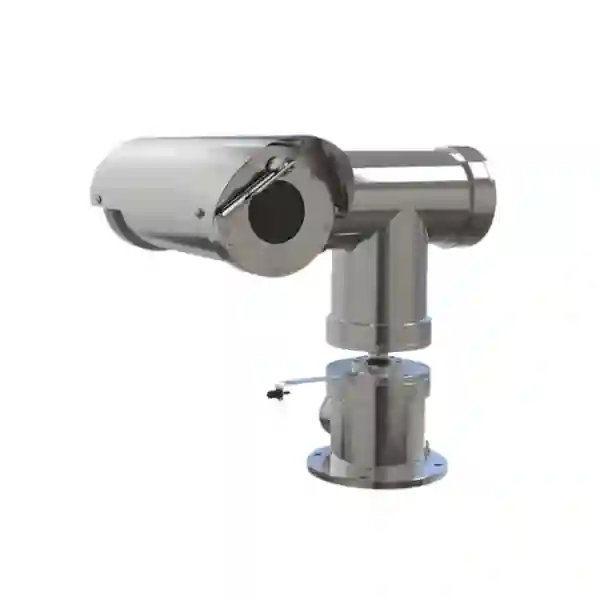
Hanwha TNU-X6320E1WT1-M Explosion-Proof PTZ Camera
Designed for demanding industrial monitoring, the Hanwha Vision TNU-X6320E1WT1-M explosion-proof PTZ camera combines full-HD network video, 32x optical zoom and remotely controlled positioning. It is a candidate for specialist surveillance designs where the correct hazardous-area protection, power system and certificate must be verified before installation. Use this guide to evaluate coverage, integration, operating conditions and the documentation required for a Tanzania project.
Essential product facts
The table separates well-documented characteristics from project-specific items that must still be checked on the submitted exact-model datasheet.
| Product identity | TNU-X6320E1WT1-M; explosion-proof positioning/PTZ network camera |
|---|---|
| Image and lens | 2MP, 1920 × 1080; up to 60fps; 32x optical zoom and autofocus |
| Electrical supply | 24 VAC; verify exact delivered unit’s maximum load |
| Environmental rating | IP66 / IP67 in historical exact-model Hanwha catalogue |
| Operating temperature | −40°C to +60°C in historical exact-model documentation |
| Cleaning feature | Integrated wiper; accessory requirements to be confirmed |
| Variant note | -M is associated with INMETRO model variant; obtain current certificate |
| Integration planning | H.265 / H.264 / MJPEG family; verify exact camera and VMS features |
| Purchasing status | Local availability, lifecycle, exact replacement and warranty require quotation |
Why this PTZ camera belongs in an industrial surveillance specification
The Hanwha Vision TNU-X6320E1WT1-M is an explosion-proof positioning network camera intended for projects where ordinary CCTV hardware may be unsuitable for the environmental and hazardous-area conditions at the proposed mounting point. It combines remote pan and tilt control with full-HD imaging and a 32x optical zoom lens, allowing an operator to move from a general view of equipment or a perimeter to a closer view of a selected asset. Its protective enclosure and wiper are particularly relevant when the camera must remain outdoors around operational infrastructure. The correct starting point is the site risk assessment, not the zoom specification alone.
For a buyer in Tanzania, a serious evaluation should combine security objectives with hazardous-area classification, approved electrical practice, network design and maintainability. A camera that produces attractive demonstration video is not automatically the right choice for a classified process area. The project team should first establish what must be observed, whether live repositioning is genuinely necessary, the distance to the target, and the conditions affecting visibility. Then the exact manufacturer configuration, certificates, cabling method and mechanical support can be checked against those requirements before any purchase is authorized.
A clear answer to the buyer’s principal question
The TNU-X6320E1WT1-M is a 2-megapixel, 1080p explosion-proof PTZ surveillance camera with a 32x optical zoom, autofocus, intelligent video analytics, a wiper and a 24 VAC power requirement. Historical Hanwha Vision America product documentation identifies the exact -M variant as an explosion-proof positioning camera and associates the suffix with the INMETRO configuration. It also lists IP66 and IP67 enclosure protection and an operating range of minus 40 to plus 60 degrees Celsius. These statements describe the documented product configuration; they are not a blanket statement of approval for any Tanzanian hazardous zone.
This product is worth considering when a control room needs to inspect different directions or assets from one suitably positioned station, rather than maintaining a permanently fixed image. It should not be selected solely to replace several fixed cameras without calculating coverage gaps during movement. In a high-risk operation, the practical solution may combine a movable PTZ for investigation with fixed cameras that continue recording defined critical areas. Ask for configuration-specific documentation and an engineered camera schedule before treating this model as an approved installation item.
What the 32x optical zoom contributes
The camera family uses a lens identified as approximately 4.44 to 142.6 mm, giving 32x optical magnification. Optical zoom changes the lens’s actual field of view and can preserve more useful subject detail than simply enlarging a captured image digitally. At the wide end, operators can orient themselves to a process platform, yard, gate or equipment line. At the telephoto end, they can look more closely at a selected location, provided light, focus, vibration and the viewing distance remain suitable. A strong zoom figure does not by itself guarantee identification at a promised distance.
When preparing a camera layout, define the smallest required observable detail, not just the furthest visible landmark. A maintenance team might need to tell whether a valve handwheel is in a particular position, whereas security staff may need to distinguish activity around a restricted entrance. Those tasks have different pixel-density and angle requirements. Use a field-of-view calculation or test image at the planned mounting height and working distance. For long-range scenes, consider atmospheric haze, heat shimmer, rain and lighting before accepting a proposed lens position.
Full-HD video and frame-rate planning
Video specifications associated with this range include 1920 by 1080 resolution and a maximum of 60 frames per second in supported H.264 or H.265 settings. Full-HD resolution gives operators a familiar viewing format for live monitoring, clip export and integration into an existing video-management environment. Higher frame rates may improve the visual continuity of movement such as a vehicle entering a yard or a rotating mechanism passing through a camera view. They also increase processing, transmission and recording demands depending on codec and scene complexity.
The best settings are application-specific. A security overview may not need to record continuously at the maximum frame rate, while a fast-moving target could justify a higher setting for selected streams. Confirm whether the desired frame rate remains available with the chosen analytics, image enhancement, encoding and recorder profile. Test the actual recorded footage, not merely the live web image. A balanced design specifies evidence needs, remote viewing capacity, bandwidth limits and archive-retention objectives together, then documents the camera profiles used to achieve them.
Pan, tilt and operator positioning
A positioning camera moves its line of sight rather than relying on a fixed perspective. The closely related manufacturer-documented TNU-X6320E1WT1-Z platform lists full 360-degree pan coverage and a tilt range from minus 90 to plus 90 degrees. These are useful reference characteristics for system planning, but the final movement limits, cable arrangement and control behavior should be confirmed for the exact -M assembly and supplied firmware. PTZ movement may be managed manually by an authorized operator or through presets, tours and alarm-assisted workflows where supported.
Decide in advance which views deserve named presets, who may move the camera, and how competing control requests will be handled. A camera that is panned toward a distant event is no longer watching its previous scene. For a site with several simultaneous hazards, an agreed priority scheme helps control-room personnel use the camera consistently. Preset labels should refer to operational assets rather than ambiguous numbers, and acceptance testing should verify that the camera returns to each selected view after power or communication interruptions as the approved configuration allows.
The difference between explosion-proof and ordinary weatherproof CCTV
Weather resistance describes protection against conditions such as dust and water entering an enclosure. Explosion-proof equipment addresses another question: whether the complete assembly is suitable for installation in a defined hazardous atmosphere under an applicable protection concept and certificate. A weather-sealed camera can remain entirely unsuitable for a zone where flammable gases or dusts may be present. Conversely, a suitably certified enclosure must still be installed using the specified entries, glands, seals, wiring and maintenance procedures to preserve its intended protection.
The TNU-X6320E1WT1-M should therefore be reviewed as a complete engineered device, not simply as a network camera inside a strong metal housing. Ask the equipment supplier for the exact certificate and marking associated with the ordered variant. Have the project hazardous-area specialist compare that evidence with the location’s zone or division, gas or dust group, temperature classification and ambient-temperature requirement. No page description can substitute for that formal check, and the INMETRO suffix should not be interpreted as automatic acceptance by a Tanzanian authority or client standard.
Understanding the -M variant and adjacent model numbers
The model string matters because closely named Hanwha units can have different movement capabilities, power arrangements, communications or certification packages. TNU identifies the positioning or PTZ product in this family; the similarly named TNO-X6320E1WT1-M is an explosion-proof zoom camera rather than the same PTZ assembly. Related TNU models with F2 in their model strings describe fiber-oriented configurations, and certain E2 variants use a different input voltage. A purchase order must reproduce the requested part number precisely rather than using a shortened family description.
Historical manufacturer product lists identify the suffix -M with the INMETRO version of the explosion-proof positioning camera. This is useful for avoiding the wrong suffix, but buyers still need a contemporary certificate package for the precise supplied item. The closely related -Z model is marked discontinued in Hanwha’s current public product catalogue and has a named successor; that status must not be automatically assigned to the -M variant. Confirm the exact -M model’s current orderability, replacement recommendation and support position directly through a formal product quotation.
Industrial deployment scenarios in Tanzania
Potential applications include monitoring processing installations, fuel-handling equipment, petrochemical infrastructure, industrial logistics, storage facilities and operational perimeters where a hazardous-area assessment identifies a need for appropriately protected imaging equipment. These are examples of possible projects, not claims that the camera is approved for every such site. The value of a movable camera is greatest when authorised staff must inspect several assets from one mounting point while retaining sufficient image quality at the chosen zoom setting.
In Tanzania, practical design factors can include outdoor exposure, dust, strong sunlight, heavy rain, remote network segments and periods of unreliable site power. Each project should establish its actual environmental load and maintenance arrangements rather than assuming the country presents one uniform set of conditions. For isolated installations, plan for safe access, network backhaul resilience, surge protection and a practical means of checking the lens window and wiper. If the site is hazardous, the electrical and mechanical installation method takes priority over convenient mounting or cable routing.
Using the built-in wiper correctly
The documented TNU-X6320E1WT1-M configuration includes a wiper, which can help clear water and some surface contamination from the viewing window. A wiper is a maintenance aid, not a promise that the window will remain unobstructed in every environment. Some industrial residues may smear, scratch or require a manufacturer-approved cleaning procedure. A washed or wiped window may still give poor images if there is salt deposition, staining, severe dust or persistent condensation in the viewing path.
Before installation, confirm how the wiper is operated, whether a separate washer system is required or offered, and which accessories are approved for the exact housing. Confirm service access for replacing consumable components. If the environment produces oily mist, abrasive dust or frequent deposits, include window inspection in the maintenance schedule and document safe isolation requirements. Do not specify an accessory merely because it appears in a related product-family catalogue; obtain a compatible accessory schedule and installation instructions for the ordered assembly.
Visibility in backlight, low light and difficult scenes
Hanwha’s associated platform specification includes wide dynamic range rated at 150 dB, day/night operation, digital noise reduction, electronic image stabilization and a defog function. Wide dynamic range can help where a sunlit yard and a shaded machinery area appear in the same scene. The day/night mechanism supports changes in illumination, while stabilization can improve usability when mounting structures transmit small movements. These image-processing functions are valuable aids, yet each has limits that should be assessed in a real or representative scene.
A PTZ position that looks good at midday may produce very different video at night or after rain. Verify available lighting at the actual camera viewpoint and make a decision about supplementary illumination, if permitted and appropriate to the site’s hazardous-area design. Check the expected zoom position under low light, because distant subjects can be less distinct than near-field demonstrations suggest. Include day, dusk, night and adverse-weather views in acceptance criteria wherever they are essential to the security or operations objective.
Video analytics as an operational aid
The camera family includes conventional intelligent video analytics such as motion, tampering and selected virtual-line or virtual-area event types. These tools can reduce reliance on a human watching a video wall continuously, but analytics effectiveness varies with the scene and how alarms are configured. Movement of steam, shadows, tree branches, vehicles and the camera itself can influence results. A feature named in a specification should not be described as guaranteed identification or as an autonomous safety system.
For a useful deployment, define a small number of high-value events with documented responses. One rule might flag activity at a restricted access point; another may support investigation of a protected equipment bay. Test them under expected light, weather and PTZ movement. Keep alarm zones away from known sources of nuisance activity where possible, record who is responsible for acknowledging events, and periodically review false positives and missed events. Critical protective actions should remain within properly engineered safety systems rather than depending on ordinary surveillance analytics.
Network architecture for a protected industrial site
The product family’s documented network interface uses IP-based video transport, with common services such as RTSP, secure web access and network management options on the related TNU platform. A network camera needs more than an available Ethernet socket: it requires suitable addressing, segmentation, bandwidth, monitoring and access controls. For a process facility, the CCTV network should be designed in accordance with the owner’s cybersecurity and operational-technology policies, with clear boundaries from sensitive control systems.
Choose the switch locations, safe-area interfaces and cable routes before selecting final enclosures or glands. Allow for the physical distance between the camera and its nearest active network equipment, including the need for approved intermediate devices where ordinary Ethernet reach is inadequate. If a long fiber run is required, do not assume the standard -M unit includes the fiber interface associated with differently coded models. Ask the integrator to identify the exact optical or copper configuration and to document every transition across hazardous and non-hazardous areas.
Power supply and electrical design
Manufacturer and exact-model catalogue references describe the TNU-X6320E1WT1-M as a 24 VAC unit. This is not a general Power over Ethernet camera, and planning should not begin with the assumption that a conventional PoE switch can supply it. Power equipment, transformers, cabling and protective devices must be selected for the final manufacturer’s electrical ratings, site conditions and starting or peak loads. Where electrical drawings use a central supply, voltage drop and cable length also need checking.
The related TNU-X6320E1WT1-Z data page lists a maximum 80 W input figure, but that value should be treated as a family design reference until the exact -M datasheet is confirmed for procurement. A power design should also account for the wiper and any other approved accessories, site backup-power philosophy, surge exposure and isolation procedures. Electrical work in a classified location must follow the approved hazardous-area installation method and be completed by appropriately qualified personnel. The finished system should be tested at the camera terminals under representative operating conditions.
Recording and storage strategy
The associated TNU platform supports H.265, H.264 and MJPEG encoding and multiple video profiles, with dual microSD memory positions described in the manufacturer’s related-model specifications. Where exact firmware and hardware verification confirms the same edge-storage configuration for the supplied -M unit, local recording can provide another layer of resilience. That does not mean an SD card is a complete replacement for a central recorder, secure archive and tested recovery workflow.
Calculate storage from the actual average and peak bitrates, number of streams, frame rates, recording hours, retention period and expected incident load. Make allowance for motion-rich scenes, rain and noise that can increase bitrates. Decide whether the camera will send continuous streams to a network video recorder, record selected events locally, or use both approaches. Keep clocks synchronized, define retention responsibilities and test what happens during a network outage. If evidence may be exported, verify playback, timestamps, access logs and export procedures before handover.
Connecting the camera to an existing VMS
Integration decisions should start with the video-management system already used by the site. The related Hanwha platform documents ONVIF and Hanwha’s own integration interface, but profile support, PTZ commands, event handling, playback and firmware dependencies must be checked against the precise TNU-X6320E1WT1-M unit. A camera can display basic video in a third-party platform while still lacking access to particular analytics, presets, wiper commands or edge-recording functions.
Ask the VMS vendor or integrator for a compatibility matrix showing the exact camera model, firmware, recorder or server version and supported functions. Test live video, time synchronization, preset selection, concurrent user control, event retrieval and reconnection after network interruption. If the system is managed from multiple control rooms, define operator priority and permissions. A short proof-of-concept using the intended software stack is often more valuable than assuming that the presence of a familiar standards logo guarantees every required feature.
Cybersecurity configuration at commissioning
Network surveillance devices should be treated as managed digital assets. Establish named administrative responsibility, strong credentials, restricted network access, secure transport where supported, logging and an update process approved by the system owner. Disable unnecessary services and isolate engineering or management access from general staff networks. In a site with remote viewing requirements, avoid exposing camera management pages directly to the public internet; use the organization’s approved secure access architecture.
Document the initial firmware version, network settings, permitted management addresses and procedure for security updates. Test account permissions for observers, operators and administrators so that someone permitted to view a feed is not automatically permitted to move the camera or change recording settings. Build maintenance windows around operational constraints, especially if a firmware update could temporarily interrupt monitoring. Record how to restore a configuration and who can authorize changes. Cybersecurity procedures should be revisited when systems, staff or network boundaries change.
Mounting and mechanical stability
An explosion-proof PTZ assembly can be substantially heavier and more demanding than a standard dome camera. The closely related TNU-X6320E1WT1-Z manufacturer listing describes a large stainless-steel assembly, but exact mass, dimensions and bracket forces must be confirmed against the -M submittal before structural work. A mounting design should consider not only dead load but also dynamic movement, wind, vibration, access for service and the integrity of the supporting structure.
Do not specify a generic CCTV pole bracket on the basis of bolt-hole appearance. Obtain the manufacturer-approved mount and fastener details, check the substrate and confirm corrosion compatibility. For coastal or chemically aggressive locations, require a suitable corrosion assessment rather than assuming every stainless-steel installation will perform identically. Locate the camera so the lens can see the intended target without obstacles while the enclosure remains accessible for safe maintenance. Confirm clearances for full PTZ movement and the routing of all cables before construction.
Enclosure materials and harsh outdoor conditions
The associated manufacturer specifications identify stainless-steel construction and IP66/IP67 environmental protection for the positioning family. Such characteristics make the design relevant to demanding outdoor settings, but neither the steel grade nor the IP code removes the need for careful installation. Water can enter through an incorrectly chosen gland, poorly sealed accessory or damaged cable entry even when the enclosure itself has passed a laboratory test.
Specify the mounting location using site-specific information about water jets, flooding risk, airborne contaminants, temperatures and cleaning operations. Include cable-entry orientation, drainage and isolation requirements in the approved installation drawing. Where washdown chemicals or marine exposure are expected, check material compatibility and the manufacturer’s cleaning instructions. Routine inspection should look for loose supports, damaged seals, corrosion, clouded windows and deteriorating cable protection. Record all checks in the facility’s maintenance system so that the environmental rating remains part of an operating plan rather than a one-time purchasing claim.
Hazardous-area certificate review before procurement
Request the current certificate or approval record for the exact model and supplied configuration, including the full marking, certificate number, applicable standards, gas or dust groups, ambient restrictions and any conditions of safe use. The suffix associated with INMETRO identifies a product configuration in Hanwha literature; it does not establish that a particular Tanzanian regulator, insurer, EPC contractor or asset owner accepts it for a proposed installation. That determination depends on the project’s governing requirements.
The buyer’s technical submittal should include a site hazardous-area classification drawing and a formal comparison between the camera marking and the installation zone. Verify that the specified glands, cable entries, seals, accessories and support hardware are included in the applicable documentation. Keep approval records alongside the drawings and inspection reports. Where a product has a successor or manufacturing change, ask whether the certificate and installation instructions apply to the exact unit being delivered. Never substitute a similar suffix without written technical acceptance.
Plan around the site inspection and commissioning workflow
Before equipment is ordered, the responsible team should walk the proposed location and confirm coverage, access, cable routes, mounting strength, electrical isolation and environmental hazards. The walkdown should include security, operations, information technology, electrical engineering and the hazardous-area specialist where appropriate. Record the line of sight at anticipated wide and zoomed positions and identify any structure that could obscure a critical target. Discuss maintenance access with the personnel who will actually service the installation.
At commissioning, inspect mechanical fixings, certified entries and cable protection before energizing the system according to the approved procedure. Validate supply voltage, network reachability, time synchronization, viewing quality, PTZ directions, presets and wiper operation. Where analytics or alarms are included, trigger representative events and verify that the control-room workflow responds correctly. Save the final configuration, serial and firmware information, approval documents, test results and as-built drawings. A camera should not be accepted simply because a live image appears on a laptop.
Choosing between PTZ and fixed cameras
A PTZ camera is valuable when a trained operator needs interactive visual investigation across several directions. A fixed camera is often better when a particular doorway, fence line or machinery point must remain continuously framed. These are complementary tools, not interchangeable versions of the same coverage. The apparent economy of covering a large site with one long-range PTZ may disappear if incidents happen simultaneously or if nobody is available to move the lens at the right moment.
During design, mark the areas that require continuous recorded evidence and those suitable for periodic inspection. Assign fixed views to permanent critical coverage where necessary, and use a movable camera for incident assessment and detail capture. Consider how the PTZ behaves during operator handover, alarm-triggered presets or automatic tours. If a safety-critical area must never go unobserved, do not rely on a roaming camera as its only visual record. The layout should be judged by operational outcomes, not by camera count alone.
Determining meaningful camera coverage
A reliable surveillance design begins with target dimensions and image-detail requirements. For example, a camera intended to observe general activity in a loading yard may need less pixel detail than a camera expected to confirm markings on an equipment panel. Working distance, mounting height, angle, illumination and zoom choice all affect what can be established from video. A number on a lens specification is not a substitute for an image-detail calculation or field test.
Prepare a camera schedule that lists each monitored scene, its purpose, the desired image detail, the worst practical viewing distance and the required time of observation. Use real site plans and, where feasible, sample footage from representative positions. Include any line-of-sight changes caused by vehicles, scaffolding, vegetation or future equipment additions. Decide whether the final requirement is detection, observation, recognition or another defined purpose, then test that purpose directly. This prevents broad marketing terms such as long range from becoming unmeasurable acceptance criteria.
Bandwidth, latency and remote links
High-resolution streams are influenced by scene movement, compression settings, frame rate and the amount of image noise. A remote industrial site may have limited backhaul even when the local camera network is fast. Rather than quoting a single universal bandwidth figure, calculate expected and peak demand for each stream, including the number of operators, recording destinations and any backup network path. Use appropriate quality-of-service and monitoring practices under the site’s network standards.
PTZ control also depends on responsiveness. A delayed picture or delayed command can make precise investigation difficult, especially at a tight zoom angle. Test camera response from the actual control room rather than only at a nearby switch. For cellular, microwave or shared long-distance links, consider the consequences of congestion, packet loss and weather-related interruption. Set realistic expectations about viewing during an outage and provide a defined recording and reconnection policy. If remote management crosses corporate or contractor networks, obtain cybersecurity approval before deployment.
Power continuity, lightning and surge planning
Industrial cameras sometimes watch locations where a loss of electrical power is itself an important operational event. A design that depends entirely on a single unprotected supply may therefore fail at the moment operators most need visibility. Discuss whether the surveillance system should be connected to a site-approved uninterruptible power system or other backup arrangement. Account for the actual load of the supplied unit and the impact on recorders, switches and network transmission equipment.
Outdoor mounting locations can also be exposed to electrical surges. Cable routing, bonding, grounding and protective devices must follow the approved electrical and hazardous-area engineering documents. Do not add an ordinary surge protector inside a classified location without assessing its suitability. Test orderly recovery after loss and restoration of power, including networking, recording, time settings and expected PTZ behavior. Where redundant network or power arrangements are proposed, verify their independence in practice instead of assuming that two devices provide resilience simply because they are physically separate.
Operator workflow and control-room usability
Useful video is produced by a complete operating workflow, not only the camera. Decide who is authorized to control pan, tilt and zoom, which locations should be stored as presets, and whether event-triggered moves are appropriate. Provide descriptive preset names and a simple instruction sheet for the control room. Operators should know how to return to a default overview, how to avoid losing an important scene and what to do when the wiper or network connection becomes unavailable.
Training should include the effect of changing focal length on the field of view and on the apparent speed of moving targets. At high optical magnification, small control inputs can cause large changes in framing. Users should learn when to capture a wide contextual view and when to zoom into a detail. Review recorded incidents to see whether camera movement helped or hindered the response. Restrict control privileges where too many simultaneous operators could interfere with one another. These simple arrangements often matter more than adding another unused feature.
Maintenance, cleaning and lifecycle support
Before purchase, establish who can provide installation documentation, approved replacement parts, firmware guidance and service assistance for the exact ordered model. Historical catalogues identify the TNU-X6320E1WT1-M, while manufacturer pages identify changes in availability for related suffixes. The current order status and a valid successor recommendation for the -M configuration should therefore be confirmed in writing. A discontinued sibling does not prove that the requested unit is discontinued, nor does an old catalogue entry guarantee present supply.
An effective maintenance plan covers housing integrity, wiper wear, lens-window cleanliness, PTZ performance, mounting condition, recording health and device cybersecurity. Maintenance staff must follow any special procedures in the hazardous-area documentation, including safe isolation and inspection of certified entries. Keep spare-part and firmware references tied to the supplied unit’s serial information. If the installation is remote, consider the practical cost of travel, site access authorization and equipment lifting when deciding service intervals and backup arrangements.
Procurement documentation and a defensible quotation
A complete request for quotation should state the exact TNU-X6320E1WT1-M model, required quantity, hazardous-area classification, supply voltage, network interface, mounting position and intended monitoring task. Ask the supplier to identify the certified camera assembly, included accessories and any items excluded from the price. Request the current datasheet, certificate copies, installation manual, lifecycle statement and confirmation of compatibility with the designated VMS and mounting hardware.
Because the project is in Tanzania, any local commercial terms must be provided in a current quotation for that project. Do not infer Tanzania availability, inventory, shipping arrangements, duties, lead times or warranty coverage from overseas price lists or historic manufacturer order notes. Have the supplier distinguish ex-works product cost from engineering, installation, testing, spares and ongoing support. Require an explicit alternative if the exact configuration cannot be supplied. The comparison should consider complete installed and maintained cost, not a headline device price without the necessary infrastructure.
Questions to settle during the technical submittal
Before approving the camera, ask whether the submitted marking is acceptable for the classified area; whether the exact -M configuration remains available; and whether any replacement has the same power, interface, certification and mounting requirements. Ask for its maximum power demand, physical mass, bracket schedule and dimensions on a current document. Confirm whether the ordered assembly includes the specified wiper and whether any washer accessories require separate purchasing or special installation.
Then check the operational design: what information must be captured, how many users need concurrent video, where recordings will be stored and how much downtime is tolerable. Establish responsibility for VMS integration testing, firmware handling, hardening, user accounts and acceptance tests. Request a clear drawing showing network and electrical connections from the camera to the safe-area systems. These questions expose incomplete quotes early, when a design can still be corrected without expensive changes to cable runs, brackets or hazardous-area installation records.
What a suitable project handover should contain
A technically complete handover is much more than a camera image and a password. It should contain the purchased model identification, serial number, applicable hazardous-area certificate documentation, approved installation drawings, cable test results, commissioning forms, settings backup, recording-policy details and a list of authorized personnel. Any differences between the planned and installed configuration should be documented and accepted by the relevant project authorities.
The handover should also explain how the camera is controlled during an incident, who receives alerts, how footage is retrieved and what happens when the network, power or wiper fails. Include maintenance instructions for window cleaning, mount inspection, approved parts and safe access. Record the chosen firmware and VMS versions so future compatibility issues can be investigated. If remote viewing or contractor access exists, document how that access is approved and revoked. A well-managed handover helps maintain both the surveillance function and the integrity of the original engineered installation.
Why broad certification claims need care
Customers sometimes read explosion-proof, IP67 and INMETRO as interchangeable assurance marks. They are not. An ingress-protection rating relates to protection against solids or water under defined tests, while an explosion-protection certificate addresses a different set of hazards, markings and conditions. Certification may apply only to a particular assembly and configuration. Neither term alone tells an engineer whether the camera belongs in a specific site location.
The safe purchasing approach is to ask for the exact documentary evidence and have it checked by the competent project team. The fact that the -M suffix is associated with INMETRO in Hanwha’s model lists should be explained clearly rather than turned into a claim of universal regional approval. If the end user, insurer, EPC contractor or responsible authority requires another accepted protection scheme, resolve it before ordering. It is also important that changes to cables, accessories, connectors or installation methods do not invalidate the approved arrangement.
Choosing the right alternative if the specification changes
A project may discover that the initial camera model is no longer the best option because the approved hazardous-area marking differs, the power network is unsuitable, or the desired view requires a different interface. The answer is not to replace the unit with the first similarly named camera. Compare the functional and certification requirements one by one, beginning with area classification and the device’s full marking. Then compare imaging, optical reach, movement, mounting, power, network, recording and maintenance.
An alternative could be a successor in the Hanwha explosion-proof positioning range, another certified configuration or a different camera arrangement altogether, depending on project needs. Hanwha publicly names a replacement for the closely related -Z unit, but that is not proof of an officially approved substitute for the exact -M order. Require written manufacturer confirmation of an appropriate equivalent, including any differences in certificates and accessories. For an installed system, plan how replacing the camera affects existing VMS integration, site permits and acceptance records.
The buying decision in one practical sequence
Begin with the site classification and the purpose of monitoring. Next, establish the required image detail, the important views and the need for live PTZ movement. Match those needs to the documented 2MP, 32x optical configuration. Verify the exact -M variant’s certificates, power rating, interface, mechanical drawings and order status. Only after those checks should the design team freeze mounting locations, electrical routes and network architecture.
Then obtain a project-specific commercial quotation, validate all specified accessories and integrate the camera with the recording and control-room environment. Build the commissioning tests around what the site actually needs to see, how it must respond, and what happens during failures. Finally, retain documentation and assign ongoing ownership for maintenance and cybersecurity. This sequence makes the procurement decision auditable and reduces the chance of receiving equipment that looks correct on a datasheet but cannot be installed or used as intended.
A focused note for Tanzania project teams
Local buyers should describe the project location and application precisely rather than relying on broad phrases such as industrial CCTV Tanzania. For example, the engineering questions for a fixed fuel transfer point differ from those for a moving equipment yard or a remote perimeter. The requested product is appropriate for further evaluation where an explosion-proof PTZ is required, but a fit decision must incorporate the site’s approved hazardous-area rules, environmental conditions and operational objectives.
FourTeck Tanzania can use the product brief as the starting point for a technical enquiry, with final suitability subject to documentation and quotation. Customers should provide the camera quantity, target-view description, relevant hazardous-area schedule, expected network arrangement and installation constraints. If those details are incomplete, a preliminary design discussion should identify what still needs engineering validation. No assertion is made here about local inventory, office location, delivery coverage, installation service, price or certifications beyond the documented product information.
Frequently asked questions
Is the TNU-X6320E1WT1-M a fixed camera?
No. It is documented as an explosion-proof positioning or PTZ camera. Do not confuse it with the similarly named TNO zoom-camera variant, which has a different mounting and movement role. Confirm the full ordered part number on every quote.
What resolution and zoom does it provide?
The model is described with 1080p imaging, up to 60 frames per second in supported modes and a 32x optical zoom lens. Image detail at a real site depends on distance, lighting, angle, motion and configured recording quality.
Can it be powered directly from a PoE switch?
The documented model requires 24 VAC power, so a normal PoE connection should not be assumed to provide its electrical supply. Have the integrator verify the final unit’s power consumption, protection and approved installation method.
Does the -M suffix mean it is automatically accepted in Tanzania?
No. Hanwha documentation associates -M with an INMETRO configuration, but suitability for a particular Tanzanian hazardous location depends on the exact certificate, project rules and competent review. Request current evidence before approving the equipment.
Is the camera waterproof?
Historic exact-model references list IP66 and IP67 environmental protection. Those ratings are not a substitute for correct gland selection, installation, inspection and the separate hazardous-area approval requirements of the project.
Does it include an automatic window wiper?
The exact model is described as a positioning camera with a wiper. Confirm what wiper controls, cleaning accessories and maintenance parts are included in the proposed supply, especially if the site has dust, rain or chemical deposits.
Does the camera record to memory cards?
The associated TNU camera platform describes dual microSD slots. Confirm the precise -M hardware and firmware, card support and capacity before designing edge recording, and do not rely on camera cards as the sole evidence-retention system.
Can it work with my existing VMS?
Compatibility must be established for the exact camera, firmware and VMS version. A basic video feed may work while PTZ presets, analytics or wiper control need additional integration tests. Request a feature-by-feature compatibility demonstration.
Is this model currently available for purchase?
Historical Hanwha product lists include the requested model, but current local supply and lifecycle status were not independently confirmed. A related -Z version is marked discontinued. Request written confirmation of the -M configuration and any official replacement.
What information is needed to request a quotation?
Provide the complete model number, quantity, hazardous-area classification, mounting location, power arrangement, network type, intended field of view and recording system. Ask for the relevant certificates, manuals, accessories, lifecycle status and project-specific commercial terms.
Would one PTZ replace all fixed cameras at a site?
Not necessarily. A PTZ can investigate different areas but cannot continuously point at all of them at once. Areas needing uninterrupted visual evidence may require fixed cameras alongside a PTZ. Define the coverage objective before deciding camera count.
Can it be installed on an existing camera pole?
Only after engineering verification. The structure, approved mount, fixings, vibration resistance, cable routing, maintenance clearance and hazardous-area installation requirements must be assessed for the exact supplied assembly.
Request a project-specific technical quotation
For the Hanwha TNU-X6320E1WT1-M, request confirmation of the exact available configuration, its applicable hazardous-area documents, electrical and mechanical submittals, approved accessories, VMS compatibility and current commercial terms. Supply the proposed location, area classification, quantity and monitoring objectives so that suitability can be reviewed before an order is placed.
Contact FourTeck Tanzania with your project specification and request an engineering review and quotation.




Reviews
There are no reviews yet.