
Industrial network surveillance · Tanzania buying guide
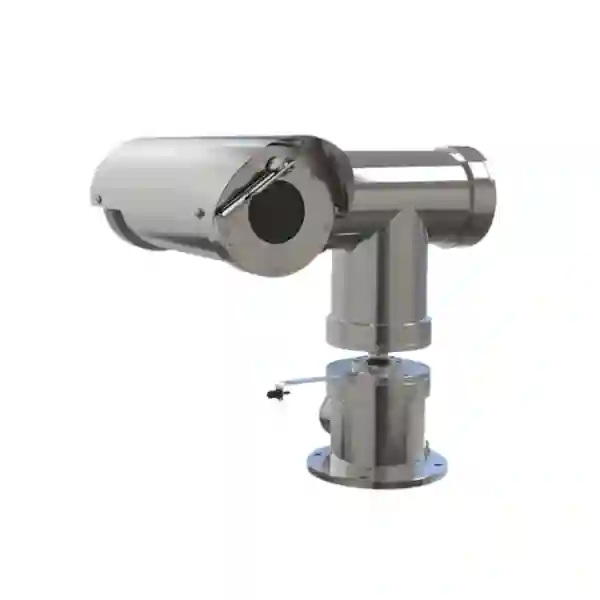
Hanwha TNU-X6320E1WT2-C Explosion-Proof PTZ Camera
A specialist 2MP Full HD positioning camera for appropriately engineered hazardous-area surveillance. Explore its 32× optical zoom, integrated wiper, video analytics and commissioning considerations before specifying a system for your industrial facility.
Key features at a glance
Full HD video, up to 60 fps
Autofocus zoom lens
Legacy model specification
Maximum 80 W listed
Manufacturer-listed ratings
For selected window moisture
Technical snapshot — original model
| Model | TNU-X6320E1WT2-C |
|---|---|
| Camera type | Explosion-proof PTZ network camera |
| Resolution | 2 MP; 1920 × 1080 |
| Sensor | 1/2.8-inch CMOS |
| Optics | 4.44–142.6 mm; 32× optical zoom, 16× digital |
| Frame rate | Up to 60 fps H.265/H.264 under listed conditions |
| Video codecs | H.265 / H.264 / MJPEG |
| Image features | 150 dB WDR; day/night ICR; gyro-based DIS; defog |
| Storage | Two microSD/SDHC/SDXC slots; listed up to 256 GB each |
| Networking | RJ-45 Ethernet; ONVIF S/G; SUNAPI |
| Enclosure | Manufacturer-listed 316L stainless steel; IP66 / IP67 |
| Power | 24 VAC; listed max. 80 W |
| Lifecycle | Discontinued; replacement TNU-X6320A1WT2-C |
Engineering note: confirm the exact applicable hazardous-area certification, ambient-temperature limit, mechanical drawing, cable-entry details and current firmware with the unit-specific documents. General family specifications are not installation approval.
The right camera for a demanding industrial site
A conventional outdoor CCTV camera is not automatically suitable for installation where flammable gases, vapours or combustible dust may be present. An industrial buyer must consider not only image quality but also how the complete equipment assembly is assessed for the area in which it will operate. The Hanwha TNU-X6320E1WT2-C addresses the surveillance side of that problem with a motorised explosion-proof positioning camera, a long optical zoom range and a protective industrial housing. It can help teams observe selected assets or boundaries without placing personnel at every viewpoint.
The product is a specialist network camera rather than a general household security device. Its value depends on correct engineering: the actual hazardous-area classification, the camera’s approval marking, safe wiring practices, mounting stability, control-room integration and the ability to maintain the equipment. Use this page to understand the capabilities of the original model and the questions that should be resolved before a procurement decision in Tanzania.
Lifecycle status: read this before ordering
Hanwha Vision’s official product information identifies TNU-X6320E1WT2-C as discontinued. It names TNU-X6320A1WT2-C as the replacement. This matters if a project specification was written several years ago, if an existing camera has failed, or if an installer is extending a system built around the earlier TNU platform. A historic model number on a drawing should not be treated as proof that new original units remain available for ordering.
The replacement designation is a useful starting point for engineering review, not an unconditional promise of identical performance or a drop-in installation. Evaluate mounting geometry, housing dimensions, cabling, hazardous-location documentation, software integration and the applicable temperature marking for the proposed successor. Confirm whether the customer requires a matching spare, an approved substitution or an updated project specification. FourTeck Tanzania can receive those details for a quotation discussion; stock and procurement terms must be confirmed separately.
Specifications that shape the buying decision
The original camera provides 1920 × 1080 Full HD video from a 1/2.8-inch CMOS imaging device. Its official product page lists H.265 and H.264 video at up to 60 frames per second in a 60 Hz configuration, along with MJPEG support. The optical system covers approximately 4.44–142.6 mm and provides a 32× optical zoom. A published 150 dB wide dynamic range specification helps define the legacy model’s image-processing capabilities.
Other stated features include autofocus, true day/night switching through an infrared-cut filter, digital image stabilisation using a gyro sensor, a defog function, an integrated window wiper, network streaming, video analytics and dual microSD storage slots. Power is 24 VAC, with manufacturer-listed maximum consumption of 80 W for this model. These figures are product specifications, not complete design values for cable selection, transformer sizing, enclosure certification or guaranteed identification distance. Those decisions require site-specific engineering.
Full HD detail: what it can and cannot show
Full HD resolution is useful for watching equipment movement, access areas, process lines and changes in site activity. Its 1920 × 1080 picture provides a familiar format for control-room monitors and many video management systems. At a suitable field of view, operators may be able to examine vehicles, gates, equipment status or activity at a monitored boundary. Detail at long distance depends on the optics, target size, lighting, atmospheric conditions and the chosen recording settings.
Resolution alone does not guarantee reliable facial identification, number-plate capture or machine-condition assessment. A narrow zoom setting increases pixels on a distant target but covers a smaller scene, while a wide setting provides more situational awareness with less detail per object. Engineering teams should define the target task first—detection, observation, recognition or identification—then assess the camera location and scene geometry. Night conditions, reflections, vibration and obstructions must be included in acceptance testing.
32× optical zoom for targeted observation
A 32× optical zoom lets an operator move between an overview and a tighter view without relying only on software enlargement. On a large industrial site, that flexibility may be useful when examining a remote gate, pipe rack, loading point or restricted perimeter. Autofocus supports changes in viewing distance, and manual focus options can help when the automatic result is affected by fences, glass reflections or layered objects.
Optical zoom is not the same as thermal sensing or a guaranteed long-range identification rating. Weather, heat shimmer, smoke, fog, strong backlighting and low illumination can reduce useful detail even when the lens is tightly zoomed. A PTZ camera also shows one selected direction at a time; if continuous coverage of several critical points is required, fixed cameras may need to complement it. Define priority views and response procedures rather than assuming one moving camera replaces a whole surveillance layout.
PTZ control and preset planning
PTZ means pan, tilt and zoom: the camera’s direction and lens position can be controlled from a supported system. Hanwha’s product information lists preset-position capability for the TNU-X6320E1WT2-C. Presets are practical when a control room repeatedly checks a loading bay, gate, machinery zone or elevated structure. Consistent framing also helps operators understand what has changed between inspections.
A useful preset plan begins with named points of interest, not a long list of arbitrary angles. Mark which views are safety relevant, which are for general security and which are only occasional inspections. Review the path of movement to ensure temporary loss of visibility from one zone is acceptable. Test operator privileges, control priority and what occurs after reconnection or power restoration. Do not assume a particular pan speed, patrol cycle or mechanical travel limit without the exact installation and product documentation.
Wide dynamic range in difficult lighting
High-contrast industrial scenes can combine bright exterior sunlight, deep shadows, vehicle lights and reflective metal surfaces in the same image. The legacy model’s published 150 dB wide dynamic range feature is designed to help preserve usable detail across contrasting brightness levels. This may be relevant at open-sided processing buildings, loading areas, gates facing the sun and locations where a bright background silhouettes a person or asset.
Wide dynamic range improves image handling but does not make poor camera placement irrelevant. A lens pointed directly into a strong light source may still produce glare, flare or reduced detail. Survey the expected sun path, night lighting and reflective surfaces before confirming a mounting point. Compare daytime and nighttime screenshots at the actual operational presets. The successor model has a separately published specification, so do not copy the original model’s 150 dB figure into a replacement bill of materials without rechecking it.
Day and night imaging: realistic expectations
The specified day/night function uses automatic infrared-cut filter switching, with manufacturer-listed minimum illumination figures of 0.05 lux in colour and 0.005 lux in black and white under stated test conditions. These laboratory figures indicate low-light sensitivity, but they do not establish the illumination required for a particular security outcome at a given distance. Noise, shutter choice, target motion and recording compression all affect practical results.
This is not a thermal camera, and the base specification should not be interpreted as an assurance of built-in infrared illumination. For unlit remote sites, plan the lighting solution around the task and applicable safety restrictions. Obtain representative night-time samples where possible, especially for moving vehicles or people. A security team that needs clear incident evidence should select exposure and frame-rate settings with motion blur in mind, not merely optimise the picture for static nighttime scenery.
Stabilisation and visibility in harsh weather
Hanwha lists digital image stabilisation with a gyro sensor and a defog function among the original model’s image features. Stabilisation may make the displayed image more comfortable to view when a tall support or industrial structure experiences minor vibration. Defog processing may also help certain reduced-contrast scenes. Their presence does not replace structural engineering or solve every visibility problem.
Large movement, severe wind, dirty glass, persistent condensation or heavy airborne material can still defeat a good imaging system. A mounting bracket should control deflection under local wind and equipment loads, while a realistic maintenance plan should address environmental deposits. Where high vibration is routine, inspect the installation and arrange scene testing before acceptance. Avoid promising uninterrupted visibility through smoke, steam, dust or weather merely because a software processing feature is available.
Integrated window wiper and cleaning strategy
The built-in wiper is a practical feature for exposed industrial surveillance, particularly where rain or deposits may collect on the camera window. It gives operators a way to clear some moisture without immediately sending personnel to an elevated or restricted location. On a port, process plant or exposed yard, this feature may reduce the number of visibility interruptions caused by ordinary surface contamination.
A wiper cannot clean every type of residue. Salt deposits, abrasive dust, grease and persistent films may require a permitted physical cleaning procedure. Verify operating instructions, replacement parts and whether a separate washer system is needed for the actual environment. Any cleaning fluid, cable route or accessory used in a hazardous area must be assessed as part of the whole installation. Do not assume the presence of a wiper proves that the equipment is maintenance-free or suitable for every corrosive chemical.
Stainless-steel construction and exposure
The manufacturer identifies stainless steel grade 316L for the original camera’s housing. This is a meaningful material choice in demanding environments because corrosion resistance is often a major concern for exposed industrial surveillance. The official specification also lists IP66 and IP67 ingress-protection ratings, which relate to defined dust and water testing conditions. These properties support equipment selection for challenging outdoor locations when the full installation is correctly specified.
Corrosion resistance is not immunity from all industrial chemicals or long-term neglect. A site near salt spray, chemical washdown, fertiliser handling or process emissions should compare the actual atmosphere with materials used in the entire assembly, including fasteners, brackets, glands, seals and adjoining equipment. Confirm cleaning agents and maintenance procedures. Do not treat an ingress-protection designation as permission for arbitrary pressure washing or as proof that incorrect cable entries can be tolerated.
Explosion-proof does not mean universally approved
The term explosion-proof describes a specialised approach to equipment design for particular hazardous conditions. It does not mean that a camera prevents a site explosion, makes an area safe, or can be installed in any classified zone without further checks. The project’s hazardous-area classification and the exact equipment marking have to be reviewed by competent personnel before procurement and installation.
The model’s published family documentation discusses certification schemes including cLC CSA and cLCus Class I Division 1. The exact TNU-X6320E1WT2-C suffix is associated with the -C certification variant. Engineers should obtain the unit-specific certificate, nameplate details, gas or dust grouping, temperature class, ambient limits and any special conditions of use. A listing that mentions multiple approvals across a product family must not be used to claim every approval applies to one specific unit. Tanzania-specific acceptance and legal requirements must be checked for the site.
Hazardous-area design and documentation
Begin a hazardous-area camera project with current area-classification drawings and the site’s approved engineering requirements. The documents should identify the relevant risk, location boundaries, equipment group, temperature class, ambient conditions, cable-entry methods and inspection obligations. That information determines whether a proposed camera variant is acceptable. Security features should be evaluated only after this basic eligibility question is answered.
The camera is one component of a broader installation that may include glands, conduit, terminations, isolators, junction boxes, power equipment, earthing and communications equipment. Each element must suit its location and the applicable design rules. Do not assume that an explosion-proof camera makes ordinary nearby accessories explosion-proof. An approved method statement, appropriate personnel and inspection records are valuable deliverables. When comparing the discontinued model with its successor, obtain the exact certification documentation for the proposed equipment rather than relying on similar-looking model names.
Temperature ratings need exact-model confirmation
Industrial buyers sometimes compare a general operating-temperature figure with the permitted ambient temperature shown on a hazardous-area certificate. These can be different design constraints. The current manufacturer information for the original TNU-X6320E1WT2-C and historical model-family listings do not present every temperature detail in the same way. This is a reason to request the exact certificate and installation documents, not to select the most generous number.
A Tanzania project should account for measured ambient temperature, direct solar exposure, radiant heat from adjacent process equipment and any potential ventilation limitations. The hazardous-area marking may impose an upper ambient limit that matters more than a general camera electronics specification. Confirm the accepted upper and lower limits for the actual suffix and certification before a purchase or substitution. Record the decision in the equipment schedule so a future maintenance team does not unknowingly install a different temperature variant.
24 VAC power: plan the full electrical path
This legacy unit specifies 24 VAC input, and Hanwha lists maximum power consumption of 80 W. It should not be ordered on the assumption that it can be powered directly by PoE from an ordinary Ethernet switch. The supply design must consider the required source, voltage drop, conductor length, equipment starting behaviour, isolation and protection method. Any transformer or supporting electrical equipment must be placed and selected appropriately for the installation location.
Electrical stability is particularly important where recording or operator control forms part of incident response. Consider what the security system should do during a utility interruption and whether backup power is required for the camera, network and recorder as a complete chain. Power calculations should use the confirmed manufacturer requirements and engineering margins rather than a guessed wattage. A qualified designer should also review surge protection, earthing, bonding and the interface between hazardous and non-hazardous areas.
Cable entries, grounding and service access
Cable installation is often the difference between an approved equipment selection and a compliant finished system. The correct gland or conduit system, sealing arrangement, thread compatibility and termination method must be chosen against the actual camera documentation and site rules. Confirm that the cable route preserves required separation, mechanical protection, drainage strategy and access for inspection.
Plan where technicians will reach the device safely for inspection, cleaning and service. A camera mounted too high or too close to moving equipment may create maintenance risk even if it provides a good picture. Provide safe isolation procedures and appropriate permits for classified areas. The grounding and bonding design must be reviewed as part of the electrical package; do not depend on incidental contact through mounting bolts. Keep a record of installed glands, supports, supply equipment and cable identifiers for future fault tracing.
Network connection and control-room integration
The exact original model includes an RJ-45 Ethernet network interface and supports widely used IP video protocols. This helps system designers consider integration into an existing routed security network instead of planning a completely isolated monitoring appliance. Hanwha also lists H.265, H.264 and MJPEG video formats, selectable streams and support for common transport and management protocols.
The equipment schedule should document the switch port, addressing plan, network segmentation, time source, recording destination and any management server. Confirm available copper distance, electrical protection and whether additional approved communications equipment is needed. Do not confuse model variants: an F2 model-family reference does not establish a built-in fibre interface on this particular TNU-X6320E1WT2-C. If long-distance fibre is required, design the complete network link using components appropriate for their installed areas.
Video management system compatibility
Hanwha lists ONVIF Profiles S and G and its SUNAPI interface for the original model. These are useful starting points when investigating interoperability with a video management system or network video recorder. ONVIF support can assist discovery and common video functions, but it does not guarantee that every advanced PTZ, alarm, preset, privacy or analytic feature will work in every VMS release.
Before an order, identify the installed recorder software, firmware version, licence requirements, supported streams and desired features. Run a compatibility check for the specific device and recorder combination. Test authentication, live view, recording, playback, PTZ controls, event subscriptions, reconnect behaviour and user privileges. If an older unit is being replaced by the newer A-series model, retest the integration rather than assuming the existing configuration can be reused unchanged. This verification is especially important on long-lived industrial CCTV systems.
Streaming and bandwidth budgeting
Multiple streams make it possible to design different viewing and recording experiences: for example, a higher-quality stream for incident recording and a more economical stream for a remote operator view. H.265 and Hanwha’s WiseStream II features can be considered when planning storage and network use. However, actual bitrate depends on the scene, motion, detail, compression settings, frame rate and chosen quality.
Avoid using one fixed bandwidth estimate as a universal answer for a 2MP camera. A busy loading area at night may behave differently from a relatively still fenced compound. Measure or simulate representative scenes and account for peak traffic, multiple viewers, recorder overhead and communications outages. For remote Tanzanian facilities, assess real uplink reliability before promising live monitoring across a wide-area network. Local recording, buffer policies and playback recovery may be more important than headline network speed alone.
Dual microSD storage and retention design
Hanwha’s product listing specifies two microSD/SDHC/SDXC slots, with up to 256 GB per slot stated in the legacy specification. These slots can be useful for edge recording or selected event workflows when configured with suitable supported media. They are not a replacement for a considered evidence-retention policy, nor do two card slots automatically guarantee redundant recording in every configuration.
A retention plan should define continuous versus event-based capture, expected frame rate, bitrate, overwrite behaviour, time synchronisation and the process for exporting evidence. Industrial operators should also define responsibility for checking storage health and responding to failures. Verify which card types and functions are supported by the installed firmware. If the installation uses a central NVR or VMS, test how temporary network outages affect the camera and what recordings are available after connectivity returns.
Analytics for alerts, not automatic conclusions
The original camera lists analytics such as motion detection, tampering, fog detection, virtual-area events and virtual-line crossing. Correctly configured, these functions can draw attention to activity near a restricted access point or other monitored zone. They are useful tools for prioritising what an operator reviews, particularly when a large site has more cameras than monitors.
An analytic event is not a verified security incident. Windblown material, lighting changes, reflections and complex industrial motion can generate unwanted alerts, while genuinely important activity can sometimes be missed. Define the monitored zone, detection objective, time schedule and escalation process before enabling events. During commissioning, test likely nuisance conditions and legitimate scenarios under both day and night lighting. Avoid describing the analytics as modern AI object recognition unless the exact original model documentation verifies that capability.
Alarm responses and operational workflow
Hanwha’s legacy specification lists event actions including notifications and recording or upload actions, subject to configuration. A control-room design should start by deciding who receives alerts, how urgently each is handled and what evidence the response team needs. For example, an intrusion event at a remote yard may deserve a different response from a tamper indication during scheduled maintenance.
A useful workflow includes event naming, camera location, preset view, timestamp, acknowledgement and escalation. Test a complete end-to-end alarm from device trigger to operator display, recording and incident record. Confirm whether the camera, VMS, network and any third-party alarm platform support the intended combination. Do not assume that every analytics event can automatically activate a plant safety response; industrial safety functions require separate design and verification.
Cybersecurity for an industrial camera
Network cameras should be treated as managed endpoints, not simply as lenses connected to a cable. Hanwha’s published security features for the legacy device include authentication, HTTPS, access restrictions and event or system logs. These can form part of a security configuration, but the protection achieved depends on firmware status, administrator settings, network design and maintenance practice.
Assign a responsible owner for credentials, configuration backups, device inventory and access reviews. Segment camera traffic from general office and operational-control networks where appropriate, disable unnecessary services, use supported encrypted interfaces and establish a controlled firmware procedure. Because the original camera is discontinued, confirm the current support and security-update position directly with the relevant product documentation before exposing it to new environments. Avoid direct internet exposure or unsupported remote-access shortcuts merely to make mobile viewing convenient.
Privacy, access rights and recorded evidence
A technically capable PTZ camera may cover areas beyond its intended monitoring task as it rotates or zooms. Establish viewing boundaries with the site owner and define which positions are permissible. The legacy model lists configurable privacy masking, which can assist in limiting capture of selected areas when correctly configured. Masking should be tested at relevant zoom levels and operating positions rather than assumed effective solely because the setting exists.
Define who may control the camera, review recorded video and export clips. Different teams may require different permissions: operators may need live view while investigators have controlled access to exports. Create retention and deletion rules consistent with the organisation’s applicable obligations. For Tanzania-based deployments, ask the responsible legal or compliance team to review privacy, workforce-notice and data-handling requirements rather than treating a CCTV product feature as a legal determination.
Applications: oil, gas and fuel-handling facilities
A hazardous-area PTZ camera may be considered for selected surveillance tasks in fuel-handling areas, tank farms and other process facilities, provided the exact certification matches the classified location. Typical operator objectives can include watching a transfer point, observing vehicle movement, checking access to controlled infrastructure and investigating an alarm without immediately sending someone into the field.
It is essential to distinguish security observation from process protection. A CCTV feed can support awareness but should not replace dedicated fire and gas detection, emergency shutdown or safety instrumented functions. Obtain the area’s classification documents and assess whether the proposed field of view is obstructed by pipes, structures or vehicles. Confirm the location of maintenance access and the potential for contamination of the camera window. Include all necessary integration and testing requirements in the scope before selecting a model.
Applications: chemical processing and industrial plants
Chemical-handling sites may present a difficult combination of corrosive atmosphere, fixed equipment, moving plant and tightly controlled access. The TNU family can be evaluated where a hazard-rated moving camera is required and where the available mounting position supports useful observation. A zoom function may help operators inspect activity in a selected part of a facility without physically approaching that location solely for a visual check.
Suitability is never inferred from the word chemical alone. Chemical compatibility, area classification, ignition risk, temperature class, mechanical protection and maintenance requirements differ greatly between processes. Review the site’s approved hazardous-area equipment list and ask a specialist to confirm the actual camera variant. An industrial camera should be considered one element of a broader system of safe working, process controls and security procedures. If the scene needs continuous coverage, add fixed viewpoints rather than relying exclusively on PTZ.
Applications: ports, terminals and exposed yards
Busy outdoor industrial sites can create a challenging visual environment: backlit gates, reflective water, tall mounting positions, high wind and periodic rain may all affect video quality. A 32× optical zoom and the window wiper can be useful features when assessing a camera for selected observation positions. A port terminal or industrial yard may also benefit from presets that bring frequently inspected points into view quickly.
Not every port or warehouse is a hazardous area. If the proposed mounting zone is not classified, a conventional outdoor PTZ may be more appropriate and economical. If hazardous substances are present, obtain the zone classification and approval requirements before choosing equipment. For coastal exposure, verify the full assembly’s corrosion and maintenance strategy. Plan around lighting, the risk of visual obstruction by containers or vehicles, and the need for recording when communications are temporarily unavailable.
Surveying the camera position before specifying it
A useful site survey translates a general request for CCTV into evidence about what the camera must capture. Identify the critical targets, distances, heights, approach routes and any structures that will obstruct them. Document the required observation at both the widest and narrowest views. Consider whether a PTZ operator will routinely be available or whether most footage will be captured through presets and automated triggers.
The survey should also record power availability, cable routes, network paths, structural fixings, wind exposure, access equipment, and hazardous-area boundaries. Test likely changes in light across the workday and confirm night lighting. Some problems are cheaper to solve by moving the mounting point than by selecting a more elaborate camera. For a discontinued model, the survey should include a clear note on whether the design can accept the currently designated replacement and what conditions must be reapproved.
Mounting and mechanical engineering
Specialist housings and PTZ mechanisms place mechanical demands on their supports. Confirm the exact mass, dimensions, mounting-hole pattern, centre of gravity and permissible bracket arrangements from the approved drawing for the actual unit being supplied. Published information for different product generations and related family variants should never be mixed to select an anchor or foundation. An engineering sign-off may be required for elevated or exposed positions.
Support design should consider wind, vibration, access loading and the effect of movement on image stability. Use specified fasteners and compatible materials and protect cables against chafing. A design that appears robust while stationary can still perform poorly during strong winds or regular industrial vibration. Coordinate maintenance access, isolation points and fall-protection needs during design, not after the equipment has been mounted. Confirm any accessory or washer-system compatibility for the exact model.
Commissioning and acceptance tests
A commissioning plan should verify both the safety-related installation details and the video system’s intended performance. Start with documentation: confirm the model and nameplate, relevant certification, approved gland and cable installation, power checks, earthing, mechanical fixings and inspection records. Only appropriately authorised personnel should undertake hazardous-area installation or testing.
Then perform functional tests. Check live view, focus, zoom, presets, image quality, day/night behaviour, wiper operation, alarms, recording, timestamp alignment, user access and reconnection after a controlled outage. Repeat critical viewing checks under conditions that resemble normal operations, including likely night lighting. Ask the customer to approve images from representative presets rather than only witnessing a close-range demonstration. Record configuration settings and hand over maintenance and incident-response instructions so the system remains useful after the installation team leaves.
Maintenance and long-term service planning
A hazardous-area CCTV installation needs planned inspection as well as occasional cleaning. Establish an inspection interval based on the facility’s equipment rules, environmental exposure and manufacturer instructions. Inspections may include checking the window, seals, glands, brackets, fixings, corrosion, cable condition, wiper operation, time synchronisation and recording health. The acceptable procedure depends on the location and should be approved by site management.
The discontinued status of TNU-X6320E1WT2-C makes spare-parts and service planning especially important. Do not assume that every replacement part, firmware package or accessory remains obtainable. Record the installed serial and hardware details, back up configuration where supported and maintain an approved path for replacement decisions. For a critical viewpoint, decide whether a temporary camera, additional fixed coverage or another operational measure is needed if the device must be removed from service.
Retrofitting an existing industrial surveillance system
A retrofit often appears simple on a drawing but becomes complicated when legacy wiring, brackets, recorder software and approvals are examined. Begin by recording the full existing model number, certification marking, mounting arrangement, power source, network topology and control interfaces. Identify whether the project is replacing a defective unit, extending coverage or upgrading image quality; each objective can lead to a different design.
If the exact original model cannot be procured, evaluate the manufacturer-identified A-series replacement with a formal change review. Check mechanical dimensions, the viewing envelope, required power, environmental limits, alarm behaviour, VMS recognition and approved accessories. Existing cable entries may not suit a new housing. Do not rely on the fact that two model numbers share many characters. Where plant approval documents reference the original camera, update the equipment schedule and safety documentation before commissioning the substitute.
Original versus designated replacement model
Hanwha’s manufacturer listing identifies TNU-X6320A1WT2-C as the successor to TNU-X6320E1WT2-C. Both are explosion-proof PTZ product designations, but a successor is not automatically identical to its predecessor. For example, published wide dynamic range figures differ between the original and the A-series successor, which makes it unsafe to copy specifications from one generation to the other.
Compare the exact current datasheets and certification schedules for the two models before approving a substitution. Important topics include optics, target coverage, usable frame rates, WDR behaviour, housing size and weight, approved temperature range, hazardous-area marking, cable-entry layout, control-system compatibility and replacement accessory requirements. A replacement decision should be documented as an engineering change when the camera is part of a controlled industrial installation. FourTeck Tanzania can use the comparison checklist to clarify which model a customer is actually requesting.
When a conventional PTZ or fixed camera is better
Explosion-proof equipment is designed for a particular environmental and safety requirement. It may be an unnecessary choice when the proposed installation point is demonstrably outside classified areas. A standard industrial outdoor PTZ could be simpler to power, mount or maintain, while several fixed cameras may provide better continuous coverage of separate critical points than one moving viewpoint.
The right comparison therefore begins with risk classification and the operational question, not with zoom alone. Ask whether a person must actively steer the view, whether an incident may occur while the lens points elsewhere, and whether consistent evidence from every entrance is essential. Evaluate environmental exposure, installation effort, recording capacity and service access as total project considerations. For hazardous zones, do not trade away required certification merely to reduce initial camera cost.
What to include in a Tanzania quotation request
Provide the exact requested model, whether a substitute is acceptable, the site type and the intended camera location. Add the approved hazardous-area classification and certification requirements, representative photographs or drawings, estimated target distances, mounting height, required view direction and expected lighting. Include details of existing power and recording equipment if this is an addition or retrofit.
Also identify the required retention period, number of operator workstations, desired PTZ presets, network distance, local environmental concerns and planned inspection arrangements. If the site has a formal approved vendor list or engineering specification, provide the relevant technical requirements for review. FourTeck Tanzania should confirm the proposed product, price, availability, warranty terms and any service scope in a formal response rather than relying on generic statements on a product page. Buyers should not assume that local installation, certification approval or immediate stock is included automatically.
A sensible procurement and approval sequence
For an industrial surveillance purchase, it is useful to sequence decisions so that an attractive camera specification does not bypass essential safety requirements. First, confirm the security or operational need and the target views. Next, establish the installed-area classification and suitable product approval. Then check the device generation, current manufacturer lifecycle status and whether a substitution needs engineering approval. Only after these checks should the team finalise the camera schedule and request commercial terms.
The subsequent stages cover structural and electrical design, network and recorder compatibility, installation method statements, commissioning tests and documentation handover. This sequence helps distinguish questions answered by the camera manufacturer from decisions made by the site’s competent engineers. The aim is not to add administration for its own sake; it is to reduce the chance of discovering an unsuitable cable entry, mounting mismatch or certification problem after equipment has arrived.
Choosing the practical next step
The Hanwha TNU-X6320E1WT2-C remains a useful reference for sites maintaining older explosion-proof CCTV installations, but its discontinued status changes the buying conversation. A new project should normally assess the designated successor or another suitable approved solution rather than assuming the original device can be supplied. An existing site may instead need compatibility, documentation or spare-replacement advice.
To move forward, gather the exact existing model label, site classification, installation photos or drawings, desired coverage and recorder details. Ask FourTeck Tanzania to review the requirement and confirm a current quotation path. No price, stock position, delivery time, Tanzania certification acceptance or installation entitlement is stated here because these depend on the actual transaction and project conditions.
Frequently asked questions
Is the Hanwha TNU-X6320E1WT2-C still a current model?
No. Hanwha Vision marks the exact TNU-X6320E1WT2-C as discontinued and names TNU-X6320A1WT2-C as its replacement. Discontinued status does not by itself establish whether a particular reseller has residual inventory, but new projects should confirm what the manufacturer currently recommends. Existing installations should also verify repair and spare-part options rather than presuming ongoing supply.
What is the main advantage of this explosion-proof PTZ camera?
Its purpose is to combine remote pan, tilt and optical zoom surveillance with an enclosure designed for specified hazardous-area applications. This can be valuable when operators need to inspect different viewpoints from a safe control location. It does not make an unsafe installation safe, and the entire assembly must match the applicable area classification and certification conditions.
What resolution and optical zoom does it offer?
The manufacturer lists 2MP Full HD imaging at 1920 × 1080 and 32× optical zoom with a 4.44–142.6 mm focal-length range. Optical zoom helps capture a closer view of selected targets, but identification results depend on target distance, lighting, weather, focus and image compression. A site survey is needed to determine whether it meets a specific evidence requirement.
Does this model support PoE or require a separate power supply?
The original TNU-X6320E1WT2-C is specified for 24 VAC input, with maximum consumption listed as 80 W. Do not assume PoE is supported simply because it is a network camera. A qualified electrical designer should confirm the supply, protective devices, voltage drop and permitted installation method for the actual site and hazardous-area requirements.
Can it connect to an existing NVR or VMS?
The legacy product lists ONVIF Profiles S and G, network video streaming and Hanwha SUNAPI. These features provide starting points for an integration check, but they cannot guarantee every advanced function will operate on a particular recorder. Confirm the software and firmware versions, licenses, authentication, recording and PTZ control functions through a compatibility test before procurement.
Does the camera record to memory cards?
The published original specification includes two microSD/SDHC/SDXC slots with a stated maximum of 256 GB per slot. Actual retention depends on bitrate, frame rate, recording schedule and the configuration supported by the installed firmware. Critical CCTV systems should define storage monitoring and evidence export rather than treating onboard memory as an assured substitute for central recording.
Is an explosion-proof camera suitable for every hazardous location?
No. Suitability depends on the installation’s area classification and the exact camera’s applicable certification, gas or dust group, temperature class, ambient limits and installation conditions. The -C suffix identifies a particular certification variant, but a family-wide approval list is not enough. The site’s competent engineers must check the unit-specific marking and approved documents.
Can it see in darkness or through smoke?
The model has day/night operation and published low-light sensitivity, but it is not a thermal imaging camera. The presence of a defog function does not guarantee visibility through heavy smoke, dust, dense fog or complete darkness. Review lighting conditions and the surveillance objective, and conduct realistic scene tests where the visibility requirement is critical.
Does the integrated wiper eliminate manual cleaning?
No. The wiper may help remove rainwater or some surface moisture, but it cannot address every abrasive, oily or chemical deposit. A cleaning and inspection plan is still needed, especially in marine or process-industry environments. The use of washers, cleaners and accessories must be compatible with both the equipment and any hazardous-area installation restrictions.
What is the operating temperature limit?
The safe answer for project selection is the limit on the exact unit’s applicable certification and installation documents. Published model-family and online specification references present differing ambient-temperature details. Do not select the most generous number without documentary confirmation, particularly for hazardous-area installations exposed to sun, high process heat or unusual local conditions.
Can the successor camera replace the original without new engineering?
Not automatically. Hanwha names TNU-X6320A1WT2-C as the replacement, but the two generations must still be compared for certifications, mounting, size, power, viewing characteristics, software interfaces and operating conditions. Where the original is named in an approved industrial equipment schedule, the substitution may require a formal engineering review and updated documentation.
What details should I provide to request a quotation in Tanzania?
Provide the exact model, site location and environment, hazardous-area classification, required certification, camera mounting and viewing distances, existing 24 VAC supply, network and recorder details, and whether the proposed replacement is acceptable. Include project drawings or photos where available. Ask for specific confirmation of equipment availability, price, supply terms and any installation or commissioning scope. Do not assume those items from the product description.
Request a technical quotation for Tanzania
Share the camera model, hazardous-area classification, proposed location, required views, existing recorder and power details. Ask FourTeck Tanzania to confirm the suitable current model, certification documents, proposed scope and commercial terms. The discontinued original should not be assumed available.
Next step: Request model verification and an application-specific quote from FourTeck Tanzania.




Reviews
There are no reviews yet.