
Industrial surveillance | Tanzania product guidance
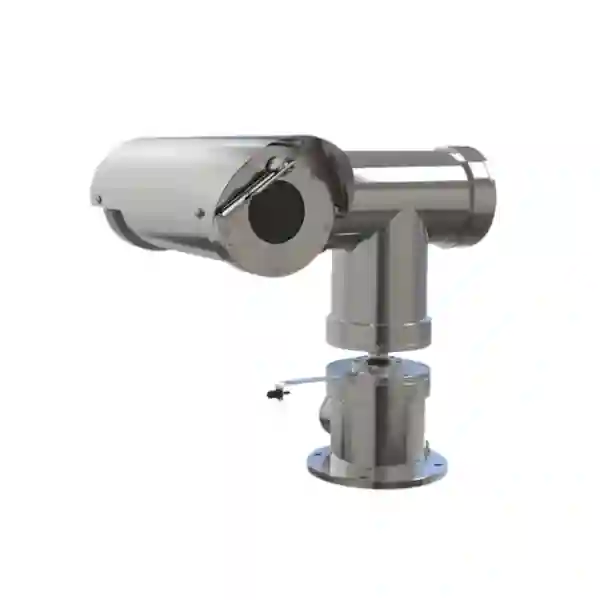
Hanwha Vision TNU-X6320E2WT1-M Explosion-Proof PTZ Camera
For hazardous-area surveillance projects that require remote positioning and optical zoom, this Wisenet T-series model offers Full HD video at up to 60 fps, 32x optical zoom, a built-in wiper, wide dynamic range and a heavy-duty stainless-steel camera station. The manufacturer lists the exact model as discontinued, so its role in a Tanzania specification should be evaluated alongside current supported options and verified hazardous-area requirements.
A practical buying summary
The Hanwha TNU-X6320E2WT1-M explosion-proof PTZ camera is designed for specialized industrial viewing requirements, not ordinary indoor or domestic CCTV. Its principal strengths are remote optical observation, multi-directional positioning, an industrial enclosure and onboard network-video functions. The first buying decision is whether the exact legacy model is genuinely required. If not, evaluate a current manufacturer-supported alternative against the same safety, power and coverage schedule.
Request a technical suitability review and quotation rather than assuming that a discontinued model, a related suffix or an accessory shown in a family brochure is available for immediate supply. Confirm certification acceptance, network design, installation scope and operating responsibilities with the project team.
Is this the right camera for your project?
The Hanwha Vision TNU-X6320E2WT1-M is an industrial positioning camera intended for projects where ordinary outdoor CCTV hardware may not be suitable. It combines Full HD imaging, remote pan and tilt, 32x optical zoom, a stainless-steel explosion-protected enclosure, and an integrated window wiper. Its value is not simply having a rugged appearance: it is the combination of a camera station design, surveillance functions, and hazardous-location construction that must be evaluated together against a site’s actual requirements.
The most important procurement fact is its product lifecycle. Hanwha Vision’s current listing identifies this exact model as discontinued. Buyers considering an expansion, repair, replacement, or specification match should first establish whether an authentic unit can still be supplied, whether spares and firmware support remain appropriate, and whether a current alternative is preferable. A discontinued device should not be presented as a routinely available new-stock camera or chosen without a lifecycle plan.
For a Tanzania project, start with an engineering brief rather than a model-only order. State the classified area, required viewing distances, camera mounting location, supply voltage, network route, recording platform, and whether the objective is live observation, forensic detail, process oversight, or incident verification. Request a documented compatibility and availability assessment before committing to a purchase or installation.
What the exact model designation tells you
Model suffixes matter on explosion-protected equipment. In this Wisenet T-series family, the E2 designation identifies the 110 V AC power configuration, W indicates the wiper-equipped construction, T1 is the standard temperature-range configuration, and M identifies the INMETRO variant. Those are useful distinctions when comparing replacement parts or responding to a bill of materials that lists several visually similar versions.
The exact TNU-X6320E2WT1-M designation does not contain the F2 segment used in the manufacturer’s series literature to identify an integrated single-mode fiber option. A general feature summary may refer to fiber across the family, but that should not be interpreted as proof that this particular non-F2 unit includes an onboard fiber interface. If fiber is specified in a project design, confirm the exact camera variant and the external network equipment that would be needed.
Do not interchange this model with a 24 V AC version, a more severe low-temperature option, or a different certification suffix based on outward appearance alone. The marking plate, order code, manufacturer documentation and hazardous-area design must all agree. This identification step is particularly important when an existing camera is being replaced under an established site maintenance procedure.
Where an explosion-protected positioning camera may be considered
Potential applications include observation of industrial process areas, fuel-handling infrastructure, certain chemical-processing locations, offshore or marine-adjacent operations, and other facilities with site-designated hazardous zones. These are examples of surveillance needs, not claims that this camera is universally approved for each environment. The applicable hazardous-area classification is determined by the facility’s engineering assessment, not by the industry name alone.
Remote positioning can help operators view several points from one elevated mounting location. A control-room operator might alternate between a wide overview and a close inspection of a gauge, transfer connection, access route or process interface. The optical zoom supports changes of scale without placing personnel near equipment solely to adjust a camera’s direction. Whether such observation is adequate for a safety or operational decision still depends on lighting, distance, resolution and operating procedures.
The camera should complement, not replace, process instrumentation, fire and gas detection, emergency shutdown systems or mandated physical inspections. Operators should define what a video image is expected to establish and what it cannot establish. For instance, video may show a visible spill or unauthorized movement, but it does not measure gas concentration, prove a pressure value, or certify that a plant is safe to enter.
Hazardous-area suitability comes before picture quality
An explosion-proof label is not a blanket authorization to install equipment in any classified location. Engineering selection must compare the device’s complete nameplate marking and supporting certificate against the site’s gas or dust group, zone or division, temperature class, ambient conditions and installation method. The original Wisenet T-series documentation describes multiple certification variants; the M suffix is associated with the INMETRO configuration.
A facility specification may ask for IECEx, ATEX, a particular national acceptance, or a named hazardous-area scheme. Do not assume these approvals are interchangeable or that an INMETRO-marked device automatically meets Tanzania regulatory and project requirements. Ask the responsible hazardous-area engineer and relevant project authority to confirm the acceptable certificate, the exact model’s current documentary evidence, and any local approval obligations.
Also review cable glands, blanking plugs, conduits, seals, earthing, bonding, fasteners and any accessory mounted in the same area. The complete installed assembly must preserve the protection concept. A compliant housing paired with an unsuitable entry fitting or undocumented field modification is not an acceptable substitute for a designed and inspected hazardous-area installation.
Full HD resolution and the role of optical zoom
The camera’s published headline output is 1920 x 1080, commonly called 2 MP or Full HD, with a maximum of 60 frames per second in supported H.264 or H.265 modes. This provides a practical format for many control-room displays and recording systems. However, a resolution figure alone does not establish whether a face, equipment label or vehicle detail will be identifiable at a specific distance.
The 4.44–142.6 mm lens offers 32x optical zoom. At the wide end an operator can survey a larger part of a scene; at the narrow end the camera can frame a smaller target with more image detail. That is useful when a mounting point is far from the observation target or when a project needs both overview and inspection views. Optical zoom is a lens function, whereas digital enlargement cannot restore scene detail that the sensor never recorded.
Before ordering, produce a field-of-view sketch with target distances and representative scene widths. If the purpose is recognition or identification, state the required pixels on target and test the proposed view. Consider where equipment, structures, piping, glare, heat shimmer, vibration and moving vehicles could block or degrade the image. A properly selected vantage point often matters more than an impressive zoom specification.
Pan, tilt and operator control
The series documentation specifies continuous 360-degree pan and a 180-degree tilt range, with published preset movement rates up to approximately 45 degrees per second horizontally and 24 degrees per second vertically. That positioning range makes the camera more flexible than a fixed-view unit where an operator must choose only one viewing direction during installation.
Flexible positioning also creates operational trade-offs. A single PTZ camera cannot simultaneously record every direction at full detail. When it is zoomed toward a remote inspection point, other activity may take place outside the field of view. Important routes or process points may require fixed supplementary cameras, independent sensors or carefully planned preset tours rather than reliance on one moving camera.
Before commissioning, define who may take PTZ control, which presets have priority, what happens after an alarm, and where the camera returns when a manual inspection ends. Test motion limits and views that may reveal restricted or private areas. Confirm joystick and preset behavior with the selected video management software, because controls and permissions can differ across integrations.
Low-light performance and realistic night expectations
The T-series specifications describe automatic day/night operation with an infrared-cut filter and nominal low-light sensitivity values of approximately 0.05 lux in colour and 0.005 lux in monochrome under specified measurement conditions. These are laboratory-style performance figures and do not guarantee clear identification under every industrial lighting pattern. Scene contrast, shutter settings, target movement and lens position all influence usable footage.
The camera is not presented here as a thermal imaging device or as a model with a built-in long-range IR illuminator. Buyers should not assume it sees heat signatures or delivers detail in total darkness simply because it can switch to black-and-white imaging. If a site requires night inspection, assess existing industrial lighting, permitted supplementary illumination and the rules governing equipment installed in the classified area.
Night tests should include moving targets, safety lights, illuminated equipment panels, reflections from stainless-steel surfaces and areas where the sun or floodlights enter the lens. Decide whether operators need situational awareness, readable text or evidentiary detail. A demonstration at the intended mounting height is the strongest way to expose night-time shortcomings before acceptance.
Wide dynamic range, defog and image stabilization
Hanwha Vision lists 150 dB wide dynamic range for this model, intended to help manage scenes containing bright and dark regions. Examples include a sunlit background behind shaded pipework or a doorway with strong exterior light. The specification can help procurement teams shortlist a camera, but actual performance should be judged in the site’s most demanding lighting conditions rather than from the numeric value alone.
The Wisenet T-series documentation also describes defog processing, backlight compensation, noise reduction and digital image stabilization associated with an onboard gyro sensor. These functions can improve usability in certain scenes, yet they are not substitutes for proper mounting, clean optics or suitable lighting. Severe atmospheric haze, steam, spray and smoke can still obstruct the scene, and digital processing cannot reveal objects fully hidden behind opaque material.
For acceptance testing, select repeatable scenes with glare, shadow, vibration and poor visibility. Record what operators must be able to recognize and compare actual clips at the chosen bitrate and frame rate. Avoid tuning every enhancement to its highest setting automatically; aggressive image processing may change motion rendition or perceived detail in ways that are unhelpful for the intended monitoring task.
Built-in wiper and the exposure of the viewing window
An integrated wiper is a practical differentiator for a camera mounted where rain, dust, spray or deposits may reach the optical window. The series description identifies a silicone wiper and a protective sunshield. These features can reduce the need for certain routine cleaning visits, especially where the camera is mounted above process equipment or at another location with restricted access.
A wiper cannot remove every deposit. Oil films, salt accumulation, abrasive dust, hardened residue and damage to the glass may still require an approved cleaning procedure. Operators should verify that the wiper sweeps the part of the window used by the camera, that it does not obstruct the normal viewing position and that appropriate maintenance intervals have been set for the specific exposure.
Hanwha Vision also lists a washer-tank accessory within this product family. Do not presume it is included in the camera package, compatible with every mounting arrangement, or suitable for installation in a particular classified area without checking the exact accessory documentation. A bill of materials should separate the camera, mounting hardware, any washer equipment and the associated installation parts.
Video analytics as an aid to operators
Manufacturer series literature describes analytics such as motion detection, tampering, directional or virtual-line events, loitering and other scene-based alerts. Such functions can assist operators by drawing attention to selected changes, but they are not guarantees that every hazardous event, person or object will be detected. The available functions and performance may depend on firmware, video settings and how a scene is configured.
A useful analytics plan starts with a narrowly defined event: movement across a marked access boundary, activity near a normally quiet area, or a camera obstruction condition. Configure the relevant region, operating schedule and response instruction. Then test people, vehicles, environmental movement and the most common false alarms. Windblown material, shadows, reflected light and routine machinery activity can produce unwanted triggers.
Alarm workflows should make responsibility explicit. Specify who sees an event, who confirms it from video, how long the clip is retained and when an alarm should be escalated. Analytics should never be treated as a certified safety instrument or the sole means of detecting a critical process hazard. Use them as an additional surveillance capability within a broader site safety and security design.
Video encoding, streams and network bandwidth
The series supports H.265, H.264 and Motion JPEG, with multiple streaming profiles. This gives an integrator options for balancing recorded image quality, control-room viewing, remote monitoring and available network capacity. A high-quality primary recording stream and a lower-bandwidth viewing stream may be helpful, provided the video management system can handle the selected combination correctly.
Bandwidth planning must be based on the actual scene and settings. Resolution, frames per second, motion, noise, compression method and bitrate control affect network traffic and disk consumption. A low-motion static view is not a suitable substitute for testing heavy movement or night-time sensor noise. Calculate both average and peak loads, and allow capacity for concurrent viewers, event exports and management traffic.
The T-series data also references WiseStream II and variable or constant bitrate configuration. Treat codec support as an opportunity to test efficiency, not a promise of a particular percentage saving. Confirm codec support on every recorder, client and integration path. Older management systems may accept one codec but not expose all metadata, recording modes or analytic functions.
Edge storage and resilient recording architecture
Two microSD, microSDHC or microSDXC slots are included in the published feature list. Series documentation describes a combined local capacity of up to 512 GB and support for recording arrangements that can use one slot after the other. The presence of card slots does not mean memory cards are supplied with the camera, and usable recording time will depend on bitrate and recording policy.
Industrial surveillance should not rely on one storage location without a retention and recovery plan. Determine whether the camera records continuously, on events, at selected times or into a central video management system. Decide how footage is handled during network outages, what happens if a card fails and how clips are protected from unauthorized changes. Test any intended failover or edge-recording recovery rather than assuming it will occur automatically.
Storage selection should consider supported card specifications, endurance under continuous writing, environmental conditions and access procedures. A camera that can record at the edge still needs careful time synchronization and an evidence-handling policy. Where footage may be used for incident investigation, document clock settings, export practices, access permissions and the retention period approved by the site operator.
IP networking and compatibility checks
The series technical material specifies RJ-45 10/100 Ethernet, IPv4 and IPv6 capabilities, and commonly used camera streaming and management protocols. It also references ONVIF profiles, RTSP and Hanwha’s SUNAPI interface in the wider T-series platform. These details are valuable starting points for integration planning, but the exact combination of firmware, recorder and camera functions must be tested before compatibility is promised.
Ask the integrator to verify live viewing, PTZ operation, presets, recording, event handling, playback, time synchronization and user permissions on the intended VMS. A camera may deliver video successfully while still requiring additional configuration for alarms or PTZ functions. The age and discontinued status of this model make a laboratory integration test especially valuable for a new project.
Industrial networks often impose segmentation, change control and restricted management access. Prepare an IP addressing plan, assign management ownership, confirm the permitted network path and document the camera’s dependencies. If live footage must pass through a remote link, evaluate latency and packet loss as well as capacity. Remote viewing should be designed around the site’s cyber and data-handling policy rather than exposing the camera directly to the public internet.
Fiber-optic connections: important variant distinction
Fiber is useful in some industrial camera architectures because it can support longer network runs and electrical isolation when paired with suitable equipment. However, the exact TNU-X6320E2WT1-M code is not an F2 variant. The manufacturer’s family specification describes an integrated simplex single-mode fiber module specifically for F2 models; the general product marketing language should not override the actual order-code distinction.
If the site’s network backbone uses fiber, there may still be a suitable architecture using a properly selected external converter or network node outside the hazardous zone, or a different camera configuration. Such an architecture needs its own power, enclosure, network, cable-route and certification assessment. Do not assume an off-the-shelf fiber converter can be mounted in a classified location.
During a like-for-like replacement, inspect the existing camera’s actual connection rather than relying on a photograph of the camera head. Record the cable medium, connector arrangement, termination location, switch port, network speed, link resilience and available space. If integrated fiber is mandatory, request a model-specific review instead of ordering the non-F2 device and expecting the feature to appear in software.
Power supply and electrical design
Hanwha Vision identifies 110 V AC power for the exact E2 model. This is a critical specification in a Tanzania project because site electrical distribution may not directly provide the voltage required by the camera. The installer must design a compliant, appropriately rated supply arrangement for the actual site. Do not connect the unit to a different mains voltage, assume Power over Ethernet capability or substitute a 24 V AC power arrangement.
The broader T-series literature describes power consumption of up to 80 W depending on configuration. Use the final exact-model electrical documentation and nameplate when sizing circuits, protective devices, power conversion and backup capacity. Consider startup behavior, supply tolerances, earth continuity, surge exposure and the effect of a supply interruption on both positioning and recording functions.
For critical observation points, define what must remain operational during a power disturbance. A UPS or protected supply may be appropriate in some designs, but its location and components must meet facility standards and hazardous-area requirements. Acceptance testing should verify safe restart, clock recovery, network reconnection and the camera’s normal home position after loss and restoration of power.
Stainless-steel housing, ingress protection and mounting
The camera station series uses electro-polished 316L stainless steel for welded housing assemblies, A4 stainless-steel fixings and a toughened-glass viewing window. The published ingress protection is IP66/IP67. Together, these characteristics make the family relevant to exposed industrial installations, but no material or IP rating eliminates the need to assess corrosive substances, mechanical impact, cleaning chemicals or mounting loads.
The series drawing indicates a large, substantial unit, with the family weight described as up to approximately 53 kg. Because weight varies by configuration and mounting hardware, structural design must use exact approved documentation rather than a casual estimate. Check the support steelwork, dynamic effects, vibration, bolt arrangement, wind exposure, maintenance access and safe lifting method before any camera is brought to site.
Surface corrosion resistance is only one part of a durable installation. Incorrect fasteners, unprotected dissimilar-metal interfaces, damaged finishes or poorly selected cable entries can create maintenance problems. Plan for inspection of seals and glass, accessible cable routing, correct torque procedures and future replacement. Mounting brackets listed for the family should be treated as accessories requiring their own fit and installation checks.
Temperature range and environmental reality
The T1 model configuration in the Wisenet T-series is associated with an operating ambient range of approximately -40 °C to +60 °C. This specification helps screen the product for outdoor industrial use, but actual installation conditions may include direct solar heating, reflected heat from nearby structures, hot equipment, vibration or aggressive airborne contaminants. An ambient rating is not permission to ignore local hot spots.
For a Tanzania facility, the engineering assessment should consider climate at the exact location, the height and orientation of the mounting point, seasonal weather, severe rain and any process-generated heat. Salt exposure and chemical spray matter where relevant. The camera’s window, glands, support and accessible maintenance points may experience different conditions from a weather station elsewhere on the property.
If the camera is replacing an existing station, review fault and maintenance records for recurring condensation, wiper failure, corrosion, seal deterioration or heat-related interruptions. A replacement proposal should address those root causes rather than repeat an arrangement that previously failed. Where the site specification calls for a different minimum or maximum ambient range, select the suitable documented model variant instead.
Cybersecurity and legacy equipment governance
Discontinued surveillance hardware deserves an explicit cybersecurity review. The presence of HTTPS, access controls or network protocols in an older specification does not establish that the product currently receives security fixes or supports every security setting required by an organization. Ask the device owner to verify available firmware, published advisories, management methods and compatibility with current network security policy.
A practical baseline includes unique administrator credentials, least-privilege user roles, restricted management interfaces, synchronized time, documented configuration backups and separation from unrelated business networks. Disable unnecessary services where supported and approved. Avoid default passwords and avoid forwarding camera management ports directly from the internet. Central logging and change records can help a maintenance team investigate unexpected behavior.
If continued use of the discontinued model is necessary, document the business reason and compensating controls. Establish who monitors vendor guidance, who approves firmware changes, and when replacement will be reviewed. Any software upgrade should be tested against the recording platform and PTZ functions before deployment. Security administration is part of the product’s ongoing cost, not a one-time installation checkbox.
Pre-installation engineering checklist
A detailed site survey prevents costly corrections after hardware reaches a restricted work area. Capture the intended scene, target distances, viewing height, mounting geometry, desired presets, illumination, vibration sources and cleaning access. Include a photograph or drawing that shows expected obstructions. The camera should be selected against those observations rather than only against a generic surveillance equipment schedule.
Next, document the hazardous-area classification and the responsible engineering sign-off. Record required certificate markings, the allowed ambient range, the protection concept, cable entry requirements, earthing and installation rules. Confirm the proposed camera and all accessories against these documents. Procurement should not finalize a hazardous-area camera solely because a distributor description uses the phrase explosion proof.
Finally, define electrical and network interfaces: actual 110 V AC supply arrangement, circuit protection, cable lengths, termination points, switch capacity, recorder platform, required storage, client software and operating permissions. Establish which party will supply and test each component. A clear interface schedule also helps identify whether a missing bracket, gasket, storage card or network converter would otherwise delay the project.
Installation, access and commissioning responsibilities
Work on explosion-protected camera stations should follow manufacturer instructions and the facility’s permit, competency and inspection requirements. Qualified installers need the approved mounting method, lifting arrangement and cable-entry design before work begins. Any action that opens or modifies the certified enclosure should be governed by the applicable maintenance procedure; improvised drilling, component substitution or seal changes can compromise the protection concept.
Commissioning should test the camera as a complete surveillance point. Verify power and restart behavior, image quality at representative distances, pan and tilt limits, presets, wiper movement, day/night transitions, network stability, recording, playback, operator controls and alarm behavior. Save representative footage under realistic lighting and network load. Document the exact firmware and configuration used to achieve acceptance.
The handover package should include the model and serial identifiers, approved certificates for the supplied unit, installation drawings, electrical information, network configuration, VMS test results, maintenance instructions and an exception list. Operators also need a simple explanation of expected performance and limitations. A thorough handover is especially important when future support staff may be maintaining a discontinued model.
Maintenance and lifecycle planning
A useful preventive-maintenance program should cover the optical window, wiper, seals, corrosion, fasteners, support stability, cable entries, earthing and image quality. The interval depends on the facility and exposure, not merely a generic calendar. If the installation is in an area with restricted access, plan inspections around the site’s permit and shutdown arrangements without compromising surveillance coverage.
Review recording and camera functions periodically as well. Confirm that time settings remain correct, cards or central storage remain healthy, alarms reach their intended recipients, presets still frame the correct targets and users retain appropriate permissions. Environmental change matters: a new structure, tank, light or pipe run may block a previously useful view even while the camera itself continues to operate.
Because Hanwha Vision lists this model as discontinued, maintenance planning should include spare availability, repair options, firmware policy and the criteria that would trigger replacement. An organization relying on multiple installed units can benefit from a configuration inventory and an agreed migration strategy. Avoid assuming that accessories, boards or a newer family member can be substituted without matching the electrical, mechanical and certification requirements.
Replacement and migration considerations
When a replacement is needed, the first question is whether it must preserve an existing certified installation or whether the site can adopt a revised architecture. A like-for-like physical shape does not mean a drop-in electrical or hazardous-area replacement. Compare approved markings, supply voltage, operating temperature, mounting loads, lens coverage, PTZ behavior, video interfaces and the requirements of the control room.
A newer model may offer different sensing, resolution, analytics or software support, but those advantages should be evaluated against what the operation actually needs. Higher resolution may create additional bandwidth and storage demand. A different lens may change what operators can inspect from the existing mount. Changing a fiber or power option can require significant infrastructure work even when the camera housing looks similar.
Do not assume that replacement suggestions shown for a different suffix, such as a C or Z variant, apply to the exact M variant. Ask for the current Hanwha-approved model-specific selection and documentary comparison. For a discontinued camera, a disciplined migration study can reduce the risk of buying equipment that works on a desk but cannot be accepted in the intended classified location.
What to ask for when requesting a quotation
Provide the exact part number TNU-X6320E2WT1-M and state whether the requirement is a legacy spare, a replacement of an existing installed unit, or a new facility design. Attach the hazardous-area schedule and the specification or photograph of the existing nameplate when available. This distinction helps the reviewing team avoid proposing an equipment family that lacks the correct certification or interface.
Include the required delivery destination in Tanzania, the number of units, intended installation environment, supported mains supply, mounting preference, camera management platform and any desired wiper or washer arrangement. Ask whether a currently supported alternative should be assessed. Do not assume a quotation will include site installation, commissioning, storage cards, brackets or network infrastructure unless these items appear explicitly in the bill of materials.
Before issuing an order, request written confirmation of the exact offered model, current manufacturer status, product condition, relevant documentation, available support, lead time, price, commercial terms and scope of supply. No stock, delivery date, warranty or Tanzania approval is asserted by this page. The appropriate next step is a technical and commercial review based on your facility’s actual constraints.
Frequently asked questions
Is the Hanwha TNU-X6320E2WT1-M still a current production model?
No. Hanwha Vision’s current product page marks the exact model as discontinued. That does not by itself establish whether a distributor holds legacy inventory, whether spares can be obtained, or whether a particular existing unit can be repaired. For procurement, request confirmation of the offered unit’s status and support path. New projects should also assess a current alternative that satisfies the same hazardous-area, electrical, optical and integration requirements.
Is this a thermal camera?
No. The documented camera is a visible-light Full HD network PTZ camera with day/night functionality. Its low-light monochrome capability is not the same as thermal imaging and should not be sold as heat detection. If thermal inspection, hot-spot observation or fire-related analytics are required, those needs must be specified separately and met by suitable equipment and approved safety processes.
What is the camera’s optical zoom?
The Wisenet T-series documentation states 32x optical zoom, with a 4.44–142.6 mm lens. This helps an operator move between overview and distant detail from a single mounting position. The usefulness of that zoom depends on the distance, subject size, image quality and obstructions. It is best verified against a documented field-of-view requirement and sample scenes.
Does the exact M model have integrated fiber?
The specific part number does not include the F2 segment. In the manufacturer series documentation, integrated single-mode fiber is identified as an F2-model feature. Do not treat a family-level reference to fiber as evidence that the non-F2 TNU-X6320E2WT1-M includes it. A fiber-connected project may need a different camera variant or a separately engineered conversion arrangement.
Can this model run on a normal PoE camera port?
The manufacturer’s exact product listing specifies 110 V AC power, not Power over Ethernet. Do not plan to supply operating power through a PoE network port or connect an unverified mains voltage. The electrical designer should confirm the nameplate, required power source, cable design and protection arrangements before installation. Network connectivity and device power are separate design decisions for this camera.
What is the maximum video resolution and frame rate?
Hanwha Vision advertises 1080p video at up to 60 frames per second. The family supports multiple stream and compression settings, so actual delivered frame rate depends on the selected codec and configuration. For an engineering specification, confirm the required output format on the actual video management platform and test the desired recording and viewing profiles together.
What does explosion-proof mean for this product?
It describes a camera station engineered for certain hazardous-area applications under specified certification markings and installation conditions. It does not mean the device is immune to explosions or approved for every gas, dust, temperature and location. The exact nameplate, certificate, installation accessories and site hazardous-area classification must be reviewed by competent personnel before the equipment is accepted.
Does an INMETRO suffix prove approval for a Tanzania site?
No automatic Tanzania approval is claimed. The M suffix identifies the manufacturer’s INMETRO version, but acceptance depends on the project’s requirements and applicable local rules. Have the responsible engineer verify the exact certificate, zone or division classification, temperature class, environmental conditions and any authority requirements before procurement or installation.
Can one PTZ camera replace all fixed cameras in an area?
Not necessarily. A PTZ station can point in different directions and zoom onto remote objects, but it cannot provide simultaneous detailed coverage of every direction. If a facility requires continuous observation of several independent locations, complementary fixed cameras or other monitoring systems may be required. Coverage design should reflect the risk assessment and the operator’s normal workflow.
Does the product include memory cards or a washer tank?
The published features identify two onboard microSD-family slots, not supplied storage cards. The manufacturer also lists washer-related accessories for the camera family, but that is not evidence that a washer tank is included in this exact unit’s package. Request an itemized quotation and confirm every required accessory, its suitability and any installation restrictions.
What mounting and structural checks are important?
The industrial positioning assembly is significantly larger and heavier than typical compact CCTV devices. Use the exact approved drawings and equipment weight to assess structural supports, bracket type, fasteners, vibration, wind and safe lifting. The mounting arrangement must also preserve hazardous-area compliance and provide appropriate maintenance access. Never rely on the appearance of a catalogue photograph to size a support.
Can the device connect to an existing VMS?
The Wisenet T-series documentation includes network video and interoperability features, including ONVIF and Hanwha interfaces. Integration is not automatic across all recorder versions. Test viewing, presets, PTZ control, recording, playback, events and permissions with the exact proposed software and firmware. Legacy status makes this pre-acceptance test especially relevant.
How should night-time performance be evaluated?
Test at the real mounting position with the site’s typical night lighting and representative moving objects. The camera supports day/night operation and has published low-light sensitivity, but it is not a thermal sensor and does not guarantee identifiable images in darkness. Evaluate glare, reflections, shadows, weather, shutter settings and the smallest target that an operator must recognize.
What information is needed for a Tanzania quotation?
Send the full model number, site type, quantity, intended mounting location, hazardous-area specification, available power, network medium, desired viewing distances, recording platform and required accessories. Indicate whether you are matching an installed unit or choosing a new design. Ask for documentary confirmation of model status, technical suitability, availability, scope of supply and commercial conditions before approving an order.
Request a model and suitability review
Share your exact model number, hazardous-area requirements, site drawings and viewing objectives with the FourTeck Tanzania team to discuss a technical quotation or a suitable alternative. Product status, commercial terms, delivery, installation scope and any applicable approvals must be confirmed before ordering.
Next step: Request technical verification and a quotation from FourTeck Tanzania.
Editorial qualification: Product specifications reflect manufacturer information and series documentation. Discontinued status, actual offered configuration, applicable certification, software support, accessories, local regulatory acceptance and commercial availability require independent confirmation for each project. This page is not a hazardous-area design approval.




Reviews
There are no reviews yet.