
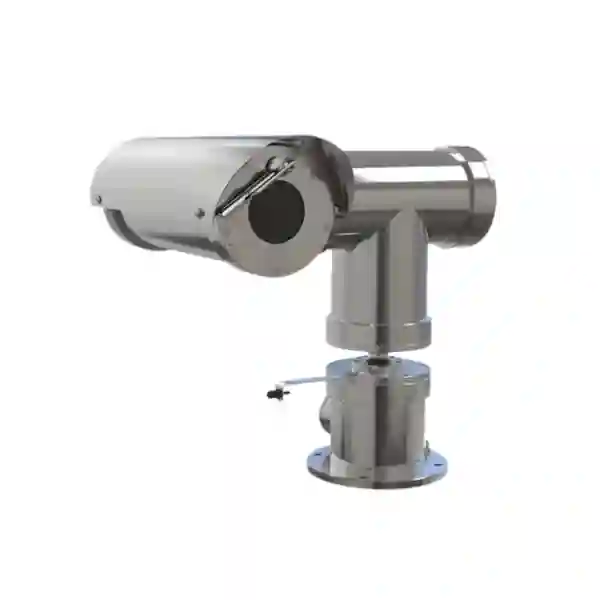
Hanwha TNU-X6320E2WT2-C Explosion-Proof PTZ Camera
Need a positioning camera for a classified industrial area? The Hanwha TNU-X6320E2WT2-C combines Full HD video, 32x optical zoom and an integrated wiper in a specialist explosion-proof assembly. Select it through a hazardous-area engineering review, not by outdoor CCTV specifications alone.
Next step: request a technical quotation with the exact model number, area classification, power information and intended camera views. Equipment approval, commercial terms and current availability require confirmation.
Verified feature summary
This reference table separates manufacturer-described capabilities from installation questions that must be closed during engineering review. It is not a substitute for the current certified drawing, equipment label or installation instructions.
| Model | TNU-X6320E2WT2-C |
|---|---|
| Camera class | Explosion-proof network PTZ / positioning camera |
| Resolution | 2MP, 1920 × 1080 |
| Maximum stated frame rate | 60 fps |
| Lens capability | 32x optical zoom with autofocus |
| Wide dynamic range | 150 dB |
| Power input | 110 V AC |
| Weather ingress marking | IP66 / IP67 |
| Camera features | Integrated wiper, video analytics, multiple streaming |
| Local memory | Dual micro SD/SDHC/SDXC slots |
| Hazardous-area information | cLC CSA per manufacturer; suitability subject to exact certification and site approval |
| Temperature limit | Confirm exact nameplate and current certified ambient range |
What this camera is designed to solve
The TNU-X6320E2WT2-C is a specialist network positioning camera for projects where a conventional outdoor PTZ would be inappropriate because the installation area has a classified hazardous atmosphere. Its value is not simply a strong enclosure or a longer zoom lens. The purchasing decision begins with matching the approved protection concept and equipment markings to the site’s risk assessment, then confirming that the camera can produce useful images from a safe, maintainable mounting position.
Industrial security teams commonly need to see across pipe racks, process boundaries, transfer areas or remote equipment without placing an operator close to every activity. Pan, tilt and optical zoom allow the monitoring team to investigate a selected scene, while Full HD video supplies context for live observation and recorded review. A positioning camera is particularly useful when the scene of interest changes during an event or inspection.
This model should be specified as part of an engineered system rather than treated as an ordinary plug-and-play CCTV purchase. The site survey, classified-area drawing, electrical design, network design and recording plan are all important. Share those project details when requesting a quote so the proposed unit, accessories and support arrangements can be checked against the real installation.
At-a-glance technical capabilities
Hanwha Vision identifies this model as a 2MP, 1080p explosion-proof PTZ camera with up to 60 frames per second, 32x optical zoom, autofocus, 150 dB wide dynamic range, intelligent video analytics, multiple streaming and an integrated wiper. Dual micro SD-family card slots support an additional recording option. These features address a practical combination of long-view inspection, adverse lighting, wet windows and network video management.
The camera is specified for 110 V AC input. That is a critical distinction when planning power distribution: the presence of an IP network interface must not be mistaken for confirmation that a conventional PoE switch can power the unit. Choose suitable wiring methods, local isolation and protection based on the approved installation documentation and the electrical rules applicable to the facility.
The protection description includes IP66/IP67 and cLC CSA hazardous-location certification in the manufacturer information. These are different kinds of claims: ingress protection concerns dust and water exposure, while hazardous-area approval concerns use in specifically classified explosive atmospheres under defined conditions. Neither marking alone establishes acceptance for every Tanzania site or every gas or dust zone.
Optical zoom versus a fixed overview camera
The 32x optical zoom changes what operators can examine without relying entirely on digital enlargement. A fixed wide-angle camera may show the general process area yet leave valve positions, equipment condition or incidents too small to review. A long-reach PTZ can narrow the field of view to inspect a chosen point, while the same platform can return to a wider scene for awareness when the investigation is complete.
Zoom should not be presented as a guarantee that a person, label, licence plate or mechanical defect can be identified from any distance. Effective detail depends on mounting height, scene width, atmospheric haze, lighting, vibration, focal setting and the pixel density required by the task. A pre-installation view study helps decide whether the target is realistically observable rather than relying on magnification alone.
Because the camera looks in one direction at a time, it is not a substitute for continuous coverage of every critical location. Sites with multiple simultaneous risks may combine fixed cameras for persistent awareness with a PTZ for active investigation. Specify the expected preset positions and who will control movement when alarms or competing operator requests occur.
Full HD video and 60 fps: where they matter
Full HD imaging provides a balanced format for many industrial control-room displays and recorded investigations. At its supported maximum frame rate, the camera can convey smoother motion than a lower-frame-rate stream when the operator is tracking a moving subject or repositioning the PTZ. The final configured frame rate may be lower to fit network conditions, scene requirements and recording retention objectives.
Resolution and frame rate must be assessed together rather than taken as separate marketing numbers. A clear, steady view at a well-chosen exposure can be more useful than a technically higher frame rate with poorly positioned lighting. For slow process observation, a lower frame rate may be entirely adequate. For rapid movement, the system designer should examine motion blur, exposure, storage demand and network traffic.
Ask the integrator to test both live and recorded images against the actual monitoring task. The control room may receive a primary high-quality stream while remote users receive a separately configured profile. During acceptance testing, use representative day and night conditions and check whether the important scene details remain visible in playback, not only in a demonstration clip.
Wide dynamic range for mixed lighting
Industrial cameras frequently face strong contrasts: outdoor sunlight behind a shaded gantry, reflective steel beside a dark vessel, or floodlights near an unlit boundary. The manufacturer’s 150 dB WDR specification is intended to help preserve detail in scenes with bright and dark regions. It is a useful capability, but the measured number does not guarantee a perfect image in every difficult arrangement.
Large, highly reflective surfaces and directly facing light sources can still reduce useful detail. Where possible, place the camera so that the critical target is not permanently silhouetted. Review exposure settings at different times and make sure the WDR configuration does not sacrifice the detail needed to distinguish small movements or equipment states.
Day and night viewing should also be considered separately. A camera that handles backlighting well during the day may need sufficient external illumination at night. Do not assume this model includes an integrated infrared illuminator unless the exact supplied configuration documents it. If additional lighting is needed in a hazardous area, its equipment approval and electrical arrangement require their own assessment.
Built-in wiper and window visibility
The integrated wiper is especially relevant at sites where rain, spray, mist or contamination can obscure the camera window. A remote operator may lose an otherwise useful view simply because droplets remain in front of the lens. The ability to clear the surface can reduce the need to visit the installation for routine visibility issues, provided the wiper and window are maintained appropriately.
A wiper does not make the assembly self-cleaning under every condition. Sticky residue, salt deposits, oil film or abrasive dust may still require a planned cleaning procedure. Avoid allowing an unapproved chemical, cloth or tool to damage the viewing window, coating or seal. The site’s maintenance plan should follow the manufacturer’s instructions for cleaning and safe access.
Discuss whether the expected environment also calls for a compatible washer system, sheltered position or additional inspection frequency. Never assume that a washer tank or mount shown among related accessories is included in this particular unit. Any connected cleaning equipment needs its own electrical, mechanical and hazardous-location review before being added to the installation.
Explosion-proof construction: what to verify
The explosion-proof description addresses a specific risk: electrical or mechanical equipment located where a flammable atmosphere might be present. Suitability is determined by the actual certified variant, equipment markings, gas or dust group, temperature class, permissible ambient range and installation conditions. The protection method should be reviewed by a competent hazardous-area engineer with access to the facility’s classification documents.
It is incorrect to treat the words explosion-proof as meaning that the camera can withstand any blast or be installed in any hazardous zone. Certification has defined boundaries, and seemingly minor substitutions in cable glands, fittings, enclosures or accessories can affect the approved assembly. The final purchase should therefore identify the precise model suffix and any required certificates before components are ordered.
For a Tanzania project, request copies of the applicable certificates and installation instructions, then have the responsible project team assess their relevance to local requirements and the specific facility. A certificate issued under one scheme is not automatic proof of acceptance by a different authority or project specification. Document the approval decision as part of the engineering file.
Understanding this exact model variant
Long Hanwha model numbers encode meaningful engineering differences. The TNU-X6320E2WT2-C designation must be quoted in full because power arrangement, environmental variant, interface options and certification can differ among products with nearly identical names. The manufacturer’s exact-model page confirms 110 V AC power, the wiper, PTZ operation and the primary video features for this designation.
Do not silently substitute a WT1, F2, Z or M variant because it looks similar or has an attractive price. A model with an additional fiber designation, a different protection certificate or another temperature option may change procurement, mounting or connectivity decisions. Confirm the unit’s label and documentation match the approved equipment schedule before shipping or installation.
The manufacturer page presents an operating temperature claim, but other publicly circulated product documents have shown a different upper limit for this code. For safe engineering selection, treat the certified ambient temperature range on the exact equipment marking and current certification documents as the controlling verification point. Do not rely on a distributor summary to settle a potentially safety-critical discrepancy.
Network connection and data paths
This is an IP video camera, so its value depends on a reliable network route between the installed unit and the video management system. The related platform documentation identifies Ethernet connectivity and modern streaming protocols. Design the connection for the actual pathway length, equipment-room arrangement, electromagnetic conditions and resilience requirements rather than assuming that an ordinary office cabling pattern will be suitable.
Pay special attention to the distinction between the Ethernet network and the camera’s 110 V AC power. An IP data connection does not remove the need for the separate, correctly designed power feed. Any switching, surge protection, isolation or media conversion installed near a classified area must also be assessed for suitability at that location.
The exact TNU-X6320E2WT2-C code should not be marketed as having built-in fiber merely because some cameras in the broader family offer fiber-equipped variants. Where the design calls for long fiber runs or electrical isolation, ask the supplier to identify the approved interface arrangement and the complete bill of materials. Test video continuity and PTZ control over the proposed connection before commissioning.
Compression, multiple streams and bandwidth
Hanwha’s related XNZ-6320 camera platform supports H.265, H.264 and MJPEG codecs, and the exact positioning camera is advertised with multiple streaming. This can help engineers create different profiles for recording, operator viewing and constrained remote links. The preferred configuration depends on the capabilities of the receiving system, not only on the camera’s list of codecs.
Higher frame rates, detailed moving scenes and frequent PTZ operation can raise the data rate. Compression efficiency also varies with changing foliage, rain, haze, machinery movement and low-light noise. A realistic bandwidth estimate should therefore be based on the scene and chosen quality settings, with enough headroom for simultaneous users and exceptional activity.
Keep the operator’s real-time video usable without undermining the retained recording. For example, a lower-bandwidth viewing profile may be appropriate for a remote dashboard, while the primary recorded stream preserves more detail. Confirm that the recorder can ingest the selected format and that any transcoding or analytics processing does not create a hidden bottleneck.
Video management system integration
Successful deployment requires more than getting a live picture into a browser. The project should confirm that the chosen VMS or NVR can discover the camera, record supported codecs, receive events, control PTZ movement, recall presets and provide the user permissions needed by the site. The manufacturer platform references ONVIF and network protocols, but each required function should be verified against the actual software version.
Some integrations expose only basic video and controls. Features such as detailed analytics metadata, event rules, device health, specialized wiper commands or configuration settings may depend on a particular driver, API or firmware release. Ask for an integration matrix that names the software version and the tested operations rather than relying on a general compatibility statement.
Before final acceptance, exercise all routine workflows from the control room. Confirm live viewing, recording and export; test a network interruption and recovery; check that PTZ movement follows the right user privileges; and document how the team will restore service after a device replacement or configuration reset. These operational tests reveal issues a simple camera-image demonstration can miss.
Intelligent video analytics: scope and limitations
Hanwha lists intelligent video analytics among the model’s main features. Depending on camera firmware and VMS configuration, analytics can assist operators in identifying selected changes in a scene and triggering a review workflow. The correct objective is to make significant video more discoverable, not to promise automatic understanding of every person, object or process event.
Industrial environments can generate difficult inputs for rules-based detection. Steam, moving machinery, reflections, insects close to the window, rain and frequent PTZ movement can all affect event quality. Configure detection zones and thresholds for the real scene, and validate performance during the operating conditions in which alarms matter.
Analytics should supplement—not replace—site safety instrumentation, process protection, human procedures or an approved life-safety system. Establish which event types the current firmware and VMS actually support, the expected nuisance-alarm level, and the human response after an event appears. If the project requires a specific analytic function, make successful testing an acceptance criterion before the purchase is finalized.
Pan, tilt, presets and operator control
PTZ control allows a monitoring team to move from wide surveillance to focused observation. For operational consistency, specify sensible preset views: a facility overview, selected equipment groups, a gate or transfer point and any other authorized targets. Name each preset for the task it serves so operators can find the required view quickly when an event occurs.
Control policy matters when multiple people monitor the same camera. An operator investigating an incident may lose sight of the target if an automated tour or another user unexpectedly moves the PTZ. Define priorities for manual control, scheduled tours and event-driven preset movement. Decide whether a safety or security event should interrupt a routine inspection sequence, and test that rule.
A continuously moving PTZ should not create an assumption that every location is monitored at every moment. Document blind periods, tour dwell times and the importance of adjacent fixed coverage where continuous observation is necessary. Include the ability to return to a known safe or useful view after power restoration in commissioning and operator training.
Onboard memory and recording resilience
The manufacturer identifies dual micro SD/SDHC/SDXC card slots. Local recording can be useful in some system designs, especially when an upstream link is temporarily unavailable, but capacity, supported media, recording modes and recovery behavior need confirmation for the exact firmware and configuration. The presence of two slots is not proof of automatic mirrored recording or uninterrupted evidence protection.
A robust recording strategy starts with the required retention period, event importance, video quality and available network storage. Estimate capacity using observed bitrates and realistic scene conditions. Decide whether the camera will record continuously, on events or according to a mixed policy, then verify how that policy behaves during outages.
Storage cards installed in challenging industrial locations may need inspection and replacement procedures. Plan secure evidence export, time synchronization, access permissions and retention controls as part of the system. Test the full path from an incident to a readable, time-stamped file; otherwise a camera that appears healthy in the live view may still fail the investigation objective.
Power engineering for a 110 V AC camera
The exact model’s 110 V AC input is a procurement-critical specification. Many industrial facilities have different distribution arrangements available at a camera mounting location, so the engineering team must check the site supply instead of assuming direct connection to an existing circuit. The final design may require appropriately approved supply equipment, protective devices and isolation methods.
Power distribution near a classified hazardous area requires coordination between the camera supplier, electrical engineer and site safety authority. Cable-entry components and field terminations must follow the certified installation method. A mechanically convenient gland or junction box is not necessarily suitable merely because it fits the thread or looks weather-resistant.
Include the actual camera load and any permitted accessory loads in the power budget, and check protection against interruptions where continuous monitoring is necessary. Avoid promising a particular restart time or backup duration without system testing. Record the as-built supply, protective device, isolation point and maintenance procedure so service teams do not have to reconstruct the electrical design later.
Mounting position, wind and vibration
A PTZ camera can offer excellent optical reach yet produce disappointing images if its supporting structure moves. Mounting design should account for wind loading, equipment vibration, bracket stiffness, maintenance access and the need to avoid obstructions throughout the intended pan-and-tilt range. A site survey should include the likely worst viewing angle, not just a convenient straight-ahead image.
Carefully consider installation on pipework, vibrating machinery or lightweight handrails. These may be unsuitable attachment points even if the mechanical hardware appears strong. The weight and attachment requirements of an explosion-proof assembly can be substantial; the final loads, fasteners and structural calculations must follow the approved camera and mount drawings.
Positioning also affects operator safety. A location that offers a good view but cannot be accessed safely for inspection, wiper service or replacement may create ongoing operational problems. Balance surveillance coverage with lifting arrangements, fall protection, isolation access and the ability to maintain hazardous-area integrity during later work.
Ingress protection, corrosion and outdoor exposure
IP66/IP67 ratings indicate specified protection against dust and water ingress under defined test conditions. They do not remove the need for correct cable entry, sealing and installation orientation. A site with heavy seasonal rainfall, wash-down operations, exposed pipe racks or water spray should confirm that the final assembly maintains its intended sealing when installed and serviced.
The related explosion-proof housing documentation describes corrosion-resistant construction, including stainless-steel components, but exact material and finish should be checked against the supplied drawing and certificate. Chemical exposure, salt air and wash-down solutions can introduce hazards that are not explained by an IP rating alone. Ask the site materials specialist to review the operating environment.
Outdoor reliability is a system property. Poorly protected cable terminations, unsealed junctions, incorrect fasteners or inaccessible cleaning arrangements can undermine an otherwise suitable camera. Define inspection intervals according to local conditions and maintenance history, then document any corrosion, seal damage or window contamination that appears during service.
Low-light performance and night observations
Day and night surveillance can involve very different visual tasks. At night, the operations team may need to see the outline of equipment, distinguish movement at a boundary or verify whether an area is clear. The camera’s imaging capabilities should be tested using the actual installed lighting rather than assuming that a daytime demonstration predicts nighttime results.
The related camera platform supports day/night switching and low-light imaging, but useful detail still depends on scene illumination, exposure and motion. A wide zoom setting can change how much light reaches the sensor. Rain, fumes, dust and reflections may further reduce clarity, especially when distant targets are involved.
Where supplemental illumination is necessary, identify the required field of view and confirm that light fixtures and wiring are suitable for the installed area classification. Do not promise that this specific camera supplies its own infrared lighting without verified exact-model documentation. Record night acceptance images at key presets so future changes in lighting or image quality can be recognized.
Planning for Tanzania industrial installations
For buyers evaluating this camera for a Tanzania project, the most useful local information is the actual site specification, not an unsupported claim about stock, delivery or installation coverage. Facilities differ significantly in climate, electrical distribution, access rules, exposure to dust or moisture and hazardous-area classification. Those facts should drive the technical schedule and procurement requirements.
Ask the project engineer to supply the installation zone or division classification, equipment marking requirements, environmental conditions, desired viewing distances and existing network architecture. If a procurement document mandates a particular approval scheme, clarify that requirement before quoting the model. The manufacturer certification must be checked against the facility’s accepted basis of design.
Commercial questions should be handled separately from technical suitability. Request confirmation of the exact orderable variant, current lifecycle status, applicable warranty terms, lead time, local taxes and delivery arrangements through a formal project quotation. None of these particulars should be assumed from an overseas seller’s listing, and a foreign price is not a verified Tanzania price.
Oil, gas and petrochemical use cases
Oil and gas installations may need visual observation around transfer systems, processing structures, storage boundaries and equipment corridors. An explosion-proof PTZ can be considered where the hazardous-area assessment permits the certified device and where operators benefit from changing the viewing direction. The specific mounting point must be selected by the facility team because classification boundaries are not uniform across a site.
Typical monitoring goals include observing activity at a remote work area, checking the condition of a visible process location and reviewing movement around an authorized route. Zoom can help the operator inspect a selected section without moving into the area. It cannot determine gas concentration, certify a safe atmosphere or replace process sensors and emergency shutdown systems.
Specify the monitoring task in operational language, such as observing a loading connection or verifying access at a defined point. Then test whether the proposed camera position and preset provide adequate visibility. This approach produces a more defensible design than choosing a PTZ solely because its brochure lists a high zoom ratio.
Chemical plants and industrial process areas
Chemical processing sites may combine classified atmospheres, difficult lighting, reflective equipment and demanding maintenance rules. A specialist camera can serve as part of a controlled observation system when the exact equipment approval is suitable. Its PTZ movement may assist in checking several process views from a location where fixed wiring and safe maintenance access have been carefully planned.
Project teams should consider whether vapours, corrosive agents or cleaning chemicals could affect exposed materials or the viewing window. An explosion-protection marking does not automatically establish chemical resistance to every substance used on site. Confirm the materials and cleaning requirements against the actual process environment and any site-specific engineering standards.
An effective deployment brief names the views required during ordinary operations and during an incident. It also identifies conditions when the camera must not be moved away from a critical view. Combine those requirements with VMS permissions, alarm handling, signage and training so that video supports established operating procedures rather than creating a parallel, unmanaged process.
Marine terminals, exposed structures and remote yards
Some maritime and heavy-industry locations place cameras on exposed towers, structures or equipment where wind, moisture and distance complicate surveillance. The camera’s enclosed construction and long optical zoom may be useful attributes, subject to suitable certification, structural design and corrosion review. Treat marine exposure as an engineering assessment rather than assuming the product is universally suitable for any waterfront environment.
At a remote camera point, communication reliability can be as important as image quality. Evaluate available cable routes, power distribution, grounding and surge measures, and the distance to network equipment. When a design proposes fiber connectivity, verify the precise interface and approved accessory arrangement instead of assuming an F2 option is present on this model.
Maintenance planning is especially important if access needs a platform, lifting equipment or a restricted work permit. Agree on a practical inspection route and safe isolation procedure before installation. The initial cost comparison should include these operational requirements, not only the price of the camera body.
Survey checklist before ordering
A productive survey begins with the engineering and surveillance objective. Mark the classified area boundaries and required equipment approvals on the same drawing as the proposed camera locations. Add the view targets, approximate distances, obstructions and the expected lighting conditions. A sample image from a comparable height and angle can help validate the field of view before expensive mounting work begins.
Next, record the available power source, isolation location, network route, cable-entry requirements, mechanical attachment, cleaning access and integration platform. Note which teams own each decision. A camera that passes an optical demonstration but lacks an approved cable-entry strategy is not ready to order.
Finally, document operational priorities: who moves the PTZ, which alarms matter, how long video must be retained, how recorded evidence is retrieved, and what happens if the network or power fails. The resulting schedule should specify this exact model or an approved alternative, rather than using the broad phrase explosion-proof camera without a complete technical definition.
Commissioning and acceptance tests
Commissioning should verify that the delivered identification label, certificate and accessories match the approved schedule. Confirm enclosure integrity and cable installation through the authorized inspection process before energizing equipment in or near a classified atmosphere. Record the approved drawings, configuration, firmware version and network addressing so future maintenance begins with dependable information.
Test camera movement across the full required viewing range and validate the planned presets. Check autofocus at distant and near targets, day and night image quality, wiper operation, live streaming, recorded playback and event behavior. Also confirm the operator’s ability to regain a useful view after interruptions or a controlled restart.
Run an end-to-end scenario with the people who will use the system. Have an operator receive a sample event, select the correct view, review playback and export the required footage. Assess whether the workflow is clear, whether timestamps agree with other systems and whether PTZ controls behave predictably. Retain sign-off images and results as the baseline for later troubleshooting.
Maintenance planning and documentation
A hazardous-area camera maintenance plan should be based on the approved instructions, facility procedures and actual exposure conditions. Typical visual checks may address window clarity, wiper condition, corrosion, external damage, mount security and cable-entry integrity. Any action that involves opening or disturbing a certified enclosure requires the appropriate authorization and method.
Keep a controlled record of component changes, firmware updates, image-setting adjustments and incident-related failures. An unrecorded configuration change can make later video evidence harder to interpret. A hardware substitution may also affect the approved hazardous-area equipment file, even if the replacement seems mechanically compatible.
Plan maintenance access from the start. Document who can isolate power, who is competent to work on the certified assembly and how the security system will cover the area while the PTZ is unavailable. This reduces the risk that an urgent repair results in unsafe work or prolonged loss of monitoring.
Cybersecurity and access management
An industrial IP camera is also a network endpoint. Its account settings, software, services and management interfaces should fit the site’s cybersecurity policy. Limit administration to authorized personnel, apply appropriately supported security configurations, and avoid exposing device management directly to untrusted networks. Firmware changes should be planned and tested for the exact model and system integration.
Separate operational roles where practical. A security operator may need live images and PTZ control without the ability to alter network settings or recording retention. A maintenance user may require a different set of privileges. Audit logs and clear account ownership make it easier to investigate changes that affect image availability or evidence quality.
Discuss how the facility will manage passwords, remote access, time synchronization, software lifecycle and the loss of network connectivity. A secure architecture should not make the camera impossible to maintain; it should provide controlled procedures for routine service and incident response. Confirm that the VMS, recorder and camera configuration use compatible authentication and encrypted-transport options where supported.
How to compare alternative camera options
When comparing this model with another hazardous-area camera, begin with the actual site classification and certified markings. A higher pixel count or a lower commercial price is irrelevant if the replacement does not meet the approved equipment requirements. After safety suitability, compare field of view, optical reach, pan-and-tilt functionality, lighting performance and installation practicality.
Check electrical input, environmental limits, mounting loads, network interfaces, firmware support and integration with the existing VMS. An apparently small suffix change can affect the required power equipment, fiber arrangement or certification. Request a side-by-side schedule that names the exact manufacturer model and documents the evidence for every important criterion.
The original TNU-X6320E2WT2-C may be considered alongside newer Hanwha positioning-camera variants where the specification allows. Do not assume a successor is a direct drop-in replacement for its brackets, hazardous-area approval, electrical feed or software configuration. Ask for a current manufacturer recommendation and an engineering review before approving substitutions.
Quotation information that speeds technical review
An effective request for quotation should identify the exact model, quantity and required delivery destination, while separating confirmed requirements from items still under review. Include the hazardous-area classification, relevant certification acceptance criteria and available power. If those details are unknown, say so clearly so the supplier does not make an unsupported assumption.
Add the desired monitoring distances, scene descriptions, mounting heights, daylight and nighttime requirements, and any existing recorder or VMS information. State whether the project requires a complete installation package, camera supply only or a documented comparison with a current alternative. Request individual pricing for necessary mounts, accessories and approved connection components.
Ask for confirmation of orderability, lifecycle status, certification package, compatible accessories, commercial terms and delivery arrangements in writing. The quote should make clear what is included and what the site must provide. This prevents a general product description from being mistaken for a site-specific engineering commitment or a final installed-system offer.
Frequently asked questions
These answers address common procurement, installation and operational questions for hazardous-area PTZ surveillance. Final selection always depends on the actual site and the delivered model documentation.
Is this a normal outdoor CCTV camera?
No. It is a specialist explosion-proof positioning camera intended for an engineered installation. The correct hazardous-location equipment markings and certificate must match the facility’s classification and accepted standards. Standard weather protection by itself does not establish suitability for a hazardous atmosphere. The project team should approve the exact variant before procurement.
What video resolution and optical zoom does it offer?
Hanwha lists 2MP Full HD video, up to 60 fps and a 32x optical zoom with autofocus for this model. Actual operating quality depends on focal setting, scene distance, lighting, vibration, network configuration and image exposure. Confirm the required pixels on target during the survey rather than estimating visibility solely from the zoom number.
Does the camera need Power over Ethernet?
The manufacturer specifies 110 V AC input for TNU-X6320E2WT2-C. Do not treat the Ethernet connection as evidence of PoE camera power. The facility must provide a suitable electrical design, protection, isolation and compliant installation method. Any power conversion arrangement should be confirmed by the responsible electrical engineer and supplier.
Is fiber networking built into this model?
Do not assume built-in fiber for the WT2-C version. Other related variants include fiber-specific identifiers, and a fiber requirement must be checked against the precise product code and current technical documentation. Describe the distance and network architecture in the quotation request so the approved connection method can be selected.
Can it replace every fixed camera on site?
No. A PTZ is useful for actively inspecting different scenes, but it can look in only one direction at a time. If continuous coverage of several critical points is required, fixed cameras may still be necessary. Review the camera tour, preset plan and blind intervals before deciding on camera quantities.
Is the wiper useful in heavy rain or industrial spray?
The integrated wiper can help clear moisture from the viewing window and restore a usable image. It does not remove every contaminant or eliminate scheduled cleaning. Conditions such as oily residue or abrasive dust may need specific maintenance procedures. Confirm any washer accessory separately rather than assuming it is included.
Does this model have automatic intelligent analytics?
Hanwha advertises intelligent video analytics, but the exact events exposed to operators depend on firmware, setup and the receiving VMS. Test the specific functions required by the site and account for nuisance triggers from weather and machinery. Analytics are a monitoring aid, not a replacement for process-safety instrumentation.
What is its certified operating temperature range?
The manufacturer product page states a broad low-to-high ambient range, but some circulated documentation presents a different upper temperature limit for the model. Because this matters for hazardous-location selection, confirm the current certificate, product label and approved installation documents for the actual delivered unit before declaring a final design limit.
Can this camera be installed at any Tanzania industrial facility?
No automatic site-wide suitability is implied. The facility must review the applicable area classification, project approval basis, installation methods, power infrastructure and environmental conditions. Commercial availability and any local certifications or services also require separate confirmation. Product features alone are not a substitute for this review.
How do I request a reliable quotation?
Provide the full model name, quantity, hazard classification, target views, available power, VMS or NVR details and desired accessories. Ask for confirmation of technical suitability, current lifecycle, documentation, lead time and commercial terms. Where requirements are incomplete, request a technical review before accepting a quotation as the final specification.
Request a model-specific industrial CCTV quotation
Ask FourTeck Tanzania to review the Hanwha TNU-X6320E2WT2-C against your project brief. Include the equipment classification, installation environment, target viewing distances, available 110 V AC arrangement, network and recorder information, and required accessories. Request written confirmation of suitability, documentation, lifecycle status and commercial terms before ordering.
Quotation and technical review by enquiry. No Tanzania stock, local certification, installation availability or delivery commitment is implied by this product overview.




Reviews
There are no reviews yet.