
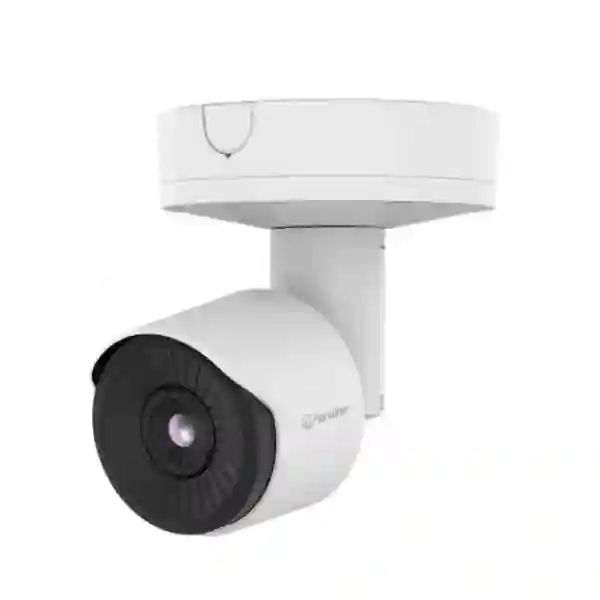
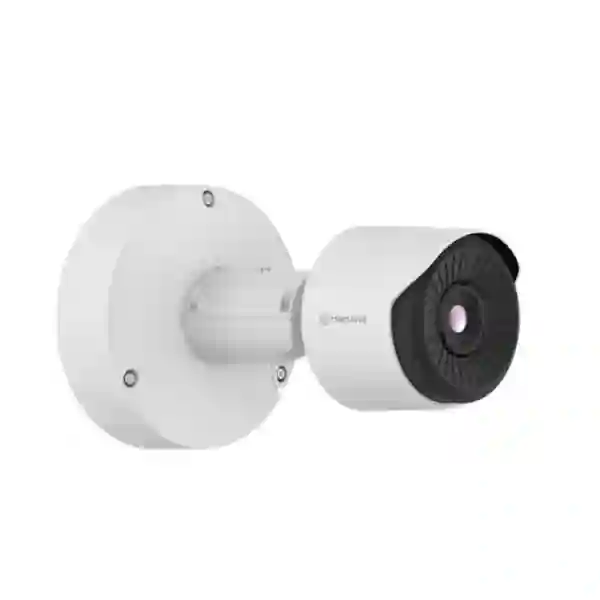
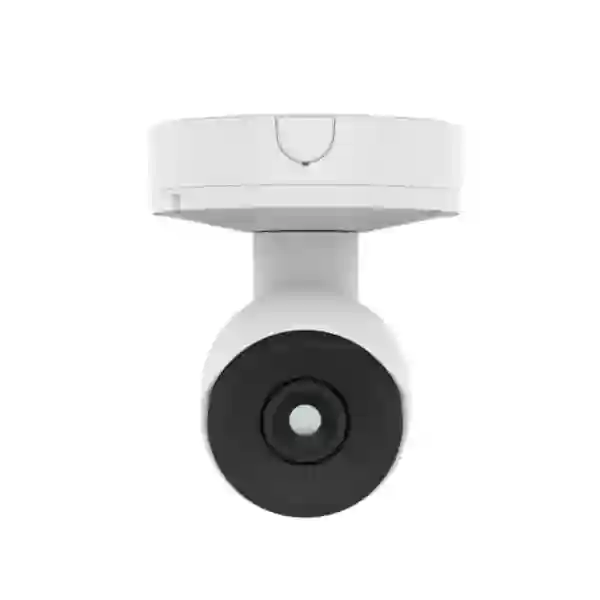
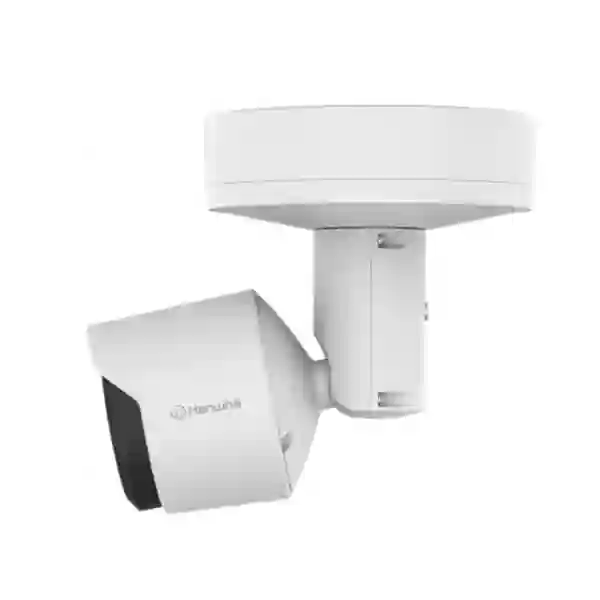
Hanwha Vision | Radiometric AI thermal monitoring
Hanwha TNO-C3010TRA Thermal Camera for Tanzania Projects
Need a thermal camera that can help your team watch equipment temperature and detect people or vehicles in a defined area? The Hanwha TNO-C3010TRA combines a 384 × 288 infrared detector, a wide 90° view, radiometric monitoring and AI analytics in one fixed bullet-style network camera. Use this guide to decide whether its coverage, alert features and installation requirements match your site before requesting a project quotation.
For facilities, security integrators and technical buyers evaluating deployment in Tanzania. Pricing, stock, local delivery and warranty must be confirmed independently.
Key specifications at a glance
| Native thermal detector | 384 × 288 pixels |
|---|---|
| Lens and horizontal view | 4.4 mm fixed | 90° |
| Frame rate | Up to 30 fps |
| Radiometric span | −40°C to +550°C |
| Smart classification | Person and vehicle |
| Power options | IEEE 802.3af PoE or 12 V DC |
| Ingress and impact protection | IP66/IP67 | IK10 | NEMA 250 Type 4X |
| Measurement regions | Up to 10 polygonal ROIs |
These are manufacturer-published model specifications. Performance is application-dependent. In particular, the radiometric temperature span does not describe permissible ambient camera temperature, and enlarged video output does not change native thermal detector resolution.
Understand the camera before choosing it
The Hanwha Vision TNO-C3010TRA is a network-connected thermal bullet camera with radiometric capabilities. It observes infrared energy instead of relying on ordinary scene illumination, so its output helps operators notice temperature patterns and warm objects when visible detail is limited. The camera is not simply an alternative colour CCTV camera: it answers a different question. Security staff may be watching movement through a perimeter, while a maintenance team may want to know whether a monitored surface is getting unusually hot. A useful buying decision begins by stating which of these tasks matters most.
For Tanzania projects, start with the actual operating environment rather than a generic camera count. Identify the hazard or security event, the distance to it, the size of the object and who will receive an alarm. Decide whether the installation needs an evidence-oriented recording workflow, operational temperature trend observation or both. The TNO-C3010TRA can contribute to those outcomes, but the complete solution also depends on correct placement, notification routing, site procedures and any equipment that will be used with it.
What is verified for this exact model
The model uses an uncooled microbolometer with a native thermal detector resolution of 384 × 288 pixels and a spectral range of 8–14 micrometres. Hanwha Vision lists output resolutions of 384 × 288 and 768 × 576, a maximum frame rate of 30 fps, a 17-micrometre pixel size and thermal sensitivity of 30 mK or better under its specified NETD measure. These attributes help describe what data the camera produces. They should not be confused with the resolution or features of a conventional visible-light megapixel camera.
The fixed 4.4 mm lens has a horizontal angular field of view of 90°, vertical view of 65.3° and diagonal view of 118.6°. The model’s published specifications also identify person and vehicle AI classification, up to ten radiometric monitoring regions, a −40°C to 550°C temperature detection range, H.265/H.264/MJPEG compression, PoE or 12 V DC power and protective enclosure ratings. Together these facts establish a useful foundation for design. Actual visibility, alert reliability and temperature-reading quality must still be checked at the intended site.
Who benefits from a wide-angle thermal camera
A 90° thermal view can be attractive where the task is to observe a broad approach, compact yard, working zone or equipment area from an appropriately placed mounting point. Facilities with difficult night lighting, operational heat concerns or a need to distinguish people and vehicles may find this combination worth evaluating. Examples include outdoor storage areas, vehicle entries, industrial compounds and equipment inspection zones. These are potential applications, not claims of completed local installations or a promise that one camera covers an entire facility.
The wide angle is particularly important to examine before purchase. It trades a broad scene view against the number of native detector pixels available for a distant target. A buyer who needs to classify a small object far down a fence line may benefit from a narrower field of view or a different camera position. Ask for a scene drawing or trial based on actual distances. Choose this model for its real view and event requirements, not because the word thermal appears in the description.
Thermal images versus ordinary CCTV images
A visible-light camera usually provides familiar scene details such as clothing colours, number plates or faces when illumination and sensor conditions permit. A thermal camera maps infrared contrast. It can reveal people or vehicles against a thermally different background, including in darkness, but the image should not be expected to reproduce ordinary colour detail. This distinction matters if an investigation needs human identification, readable signage or vehicle registration information. The thermal camera may detect an event while a separate visible camera supplies contextual evidence.
Pairing the TNO-C3010TRA with suitable visible-light coverage can therefore create a stronger workflow than replacing every conventional camera. An operator might receive a thermal intrusion alert, inspect the event and then call up a visible camera for identification where lighting and image quality allow. The two devices should be positioned with compatible fields of view and coordinated timestamps. Plan for these operational steps in the system design instead of assuming every thermal alert automatically produces all the visual information an incident report requires.
Understanding detector resolution and output size
The camera’s native thermal detector is 384 × 288. Hanwha Vision additionally lists a 768 × 576 output option. This larger output format should not be described as a separate higher-resolution thermal sensor, because enlarging a frame does not create newly captured infrared detail. When comparing models, use the native detector pixel count, lens angle, sensitivity, target size and distance together. A nominal output resolution viewed alone can lead to the wrong expectation about small target detail.
For an operational deployment, request representative images or evaluate a sample at the proposed mounting height and distance. A person who occupies only a small number of pixels may be detected under certain conditions but will not suddenly gain recognizable facial detail through display enlargement. Similarly, a small hot electrical connection can become difficult to isolate if the target covers too little of the scene. Thermal specification numbers are most useful when translated into how the actual target appears in the planned installation.
A 4.4 mm lens and a 90-degree horizontal view
The fixed 4.4 mm lens offers a broad horizontal angle, and its focus is fixed rather than operator-controlled optical zoom. This makes initial site planning especially valuable. Measure the width and depth of the monitored space, locate likely obstacles and note whether the camera must view a wall, open yard, gate, machinery panel or conveyor. A broad view is helpful when important objects are spread across an area, but it can also include irrelevant moving heat sources that complicate alert tuning.
Mounting geometry affects the result. A high position may reduce obstruction from vehicles yet cause a person to occupy fewer detector pixels. A low viewpoint might improve target detail while introducing occlusions. Avoid aiming into surfaces that hide the intended object or place the target at an extreme edge without testing. Because the optical field of view is fixed, moving the camera or selecting another model is often more realistic than expecting a software setting to change the underlying optical coverage.
Detection, recognition and identification are different
The manufacturer’s DRI figures refer to detection, recognition and identification under stated Johnson-criteria pixel assumptions. For this model the published examples include person detection at 115 m, person recognition at 29 m and person identification at 14 m. Vehicle figures are 294 m for detection, 74 m for recognition and 37 m for identification. These numbers are planning references linked to defined target and pixel criteria, not guaranteed real-world AI alert distances or a promise of facial or plate identification.
Actual thermal contrast, target orientation, weather, background, obstruction and the analytics settings can change what is usable. A detection-level target means something may be discernible, not that an operator can confirm exactly who it is. Ask project designers to separate simple awareness from evidential needs and to confirm the criteria against physical measurements. Where a specific alarm must reliably fire at a defined distance, validate it on site and document the acceptance test instead of interpreting a DRI number as unconditional coverage.
Radiometric monitoring and temperature range
Radiometry adds temperature-related information to the thermal image. Hanwha Vision specifies a temperature detection span from −40°C to 550°C for the TNO-C3010TRA. This makes the camera worth considering for observing certain industrial materials and equipment whose surface-temperature behaviour is part of an operating risk assessment. It is also useful when a maintenance team wants an alarm as a monitored area warms or cools outside a selected threshold. The listed span describes the camera’s measurement capability, not the temperature at which the camera itself can safely operate.
Before assigning a measurement task, confirm which surface is visible and what temperature is expected in normal service. A camera observing the exterior of an enclosure does not automatically know the temperature of a hidden internal terminal. For some faults, thermal monitoring supplies a useful early signal; for other faults, the surface may remain normal until the problem develops. A trustworthy deployment combines the sensor with appropriate thresholds, routine inspection and existing safety controls rather than declaring every hot object dangerous.
Temperature accuracy needs context
The published radiometric accuracy specification is ±2°C for measured temperatures at or below 150°C and ±15% above 150°C. These are manufacturer-stated figures, not guaranteed accuracy for every material or position. Surface emissivity, reflected radiation, distance, the viewing angle and surrounding conditions all influence a practical thermal reading. High-gloss or reflective surfaces can be especially misleading because the apparent infrared signal may contain reflections from other sources.
A purchase specification should identify the temperature band in which decisions will be made, the smallest area of interest and whether small changes or absolute thresholds matter. For example, a condition-monitoring programme may care about a trend from a stable baseline, whereas a safety procedure might require independent instrumentation and a verified maximum temperature. Do not set a critical cut-off simply because a value appears on screen. Commission the system with relevant site knowledge, reference measurements when appropriate and a clear rule for handling uncertain readings.
Configurable temperature regions of interest
The model supports radiometric monitoring across the field of view and up to ten user-configurable polygonal regions of interest. A region lets the installer direct temperature evaluation to a defined part of the image, such as an equipment surface, loading bay segment or designated process area. Hanwha Vision lists condition monitoring for temperatures above or below thresholds and for increases or decreases. The exact alarm configuration should be verified in the installed firmware and management interface.
ROI placement is a design decision. If machinery moves, a fixed shape may no longer cover the correct surface. If several components overlap in the camera image, a single region may mix unrelated temperatures and produce confusing alarms. Build a labelled ROI plan showing each target, expected operating state, exception condition and intended response. Keep the regions tight enough to be useful but large enough to account for ordinary positional variation. Recheck them after any camera alignment adjustment or equipment relocation.
Surface emissivity and reflected heat
A radiometric camera measures infrared radiation reaching its detector, and the apparent temperature depends on more than a target’s internal heat. Different surfaces emit differently; shiny metal, painted steel, rubber, plastic and masonry can behave differently in thermal inspection. Reflections from sunlight, nearby hot machinery or other environmental sources may also affect what appears warm. This is why a thermal image is not equivalent to inserting a contact probe into the material being monitored.
For project handover, record the type of target surface, its approximate orientation and the conditions under which a temperature alarm is credible. If exact temperatures are essential, use a suitable reference instrument and a documented method to check the camera reading. If relative changes are the main aim, establish normal baselines at representative production loads and ambient conditions. Operators should know which observed events are strong reasons to inspect and which are likely measurement artefacts that need verification.
AI person and vehicle classification
The TNO-C3010TRA includes AI-based object classification for people and vehicles. This helps shift alarm design away from reacting to every pixel-level motion change. On a suitable scene, a security team may use classification to prioritize relevant activity in a yard or along a monitored route. The camera also supports BestShot thumbnails, which can assist a quick review of detected objects. These are analytics tools, not biometric identity recognition, and they do not replace site testing.
An AI label should be interpreted as a machine-generated event classification. Heat signatures overlap, objects partly disappear behind obstacles and some weather or backgrounds can challenge thermal contrast. Every security procedure should define how an operator confirms a high-priority event before escalation. For critical perimeter protection, establish a test set representing walking persons, vehicles, direction of movement and expected environmental variation. Log both missed events and nuisance notifications during tuning rather than using a single successful demonstration as proof of dependable operation.
Virtual lines and virtual areas
The supported AI analytics include virtual line events for crossing and direction, and virtual area rules such as loitering, intrusion, entering and exiting. These are useful when the site has a clear operational boundary that can be expressed within the camera’s view. A gate approach may need a direction-based notification, while a restricted equipment compound may need an entry alert outside working hours. Rules should correspond to actual site policy instead of being enabled simply because the interface offers them.
Plan the line or area based on where a target can be adequately observed. A rule drawn across a distant or partially obstructed zone may have less practical value than a shorter, well-defined boundary closer to the camera. Consider moving shadows, nearby traffic, animals, permitted personnel and scheduled operations when deciding what constitutes an exception. Confirm which object classes are supported for the required rule in the current firmware, then test the full event chain from detection through the final operator notification.
From camera event to useful action
A thermal alert only becomes valuable when it reaches the right person with enough information to decide what to do. Hanwha Vision lists camera-side responses including event recording, network notifications, alarm output, PTZ preset handover and MQTT publication. The system may be integrated with software or devices that consume these events, subject to platform capability and configuration. The buyer should map each alarm class to a recipient, priority, acknowledgement procedure and escalation rule.
For an equipment-temperature event, the response could be an inspection request rather than an immediate shutdown, depending on the validated risk procedure. For an intrusion event, it may be a verification task for a security operator. Avoid routing every low-priority temperature change to an emergency channel. A good specification identifies what data is recorded, what happens when communications fail and who reviews alarm history. Ask the integrator to demonstrate a complete alarm path with the intended platform, not just a blinking camera status indicator.
Industrial equipment observation
Potential industrial use cases include monitoring accessible exterior surfaces on equipment, observing process areas and watching for unusual hot spots in locations with predictable operating patterns. This can complement rounds performed by qualified technicians, especially when a fixed viewpoint is helpful for trend comparison. The TNO-C3010TRA is suitable for evaluating such applications because its radiometry, configurable regions and network alerts allow a monitored scene to be translated into reviewable temperature events.
However, not every component can be measured reliably from a mounted camera. Cabinets may conceal internal heat; reflections may distort exposed metal temperatures; dust, dirt and obstructions can block a surface. The camera does not certify that an electrical installation is safe. The project team should select targets that can actually be seen, document normal operating patterns, establish a reasonable alarm strategy and maintain independent inspection or protective equipment where required. The objective is actionable situational awareness, not a claim that monitoring eliminates equipment failures.
Warehouses, waste areas and battery facilities
Storage yards and processing facilities can contain materials whose temperature behaviour merits observation. Hanwha Vision identifies industrial safety settings, including waste management and battery charging environments, as potential uses of its radiometric technology. For a warehouse or charging area, the first step is a site-specific hazard review: what can heat up, where can it be seen, how fast might conditions change and what response is feasible? Camera placement and region configuration should follow that hazard assessment.
Thermal cameras cannot see through solid barriers or guarantee identification of all developing hazards. A hot surface hidden by stacked goods, a closed enclosure or parked equipment may not be visible. Environmental temperature variation can also require different operating thresholds at different times. For any safety-critical area, use thermal monitoring as one layer alongside appropriate fire detection, electrical protection, ventilation, operating procedures and qualified personnel. Confirm any required approvals, permits or system design obligations separately rather than assuming the camera’s enclosure ratings satisfy an entire facility safety standard.
Perimeter and vehicle-area observation
A thermal security camera can assist in detecting heat-contrasting targets along a perimeter, inside a facility yard or at an access route. The person and vehicle classification features are most useful when the rule reflects the type of movement that needs attention. A restricted pedestrian approach may require an intrusion alert, while a vehicle-only route could use classification and directional rules. The camera’s wide angle can help cover a compact approach or intersection from a well-chosen position.
For a long boundary, one wide-angle device may not supply sufficient pixels on a distant person. Fence turns, walls, parked trucks and vegetation may block key areas. A practical design may use several viewpoints or combine wide-angle overview with more focused cameras. Assess the likelihood of objects crossing the view at angles that cause occlusion. Also determine how alarms are verified, stored and escalated during quiet hours. The correct number of cameras emerges from the site geometry and required detection confidence, not a generic perimeter-distance formula.
When to combine thermal and visible cameras
Thermal monitoring excels at showing infrared contrast, but a security investigation may also require ordinary scene detail. A visible camera can contribute information about clothing, signage, faces or number plates under suitable optical conditions. Pairing the two modalities gives operators a way to cross-check what a thermal alarm represents. The combination is particularly relevant where a thermal device is placed to cover a broad dark or low-visibility area and a conventional camera observes the adjacent access point.
Plan both perspectives together. Synchronize device clocks, confirm the video management platform can retrieve each feed and map the camera names to recognizable locations. Test an event at the edge of the thermal field of view and see whether another camera can provide useful context. If it cannot, repositioning may be more valuable than adding another unconfigured feature. This avoids the common mistake of installing two cameras that technically work but do not help an operator reconstruct the same event.
Streaming, codecs and bandwidth planning
The camera supports H.265, H.264 and MJPEG, with a published maximum 30 fps frame rate and multiple streaming profiles. Hanwha Vision lists WiseStream II and WiseStream III smart-codec support. These options give system designers flexibility to balance image delivery and network load, but they do not establish a single universal bandwidth figure. Bitrate changes with the codec, resolution, frame rate, scene activity and configuration. Retention calculations should use measured or carefully modelled streams.
Before procurement, determine whether the system needs continuous recording, event-triggered recording or a mixture. Confirm how many clients or recorders will request the feed and whether the selected management platform supports the desired codec and event metadata. A remote site on limited connectivity may use a different recording profile from a local control room. Always leave network capacity for alerts, management traffic and future growth. Verify real measured usage during commissioning, especially when multiple profiles are enabled at once.
Onboard storage and recording strategy
The manufacturer’s current specifications list one microSD, SDHC or SDXC storage slot with support up to 1 TB. Edge storage can be a useful element in a recording plan where local event capture is required or network connectivity is occasionally interrupted. It is not a substitute for a full retention and evidence-handling design. Actual storage duration depends on bitrate, frame rate, recording schedule, the chosen card and event frequency, so do not promise a certain number of days without a calculation.
Decide whether recording is primarily for operational review, incident evidence or thermal trend investigation. Each purpose has different requirements for time synchronization, access rights, backups and deletion. A well-designed system documents who can retrieve footage and what occurs when the card fills or fails. Storage media must be suitable for the intended write duty and environmental conditions. Test the exact edge-to-server workflow before accepting the installation; the presence of a card slot alone does not prove that every outage scenario is covered.
Integration with a recording or management system
Hanwha Vision lists ONVIF profiles S, G, T and M for the TNO-C3010TRA, along with its SUNAPI interface and Open Platform support. These are useful starting points when evaluating integration with a video management system, network recorder or analytics workflow. Nevertheless, a supported protocol does not establish that every product from another supplier will expose every temperature measurement, alert rule, AI event or metadata field in the same manner.
Ask the system integrator to verify the exact device firmware and the intended software versions. Confirm video display, recording, event presentation, searching, export permissions and alarm acknowledgement one by one. If radiometric values or ROI events must be consumed by third-party software, request a demonstration of that data path rather than accepting a general statement of ONVIF compatibility. Consider maintenance ownership: someone must be responsible for retesting integrations after future firmware, recorder or management-system changes.
Cybersecurity features and their practical use
The model’s published security capabilities include signed and encrypted firmware protection, secure boot, user authentication safeguards, HTTPS, encrypted communication options, IEEE 802.1X network authentication, a trusted platform module and support for encrypted storage partitions. These features provide controls that can support a secure design, but they do not automatically secure a camera with default credentials, excessive network exposure or abandoned firmware maintenance. Deployment practice remains critical.
Start by using unique strong administrative credentials, appropriately restricted user accounts and a separate management policy for camera networks. Restrict inbound access and confirm which services the installation actually requires. Enable secure transport and logging as supported by the chosen integration, then check that time synchronization works. Record the model, serial number, network location and installed firmware in an asset register. Security reviews should include the camera, recorder, management software and any remote access gateway; the weakest system component can undermine otherwise capable device security.
Updates, support and operational ownership
Camera firmware and compatible management software can evolve after installation. Hanwha Vision’s official support portal maintains model-specific files, including data sheets, manuals and firmware. A responsible project should identify who monitors those updates, evaluates their relevance and approves any change. Update procedures should consider maintenance windows, configuration backups and the possibility that a new release changes how events or integrations behave. Do not assume the newest firmware automatically matches every deployed recorder.
For a Tanzania installation, ask the proposing supplier to state the support contact and escalation route that actually apply to the quoted product. Verify any warranty, support or replacement commitments in writing rather than relying on generic catalogue descriptions. Also decide who owns the site configuration file, camera credentials and documentation after handover. These details are easy to overlook during procurement but become essential when staff change, a component fails or an investigation requires reliable historical configuration records.
Weather protection and physical robustness
Hanwha Vision lists environmental protection including IP66, IP67, IK10 and NEMA 250 Type 4X for this model. These published equipment ratings are relevant when assessing an exposed camera location, but they do not remove the need for proper mounting, cable protection and connector sealing. Enclosure performance is only one element of outdoor reliability. Water pathways through conduits, unsupported cable runs and poorly chosen fittings can create installation failures even when the camera body has strong environmental credentials.
Review the particular location for rain exposure, dust, potential impact, vibration, airborne contamination and access for cleaning. A protective rating does not imply immunity to every chemical, corrosive atmosphere or misuse condition. If the mount is near industrial equipment or a coast-exposed site, check the actual environment and material compatibility. Choose approved mounting and cable accessories for the intended support surface. After installation, inspect the seals and cable entries, and record the orientation so future servicing can preserve the original weatherproofing arrangement.
Camera operating temperature is not target temperature
Two different temperature numbers appear in the specifications and should never be mixed up. The radiometric target detection range is −40°C to 550°C. The published ambient camera operating range is −40°C to +60°C, with non-condensing humidity conditions. The camera is designed to observe hotter targets within its measurement capability, not to sit inside a 550°C environment. This distinction is especially important near hot processes, furnaces and high-temperature plant surfaces.
Before choosing a mounting point, estimate the air temperature around the actual camera body under the most demanding expected operating conditions. Consider direct sunshine, radiant heat from nearby machinery, confined boxes, ventilation and maintenance access. Do not assume a standard shade structure is adequate without evaluating heat exposure. Also distinguish ambient humidity from water entering an installation through damaged sealing. If the proposed site exceeds the manufacturer’s operating limits, modify the arrangement or select an appropriate alternative rather than relying on the measurement span as an environmental rating.
PoE and 12 V DC power choices
The TNO-C3010TRA supports IEEE 802.3af Class 3 Power over Ethernet and 12 V DC supply options. Hanwha Vision specifies maximum consumption of 10.8 W with PoE and 9.4 W with 12 V DC. This simplifies initial power planning but does not mean a site can ignore cable length, supply quality, surge exposure or switching capacity. The entire installation must provide stable power at the camera under expected load.
For PoE, check the switch or injector budget across all connected devices and the physical cable route. For a separate DC supply, verify polarity, power capacity and the protection needed for the installation. Select a suitable uninterruptible supply if camera and recorder operation must continue through short power disruptions. External protective devices may be required by the engineering design. Commissioning should include a restart test and confirmation that recording and alert rules recover properly after power is interrupted. The preferred arrangement depends on available infrastructure, not just which connector is convenient.
Network design for a reliable deployment
A thermal camera used for operational alerts is part of an IP system. The TNO-C3010TRA has an Ethernet network interface and supports common networking and streaming protocols. The site should allocate addressing, routing, time synchronization and access-control rules before mounting begins. Good design avoids exposing device management functions unnecessarily and lets authorised recorders or operators reach the streams they genuinely need.
In facilities with several buildings, consider the reliability of the inter-building connection and how alerts behave when links are down. Fibre, copper or other infrastructure choices require normal network engineering assessment; the camera specification alone does not prescribe the best transport. Identify whether recordings remain available locally during a connection failure and whether missed notifications are retried. Agree which team owns network changes and which team owns security operations. A clear fault boundary can reduce wasted troubleshooting when a device is powered but the control room cannot see it.
Placement, height and line-of-sight checks
Before fixing the camera to a wall, ceiling or pole, prepare a simple marked-up view plan. Show monitored assets, typical movement routes, lighting or thermal background concerns, obstructions and required event boundaries. The broad 90° horizontal view should cover the actual scene rather than a nominal distance on paper. Nearby structures, vegetation, moving equipment and parked vehicles can all remove portions of the target from sight.
Perform a practical walk-through at the intended mounting position. Verify the important targets at the farthest and nearest useful positions and inspect what happens at the edges of the view. Check for reflected heat, hot exhausts and unrelated equipment that could dominate the image. Where operational conditions change during the day or production cycle, repeat the review at representative states. Final acceptance should be based on the configured image and events, not solely on a drawing or a manufacturer’s detection-distance table.
Commissioning and acceptance testing
A meaningful acceptance test starts with a written statement of success. For a perimeter application, this might identify the types of person or vehicle movement that must generate an event at agreed positions. For radiometry, it might define a monitored surface, permitted normal range and escalation threshold. The expected response and evidence record should also be specified. Without this baseline, an installer may prove that the camera powers on while leaving the actual purpose untested.
Verify image orientation, focus suitability, time synchronization, event rules, recording, notification delivery, cyber settings and power recovery. Record relevant firmware and software versions and save the final configuration under authorised control. Test at more than one time or operating state if the application depends on changing thermal backgrounds. Hand over a concise map of regions of interest, virtual lines, camera location and alert recipients. Document limitations found during testing so that operators can make informed decisions instead of assuming every scene is equally reliable.
Reducing nuisance alerts without hiding real events
Unwanted alarms can originate from unrelated people, permitted vehicles, thermal reflections, environmental changes or overly broad monitoring rules. Reducing them is not simply a matter of raising a sensitivity threshold until notifications stop. That approach can also suppress events the system was intended to detect. A better method begins with reviewing recorded examples and determining whether the issue is scene geometry, classification, ROI placement, operating schedule or the chosen event condition.
Tune each rule against both positive and negative test cases. Confirm that a person crossing a restricted boundary still triggers after changes intended to exclude legitimate traffic. Compare temperature readings against normal process cycles and distinguish persistent increases from predictable short fluctuations. Agree how often alerts will be audited and who can authorise configuration edits. Keep a change log showing why each threshold was selected. This makes the system easier to maintain and prevents silent drift away from the original monitoring objective.
Maintenance, cleaning and periodic review
Fixed thermal monitoring requires ongoing attention even when the camera enclosure is robust. Dirt, dust, bird activity, vegetation growth, mechanical changes and later site alterations can affect the view. A camera that was correctly aligned at handover may become less useful if new equipment blocks a region of interest or a vehicle shelter is installed in the scene. Include viewpoint checks in routine maintenance rather than waiting for an incident.
At suitable intervals, inspect the housing and cable entries, verify network health, review recent events and check that the operator receives test notifications. Compare the camera view against the original commissioning record and adjust authorised rules if working conditions have changed. Firmware and recorder compatibility should be reviewed as part of controlled system maintenance. For radiometric tasks, recheck measurement assumptions and baselines when target surfaces or process loads change. A reliable long-term installation combines physical inspection, software management and human review of alert usefulness.
Limits that should shape the purchasing decision
The TNO-C3010TRA is not a substitute for a visible-light identification camera, a contact thermometer, a certified fire-detection system or a complete machine-protection controller. It cannot view through solid barriers, and a temperature reading describes the observed infrared conditions rather than every hidden internal component. AI object classification can assist an operator but should not be presented as a promise to detect every person or vehicle in every situation.
Its broad fixed lens may also be inappropriate for a small, distant target. A different focal length, a separate temperature sensor or more than one camera could be better for a particular layout. Assess total system cost, including mounts, network equipment, storage, event software, commissioning and support rather than focusing only on the camera body. If the intended outcome is a safety-critical automatic action, conduct the necessary professional risk assessment and specify independent protective layers. Choose the product because it meets documented acceptance criteria, not because a long feature list looks comprehensive.
How this model differs from narrower-view alternatives
A purchaser considering the TNO-C3010TRA should first decide whether scene breadth or detail on distant targets matters more. A wider lens is useful for surveying a larger nearby area; a narrower lens generally concentrates detector pixels over a smaller angle and can be better for some distant-object tasks. Hanwha Vision offers other models in its radiometric thermal family, but differences should be confirmed for each exact model rather than inferred from a similar-looking housing.
Prepare a side-by-side comparison that includes native detector resolution, field of view, target size at the required range, available frame rate, temperature monitoring features, environmental ratings and system compatibility. Avoid using only maximum detection figures as the decision criterion. If a supplier proposes a substitution, request a revised view plan and demonstrate the same acceptance test with the substitute. A camera that is technically more specialised can still be a worse purchase if its angle excludes an important portion of the process area.
Questions to resolve before requesting a quotation
A useful quotation request includes more than the product name. Share the number of viewpoints, approximate distances, mounting surfaces, power and network availability, and the purpose of each monitoring position. State whether the priority is person or vehicle detection, temperature exceptions, general operational awareness or a combination. For temperature use, identify the visible surface and expected operating conditions; for security use, identify the boundary or route and the type of alert required.
Ask the proposed supplier to confirm the exact Hanwha TNO-C3010TRA model, firmware suitability, necessary accessories, recorder or VMS compatibility, recording requirements and commissioning responsibilities. Confirm local commercial terms separately, including actual stock position, delivery arrangements, warranty coverage and applicable taxes. A project-specific review can identify whether one fixed wide-angle camera is enough or whether additional coverage is justified. This is a better foundation for a cost comparison than a camera-only price without the system elements that make its data actionable.
A practical Tanzania project checklist
For facilities planning a deployment in Tanzania, the first checklist item is the site itself. Document actual mounting conditions, temperature exposure, available power, network routes and the response team that will receive alerts. The same camera may be proposed for an indoor process area, a sheltered vehicle entrance or an exposed yard, but the installation requirements are different. Do not assume that broad country-level climate descriptions replace measurements at the particular mounting point.
The next step is technical and commercial validation. Confirm that procurement, shipment and any necessary import or export arrangements are appropriate for the exact camera and intended use; do not infer clearance from a product catalogue. Verify which equipment, labour and services are included in a local proposal. Keep installation permissions, customer-site rules and any sector-specific safety or regulatory obligations with the responsible project team. The aim is a verifiable specification for the actual Tanzania site without making unsupported promises about availability, nationwide service coverage or official approvals.
What a well-designed handover should include
At completion, the purchaser should receive a usable account of what was installed and why. That record should list the exact model and location of each camera, the agreed monitoring purpose, mounting viewpoint, network configuration owner and recorder destination. It should also describe the thermal regions of interest or security analytics boundaries in plain language. Screenshots or annotated scene plans can make these choices easier to understand without exposing sensitive credentials in routine documents.
Include the final commissioning tests, observed limitations, support and maintenance responsibilities, alert recipients and escalation instructions. Record which configuration settings can be changed locally and which require approval. For temperature monitoring, document the thresholds and the reasoning behind them. For perimeter monitoring, document the object classes and movements tested. A useful handover makes the buyer less dependent on individual installers and gives future technicians an evidence-based starting point when a site modification or a new risk assessment requires an adjustment.
Buyer FAQs: can it work without visible light?
Yes. The TNO-C3010TRA is a thermal camera and does not need conventional visible light to form a thermal image. It responds to infrared energy from the scene. That does not mean every target will always be clear: thermal contrast, obstruction, rain, fog and atmospheric effects can change practical performance. For a security design, test the intended subjects under the expected site conditions, particularly where a missed event would have serious consequences. If colour or identifying visual detail is needed, plan complementary visible-light coverage.
Buyer FAQs: does it identify people by name or face?
No facial-recognition or personal identity capability should be inferred from the specified thermal AI classification. The verified model features describe classification of people and vehicles and associated scene analytics. A detection or classification label is not confirmation of someone’s identity. If an investigation requires identification, a suitably positioned and configured visible-light camera or another authorised process may be necessary. Keep the distinction clear in user training and do not promise facial detail from a 384 × 288 thermal detector.
Buyer FAQs: can it measure the temperature inside a closed cabinet?
Not directly through a solid opaque enclosure. The camera observes infrared energy from surfaces that are visible in its field of view. An external cabinet surface can be monitored, but its temperature may not track a hidden component closely enough for a particular safety decision. For internal electrical or process measurements, use suitable access arrangements and professional methods, following all safety procedures. Define exactly what is visible and what inference can reasonably be drawn from a change in that measured surface.
Buyer FAQs: does a 550-degree range mean it operates in 550-degree heat?
No. The −40°C to 550°C specification is the stated target temperature detection range. The camera’s published ambient operating range is −40°C to +60°C. It should be mounted within its environmental limits, taking account of radiant heating and the real local conditions. If a target is extremely hot, keep the camera at an appropriate distance and verify the geometry and measurement method. Confusing these two ratings could result in incorrect placement and equipment damage.
Buyer FAQs: is 768 × 576 the native thermal resolution?
No. The native thermal detector is 384 × 288 pixels. The manufacturer also lists 768 × 576 as an available output resolution. When evaluating how much fine thermal detail can be captured, buyers should use the native detector resolution together with the lens field of view and target distance. Displaying a larger output frame does not make a small target occupy more independently captured detector pixels. Request a representative scene test where target size is important.
Buyer FAQs: will any recorder display the temperature alarms?
Not necessarily. The camera supports common video protocols and specific ONVIF profiles, but third-party platforms vary in how they handle radiometric values, AI events and ROI conditions. Confirm the exact recorder or VMS version, the events that must be displayed, and any needed integration configuration. A normal live video stream can work while a specialised thermal event remains unavailable in the user interface. Ask for a demonstration of the complete required workflow before making integration commitments.
Buyer FAQs: what storage duration is available?
The device includes an edge card slot and supports certain microSD-family media up to the stated maximum of 1 TB. That is a capacity specification, not a retention promise. Actual retention depends on video bitrate, recording hours, event frequency, codec and whether other recording systems are used. For evidence retention, calculate a storage target from the recording policy and verify it with the proposed system. Decide how footage will be backed up, accessed and securely deleted.
Buyer FAQs: can the thermal camera replace fire protection?
No. Thermal observation may support early awareness of abnormal heat in suitable visible areas, but it is not a blanket replacement for required fire detectors, suppression systems, protective controls or qualified inspections. A thermal camera may miss heat behind barriers or under conditions that defeat measurement assumptions. A facility should complete the appropriate hazard assessment and use the camera only as one defined monitoring layer. The alarm response must be documented, tested and coordinated with existing emergency procedures.
Buyer FAQs: is a Tanzania price or warranty available here?
No price, local stock position, delivery schedule or Tanzania-specific warranty has been verified for this listing. Those details require a current project quotation or authorised supplier confirmation. The model number identifies the Hanwha Vision product, but it is not automatically the merchant’s stock-keeping unit. Buyers should request the exact commercial terms, required accessories and complete installation scope before comparing offers. Avoid treating international catalogue information as evidence of local availability.
Buyer FAQs: what is the sensible next step?
Start with the scene and requirement, not a speculative quantity. Share the target distance, approximate viewing width, environmental conditions and the event or temperature change you need the system to detect. State the proposed recorder or video management platform and whether event records must be stored centrally or at the edge. Request a suitability and compatibility review, then confirm the exact equipment, integration, commissioning and commercial scope in a quotation. This gives a project team a testable basis for selecting the Hanwha TNO-C3010TRA.
Request a project-specific camera quotation
To assess this camera for your proposed Tanzania installation, provide a brief site description, target distance, monitoring objective, power and network details and any recorder or VMS already selected. Ask for confirmation of the exact model, accessories, integration scope, commissioning approach and current commercial terms. The next decision should be based on a documented view plan and acceptance criteria, not an assumed price or a generic camera count.
Ask FourTeck Tanzania for a suitability review and quotation. No live stock, price or fulfillment claim is made on this page.




Reviews
There are no reviews yet.