
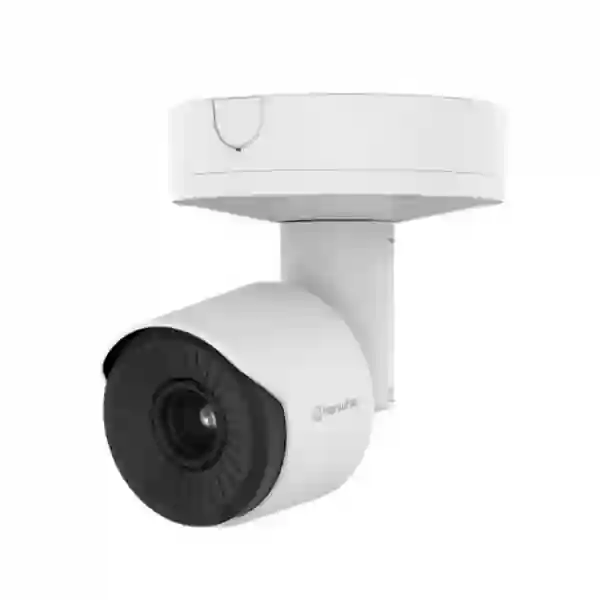
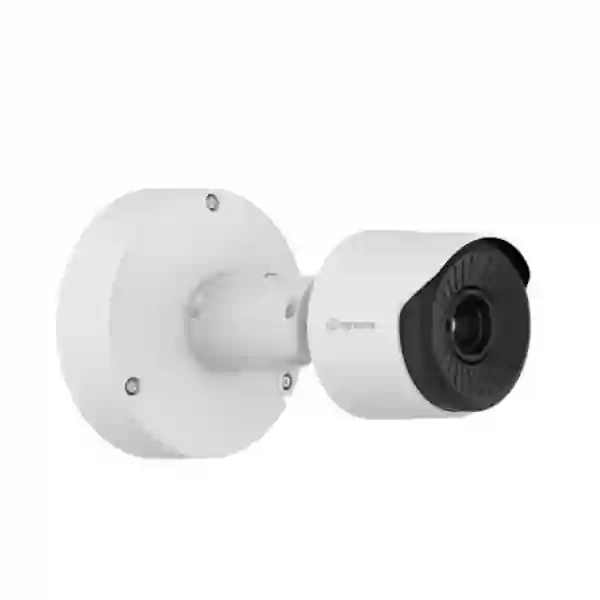
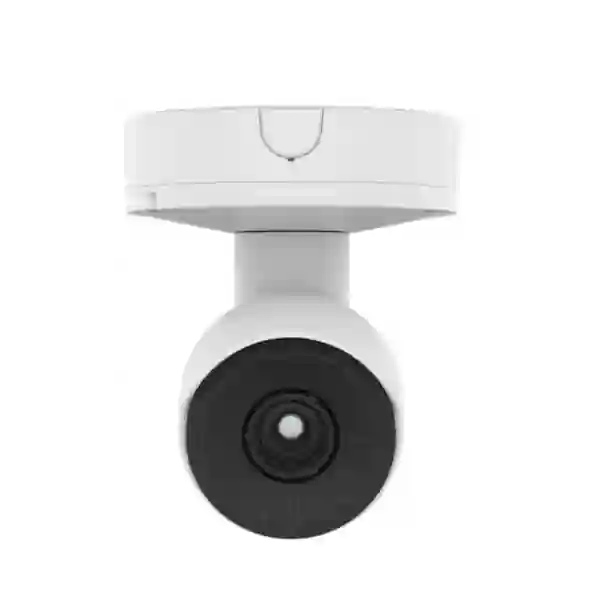
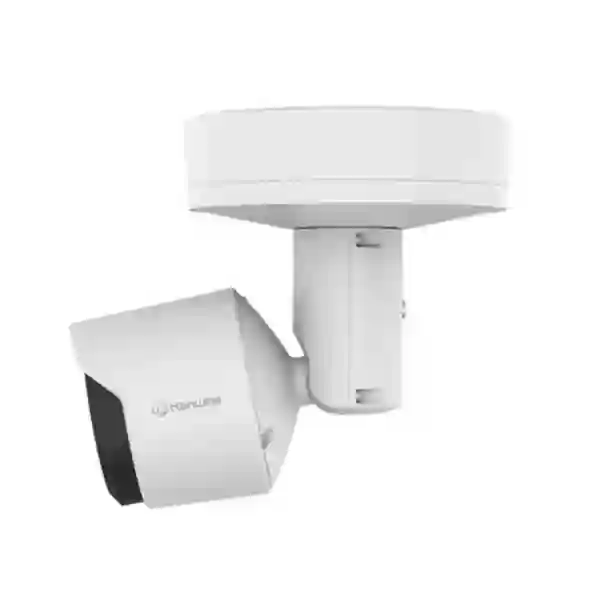
Hanwha Vision TNO-C3052T — 19 mm QVGA AI Thermal Camera
Protect a defined perimeter or approach with heat-based person and vehicle detection, without depending on visible light. The Hanwha TNO-C3052T thermal camera combines a native 384 × 288 detector, 19 mm fixed lens, 8 fps video and edge AI event analytics. It is best assessed against a real detection distance and site plan, not purchased on the strength of a theoretical range alone.
At a glance: why consider this model?
- Thermal contrast for surveillance in darkness without relying on a visible-light scene
- Person and vehicle classification with virtual-line and virtual-area event rules
- Fixed 19 mm field of view for planned corridors and perimeter sectors
- 8 fps video with H.265, H.264 and MJPEG choices
- PoE or 12 V DC input, outdoor-rated housing and ONVIF integration options
For a Tanzania security project, request a technical suitability review based on planned mounting positions, target distance, video-management compatibility and the desired response to an alert. Product availability and commercial details must be confirmed separately.
Verified technical specifications
| Specification | TNO-C3052T value |
|---|---|
| Product type | Outdoor AI thermal IP network camera |
| Native thermal detector | 384 × 288 uncooled microbolometer, 17 μm pixels |
| Output resolutions | 384 × 288 and 768 × 576 options |
| Focal length / lens | 19 mm fixed, F1.0 |
| Horizontal / vertical field | 19.3° / 14.6° |
| Minimum object distance | 10.6 m |
| Thermal sensitivity | NETD ≤20 mK at 25°C, F1.0 |
| Maximum frame rate | 8 fps; H.265, H.264 or MJPEG |
| AI object types | Person and vehicle |
| Published AI detection limit | Person up to 128 m; vehicle up to 170 m |
| Power | PoE IEEE 802.3af Class 3 or 12 V DC |
| Maximum consumption | PoE 10.8 W; 12 V DC 9.4 W |
| Recording medium | One microSD/SDHC/SDXC slot, maximum 1 TB |
| Interoperability | ONVIF S, G, T, M; SUNAPI |
| Weather / impact | IP66, IP67 and IK10 |
| Operating temperature | −40°C to +60°C |
| Housing / weight | Aluminium, approximately 1.73 kg |
All figures above refer to the specified model and its published manufacturer documentation. Ranges and operational outcomes require verification for the intended site; manufacturers may update specifications.
What this thermal camera is designed to do
The Hanwha TNO-C3052T thermal camera is intended for teams that need to notice people or vehicles entering a monitored area even when conventional visible-light images are difficult to obtain. It measures patterns of infrared energy rather than relying on streetlights, floodlights, or reflected visible light. For a security team watching a fenced facility, an equipment yard, or a dark approach road, that distinction can make the difference between searching an empty-looking video image and receiving an event that deserves review. Its main purpose is security awareness and event detection, not creating conventional colour identification footage.
This is a QVGA AI thermal network camera with a 384 × 288 detector, a fixed 19 mm lens and a maximum 8 frames per second stream. It classifies people and vehicles and offers event rules such as line crossing and intrusion. The right purchasing question is not simply how far thermal imaging can see. It is whether a person or vehicle at the actual risk boundary will be large enough, sufficiently distinct from the background and inside the selected field of view for the required alert. Ask for a project-specific coverage review before selecting camera positions.
The practical specification snapshot
Several specifications have a direct effect on how the camera should be designed into a site. The 384 × 288 figure describes the native thermal detector; a 768 × 576 output option must not be mistaken for a higher-resolution sensor. The 19 mm fixed lens gives a relatively concentrated scene, making it a considered choice for a defined approach, lane or perimeter segment rather than an unlimited wide-area view. The 8 fps maximum is suitable for many alert-led observation tasks, but projects that depend on rapid motion assessment should explicitly evaluate that temporal limit.
Other useful planning figures include NETD of no more than 20 mK at 25°C with an F1.0 lens, horizontal field of view of 19.3 degrees, minimum object distance of 10.6 m, PoE or 12 V DC power and network video using H.265, H.264 or MJPEG. Weather and impact ratings make the housing appropriate for demanding outdoor deployments, although cable entries, mounting hardware and installation workmanship remain separate project responsibilities. These values come from Hanwha Vision’s model-specific published specifications.
Understand thermal imaging before specifying a camera
A thermal camera forms an image from apparent temperature differences and infrared radiation, not from reflected daylight. That makes a heat-emitting person potentially distinguishable in darkness where a colour camera would need lighting. It also means the picture looks fundamentally different: facial colour, vehicle paint, printed signs and other visible-light details are not preserved as they would be in an optical image. Operators should plan a companion visible-light camera when an incident investigation requires conventional identity or colour evidence.
Thermal viewing is useful, but it is not equivalent to seeing perfectly through all obstacles. Walls, dense foliage, opaque objects and certain glazing arrangements can obstruct the relevant heat signature. Atmospheric conditions, long distance, background temperature, rain, fog and humidity can all influence useful contrast. A camera may still detect a warm subject when an ordinary CCTV image is weak, but real detection quality must be tested for the particular setting. Define the decision you want an operator to make, then choose imaging and analytics that support that decision rather than relying on a generic night-vision claim.
Native pixels, stream resolution and useful detail
The TNO-C3052T uses an uncooled microbolometer with 384 × 288 detector elements and a 17 micrometre pixel size. It is a true thermal detector, not a standard optical image with a thermal-looking overlay. The network specification lists both 384 × 288 and 768 × 576 output resolutions. The larger output can help display or integration workflows, but upscaling does not generate the same new scene information as a detector with more native pixels. For sizing a distant human target, native spatial detail is the relevant starting point.
An equipment buyer should ask how many detector pixels will represent the smallest relevant object at the intended distance. A person crossing a distant road may appear as a much smaller shape than a person walking close to a fence. That affects classification confidence and an operator’s ability to interpret the alert. Screen size, digital zoom and recording export do not reverse inadequate target sampling at capture. If fine detail is essential over a broad area, review higher-resolution thermal options, additional viewpoints or a complementary optical camera rather than assuming output resolution alone will solve the problem.
What the fixed 19 mm tele lens means on site
The fixed 19 mm lens gives a horizontal angle of approximately 19.3 degrees and a vertical angle of 14.6 degrees. These angles describe how much of the scene fits in the thermal view; they do not describe an automatic pan or optical zoom system. A narrower view can allocate more of the available pixels to a particular roadway or approach than a very wide lens, but it also leaves more area outside the picture. Camera placement therefore starts with a scaled plan, a line-of-sight survey and an explicit list of approach directions.
The stated minimum object distance is 10.6 metres, so placing this model immediately above a close doorway may be unsuitable for the intended monitoring task. At a fence corner, a single fixed view could leave an unexpected blind region close to the support pole, while a long, straight perimeter may use the lens more effectively. During design, mark foreground exclusions, obstructions, vehicle routes, likely walking paths and the distance to every critical boundary. The best location is the one that reliably observes the decision zone, not necessarily the tallest mounting point.
AI detection distances versus theoretical DRI
Hanwha Vision lists model-specific AI detection distances of up to 128 metres for a person and up to 170 metres for a vehicle. Those figures are much more relevant to an automated people-or-vehicle alert plan than a headline claim about the farthest heat signature that might be observable. Even these AI figures are published limits under stated evaluation assumptions, not a promise that every subject will trigger an event at that range in any climate, mounting geometry or background.
The same specifications list theoretical Johnson-criteria detection distances of 678 metres for a person and 1,731 metres for a vehicle. These values use a different definition of detection and should never be presented as guaranteed AI classification ranges. The listed Johnson-criteria recognition and identification distances are different again. For an operational perimeter, decide whether the requirement is to notice something, classify it as a person or vehicle, or obtain evidence of a particular identity. Thermal classification does not provide facial identification. Commissioning tests must measure the actual end-to-end event outcome at the distances the customer intends to protect.
People and vehicle classification at the edge
The camera’s AI engine distinguishes person and vehicle object categories. This can help operators focus on events that matter to a security plan instead of treating every movement as equally urgent. A rule might flag a person entering an equipment enclosure after hours, or a vehicle crossing an access boundary outside normal traffic patterns. Object classification should be configured together with the site rules, schedules and response plan; the word AI alone does not establish that an alarm will be reliable.
Consider a compound with a guard route, maintenance vehicles and visitors. The desirable outcome may be to ignore permitted daytime activity but alert when a classified person enters a defined restricted zone at night. That requires appropriate scene boundaries, controlled schedules and checks for overlapping thermal objects. Trees moving in wind, animals and ordinary scene variation can often be treated differently from people and vehicles, yet false positives and missed detections can still occur. Record actual test results and adjust rules using representative site activity rather than relying solely on factory defaults.
Virtual lines, areas and event rules
The model supports AI-related object detection, virtual-line crossing or direction rules, virtual-area loitering, intrusion, entry and exit events, as well as motion detection. A virtual line works best when there is a meaningful boundary to cross, not an arbitrary shape drawn across a busy public route. A virtual area may be better for detecting prolonged presence in a secured courtyard or a loading bay outside business hours. Event rules should be linked to a clear operator response, not multiplied without purpose.
Before enabling alerts, choose where the subject should first be noticed, what movement constitutes a violation and which authorized movements must remain uneventful. A single perimeter may need different rules for the public-facing approach, internal roads and the sensitive equipment zone. Use scheduled rules where access changes by shift or by maintenance window. Test both entry and exit paths, and review event thumbnails against recordings. A camera event is a decision-support signal; it does not replace an access-control policy, a guard’s judgement or a documented incident-response process.
Use thermal detection to reduce avoidable alert load
Traditional pixel-motion alerts can react to shadows, rain streaks, vegetation or sudden image changes. Thermal object classification offers a more targeted starting point when the security goal is people or vehicles. However, changing the detector does not eliminate all nuisance events. Exhaust systems, moving warm machinery, road traffic, background heat changes and partial occlusions may affect the scene. Each deployment needs its own acceptance criteria for missed events and unnecessary notifications.
An effective alert design separates three tasks: deciding that a relevant object exists, determining whether its behaviour violates a rule, and presenting enough context for a human response. For example, a person entering a protected zone may create a high-priority alert while a vehicle passing along an authorized exterior road creates no event. Guard teams should agree on escalation, acknowledgement and evidence retention before go-live. During the first operating period, review actual events, tighten zone boundaries and avoid suppressing legitimate activity just to make an alert counter look smaller.
Total darkness, rain and challenging contrast
The advantage of thermal imaging is independence from visible illumination. Security operations can observe heat contrast at night without switching on a floodlight solely for the thermal camera. That can be valuable at remote boundaries or where conventional CCTV images become unhelpful after lighting failure. Published sensitivity of NETD no more than 20 mK indicates the detector’s ability to distinguish small apparent temperature differences under defined conditions; it does not guarantee that every object remains distinguishable under all weather patterns.
Heavy rain, hot surfaces, fog, humidity and the distance through the air can alter how a subject appears. A sun-heated wall or paved yard can also behave differently from a cooler background after sunset. For Tanzania installations, a site evaluation should consider the real operating season, heat, humidity, dust, storms and the local terrain without assuming one region represents every site. Arrange tests near the critical boundary and, where possible, under different ambient conditions. Treat the published environment ratings and thermal sensitivity as design inputs, then verify operational performance with site evidence.
Define the right security use case
This model is worth considering when the buyer’s main question is whether a person or vehicle has entered an area that should remain clear. It can support perimeter awareness around industrial yards, secured storage compounds, infrastructure sites and limited-access grounds. These are examples of possible applications, not statements that a particular customer, industry or Tanzanian facility has already installed the camera. Suitability depends on coverage geometry, response workflow, the size and movement of targets and the security platform.
A typical requirement statement might be: detect a walking person crossing the south fence approach, classify the subject, notify a control room and retain an event clip. That requirement can be tested. A vague statement such as ‘monitor the whole property at night’ cannot, until the property is divided into measurable sections. List the priority event zones, normal traffic conditions, acceptable alarm delay, operator response and backup recording needs. A defensible design begins with those operational details and uses the model’s features only where they address a specific risk.
Industrial yards and logistics compounds
In a yard with containers, equipment or parked vehicles, conventional CCTV coverage may be difficult after dark. Thermal imaging can provide an additional layer for identifying movement along a long approach or behind a defined boundary. A fixed 19 mm view can be aimed at a particular access corridor, but stacked materials, trucks and changing storage layouts can block thermal sightlines. The plan must account for where objects will be parked tomorrow, not only for how the yard looks during the survey.
Classified vehicle events may help a control room distinguish a truck moving along an unauthorized route from unrelated changes in the picture. Person classification may be useful near a restricted loading area. None of this automatically proves theft, trespass or malicious intent; it signals activity for evaluation. For reliable deployment, keep the camera’s zone definitions aligned with yard operations, define after-hours exceptions, test moving targets at realistic speeds and ensure guard staff can see an associated optical view when colour, registration plates or facial details become necessary.
Energy, utilities and remote assets
Sites containing substations, fuel infrastructure, communications equipment or remote utility assets may need warning when an unexpected person approaches a protected area. Thermal imaging is a possible tool for that early awareness, particularly when ordinary lighting is limited. The camera’s outdoor ratings and network interfaces support consideration for physically demanding installations, but a complete design also needs stable power, secure connectivity, suitable mounting and a response path for unattended periods.
Do not confuse thermal perimeter surveillance with certified fire detection, electrical fault diagnosis or calibrated industrial thermography. The published model includes region-of-interest condition monitoring, but a dedicated safety or maintenance task should use equipment and a design validated for that purpose. A thermal image that shows a bright object is not, by itself, a reliable measured temperature or cause of failure. For a high-consequence installation, document the required safety standard independently, choose the appropriate sensor class and keep operational security analytics separate from life-safety claims.
Campuses, warehouses and restricted corridors
Large grounds sometimes include a mixture of public areas, staff routes and secured spaces. The useful role for the TNO-C3052T is a clearly bounded corridor where night-time person or vehicle activity warrants attention. Rather than applying one broad alarm to an entire campus, establish sensitive zones around technical rooms, rear gates or storage areas and use the site’s permitted movement patterns to define event schedules.
Privacy, staff safety and operational context still matter. Thermal imagery contains less visible-light detail than ordinary CCTV, but it is still surveillance information that should be managed under the applicable policies. Set appropriate retention, user access and incident-review procedures. Confirm which events require a real-time response and which need only an audit trail. A well-designed system should help a small security team prioritize meaningful incidents while allowing authorized staff to work without constant alerts. Where identity evidence is important, pair thermal event detection with suitable other cameras and controlled access records.
Installation planning and line-of-sight checks
Start with a drawing that identifies the monitored boundary, expected object paths, mounting surfaces, cabling routes and possible obstructions. Position the fixed lens so the risk area falls inside the 19.3-degree horizontal field of view and the likely subject range is realistic for AI classification. Verify the 10.6 m minimum object distance when considering near-field coverage. Higher installation is not always better: a steep downward angle can shorten the useful view along an approach and create dead ground close to the mounting point.
During a physical survey, examine light poles, fence posts, corners, roof edges, vegetation and structures that can conceal targets. Check the effect of doors and gates opening, vehicles stopping and stored materials moving. Confirm safe access for future maintenance, the ability to position and lock the camera, and suitable equipment for pole or wall mounting. Hanwha lists mounting accessories, but select exact brackets against the actual supporting surface and approved installation instructions. Avoid assuming an unverified accessory is included with the camera or automatically compatible with every site.
Outdoor housing and environmental protection
The TNO-C3052T carries IP66/IP67 protection and IK10 impact resistance in the manufacturer specification, together with references to NEMA 4X, NEMA TS 2 and selected MIL-STD-810H environmental test methods. The listed operating temperature is minus 40 to plus 60 degrees Celsius and the specified operating humidity is 0 to 95 percent relative humidity without condensation. These are product-level specifications, not a declaration that a completed installation is immune to flooding, lightning, corrosion or improper sealing.
Installer practices are decisive. External terminations must be appropriately protected, cable routing should reduce water entry, and fixing hardware must be suitable for the exposure. A sealed camera can still be undermined by an unsuitable junction box, poorly installed cable gland or an unsecured mounting pole. In coastal or high-corrosion environments, assess the whole assembly rather than relying on one rating. The camera’s enclosure is aluminium and the unit weighs approximately 1.73 kilograms, so verify the supporting structure and vibration conditions. Inspect after installation and include periodic physical checks in the maintenance plan.
Power architecture, PoE and resilience
The manufacturer specifies two power methods: IEEE 802.3af Class 3 PoE or 12 V DC. Its stated maximum consumption is 10.8 W on PoE and 9.4 W on 12 V DC. A designer should choose a compatible, adequately budgeted power source and account for all other equipment sharing the network switch or backup system. PoE can simplify a camera run by carrying network data and power over the appropriate cabling, but it does not remove the need to engineer cable distance, switch capacity and surge protection.
Where the monitored site must remain operational during short power interruptions, calculate an appropriate UPS or other backup arrangement for the camera, switches, recording equipment and any communications links. A powered camera without an operating recorder or route to the control room may fail the actual security objective. Plan for safe electrical installation and site-specific earthing practices through qualified personnel. Review how the system behaves after a power restoration, whether time synchronisation returns correctly and whether critical events are still preserved when parts of the network are temporarily unavailable.
Network video and codec choices
The camera supports H.265, H.264 and MJPEG and includes WiseStream codec features. It uses a shielded RJ-45 Ethernet connection and offers multiple streaming profiles. These capabilities help integrate the thermal feed into an IP surveillance architecture, but the correct bitrate and recording configuration depend on image content, frame rate, compression, event frequency and the recorder. Do not assume a universal storage figure or fixed monthly bandwidth from a product model alone.
A practical integrator should identify which stream goes to the live monitor, which stream is recorded, which stream supports analytics review and whether additional clients require separate profiles. H.265 may save bandwidth in appropriate conditions, but decoding support must be checked on the intended VMS or recorder. Test the picture after compression rather than selecting settings by nominal bandwidth only. Synchronise device clocks using an approved time source, configure the relevant network services and keep the security camera network separated from unrelated business traffic where the organisation’s architecture requires it.
Storage, recording and evidence handling
An on-camera microSD, SDHC or SDXC slot is specified with a maximum capacity of 1 TB, subject to using appropriate compatible media. Edge storage can provide a useful local recording option in a system design, but it should not be treated as a substitute for an agreed retention policy or an independently managed recorder without testing the actual workflow. Decide whether events should generate continuous footage, event-only clips, local backup copies or a combination.
Retention planning should include the number of cameras, stream settings, event frequency, recording schedule, operational uptime and the period for which evidence is needed. Verify how the chosen recorder responds to a disconnected camera, how recordings are exported and how access is logged. If an incident could require a thermal clip and a normal optical image, provide a way to correlate time and location across those feeds. Media capacity alone does not guarantee successful retrieval: operational policies, passwords, time stamps and periodic playback tests are equally important.
Video management and ONVIF compatibility
The official specification lists ONVIF Profiles S, G, T and M, as well as Hanwha Vision SUNAPI support. This gives integrators useful standards-based and vendor-specific possibilities for connecting the device to a VMS or network video recorder. However, a profile listed on a camera does not automatically mean every recorder exposes every analytic event, metadata field or management operation. Compatibility must be checked against the exact VMS product, software version and firmware used in the deployment.
During a proof of concept, verify video discovery, stream selection, user authentication, time settings, recording, playback and event mapping. In particular, confirm whether person and vehicle classifications appear as events in the management platform or only in the camera interface. A control room that receives video but not the intended intrusion alert has not met the same security requirement. Document supported integration paths, required licences where applicable and the person responsible for resolving firmware changes. Do not promise integrations that have not been tested on the buyer’s specified recording environment.
Alarm outputs and operational response
The camera specification includes two configurable alarm I/O ports, MQTT support and several event delivery methods including recordings, notifications and file transfer under supported configurations. These options can help a system send a thermal detection event to a security workflow. They are building blocks rather than a ready-made monitoring service. The project must define who receives alerts, how they are acknowledged and what happens when a camera or communications link fails.
For example, a classified person crossing a restricted boundary might create an alert on the VMS, mark a recording and prompt a guard to review an associated optical camera. A more demanding environment may use a separate alarm platform with agreed escalation and auditing. Verify each output with the actual receiving software, network restrictions and security policy. Avoid exposing device services directly to the public internet merely to make alerts easier to reach. A reliable alarm is not just one that triggers; it is one that arrives with enough context for a responsible response.
Device and network cybersecurity
Hanwha Vision lists secure boot, signed and encrypted firmware, protected credentials, HTTPS, network authentication, audit logging, secure storage options and a hardware secure element. The secure element is specified with FIPS 140-3 Level 3 and Common Criteria EAL6+ credentials. Those statements describe the manufacturer’s security architecture and component credentials; they must not be interpreted as a blanket promise that every installed system is certified against every local regulation.
Secure deployment still requires an owner to change default credentials, configure named accounts, restrict administrative access, manage firmware updates and review event logs. Use encrypted management connections and an approved network segmentation plan. Disable unnecessary services when compatible with site requirements and protect the recording platform as well as the camera. Establish a process for responding to manufacturer security advisories and safely maintaining credentials when personnel change. Security features improve the available controls, but misconfigured remote access, unpatched infrastructure or shared passwords can still compromise a surveillance system.
Thermal palettes and practical operator visibility
The model provides thermal display palettes including white hot, black hot and several coloured presentations. A palette changes how heat differences are displayed to an operator; it does not alter the fundamental detector resolution or turn a thermal frame into a conventional colour photograph. Different scene conditions may make one palette easier for a particular guard team to interpret, so palette selection should be part of commissioning rather than an aesthetic choice.
Train operators to recognise what a classified thermal subject looks like at the actual target distance. A small person seen head-on, a side-on moving vehicle and a person partially concealed behind a fence can each appear differently. Use recorded site examples where available and make sure staff understand the difference between an automated classification and a confirmed incident. Thermal displays can be powerful for locating activity in darkness, but interpreting the action, verifying authorization and documenting a response remain human and procedural responsibilities.
Condition monitoring is not a universal thermometer
The published specification identifies region-of-interest condition monitoring with increase and decrease settings and hybrid palettes. That may be useful when an operator wants to observe relative changes in selected scene regions. It does not establish that the camera is a calibrated temperature-measurement instrument, an approved fire detector or a substitute for a formal industrial maintenance survey. If a procurement document needs absolute temperature readings, alarm accuracy or a specific safety certification, request exact-model evidence before assigning that task to this unit.
Thermal surveillance and thermal process monitoring are related but distinct problems. A perimeter camera may excel at showing a moving heat signature while a maintenance application demands emissivity settings, accuracy tolerances, measurement ranges and traceable testing. Ask the buyer to state whether the main objective is intrusion awareness, heat trend monitoring or early hazard detection. If more than one outcome is needed, an engineered combination of sensors may be preferable. Never make a life-safety promise based only on a bright-looking thermal image.
Comparing 8 fps with faster thermal alternatives
The TNO-C3052T has a maximum 8 fps rate. Hanwha Vision also identifies the related TNO-C3050T as a 19 mm model with a 30 fps capability. These models should not be treated as interchangeable simply because they share a focal-length description. Faster temporal sampling can matter when viewing high-speed vehicles or when an investigator needs a smoother sequence of movement; an 8 fps stream may be adequate when the primary task is a person-or-vehicle alert at a fixed perimeter.
Before selecting a different frame rate, check the operational need rather than paying for an untested preference. List typical target speeds, distances and scene crossings; determine the necessary time to alert; and test representative recordings. Frame rate is only one variable beside sensor resolution, target contrast, lens angle and analytic capability. Export rules and regional product availability may differ for thermal products, so request confirmation for the intended order without assuming local lead time or regulatory approval. The exact model suffix matters in every quote and specification.
Comparing thermal cameras with optical CCTV
A visible-light camera is generally preferred when the buyer needs conventional colour footage, facial evidence or the appearance of vehicle markings under appropriate conditions. A thermal camera is often considered when locating a person or vehicle by heat contrast in darkness is more important than those visual details. One type should not be declared universally superior to the other. The two often answer different security questions, and a combined plan can deliver stronger awareness than trying to make either camera do everything.
Consider a long access road at night. A thermal view may help operators notice movement beyond the illuminated gate, while an optical camera positioned closer to the access point may produce a familiar image for follow-up. The appropriate number and position of cameras depend on distance, target size, obstruction, available lighting and response workflow. Ask where the first alert should occur and where the actual identification should occur. This distinction is especially important when the thermal image covers more distance than the site can illuminate.
Project checklist before requesting a quotation
To produce a useful quotation, describe the type of site, the perimeter or approach to be protected, the approximate critical detection distance and whether the main targets are people, vehicles or both. Include a simple drawing or photographs of likely mounting positions, while avoiding disclosure of sensitive site details to unverified channels. State whether fixed-lens coverage is acceptable, whether an optical partner camera is required and whether analytics must integrate with an existing recorder or control-room software.
Also identify the power and network arrangements, number of viewing stations, recording retention target and environmental conditions. Mention whether commissioning, brackets, cabling, mounting hardware, network switches or other accessories should be included in the scope, without assuming they are supplied with the camera. Ask the supplier to verify the precise model, current regional availability, applicable commercial terms and required accessories. A quote that names only a camera body can omit the site-specific work needed to make the security outcome reliable.
Commissioning and acceptance testing
Once installed, verify that the lens covers the planned zone and that no new obstruction or blind region has appeared. Walk through the boundary using representative people and, where safe, drive a vehicle through the relevant test route. Check classification, event timing and delivery to the intended operator interface. Record the weather, target distance, direction, approximate speed and camera configuration for every test. Repeated successful events at the intended working distance are more persuasive than a theoretical range printed in a brochure.
Test authorized movement as well as intrusion scenarios. Confirm that ordinary traffic does not overwhelm the operator, that schedules work as intended and that recording starts or marks the event correctly. Inspect night-time footage and playback exports, then test a network interruption and power restoration where the system design permits. Agree on acceptance criteria before the visit, including acceptable alarm delay and a process for fixing missed events. Retest after major site-layout changes or firmware updates that affect analytics.
Ongoing ownership and maintenance
Thermal cameras need routine care even when their enclosures carry demanding outdoor ratings. Establish a schedule to inspect the mounting assembly, clean the exterior optical surface according to manufacturer instructions, check seals and cable entries, and confirm that the field of view still matches the original site plan. Vegetation grows, vehicles park in new places and physical structures change. Any of these can reduce detection usefulness without causing an obvious device error.
On the digital side, review firmware maintenance, account access, NVR health, event delivery, available storage and time synchronization. Retain a backup of approved configuration settings under the organisation’s security procedure. Periodically trigger controlled person and vehicle test events and confirm that a responsible operator can find the corresponding recording. Include clear ownership for fault reporting, password management and vendor support escalation. The total value of a detection system depends on whether it keeps meeting the original site objective, not merely whether the camera still reports as online.
A considered fit for buyers in Tanzania
For a project in Tanzania, the TNO-C3052T may be worth evaluation when thermal person-and-vehicle alerts are needed at a measured distance along a defined site boundary. The buyer should verify that the 19 mm fixed view, 8 fps limit and native 384 × 288 detail match the required alert task. Tanzania includes varied site conditions, so a design should be based on the actual property, installation environment, operating procedures and communications availability rather than an assumed nationwide template.
Commercial details are project-specific. This description does not assert local stock, an installed reference site, a delivery window, a local certificate, a particular warranty, installation coverage or a published Tanzanian shilling price. Those items should be confirmed in an individual quotation. The strongest next step is to share the target distance, site layout, recording platform and intended response workflow for a suitability assessment. That allows the team to decide whether this fixed AI thermal camera is the right component, whether another lens is needed or whether a combined thermal and optical design would better address the risk.
Frequently asked questions
Can this model see people at night without floodlights?
It detects infrared heat patterns rather than depending on ordinary visible illumination, so it can support observation in complete darkness. However, weather, target distance, obstructions and temperature contrast still matter. A person behind an opaque barrier cannot be assumed to remain visible, and usable evidence should be tested at the actual site. An optical camera may still be appropriate for colour images or identifying details.
Does 768 × 576 mean the sensor is higher resolution than QVGA?
No. The native uncooled thermal detector has 384 × 288 pixels. The specification also lists a 768 × 576 output option, which should be understood as an available video presentation rather than a larger underlying detector. For a distant subject, physical pixel coverage and the lens field of view are the more important design inputs. Upscaled output should not be marketed as native high-resolution sensing.
How far away can its AI identify a person or vehicle?
Hanwha lists AI detection distances up to 128 metres for a person and 170 metres for a vehicle. These figures concern AI object detection, not confirmation of an individual’s identity. Johnson-criteria thermal detection ranges are much greater but use a different metric, and they should not be used as a guaranteed AI alarm range. Site testing at the required operating distance is essential.
Does this camera provide 30 fps?
No. The TNO-C3052T is specified for a maximum of 8 frames per second. Buyers comparing similar model names should check the exact suffix and the manufacturer specification. The related TNO-C3050T is listed separately with a 30 fps capability. Whether higher frame rate is needed depends on object speed, the operator’s assessment task and the intended recording workflow.
Can it record to a memory card?
The published specifications list one microSD, SDHC or SDXC slot with capacity up to 1 TB. Recording behaviour, card suitability and retention still depend on the actual configuration and media. A site needing managed evidence retention should verify the connection to its NVR or VMS and test retrieval after an incident. An on-camera card alone is not a complete backup or evidence management policy.
Will it connect to a third-party VMS?
The camera lists ONVIF Profiles S, G, T and M and Hanwha Vision SUNAPI capabilities. Those interfaces provide integration options, but a specific recorder may support video while omitting certain AI analytics or metadata features. Before ordering, ask for a compatibility check with the exact VMS release, recorder firmware and required alarm workflow. Demonstrating an alert in the control room is more useful than checking video visibility alone.
Does it measure equipment temperature accurately for industrial safety?
The published page includes region-of-interest condition monitoring features but does not, on that basis alone, establish the unit as a calibrated industrial thermometer or life-safety fire detector. Projects requiring absolute temperature precision, certified alarms or electrical fault diagnosis should specify equipment and evidence for that separate requirement. Avoid assigning a safety-critical duty to a perimeter surveillance camera without validation.
Can this camera be installed outdoors during heavy rain?
The housing is specified with IP66/IP67 and IK10 ratings, plus other environmental references, and is intended for demanding outdoor security use. Installation quality remains critical. Cable entries, mounting assemblies, electrical protection and environmental exposure must be engineered as a whole. Rain and humidity may also influence thermal scene quality, so the desired detection result should be assessed under realistic conditions.
Is PoE supported, or is a separate power supply required?
The model supports IEEE 802.3af Class 3 Power over Ethernet and an alternative 12 V DC input. The maximum published power figure is 10.8 watts for PoE and 9.4 watts for DC. The project must still provide an appropriate power source, cable route and power budget. If alerts must survive power interruptions, the network switch, recorder and communications infrastructure need a compatible backup plan.
Is this suitable for recognizing faces or reading plates?
Thermal imaging is intended to show heat contrast, not ordinary reflected-light detail. This makes it valuable for detection in darkness but unsuitable as a promise of facial recognition, colour verification or license-plate reading. Where those outcomes are required, design the appropriate optical camera coverage and lighting separately. The security workflow can then use the thermal alert to direct an operator toward more suitable evidentiary footage.
What information should be supplied for a Tanzania quotation?
Provide the exact model, target distance, approximate location of the monitored boundary, whether the targets are people or vehicles, preferred mounting position and existing recording system. State whether accessories, power equipment, cabling or a paired optical camera need to be included. The supplier can then review suitability, integrations and commercial terms. Stock, local delivery, price and installation coverage should be confirmed rather than assumed.
What maintenance should the site plan for?
Schedule visual inspection of mounting hardware, exterior cleaning in accordance with the official instructions, review of event recordings, verification of network connectivity and controlled AI alert tests. Update camera software through an approved security process and review account permissions. Recheck analytical zones after changes to vegetation, fences or yard activity. Continued alert performance matters more than the simple fact that a camera remains powered.
Does it pan or zoom to follow a moving object?
The product has a fixed 19 mm athermalized lens and manually adjustable positioning for installation. Published pan, tilt and rotate ranges describe mechanical alignment, not evidence of a motorized PTZ tracking mechanism or an optical zoom lens. If continuous tracking across multiple sectors is required, a separate supported PTZ or multi-camera solution should be specified and tested with the security management platform.
Does its secure element make the whole installation compliant?
The manufacturer’s specification lists a secure element with FIPS 140-3 Level 3 and Common Criteria EAL6+ credentials, alongside secure boot, authentication and communication safeguards. These are valuable device capabilities but do not automatically certify the entire surveillance installation against an organisation’s policies or Tanzanian regulations. Network architecture, firmware maintenance, access management and relevant approval requirements need their own verification.
Request a TNO-C3052T project suitability review
The Hanwha TNO-C3052T thermal camera is a specialised security component. Ask for a Tanzania project quotation with the intended alert distance, site plan, recording platform and accessories identified. Confirm the exact 8 fps model, availability and commercial terms before ordering. A project-specific review helps establish whether this fixed 19 mm thermal view, a different lens or a combined thermal and optical system is the appropriate solution.
Next step: contact FourTeck Tanzania with your perimeter layout and security requirements to request a tailored quotation.




Reviews
There are no reviews yet.