
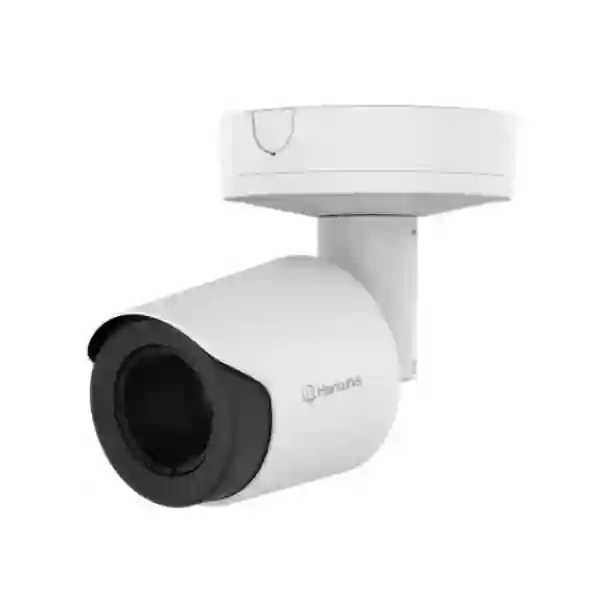
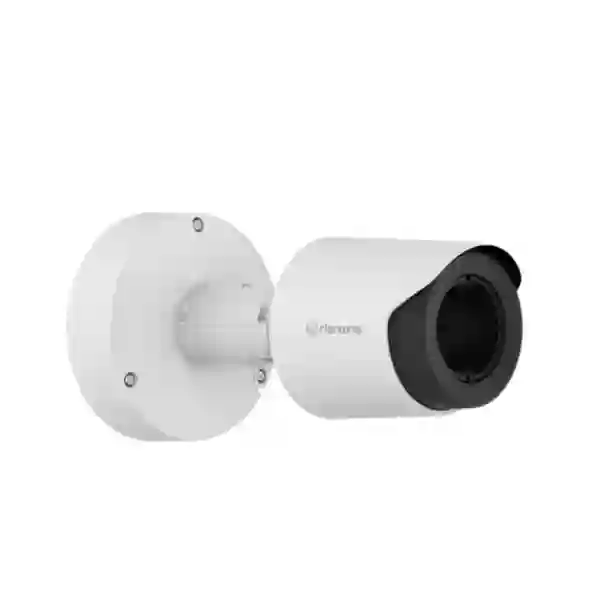
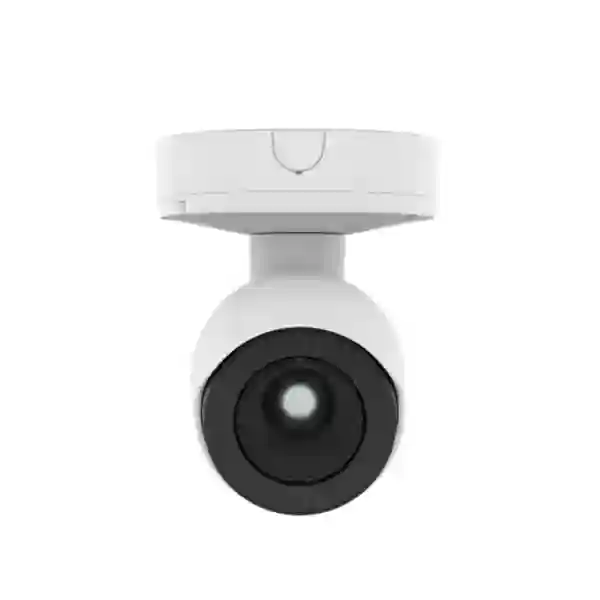
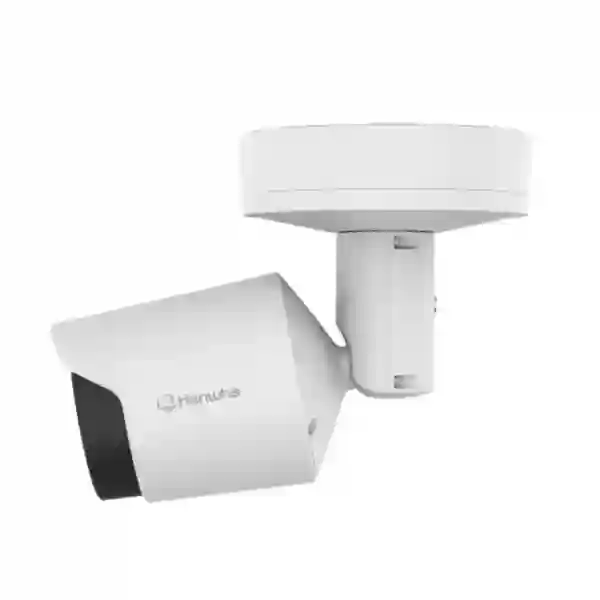
TNO-C3060T: 35 mm AI thermal camera for focused perimeter monitoring
The Hanwha Vision TNO-C3060T brings 384 × 288 thermal sensing, a narrow 35 mm field of view, 30 fps video output, and person/vehicle analytics to outdoor security projects. It is designed for teams that need an early warning from a defined perimeter sector, not a substitute for daylight identification footage. Plan the field of view and test real alarm distances before purchase.
Key specifications at a glance
The table summarizes Hanwha Vision’s published specifications for the exact TNO-C3060T model. It is intended for initial selection; final design should use current manufacturer documentation and tested site conditions.
| Thermal imaging device | Uncooled microbolometer, 384 × 288; 17 µm pixel pitch |
|---|---|
| Video resolutions | 384 × 288 and 768 × 576 output |
| Maximum frame rate | 30 fps for H.265, H.264 and MJPEG |
| Lens / horizontal viewing angle | 35 mm fixed F1.0 / 10.7° |
| Thermal sensitivity | NETD ≤ 20 mK at 25°C, F1.0 |
| AI classification | Person and vehicle |
| Manufacturer reference AI ranges | Up to 234 m person; 311 m vehicle, dependent on conditions |
| Compression / integration | H.265, H.264, MJPEG; ONVIF S/G/T/M; RTSP |
| Power | IEEE 802.3af Class 3 PoE or 12 V DC |
| Storage | Single microSD/SDHC/SDXC slot, up to 1 TB |
| Environmental rating | IP66/IP67, IK10; -40°C to +60°C operating range |
Why this camera deserves consideration
For a site that must detect movement beyond an ordinary CCTV camera’s useful visual range, the Hanwha Vision TNO-C3060T combines a thermal sensor, fixed 35 mm telephoto optics, and onboard analytics. It is especially relevant when the operational question is whether a person or vehicle has entered a protected area, rather than what colour clothing or number plate it carries.
The camera sees differences in emitted thermal energy, so it can form an image in darkness without visible scene lighting. That is valuable around boundaries, industrial yards, infrastructure corridors, and isolated compounds where adding floodlights may be impractical. Thermal imaging does not eliminate the need for clear sight lines, thoughtful positioning, or independent verification of alarm performance.
Buyers planning a project in Tanzania should start by sharing a site plan, approximate detection distances, mounting points, and the intended alarm response. Those inputs determine whether this 35 mm field of view is appropriate. They also help distinguish a technically suitable camera from a listing that merely sounds impressive on paper.
What the product actually is
The TNO-C3060T is a network-connected thermal bullet camera from Hanwha Vision’s T series. Its uncooled microbolometer captures thermal detail at a native sensor resolution of 384 × 288 pixels with a 17 micrometre pixel pitch. The manufacturer lists 768 × 576 and 384 × 288 video resolutions, but the higher output setting should not be confused with a physically higher-resolution detector.
The camera supports video encoding in H.265, H.264, and MJPEG with a maximum listed frame rate of 30 frames per second. It is the 30 fps 35 mm member of a family that also contains 8 fps and differently lensed variants. Model suffixes matter: do not substitute specifications from the similarly named TNO-C3062T.
Its primary mission is situational awareness and perimeter alerting. It does not replace a conventional visible-light camera when investigators need facial detail, clothing colour, lettering, or vehicle registration. A combined thermal-and-optical plan may offer the more practical evidence and response workflow where identification is important.
Thermal visibility versus conventional CCTV
Conventional cameras rely on available visible light or infrared illumination. A thermal camera instead senses long-wave infrared radiation in the 8–14 micrometre band. That distinction can be useful after sunset and in uneven lighting where bright headlights, glare, or shadows make ordinary security video difficult to interpret.
The technology also has limits. A thermal image normally lacks the fine texture of a daylight camera. Glass can obstruct long-wave thermal imaging, while weather, dense vegetation, hot backgrounds, and atmospheric conditions can reduce contrast. No thermal surveillance camera should be described as seeing through walls, buildings, or all types of fog.
For a gate or loading dock, pairing this thermal unit with a visible-light overview camera can help operators receive a reliable early warning and then inspect the scene in recognisable detail. For a remote perimeter, the balance may favour thermal detection first, followed by a patrol or coordinated PTZ view.
35 mm lens and scene coverage
The fixed 35 mm athermalized lens has an F1.0 aperture and a stated horizontal field of view of 10.7 degrees, with 8.0 degrees vertically. This is a comparatively narrow angle, suitable for watching a selected distant sector rather than a broad nearby courtyard. The specified minimum object distance is 36.1 metres.
A narrow lens gives a defined surveillance corridor, but it also means that an intruder moving outside the scene will never trigger an image-based rule. Installers should calculate the scene width at the chosen distance, account for terrain elevation, and check where the protected boundary crosses the image. One camera cannot simply be assumed to cover an entire fence.
Before procurement, draw the projected viewing wedge on the site plan and mark obstructions such as trees, walls, equipment, and parked vehicles. For a shorter or wider area, another lens option in the family may be better; choosing the longest-looking range specification is not the same as choosing the right solution.
Understand the three kinds of distance
Camera specifications often quote detection, recognition, and identification distances based on defined image-size criteria. The manufacturer lists Johnson-criteria estimates for this model, including person detection at 1,230 metres. These figures describe theoretical image-based criteria, not a promise that its onboard AI will reliably generate a usable person alert at that distance.
Hanwha’s exact-model specification separately lists AI detection distance up to 234 metres for a person and up to 311 metres for a vehicle, under its stated reference conditions. Site conditions, target direction, visibility, installation angle, background temperature, and the settings used for event rules can materially change actual performance.
A buyer should specify the desired operational outcome. Detecting the existence of a heat source, classifying it as a person, alerting an operator, and obtaining evidence acceptable for an investigation are four distinct requirements. A disciplined acceptance test should establish which outcome is expected and at which surveyed locations.
AI person and vehicle classification
The camera’s built-in AI engine classifies people and vehicles and supports object-detection analytics. Its available virtual-line functions include crossing and direction; virtual-area functions include intrusion, loitering, enter, and exit. These functions let operators express security rules in terms of behaviour in a designated part of the image.
Imagine a storage compound with an inner vehicle roadway and an outer restricted strip. One rule might flag a vehicle entering a protected zone after hours, while another watches for a person crossing a line parallel to the fence. These are configuration examples, not claims that the camera understands business schedules without setup.
AI analytics are decision aids rather than an automatic guarantee against false alarms. A reliable design should consider target size in pixels, heat contrast, overlapping objects, classification confidence, and whether the event has a sensible follow-up. During commissioning, test people and vehicles moving in both directions across each defined rule.
Building a practical perimeter alarm
An effective perimeter setup begins with a risk boundary and a response action. Decide exactly which crossing deserves an alarm, what should be ignored, and who is responsible for reviewing the event. The camera can provide motion-related and analytics events, but the wider system must make those events understandable and actionable.
Divide the site into clear sectors rather than relying on one oversized detection area. Account for pedestrian access, authorized vehicle routes, vegetation movement, and activity immediately outside the property. Position virtual lines where movement across them is meaningful. In many deployments, a short delay or a monitored confirmation process may be better than forwarding every event.
An alarm design should also cover network failures, power interruptions, and periods when monitoring staff are unavailable. If the camera is installed for safety or critical infrastructure protection, it is sensible to agree on escalation rules, recordings, response responsibility, and routine checks before the system enters service.
Where the camera can fit
Potential applications include lengthy perimeter sections, utility sites, industrial plots, logistics compounds, transport-related boundaries, and areas around critical plant. These are examples of technical use cases, not claims about particular facilities, projects, customers, local offices, or approved deployments within Tanzania.
At an industrial yard, the narrow field of view can concentrate on a specific approach route. Around a warehouse perimeter, the camera may work as one detection layer alongside access control and optical verification. At a remote asset, it may help operators prioritize potential intrusions instead of continuously watching a static video screen.
A site with many blind corners, very short sight lines, or dense foliage may require several positions or a different sensing approach. The final selection should follow a risk assessment, a field-of-view drawing, and a test of the actual surveillance scene rather than a generic industry label.
Designing for Tanzanian conditions
Projects in Tanzania may involve high solar loading, seasonal rainfall, coastal exposure, dusty road approaches, or varying network and electrical infrastructure. These are planning considerations, not proof that any particular site has those conditions. Begin by recording the actual ambient conditions and exposure at the intended installation point.
Hanwha specifies operation from minus 40 to plus 60 degrees Celsius and non-condensing relative humidity up to 95 percent. That published operating envelope is useful, but it does not excuse a poorly sealed cable entry, an unsuitable pole, or a power cabinet that overheats in direct sunlight.
Where a site is exposed to storms or salt-laden air, check the whole installation, including conduit, connectors, mounting hardware, earthing, surge practices, and maintenance access. The system’s resilience is often limited by the weakest external component, not the camera housing’s headline ingress rating.
Outdoor protection and housing
The TNO-C3060T carries manufacturer-listed IP66 and IP67 ingress protection and IK10 impact resistance. Hanwha also lists environmental standards including NEMA 4X, NEMA TS 2, and relevant MIL-STD-810H methods. These are product-level references; they are not independent confirmation of any country-specific regulatory approval for a project.
The compact bullet housing is made from aluminium and is approximately 107.3 millimetres in diameter and 275 millimetres long. The camera weighs approximately 2.37 kilograms. Those dimensions help an installer assess bracket strength, clearance, wind exposure, and safe access, although a complete assembly may weigh more once accessories and mounting hardware are included.
Protection ratings should be interpreted in the context of correct installation. An exposed, damaged gasket or unprotected wiring path can undermine an otherwise robust unit. Ask the installer to document weatherproofing, accessible isolation, and how the camera can be safely cleaned or serviced.
Power options and electrical planning
The manufacturer lists IEEE 802.3af Class 3 Power over Ethernet and 12 V DC as supported input options. Maximum consumption is listed as 10.8 watts on PoE and 9.4 watts on 12 V DC. These ratings assist with switch sizing, power supplies, battery calculations, and network-cabinet design.
A PoE switch can simplify the installation by carrying data and power on one Ethernet connection, subject to distance and cable-design limits. A DC-powered deployment may fit a different site architecture. Neither option removes the need to verify local power stability, grounding practices, cable integrity, and surge protection at exposed mounting points.
Where uptime matters, calculate expected autonomy for the camera, any network switch, recorder, and communication equipment together. A camera may remain powered while its upstream network device is off, creating a false impression of operational resilience. Test both normal and backup power paths during commissioning.
Network and video integration
The camera uses a metal-shielded RJ-45 Ethernet interface supporting 10/100/1000BASE-T. Published video protocols and interfaces include RTSP and ONVIF profiles S, G, T, and M, alongside Hanwha’s SUNAPI and Open Platform capabilities. These options can support integration planning with compatible recorders and video management systems.
Compatibility is not the same as a confirmed installation. An integrator should verify the exact VMS version, licensed features, event subscriptions, discovery behaviour, stream settings, and supported analytics metadata. A display that successfully shows video may still lack the event handling or alarm workflow required by the project.
Agree early on which application will display live streams, archive events, distribute notifications, and manage user permissions. Test alarm events, recording playback, time synchronization, and device reconnection after a network outage. This keeps project acceptance focused on operational functionality instead of simply confirming that the camera appears online.
Compression and bandwidth budgeting
H.265, H.264, and MJPEG support gives the system designer choices for compression and compatibility. Hanwha also lists WiseStream II and WiseStream III smart-codec functionality, along with configurable bitrate control. The appropriate setting depends on the receiving platform, moving thermal detail, recording objectives, and the available network path.
Do not estimate storage or mobile-backhaul requirements from the maximum frame rate alone. Recording duration depends on configured resolution, frame rate, bitrate, codec, scene activity, event policies, and retention requirements. An always-recording thermal stream can impose very different costs from an event-based workflow.
Before ordering network equipment, create a bandwidth budget for every camera and every viewing or recording destination. Include headroom for concurrent live monitoring, maintenance access, and other systems sharing the link. Verify the final bitrate in a representative scene, rather than treating a generic calculation as an assured performance result.
Edge storage and recorder design
The camera supports one microSD, SDHC, or SDXC storage slot, with manufacturer-listed capacity up to 1 TB. Edge storage can be a useful design element for local event recording or resilience planning, but compatible media, recording mode, and retention settings should be confirmed before the product is commissioned.
Recording directly to the camera does not automatically replace a secure central archive. Consider how operators locate footage, whether recording continues when an upstream service fails, and how important clips are preserved. A site may need a recorder, network-attached storage, or a VMS depending on its operational and retention requirements.
Storage cards have finite endurance and can be affected by temperature and writing patterns. Include card-health checks, access controls, and a retrieval procedure in maintenance plans. A successful demonstration should show not only that a clip was created but also that authorized staff can recover it at the required time.
Cybersecurity by design
Hanwha lists secure boot, signed and encrypted firmware, network authentication, encrypted communication options, audit logs, and a secure element with FIPS 140-3 Level 3 and CC EAL6+ references. These capabilities help inform a cybersecurity assessment, but secure hardware does not make a badly configured deployment secure by itself.
Use unique administrator credentials, assign only necessary access, isolate surveillance systems appropriately, and plan firmware maintenance. Decide whether remote access is genuinely required and which approved pathway will be used. Avoid exposing a camera administration interface directly to the public internet simply because a remote operator wants a quick connection.
Accountability also matters after handover. Record installed firmware versions, approved user roles, certificate handling, configuration backups, and the process for revoking departed users. Confirm which protocols must remain enabled for the actual VMS. A smaller, documented attack surface is easier to maintain than unrestricted default access.
Thermal sensitivity and image interpretation
The manufacturer reports thermal sensitivity of 20 millikelvin or better at 25 degrees Celsius with an F1.0 lens. A lower NETD value reflects the device’s capacity to resolve small temperature differences under specified conditions. It should not be presented as a claim of precise temperature measurement or as a guarantee of perfect detection in all scenes.
The camera provides several thermal display palettes, including white-hot and black-hot options. Palette selection influences what is easiest for a human operator to interpret but does not create additional thermal sensor detail. An engineer should examine representative scenes before choosing the display scheme used in a control room.
A thermally bright object need not be a person, a fire, or a security incident. Sun-warmed surfaces, equipment, animals, and reflections in some settings can complicate interpretation. Event rules and operator training should therefore work together, especially at sites where nuisance alarms are costly.
Radiometry is not a blanket promise
Hanwha lists hybrid palettes and region-of-interest condition monitoring for increase or decrease. Those functions are worth discussing during design, but they should not be converted into an unsupported promise that the TNO-C3060T is a calibrated industrial thermometer, certified fire detector, or a substitute for dedicated process instrumentation.
If the project requires alarms at an exact temperature threshold, defined temperature measurement accuracy, or formal safety-system behaviour, ask for a separate technical verification against the exact model’s supported radiometric functions and required standards. The product’s primary documented strengths here are thermal surveillance and AI event analytics.
This distinction protects both the buyer and integrator. A camera can be excellent for security perimeter detection while being the wrong instrument for a tightly specified process temperature or fire-protection application. State the acceptance criterion first and then validate the product against it.
Choosing the mounting position
A fixed telephoto lens rewards careful placement. Begin with the height, distance, and line of sight required to see people or vehicles in the protected zone. Check whether the site is level, sloped, terraced, or partly blocked by equipment. Vertical coverage is limited, so an incorrect camera tilt can exclude important parts of the area.
Mounting positions should also consider tamper risk, repair access, vibration, rain runoff, and the practicality of pulling a safe cable route. Hanwha lists mechanical pan, tilt, and rotation adjustment ranges for installation; these do not make the camera a remotely controlled PTZ unit.
Take reference images from the proposed mounting position or use a field survey to validate geometry before hardware is fixed. Once installed, secure the bracket and recheck the scene after any mechanical adjustment. A few degrees of misalignment can matter more on a narrow thermal field of view.
Virtual lines, areas, and masking
The exact shape of an analytics rule should reflect the operational boundary. A virtual line may suit a fence crossing or one-way approach; an intrusion zone may suit a compound corner. Loitering detection can be relevant where lingering is itself meaningful, but an operator must decide how to handle legitimate workers and service traffic.
The camera also provides configurable motion zones and privacy masking. The manufacturer lists up to eight eight-point polygonal motion zones and six rectangular privacy masks. These features should be reviewed for the exact firmware and recording configuration, especially when a boundary faces neighbouring property or a public route.
A site manager should sign off the final detection and masking plan. Otherwise, the installer may optimize a rule to trigger during a demonstration while unintentionally overlooking real traffic or retaining unnecessary footage. Periodically revisit the rules as buildings, vegetation, and normal movement patterns change.
Alarm outputs and automated handover
The camera supports analytics and other alarm triggers, with manufacturer-listed options for notifications, recordings, file transfers, configurable alarm I/O, MQTT, and PTZ preset handover. Such capabilities can help a thermal event initiate an orderly response rather than remain only a coloured marker on a live screen.
An integrator might configure a thermal virtual-line event to create a VMS bookmark, notify an operator, and cue a compatible PTZ camera toward the relevant sector. Each step requires integration testing, especially when multiple systems from different vendors are involved. A camera-side feature should not be mistaken for a complete, validated automation.
Check how frequently an alarm repeats, how it resets, and what happens when a downstream device or message broker is unavailable. Define who acknowledges incidents and who owns the audit trail. Good automation reduces friction for security staff without hiding whether a critical alarm was actually received.
Operations in complete darkness
Thermal imaging can detect suitable temperature contrast even when visible illumination is absent. This gives the TNO-C3060T a different surveillance role from an ordinary daytime bullet camera, and can be attractive where maintaining floodlighting over long distances is expensive or would disturb surrounding activities.
However, camera performance still depends on target contrast, viewing geometry, environmental conditions, and the chosen analytic rules. Periods when the background and subject temperatures are similar may present more challenging imagery. Operators should not equate darkness capability with an unconditional promise of seeing every intruder.
Plan acceptance tests for daytime heat, evening transition, overnight operation, and any conditions that are important to the site. A single successful after-dark demonstration is encouraging, but it is not a substitute for a structured evaluation of the different scenarios the security team expects to encounter.
Weather, dust, and environmental obstructions
Outdoor surveillance design should anticipate rain, wind-driven dust, heat, and seasonal growth. The camera housing has published environmental protection, but heavy precipitation or atmospheric effects can still degrade the thermal view. There may also be practical obstructions from wet branches, moving machinery, or temporary storage.
Establish a routine for inspecting the lens window, enclosure, mounting points, and external cabling. Cleaning should follow manufacturer guidance; abrasive wiping or unsuitable chemicals can damage optical surfaces. Do not assume a conventional CCTV lens-cleaning procedure is automatically safe for every thermal front window.
Where landscape maintenance is outside the security contractor’s control, name the responsible site team and define how visibility will be preserved. A successful perimeter deployment requires the viewed corridor to remain clear after installation, not merely during the initial survey.
The role of optical verification
Thermal and visible-light cameras answer different questions. A thermal sensor can indicate the presence and location of a heat-bearing target under conditions that challenge ordinary imaging. An optical camera may be better for identifying colour, markings, faces, or details needed to understand what happened after an alarm.
For higher-risk sites, use the thermal camera as a detection input and a separate optical camera as the verification layer. The operator can then review a thermal event alongside a conventional overview or zoomed scene. If PTZ handover is planned, test preset accuracy and the delay between thermal detection and visual acquisition.
That approach can make incident review more reliable, but it should not be sold as automatic identity recognition. Camera placement, lighting, resolution, and evidence policy still determine what can be captured. Always confirm whether any companion camera or software licence is included in the actual quotation.
Comparing alternatives in the family
The 35 mm TNO-C3060T is one lens-and-frame-rate choice within Hanwha’s QVGA AI thermal range. A shorter lens may cover a wider, nearer area, while a longer lens may concentrate on a narrower distant corridor. Optical geometry, not marketing descriptions alone, should decide the most useful model for the site.
The TNO-C3062T is also a 35 mm thermal model, but Hanwha lists an 8 fps maximum frame rate for that variant, compared with 30 fps for the TNO-C3060T. The comparison is important because similarly named listings may reuse images, tables, or general series information while omitting the exact frame-rate difference.
Compare each candidate against the required coverage distance, width of the protected area, event frequency, recorder compatibility, and any applicable regional supply requirements. There is little value in paying for a specification that does not improve the operational result. Confirm availability and export conditions for the exact ordered variant.
When a different camera is better
The TNO-C3060T is not necessarily the right tool for a compact indoor corridor or a customer-facing counter. Its relatively narrow field of view and minimum object-distance specification make those tasks poor starting assumptions. Standard optical CCTV may be more appropriate where appearance, detailed identification, or close-range coverage dominates.
A wide, irregular perimeter may also call for several lenses or technologies rather than one telephoto thermal camera. Radar, beam sensors, fixed optical units, and PTZ verification can serve complementary roles, depending on vegetation, terrain, available infrastructure, and the site’s threat model.
Before deciding, define the events the security system must detect and the false-alert tolerance staff can manage. Ask whether a narrower but deeper view truly solves the coverage problem. A well-documented combination of technologies can sometimes outperform a collection of otherwise excellent cameras deployed without a coherent plan.
Site survey checklist
First, identify the protected boundary, approach paths, normal authorized traffic, and any neighbouring activities. Record the distances to the important test points and prepare a simple drawing showing candidate cameras and their viewing direction. Include objects that may obstruct the scene at different times of year.
Next, examine mounting structures, cable routes, PoE or DC power, network capacity, recording location, and physical access for maintenance. Determine whether the monitoring team needs live video, event clips, PTZ handover, alarm outputs, or integration with an existing VMS. These requirements determine the accessory and software scope.
Finally, agree how performance will be proved. Define the expected person and vehicle cases, test directions, environmental conditions, notification path, and acceptance records. If the project team has not decided what successful detection looks like, the camera order is premature regardless of how strong the datasheet appears.
Commissioning and acceptance testing
Commissioning should begin with correct power-up, secure device access, firmware verification, and dependable time synchronization. Confirm that the camera streams through the chosen recorder or VMS and that users see the intended scene. Recheck that the 35 mm viewing angle covers the complete required sector.
Configure analytics using real movement paths rather than only drawing attractive lines on the screen. Test authorized traffic, people crossing the protected boundary, vehicles at the planned distances, and plausible nuisance scenarios. If a person is too small in the image for dependable classification, record that limitation and consider changing the geometry.
Complete the test by proving event recording, alarm routing, acknowledgement, playback, network-recovery behaviour, and any PTZ handover. Deliver a marked-up site plan, configuration record, training notes, and an agreed maintenance procedure. This evidence gives the owner a practical basis for acceptance and future troubleshooting.
Operator training and alarm response
A useful system is not measured only by the number of analytics events produced. It is measured by whether staff can distinguish meaningful incidents, investigate quickly, and take the right action. Operators should understand what thermal images show, what the event label means, and when a second camera or patrol is necessary.
Training should include ordinary site movements, environmental false positives, alarm acknowledgement, clip retrieval, and reporting. Demonstrate several scenarios using the actual installation rather than generic promotional footage. Staff should know whom to contact if the camera stops communicating or the field of view is blocked.
Set expectations for supervision and escalation. For example, an automated alarm may be reviewed before dispatch unless the site’s risk policy requires immediate response. The chosen process should be appropriate to local staffing and safety requirements, not assumed from a product feature list.
Recording, privacy, and governance
Perimeter monitoring may include workers, visitors, delivery vehicles, and areas beyond the intended property line. Before enabling recording, decide the legitimate monitoring purpose, who may view footage, how long it will be kept, and how access requests or incidents will be handled under applicable local rules.
Configure camera direction and masking to limit unnecessary surveillance. Apply role-based user permissions, protect stored exports, and ensure that event records are not shared casually. The camera offers useful security controls, but policies, access audits, retention settings, and organizational accountability remain necessary.
Where compliance advice is required, obtain review from qualified local advisers rather than treating a camera product description as a statement of Tanzanian legal approval. The page describes available functions and deployment considerations; it does not certify the buyer’s intended surveillance purpose or data handling.
Maintenance and lifecycle planning
After installation, establish a schedule for checking the live scene, camera alignment, enclosure, power supply, cables, storage status, event delivery, and software health. A regular walk test can reveal a changed viewing corridor, damaged bracket, or new obstruction that a remotely reported online status will not show.
Document the process for firmware evaluation and change control. Updates may improve security or compatibility but should be reviewed against the installed recorder, VMS, and project-specific analytics configuration. Back up settings before significant changes and retest the critical alarm rules afterwards.
Also plan for eventual accessory replacement, storage-media wear, and failed upstream equipment. The cost of a thermal installation includes commissioning, training, connectivity, monitoring, and maintenance as well as the camera itself. Ask for those items to be separated in the scope of work so that the ongoing commitment is clear.
Questions to ask before requesting a quote
Ask whether the quoted camera is specifically TNO-C3060T and not an 8 fps sibling or a different focal-length variant. Request the exact manufacturer model, included accessories, power solution, and compatible recorder or VMS details. The site survey should specify the distances and boundary widths the design is intended to cover.
Clarify whether the offer includes mounting hardware, protected cabling, network switches, storage media, software licences, configuration, event integration, training, and acceptance testing. These components can materially affect project cost. A price for the camera body alone is not equivalent to a price for a working perimeter security solution.
For procurement in Tanzania, separately confirm current availability, ordering terms, any required import or export documentation, delivery arrangements, support responsibilities, and applicable warranties with the supplier. None of these commercial details should be inferred from specifications or prices published in another market.
What a good project proposal should contain
A useful proposal states the protected zones, camera locations, model selections, power architecture, cable path, network and recording design, event workflow, and acceptance tests. It should also identify what is excluded. This prevents disagreements over whether the job was intended merely to show thermal video or to deliver a functioning alarm system.
Ask for a camera schedule with exact model numbers and lens selections, plus a scene-coverage diagram. Include the monitoring and escalation responsibilities, preferred retention policy, and documentation deliverables. Where the project requires connection to existing infrastructure, list the exact integration and software-version assumptions.
The most meaningful next step is a site-specific technical quotation, supported by measurements and a clear scope. Share boundary length, required alert range, available mounting points, and recorder or VMS details when requesting guidance. These facts allow a much better assessment than asking whether one model is simply ‘long-range’.
A practical buying decision
Choose the Hanwha Vision TNO-C3060T when the site needs a focused thermal view and person-or-vehicle event analytics within a thoroughly planned surveillance sector. Its 35 mm optics, 30 fps video capability, outdoor housing, and network interfaces make it a credible candidate for selected perimeter tasks.
Do not choose it solely because the published theoretical detection distance is large. Confirm actual AI alert requirements, the width and length of the monitored corridor, target presentation, environmental conditions, and the response workflow. This model is a component of a security design, not a substitute for one.
For a Tanzania project, the buying process should end with a verified model-specific quote, an installation plan, and a measured acceptance test. Request confirmation of local ordering conditions and exact equipment scope before committing. That approach makes performance limitations transparent and gives installers and site operators a common definition of success.
Frequently asked questions
Can the TNO-C3060T operate at night without floodlights?
Yes. Its long-wave thermal detector can form imagery without visible light, provided targets have suitable thermal contrast. Weather, obstructions, and background conditions still affect the usefulness of the image. It does not produce ordinary colour night video or reveal details hidden behind walls.
Is the TNO-C3060T a 30 fps or 8 fps model?
Hanwha lists up to 30 fps for the TNO-C3060T. The similarly named TNO-C3062T is the 8 fps 35 mm variant. Verify the full model designation on the quote and shipment rather than relying on a generic series description.
Does 768 × 576 mean the thermal sensor has that resolution?
No. The manufacturer identifies a 384 × 288 uncooled microbolometer as the sensor. The camera also provides a 768 × 576 output setting. The higher video-output dimensions should not be presented as a separate higher-resolution physical sensor.
How far away can its AI detect a person?
Hanwha lists an AI detection distance up to 234 metres for a reference person and 311 metres for a reference vehicle. These are specified reference values, not guaranteed alarm distances for every site. A field test should verify performance at the intended boundary.
Can the same camera identify faces or read number plates?
Do not plan on that outcome. Thermal images emphasize heat differences and are not a direct replacement for optical identification footage. If names, faces, text, clothing colours, or registration plates matter, include a suitably placed visible-light camera in the system design.
Is the camera compatible with an existing recorder?
The camera supports common network interfaces including ONVIF profiles S, G, T, and M and RTSP. However, particular recording, metadata, analytics, and event features depend on the recipient device and software version. Confirm interoperability with the intended recorder or VMS before ordering.
Does it use PoE?
Yes. Hanwha lists IEEE 802.3af Class 3 PoE and 12 V DC options. The design should still verify cable distance, switch power budget, electrical protection, and any backup supply needed for the camera and the devices that carry its traffic.
What protection does the outdoor housing provide?
The manufacturer specifies IP66/IP67 ingress protection and IK10 impact resistance, together with other listed environmental standards. Suitable installation practices remain essential. The ratings do not independently validate the entire bracket, external cable run, switch enclosure, or site.
Can it measure precise process temperatures or replace a fire alarm?
Do not assume so. Published region-of-interest condition-monitoring functions are not the same as a verified calibrated thermometer or certified fire-protection system. Any temperature-measurement or safety-critical requirement needs explicit model-specific technical validation before purchase.
What should I provide when requesting a quotation in Tanzania?
Provide the exact model, intended site type, boundary distances, viewing widths, mounting heights, available power, network and recorder details, and desired alarm workflow. Ask separately for confirmation of current local availability, pricing, shipment terms, warranty scope, and required documentation.
How many cameras are needed for a long boundary?
There is no defensible fixed number without a survey. Camera count depends on the field of view, distance to the target zone, terrain, obstructions, overlap, and the analytics result required. A sector diagram and on-site verification should determine final quantity.
Request a site-specific TNO-C3060T quotation
For a Tanzania perimeter-security project, request confirmation of the exact model, supply terms, camera count, required accessories, compatible recording platform, and installation scope. Share a site plan showing the boundary, desired alert distance, mounting options, power availability, and alarm response requirement. A responsible quotation should distinguish manufacturer reference values from performance verified at your location.
Contact FourTeck Tanzania to discuss technical suitability and obtain a verified quotation.




Reviews
There are no reviews yet.