
Portable Business Voice • Wi-Fi Mobility • SIP Communication
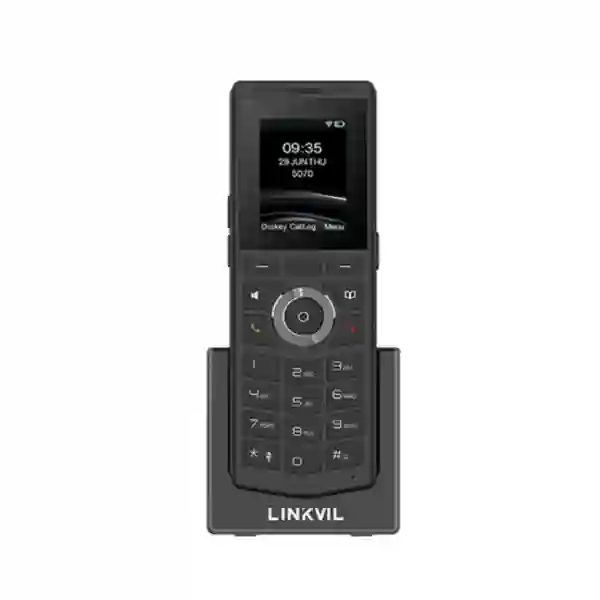
LINKVIL W610W Portable Wi-Fi Phone
The LINKVIL W610W is built for staff who need a business extension without being tied to a desk. It connects directly to a managed Wi-Fi network, supports SIP calling, fast roaming, Bluetooth 5.0 headsets, HD voice and a configurable push-to-talk key, making it relevant to offices, hotels, warehouses, retail teams, facilities staff and other users who move between work areas throughout the day. For Tanzania buyers, the most important question is not only whether the handset has the right features, but whether the wireless network, SIP platform, roaming design and security settings are prepared to support reliable voice while users move.
Dual-band Wi-Fi
Built-in 2.4GHz and 5GHz Wi-Fi supports IEEE 802.11 a/b/g/n/ac, allowing the handset to operate across common enterprise wireless bands.
Fast roaming support
IEEE 802.11k/v/r support is intended to improve handoff behaviour between compatible access points when users move through a properly designed wireless environment.
Business mobility
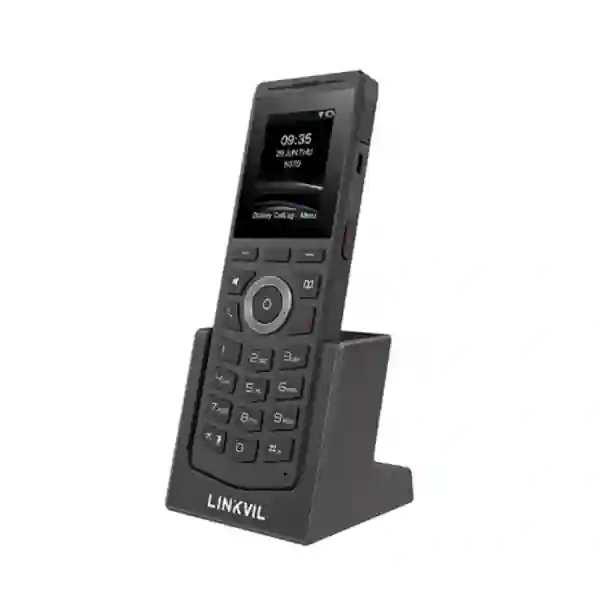
Bluetooth 5.0, vibration alert, belt clip support, a desktop charging base and a configurable PTT key support mobile working roles.
Battery-powered calling
The 1900mAh rechargeable battery is rated by the manufacturer for up to 9 hours of talk time and up to 200 hours standby, with actual performance dependent on environment and usage.
What the LINKVIL W610W is designed to solve
Traditional desk phones work well when the user remains at one workstation, but many employees spend much of the day moving between reception areas, stock rooms, hotel floors, maintenance zones, production support areas, meeting spaces or customer-facing locations. The W610W addresses that mobility requirement by putting a SIP extension on the Wi-Fi network. Instead of requiring a separate DECT base for the handset, the phone uses the organization’s wireless LAN, so the quality of the deployment is closely tied to Wi-Fi coverage, roaming configuration, capacity and network policy.
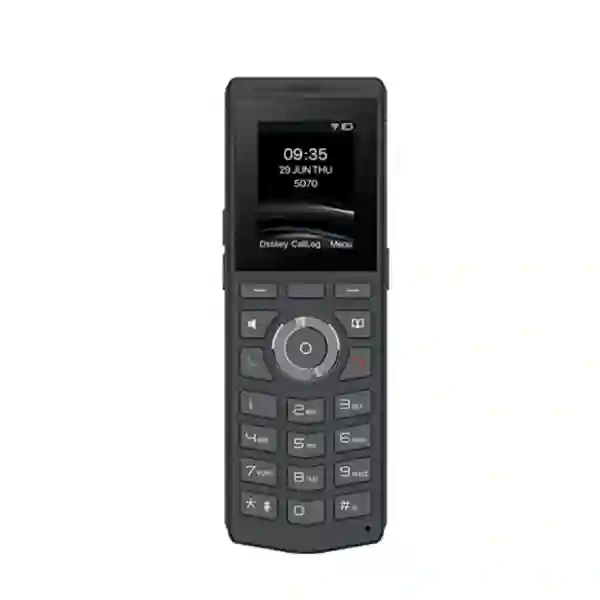
Fanvil’s LINKVIL documentation specifies a 2.0-inch 240×320 colour display, four SIP lines, handset, hands-free and headset modes, 16 DSS keys, HD voice, vibration, a belt clip, a desktop charging base and a standard Type-C charging interface. The device supports local contacts, remote XML/LDAP phonebooks, call logs, voicemail indication, call forwarding, call waiting, speed dial, intercom, three-way local conferencing, emergency calling, do-not-disturb and one-key PTT operation. These features make the handset useful as a general mobile SIP endpoint rather than a simple wireless extension with only call and hang-up functions.
The network layer is equally important. LINKVIL lists WPA/WPA2-PSK and 802.1X EAP security, RTP/RTCP/SRTP, STUN, DHCP, SNTP, HTTP/HTTPS, FTP/TFTP and TR-069, together with auto-provisioning methods and a web management interface. Organizations considering multiple handsets can therefore plan standardized provisioning, firmware management and configuration rather than treating every phone as an isolated device. Where voice security is required, the SIP platform, certificates and endpoint settings should be aligned with the same policy.
Verified technical highlights
| Area | Verified W610W specification | Deployment relevance |
|---|---|---|
| Display | 2.0-inch 240×320 colour LCD | Compact user interface for mobile calling and menu access. |
| Wi-Fi | 2.4GHz 802.11 b/g/n and 5GHz 802.11 a/n/ac | Use with business WLANs; channel planning and coverage remain critical. |
| Roaming | IEEE 802.11k/v/r | Helps mobility across compatible access points when WLAN design is consistent. |
| Security | WPA/WPA2-PSK, 802.1X EAP, SRTP support | Can participate in controlled wireless and encrypted voice environments. |
| Bluetooth | Bluetooth 5.0 | Supports wireless-headset workflows where compatible. |
| Audio | G.722, Opus plus narrowband codecs; AEC, VAD, CNG and packet-loss handling | Wideband quality depends on PBX, codec path and network conditions. |
| Battery | 1900mAh; up to 9h talk / 200h standby | Useful for shift mobility; real runtime varies with signal, roaming and usage. |
| Physical | 156×53×17.7mm, 147g with battery, 1.8m drop height | Portable form factor for mobile business roles. |
Wi-Fi roaming, voice quality and deployment planning
A Wi-Fi phone is only as dependable as the radio environment supporting it. Buyers should resist treating the W610W as a handset-only purchase when the intended users will walk between rooms, corridors, floors or operational zones while on active calls. IEEE 802.11k, 802.11v and 802.11r provide mechanisms that can improve roaming decisions and handoff performance, but compatible access points, consistent SSID and security settings, appropriate signal overlap and sensible channel design are still required. A site can show strong Wi-Fi bars and still deliver poor voice if interference, retry rates, airtime congestion or delayed roaming are excessive.
Voice traffic is sensitive to latency, packet loss and jitter, so network teams should consider voice VLAN design, QoS, DHCP, DNS, firewall policy and wireless airtime together. In warehouses, racking and stock can change propagation. In hotels, reinforced walls, lift shafts and dense room layouts can create uneven coverage. In retail, guest devices may increase client count and airtime load. In offices, video meetings, cloud applications and large file transfers may share the same infrastructure. A practical rollout normally starts with a coverage and capacity review, then validates a small number of W610W units while users move through the real work area.
For organizations building or refreshing the WLAN, FourTeck Tanzania’s business technology solutions overview explains how IP phones, Wi-Fi, switching, firewalls and other systems should be planned together rather than purchased as separate boxes. Buyers can also use the FourTeck Tanzania technology shop to review related networking and communication categories. For implementation planning, the FourTeck Tanzania services page provides broader project context around deployment and support.
Related business phone options on FourTeck Tanzania
The W610W is designed for wireless mobility, so it should not automatically replace every fixed desk phone. Standard users who remain at a desk may prefer a wired SIP endpoint, while mobile staff may benefit more from the Wi-Fi handset. For mixed environments, compare roles before standardizing. The Dinstar C60S Business IP Phone is a basic wired SIP desk option for users who do not need mobility. The Dinstar C60SP PoE Business IP Phone is relevant where central PoE-powered desk telephony is preferred. The Dinstar C60U-W Wi-Fi IP Phone gives buyers another wireless-capable business phone to compare for fixed or semi-fixed desk use, while the Dinstar C62UP PoE Business IP Phone is suited to projects that want a wired multi-account endpoint with PoE. These links help procurement teams compare mobile Wi-Fi calling with conventional desk-phone architectures instead of choosing by brand or screen size alone.
Buying guidance: when the W610W is a strong fit
Choose the LINKVIL W610W when users genuinely need to move and remain reachable on the same business voice system. Typical roles can include hotel operations staff, warehouse supervisors, store managers, facilities personnel, security teams, clinic support staff, education administrators and office users who frequently leave their desks. Confirm that the SIP platform supports the required call features, that the WLAN offers reliable coverage across the intended movement path, and that the chosen authentication method can be deployed consistently. If Bluetooth headsets are important, validate the exact headset model before a large rollout. If PTT is a key workflow, test the required multicast or platform behaviour in the live environment.
Do not select the W610W purely to avoid running a network cable to a desk. A fixed user may receive more predictable service from a wired PoE phone, especially where the existing LAN is already designed for voice. Conversely, a worker who crosses large operational spaces may benefit substantially from a phone built around wireless mobility. The decision should therefore follow user role, movement pattern, Wi-Fi readiness, battery and charging routines, headset preference, PBX compatibility and support model.
LINKVIL W610W Portable Wi-Fi Phone Tanzania
For organizations evaluating the LINKVIL W610W Portable Wi-Fi Phone in Tanzania, the most useful starting point is to define where users move and which conversations must continue while they are away from a fixed desk. Tanzania deployments can range from corporate offices and hospitality properties to warehouses, retail locations, clinics, education sites and distributed operational facilities. In each case, the handset brings SIP voice onto the existing wireless network, which can simplify mobility but also makes WLAN quality a core part of the telephony design. A buyer should therefore identify the approximate coverage area, access-point platform, number of simultaneous mobile users, PBX or SIP service, security requirements and charging routine before confirming quantities.
The W610W supports both 2.4GHz and 5GHz wireless bands and IEEE 802.11k/v/r roaming. In a Tanzania office with multiple access points, that can be valuable when employees move between work zones while talking. In a hotel, staff may cross corridors and service areas; in a warehouse, they may move between aisles, loading zones and stock locations. The phone can benefit from a properly designed WLAN, but roaming standards do not compensate for coverage gaps or congested channels. A pre-deployment survey or at least a pilot test should verify signal overlap, call continuity and battery behaviour under realistic movement. This matters more than simply checking whether a smartphone can browse the internet in the same area because voice is more sensitive to delay and handoff interruptions.
Procurement teams should also confirm how phones will be configured and supported. LINKVIL documents web management, firmware upgrade, configuration import/export, syslog and multiple auto-provisioning methods. These capabilities can help an IT team standardize account settings, directories, time configuration and security policy across multiple units. For a quotation, include the number of handsets, user roles, SIP platform, WLAN vendor, authentication method, expected roaming area, Bluetooth headset requirement, PTT use, charging locations and whether centralized provisioning is required. FourTeck Tanzania can use those details to frame the handset as part of a working voice solution rather than a standalone wireless device. For broader project planning, the FourTeck Tanzania contact page provides the verified enquiry route.
LINKVIL W610W Portable Wi-Fi Phone Dar es Salaam
Dar es Salaam businesses often operate across busy multi-room offices, hotels, logistics facilities, retail environments and service locations where staff spend significant time away from a fixed desk. The LINKVIL W610W can fit these workflows by giving a mobile employee a SIP extension that follows them across the Wi-Fi network. This is especially relevant for supervisors, floor managers, hospitality staff, operations teams and support personnel who need direct voice contact without depending on a personal mobile number. The phone’s vibration alert can also be useful in noisy or customer-facing environments where an audible ringtone alone may be easy to miss.
A Dar es Salaam rollout should begin with the wireless network rather than with handset quantity. Buildings with concrete walls, glass partitions, multiple floors or crowded radio environments can create very different coverage conditions from open office space. The W610W supports 2.4GHz and 5GHz operation, but each band has different propagation and capacity characteristics. A site with several access points should be checked for channel overlap, client density and roaming behaviour. If staff must stay on an active call while moving between floors or departments, test handoffs through the actual route they use. The 802.11k/v/r capabilities are valuable only when the infrastructure is configured to work with them and the RF environment remains stable.
The SIP design should be reviewed at the same time. Confirm extension numbering, incoming call routes, voicemail, transfer methods, directory access, codec policy and any call-recording or security requirements. Because the W610W supports four SIP lines and multiple programmable functions, administrators can tailor the handset to different mobile roles rather than using one identical key layout for everyone. Headset users can evaluate Bluetooth 5.0, while users who need rapid group communication can test the configurable PTT function. For organizations operating both Tanzania and UAE sites, FourTeck UAE offers a regional technology route for related infrastructure projects, helping multi-country IT teams keep communication and network standards aligned.
LINKVIL W610W Portable Wi-Fi Phone Mwanza
Mwanza organizations considering a portable Wi-Fi phone may be focused on branch mobility, hospitality operations, education, healthcare support, retail or warehouse communication. The W610W is useful when a staff member needs to remain on the company SIP system while walking through the site. Instead of issuing a desk phone that is unavailable whenever the employee leaves their station, the business can assign a portable handset tied to the user’s extension. The compact form factor, belt clip, vibration function and dedicated controls are practical for operational roles where a conventional desktop endpoint is not convenient.
The network requirements deserve careful attention before deployment. A business may already have Wi-Fi that works well for laptops, yet voice can expose weak roaming, inconsistent coverage and airtime congestion that normal browsing does not reveal. In Mwanza branches, a pilot can help confirm whether access-point spacing and transmit power allow a call to continue as the user moves. Where several SSIDs exist, administrators should avoid unnecessary complexity and ensure the phone remains on the intended business voice network. If 802.1X EAP authentication is planned, the certificate or credential workflow should be tested so handsets can rejoin the network reliably after reboot, battery replacement or configuration changes.
Operational support should also be planned. The W610W supports web management, auto-provisioning methods and logging functions that can help an IT team maintain several devices consistently. A device register can record the handset MAC address, assigned user, extension, firmware level and location. Charging bases should be placed where shift users naturally return the handset, and battery expectations should be based on real calling patterns rather than the laboratory maximum. When requesting a Mwanza quotation, provide the expected number of units, whether handsets are assigned personally or shared by shift, the SIP/PBX platform, WLAN make and model, coverage area and whether PTT or Bluetooth headsets are part of the workflow. These details improve both product selection and deployment planning.
LINKVIL W610W Portable Wi-Fi Phone Arusha
Arusha has a mix of hospitality, tourism administration, professional services, education, logistics and commercial operations where employees may need to stay reachable while moving through a property. The LINKVIL W610W can serve as a mobile SIP endpoint for hotel supervisors, front-office support, facilities teams, store personnel and other users who cannot remain beside a desk phone. Its colour display, programmable keys, speakerphone, vibration alert and headset support allow the handset to function as a practical business communication device rather than only a basic cordless receiver.
Hospitality is a particularly useful example. A hotel may already have managed Wi-Fi across guest and staff areas, but a voice deployment should not automatically use the same SSID and policy as guest internet. Staff telephony may benefit from its own controlled network or VLAN, predictable authentication, QoS and careful access-point tuning. A W610W user could move between reception, offices, service corridors and operational zones, but the intended route should be tested for call continuity. Thick walls, stairwells, lifts, outdoor transitions and back-of-house spaces can create coverage edges that are not obvious from guest-room internet tests.
Before ordering multiple units for Arusha, define which users actually need mobility and which can remain on wired desk phones. This role-based approach prevents the WLAN from carrying unnecessary voice endpoints and can reduce charging and battery management overhead. For call-heavy mobile employees, test a compatible Bluetooth headset and confirm that the desired control behaviour is supported. For maintenance or security coordination, evaluate the configurable PTT button within the planned communication method. Include the IP PBX, SIP account count, phonebook needs, roaming area, WLAN security mode and support process in the quotation request. If the broader project also needs access points, switching, firewall rules or cabling, those components should be considered as one architecture so the phone is not blamed for weaknesses elsewhere in the network.
LINKVIL W610W Portable Wi-Fi Phone Dodoma
Dodoma offices, institutions and service organizations can use the LINKVIL W610W where employees need an official SIP extension but also move between desks, departments, meeting areas or service points. The handset’s four SIP lines, programmable DSS keys, call forwarding, call waiting, voicemail indication and three-way conference functions can support daily office communication, while Wi-Fi mobility reduces dependence on a single wall outlet or desk location. It can be particularly useful for facility coordinators, office administrators, technical support staff and supervisors whose work is distributed across a building.
For structured deployments, administrators should decide how the phone will authenticate to both the wireless network and the SIP system. LINKVIL documents WPA/WPA2-PSK and 802.1X EAP on Wi-Fi, together with SRTP support at the voice layer. A secure design should match these endpoint capabilities with the WLAN controller, RADIUS environment, PBX and certificate policy rather than simply enabling options independently. The phone also supports provisioning through FTP, TFTP, HTTP, HTTPS, DHCP option 66, SIP PnP and TR-069, which can help organizations create repeatable configurations. The selected provisioning method should be tested and protected appropriately.
Continuity planning matters because a Wi-Fi phone depends on the entire wireless and IP path. If access points, switching or the PBX lose power, the handset may remain on but calls cannot continue. Dodoma organizations that require voice during short power interruptions should therefore review UPS support for access points, switches, routers and the PBX or internet equipment, not just the handset battery. A quotation should specify the number of mobile users, building layout, access-point estate, desired call features, SIP platform, directory requirements, security method and whether devices will be shared across shifts. This creates a complete deployment picture and helps determine whether the W610W should be used across all mobile roles or combined with fixed IP phones for stationary users.
LINKVIL W610W Portable Wi-Fi Phone UAE
For UAE businesses, the LINKVIL W610W can be positioned as a mobile SIP endpoint for warehouses, hospitality properties, retail operations, offices, service environments and facilities teams that already depend on managed Wi-Fi. The same operational questions apply as in Tanzania: which users move, how large is the roaming area, what SIP platform is in use and whether the WLAN can maintain voice quality during handoffs. Multi-country organizations can benefit from standardizing on the same handset and provisioning profile where infrastructure is compatible, because user training, button layouts, directory behaviour and support procedures can remain consistent across branches.
The UAE often includes high-density enterprise WLAN deployments, so capacity planning can be as important as coverage. A signal may appear strong while airtime is busy with laptops, smartphones, IoT devices and guest traffic. Voice should be tested under realistic load and on both 2.4GHz and 5GHz bands where appropriate. The W610W’s 802.11k/v/r support can improve roaming when the wireless infrastructure is configured coherently, but individual AP settings, minimum data rates, channel widths, power levels and steering policies still affect results. Warehouses may also require careful testing around racks and moving inventory that can change RF conditions.
Organizations with UAE operations can use FourTeck UAE IT and telecom solutions for regional project coordination and FourTeck’s IP phone specialist site for broader business telephony context. When requesting a W610W quotation, provide the PBX type, number of mobile extensions, WLAN platform, roaming area, headset needs, PTT requirement and security policy. If the same organization also operates in Tanzania, document a shared baseline for SIP settings, firmware, naming and user profiles while allowing each site’s RF design and local telecom environment to be treated separately.
LINKVIL W610W Portable Wi-Fi Phone Uganda
Ugandan organizations can consider the W610W when they need portable SIP calling across offices, warehouses, hospitality sites, clinics, schools or operational facilities. A mobile phone on the public cellular network may keep a worker reachable, but it does not necessarily provide the same extension plan, transfer functions, internal dialing or PBX controls as a dedicated business SIP handset. The W610W keeps the user within the organization’s VoIP environment while allowing movement through wireless coverage, which can be valuable for teams that need internal call handling without returning to a desk.
A successful Uganda deployment should distinguish between a good internet connection and a good voice-ready WLAN. Internal Wi-Fi conditions can affect a call even if the external internet link is stable. Coverage gaps, AP congestion, poor channel reuse or delayed roaming can create audio breaks. Before scaling to many handsets, test a pilot across the actual building. The phone’s vibration function, belt clip and Bluetooth support can be evaluated for staff working in louder or hands-busy environments. Battery routines should also be planned for shifts, with charging bases positioned where devices can be returned consistently.
For cross-border organizations, FourTeck Uganda provides regional context for IP PBX, VoIP and networking projects. IT teams can align extension templates, SIP security, firmware and support procedures between Uganda and Tanzania while still testing each site independently. A quotation request should include handset quantity, whether units are shared, the PBX, WLAN vendor, security method, desired roaming coverage and any need for Bluetooth or PTT. Where the existing WLAN is weak or unmanaged, budget for the wireless improvements needed to make voice dependable rather than assuming the handset itself can solve RF limitations.
LINKVIL W610W Portable Wi-Fi Phone Kampala
Kampala offices and service businesses can use the LINKVIL W610W to support employees who need extension mobility across busy workspaces. Reception support staff, building coordinators, store managers, warehouse supervisors and technical personnel may frequently leave a desk but still need to answer direct calls, receive transfers or contact colleagues. Assigning a portable SIP handset can keep those users connected to the business phone system without relying on forwarding every call to a personal mobile device.
Dense Wi-Fi environments require deliberate planning. A Kampala office may have employee laptops, smartphones, guest Wi-Fi, wireless printers and collaboration traffic sharing the same access points. Adding voice handsets means airtime and roaming behaviour should be reviewed rather than assumed. The W610W’s dual-band support allows network teams to use the available 2.4GHz and 5GHz infrastructure according to coverage and capacity requirements, while 802.11k/v/r can help with roaming on compatible WLANs. The right AP placement and channel plan remain critical. If a user walks through a known dead zone, no roaming feature can create a signal where one does not exist.
For larger deployments, centralized configuration can reduce support variation. Administrators can standardize SIP server addresses, codecs, directories, DSS keys and firmware, then document each handset assignment. Before purchasing a large quantity, test call transfer, voicemail indication, directory access, headset pairing and any PTT function on the actual PBX. Kampala procurement teams should also ask whether users need a portable Wi-Fi phone or simply a wireless headset attached to a desk phone; the former is most valuable when the entire handset must travel with the employee. Clear role definition helps avoid overbuying mobile devices where a fixed endpoint would be simpler.
LINKVIL W610W Portable Wi-Fi Phone Arua
Arua branches and institutions can use the W610W as a portable extension when local staff need mobility and the organization already has, or plans to build, dependable Wi-Fi. Branch environments often benefit from simple, repeatable endpoint standards because central IT teams may support users remotely. The W610W’s web management, provisioning options, configuration export/import and logging features can support this model, allowing settings to be prepared consistently instead of relying on manual configuration by each local user.
The branch should first confirm the basics: stable access-point coverage, predictable DHCP and DNS, reachability to the PBX, correct firewall rules and reliable power to the network. A portable handset can have a charged battery but still lose calling capability if the branch router, switch or access points shut down. If voice continuity is important during short outages, the supporting network equipment should be placed on appropriate backup power. The handset’s charging base and Type-C interface provide practical charging options, but a shift procedure is still useful so shared phones are not handed to the next user with insufficient battery.
For an Arua quotation, identify whether the handset will register to a central PBX over the internet, a local PBX or a cloud platform. That decision can affect firewall, VPN and latency considerations. Include the number of devices, expected simultaneous calls, roaming area, WLAN model, SIP platform, security policy, directory requirements and who will maintain firmware. A pilot can confirm whether the handset behaves correctly when users walk through the site and whether the network supports the desired audio quality. This approach turns a branch phone purchase into a manageable communication standard that can be supported from a central IT team.
LINKVIL W610W Portable Wi-Fi Phone Mbarara
Mbarara businesses can consider the W610W for mobile staff in healthcare support, retail, education, hospitality, warehouses and general commercial environments. The main advantage is not simply that the handset is cordless; it is that it can operate as a SIP phone on the organization’s Wi-Fi network and participate in business call handling. Users can receive transferred calls, access voicemail indications, use programmable functions and continue working away from a desk. This can reduce missed internal calls when the employee’s role naturally involves movement.
For environments where workers move between rooms or buildings, the wireless design should be mapped around the intended walking path. Check whether access points overlap enough to avoid long periods at weak signal levels, and confirm that the WLAN’s roaming and security settings remain consistent. A site may also need separate staff and guest wireless policies so the phone is not sharing an uncontrolled guest network. If 802.1X EAP is selected, administrators should confirm how credentials are issued and renewed. If WPA/WPA2-PSK is used, key management should follow the organization’s security policy.
The W610W’s battery rating can support mobile work, but real runtime varies with signal conditions, screen use and call volume. Mbarara organizations operating long shifts should test actual runtime and decide whether each user has a personal handset, whether phones are shared, and how charging bases will be organized. Where a phone is shared between shifts, configuration and contacts should avoid exposing unnecessary personal information. A quotation should include the expected shift pattern, user count, call volume, SIP platform, access-point estate, charging arrangement, headset needs and whether central provisioning is required. Those details make it easier to determine the right quantity and support plan.
LINKVIL W610W Portable Wi-Fi Phone Gulu
Gulu organizations that manage several departments or dispersed work areas can use the W610W where staff need to carry the business extension with them. A portable Wi-Fi handset can be more appropriate than a desk phone for supervisors, campus staff, maintenance teams or service personnel who spend much of their time away from a fixed workstation. The handset’s programmable DSS keys can provide quick access to frequently used extensions or functions, while the PTT button can be evaluated for rapid team communication where the chosen network and call method support it.
A disciplined deployment is particularly useful when technical support is remote. IT teams can prepare a standard configuration, document firmware and account settings, and maintain a device inventory. The W610W supports centralized management methods that can reduce manual variation, but the chosen provisioning method should be secured and tested. Logs and packet capture can assist troubleshooting if a phone registers but calls fail or audio becomes one-way. Network diagnostics should include the wireless link, IP addressing, PBX registration, firewall path and codec negotiation rather than focusing only on the handset.
Gulu buyers should also decide whether the current access points are capable of reliable roaming. If the WLAN was installed primarily for occasional internet access, a voice rollout may expose areas that need additional APs, better placement or channel changes. A small pilot with users walking their normal route is often more informative than a desktop test. Include in the quotation the number of handsets, floors or zones covered, SIP/PBX type, WLAN vendor, preferred security method, Bluetooth requirements, PTT use and charging model. This lets procurement compare the total working solution with alternatives such as wired IP phones, DECT systems or softphone-based mobility.
LINKVIL W610W Portable Wi-Fi Phone Kenya
Kenyan businesses can deploy the LINKVIL W610W where a mobile SIP handset is needed for warehouse, hospitality, retail, office, education or healthcare support workflows. The phone has direct commercial relevance in the region because buyers often compare dedicated Wi-Fi handsets with DECT phones and mobile softphones. The W610W is most compelling where the organization already runs a managed WLAN and wants employees to use a purpose-built physical handset with keypad, speakerphone, vibration alert, belt clip, programmable keys and business SIP functions rather than a personal smartphone.
Selection should focus on the network and workflow rather than the advertised feature list alone. Confirm how users roam, which access points support the required standards, whether the handset should use 2.4GHz or 5GHz in each area and whether voice traffic will receive appropriate priority. Warehouses and retail stores may experience changing RF conditions as shelves, stock and customer devices affect the environment. Hotels and offices may have dense AP deployments where transmit power and channel overlap need tuning. A pilot should include active calls while users walk across the intended route, not only stationary registration tests.
For Kenya-focused requirements, FourTeck Kenya provides regional coverage for VoIP, networking and broader IT infrastructure. Multi-country buyers can use a common W610W configuration baseline across Kenya and Tanzania if PBX and WLAN policies are compatible, while keeping local RF validation separate. A complete quotation request should state phone quantity, user roles, PBX model or cloud service, wireless infrastructure, authentication method, roaming area, headset and PTT needs, and whether the project includes access-point or network upgrades. This allows the handset to be evaluated as one part of a reliable voice system rather than an isolated product.
LINKVIL W610W Portable Wi-Fi Phone Kuwait
Kuwait organizations can use the W610W for staff who move through corporate offices, hospitality sites, warehouses, retail operations or service facilities while remaining part of the SIP phone system. A portable Wi-Fi handset can be easier to standardize than personal mobile devices because IT controls the endpoint, extension, firmware and configuration. The W610W’s 2.0-inch display, four SIP lines, programmable keys, Bluetooth 5.0, vibration and PTT control make it suitable for mobile operational users who need dedicated call handling rather than a general-purpose smartphone.
Wireless design is important in larger Kuwait properties where high client density can make airtime management a concern. Wi-Fi voice should be planned around both coverage and capacity, with deliberate channel reuse, appropriate access-point power and consistent security configuration. Roaming support can reduce interruptions but does not replace RF design. Administrators should also confirm whether their WLAN uses features such as band steering, minimum RSSI or client load balancing, because aggressive policies can affect a voice handset differently from a laptop. Real-world tests should include busy periods and the full user movement path.
For local project context, FourTeck Kuwait covers IP PBX, VoIP, Wi-Fi and network infrastructure. A Kuwait quotation should identify how many handsets will be active simultaneously, whether they are assigned or pooled, the SIP platform, WLAN design, authentication policy, charging routine and headset requirements. Where businesses also operate in Tanzania, the same provisioning profile may reduce administration, but local time settings, network credentials, PBX routing and regulatory or carrier dependencies should be treated per site. Standardization works best when it controls endpoint configuration without pretending that every building has the same radio environment.
LINKVIL W610W Portable Wi-Fi Phone Ghana
Ghanaian organizations looking for portable business voice can consider the W610W where employees need to stay within the corporate SIP environment while moving across a site. In warehouses, hotels, schools, clinics, retail branches and offices, the handset can be assigned to users who routinely leave a fixed workstation. The dedicated physical keypad and call controls may be preferable to a softphone for staff who need a device that is always ready for voice, while the vibration alert and belt clip support practical mobile use.
The surrounding WLAN should be tested for low-latency voice and predictable roaming. Coverage maps designed for data may not reveal the experience of a user walking with an active call. A Ghana deployment should therefore include walk tests, call transfers and inbound-call tests across the intended work zones. If the wireless network has separate staff and guest SSIDs, place the phone on the managed business network and use an authentication method consistent with organizational security policy. Where voice encryption is required, confirm that the PBX and endpoint settings align rather than enabling SRTP in isolation.
Organizations can use FourTeck Ghana for regional technology planning across communication and network categories. A Ghana quotation request should include the number of users, building or campus layout, WLAN vendor, SIP platform, expected call volume, security method and charging plan. It is also useful to state whether the handset is being considered as an alternative to DECT, a wired IP phone or a mobile softphone, because each approach has different infrastructure and user-experience implications. The W610W is strongest when existing business Wi-Fi is well managed and users genuinely need a dedicated portable SIP endpoint.
LINKVIL W610W Portable Wi-Fi Phone Nigeria
Nigerian businesses can consider the LINKVIL W610W for mobile operational roles in large offices, hospitality, warehousing, retail, healthcare support, education and facilities management. The phone allows a user to carry a SIP extension through wireless coverage while retaining familiar business call controls. This can be useful for supervisors who need direct extension reachability but cannot remain at one desk, or for service teams who receive calls from reception and need to move across a property while staying connected.
The project should assess Wi-Fi and power resilience together. A charged handset may operate for hours, but its calls depend on access points, switches, routers and the PBX path. If continuity during power interruptions is important, network infrastructure should be backed appropriately. Wireless planning should also account for high client density, interference and building materials. The W610W’s dual-band radio and 802.11k/v/r support can participate in a capable enterprise WLAN, but performance depends on AP placement and policy. Pilot testing should include active roaming, not just registration near one access point.
For Nigeria-focused requirements, FourTeck Nigeria provides a regional route for broader IT and communication solutions. Procurement teams should provide handset quantity, expected simultaneous calls, PBX or cloud platform, WLAN make and model, floor plan or zone description, security policy, battery/charging routine, headset needs and PTT expectations. If devices will be shared across shifts, define ownership and sanitation procedures, configuration access and how users identify their extension. A well-specified rollout can make the W610W an operational tool rather than another unmanaged wireless device added to an already busy network.
LINKVIL W610W Portable Wi-Fi Phone Seychelles
Seychelles hospitality, resort, office and service environments can be strong candidates for portable Wi-Fi voice because staff often move between reception, operations, guest-service areas, maintenance zones and back-office locations. The W610W can place a dedicated SIP handset on the managed wireless network so a staff member remains reachable through the property’s phone system while away from a desk. The device’s compact size, vibration function, Bluetooth support and programmable keys can fit mobile workflows where a full desk phone is impractical.
Properties with multiple buildings or outdoor transitions should pay particular attention to RF boundaries. A resort may have strong Wi-Fi inside rooms but weaker coverage on pathways, service corridors or transitions between buildings. An active voice call can expose these gaps immediately. Before rollout, map the routes staff actually use and test calls while moving through them. Outdoor or semi-outdoor areas may require dedicated access points and carefully planned roaming. Network teams should also separate staff communication traffic from guest wireless access where appropriate, both for security and for more predictable performance.
A Seychelles quotation should include the number of portable users per shift, whether handsets are assigned by person or department, the PBX platform, WLAN controller and AP models, authentication method, coverage zones and charging locations. For hospitality environments, consider how incoming guest calls are transferred, whether directory names are required and how missed calls or voicemail are handled. If Bluetooth headsets are intended for housekeeping coordination, reception support or facilities work, validate the selected headset. The W610W should be treated as part of the property’s communication architecture, with Wi-Fi, switching, firewall rules and voice configuration tested together before final acceptance.
Compatibility and integration checklist
Before approving a W610W deployment, verify the exact SIP server or PBX version, extension authentication method, codecs, voicemail indication, transfer behaviour, directory integration, time synchronization, firmware and desired security features. Then validate the WLAN: SSID, authentication, DHCP, DNS, VLAN, firewall policy, access-point coverage, roaming and QoS. Finally, validate the user workflow: call volume, walking route, battery duration, charging routine, headset pairing and PTT behaviour. A small pilot should reproduce real movement and real call handling, not just confirm that the handset can register.
Frequently asked questions
Does the LINKVIL W610W need a DECT base station?
The W610W is a Wi-Fi SIP phone. It connects through a compatible wireless LAN rather than using a dedicated DECT base. That means reliable Wi-Fi coverage and roaming design are central to call quality.
Does the W610W support 5GHz Wi-Fi?
Yes. LINKVIL specifies 2.4GHz 802.11 b/g/n and 5GHz 802.11 a/n/ac support. The appropriate band depends on access-point design, coverage, interference and client density.
Can the W610W roam between access points?
The handset supports IEEE 802.11k/v/r roaming features. Good results still depend on compatible access points, consistent SSID and security settings, adequate signal overlap and a well-designed WLAN.
How long does the battery last?
The manufacturer rates the 1900mAh battery for up to 9 hours of talk time and up to 200 hours of standby. Actual runtime varies with usage, radio conditions, roaming, screen activity and environment.
Can I use a Bluetooth headset?
The W610W includes Bluetooth 5.0 and supports wireless-headset use. For business rollout, test the exact headset model and call-control behaviour before purchasing large quantities.
Is the W610W suitable for warehouses and hotels?
Those are among the mobile scenarios identified by the manufacturer, but suitability depends on the actual site. Warehouses and hotels often require careful RF planning because shelving, walls, lifts, corridors and dense client populations can affect Wi-Fi voice.
What should I provide for a quotation?
Provide the quantity, user roles, SIP/PBX platform, WLAN vendor and access-point models, coverage area, security method, headset and PTT requirements, charging approach and whether configuration or network work is required.
Quotation checklist for the LINKVIL W610W
Decision recap
The LINKVIL W610W is best viewed as a business mobility endpoint, not simply a cordless replacement for a desk phone. Its dual-band Wi-Fi, 802.11k/v/r roaming support, four SIP lines, HD audio, Bluetooth 5.0, programmable DSS keys, vibration alert, PTT button and rechargeable battery give it the right foundation for employees who need to move while staying on the business voice system. The final user experience depends on the network around it. Organizations should validate wireless coverage, handoff behaviour, PBX integration, security, charging and user workflow before a large rollout.
For stationary users, a wired PoE phone may remain simpler. For truly mobile employees, the W610W can reduce missed calls and keep internal communication connected across the work area. A mixed endpoint strategy often provides the best balance: portable Wi-Fi phones for moving roles, wired phones for desks and conference devices for shared rooms. The correct quantity and configuration follow from how people actually work.
Talk to FourTeck about your W610W deployment
If you already know the number of LINKVIL W610W handsets required, send the model, quantity and destination. If you are still evaluating whether Wi-Fi handsets are appropriate, include your PBX platform, access-point environment, expected roaming area and user roles so the discussion can cover compatibility and network readiness as well as the handset itself. For organizations with several sites, share the branch locations and whether you want a common device and provisioning standard.
Use the verified FourTeck Tanzania contact page to request pricing, compatibility guidance or a deployment discussion.

Reviews
There are no reviews yet.