
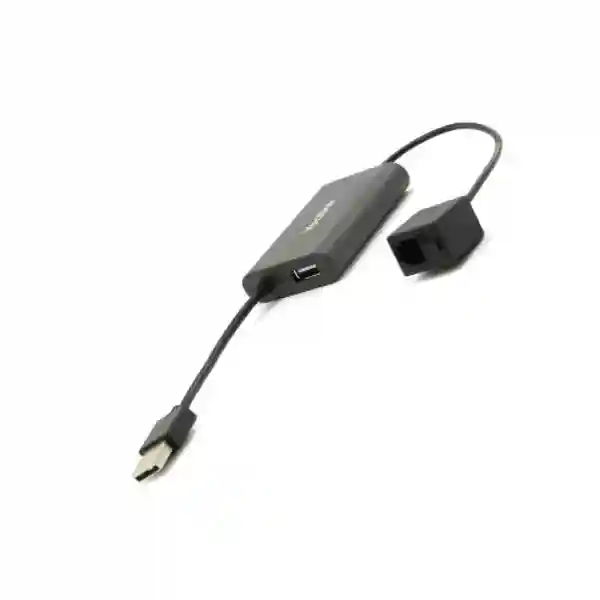
Yealink CPN10 PSTN Box
The Yealink CPN10 PSTN Box is a compact accessory for organizations that need to connect supported Yealink conference phones or desk IP phones to a traditional public switched telephone network line while continuing to use SIP-based calling. It is especially useful in offices, meeting rooms, branch locations and transition environments where analog PSTN service must remain available alongside an IP telephony platform.
CPN10 provides one RJ11 PSTN interface and a USB connection to compatible Yealink phones. Yealink states that it is plug-and-play, needs no additional power, supports USB call recording and supports up to two cascaded units in supported scenarios.
Keep an analog telephone line available while using supported Yealink SIP phones.
The CPN10 is powered through its connection to the compatible Yealink endpoint and does not need a separate power adapter.
Yealink specifies one USB 2.0 port and one RJ11 port in a 73 × 48 × 15 mm enclosure.
Up to two CPN10 units can be cascaded on supported endpoints for local PSTN conferencing requirements.
What the Yealink CPN10 PSTN Box does
Many businesses have moved their internal voice environment to SIP, IP PBX or hosted telephony, yet still retain one or more analog PSTN lines for operational, migration or site-specific reasons. The CPN10 creates a practical bridge for compatible Yealink endpoints. Instead of keeping a separate analog conference phone on the table, a supported Yealink conference or desk phone can gain PSTN calling capability through the CPN10 while remaining part of an IP-based communication environment. This makes the accessory relevant to organizations replacing legacy telephony gradually, maintaining specific analog services, or needing a controlled fallback path in a meeting-room or office environment.
Yealink’s current product information lists compatibility with CP860, CP920, CP960, CP925, CP965, T67LTE, VP59, T58A, T58W, T57W, T54W, T53W and T53. Because product firmware, region and endpoint revisions can affect behavior, buyers should confirm the exact phone model and intended call flow before procurement. FourTeck can help customers define whether the goal is a simple single-line PSTN connection, local conferencing, coexistence during a SIP migration, or a wider voice-system upgrade.
Verified features and physical specifications
| Purpose | Adds PSTN connectivity to supported Yealink phones while enabling SIP and PSTN calling modes. |
| Interfaces | 1 × USB 2.0 port and 1 × RJ11 port. |
| Dimensions | 73 × 48 × 15 mm. |
| Power | No additional power supply required. |
| Recording | USB call recording supported in compatible deployments. |
| Cascade | Up to two CPN10 units supported in cascade for applicable PSTN conference use. |
| Operating humidity | 10–95%. |
| Package | CPN10 PSTN Box, 3 m PSTN cable, double-sided tape and quick-start guide according to Yealink product documentation. |
Compatibility, integration and buying guidance
The most important buying question is not simply whether a site has an analog line. It is whether the exact Yealink endpoint and the intended feature set are compatible with the CPN10. A current Yealink product page identifies a broad set of compatible conference and desk phones, but organizations should still confirm their specific endpoint model, firmware and physical port arrangement. For a new deployment, it can also be worth comparing whether the business should retain PSTN at all, or whether the same requirement can be addressed more cleanly through SIP trunks, a business IP PBX or a cloud voice service.
If PSTN remains necessary, document the line purpose before installation. A conference-room line may be used for direct external calls, a local three-way PSTN conference, or continuity during a wider voice migration. A branch office may use the line because local carrier services are still analog. A reception environment may need a specific number kept active during a staged PBX replacement. Clear intent helps the installer avoid unnecessary routing complexity and makes future support easier.
For wider telephony planning, FourTeck Tanzania describes business voice solutions across IP PBX, SIP, conference phones, desk phones and network readiness. Customers can review the FourTeck Tanzania technology portfolio, browse the FourTeck Tanzania shop, or discuss installation and integration through the FourTeck Tanzania services overview. Organizations with regional operations can also compare support options through FourTeck Uganda and FourTeck Kenya.
Typical business use cases
Hybrid voice migration
Keep a required analog line available while users move to SIP extensions and IP-based call handling. The CPN10 can reduce the need for a second telephone on a desk or meeting table when the selected Yealink endpoint supports both modes.
Meeting-room PSTN access
Connect a compatible Yealink conference phone to an existing PSTN wall line so the room can place or receive traditional calls while retaining the endpoint’s normal IP calling role.
Branch and legacy-site integration
Use the CPN10 where telecom infrastructure still includes analog service and a business wants a consistent Yealink endpoint strategy across locations with different carrier technologies.
Yealink CPN10 PSTN Box Tanzania
For organizations in Tanzania, the Yealink CPN10 PSTN Box is most relevant where business telephony is moving toward SIP but an analog PSTN line still has a defined operational role. Enterprises, professional offices, hotels, education institutions, NGOs, branch networks and meeting-room environments can all face mixed telephony conditions. One location may already use an IP PBX while another still relies on an analog carrier line. A headquarters meeting room may use a SIP conference phone but still need access to a legacy public number. The CPN10 gives supported Yealink phones a straightforward way to connect that PSTN line without adding a separate analog handset to the workspace.
A Tanzania procurement request should identify the exact Yealink phone model, the number of PSTN lines, whether call recording is required, whether the PSTN line must coexist with SIP, and whether the project includes PBX or network changes. This matters because CPN10 is an accessory rather than a complete phone system. It depends on a compatible Yealink endpoint and on the physical PSTN service presented at the site. Buyers should also confirm whether their analog service is delivered directly by a carrier, through a gateway, or from an existing PBX, because these scenarios can require different configuration decisions.
FourTeck Tanzania can position the CPN10 within a wider voice design covering conference phones, SIP accounts, call routing, switching, PoE, VLANs and Internet connectivity. For a simple accessory order, provide the endpoint model and quantity. For a broader project, include the current PBX type, user count, branch locations and call-flow objectives. That approach allows a quote to reflect the actual deployment rather than treating the PSTN adapter as an isolated item.
Yealink CPN10 PSTN Box Dar es Salaam
Businesses in Dar es Salaam often operate a mix of modern IP infrastructure and older voice services across offices, warehouses, hotels, clinics, project sites and branch environments. The Yealink CPN10 PSTN Box can be useful when a compatible Yealink phone is already part of the communications environment but a traditional PSTN line still needs to remain usable. Instead of maintaining a separate analog conference phone or desk device, the CPN10 allows the supported Yealink endpoint to access the analog line while continuing to operate with SIP calling.
For Dar es Salaam buyers, the practical focus should be on system fit. Confirm the exact Yealink model, the physical telephone line, the expected inbound and outbound call behavior, and whether the line is intended for routine calls, a meeting-room requirement or temporary coexistence during a migration. If the site uses a business firewall, managed switches and voice VLANs, the IP side should be reviewed at the same time so that SIP quality and PSTN access are both reliable. The CPN10 itself does not replace an IP PBX or SIP provider; it extends the phone’s access to an analog service.
For project quotations in Dar es Salaam, include the number of rooms or desks requiring PSTN access, existing Yealink endpoints, PBX platform, network switch type and whether configuration support is required. If multiple sites are being standardized, document which branches remain on PSTN and which already use SIP. This allows a phased migration plan and helps avoid buying adapters for locations where analog connectivity is no longer necessary.
Yealink CPN10 PSTN Box Mwanza
In Mwanza, organizations planning voice upgrades may encounter a practical mix of analog lines and IP-based telephony, particularly when different buildings or branches have been upgraded at different times. The Yealink CPN10 PSTN Box is designed for that coexistence scenario. When paired with a supported Yealink conference or desk IP phone, it provides a path to a traditional PSTN line while the endpoint continues to support SIP-based communication. This can simplify meeting-room equipment and reduce the need to keep two separate phone devices available for different call types.
A good Mwanza deployment starts with verification. The buyer should identify the Yealink endpoint model, inspect how the PSTN line is presented, and confirm whether the line originates from a telecom provider or from an internal analog PBX port. The call-flow requirement should also be written down: users may need outgoing analog calls, incoming PSTN access, a local three-way conference or coexistence during a system change. These details influence configuration and user training more than the physical installation itself.
For institutions with branches around the Lake Zone, standardization is often valuable. A consistent Yealink endpoint platform can simplify user experience, while CPN10 units can be reserved only for sites that genuinely require analog access. Procurement teams should provide quantities by site, compatible phone models and the expected implementation schedule. Where the project also includes IP PBX, SIP trunks or network changes, combine the requirements in one design so QoS, VLANs, switching and telephony configuration are addressed together rather than as separate purchases.
Yealink CPN10 PSTN Box Arusha
Arusha has a wide range of business environments, including hospitality, tourism, professional services, NGOs, education and distributed project offices. Some may use cloud or IP-based telephony at their primary site while keeping analog PSTN service for a specific line, meeting room or legacy requirement. The Yealink CPN10 PSTN Box gives compatible Yealink phones a practical way to access that traditional line, supporting a cleaner transition between legacy voice infrastructure and modern SIP calling.
Before specifying CPN10 for an Arusha site, assess whether analog access is still required long term. If the PSTN line exists only because an older system has not yet been migrated, a SIP trunk or full PBX upgrade may offer a better strategic path. If the line has a continuing operational purpose, CPN10 can be a compact solution because it does not need a separate power supply and can connect through the supported Yealink phone. This makes it especially suitable where desk or meeting-room space should remain uncluttered.
For quotation preparation, state the Yealink model, number of analog lines, whether USB call recording is required, and whether users need assistance switching between SIP and PSTN modes. For hotels or multi-building campuses, include the PBX architecture and location of analog extensions. For project offices, include whether the PSTN line is temporary or expected to remain after wider IP deployment. These details help distinguish a simple accessory purchase from a communication-system integration task.
Yealink CPN10 PSTN Box Dodoma
Government offices, institutions, enterprises and growing organizations in Dodoma may need to integrate existing analog telephone services with newer SIP endpoints. The Yealink CPN10 PSTN Box is designed for precisely this type of mixed environment. Connected to a compatible Yealink conference phone or desk IP phone, it enables access to a PSTN line while preserving the device’s role in an IP-based telephony system. The result is a measured migration path rather than a forced replacement of every legacy line at once.
In procurement-led environments, compatibility documentation is important. The requisition should list the exact endpoint model and quantity, identify whether the analog line is direct PSTN or supplied from a PBX, and explain the required call behavior. This prevents a generic accessory purchase from arriving without a clear integration plan. If the deployment includes multiple meeting rooms or offices, it is also useful to identify which locations truly require PSTN access and which can be fully migrated to SIP.
Technical teams should treat the CPN10 as one component of the voice system. SIP performance still depends on correct network design, stable connectivity, suitable QoS and the PBX or service provider configuration. Analog line quality and wiring should also be checked. A complete Dodoma quotation can therefore include the PSTN adapter, compatible Yealink endpoints, voice-network configuration, call-flow setup and user handover where needed. This provides a clearer operational outcome than buying hardware without considering how it will be used.
Yealink CPN10 PSTN Box UAE
Organizations in the UAE often operate sophisticated SIP, hosted PBX and unified communications environments, yet analog lines can remain in use for specific legacy workflows, branch transitions or specialized business requirements. The Yealink CPN10 PSTN Box offers compatible Yealink endpoints a direct way to access a PSTN line without requiring a separate analog phone. This can be useful for businesses standardizing conference rooms or executive desks while still managing a staged migration away from older telecom services.
For UAE projects, verify the endpoint model and the exact analog service before ordering. The CPN10 should be selected because there is a defined need for PSTN connectivity, not simply as a general phone accessory. Where a company already has SIP trunks and resilient Internet connectivity, it may be preferable to retire unnecessary analog services. Where PSTN must stay, the CPN10 can simplify the endpoint layer and allow users to work from a familiar Yealink interface.
Multi-site businesses should document which branches require analog access, how calls are routed, and whether recording or conference use is expected. Procurement teams can then standardize phone models while allocating CPN10 units only to the relevant locations. For wider regional technology planning, FourTeck’s UAE operations can help customers align voice endpoints, PBX requirements and network infrastructure. A quote request should include destination, quantity, compatible phone models and whether configuration or implementation support is needed.
Yealink CPN10 PSTN Box Uganda
Ugandan businesses moving from conventional telephony toward SIP can encounter a transition period in which some analog lines remain operational. The Yealink CPN10 PSTN Box supports this hybrid stage by allowing compatible Yealink conference and desk phones to use PSTN alongside SIP. This is useful for branch offices, meeting rooms and organizations that want a consistent endpoint platform even when carrier services differ between sites.
The first design question is why the PSTN line is being retained. It may carry an established public number, serve a local office requirement, support a temporary migration phase or provide access where IP voice has not yet been fully introduced. Once the purpose is clear, the correct Yealink endpoint can be confirmed and the CPN10 added only where necessary. This reduces unnecessary hardware and creates a cleaner migration plan.
For Uganda-wide deployments, list each branch, the number of supported Yealink endpoints and the analog lines that must remain active. Include PBX information if calls need to move between PSTN and internal extensions. Network teams should also review SIP readiness, switching, VLANs and QoS for the IP side. FourTeck Uganda can be referenced for regional planning, while the Tanzania team can coordinate requirements for cross-border customers. The result should be a documented voice architecture rather than a collection of unconnected accessories.
Yealink CPN10 PSTN Box Kampala
Kampala businesses frequently deploy IP phones for manageability, remote extensions and better integration with modern PBX platforms, but many still encounter analog services in existing buildings or during migration projects. The Yealink CPN10 PSTN Box is intended for these mixed environments. It enables supported Yealink devices to connect to PSTN while continuing to operate as SIP endpoints, helping teams avoid maintaining separate phones for different networks.
A Kampala installation should be planned around actual call flow. If the CPN10 is connected to a meeting-room phone, determine who receives incoming analog calls and whether users need local three-way conferencing. If it is connected to a desk phone, define whether the PSTN line is primary, secondary or temporary. Where the analog port comes from an existing PBX rather than the telecom carrier, document that distinction because numbering and dialing behavior may differ.
For purchasing, provide the model of every Yealink endpoint, quantity of CPN10 units, number of PSTN circuits and any requirement for call recording. If a broader IP PBX project is planned, include extension counts, branch links, SIP trunk details and current network design. This gives the installer enough information to integrate the accessory correctly and helps the business decide whether analog service should remain part of the long-term architecture or only support a phased transition.
Yealink CPN10 PSTN Box Arua
In Arua, connectivity and telecom options can vary by organization, building and service provider, which makes a mixed voice strategy relevant for some deployments. The Yealink CPN10 PSTN Box offers a straightforward way for a compatible Yealink phone to access a traditional PSTN line while still functioning in a SIP environment. This can help organizations standardize on modern endpoints without immediately removing every analog service.
A branch may use SIP for internal extensions and routine business calling but retain an analog line for a public number or local carrier service. In that case, CPN10 can reduce desk clutter and simplify user training because the same supported Yealink endpoint can handle both services. The accessory itself is compact, does not require a separate power supply, and uses USB and RJ11 interfaces, but successful deployment still depends on line quality and correct phone configuration.
For Arua procurement, avoid ordering solely by product name. State the exact endpoint model, describe the analog source, and clarify whether the user needs incoming calls, outgoing calls, conferencing or recording. For regional organizations, compare this requirement with other Uganda branches so the voice design remains consistent. If only one or two sites require PSTN while others are fully SIP-based, the CPN10 can be allocated selectively rather than becoming a default accessory for every phone.
Yealink CPN10 PSTN Box Mbarara
Mbarara organizations upgrading office communications may need a practical way to keep selected analog lines active while introducing SIP phones and IP PBX services. The Yealink CPN10 PSTN Box supports that transition on compatible Yealink devices. Rather than installing separate analog and IP phones side by side, the business can use one supported endpoint and extend it with PSTN access through CPN10.
The value is strongest when the analog requirement is clearly defined. A meeting room may still receive calls on a longstanding number. A branch may be waiting for a wider carrier migration. An organization may be standardizing hardware across locations while telecom services are modernized in phases. In each case, CPN10 can be included as a targeted compatibility accessory rather than a permanent assumption for every site.
For Mbarara projects, verify the phone model against Yealink’s compatibility list, check the PSTN line and record the desired user experience. If the call must be transferred into an IP PBX, confirm whether that function belongs on the phone, PBX or a dedicated gateway. If recording is required, confirm the supported method and organizational policy. Procurement information should include quantity, site, endpoint model, PBX platform and installation scope so the quote covers the full requirement rather than only the adapter hardware.
Yealink CPN10 PSTN Box Gulu
For businesses and institutions in Gulu, a phased telephony upgrade can create a period in which analog PSTN service and SIP calling need to coexist. The Yealink CPN10 PSTN Box is designed to bridge that gap for supported Yealink endpoints. It can be attached to a compatible conference or desk IP phone so users retain access to the PSTN line without adding an entirely separate analog telephone.
This approach is suitable for organizations that want a consistent endpoint experience across offices while carrier services differ by location. The phone remains part of the IP telephony environment, while CPN10 provides the analog connection. Yealink also documents USB call recording support and the option to cascade up to two CPN10 units in supported scenarios, which may be relevant for particular conference-room requirements.
Before purchasing for Gulu, confirm the exact endpoint model, firmware and PSTN source. If a business uses several branch offices, document which sites still need analog service and whether those lines are expected to remain long term. Combine the accessory requirement with PBX, SIP, switching and network planning when appropriate. A clear site-by-site inventory helps prevent overspending and makes later migration easier because the organization knows which analog dependencies still exist.
Yealink CPN10 PSTN Box Kenya
Kenyan organizations with branch offices, meeting spaces and mixed-generation telephony can use the Yealink CPN10 PSTN Box where a supported Yealink endpoint must retain access to an analog PSTN line. The accessory is particularly useful during a staged migration to SIP, because users can continue working with a modern Yealink phone while specific legacy services remain active.
The decision should start with compatibility and architecture. Confirm whether the phone is one of the supported Yealink models, determine where the analog line originates, and decide whether the line is strategically necessary. In a mature SIP environment, retiring unused analog circuits may be more efficient. In a branch that still depends on PSTN, however, CPN10 can provide a compact and low-complexity integration point without requiring a separate powered gateway for a simple endpoint-level need.
For Kenya procurement, include project quantity, endpoint models, branch destinations, call-flow requirements and any configuration scope. Businesses coordinating Kenya and Tanzania locations can standardize Yealink endpoints while adapting line interfaces to each site. FourTeck Kenya provides a regional point of reference for customers planning broader voice, networking and security infrastructure. The CPN10 should ultimately support a documented migration or coexistence strategy, not become an unmanaged exception that is difficult to support later.
Yealink CPN10 PSTN Box Kuwait
Businesses in Kuwait typically have access to advanced IP telephony platforms, yet analog interfaces may remain part of older PBX estates, specific telecom circuits or phased infrastructure upgrades. The Yealink CPN10 PSTN Box can serve as an endpoint-level bridge where a compatible Yealink phone must access a PSTN line while remaining part of a SIP deployment.
Because analog requirements in modern offices are often exceptions rather than defaults, buyers should verify the business reason before adding CPN10 to a project. If the objective is continuity during a migration, document the planned end state. If the PSTN line will remain permanently, document its number, location and operational purpose. This information makes support easier and prevents the line from becoming an undocumented dependency.
For procurement teams, the request should include exact Yealink phone models, number of analog lines, user locations and whether local conferencing or USB call recording is expected. If a central IP PBX is involved, the voice engineer should verify whether endpoint-level PSTN integration or a central gateway is the better architecture. The CPN10 is best suited to clearly defined compatible endpoint scenarios where simplicity and local analog access are priorities.
Yealink CPN10 PSTN Box Ghana
Ghanaian businesses modernizing communications may still rely on analog PSTN services at selected branches, reception points or conference rooms. The Yealink CPN10 PSTN Box gives supported Yealink phones a way to handle that legacy connection while participating in a SIP-based voice environment. This supports phased upgrades and can reduce the number of separate handsets required at a desk or in a meeting space.
A strong deployment plan should distinguish between temporary and permanent analog requirements. Temporary PSTN access might be retained during a PBX replacement or carrier transition. Permanent access may support a particular external number or service. By recording the purpose, phone model and line source, the technical team can configure the endpoint correctly and create a clearer path for future migration.
When requesting a Ghana quotation, include quantities, compatible Yealink endpoints, PBX information and whether installation support is required. For branch rollouts, provide a site schedule and identify which locations need CPN10 units. If the project also includes IP phones, switches, routers or firewalls, consider the voice network as one system so SIP quality, security and analog integration are planned together. This reduces troubleshooting and helps procurement compare the real cost of maintaining PSTN against completing a full SIP migration.
Yealink CPN10 PSTN Box Nigeria
Nigeria’s large and diverse business market includes enterprises with fully IP-based voice systems as well as organizations that still rely on analog PSTN lines in selected offices. The Yealink CPN10 PSTN Box can help bridge those environments by adding PSTN access to compatible Yealink conference and desk phones. It is particularly useful where hardware standardization is desired but telecommunications infrastructure differs by city, branch or building.
For Nigerian deployments, planning around resiliency and carrier diversity may also influence the decision. The CPN10 is not a universal failover device and should not be treated as one without a defined call-flow design, but an available analog line can be part of a broader continuity strategy when the supported phone and system are configured appropriately. The technical team should document which calls use SIP, which use PSTN, and what users should do if one service is unavailable.
Procurement teams should provide model numbers, quantities, line types, destination sites and installation expectations. Larger organizations should evaluate whether endpoint-level adapters or centralized gateways are more manageable across many branches. For a small number of compatible endpoints, CPN10 offers a direct and compact approach. For extensive analog integration, a gateway architecture may be more scalable. The quotation should therefore be based on the actual number of lines and intended call behavior, not only on user count.
Yealink CPN10 PSTN Box Seychelles
Organizations in Seychelles may operate hospitality properties, professional offices, public institutions and distributed sites where existing analog voice services need to coexist with IP telephony. The Yealink CPN10 PSTN Box provides compatible Yealink phones with access to a PSTN line, making it suitable for controlled hybrid deployments where removing the analog service immediately is not practical.
Hospitality and multi-building environments should pay particular attention to the origin of the analog line. A wall jack may connect directly to a carrier, to a hotel PBX, or to another gateway. Identifying that source is essential before connecting CPN10 and deciding how users will dial. The Yealink endpoint itself should also be checked against the current compatibility list, especially when standardizing conference phones across several rooms.
For Seychelles procurement, provide the exact endpoint model, quantity, site name, line purpose and whether the request includes configuration. If equipment is being sourced for multiple properties or islands, standardize the design where possible and document exceptions. The CPN10 can be a useful part of a transition plan, but long-term architecture should still consider whether SIP trunks, centralized call control or managed cloud voice can eventually reduce dependence on analog circuits.
Deployment checklist
Frequently asked questions
What is the Yealink CPN10 used for?
It is a PSTN box that connects supported Yealink conference and desk IP phones to a traditional public switched telephone network line while allowing the endpoint to continue supporting SIP-based calling.
Which Yealink phones support CPN10?
Yealink’s current product information lists CP860, CP920, CP960, CP925, CP965, T67LTE, VP59, T58A, T58W, T57W, T54W, T53W and T53. Confirm the exact endpoint and firmware before purchase.
Does CPN10 need a separate power adapter?
No. Yealink lists the CPN10 as requiring no additional power.
Can CPN10 support call recording?
Yealink documents USB call recording support. The actual workflow depends on the compatible phone and deployment, so confirm the endpoint configuration and organizational recording policy.
Can two CPN10 units be connected?
Yealink states that up to two CPN10 units can be cascaded in supported PSTN conference scenarios.
What information should I provide for a quote?
Provide the Yealink phone model, number of CPN10 units required, site or destination, source and number of PSTN lines, PBX or SIP platform, and whether installation or configuration support is needed.
Quotation checklist for Yealink CPN10
A useful quotation request should include the product quantity, exact compatible Yealink endpoint model, city or country, number of analog lines, whether the line is direct PSTN or from a PBX, intended calling behavior, recording requirement and any installation or configuration scope. For multi-site projects, list quantities by branch. This helps FourTeck determine whether CPN10 is the right accessory for each location and whether additional IP PBX, SIP, network or gateway components should be considered.
Decision recap
Choose the Yealink CPN10 PSTN Box when you have a compatible Yealink endpoint and a clear requirement to retain a traditional analog PSTN line. It is well suited to hybrid environments, conference rooms and phased migrations because it is compact, does not require separate power and supports both SIP and PSTN use through supported phones. Do not purchase it as a generic analog gateway without confirming endpoint compatibility and call-flow requirements. For large-scale analog integration, compare a centralized gateway approach before standardizing on endpoint adapters.
Talk to FourTeck about PSTN and Yealink integration
FourTeck can help you match the CPN10 to compatible Yealink phones and place the accessory in the correct voice architecture. For a focused accessory request, send the phone model and quantity. For a broader telephony project, include your PBX platform, SIP requirements, analog lines, branch locations and network environment so the solution can be planned as one system.



Reviews
There are no reviews yet.